Summary
Table of Content

Socks Market
Get a free sample of this report
Form submitted successfully!
Error submitting form. Please try again.
Thank you!
Your inquiry has been received. Our team will reach out to you with the required details via email. To ensure that you don't miss their response, kindly remember to check your spam folder as well!
Request Sectional Data
Thank you!
Your inquiry has been received. Our team will reach out to you with the required details via email. To ensure that you don't miss their response, kindly remember to check your spam folder as well!
Form submitted successfully!
Error submitting form. Please try again.
Socks Market Size
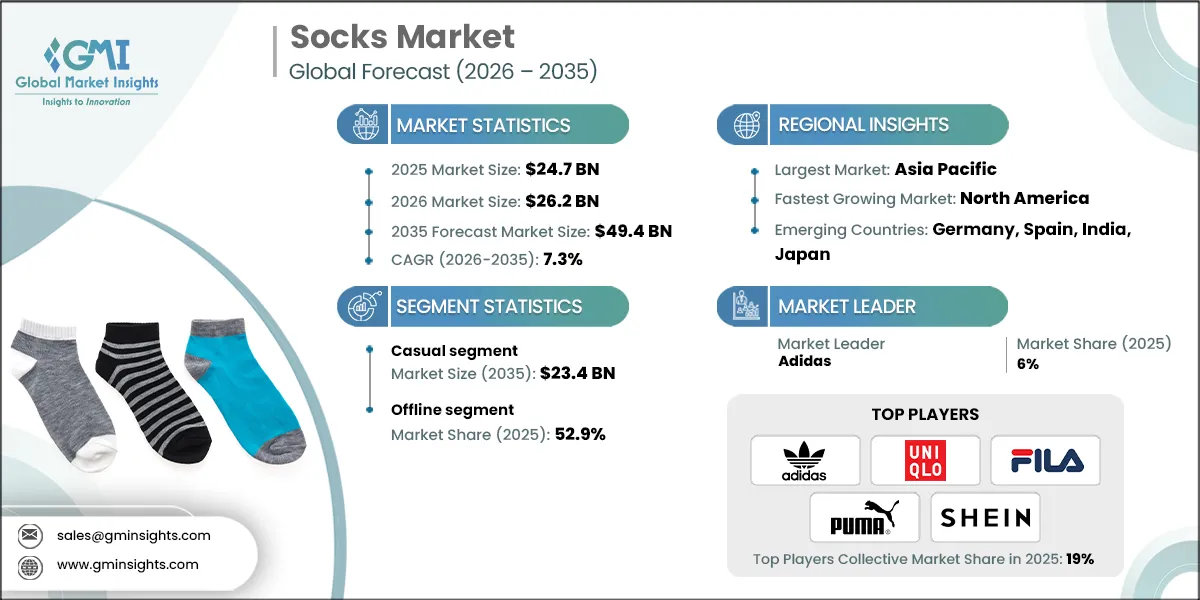
The global socks market was valued at USD 24.7 billion in 2025. The market is expected to grow from USD 26.2 billion in 2026 to USD 49.4 billion in 2035, at a CAGR of 7.3%, according to latest report published by Global Market Insights Inc.
Socks Market Key Takeaways
Market Size & Growth
- 2025 Market Size: USD 24.7 Billion
- 2026 Market Size: USD 26.2 Billion
- 2035 Forecast Market Size: USD 49.4 Billion
- CAGR (2026–2035): 7.3%
Regional Dominance
- Largest Market: Asia Pacific
- Fastest Growing Region: North America
Key Market Drivers
- Rising demand for eco-friendly and sustainable socks.
- Growing spending on health.
- Rising levels of discretionary spending.
Challenges
- Changing consumer preferences and trends.
- Counterfeit and imitation products.
Opportunity
- Growth in sustainable and eco-friendly socks.
- Expansion of smart and functional socks.
Key Players
- Market Leader: Adidas led with over 6% market share in 2025.
- Leading Players: Top 5 players in this market include Adidas, UNIQLO, FILA, Puma, Shein, which collectively held a market share of 19% in 2025.
Get Market Insights & Growth Opportunities
As consumers increasingly prioritize eco-friendliness and sustainability, the socks market is poised for growth. Notably, younger consumers are leading the charge, emphasizing the significance of environmentally conscious products in their purchasing decisions. Today's consumers are gravitating towards socks crafted from natural materials, such as bamboo, organic cotton, and recycled fibers.
Additionally, there are many government policies and initiatives that are supporting the eco-friendly direction of the global socks market. For example, the European Union Green Deal aims to reduce the impact of textile waste while supporting manufacturers to implement environmentally sustainable production methods. The EU green deal has prompted many manufacturers, including Bombas and Allbirds, to launch eco-friendly sock lines that use eco-friendly and recycled materials.
In addition to these government policies, consumers are becoming more aware of the negative effects of textiles on the environment and are looking to purchase socks that are environmentally friendly. According to the United Nations Environment Programme (UNEP), the fashion industry generates about 10% of the world's carbon footprint and contributes over 20% of the world's total water pollution. This has led consumers to seek out eco-friendly sock options from brands that have included them in their product lines in order to satisfy the increasing demand for eco-friendly socks.
New technologies in sustainable manufacturing are an important factor for many sectors in order to achieve consistent market growth. Biodegradable fibers and water-efficient production methods allow businesses to manufacture a high-quality eco-friendly sock with little effect on the planet. For example, one business, called Pact, produces apparel that meets the standards of the Global Organic Textile Standard (GOTS) by using organic cotton. GOTS certification provides assurance to consumers that the product was created with a minimal environmental impact.
Soon consumer trends and the emergence of legislation regulating sustainability along with new sustainable production technologies anticipated over the coming years it is likely there will be significant growth in the market as brands continue their alignment to meet the needs of consumers for more sustainable goods.
To get key market trends
Socks Market Trends
Changing innovation and technology transformation are important for the growth of the market.
- The socks industry has experienced remarkable growth over time, with the casual sock segment being the primary driver for market growth through Product Type. The growth of the casual sock segment can be traced back to shifting consumer preferences and lifestyles that have resulted in an increased demand for versatile and comfortable sock options. Casual socks are now worn every day for everything from work to leisure and sports, making them a must-have item.
- In 2023, the U.S. Bureau of Economic Analysis (BEA) reported a 4.2% increase in consumer spending on apparel. This data indicates that there is an increasing need for functional and comfortable clothing products, particularly in the sock category. Casual socks are typically constructed from soft, breathable fabric blends, such as cotton. The casual sock product category meets the demand for both comfort and function.
- Top socks manufacturers such as Hanesbrands Inc. and Puma SE have been able to adequately capitalise on these growing trends for casual socks by building both their brands and their product offerings in the casual sock category. For example, Hanesbrands has launched their "X-Temp" brand of socks that feature moisture-wicking technology designed specifically for all-day comfort for active consumers.
- The expansion of hybrid work models has supported the growing trend toward casual sock products. As more employees continue to work from home, increasing numbers of people now prefer to wear the most comfortable, yet functional socks. Casual socks have become the go-to option.
- Casual socks are expected to continue the trend of increasing sales creating consumer demand from consumers for socks that provide comfort and a wide array of usages, as well as innovative product Lines from leading players within the industry.
Socks Market Analysis
Learn more about the key segments shaping this market
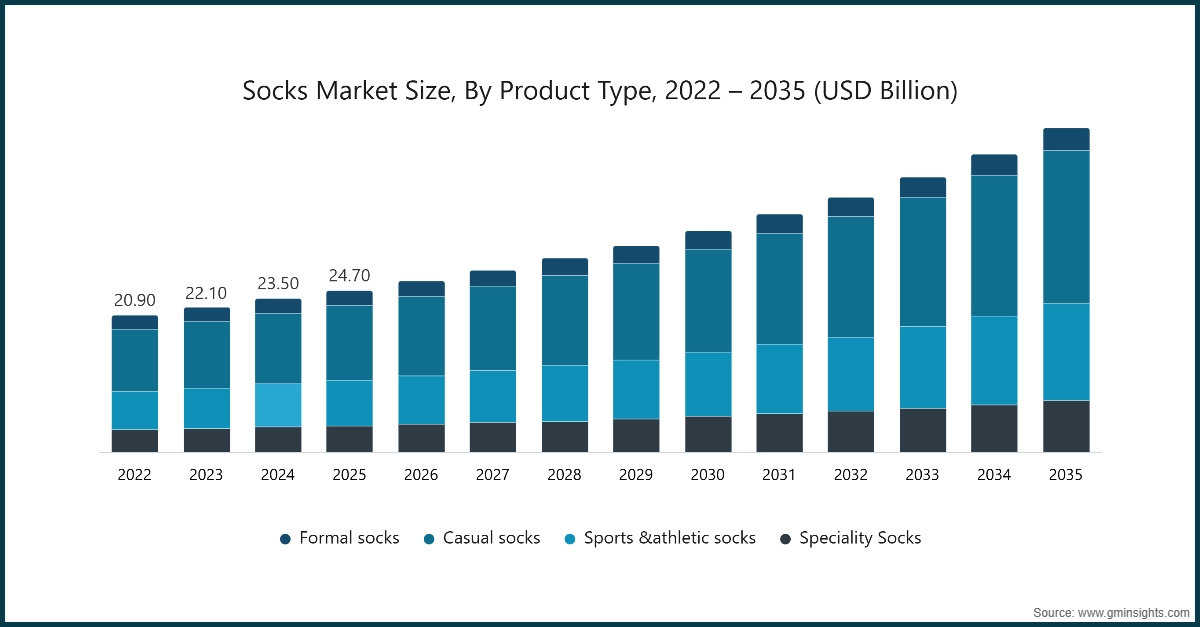
Based on product type, the socks industry is segmented specialty socks, sports &athletic socks, casual socks, formal socks. The casual segment accounts for revenue of around USD 11.4 billion in the year 2025 and is expected to reach USD 23.4 billion by 2035.
- The socks market has experienced remarkable growth over time, with the casual sock segment being the primary driver for market growth. The growth of the casual sock segment can be traced back to shifting consumer preferences and lifestyles that have resulted in an increased demand for versatile and comfortable sock options. Casual socks are now worn every day for everything from work to leisure and sports, making them a must-have item.
- In 2023, the U.S. Bureau of Economic Analysis (BEA) reported a 4.2% increase in consumer spending on apparel. This data indicates that there is an increasing need for functional and comfortable clothing products, particularly in the sock category. Casual socks are typically constructed from soft, breathable fabric blends, such as cotton. The casual sock product category meets the demand for both comfort and function.
- Top socks manufacturers such as Hanesbrands Inc. and Puma SE have been able to adequately capitalize on these growing trends for casual socks by building both their brands and their product offerings in the casual sock category. For example, Hanesbrands has launched their "X-Temp" brand of socks that feature moisture-wicking technology designed specifically for all-day comfort for active consumers.
- The expansion of hybrid work models has supported the growing trend toward casual sock products. As more employees continue to work from home, increasing numbers of people now prefer to wear the most comfortable, yet functional socks. Casual socks have become the go-to option.
- Casual socks are expected to continue the trend of increasing sales creating consumer demand from consumers for socks that provide comfort and a wide array of usages, as well as innovative product Lines from leading players within the industry.
Learn more about the key segments shaping this market
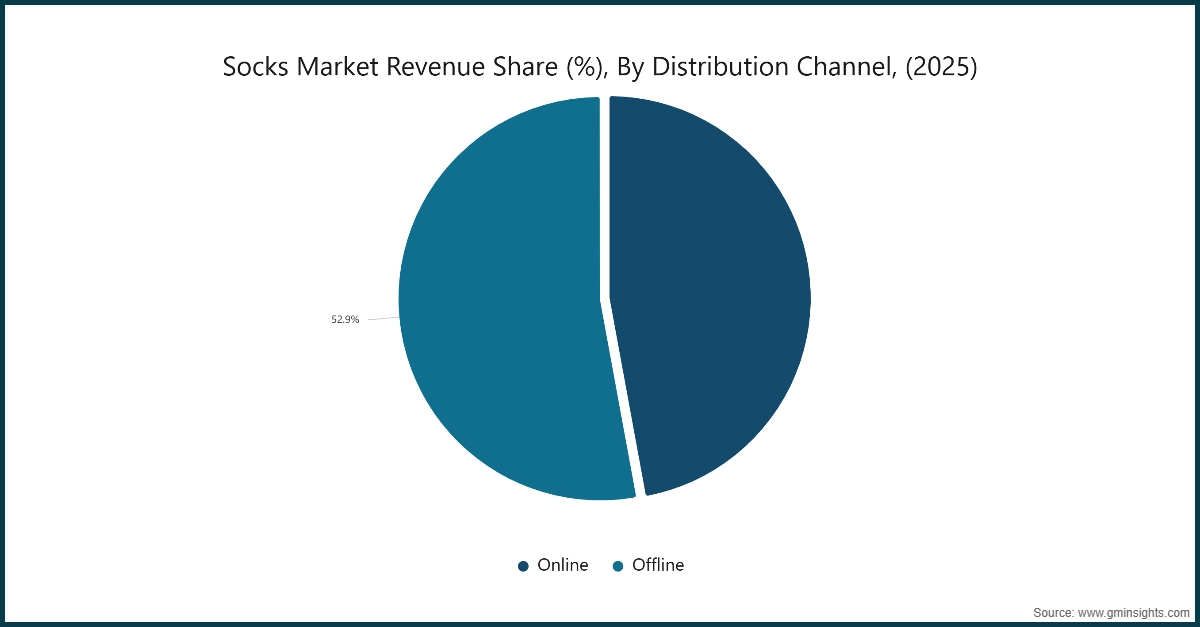
Based on the distribution channel, the market is bifurcated into online and offline channel. The offline segments held the largest share, accounting for 52.9 % of the global socks industry in 2025.
- The offline channel dominates the socks market, driven by consumer preferences and shopping behaviors. The most recent information from the U.S. Census Bureau indicates that brick-and-mortar outlets accounted for approximately 85% of total U.S. retail sales in 2023. Consumers remain very reliant on stores to give them an opportunity to view, touch/feel, test, and try on the products before they buy them, especially those considered comfort products such as athletic or medical socks.
- Walmart and Target are examples of retailers that are able to provide immediate availability of products at the time of purchase via their extensive physical store footprints, allowing customers to make an immediate decision about whether they want to buy something instead of having to wait for delivery of online orders. Specialty retailers such as Foot Locker also provide an opportunity for consumers to purchase socks that meet a specialized need by offering a focused selection of socks.
- Adding to the attraction of physical retailers is the personal attention given by retail staff members when assisting customers in making choices for socks that fit certain criteria, such as size, material, or brand. Nordstrom provides a good example of this type of personalized shopping experience through its in-store staff who guide customers to sock selections of high quality.
- Promotional and discount offers at physical locations significantly impact how customers view the store. One example of this is that according to the National Retail Federation, physical outlet store promotional offers increased traffic by 20% to physical outlet stores during seasonal sales in 2023. Customers take advantage of lower prices and make more impulse purchases, increasing overall sales.
- Therefore, offline channel via promotional strategy gives the socks market an edge over any channel by combining the advantages of direct access, experience, and specific promotional benefits. Recent government statistics, together with the experiences of large retailers, strongly indicate that this channel meets the needs of consumers effectively.
Looking for region specific data?
North America Socks Market
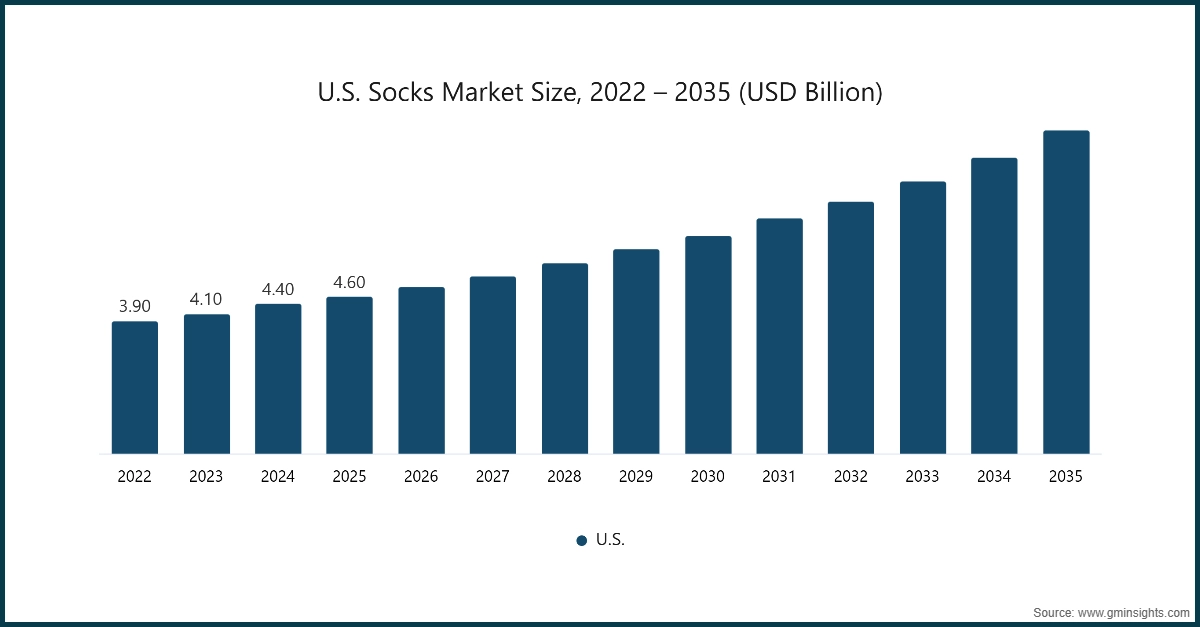
In 2025, the U.S. dominated the socks industry growth in North America, accounting for 59% of the share in the region.
- According to the U.S. Bureau of Economic Analysis, personal consumption expenditures on apparel and footwear rose by 6.2% in 2025, reflecting robust discretionary spending. Additionally, the U.S. Census Bureau reported that e-commerce sales grew by 7.8% year-over-year, accelerating online sock purchases and subscription models.
- Further the market is driven by strong demand for premium and performance socks. High consumer spending on sportswear and athleisure, coupled with rising health awareness, supports growth in compression and functional socks segments.
Asia Pacific Socks Market
Asia Pacific market is expected to grow at 8% during the forecast period.
- The market is fueled by rapid urbanization, rising disposable incomes, and expanding middle-class populations in China and India. Increasing adoption of Western fashion trends and booming e-commerce platforms like Flipkart and Alibaba further amplify demand for affordable and stylish socks.
Europe Socks Market
Europe market is expected to grow at 7% during the forecast period.
- Europe’s market, benefits from strong sustainability initiatives and consumer preference for eco-friendly products. The region’s fashion-forward culture and premium segment demand, particularly in Germany, France, and the UK, drive innovation in organic cotton and recycled fiber socks.
Middle East and Africa Socks Market
Middle East and Africa market is expected to grow at 6.6% during the forecast period.
- The MEA region is supported by rising urbanization and increasing penetration of global fashion brands. Expanding retail infrastructure and growing interest in athleisure among younger demographics contribute to higher demand for sports and casual socks.
Socks Market Shares
The top companies in the socks industry include Adidas, UNIQLO, FILA, Puma and Shein and collectively hold a share of 19% of the market in 2025. These prominent players are proactively involved in strategic endeavors, such as mergers & acquisitions, facility expansions & collaborations, to expand their product portfolios, extend their reach to a broad customer base, and strengthen their market position.
Adidas offers a wide range of performance and lifestyle socks crew, ankle, no-show featuring moisture-wicking fabrics, cushioned soles, and compression designs targeted at athletes. The brand emphasizes sustainable materials through its “Primegreen” and “Primeblue” lines, aligning with its broader sustainability strategy.
Uniqlo’s socks lineup focuses on simplicity, comfort, and functionality, including HEATTECH thermal socks, SUPIMA cotton blends, pile, and sports styles. All products are affordably priced, designed for mass appeal and everyday wear, available in multi-packs via their omnichannel network.
FILA’s sock range blends sporty heritage with practicality, offering unisex bamboo-quarter, performance, tennis, and novelty styles. Products typically come in multipacks with retro logos and cushioned support, sold through its official site and third-party retailers.
Socks Market Companies
Major players operating in the socks industry are:
- Adidas
- Bombas
- Burlington Socks
- Falke
- Fruit of the Loom
- Gold Toe Brands
- Happy Socks
- Hanesbrands
- Jockey International
- Nike
- Puma
- Smartwool
- Sock Dreams
- Stance
- Under Armour
Puma focuses more broadly on athletic apparel and footwear, its socks positioned within performance and lifestyle categories are part of its distribution through global retail partners. They include cushioned, sports, and casual varieties, aligned with the brand’s mix strategy.
Shein dominates the fast-fashion socks space with highly affordable, novelty-driven offerings. Their catalog is vast fun prints, seasonal themes, patterns, and bulk multipacks catering to trend-conscious consumers via frequent drops and high-volume e-commerce sales.
Socks Market Report Attributes
| Key Takeaway | Details |
|---|---|
| Market Size & Growth | |
| Base Year | 2025 |
| Market Size in 2025 | USD 24.7 Billion |
| Market Size in 2026 | USD 26.2 Billion |
| Forecast Period 2026-2035 CAGR | 7.3% |
| Market Size in 2035 | USD 49.4 Billion |
| Key Market Trends | |
| Drivers | Impact |
| Rising demand for eco-friendly and sustainable socks | Eco-conscious consumers are driving demand for socks made from organic and recycled materials, creating premium pricing opportunities for brands. This trend strengthens brand loyalty and positions sustainability as a key differentiator. |
| Growing spending on health | Health-focused lifestyles are boosting sales of compression, diabetic-friendly, and performance socks. This shift supports innovation in functional designs and expands the medical and sportswear segments. |
| Rising levels of discretionary spending | Higher disposable incomes enable consumers to purchase premium, designer, and subscription-based socks. This trend fuels growth in fashion-forward and luxury segments globally. |
| Pitfalls & Challenges | Impact |
| Changing consumer preferences and trends | Rapid fashion shifts and evolving lifestyles shorten product lifecycles, creating inventory risks. Brands must adopt agile production and trend forecasting to remain competitive |
| Counterfeit and imitation products | Fake products erode brand trust and revenue, especially in premium and sports categories. Strong anti-counterfeit measures and digital authentication are essential to protect market share. |
| Opportunities: | Impact |
| Growth in sustainable and eco-friendly socks | Eco-friendly socks offer a strong niche for brands leveraging certifications and transparency. This opportunity aligns with global sustainability goals and premium consumer demand. |
| Expansion of smart and functional socks | Smart socks with sensors for fitness and health monitoring open new revenue streams. Collaborations with health-tech and sports brands can accelerate adoption in high-value markets. |
| Market Leaders (2025) | |
| Market Leader |
6% market share |
| Top Players |
Collective market share in 2025 is 19% |
| Competitive Edge |
|
| Regional Insights | |
| Largest Market | Asia Pacific |
| Fastest growing market | North America |
| Emerging countries | Germany, Spain, India, Japan |
| Future outlook |
|
What are the growth opportunities in this market?
Socks Industry News
- In January 2026 Falke opened pre-orders for the advanced SK4 men’s ski socks featuring light padding, merino wool insulation, and precision fit tailored for serious skiers. The SK4 line enhances moisture-wicking and direct boot control, positioning Falke at the forefront of performance ski apparel.
- In November 2025, Marquee Brands completed the acquisition of Stance, a move that transitions Stance to a licensing model and tasks United Legwear & Apparel Co. with global operations. The partnership aims to extend Stance’s premium sock and underwear lines across new territories, supporting further expansion into athleisure.
- In September 2025, Smartwool launched its fall/winter 2025 sock collection introducing innovations like Intraknit engineered merino ski and snow socks and an expanded second cut line using up to 75 % recycled materials. The debut also featured performance all-season hike and cold weather run socks with mapped ventilation.
- In July 2025 Bombas introduced its new “floral socks” collection, offering bold, pattern-rich designs across multiple height options. This release reflects Bombas’ continued focus on blending style with comfort and marks its largest single-category rollout for casual statement socks.
- In June 2025, Adidas announced its 2025 Sustainability Report highlighting that 90% of products now incorporate low-impact materials, reinforcing its leadership in eco-innovation. Outlining progress toward a 70 % reduction in Scope 1 and 2 emissions by 2030, cementing the brand’s commitment to the science-based targets initiative.
The socks market research report includes in-depth coverage of the industry, with estimates & forecasts in terms of revenue (USD Billion) volume (Million Units) (from 2022 to 2035), for the following segments:
Market, By Product Type
- Specialty socks
- Sports & athletic socks
- Casual socks
- Formal socks
Market, By Material
- Cotton
- Wool
- Polyester
- Nylon
- Spandex
- Acrylic
Market, By Length
- Ankle socks
- Crew socks
- Calf socks
- No-Show socks
Market, By Price
- Low
- Medium
- High
Market, By Consumer Group
- Men
- Women
- Kids
Market, By Distribution Channel
- Online
- E-Commerce
- Company website
- Offline
- Supermarkets/Hypermarkets
- Specialty Stores
- Others (Individual stores, Departmental stores, etc.)
The above information is provided for the following regions and countries:
- North America
- U.S.
- Canada
- Europe
- Germany
- France
- UK
- Italy
- Spain
- Asia Pacific
- China
- Japan
- India
- Australia
- South Korea
- Latin America
- Brazil
- Mexico
- Argentina
- MEA
- Saudi Arabia
- UAE
- South Africa
Frequently Asked Question(FAQ) :
What is the socks market size in 2025?
The market size for socks was valued at USD 24.7 billion in 2025. Growth in demand for casual and specialty socks, along with increasing consumer focus on comfort and style, has driven market expansion.
What is the market size of the socks industry in 2026?
The socks market size reached USD 26.2 billion in 2026, reflecting steady growth supported by rising consumer spending on premium and functional socks.
What is the projected value of the socks market by 2035?
The market size for socks is expected to reach USD 49.4 billion by 2035, growing at a CAGR of 7.3%. This growth is attributed to increasing demand for sports and athletic socks, as well as innovations in sustainable and performance-oriented materials.
What is the revenue forecast for the casual socks segment by 2035?
The casual socks segment is projected to generate USD 23.4 billion in revenue by 2035, supported by increasing consumer preference for versatile and comfortable socks.
What was the market share of the offline distribution channel in 2025?
The offline distribution channel held the largest share of the socks industry in 2025, accounting for 52.9% of the global market. This dominance is attributed to the strong presence of retail stores and consumer preference for in-person shopping experiences.
Which region led the socks market in North America in 2025?
The U.S. dominated the market in North America in 2025, capturing 59% of the regional share. Its leadership is driven by high consumer spending, a strong retail network, and increasing demand for premium and branded socks.
Who are the key players in the socks market?
Key players in the market include Adidas, Bombas, Burlington Socks, Falke, Fruit of the Loom, Gold Toe Brands, Happy Socks, Hanesbrands, Jockey International, Nike, Puma, Smartwool, Sock Dreams, Stance, and Under Armour.
Socks Market Scope
Related Reports