Summary
Table of Content

Smart Textiles with Integrated Electronics Market
Get a free sample of this report
Form submitted successfully!
Error submitting form. Please try again.
Thank you!
Your inquiry has been received. Our team will reach out to you with the required details via email. To ensure that you don't miss their response, kindly remember to check your spam folder as well!
Request Sectional Data
Thank you!
Your inquiry has been received. Our team will reach out to you with the required details via email. To ensure that you don't miss their response, kindly remember to check your spam folder as well!
Form submitted successfully!
Error submitting form. Please try again.
Smart Textiles with Integrated Electronics Market Size
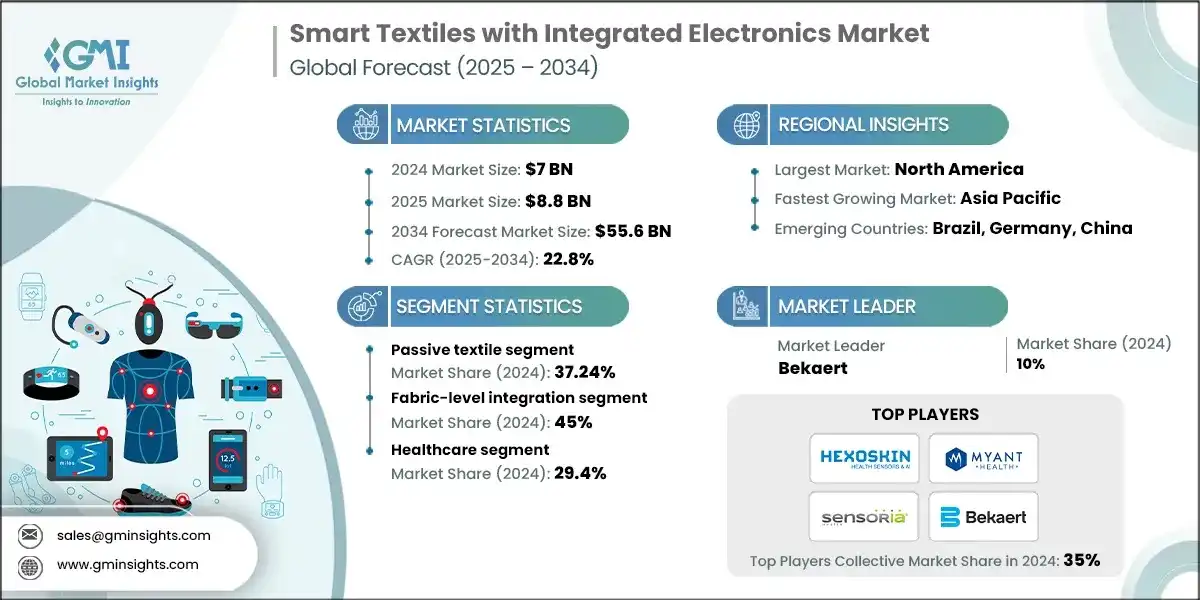
The global smart textiles with integrated electronics market was estimated at USD 7 billion in 2024. The market is expected to grow from USD 8.8 billion in 2025 to USD 55.6 billion in 2034, at a CAGR of 22.8% according to latest report published by Global Market Insights Inc.
Smart Textiles with Integrated Electronics Market Key Takeaways
Market Size & Growth
- 2024 Market Size: USD 7 Billion
- 2025 Market Size: USD 8.8 Billion
- 2034 Forecast Market Size: USD 55.6 Billion
- CAGR (2025–2034): 22.8%
Regional Dominance
- Largest Market: North America
- Fastest Growing Region: Asia Pacific
Key Market Drivers
- Growing demand for wearable technology.
- Advancements in flexible electronics and materials.
- Growth in healthcare and medical applications.
Challenges
- High manufacturing and material costs.
- Durability and washability issues.
Opportunity
- Rising Health and Fitness Awareness:.
- Integration with IoT and Connected Devices.
Key Players
- Market Leader: Bekaert led with over 10% market share in 2024.
- Leading Players: Top 5 players in this market include Hexoskin, Myant Inc., Sensoria Inc., Bekaert, which collectively held a market share of 35% in 2024.
Get Market Insights & Growth Opportunities
This growth suggests that integration of electronic ability into cloth might be there. Flexible electronics innovation, energy harvesting technology, and sensor technologies are the drivers of this growth that can drive textiles beyond their traditional uses.
Market size is expected to grow from USD 8.8 billion in 2025 to USD 55.6 billion in 2034, with evidence of extensive adaptation in various industries.
It is largely dominated by the healthcare industry. Intelligent textiles are opening doors to real-time monitoring of patients, early detection of diseases, and tailored treatment of medicine. Biosensors, temperature sensors, and movement sensors in clothing are revolutionizing health care substantially.
Manufacturing advances, for example, the development of conductive fibers, printable flexible circuits, and nanodevices, are decreasing production costs while increasing performance. Durable washable electronic fabrics are overcoming previous limitations and increasing commercial orders. Energy-harvesting technologies such as triboelectric and piezoelectric systems are also charting a vision of self-charging smart apparel with up to 1,768.2 mW/m² power densities.
Supporting the resilience to such growth are continuous investments in research and development. Leading textile manufacturers are working with technology companies towards that end. Government-sponsored smart manufacturing and take-up of Industry 4.0 initiatives also provide a supportive environment for the use of smart textiles into commercial and industrial sectors.
To get key market trends
Smart Textiles with Integrated Electronics Market Trends
The market for smart textiles integrated with advanced electronics is evolving rapidly. These changes are redefining how textiles are designed, produced, and used, leading to significant growth and innovation.
Advanced Sensing Capabilities
- Advanced sensing technologies are now integrated into smart fabrics, and their performance is optimized. Smart fabrics can sense and react in real time to stimulations. Smart fabrics can measure physiological parameters accurately, including glucose, heart rate, and breathing rates.
- Multi-point sensing has improved temperature sensing to enable high-accuracy thermal mapping. In-fiber sensor arrays enable high-precision temperature control. Strain and pressure sensors are helpful for detecting body movement and outside pressures, used in sports and rehabilitation treatments.
- Chemical sensing is also being carried out with textiles, to sense environmental contaminants and health biomarkers. Chemically sensitive coatings enable textiles to be used as early warning devices for environmental monitoring.
Energy Harvesting
- Energy harvesting is making smart textiles work regardless of the power available. Triboelectric nanogenerators (TENGs) capture energy from vibrations and body motions with high power density.
- Piezoelectric nanogenerators (PENGs) convert pressure into electricity and suit repetitive motion like walking and breathing. Piezoelectric material replacement in fibers distributes the energy harvesting across the fabric.
- Thermoelectric generators (TEGs) utilize temperature differences between body and surroundings to supply power, so ideally suited for low-power applications. Flexible solar cells embedded in clothing are used for outdoor energy harvesting.
- Supercapacitors and flexible batteries, which are easy to integrate into apparel, are gaining momentum in energy storage. They are flexible, washable, and have a large energy carrying capacity. Hybrid systems linking energy harvesting modes to storage provide increased reliability and seamless operation.
Miniaturization and Flexibility of Electronics
- Electronic miniaturization and flexibility are the double keys to their integration into garments. Not to the detriment of appearance or comfort. Printing electronics and nano-scale integration technology makes ultra-thin flexible systems possible.
- Conductive inks are employed to create flexible printed circuits so that they can be printed onto cloth. They function even when they are washed and reused repeatedly. Stretch conductors allow electronic systems to follow the stretchiness of cloth without compromising performance.
- Sensors and processors at the micro-scale are being created to be encapsulated within single fibers, taking hardly any space without sacrificing capability. Packaging at advanced levels provides protection to such devices from exposures to environments without sacrificing textile properties.
Smart Textiles with Integrated Electronics Market Analysis
The smart textiles with integrated electronics industry demonstrates significant diversification across product categories, applications, and technology integration approaches. This comprehensive analysis examines market dynamics across key segmentation categories, providing insights into growth drivers, competitive positioning, and future opportunities within each segment.
Learn more about the key segments shaping this market
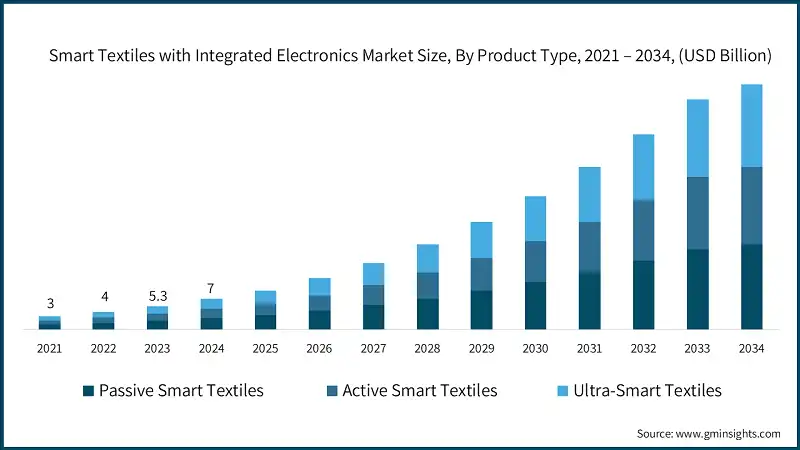
Based on product type, the market is segmented into ultra smart textile, passive smart textile, and active smart textile. The passive textile segment accounted for market share of approximately 37.24% market share in 2024 and is estimated to grow at a CAGR of around 21.9% from 2025 to 2034.
- Ultra-intelligent fabrics are the most sophisticated type of electronic smart fabrics with sensing, processing, and acting capabilities on environmental changes. Ultra-smart fabrics integrated sensing, actuation, processing, and communication in a single material.
- The 22.9% CAGR is complemented by increasing demand for multi-functional apparel used in health monitoring, military uses, and competitive sportswear. The apparel employs new materials including shape-memory alloys, electroactive polymers, and smart fibers that respond to ambient temperature conditions. They employ onboard microprocessors, wireless modules, and sensors for onboard powering and real-time data transmission.
- Passive smart textiles possess the largest market share of 37.24%. Passive smart textiles can sense environmental pressures like pressure, humidity, or temperature but can neither respond nor change themselves. Passive smart textiles are sensing platforms without integrating an external power source. This reflects the maturity and ubiquity of passive sensing technologies.
- 21.9% CAGR is attributed to increasing use in medical therapy, environmental sensing, and industrial security. Intelligent clothing is passive with phase-change materials, thermochromic materials, and fiber-optic sensors that sense and indicate environmental change. They are being used more in those applications where continuous monitoring is needed without including the added complexity of active systems.
- Active function textiles or intelligent textiles can sense and react to the environment with such attributes as actuators to change temperature, shape, or permeability. Material innovation such as shape-memory fibers and thermochromic materials lead to innovation. Medical devices, protective gear, and adaptive clothing are utilized more emphatically due to their responsiveness translating to phenomenal advantages. Smart cloth incorporates heaters, coolers, and actuators into it that it utilizes to change properties as a function of need of wearer or environmental inputs.
Learn more about the key segments shaping this market
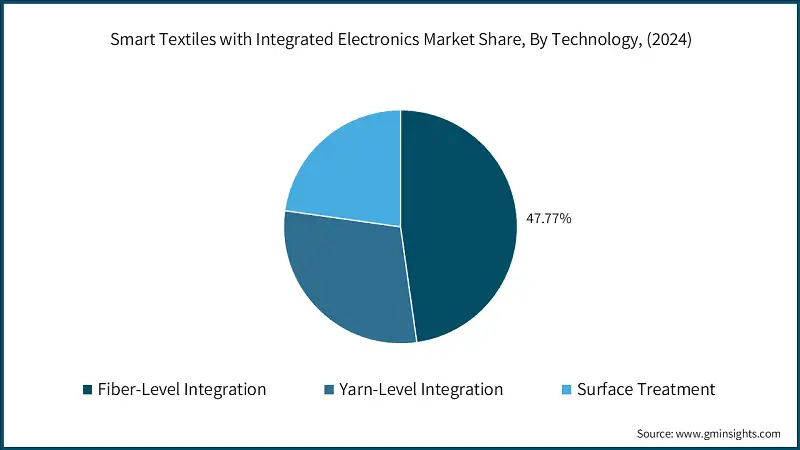
Based on technology, the global smart textiles with integrated electronics market is categorized into fabric-level integration, yarn-level integration, and surface treatment/coating. The fabric-level integration segment held around 45% of the total market share in 2024 and is anticipated to grow at a CAGR of 24.9% from 2025 to 2034.
- In this method, electronic components are added to fabric during production. It provides for electronic functionality to be added without bringing any alteration to the look or feel of the fabric. Methods include adding conductive fibers, in- seven sensors, and embedded circuits into the fabric via weaving or knitting.
- Technology enables electronic systems to be dispersed on fabric substrates in order to increase functionality and reliability. A few examples are smart clothing with heaters, sensor networks for sensing, and clothing with communication systems integrated within it. It also enables greater washability and durability over surface-mount components.
- Yarn-level integration involves embedding electronic features into yarns at the production stage. Electronics, sensors, and electronic materials are incorporated into yarns when twisted or spun to create "smart yarns" that can be used in regular textile production.
- It is also scalable and can be integrated into existing textile production systems. Some of the abilities of smart yarns include optical data transmission using optical fibers, electric connections using conductive fibers, and sensors for environmental monitoring. The process allows electronics to be integrated into textiles without affecting their traditional characteristics.
- Surfacing treatment and coating technology is a terminology used to describe the incorporation of electronic functionality into treated or finished fabrics using conductive coatings, printed electronics, or surface mount components. Surfacing treatment and coating technology is an inexpensive method of combining existing fabrics with intelligence features.
- The technology is function and design compatible since it can be adapted to fit specific applications. These are the printed sensors made of fabric, electromagnetic shielding through conductive paints, and surface mounting modules for specific applications. It is well suited to small-scale applications and prototyping where level integration at the level of the fabric cannot be achieved.
Based on the application, global smart textiles with integrated electronics market is categorized as healthcare & medical, sports & fitness, military & defense, and others. The healthcare segment held around 29.4% of the total market share in 2024.
- The healthcare and medical segment is leading with the highest market share of 29.4% and the highest growth rate of 23.5% CAGR. It indicates the high potential of smart fabrics in medical applications. The market comprises patient monitoring systems, rehabilitation appliances, drug delivery devices, and diagnostic devices integrated into textiles. Rising healthcare spending, aging population, and the shift towards preventive as well as personalized medicine are contributing towards the growth.
- Smart medical textiles make it possible to monitor the body's vital signs in real time, pre-disease diagnosis, and customized treatment. Smart fabrics have built-in biosensors that can detect glucose, ECG, respiratory rate, and temperature. New uses include smart bandages that have drug delivery, compression garments with pressure, and sensor-garment rehabilitation textiles that respond to movement.
- The wellness and fitness industry is driven by increasing concern for health and utilization of performance monitoring technology. Intelligent textiles in the industry deliver sporting performance information in real-time, biomechanical analysis, and physiological monitoring during exercise and training.
- Applications include smart sportswear with running analysis sensors, via swimming performance measurement and team sports analysis. The fabrics give quantitative feedback regarding performance, injury prevention, and training optimization to coaches and athletes. Joint ventures among sports technology companies and textile firms propel the segment since the latter give birth to innovation in wearables sports analytics.
- Defense and military industry focusing on the use of high-tech textile technology in the military. High-tech textiles here refer to soldier tracking technologies, sensor-embedded ballistic protection, and communication systems integrated into clothing. These technologies improve soldier survivability, situational awareness, and mission success.
- Its applications in defense are smart apparel with communication modules, body armor that senses impact, and threat-identifying chemical and biological fabrics. Government investment in defense technology and demand for improved protection systems for modern warfare sustain its industry.
Looking for region specific data?
North America Smart Textiles with Integrated Electronics Market
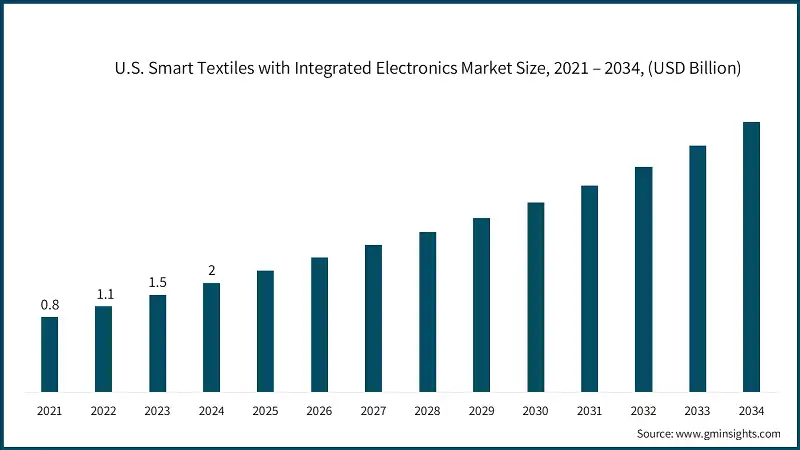
- North America holds a 33.5% market share because it has very advanced research institutes, huge R&D investments, and early adoption of smart textile technologies. Growth is regionally driven by the U.S. through the activities of big tech companies, research organizations, and military applications. Intellectual property protection is strong, there is venture capital investment, and industry-academia collaboration promotes the region.
- Value drivers include the deployment of health technologies, defense modernization initiatives, and smart textiles embedding into consumer electronics. The region's established healthcare infrastructure and growing population of seniors are driving demand for medical monitoring textiles. Gentherm Inc., Interactive Wear AG, and AiQ Smart Clothing Inc. are driving innovation and triggering commercial adoption.
Asia Pacific Smart Textiles with Integrated Electronics Market
- The Asia Pacific region with a market share of 29% is the highest growth region at a CAGR of 23.3%. It is being fueled by rising industrialization, robust manufacturing capacity, and rising technology adoption. China is dominating the region because of its humongous manufacturing capacity, government encouragement of smart manufacturing, and expanding consumer electronics market. The region is supported by cheap manufacturing, clustered supply chains, and rising domestic demand for smart textile solutions.
- South Korea and Japan are also major contributors through their research in advanced materials, electronics integration, and high-tech manufacturing. The region's base for advanced textile manufacturing enables volume scaling of smart textile manufacturing at lower costs. Government-backed programs promoting smart manufacturing and Industry 4.0 additionally fuel market growth.
Europe Smart Textiles with Integrated Electronics Market
- Europe accounts for 23.6% of the market share and is growing steadily at a 22.9% CAGR. Its growth is driven by sophisticated research infrastructure, sustainability initiatives, and regulatory support for new technology. Automotive, industrial textiles, and new manufacturing drive the region from Germany. Efficient research centers coordinated funding initiatives, and emphasis on sustainable technology development give the region support.
- European market is characterized by high-performance applications, sustainability needs, and regulatory needs. Industry safety products, medical technology, and automotive textiles are the most applicable uses. Schoeller Textiles AG and Ohmatex A/S are driving innovation and developing Europe as a center of high-performance smart textile innovation.
Smart Textiles with Integrated Electronics Market Share
Bekaert holds an 8-10% market share, making it the market leader. The company uses its expertise in advanced materials and fiber technologies to create innovative smart textile solutions. Its leadership is supported by strong research and development, a large patent portfolio, and partnerships with technological companies and end-user industries. The top five players together account for 30-35% of the market, showing a fragmented competitive landscape with room for consolidation and growth.
Competitive Strategies and Market Positioning
- Major market players of intelligent textiles are pursuing different strategies to consolidate their market position and accelerate growth. Differentiation of technology is one such key area, wherein players are heavily investing in research and development to develop differentiated technologies and intellectual properties. They concentrate on capabilities such as energy harvesting, sensor accuracy, long life, and integration processes in an effort to be competitive.
- Strategic alliances are also becoming increasingly important. Textile producers are joining forces with electronic firms, software houses, and end-users to develop end-to-end products. The collaborations bring together textile knowledge and capability in electronics, accelerate product development, and create new markets. Vertical integration is another trend, as companies desire to own large portions of the smart textile value chain.
Merger and Acquisition Activities
- Smart textiles market is seeing increased merger and acquisition activity as firms seek to take on new technology, enhance their market presence, and gain scale. Major textile producers are taking over technology start-ups to gain access to new smart textile technology and drive digital transformation. Electronics firms are taking over textile firms to enhance functionality in wearable and flexible electronics.
- Transactions recently have been heading towards companies with focus areas of sensing technologies, energy harvesting, and manufacturing processes. Transactions enable mature companies to rapidly leverage new technologies and become better competitive players, while startups are exposed to resources so that they may grow and reach market. The trend will also persist as the market gets more mature and opportunities for consolidation grow.
Innovation and Product Development Strategies
- Market leaders are making significant investments in product development and innovation to sustain their position and exploit new opportunities. Top companies spend 8-15% of revenues on research and development, given the tech-intensive nature of smart textiles. They are establishing focused research centers, collaborating with universities, and joining government research initiatives to develop smart textile technologies.
Regional Market Share Distribution
- The global smart textiles market shows regional strengths and specializations. North American companies lead in healthcare and defense applications, benefiting from advanced research and early market adoption. European companies focus on high-performance applications, sustainability, and regulatory compliance. Asian companies emphasize manufacturing capabilities and cost-effective solutions.
- As companies expand internationally and set up global operations, regional market share distribution is changing. Cross-border partnerships and joint ventures are becoming more common as companies aim to access regional markets, manufacturing strengths, and technological expertise. This globalization of the smart textiles market is creating opportunities for companies to use regional advantages while competing globally.
Smart Textiles with Integrated Electronics Market Companies
Major players operating in the smart textiles with integrated electronics industry are:
- AiQ Smart Clothing Inc.
- Clothing+
- Gentherm Inc.
- Hexoskin (Carré Technologies)
- Interactive Wear AG
- Intelligent Textiles Ltd.
- Loomia Technologies
- Myant Inc.
- Nextiles Inc.
- Ohmatex A/S
- Schoeller Textiles AG
- Sensoria Inc.
- Textronics
- Vista Medical Ltd.
- Xenoma Inc.
The market for smart textiles with integrated electronics includes a wide range of companies, from established textile and electronics manufacturers to startups and research organizations. These companies are advancing the market through innovative technologies, product launches, and partnerships across the smart textiles value chain.
- Hexoskin (Carré Technologies) encompasses smart clothing for sport and health performance tracking. Hexoskin's smart shirts track cardiac activity, breathing, and body movement. High medical-grade accuracy is critical, and Hexoskin is therefore a leader in healthcare and sports science applications.
- Interactive Wear AG designs and produces smart textile solutions for industrial, medical, and consumer markets. Conductive textiles, flexible electronics, and wireless communication systems of textiles are few of its technologies. It collaborates with companies to integrate smart textile technology into their products.
- Intelligent Textiles Ltd. invents new processes and materials for intelligent textiles. They investigate conductive fibers, sensing materials, and compatible integration methods with scalable manufacturing. Custom solutions are made possible through their platform approach to different applications.
- Loomia Technologies integrates soft circuits into clothing, creating soft circuits that make their way into fabrics. Its methods create washable, flexible electronic fabrics for industry and consumers. It circumvents the largest barriers to mass production of smart textiles.
- Sensors, actuators, and communication technology are embedded in clothing by Myant Inc. and "textile computing" platforms developed. Healthcare monitoring, human-machine interface, and wearables are possible applications. The platform model of the company allows for multiple types of applications.
- Nextiles Inc. is a company involved with smart sport and fitness fabrics. Its fabrics contain sensors that can track performance and provide real-time feedback in terms of movement, muscle activation, and performance. As a company involved with sports application, it should have extensive experience within the industry.
Specialized Manufacturers and Their Expertise - Ohmatex A/S is an intelligent textile solutions manufacturer for industrial, sports, and healthcare applications. Its key competences are the manufacturing of conductive cloth, sensor integration, and manufacture of customized intelligent textiles. As a European company, it offers quality manufacturing along with regulatory support.
- Schoeller Textiles AG integrates traditional textile production with intelligent innovation. Its products include temperature management textiles, moisture management products, and sensor-integrated protective textiles. The strong manufacturing capacity of the company allows it to maintain its intelligent textile innovation.
Smart Textiles with Integrated Electronics Market Report Attributes
| Key Takeaway | Details |
|---|---|
| Market Size & Growth | |
| Base Year | 2024 |
| Market Size in 2024 | USD 7 Billion |
| Market Size in 2025 | USD 8.8 Billion |
| Forecast Period 2025 - 2034 CAGR | 22.8% |
| Market Size in 2034 | USD 55.6 Billion |
| Key Market Trends | |
| Drivers | Impact |
| Growing demand for wearable technology | Increasing consumer interest in smart devices is driving adoption of textile-integrated electronics. |
| Advancements in flexible electronics and materials | Innovations in conductive fabrics and stretchable circuits enable more versatile and comfortable smart textiles. |
| Growth in healthcare and medical applications | Rising need for remote patient monitoring and health tracking fuels demand for smart textile solutions. |
| Pitfalls & Challenges | Impact |
| High manufacturing and material costs | Expensive production processes and specialized materials limit widespread adoption. |
| Durability and washability issues | Maintaining functionality after repeated washing and use remains a key technical challenge. |
| Opportunities: | Impact |
| Rising Health and Fitness Awareness: | Growing consumer interest in wearable health monitoring devices creates demand for smart textiles that can track heart rate, respiration, temperature, and movement. |
| Integration with IoT and Connected Devices | The proliferation of IoT ecosystems allows smart textiles to be integrated into larger networks, enabling real-time data collection, cloud analytics, and remote monitoring. |
| Market Leaders (2024) | |
| Market Leaders |
10% market share |
| Top Players |
Collective market share in 2024 is Collective market shares 35% |
| Competitive Edge |
|
| Regional Insights | |
| Largest Market | North America |
| Fastest growing market | Asia Pacific |
| Emerging countries | Brazil, Germany, China |
| Future outlook |
|
What are the growth opportunities in this market?
Smart Textiles with Integrated Electronics Industry News
- January 2025: Scientists created energy storage-enabled smart flexible fabrics with storage capacities of 264.8 J/g without compromising washability and fabric flexibility. The innovation combines energy storage into fabric to bring self-powered intelligent clothes to life.
- December 2024: A study estimated the market to produce smart textiles would reach USD 470 million by 2034. The research referred to more usage of automated manufacturing and quality control systems dedicated to smart textiles.
- November 2024: A report pointed out progress in triboelectric nanogenerators, with 1,768.2 mW/m² power densities. The progress improves energy harvesting to be applied to smart wear clothes.
- October 2024: Researchers unveiled progress in energy-harvesting clothing, as piezoelectric nanogenerators have attained 22 μW/cm² power densities. Progress aids wearable electronics and autonomic monitoring.
- September 2024: European fabric producers initiated a study project on sustainable intelligent textile production from recyclable material and green processing to respond to green technology demand.
- March 2024: Scientists explored intelligent textiles to generate electricity, and news of progress in energy harvesting technologies embedded in clothing was reported. The study is useful for creating the next generation of smart textiles.
The smart textiles with integrated electronics market research report includes in-depth coverage of the industry with estimates & forecasts in terms of revenue ($ Bn/Mn) and volume (Thousand Units) from 2021 to 2034, for the following segments:
Market, By Product Type
- Passive smart textiles
- Active smart textiles
- Ultra-smart textiles
Market, By Technology
- Fiber-level integration
- Yarn-level integration
- Surface treatment
Market, By Application
- Healthcare & medical
- Sports & fitness
- Fashion & lifestyle
- Military & defense
- Automotive
- Industrial
- Others
The above information is provided for the following regions:
- North America
- U.S.
- Canada
- Europe
- UK
- Germany
- France
- Italy
- Spain
- Russia
- Asia Pacific
- China
- India
- Japan
- Australia
- South Korea
- Latin America
- Brazil
- Mexico
- Argentina
- MEA
- UAE
- South Africa
- Saudi Arabia
Frequently Asked Question(FAQ) :
What is the market size of the smart textiles with integrated electronics industry in 2024?
The market size was USD 7 billion in 2024, growing at a CAGR of 22.8% through 2034, driven by rising demand for wearable technology and advancements in flexible electronics.
What is the current smart textiles with integrated electronics market size in 2025?
The market size is projected to reach USD 8.8 billion in 2025.
What is the projected value of the smart textiles with integrated electronics market by 2034?
The market is expected to reach USD 55.6 billion by 2034, fueled by innovations in conductive fabrics, sensor integration, and healthcare monitoring applications.
How much revenue did the passive smart textile segment generate in 2024?
The passive smart textile segment accounted for 37.24% market share in 2024.
What was the valuation of the fabric-level integration technology segment in 2024?
Fabric-level integration held 45% market share. Its growth is supported by increasing use of conductive fibers and embedded circuits enhancing textile functionality and durability.
What is the growth outlook for the healthcare & medical application segment from 2025 to 2034?
The healthcare & medical segment is projected to grow at a 23.5% CAGR through 2034.
Which region leads the smart textiles with integrated electronics market?
The U.S. dominated the market with 33.5% share. Growth is driven by strong R&D investments, defense modernization, and adoption of smart textiles in healthcare and consumer electronics.
What are the upcoming trends in the smart textiles with integrated electronics industry?
Key trends include integration of energy-harvesting technologies, miniaturization of electronic components, and increasing adoption of IoT-enabled smart clothing for health, fitness, and defense applications.
Who are the key players in the smart textiles with integrated electronics market?
Key players include Hexoskin (Carré Technologies), Myant Inc., Sensoria Inc., Bekaert, Nextiles Inc., Xenoma Inc., AiQ Smart Clothing Inc., Gentherm Inc., Interactive Wear AG, Intelligent Textiles Ltd., Ohmatex A/S, Schoeller Textiles AG, Loomia Technologies, Textronics, and Vista Medical Ltd.
Smart Textiles with Integrated Electronics Market Scope
Related Reports