Summary
Table of Content

Smart Seed Planting Machine Market
Get a free sample of this report
Form submitted successfully!
Error submitting form. Please try again.
Thank you!
Your inquiry has been received. Our team will reach out to you with the required details via email. To ensure that you don't miss their response, kindly remember to check your spam folder as well!
Request Sectional Data
Thank you!
Your inquiry has been received. Our team will reach out to you with the required details via email. To ensure that you don't miss their response, kindly remember to check your spam folder as well!
Form submitted successfully!
Error submitting form. Please try again.
Smart Seed Planting Machine Market Size
There has been an increase in demand from an increased focus on maximizing both productivity and efficiency. Farmers are under increasing pressure to maximize yield while also keeping input costs low and as such farmers can use data to make decisions about when and where to plant based on factors such as soil condition, moisture level, micro‑zonal variation, and seed characteristics. Additionally, with digital tools, sensors and automation technology becoming more accessible to farmers, farmers are realizing that planting seeds more precisely can lead to improved rates of germination as well as reduced waste and therefore provide for more consistent crop outcomes.
Smart Seed Planting Machine Market Key Takeaways
Market Size & Growth
- 2025 Market Size: USD 10.8 Billion
- 2026 Market Size: USD 11.4 Billion
- 2035 Forecast Market Size: USD 24.2 Billion
- CAGR (2026–2035): 8.8%
Regional Dominance
- Largest Market: North America
- Fastest Growing Region: Asia Pacific
Key Market Drivers
- Rising demand for precision agriculture.
- Shift toward large‑scale mechanized farming.
- Labor shortages & rising wages.
Challenges
- High initial capital costs.
- Limited technical knowledge among farmers.
Opportunity
- Integration of AI‑driven decision support.
- Growth of autonomous & electric planters.
Key Players
- Market Leader: Deere & Company led with over 32% market share in 2025.
- Leading Players: Top 5 players in this market include Deere & Company, CNH Industrial, AGCO, Trimble, Kubota, which collectively held a market share of 70% in 2025.
Get Market Insights & Growth Opportunities
Climate variability has further diminished the reliability of guess-based traditional farming. Precision planting machines have enabled farmers to adapt to these fluctuations in environmental conditions through their inherent repeatability and consistency of operation. The ability to monitor planting performance in real-time, make self-adjustments to equipment settings, and document every square foot of a field provide for improved long-term planning and risk management. The transition from traditional farming practices to precision farming systems represents much more than a technological advancement; it is essential to sustaining productivity in current-day agriculture by providing added value beyond what was previously available.
As the global agricultural landscape continues to change, we see many farms consolidating into larger operating units due to economies-of-scale. The scale of these operations also dictates the level of machine cover per hectare per hour and therefore requires the use of high-speed planting machines and producing plantings with accurate spacing. Large scale farming has become dependent upon machinery which can maximize both planting speed, uniformity, and operational efficiency, making smart seed planting machines extremely high in value. This reliance on mechanization reduces a farmer's reliance on manual labor to perform most planting tasks, which are increasingly less available and more expensive in most regions of the world. As more fields become larger and planting timeframes get tighter, high-capacity intelligent planters will give farmers distinct advantages with respect to both output and reliability.
Additionally, large scale farms typically have greater financial resources than other farms, which allows them to invest in new technologies and therefore, accelerate the implementation of smart machinery. The increased level of return on investments that can be achieved through improved planting precision will also have a significant positive effect on farm productivity and profitability at a large scale. As tractors become more powerful and the equipment ecosystem becomes more integrated, the growth of digital and automated planting solutions will provide commercial farms with additional opportunities to modernize their farming practices. As this transition to mechanized technology-enabled farming continues to grow, the expectations of farmers for equipment will also increase, putting pressure on equipment manufacturers to innovate quicker than ever before.
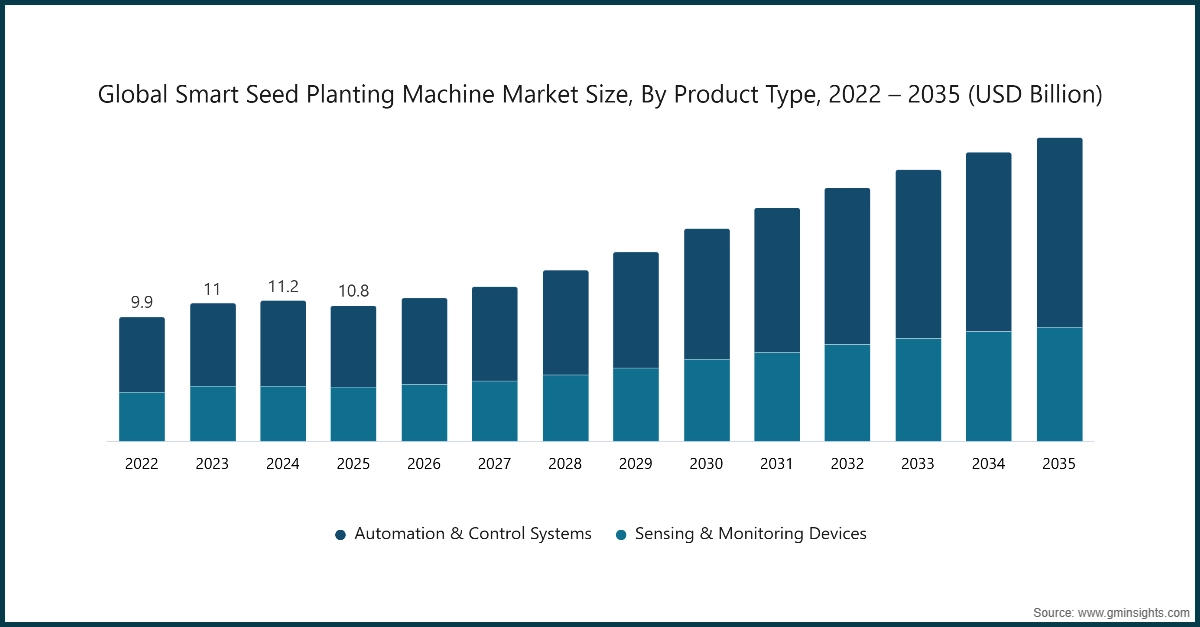
The smart seed planting machine market was estimated at USD 10.8 billion in 2025. The market is expected to grow from USD 11.4 billion in 2026 to USD 24.2 billion in 2035, at a CAGR of 8.8% according to latest report published by Global Market Insights Inc.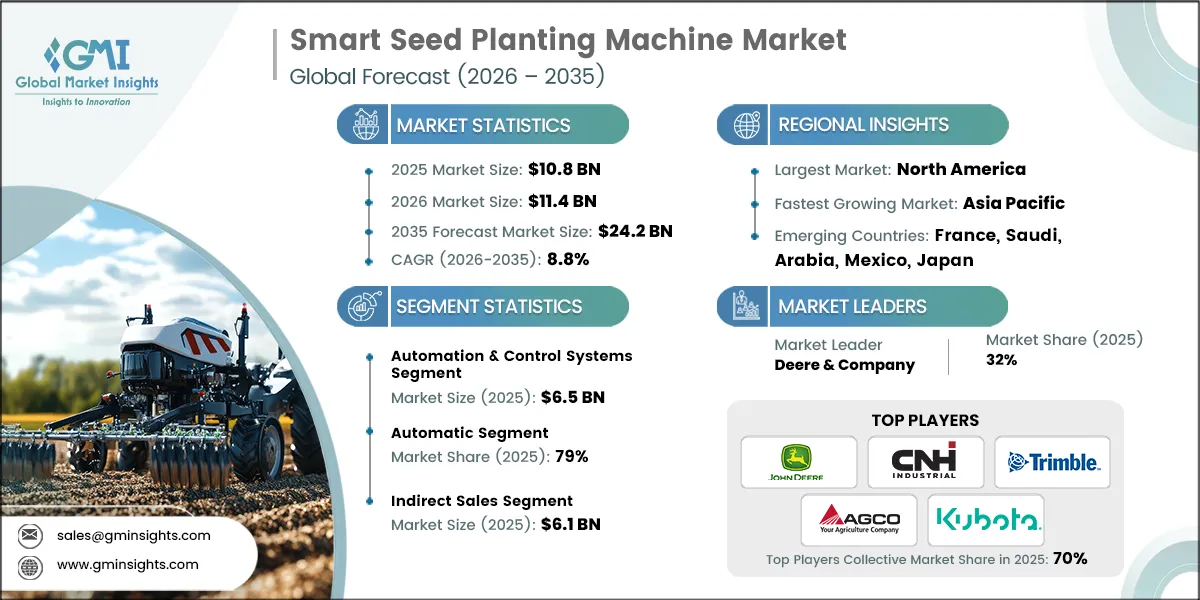
To get key market trends
Smart Seed Planting Machine Market Trends
As agriculture undergoes rapid change to be more digital, automated and data driven, the market for smart seed planting machines continues to grow steadily. Farmers are using smart seeding technologies for improved planting accuracy and decreasing their reliance on labor, thereby increasing their productivity. Sensors, robotics, AI decision systems and advanced automation technologies are changing the way farmers prepare and seed their fields. Innovations to plant crops have led to the development of smart seed planting machines that fit into the modern agriculture equipment ecosystem.
- Smart seed planters include GPS guidance systems, variable rate application capabilities, automated seed metering and soil-sensing technologies, allowing farmers to adjust their planting parameters in- real-time and to maximize both seed placement and resource use. This continuing trend represents the increasing use of precision agriculture, in which data is used to inform every step of the planting process.
- Automation is rapidly taking over the agricultural industry. Farmers are under pressure to minimize human labor and increase productivity. The use of self-driving tractors, automatic seed distribution systems, and automatic calibration technology are helping farmers to be more productive by reducing downtime. This trend meets the needs of farmers who need to produce more on larger farms than they can through manual methods.
- Numerous new connectivity options including machine monitoring through telematics, cloud-based machines and apps allow for transformation of equipment from planting and agricultural machinery into intelligent and connected systems. Machines enabled by Internet of Things technologies track operational metrics, send performance alerts and sync planting data with farm management systems. The evolution of these digital ecosystems allows farmers to optimize equipment maintenance, improve uptime and improve precision results.
- The development of new sustainable products is also being driven by sustainability. Electric and hybrid planting systems, low-disturbance, and more efficient seed delivery are all innovations now being developed by manufacturers. Additionally, manufacturers have developed machines that minimize soil compaction, reduce fuel usage, and promote eco-friendly farming practices. These objectives support sustainability goals on a global scale, and the market demand for sustainable agricultural products continues to rise.
Smart Seed Planting Machine Market Analysis
Learn more about the key segments shaping this market
Based on product type, the smart seed planting machine market is automation & control systems and sensing & monitoring devices. In 2025, automation & control systems held the major market share, generating a revenue of USD 6.5 billion.
- Modern smart planting devices rely on automation & control systems to plant seeds precisely and consistently with maximum efficiency. To achieve this, these systems consist of computerized seed metering, servo motors for actuators, programmable logic controllers in real time and machine communication interfaces to provide accurate seed placement and depth and row spacing of seeds. Automation of key seed planting parameters reduces human error and variability, resulting in more uniform crop emergence and greater yield predictability for the farmer.
- An additional benefit of automation & control systems is their ability to integrate with other technologies to provide real-time feedback from the field regarding planting conditions. Once feedback is received from the sensor input, the planting equipment will automatically adjust its planting depth or seed rate based on feedback received from its sensors to keep the planting operation in tune with the changing field conditions. By providing closed loop control, Automation & control systems greatly increase planting efficiency while minimizing the use of resources.
- In addition to improving field-level accuracy, Automation & Control Systems (ACS) assist with larger farm management goals by providing connectivity and capturing data historically. More advanced systems can log performance data relative to planting, then send it to cloud sites then integrate it into other existing farm records; thereby enabling thorough analytics for use after the planting season ends. This digital traceability allows for the refinement of future planting methods and more effective use of inputs over multiple planting seasons by participating through multiple planting seasons.
Learn more about the key segments shaping this market
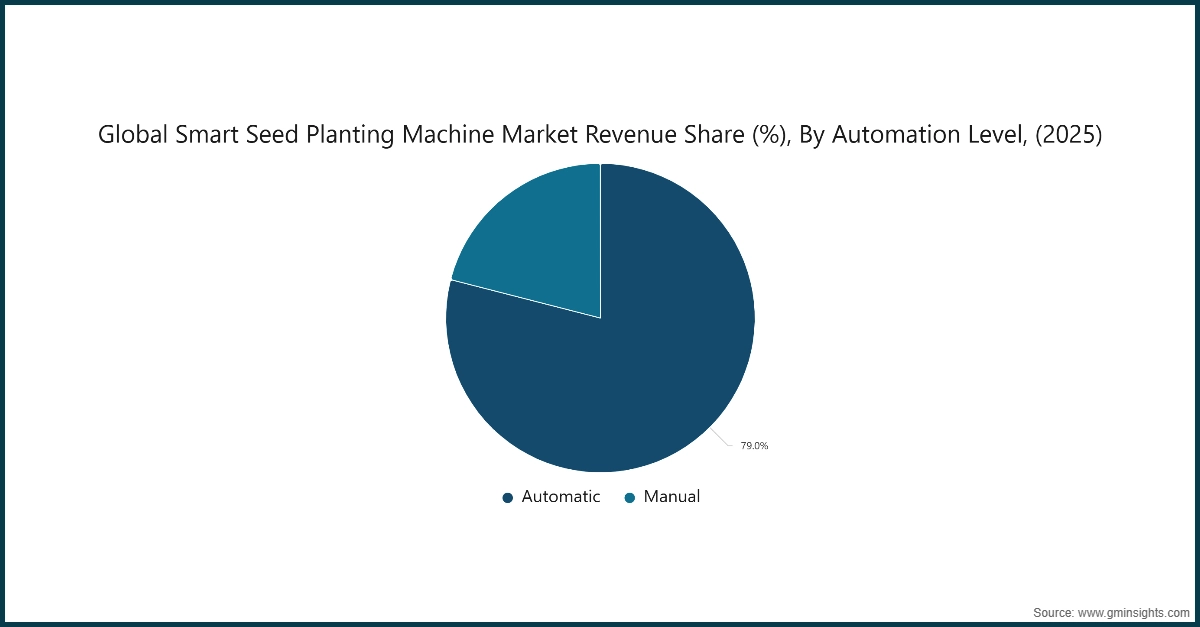
Based on automation level, the smart seed planting machine market is segmented in automatic and manual. The automatic segment held the largest share, accounting for 79% of the market in 2025.
- Planters automated at the automatic automation level do core planting tasks without the need for human operators to intervene after setting target parameters of seed rate, spacing, and depth. The onboard electronics and actuators meter and space the seed as well as control the planting depth. The automatic guidance system will keep the seed rows aligned. The operator usually only sets these parameters once, and from that point on, the planter will maintain these same parameters automatically, regardless of the changing field conditions. The operator has less to do at this level of automation, and consistency among planting passes is maintained since the planter performs consistently regardless of the speed of operation or terrain being traversed.
- Automated plantings require integration of four different types of sensors including seed flow, ground contact/ground pressure, positioning, and in some instances, basic soil feedback. The sensors send the measurement data back to the closed-loop controller. The controller compares the real-time measurement to the predetermined setpoint, then commands the appropriate adjustment. If an error-handling routine detects a problem with the planting system, it will either pause the planting line or provide an alert so that the operator can correct the situation. The result of this automatic process is uniform emergence, fewer misses in the seed, and more efficient use of inputs with very little human operator intervention.
- An operator perceives an automatic level as simple to set up through a human machine interface (HMI) or a cab screen, through guided calibration wizards, and through a status dashboard with real-time performance metrics. These machines will often have basic telematics capabilities, which means they can log production data and give only limited remote support and the operator does not have to have any advanced autonomy to use. These types of machines will fit into a mixed fleet where other tasks can still be done manually or with semi-automatic processes, but also provide immediate improvements in precision, speed, and consistency. Eventually, automatic planting equipment provides a basis for creating standards in planting quality for future advanced artificial intelligence decision support systems.
Based on distribution channel, the smart seed planting machine market is segmented in direct sales and indirect sales. In 2025, indirect sales segment held the largest market share, generating a revenue of USD 6.1 billion.
- Indirect sales are a distribution strategy where manufacturers sell their products indirectly through other parties, as opposed to direct sales. By using the sales channel of intermediaries to reach customers, companies can increase their overall market coverage by using the sales relationships, networks and established infrastructure of the intermediaries. This method is particularly beneficial when entering a new country or region. Local intermediaries already know what products will sell in their region, what regulations there are in your industry, and the specific needs and preferences of customers in that area. Companies can also benefit from reducing their own workload by outsourcing sales, logistics and in some cases after-sales support to intermediaries.
- Another benefit of the indirect model is that it allows manufacturers to devote more time and attention to their core competencies, such as improving product design, production efficiency, and developing strong brands. Indirect channel partners will often provide added-value services to customers that enhance customer satisfaction and loyalty, such as local marketing support, financing to purchase products, installation assistance, and ongoing maintenance of products. In addition, the indirect sales model requires strong channel management policies to maintain consistency of messaging and service between all indirect channel members; thus, the company must establish a pricing structure, conduct comprehensive training and establish performance incentives for the indirect channel to achieve maximum sales and service consistency.
Looking for region specific data?
North America Smart Seed Planting Machine Market
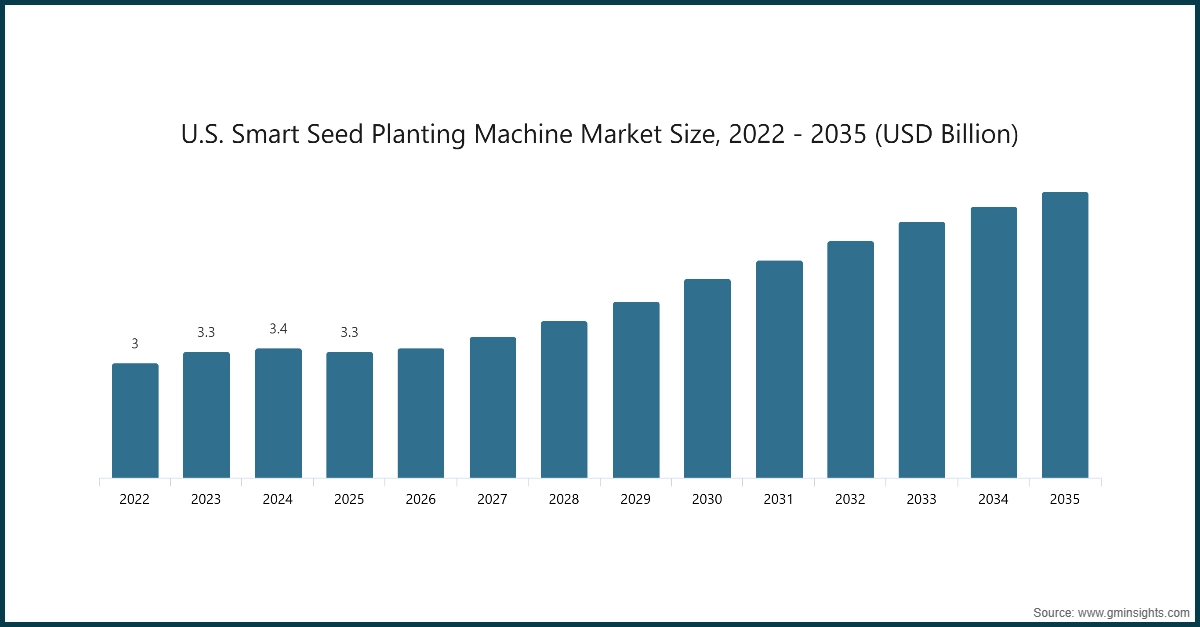
In 2025, the U.S dominated the North America smart seed planting machine industry, accounting for around 79.7% and generating around USD 3.3 billion revenue in the same year.
- The U.S. has a huge impact on the development of smart machinery for planting seeds because it has one of the most mechanized agricultural sectors in the world and also traditionally has a culture of adopting new technologies early. The large size of American farms, labor costs, and the availability of capital make U.S. farmers more open to using automation and precision planting tools as well as sensor-based machines in their business practices. Also, because of the presence of major manufacturers of agricultural machinery in the U.S., large farms in the U.S. have access to digital farming technology; thus, there is a strong ecosystem of agritech start-ups that helps fuel the development of smart planting technology.
- Smart seed configuration machine sales have been driven by high advancement of farming globally and across all North American markets, including Canadian farming. As a leading agricultural force, North America has developed and implemented mechanization technologies at advanced levels; furthermore, American and Canadian farmers utilize technology to aid in planting their crops. North America also possesses an adequate level of technology and distribution channels to help farmers in each market transition quickly to smart-seed configuration machines.
- Smart-seed configuration machine sales in both the U.S. and Canada have resulted from large-scale operations, capital investments in automation and expanding agricultural policies, such as efficiency and sustainable farming. Because of these characteristics, there is not a location in the world that is currently seen as a smarter, better or faster-growing market for smart-seed configuration machines than North America; therefore, the continuous development and use of innovative plant configurations will shape the future direction of plant science on a global scale.
Europe Smart Seed Planting Machine Market
Europe smart seed planting machine industry held 21.5% share in 2025 and is expected to grow at 8.2% during the forecast period.
- The market for smart seed planters in Europe is mature and focused on innovation with a strong regulatory framework supporting sustainable farming and efficient use of land. Farmers on average manage medium size farms that place a major emphasis on adequate precision, environmental compliance and optimization of resources; this will promote the demand for planting technologies that reduce the use of inputs, support traceability and allow for uniform establishment of crops .Europe has had an established record of advanced agricultural engineering and the use of digital farm management systems and this provides additional support for Europe as one of the key markets for smart seeding solutions.
- In addition, the European drive toward achieving carbon-neutral farming is leading to a greater reliance on automation and fuel-efficient equipment. Manufacturers in Europe have traditionally invested significant resources into R&D and are therefore able to manufacture highly specialized and advanced technologically capable equipment for a variety of crop types and farming scenarios. The existence of strict quality regulations in conjunction with farmers who are technically proficient has led to the rapid acceptance of new technologies for seed placement, variable rate planting, IoT-enabled monitoring, etc., making Europe a continuing development center for premium and high-precision smart seed planting technologies.
Asia Pacific Smart Seed Planting Machine Market
The Asia Pacific held a market share of 27.2% in 2025 and is anticipated to grow with a CAGR of around 9.6% from 2026 to 2035.
- As agricultural modernization is occurring rapidly in the APAC region, this is also causing industry-wide pressure for governments throughout the region to support moving toward mechanization, which is prompting an increase in the demand for smart seed planting machines. Countries such as China, India, Japan, and Australia are all being impacted by increasing population sizes and therefore need to increase their efficiencies for producing food. This need is driving the rapid growth of precision agriculture, such as using sensor-based seeders and semi-autonomous planters, with each of these countries continuing to show strong growth in adopting precision agriculture tools.
- While the size of farms in the APAC region varies widely, there is a distinct trend towards using mechanized, data-driven farming methods that continue to increase each year. The adoption of low-cost equipment and local manufacturing ecosystems help enable small to mid-sized farms throughout the region to become more successful. Different regions want innovations to be feasible, durable, affordable and adaptable to the diverse conditions of their farms, i.e., whether they are highly fragmented holdings in South Asia or large commercial farms in Australia. Regional digital connectivity will improve, and the number of farm-tech startups will continue to grow. Therefore, the APAC region is expected to play a key role in developing the next generation of affordable, scalable smart planting technology that aligns the principles of precision agriculture with the practicality confounded to each regional market's unique requirements.
Latin America Smart Seed Planting Machine Market
Latin America smart seed planting machine industry is growing at a CAGR of 7.8% during the forecast period.
- With vast tracts of land dedicated to agriculture and a growing trend toward mechanization, Latin America presents an opportunity for the growth of smart seed planter technologies. Large commercial farms in Brazil and Argentina utilize advanced planting methods to increase productivity. The markets in LATAM seek planters that provide high capacity, use automation to achieve uniformity, and possess the technology to plant in large areas of varying types of land. As agricultural exports drive many of the economies in LATAM, increasing planting accuracy and efficiency becomes essential for growers.
- At the same time, many smallholder and mid-sized farms exist in LATAM. Thus, there will be both high-end premium and below-average cost smart planting machine solutions needed in the region. Because farmers want to decrease their reliance on manual labor and want to optimize their use of resources, there is a significant growth in interest in technologies designed to assist farmers with these goals. As rural connectivity improves and more farmers understand the benefits associated with precision agriculture, LATAM is maturing into an exciting, high-growth market for both high-end and low-end smart planter technology, which will enable service and support for both farmers seeking scalable systems and those who want cost-effective innovative products. The convergence of scalable systems and current investments being made into the digitization of agriculture creates a strong growth opportunity for smart seeding technologies in LATAM.
Smart Seed Planting Machine Market Share
Deere & Company is leading with 32% market share. Deere & Company, CNH Industrial, AGCO Corporation, Trimble, Kubota, collectively hold around 70%, indicating moderately fragmented market concentration. These prominent players are proactively involved in strategic endeavors, such as mergers & acquisitions, facility expansions & collaborations, to expand their product portfolios, extend their reach to a broad customer base, and strengthen their market position.
John Deere is a leading company in the world of agricultural machinery. Their products utilize cutting-edge technologies, such as precision planting systems, greater automation, and the use of connected devices (often referred to as the Internet of Things, or IoT). The innovation and commitment to providing farmers with intelligent tools means they will be able to optimize where they plant their seeds, thereby improving their production from the fields they manage. John Deere’s significant history as a trusted brand, along with their continued focus on innovation, has made them an influential leader in the world of smart / sustainable agriculture now and for years to come.
AGCO is an important company within the global agricultural equipment market; they provide a wide variety of brands and technologies that help farmers improve their modern-day agricultural practices. Through the precision planting area of smart planting, AGCO offers products and services that focus on precision agriculture, automation and digital/technology integration. AGCO produces products that allow for more accurate seed placement than ever before as well as enabling farmers to more effectively manage their fields than ever before. With an emphasis on innovative design and farmer-focused engineering, AGCO is very much positioned as a leader in the development of new intelligent planting systems.
Smart Seed Planting Machine Market Companies
Major players operating in the smart seed planting machine industry are:
- AGCO
- Agrisem International
- Bourgault Industries
- CLAAS KGaA
- CNH Industrial
- Deere & Company
- Jumil
- Kinze Manufacturing
- Kubota
- Mahindra & Mahindra
- MaterMacc
- Semeato
- Trimble
- Väderstad AB
- Yetter Farm Equipment
Mahindra & Mahindra is recognized as a leader in the manufacture of agricultural machinery with a dominant position in developing and global markets, creating dependable, low-cost equipment. The company continues to extend its smart machinery categories with improved technology in their seed planters and precision tools that will enhance productivity at the small- and mid-scale level. By combining technological innovation with affordability, Mahindra strengthens its position in both mechanized and technological-enabled agricultural sectors.
Trimble is a GPS, automation, and precision agriculture company that specializes in technologies to improve the performance of machines in the field with increased productivity. Trimble does not directly manufacture seed planters. Instead, Trimble offers the digital infrastructure (navigation systems, sensors, control modules and software platforms) that drive intelligent seeding devices from various manufacturers. Trimble is an enabling force behind the development of advanced precision planting capabilities due to its proficiency in data analysis and real-time field intelligence capabilities.
Smart Seed Planting Machine Market Report Attributes
| Key Takeaway | Details |
|---|---|
| Market Size & Growth | |
| Base Year | 2025 |
| Market Size in 2025 | USD 10.8 Billion |
| Market Size in 2026 | USD 11.4 Billion |
| Forecast Period 2026-2035 CAGR | 8.8% |
| Market Size in 2035 | USD 24.2 Billion |
| Key Market Trends | |
| Drivers | Impact |
| Rising demand for precision agriculture | Achieves better seeding precision, therefore increases total crop output on the field. |
| Shift toward large‑scale mechanized farming | Increases needs for high-capacity precision planting machines to plant more area faster. |
| Labor shortages & rising wages | Increases the rate at which farmers are using robotic tools for seed planting; therefore, there is less need for human help. |
| Pitfalls & Challenges | Impact |
| High initial capital costs | This leads to limited small and medium size farmer adoption due to financial limitations. |
| Limited technical knowledge among farmers | This leads to low effective utilization of smart planters and results in training barriers to usage. |
| Opportunities: | Impact |
| Integration of AI‑driven decision support | Enhance real-time planting decision making and provide consistent yields. |
| Growth of autonomous & electric planters | Facilitates cleaner and more efficient planting operations with minimal interaction from humans. |
| Market Leaders (2025) | |
| Market Leader |
32% market share |
| Top Players |
The collective market share in 2025 is 70% |
| Competitive Edge |
|
| Regional Insights | |
| Largest market | North America |
| Fastest growing market | Asia Pacific |
| Emerging countries | France, Saudi Arabia, Mexico, Japan |
| Future Outlook |
|
What are the growth opportunities in this market?
Smart Seed Planting Machine Industry News
- In January 2026, AGCO unveiled ArrowTube at its winter conference, a retrofit seed‑delivery and orientation system that accelerates seed, uses controlled friction, and places it into a sub‑furrow knife track to maintain high‑speed spacing while orienting corn seed tip‑down/embryo‑across for more uniform emergence.
- In January 2026, Bourgault Industries introduced the CDi50 integrated air seeded with a 50‑ft working width, two onboard tanks totalling 225 BU, configurable openers with 7.5/10/12 in row spacing, and optional Mid Row Banders for targeted fertilizer placement in a transport‑friendly frame.
- In September 2025, Jumil announced two planting additions at Expointer a rice‑line planter and articulated planters from 9 rows broadening precision planting options for Brazilian growers and tightening transport envelopes.
- In March 2025, CNH Industrial detailed Model Year 2026 Case IH Early Riser planter updates EM FlowSense per‑row liquid monitoring on the Pro 1200 display, new residue‑management parts, split‑scale tank visibility, and a new 2160 configuration (90‑ft, 24 rows, 22 in) to boost in‑cab control and placement accuracy.
- In February 2025, Deere & Company expanded its planter precision upgrade program with meter‑only retrofit kits ExactEmerge and MaxEmerge 5e delivering electric‑drive high‑speed metering, curve compensation, row shutoff, and variable‑rate on existing bars, plus an ultimate planter upgrade path for older frames.
The smart seed planting machine market research report includes in-depth coverage of the industry with estimates & forecasts in terms of revenue (USD Billion) & volume (Thousand Units) from 2022 to 2035, for the following segments:
Market, by Product Type
- Automation & control systems
- Guidance systems
- Drive systems
- Display systems
- Control systems
- GPS receivers
- Drones/UAVS
- Sensing & monitoring devices
- Smart metering systems
- Sensors
- Cameras
- Delivery systems
Market, by Automation Level
- Automatic
- Manual
Market, by Crop Type
- Row crops
- Grains & cereals
- Pulses & oilseeds
- Vegetables & fruits
- Forestry
Market, by Application
- Small farms (Below 400 hectares)
- Large farms (Above 400 hectares)
Market, by Distribution Channel
- Direct sales
- Indirect sales
The above information is provided for the following regions and countries:
- North America
- U.S.
- Canada
- Europe
- Germany
- UK
- France
- Italy
- Spain
- Asia Pacific
- China
- India
- Japan
- Australia
- South Korea
- Latin America
- Brazil
- Mexico
- Argentina
- Middle East and Africa
- South Africa
- Saudi Arabia
- UAE
Frequently Asked Question(FAQ) :
What is the market size of the smart seed planting machine in 2025?
The market size was USD 10.8 billion in 2025, with a CAGR of 8.8% expected through 2035. Increasing demand for productivity and efficiency, coupled with advancements in precision agriculture, is driving market growth.
What is the projected value of the smart seed planting machine market by 2035?
The market for smart seed planting machines is poised to reach USD 24.2 billion by 2035, driven by automation, digital tools, and sustainability-focused innovations.
What is the expected size of the smart seed planting machine industry in 2026?
The market size is projected to reach USD 11.4 billion in 2026.
How much revenue did the automation & control systems segment generate in 2025?
The automation & control systems segment generated approximately USD 6.5 billion, dominating the market in 2025.
What was the valuation of the automatic segment in 2025?
The automatic segment accounted for 79% of the global market share in 2025, led by its ability to perform core planting tasks autonomously.
What is the growth outlook for the indirect sales segment?
The indirect sales segment held the largest market share in 2025, generating USD 6.1 billion, with continued growth expected due to its ability to expand market coverage through intermediaries.
Which region leads the smart seed planting machine sector?
North America leads the market, with the U.S. accounting for approximately 79.7% of the regional revenue, generating USD 3.3 billion in 2025. This dominance is fueled by advancements in precision agriculture and automation technologies.
What are the upcoming trends in the smart seed planting machine market?
Trends include the adoption of GPS-guided systems, variable rate applications, IoT-enabled connectivity, sustainable planting systems, and automation technologies like self-driving tractors and automated seed distribution systems.
Who are the key players in the smart seed planting machine industry?
Key players include AGCO, Agrisem International, Bourgault Industries, CLAAS KGaA, CNH Industrial, Deere & Company, Jumil, Kinze Manufacturing, Kubota, and Mahindra & Mahindra.
Smart Seed Planting Machine Market Scope
Related Reports