Summary
Table of Content

Smart Ovens Market
Get a free sample of this report
Form submitted successfully!
Error submitting form. Please try again.
Thank you!
Your inquiry has been received. Our team will reach out to you with the required details via email. To ensure that you don't miss their response, kindly remember to check your spam folder as well!
Request Sectional Data
Thank you!
Your inquiry has been received. Our team will reach out to you with the required details via email. To ensure that you don't miss their response, kindly remember to check your spam folder as well!
Form submitted successfully!
Error submitting form. Please try again.
Smart Ovens Market Size
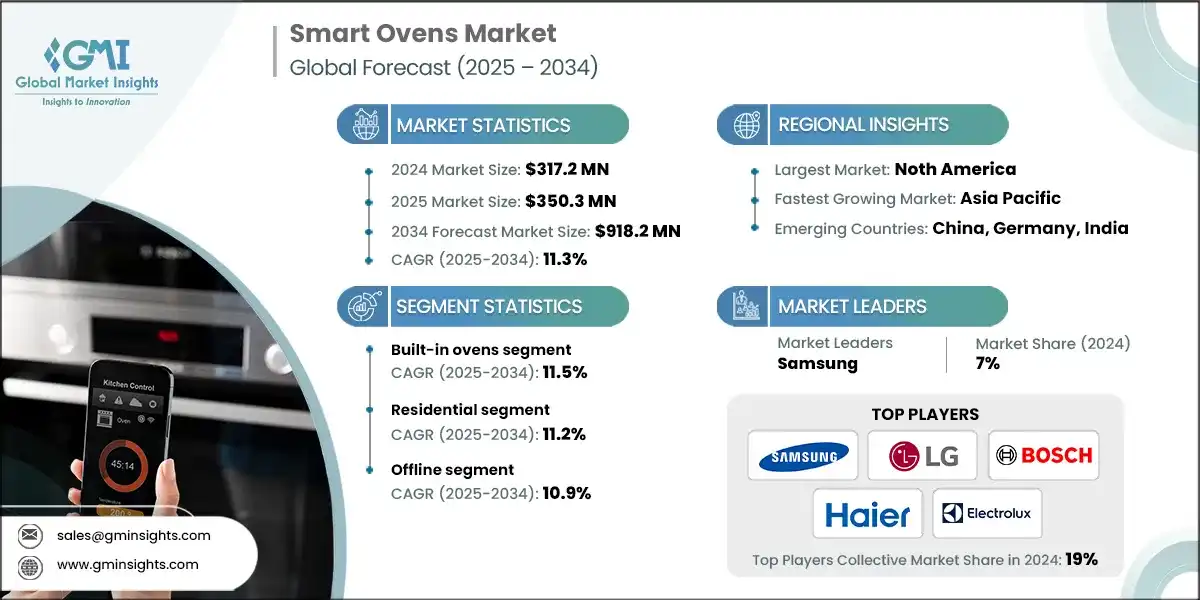
The global smart ovens market size was estimated at USD 317.2 million in 2024. The market is expected to grow from USD 350.3 million in 2025 to USD 918.2 million in 2034, at a CAGR of 11.3%.
Smart Ovens Market Key Takeaways
Market Size & Growth
- 2024 Market Size: USD 317.2 Million
- 2025 Market Size: USD 350.3 Million
- 2034 Forecast Market Size: USD 918.2 Million
- CAGR (2025–2034): 11.3%
Regional Dominance
- Largest Market: North America
- Fastest Growing Region: Asia Pacific
Key Market Drivers
- Increasing consumer demand for smart home appliances.
- Advancements in IoT technology enabling seamless integration.
Challenges
- High initial costs associated with smart ovens.
- Concerns over data privacy and security due to connectivity features.
Opportunity
- Growing penetration of smart home ecosystems in developing regions.
- Innovations in AI and machine learning to enhance user experience and functionality.
Key Players
- Market Leader: Samsung led with over 7% market share in 2024.
- Leading Players: Top 5 players in this market include Samsung, LG, Bosch, Haier, Electrolux, which collectively held a market share of 19% in 2024.
Get Market Insights & Growth Opportunities
The market is expanding with increased adoption of smart home technology and increased demand for automation and convenience within the home environment. Increased adoption of smart home technology is among the key drivers since customers need to add more smart devices into their IoT infrastructures. Wi-Fi-enabled, voice-controlled, and remotely connected smart ovens are a part of the smart home automation trend and convenience.
- Based on the smart home data of U.S. Department of Commerce, United States levels of adoption for smart homes depict a significant digital divide. The highest adopted are in Connecticut at 28.2%, Utah at 27.8%, and Maryland at 27.6%. In contrast, there are some states such as Alaska (13%), Mississippi, and Wyoming way behind with penetration below 16%.
- According to American Home Shield's survey, Americans have spent on average, a total of USD 3,026 on smart devices. The maintenance and subscription charges are equally growing, as they spend, on average, USD 498 on maintenance charges every year. Smart home ecosystem users plan to continue growing the size of their smart home system forecast to spend a USD 896 in 2025 on smart technology.
Besides, they are more energy-conscious and sustainable and thus invest in intelligent ovens with energy-saving capabilities and precise cooking control that assists in the reduction of wastage.
Rapid urbanization and changing lifestyles of consumers are the factors also propelling market growth. Smart ovens, equipped with pre-programmed cooking functions and recipe assistance, offer a quick and efficient solution for those pressed for time in the kitchen.
Healthy food trends are also influencing demand for smart ovens. Consumers are looking for products that enable healthy cooking, such as grilling, air frying, and steaming, provided by some smart ovens. This trend is common among millennials and younger generations who prioritize health and wellness in their consumption patterns.
The growth of online shopping websites has helped smarter ovens reach more customers. The online stores present information about the products, ratings by the customers, and market prices, and this helps the customers make the right purchasing decisions.
To get key market trends
Smart Ovens Market Trends
- The market is growing significantly due to technological advancement and growing demand from consumers for connected home appliances. Smart ovens with Wi-Fi connectivity, voice commands, and remote monitoring are increasingly becoming popular among tech users due to convenience and efficiency in the cooking process.
- The integration of artificial intelligence (AI) and machine learning (ML) into such appliances also increases their functionality, providing customized cooking guidance and automatic temperature adjustment. Such technology is especially desirable for busy families and individuals seeking to simplify meal preparation.
- The Bosch Series 8 sensor oven has many modes of cooking. The new Bosch Series 8 accent line sensor oven is loaded with inbuilt artificial intelligence (AI). AI software needs a learning process to generate correct predictions. This kind of machine learning process assists systems in learning from large datasets.
- Increasing disposable incomes and smart home settings adoption are critical drivers for the market. Consumers are increasingly investing in smart kitchen appliances to complement their connected lifestyles. Also, health-centric eating and home cooking lifestyle has driven demand for smart ovens since these products have pre-programmed settings for different recipes in order to obtain accurate cooking and improved nutritional results.
- The capacity to adjust and regulate these ovens remotely through smartphone apps has also helped spread their popularity, with customers enjoying more flexibility and power over their culinary experience.
- Partnership and collaborations between technology suppliers and manufacturers are driving market growth. Savant partnered with Monogram Appliances to launch the Savant Smart Hearth Oven and establish a high-end appliance referral program.
- This initiative is intended to equip technology integrators with the information they need to market and support Monogram-branded appliances to consumers, as trends are leaning toward greater utilization of sophisticated technology in high-end kitchen appliances.
- Despite the positive growth trajectory, there are some challenges of the market in the shape of high investment at the concern over privacy and security issues regarding interconnected devices. Companies are responding to this demand by providing low-cost versions and increasing cybersecurity with tough controls to restore confidence among customers. Furthermore, the integration of energy-efficient technologies in smart ovens aligns with the global push for sustainability, making them an attractive option for environmentally conscious consumers.
Smart Ovens Market Analysis
Learn more about the key segments shaping this market
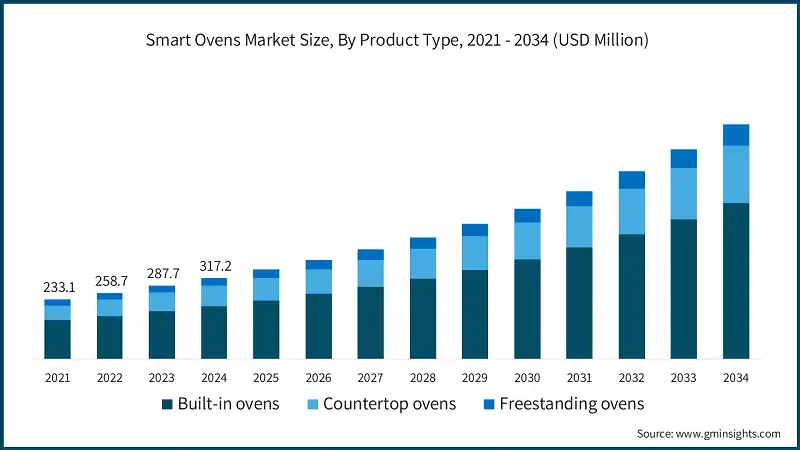
Based on the product type, the market is divided into built-in ovens, countertop ovens and freestanding ovens. In 2024, built-in ovens dominated the market, generating revenue of USD 207.9 million and expected to grow at a CAGR of 11.5% during the forecast period.
- The market for the built-in ovens segment is driven by increasing consumer preference for modern kitchen designs and integrated appliances. These ovens offer space-saving solutions and advanced features, such as smart connectivity and energy efficiency, which appeal to urban households.
- The increasing penetration of smart home products also favors the growth of integrated ovens, especially in advanced economies. Moreover, manufacturers are investing in next-gen designs and functionalities to cater to changing consumers' requirements, which is expected to drive the segment further.
- Countertop smart ovens projected to grow steadily at a CAGR of 11.1% during the forecast period. These ovens are particularly popular among small households and individuals with limited kitchen space.
- Growing popularity of home cooking and baking, coupled with greater availability of small and compact models, will be a major driver of the segment growth in the forecast period.
Learn more about the key segments shaping this market
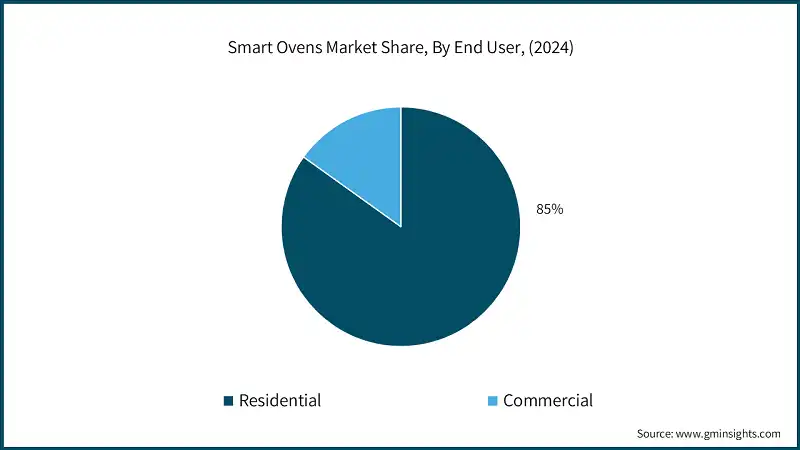
Based on end user, the smart ovens market is segmented into residential and commercial. In 2024, the residential segment dominates the market with 85% market share, and the segment is expected to grow at a CAGR of 11.2% from 2025 to 2034.
- Increased demand by consumers for home smart appliances and increased disposable incomes are driving the penetration of smart ovens in homes. Remote control, voice control, and power saving are some of the benefits that appeal to household consumers. Also, increased popularity of home baking and cooking is also driving demand in this sector.
- According to U.S. Bureau of Labor Statistics, over 90 percent of American households possess a microwave oven. According to European Commission statistics, in 2020 there were 240 million working ovens in the EU27, approximately 1 oven per household. The ovens are used an average of 110 times a year, a total of 25 billion cycles in the EU27, on average 2 cycles per household per week.
- The commercial market is expected to grow steadily throughout the forecast period. Usage of smart ovens in restaurants, bakeries, and cafes is on the rise because they can enable operations to become more efficient and maintain consistent food quality. Programmable settings and multifunctionality are most suitable for commercial consumers.
Based on distribution channel, the smart ovens market is segmented into online and offline. In 2024, the offline segment is expected to grow at a CAGR of 10.9% from 2025 to 2034.
- Many consumers use offline channels to inspect products physically before purchasing, particularly for high-end appliances such as smart ovens. Key players in this segment are concentrating on customer experience by conducting in-store demonstrations and expert advice.
- The online segment is also projected to achieve a CAGR of 12.7% in 2025-2034. The online segment has been expanding fast due to increasing e-commerce penetration and the ease provided by them to consumers. Smartphone penetration and enhanced internet penetration have further accelerated online sales.
- In the U.S. economy, online shopping contributed 15.9% of all retail sales in the first quarter of 2024, an increase of 8.6% from the period of 2023, and more than long term average of 6.4%, and thereby indicating increase in online sales. With improving online sales, consumerware product sales through the channel are sure to be provided with a boost.
Looking for region specific data?
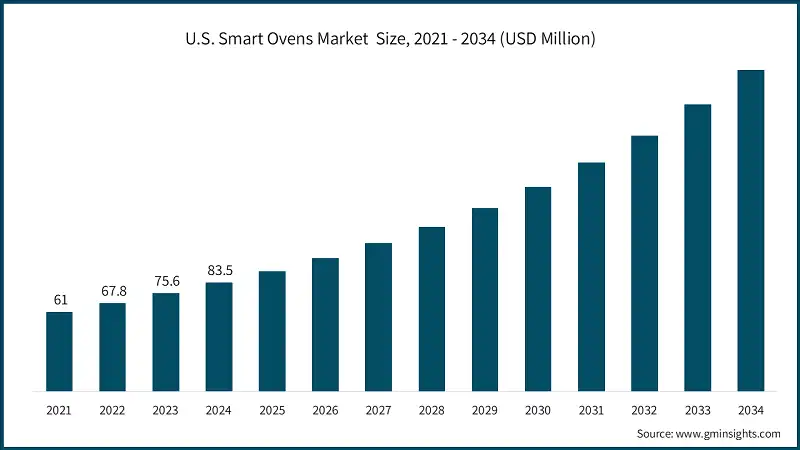
In terms of country, the United States led the smart ovens market with 77% of the North American market share and estimated USD 83.5 million in revenue during 2024.
- The U.S. market is driven mainly by growing adoption of smart home technology and increasing demand for energy-efficient appliances. The market is further propelled by increased smart home building throughout the U.S. that is driving up demand for smart ovens as consumers aim to include smart appliances in their homes to become more efficient and convenient.
- As per the Ruby Home survey, the market size of the U.S. smart home industry was USD 31.5 billion in 2022. 7 out of 10 home buyers are searching for a smart home. In 2023, there are about 63.43 million homes that have actually installed smart home devices in the U.S. It is close to half (45%) of the total homes of the U.S. which have smart devices.
- Smart ovens with advanced cooking capabilities, recipe guidance, and nutritional monitoring are gaining popularity among consumers who are health conscious. These functionalities help cook food correctly for the consumers, producing improved nutritional results.
The Europe smart ovens market was valued at USD 84 million in 2024 and is projected to grow at a CAGR of 10.9% between 2025 and 2034.
- Growing demand from consumers for smart home appliances is one key driver, with households in the region preferring advanced technologies to develop comfort and effectiveness. Growing penetration for Internet of Things (IoT) and smart devices has also led to the growth of smart ovens, with simple interoperability with other smart home systems.
- Germany, being a strong market in Europe, is the region's growth driver. The high disposable incomes and advanced technological base of the country have motivated consumers to utilize high-end intelligent kitchen appliances.
The Asia Pacific smart ovens market was valued at USD 96 million in 2024 and is projected to grow at a CAGR of 11.9% between 2025 and 2034.
- Urbanization levels and rising disposable incomes in the region have propel demand for higher-end kitchen appliances, such as smart ovens. China, as one of the major players in the local market, is expanding vigorously owing to its high population base and emerging middle-class population. The increasing use of smart homes in urban metropolises has also increased the demand for smart ovens.
The Middle East and Africa smart ovens industry was valued at USD 17 million in 2024 and is projected to grow at a CAGR of 10.6% between 2025 and 2034.
- The Saudi Arabian market growth is stimulated by rising urbanization as well as the growing use of smart home solutions. Increased disposable incomes in the population have resulted in higher spending on sophisticated kitchen appliances.
- Government efforts to support smart city initiatives and technological innovation in IoT-enabled home appliances also favor the growth of the market. Saudi Arabia's vision to achieve high-speed technology and Vision 2030 ambitious plans have made the country a promising market for smart home technology.
Smart Ovens Market Share
- The top 5 companies in the market are Samsung, LG, Bosch, Haier, Electrolux collectively hold a share of 19% in the market.
- These companies continue to acquire and merge with others, expand facilities, and make various collaborations to increase their product offerings, access customer bases, and secure their market positions.
- Samsung is gaining market share in the smart ovens industry by using its credibility with the customers and adopting cutting-edge technologies like AI and IoT in its products. Samsung spends a lot on marketing ads and collaborations to increase its visibility and presence. Its focus on innovation and sustainability, for instance, low-power design, just adds to its position in the industry.
- LG increases its market share through focus on product innovation and quality. Features of smart ovens such as Wi-Fi connectivity, app control, and sensor cooking are implemented in LG ovens to satisfy the contemporary needs of consumers. High-quality designs and reliability are also focused on by LG, and it targets premium customers. Strategic partnerships and a strong distribution channel help the company penetrate several regional markets successfully.
- Haier is consolidating its market position in the smart oven sector by emphasizing affordability and accessibility. Haier provides a variety of smart ovens with basic features such as app control and multi-functionality cooking modes at affordable prices. Haier's strategy is to enhance its presence in growth markets by emphasizing localized marketing and partnering.
Smart Ovens Market Companies
Major players operating in the smart ovens industry are:
- Alto-Shaam
- Breville
- BSH Home Appliances
- Electrolux
- Fagor Professional
- GE Appliances
- Haier
- June Oven
- KitchenAid
- LG Electronics
- Nuwave
- Samsung
- Sharp
- UNOX
- Whirlpool
- To improve the product and market share key players are constantly investing in technological activities and are also entering into partnerships to provide improved and better solutions for the customers. These investments are benefiting both companies and customers as they help develop and offer solutions as per the changing technological trends and thus the customer requirements.
- Electrolux is a global appliance manufacturer, renowned for its innovative and eco-friendly products in the home appliances sector. Electrolux specializes in high-end technology and energy efficiency, meeting changing consumer demands. With a strong supply chain and research and development spend, the company keeps enhancing its product offering, with a competitive advantage in the smart oven segment during the forecast period.
- Breville, an Australian home-grown brand, is among the top smart oven brands renowned for high-end and high-performance kitchen appliances. It is primarily involved in high-performance smart ovens with elements such as Element IQ technology, precision cooking, and app control. Highly committed to innovation and design, the company is making its mark globally through strategic collaborations and promotional efforts.
Smart Ovens Market Report Attributes
| Key Takeaway | Details |
|---|---|
| Market Size & Growth | |
| Base Year | 2024 |
| Market Size in 2024 | USD 317.2 Million |
| Market Size in 2025 | USD 350.3 Million |
| Forecast Period 2025 - 2034 CAGR | 11.3% |
| Market Size in 2034 | USD 918.2 Million |
| Key Market Trends | |
| Drivers | Impact |
| Increasing consumer demand for smart home appliances | Increased demand for smart ovens as consumers prioritize convenience and modern kitchen solutions. |
| Advancements in IoT technology enabling seamless integration | Enhanced functionality and user experience, driving higher adoption rates of smart ovens. |
| Pitfalls & Challenges | Impact |
| High initial costs associated with smart ovens | Limited market penetration in cost-sensitive consumer segments. |
| Concerns over data privacy and security due to connectivity features | Consumer hesitation and potential regulatory scrutiny, impacting market growth. |
| Opportunities: | Impact |
| Growing penetration of smart home ecosystems in developing regions | Significant growth potential in developing regions such as smart home ecosystems gain traction. |
| Innovations in AI and machine learning to enhance user experience and functionality | Improved product offerings and differentiation, fostering competitive advantage and market expansion. |
| Market Leaders (2024) | |
| Market Leaders |
7% market share |
| Top Players |
Collective market share in 2024 is 19% |
| Competitive Edge |
|
| Regional Insights | |
| Largest Market | North America |
| Fastest Growing Market | Asia Pacific |
| Emerging Countries | China, Germany, India |
| Future outlook |
|
What are the growth opportunities in this market?
Smart Ovens Industry News
- In December 2024, BSH Home Appliances (Bosch) has launched the Siemens Experience Centre in Bengaluru, India. This advanced facility redefines customer engagement, providing an immersive journey into Siemens' premium innovations. The center aims to transform the way consumers engage with home appliances.
- In July 2024, Samsung Electronics unveiled its newest oven range. The Combi Smart Oven, featuring Air Fry & Steam with Air Fry capabilities, can ferment ingredients, allowing users to proof dough and craft homemade yogurt. Owing to its integrated air fry function, customers can savor healthier renditions of their fried dishes, eliminating the necessity for a deep fryer or any additional appliance.
- In February 2024, At AAHAR 2024, Alto-Shaam unveiled its newest multi-cook ovens, showcasing its commitment to innovation in the multi-cook category. By integrating controlled humidity with the patented vertical airflow of Structured Air Technology, the ovens allow operators to simultaneously steam, bake, grill, and air fry across three independent chambers, all within a ventless space, ensuring uncompromised quality.
- In March 2023, GE Profile unveiled its latest innovation, the Smart Oven featuring Zero Preheat Technology. This groundbreaking technology positions it as the sole countertop oven that eliminates the preheating phase across all cooking modes. By directly targeting food, the oven achieves optimal temperatures swiftly, eliminating the process typically associated with warming up.
The smart ovens research report includes in-depth coverage of the industry with estimates & forecasts in terms of revenue (USD Million) and volume (Thousand Units) from 2021 to 2034, for the following segments:
Market, By Product Type
- Built-in ovens
- Countertop ovens
- Freestanding ovens
Market, By Configuration Type
- Single ovens
- Double ovens
Market, By Cooking Technology
- Convection
- Traditional
- Steam injection
- Others (advantium etc.)
Market, By Price Range
- Below $1000
- $1000-$2000
- Above $2000
Market, By End Use
- Residential
- Commercial
- HoReCa
- Offices
- Hospitality
- Healthcare
- Others (resort & cruise etc.)
Market, By Distribution Channel
- Online
- E-commerce
- Company websites
- Offline
- Supermarkets/hypermarket
- Specialty retail stores
- Others (independent retailer etc.)
The above information is provided for the following regions and countries:
- North America
- U.S.
- Canada
- Europe
- Germany
- UK
- France
- Spain
- Italy
- Netherlands
- Asia Pacific
- China
- Japan
- India
- Australia
- South Korea
- Latin America
- Brazil
- Mexico
- Argentina
- MEA
- South Africa
- Saudi Arabia
- UAE
Frequently Asked Question(FAQ) :
What is the market size of the smart ovens market in 2024?
The market size was USD 317.2 million in 2024, driven by growing adoption of smart home appliances and consumer demand for convenience.
What is the projected value of the smart ovens market by 2034?
The market is expected to reach USD 918.2 million by 2034, expanding at a CAGR of 11.3% from 2025 to 2034.
What is the estimated market size of smart ovens in 2025?
The market is forecast to reach USD 350.3 million in 2025, supported by increasing urbanization and consumer preference for energy-efficient kitchen appliances.
How much revenue did the built-in ovens segment generate in 2024?
Built-in ovens generated USD 207.9 million in 2024, leading the market with strong demand for integrated kitchen appliances.
What is the growth outlook for countertop smart ovens from 2025 to 2034?
Countertop smart ovens are projected to grow at a CAGR of 11.1% through 2034, supported by rising popularity in small households and limited-space kitchens.
Which end-user segment dominates the smart ovens market?
The residential segment dominated with 85% share in 2024 and is projected to grow at a CAGR of 11.2% during 2025–2034.
Which region leads the smart ovens industry?
North America was the largest market in 2024, led by the U.S., which accounted for USD 83.5 million, driven by high adoption of smart home technology.
Which region is expected to grow fastest in the smart ovens industry?
Asia Pacific is projected to be the fastest-growing region at a CAGR of 11.9% from 2025 to 2034, driven by rising disposable incomes and urbanization.
Who are the key players in the smart ovens market?
Major players include Samsung, LG Electronics, Bosch, Haier, Electrolux, Whirlpool, Breville, GE Appliances, Sharp, KitchenAid, June Oven, Nuwave, Alto-Shaam, UNOX, and Fagor Professional.
Smart Ovens Market Scope
Related Reports