Summary
Table of Content

Smart Meter Market
Get a free sample of this report
Form submitted successfully!
Error submitting form. Please try again.
Thank you!
Your inquiry has been received. Our team will reach out to you with the required details via email. To ensure that you don't miss their response, kindly remember to check your spam folder as well!
Request Sectional Data
Thank you!
Your inquiry has been received. Our team will reach out to you with the required details via email. To ensure that you don't miss their response, kindly remember to check your spam folder as well!
Form submitted successfully!
Error submitting form. Please try again.
Smart Meter Market Size
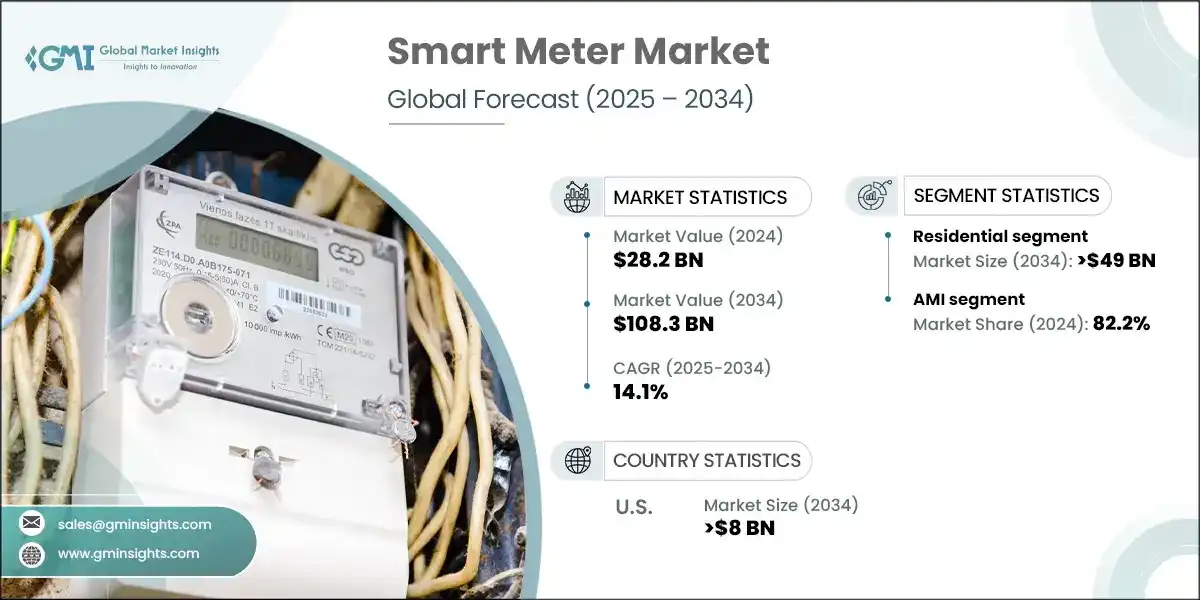
The global smart meter market was estimated at USD 28.2 billion in 2024. The market is expected to grow from USD 32.9 billion in 2025 to USD 108.3 billion in 2034, at a CAGR of 14.1%.
Smart Meter Market Key Takeaways
Market Size & Growth
- 2024 Market Size: USD 28.2 Billion
- 2034 Forecast Market Size: USD 108.3 Billion
- CAGR (2025–2034): 14.1%
Key Market Drivers
- Increasing Renewable Energy Integration.
- Regulatory Mandates for Accurate Billing and Grid Reliability.
- Growing Demand for Energy Efficiency and Usage Optimization.
Challenges
- High initial capital expenditure.
Opportunity
- Integration with IoT and Smart Grid Infrastructure.
- Expansion in Smart Cities and Urban Infrastructure.
Key Players
- Market Leader: Itron led with over 13% market share in 2024.
- Leading Players: Top 5 players in this market include Itron, Landis + Gyr, Honeywell International, Siemens, Schneider Electric, which collectively held a market share of 30% in 2024.
Get Market Insights & Growth Opportunities
- The smart meter industry is experiencing rapid growth driven by technological advancements, regulatory policies, and increasing consumer demand for efficient energy management. Smart meters are digital devices that record electricity, gas, or water consumption in real-time and transmit data to utility providers, enabling improved monitoring, billing accuracy, and energy efficiency.
- One primary factor fueling market expansion is the global push toward smart grid infrastructure. Governments worldwide are investing heavily in modernizing their energy systems to enhance reliability, reduce transmission losses, and integrate renewable energy sources. For instance, in U.S., there was USD 82 billion in actual energy & industry investment.
- Similarly, investment in solar and storage posted annual gains in 2024 relative to 2023, up 2% and 14%, respectively. Annual investment in wind was flat year-on-year compared to 2023. Moreover, the country accounts for 15% of global clean energy investment and remains a major investor in oil and gas.
- Smart meters are integral to these initiatives, providing the data necessary for grid optimization and demand response programs. For instance, countries like the United States, China, and members of the European Union have set ambitious targets for deploying millions of smart meters nationwide, supported by policies and incentives.
- Technological innovations are also key drivers. Advances in IoT (Internet of Things) connectivity, data analytics, and wireless communication protocols have made smart meters more affordable, reliable, and easier to install. Features such as two-way communication, remote management, and real-time data visualization enhance consumer engagement and utility efficiency. As a result, utility companies are increasingly adopting smart meters to improve operational efficiency and customer satisfaction.
- Consumer awareness and demand for transparency and control over energy consumption are further propelling market growth. Smart meters empower consumers to monitor their usage patterns, identify wastage, and adopt energy-saving habits, aligning with global sustainability goals. Additionally, smart meters facilitate dynamic pricing models, encouraging consumers to shift their usage to off-peak times, thereby reducing strain on the grid and lowering costs.
To get key market trends
Smart Meter Market Trends
- The smart meter industry is rapidly evolving, driven by technological innovations, regulatory mandates, and shifting consumer preferences. Several key trends are shaping the landscape, indicating a dynamic and promising future.
- One prominent trend is the increasing adoption of advanced communication technologies such as NB-IoT (Narrowband Internet of Things), LTE-M, and 5G. These wireless protocols enhance connectivity, reliability, and real-time data transfer capabilities of smart meters. The deployment of 5G, in particular, promises ultra-low latency and massive device connectivity, enabling more sophisticated grid management and demand response strategies.
- The rising preference for solar energy is driving the overall demand for smart meters all over the world. For instance, in 2024, the U.S. solar energy sector experienced a record-breaking year, adding more new capacity than any other energy technology in the past two decades. Utility-scale solar generation reached 218.5 terawatt-hours, with total solar generation, including small-scale, estimated at 303.2 TWh.
- Similarly, wind energy is also growing tremendously, driving the smart meter market. In 2024, Europe installed 16.4 GW of new wind power capacity, with 13.8 GW coming from onshore and 2.6 GW from offshore wind. The EU-27 accounted for 12.9 GW of this new capacity. Despite this growth, Europe's wind power expansion is not on track to meet its 2030 renewable energy targets.
- Another significant trend is the integration of big data analytics and artificial intelligence (AI). Smart meters generate vast amounts of consumption data, which, when processed using AI algorithms, can provide insights into usage patterns, detect anomalies, and predict maintenance needs. This data-driven approach helps utility providers optimize grid operations, reduce costs, and improve customer experience.
- Consumer engagement is also transforming with the advent of user-friendly digital platforms and mobile apps linked to smart meters. These tools enable consumers to monitor their energy consumption in real-time, set usage goals, and receive tailored recommendations for energy savings. Such transparency fosters greater customer participation in energy conservation efforts, aligning with sustainability goals.
- Furthermore, the push towards renewable energy integration is a notable trend. Smart meters facilitate bi-directional energy flow, allowing households with solar panels or other distributed generation sources to send excess power back to the grid. This capability supports the growth of prosumer consumers who also produce energy and enhances grid stability and efficiency.
- Regulatory and government initiatives remain a driving force. Many countries have set mandates for the widespread deployment of smart meters as part of their smart grid and energy transition policies. These regulations often include timelines and incentives to accelerate adoption, ensuring that utilities and consumers adopt these technologies at scale.
Smart Meter Market Analysis
Learn more about the key segments shaping this market
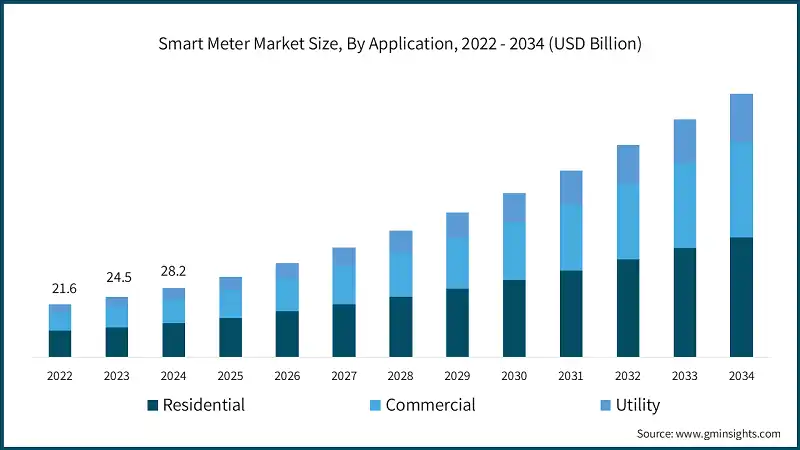
- Based on applications, the market is segmented into residential, commercial, and utility. The residential segment is anticipated to exceed USD 49 billion by 2034, due to increasing adoption of smart meters to enhance energy efficiency, promote demand response, and support smart home integration, driven by rising consumer awareness and government initiatives promoting sustainable energy consumption.
- This growth is primarily driven by increasing government initiatives and regulations aimed at modernizing energy infrastructure and promoting energy efficiency in households. Governments worldwide are incentivizing the adoption of smart meters to enable consumers to monitor their energy usage in real-time, leading to better energy management and cost savings.
- Moreover, rising consumer awareness about energy conservation and the environmental benefits of reducing carbon footprints are fueling demand for smart meters in residential settings. The proliferation of smart home devices and IoT connectivity has further accelerated adoption, as homeowners seek integrated solutions for energy management.
- Additionally, the expansion of smart grid infrastructure allows utilities to remotely manage and optimize residential energy consumption, reducing operational costs and enhancing grid stability. Technological advancements such as wireless communication protocols, user-friendly interfaces, and data analytics are making smart meters more accessible and appealing to homeowners.
- Global electrical consumption is rising significantly due to various factors. For instance, in 2024, the U.S. experienced a rebound in electricity demand following a decline in 2023, with an estimated growth of 2.5%. This upward trend is expected to persist, as the Energy Information Administration (EIA) forecasts record-breaking levels of power consumption for 2025 and 2026.
- This rising consumption is creating a huge need for power plants and thereby increasing the demand for smart meters across the world. Additionally, emerging economies are investing heavily in expanding and modernizing their power infrastructure to meet increasing energy demands, which in turn boosts the requirement for such equipment.
Learn more about the key segments shaping this market
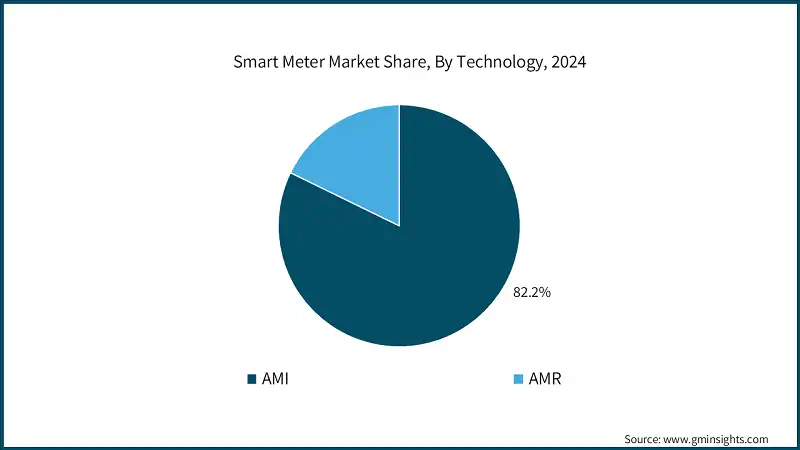
- Based on technology, the smart meter market is segmented into AMI, and AMR. The smart meters industry is segmented into advanced metering infrastructure (AMI) and automated meter reading (AMR), both of which are crucial for modern energy management. AMI segment holds the overall market share of 82.2% in 2024 due to its widespread adoption enabled by its ability to facilitate real-time data collection, remote meter reading, improved grid management, and enhanced customer engagement.
- AMR represents the traditional method of remotely collecting meter readings, typically through one-way communication systems. It allows utilities to gather consumption data periodically without manual reading, reducing labor costs and improving accuracy compared to manual reading. However, AMR has limitations in data collection frequency and lacks real-time insights, which can hinder proactive energy management.
- The countries are investing heavily in the utility and energy sector, driving the huge demand for smart meters. For instance, China has seen a precipitous rise in clean energy investment, particularly in renewables. In 2024 China's clean energy investment was more than USD 625 billion, almost doubling since 2015.
- Similarly, the quarterly investment report revealed that Australia had its best year for large-scale renewable energy investment since 2018 with 4,346 MW of new generation capacity. The quarterly result, which saw 1,598 MW of new generation capacity committed across seven projects is in line with the pace required for Australia to maintain its timely transition to a grid powered by clean energy.
- On the other hand, AMI is a more advanced technology that enables two-way communication between meters and utility providers. This system supports real-time data transmission, remote diagnostics, and two-way control, facilitating dynamic energy management, faster outage detection, and better demand response.
- AMI also supports integration with smart home systems and energy management solutions, empowering consumers with detailed usage insights and promoting energy efficiency. Both segments are vital since AMR provides a cost-effective solution for basic remote reading, especially in areas with limited infrastructure, while AMI offers comprehensive, real-time energy management capabilities essential for the development of smart grids.
- As industry progresses, AMI is gaining prominence due to its advanced features, making it a key driver of the digital transformation in energy systems. Static drives, which use power electronic components such as thyristors or IGBTs, offer superior efficiency compared to pony motors or other starting methods. They enable precise control of starting current and torque, reducing wear and tear on equipment, and ensuring more reliable operation.
Looking for region specific data?
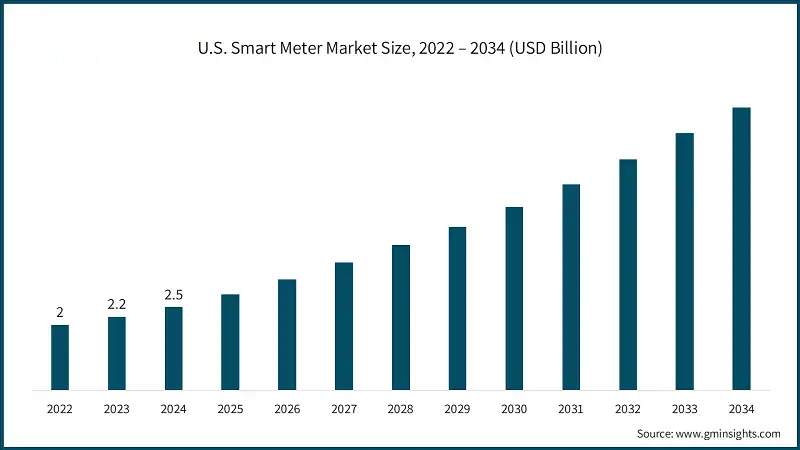
- The U.S. smart meter market is anticipated to exceed USD 8 billion by 2034. Regulatory policies aimed at maintaining grid reliability and accommodating the increased share of intermittent renewable sources necessitate advanced reactive power compensation devices like smart meters.
- The U.S. is among the most advanced economies globally, accounting for approximately 26.2% of the world's total GDP in nominal terms and 14.8% based on purchasing power parity, as reported by the World Bank. Additionally, the U.S. holds an influential position in international trade, with its exports and imports significantly affecting global trade dynamics.
- The increasing demand from industries like oil and gas is driving substantial growth in the smart meter market. As the world’s second-largest economy, the U.S. accounts for around 15% of global clean energy investments and continues to be a major investor in oil and gas. Consequently, the U.S. market is a crucial segment, making a significant contribution to the overall global market size.
- The APAC (Asia-Pacific) and Middle East regions are increasingly vital for the growth of the smart meter market due to rapid urbanization, economic development, and a rising focus on sustainable energy solutions. APAC, home to countries like China, India, and Japan is experiencing significant energy consumption growth, prompting governments to adopt smart grid technologies to improve energy efficiency and reduce losses.
- For instance, China had set target to install over 300 million smart meters by 2025 as part of its broader smart grid initiative, reflecting a strong government push towards modernization. India’s government has also launched programs like the National Smart Grid Mission, targeting the installation of millions of smart meters to enhance electricity distribution and reduce theft.
- Similarly, the Middle East is investing heavily in renewable energy and smart infrastructure to diversify its energy sources and optimize resource management. Countries like the UAE and Saudi Arabia have introduced policies to deploy smart meters across urban areas. The UAE’s Smart Dubai initiative, for instance, emphasizes the integration of smart technologies into urban infrastructure, including smart meters, to improve service delivery.
Smart Meter Market Share
- The top 5 companies in the smart meter industry are Itron, Landis + Gyr, Honeywell International, Siemens, Schneider Electric. They are contributing around 30% of the market in 2024.
- These leading companies are crucial players in the global smart meter market, owing to their technological expertise, broad product ranges, and innovative solutions. As industry leaders, they design high-performance, reliable smart meters vital for ensuring grid stability, voltage regulation, and reactive power management in modern power systems.
- Furthermore, these corporations expand their impact through their worldwide presence and extensive service networks, enabling them to undertake large-scale projects across regions such as the Middle East, Asia Pacific, and Europe. Their capacity to tailor solutions to meet specific grid needs makes them preferred partners for utilities and independent power producers.
- In addition to manufacturing, these companies offer comprehensive after-sales support, maintenance, and training services, which are essential for the long-term efficiency and sustainability of smart meters. Their leadership and technological innovations have reinforced their positions as industry frontrunners, fueling growth and driving progress in the evolving energy sector.
Smart Meter Market Companies
- In March 2025, Itron and Chint Global have introduced what they assert as the first smart meter based on the DLMS AC Electricity Smart Meter (ACESM) Generic Companion Profile (GCP) standard. The GCP-based meter, available globally, features an Itron Gen5 network interface card (NIC) embedded in a Chint electric meter.
- In January 2023, Ansaldo Energia, in collaboration with Terna, transported smart meters and a transformer to the Codrongianos electrical station in Sassari province, using a combination of sea and land routes. Smart meters, a specialized form of electric generator, will be integrated into Terna's transmission grid to support reactive energy exchange and improve short-circuit power.
- In March 2023, Toshiba Energy Systems received an order from Tohoku Electric Power to install a STATCOM. This STATCOM will play a crucial role in enhancing grid stability during the transmission of high-capacity power and ensuring a reliable power supply in the event of a transmission system fault.
- In June 2023, Kamstrup secured a substantial contract through a competitive tender process with BKW Energie AG, an energy and infrastructure company based in Bern. The contract involves providing 404,000 OMNIPOWER electricity meters along with a head-end system.
Major players operating in the smart meters market are:
- Apator SA
- ABB
- AEM
- Aclara Technologies LLC
- ARAD Group
- B Meters Metering Solutions
- Badger Meter, Inc.
- Chint Group
- General Electric
- Honeywell International, Inc.
- Itron, Inc.
- Iskraemeco Group
- Kamstrup
- Larsen & Toubro Limited
- Landis + Gyr
- Ningbo Water Meter Co., Ltd.
- Osaki Electric Co., Ltd.
- Raychem RPG Private Limited
- Schneider Electric SE
- Siemens
- Sensus
- Sontex SA
- Wasion Group
Smart Meter Market Report Attributes
| Key Takeaway | Details |
|---|---|
| Market Size & Growth | |
| Base Year | 2024 |
| Market Size in 2024 | USD 28.2 Billion |
| Forecast Period 2025 - 2034 CAGR | 14.1% |
| Market Size in 2034 | USD 108.3 Billion |
| Key Market Trends | |
| Drivers | Impact |
| Increasing Renewable Energy Integration | The rising adoption of renewable energy sources like solar and wind requires advanced metering solutions. Smart meters enable real-time monitoring and management of variable energy inputs, ensuring grid stability and efficient integration of renewables into existing power systems. |
| Regulatory Mandates for Accurate Billing and Grid Reliability | Smart meters facilitate precise energy measurement, improve billing accuracy, and support grid reliability, encouraging utilities to upgrade infrastructure and comply with evolving standards. |
| Growing Demand for Energy Efficiency and Usage Optimization | Smart meters provide detailed consumption data, enabling demand-side management, peak shaving, and energy-saving initiatives, thereby promoting efficient energy use and supporting sustainability goals. |
| Pitfalls & Challenges | Impact |
| High initial capital expenditure | This high initial cost can deter utilities, especially smaller or budget-constrained ones, slowing widespread adoption and delaying the realization of benefits like improved grid management and energy efficiency. |
| Opportunities: | Impact |
| Integration with IoT and Smart Grid Infrastructure | This integration enhances demand response, predictive maintenance, and energy efficiency, offering utilities improved operational control and consumers better energy savings, thus driving market growth and technological innovation. |
| Expansion in Smart Cities and Urban Infrastructure | As urban areas adopt smart city initiatives, the deployment of smart meters becomes essential for efficient energy management. |
| Market Leaders (2024) | |
| Market Leaders |
13% market share |
| Top Players |
Collective market share in 2024 is 30% |
| Competitive Edge |
|
| Regional Insights | |
| Largest Market | Asia Pacific |
| Fastest Growing Market | Europe |
| Emerging Country | |
| Future Outlook |
|
What are the growth opportunities in this market?
Smart Meters Industry News
- In February 2024, Connexin secured the UK's largest smart water metering contract, partnering with Essex & Suffolk Water to install up to one million smart meters throughout Essex and Suffolk by 2035. Under the agreement, Connexin will deploy wireless network infrastructure and supply Itron smart water meters, allowing for real-time, remote monitoring of water consumption for both households and businesses.
- In May 28, 2025, Itron, Inc. signed a contract with Hellenic Electricity Distribution Network Operator (HEDNO) to deploy grid edge solutions in Greece. The project includes managing 7.7 million meters with Itron’s Meter Data Management system and overseeing nearly 1 million new narrowband-IoT smart meters from ZIV Automation via Utility IQ. Itron’s strong financial health supports this large-scale deployment.
- In January 2024, Xcel Energy achieved milestone by deploying 2 million Itron smart meters which was a part of IAMI (Integrated Advanced Metering Infrastructure) 2.0 initiative. The goal of the initiative is to install 3 million smart meters in the region. The benefits of this achievement are already evident in the form of improved grid reliability, increased energy efficiency, and deeper analytics of customer behaviors.
- In November 25, 2024, Landis+Gyr signed a 15-year agreement with TREFOR in Denmark to supply and support smart water and heat meters using NB-IoT technology. The project includes deploying advanced meters and the Emerge cloud-based system, starting in early 2025. Full deployment is planned by 2027, marking a key step in Denmark’s move toward a more efficient, data-driven utility infrastructure.
The smart meter market research report includes in-depth coverage of the industry with estimates & forecast in terms of revenue (USD Million) from 2021 to 2034, for the following segments:
Market, By Application
- Residential
- Commercial
- Utility
Market, By Technology
- AMI
- AMR
Market, By Product
- Smart Gas
- Smart Water
- Smart Electric
The above information has been provided for the following regions and countries:
- North America
- U.S.
- Canada
- Europe
- Germany
- UK
- France
- Italy
- Sweden
- Asia Pacific
- China
- Japan
- India
- South Korea
- Australia
- Middle East & Africa
- UAE
- Saudi Arabia
- South Africa
- Egypt
- Latin America
- Brazil
- Mexico
- Argentina
Frequently Asked Question(FAQ) :
What is the market size of the smart meter in 2024?
The market size was USD 28.2 billion in 2024, with a CAGR of 14.1% expected through 2034 driven by smart grid infrastructure development and increasing renewable energy integration.
What is the projected value of the smart meter market by 2034?
The smart meter market is expected to reach USD 108.3 billion by 2034, propelled by IoT connectivity, regulatory mandates, and growing demand for energy efficiency optimization.
How much revenue is the residential segment expected to generate by 2034?
The residential segment is anticipated to exceed USD 49 billion by 2034, owing to government initiatives promoting energy efficiency and rising consumer awareness about energy conservation.
What was the market share of the AMI technology segment in 2024?
AMI (Advanced Metering Infrastructure) held 82.2% market share in 2024, leading due to its real-time data collection capabilities and two-way communication features.
Which region leads the smart meter market?
The U.S. smart meter market is anticipated to exceed USD 8 billion by 2034, supported by regulatory policies for grid reliability and accommodating increased renewable energy integration.
What are the upcoming trends in the smart meter market?
Key trends include adoption of advanced communication technologies like 5G and NB-IoT, integration of AI and big data analytics, bi-directional energy flow for renewable integration, and enhanced consumer engagement through mobile apps.
Who are the major key players in the smart meter market?
Major key players include Apator SA, ABB, AEM, Aclara Technologies LLC, ARAD Group, B Meters Metering Solutions, Badger Meter Inc., Chint Group, General Electric, Honeywell International Inc., Itron Inc., Iskraemeco Group, Kamstrup, Larsen & Toubro Limited, Landis + Gyr, Ningbo Water Meter Co. Ltd., Osaki Electric Co. Ltd., Raychem RPG Private Limited
Smart Meter Market Scope
Related Reports