Summary
Table of Content

Smart Materials Market
Get a free sample of this report
Form submitted successfully!
Error submitting form. Please try again.
Thank you!
Your inquiry has been received. Our team will reach out to you with the required details via email. To ensure that you don't miss their response, kindly remember to check your spam folder as well!
Request Sectional Data
Thank you!
Your inquiry has been received. Our team will reach out to you with the required details via email. To ensure that you don't miss their response, kindly remember to check your spam folder as well!
Form submitted successfully!
Error submitting form. Please try again.
Smart Materials Market Size
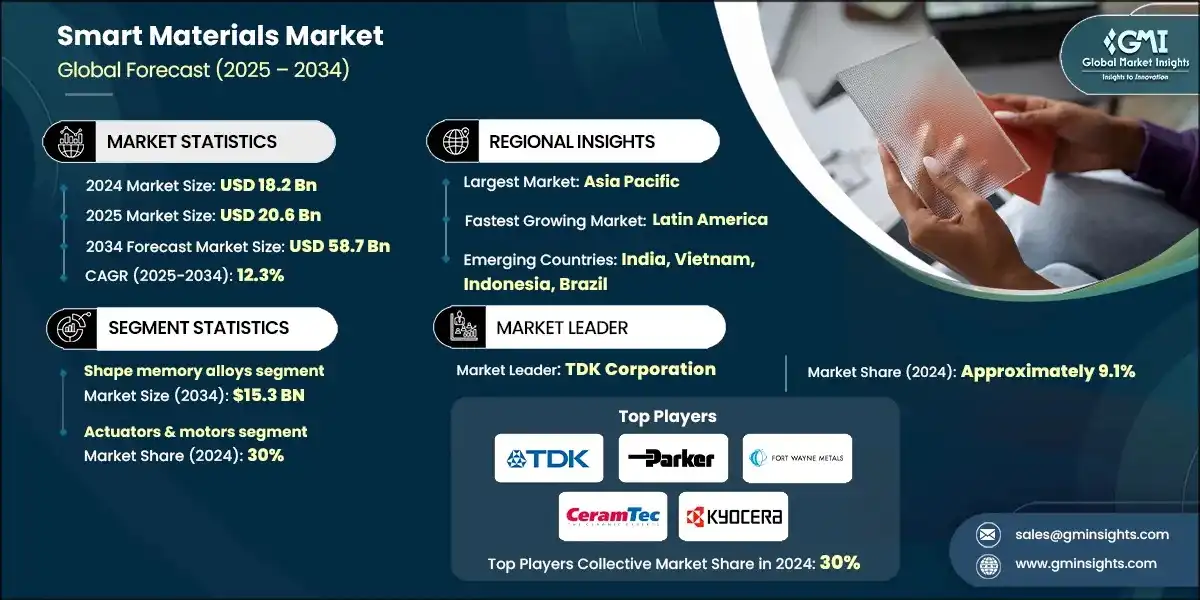
The global smart materials market was estimated at USD 18.2 billion in 2024 and is set to expand from USD 20.6 billion in 2025 to USD 58.7 billion by 2034, reflecting a 12.3% CAGR over 2025–2034 according to latest report published by Global Market Insights Inc. Smart materials increasingly ride alongside connected sensors, edge AI, and predictive maintenance to enable self-diagnosing infrastructure and assets (e.g., piezo-based SHM, wireless sensor power from harvesters).
Smart Materials Market Key Takeaways
Market Size & Growth
- 2024 Market Size: USD 18.2 Billion
- 2025 Market Size: USD 20.6 Billion
- 2034 Forecast Market Size: USD 58.7 Billion
- CAGR (2025–2034): 12.3%
Regional Dominance
- Largest Market: Asia Pacific
- Fastest Growing Region: Latin America
Key Market Drivers
- Automotive & Electronics Integration.
- Biocompatible Materials in Healthcare.
- Energy Efficiency in Infrastructure.
Challenges
- Cost Barriers from Rare-Earth Dependence.
- Regulatory and Qualification Hurdles.
Opportunity
- Self-Powered IoT Devices.
- Advanced Thermal Management Solutions.
Key Players
- Market Leader: TDK Corporation led with over 9.1% market share in 2024.
- Leading Players: Top 5 players in this market include TDK Corporation, Parker Hannifin Corporation, Fort Wayne Metals, CeramTec GmbH, KYOCERA Corporation, which collectively held a market share of 30% in 2024.
Get Market Insights & Growth Opportunities
Smart materials are developed to respond in a predictable manner when reacting to a stimulus (stress, temperature, electric or magnetic fields), which facilitates sensing, actuation, energy storage, color change/transformation, and even self-repair functionalities in products and structures. We see in the industry, from data surrounding regulatory efforts like the EU’s RoHS, that we are entering a multi-faceted era of innovation for lead-free ceramics and similar solutions based on applied mechanics, while government programs focused on mobility (for electricity) and the grid, are expanding the addressable use cases for smart materials in energy and transportation.
The market of smart materials is shifting from niche deployment to more mainstream roles in vehicle, factory building, and aerospace system infrastructure. The increased relevance of the smart materials market is based on three legs: regulation (limited lead materials and sustainability initiatives), electrification/digitization (EVs, grid upgrades, IoT/AI), and manufacturing innovations (thin films, nanostructures, 4D printing). Europe’s RoHS policy continues to encourage the development and adoption of lead-free piezoelectric materials, while the influx of funding (from government sources in the United States) across grid-resiliency and smart infrastructure projects, leads to infrastructure upgrades that rely on advanced materials for sensing, actuation, or thermal management elements.
Looking at product families clarifies where value concentrates. Shape memory alloys (SMAs) dominate high-value medical devices and emerging morphing aerostructures, and industry analyses consistently place NiTi at the center of growth due to superior biocompatibility and fatigue performance in stents, guidewires, and implants. Piezoelectric materials sustain large, diversified demand from actuators, sensors, ultrasound, and energy harvesters, with Asia Pacific contributing a substantial market share through electronics manufacturing and automotive applications. Magnetostrictive materials hold critical niches in precision positioning and vibration control, particularly in industrial and defense systems where reliability at scale matters.
Thermal management and energy storage markets continue to pull in phase change materials (PCMs), spanning green buildings, data centers, EV battery packs, and consumer devices. Composite PCMs (cPCMs) combining paraffins with graphite foams or CNTs sharply raise thermal conductivity and cycling stability, making them suitable for high-power electronics and battery thermal management. On the processing front, additive manufacturing and engineered microstructures are delivering step-changes in strength-to-weight and delamination resistance, as seen in MIT’s “nanostitching” for composites, pointing to durable, lighter components across the value chain.
Aerospace and defense validate many frontiers use cases that later trickle into other sectors. NASA’s spanwise adaptive wing project shows SMA-based actuation can replace heavier hydraulic systems, enable large wing folds and point to weight and efficiency gains in future airframes. Meanwhile, structural-health-monitoring (SHM) solutions using piezoelectric networks are maturing, with embedded sensors and guided-wave methods extending from aircraft to wind turbines, bridges, and industrial assets.
To get key market trends
Smart Materials Market Trends
- Environmental policies (RoHS) and hospital safety standards are accelerating the shift to lead-free piezoceramics and biocompatible alloys; research has demonstrated record piezoelectric responses in lead-free thin films and continued medical use of Nitinol in minimally invasive devices.
- 4D printing, nano structuring, and hybrid composites are combining sensing, actuation, damping, and thermal regulation in lighter systems for aerospace, vehicles, and consumer devices.
- Environmental sustainability and regulatory compliance keep reshaping materials selection. RoHS restrictions on hazardous substances in electronics have pushed suppliers to innovate lead-free piezoceramics and recyclable polymer systems, which is why we now see record performance in lead-free piezo thin films and a steady increase in investment toward non-toxic alternatives across sensors and actuators.
- Nanostructured interfaces and architectures like “nano stitches” are lifting interlaminar toughness and crack resistance by more than half, which changes design envelopes for thin-ply laminates in aerospace and high-performance vehicles. Combine that with 4D printing methods that embed time/temperature-dependent changes in shape or stiffness, and you get structures that can morph and adapt without heavy mechanical subsystems especially relevant for weight-critical platforms.
- Breaking it down by segment, SMAs are not just for medical stents anymore. NASA’s spanwise adaptive wing actuation shows how NiTi-based tubes can deliver large torque in compact footprints, displacing hydraulic actuators and potentially trimming mass while boosting control authority across flight regimes. On a similar timeline, energy harvesting for IoT via piezoelectric or triboelectric approaches is moving from pilots to embedded deployments, particularly in locations where maintenance access is limited and battery swaps are costly.
- Thermal management remains a high-impact theme as composite PCMs with graphite or CNT scaffolds resolve the low-conductivity handicap that limited first-generation paraffins, and they’re now viable for steady-state smoothing of temperature spikes in EV packs and power electronics. Expect to see long-term contracts between electronics OEMs and specialty materials suppliers as designs lock in around standardized form factors and thermal performance specs.
Smart Materials Market Analysis

Learn more about the key segments shaping this market
Based on product type, the smart materials industry is divided into shape memory alloys, piezoelectric materials, magnetostrictive materials, electroactive polymers, phase change materials, electrochromic materials, self-healing materials. Shape memory alloys segment generated a revenue of USD 5 billion in 2024 and is forecasted to reach USD 15.3 billion in 2034 at a CAGR of 11.7%.
- Shape Memory Alloys (SMAs) continue to command premium market share given their proven role in minimally invasive medical devices and the emerging adoption in morphing aerostructures. The data indicate NiTi-based products dominate SMA revenue because of biocompatibility, super elasticity, and fatigue life that suits stents and guidewires, while aerospace and robotics expand the addressable market with compact, high-energy-density actuation. Looking at growth mechanics, SMA demand scales with surgical volumes and catheter-based therapies, and it correlates with the maturity of additive manufacturing and finishing processes for precision components.
- Piezoelectric materials form the sector’s second anchor, with ceramics powering actuators, ultrasound, and precision motion in manufacturing and consumer devices. Magnetostrictive materials retain leadership where ruggedness, nanometer positioning, and high-force response outweigh cost thin film deposition systems, precision machining, and industrial sonar being telling examples. Electroactive polymers and electrochromic materials are growing off smaller bases; their appeal lies in flexibility, surface integration, and energy efficiency for haptics and adaptive glazing, respectively.
- Phase Change Materials (PCMs) are the understory that’s becoming a canopy, especially as thermal loads rise across EV packs, data center racks, and compact consumer enclosures. Composite PCMs that embed graphite or CNT networks elevate conductivity by multiples and maintain latent heat capacity, which allows designers to cap peak temperatures and reduce active cooling duty cycles. Better battery health, fewer thermal throttling events, and more consistent performance under variable load profiles.
Learn more about the key segments shaping this market
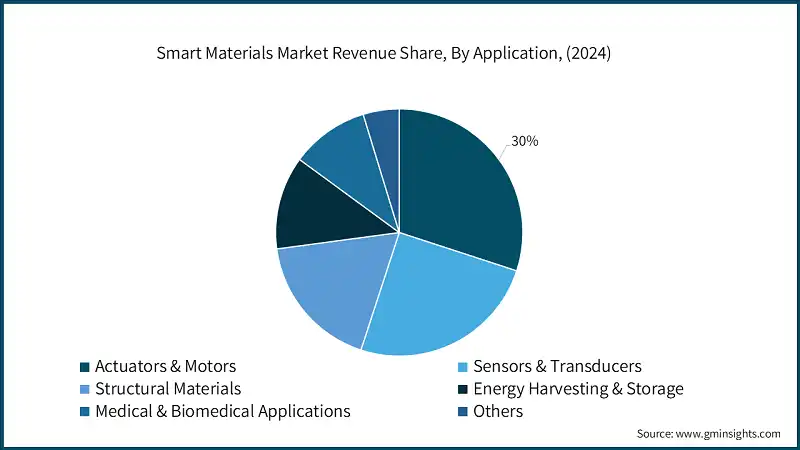
Based on application, the smart materials market is divided into actuators & motors, sensors & transducers, structural materials, energy harvesting & storage, medical & biomedical applications, others. In 2024, actuators & motors segment held major market share, accounted for 30% share.
- Actuators and motors represent the largest use case cluster for smart materials because they convert compact footprints into precise mechanical work. The real driver here is the need for high-frequency, low-hysteresis motion in robotics, optics, and automotive subsystems, where piezo stacks or SMAs outclass electromagnetic systems on size-to-force in specific niches.
- Sensors and transducers follow closely; embedded piezo networks enable condition monitoring and closed-loop control across turbines, presses, and aircraft structures to reduce downtime and extend asset life.
- Energy harvesting and storage is rising, too, with piezo/tribo harvesters and PCMs enabling self-powered sensors and thermal buffers in constrained spaces where maintenance is expensive. Medical and biomedical applications provide the highest value density per unit, with materials enabling less invasive procedures, embedded sensing, and long service lifetimes inside the body.
Looking for region specific data?
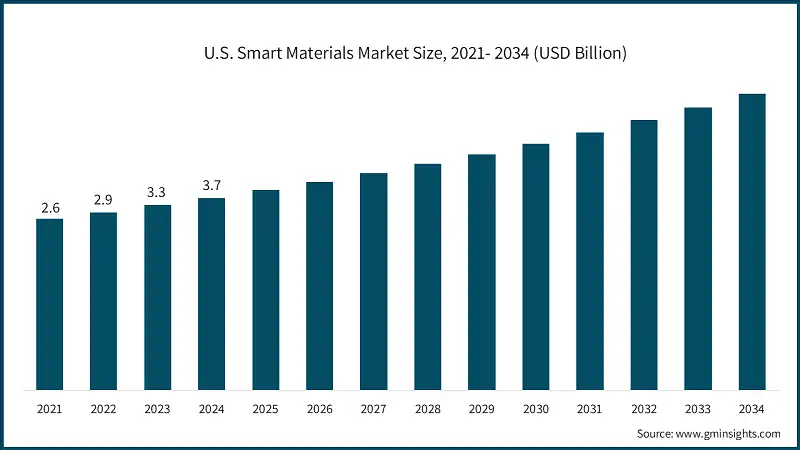
- The U.S. smart materials market generated a revenue of USD 3.7 billion in 2024. The U.S. market is projected to grow at a CAGR of 12.2% reaching USD 11.7 billion by 2034. North America market growth is anchored by aerospace, defense, and medical devices, paired with substantial grid modernization programs that prioritize resilience and smart infrastructure upgrades.
- Europe smart materials industry generated a revenue of USD 3.9 billion in 2024. Europe market is projected to grow at a CAGR of 11.9% reaching USD 12.2 billion by 2034. Europe market dynamics reflect strict environmental regulation and deep automotive and industrial supplier bases. The EU’s RoHS framework keeps up pressure on lead-free ceramic innovation, while aerospace clusters in Germany, France, and the UK advance adaptive structures and SHM adoption in airframes.
- Germany’s automotive tier suppliers integrate piezo, EAPs, and PCMs into vehicle comfort, safety, and battery systems, while France’s aerospace primes and UK research programs push morphing wings and composite durability for efficiency gains. Italy and Spain add consumer electronics and industrial demand that broadens base-load volumes for sensors, actuators, and thermal solutions.
- Asia Pacific smart materials market generated a revenue of USD 8.3 billion in 2024. Asia Pacific market is projected to grow at a CAGR of 12.6% reaching USD 27.3 billion by 2034. Asia Pacific market leadership comes from concentrated electronics and automotive manufacturing, vertically integrated supply chains, and policy incentives for advanced materials and smart manufacturing. The China market gains from domestic electronics and EV scale, while the India smart materials industry expands with electronics, aerospace, and advanced materials research centers that feed new applications.
- Japan’s and South Korea’s component ecosystems piezo ceramics, sensors, and battery materials continue to seed global exports and joint innovation programs with Western OEMs. The region’s manufacturing density means faster iteration cycles, letting suppliers co-develop with customers and lock in sockets sooner than in other regions.
- Latin America is at the beginning but quickly developing stage in the uptake of smart materials, and BR and MX are leading the way with respective government programs to bolster innovation ecosystems featuring bio-based & adaptive materials. BR universities and public research organizations are making headway with smart polymers for biomedical applications and agriculture applications with respect to tropical or humid climate conditions. The automotive manufacturing sector in MX is gradually adopting smart materials that also happen to be lightweight in some part due to trade relationships with North American OEMs who are willing to help with the technology transfer opportunities. The urban development plans of Colombia and Chile are also incorporating elements of smart infrastructure, including buildings and bridges with smart sensors to monitor various urban infrastructure systems.
- MEA has some unique growth opportunities that are generating some excitement around energy and infrastructure investment along new large-scale projects, mainly in the GCC countries. The UAE and Saudi Arabia have already started pilot testing smart construction materials aligned with the Vision 2030 infrastructure targets - for example, use of smart shape memory concretes and adaptive insulation technologies for use in high-rise buildings.
Smart Materials Market Share
Top-tier players collectively control a modest share of the smart materials industry, pointing to fragmentation and room for consolidation. TDK stands out with a broad portfolio spanning piezoelectric materials, magnetic materials, and sensor systems that slot directly into automotive and IoT applications. The numbers tell us this scale supports sustained R&D and global service infrastructure, which in turn helps win sockets in fast-moving electronics categories.
Market concentration remains moderate. The combined market share of the top five suppliers sits near one-third, with regional specialists in ceramics, alloys, and functional polymers accounting for the remainder. Technology integration is the differentiator. Companies that can pair materials science with electronics, simulation, and application engineering tend to capture more value than commodity suppliers.
The mergers and acquisitions activity in the last 24 months has reflected some strategic moves to secure valuable capabilities and capacity. Fort Wayne Metals has already doubled its Nitinol melt output from 2022 levels to 2024 and is projected to double again to 1,000,000 pounds in 2025, showing the growth in medical and interventional device demand for super elastic alloys. Resonetics completed the acquisitions of Memory and SAES Smart Materials (medical Nitinol) in late 2023 to vertically integrate nitinol conversion and component manufacturing. Likewise, BASF, Covestro, and Dow further developed their advanced polymer and coating positions aligned to EVs and power electronics, including custom e-mobility materials and carbonate solvents for Li-ion electrolytes.
Competitive strategies revolve around three patterns. First, vertical integration to de-risk supply and guarantee quality, a theme visible in NiTi and in high-spec ceramics. Second, co-development partnerships with OEMs that compress design designs and increase switching costs; examples include e-mobility collaborations and adaptive structure pilots in aerospace. Third, regional capacity adds near end-customers to handle qualification, logistics, and after-sales support especially important for automotive and medical devices where validation is lengthy and localized.
Smart Materials Market Companies
Major players operating in the smart materials industry are:
- APC International, Ltd.
- Arkema S.A.
- ATI Inc.
- BASF SE
- CeramTec GmbH
- Covestro AG
- Dow
- Dynalloy, Inc.
- Fort Wayne Metals
- G.RAU GmbH & Co. KG
- Johnson Matthey
- KYOCERA Corporation
- LORD Corporation
- Metalwerks PMD, Inc.
- NOLIAC AS
- Parker Hannifin Corporation
- Piezo Kinetics, Inc.
- SAES Getters S.p.A.
- Smart Material GmbH
- TDK Corporation
TDK Corporation: TDK Corporation makes it possible to design for the automotive and Internet of Things (IoT) industries, TDK exemplifies the global reach of the automotive industry and sustained research and development in piezoelectric, magnetic, and sensing technologies. After pivoting its business focus and divesting the U.S. medical Nitinol operations in 2023, SAES Getters is growing the industrial shape memory alloy materials and new functional materials in zeolites and microcapsules.
Johnson Matthey: Johnson Matthey continues to strengthen and advance materials in its Medical Device Components division. They still have surface engineering and specialty materials for automotive and healthcare, while also expanding advanced materials. As a leading European supplier of advanced ceramics, CeramTec GmbH is also a supplier of piezoelectric and high-performance ceramics for the automotive and industrial and medical markets. They have also recently advanced their capacity for innovative product development around lead-free piezo ceramics.
KYOCERA Corporation: KYOCERA Corporation utilizes advanced ceramics for sensors and electronic components globally and is strong in Asia supporting exports for automotive and consumer electronics. Parker Hannifin includes thermal interface materials and EMI shielding in their motion and control technology and cooling for EV batteries and electronics. BASF SE works with electroactive polymers and other thermal materials and specialized coatings with power electronics and e-mobility.
Covestro AG: Covestro AG provides high-performance automotive and electronics grade plastic systems which support thermal management and connected smart products. This is part of their circularity and digitalization strategy. Dow invests in battery-related carbonate solvents and functional polymers which enable Li-ion electrolytes and portable high-performance façade systems. This underlies energy storage and energy efficient building applications. Arkema S.A. provides specialty polymers and electrochromic materials for smart building applications and automotive glazing.
APC International: APC International provides piezoceramic elements for medical and industrial ultrasound devices, actuators, and sensors. For aerospace and defense, and smart-material-compatible metallurgy, ATI Inc. supplies specialty alloys. For robotics, aerospace, and automation, Dynalloy and Smart Material GmbH develop SMA actuation solutions. Fort Wayne Metals provides Nitinol melting and precision wire for medical devices and aims to increase the annual melted Nitinol volume to one million pounds.
Smart Materials Market Report Attributes
| Key Takeaway | Details |
|---|---|
| Market Size & Growth | |
| Base Year | 2024 |
| Market Size in 2024 | USD 18.2 Billion |
| Market Size in 2025 | USD 20.6 Billion |
| Forecast Period 2025 - 2034 CAGR | 12.3% |
| Market Size in 2034 | USD 58.7 Billion |
| Key Market Trends | |
| Drivers | Impact |
| Automotive & Electronics Integration | Automotive and consumer electronics sectors are increasingly adopting piezoelectric, SMA, and magnetostrictive materials for volume platforms. |
| Biocompatible Materials in Healthcare | Growing need for materials like Nitinol in minimally invasive devices and implants. |
| Energy Efficiency in Infrastructure | Surge in grid modernization and green building construction driving adoption of thermal and sensing smart materials. |
| Pitfalls & Challenges | Impact |
| Cost Barriers from Rare-Earth Dependence | Some smart materials rely on rare-earth elements and advanced manufacturing processes, inflating costs. |
| Regulatory and Qualification Hurdles | Complex and long product qualification cycles in aerospace, medical, and defense sectors. |
| Opportunities: | Impact |
| Self-Powered IoT Devices | Piezoelectric and triboelectric energy harvesters enable battery-free sensors for smart applications. |
| Advanced Thermal Management Solutions | Use of phase change materials (PCMs) in EVs and power electronics for better thermal regulation. |
| Market Leaders (2024) | |
| Market Leaders |
Approximately 9.1% market share in 2024 |
| Top Players |
Collectively 30% market share in 2024 |
| Competitive Edge |
|
| Regional Insights | |
| Largest Market | Asia Pacific |
| Fastest growing market | Latin America |
| Emerging countries | India, Vietnam, Indonesia, Brazil |
| Future outlook |
|
What are the growth opportunities in this market?
Smart Materials Industry News
- In Mar 2025, TDK during the FY2025 performance briefing, stated the company’s focus on materials-enabled, edge AI, and sensor solutions driven products.
- In Jan 2025, integration of medical device components, Johnson Matthey advanced materials focus sharpening post-transaction integration for its divested advanced materials.
- In Nov 2024, CeramTec launched lead-free piezo products to meet RoHS compliance, for use in European automotive sensors.
- In September 2024, Kyocera increased piezoelectric production at its Asian facilities in response to consumer electronics and automotive industry demand.
- In August 2024, Parker Hannifin introduced new SMA-influenced actuator and thermal management solutions for aerospace and EV applications through its Chomerics and Motion divisions.
- In July 2024, BASF expanded its program for electroactive polymers and materials for automotive interior to include power electronics and batteries, showcasing this at industry events in North America.
The smart materials market research report includes in-depth coverage of the industry, with estimates & forecast in terms of revenue (USD Billion) & volume (Tons) from 2021 to 2034, for the following segments:
Market, By Product Type
- Shape memory alloys
- Nickel-titanium alloys
- Copper-based alloys
- Iron-based alloys
- Piezoelectric materials
- Lead-based ceramics
- Lead-free ceramics
- Piezoelectric polymers
- Single crystal piezoelectrics
- Magnetostrictive materials
- Terfenol-d materials
- Galfenol materials
- Amorphous magnetostrictive materials
- Electroactive polymers
- Dielectric eaps
- Ionic eaps
- Ferroelectric polymers
- Phase change materials
- Organic pcms
- Inorganic pcms
- Eutectic pcms
- Electrochromic materials
- Inorganic electrochromics
- Organic electrochromics
- Hybrid systems
- Self-healing materials
- Intrinsic self-healing systems
- Extrinsic self-healing systems
Market, By Application
- Actuators & motors
- Linear actuators
- Rotary actuators
- Microactuators & mems
- Sensors & transducers
- Strain & stress sensors
- Temperature sensors
- Chemical sensors
- Pressure sensors
- Structural materials
- Adaptive structures
- Vibration damping systems
- Load-bearing smart components
- Energy harvesting & storage
- Vibration energy harvesting
- Thermal energy harvesting
- Solar energy enhancement
- Medical & biomedical applications
- Implantable devices
- Drug delivery systems
- Diagnostic equipment
- Others
Market, By End Use Industry
- Healthcare & medical devices
- Aerospace & defense
- Military applications
- Commercial aviation
- Space applications
- Automotive industry
- Comfort & convenience systems
- Safety applications
- Performance enhancement
- Electric vehicle integration
- Consumer electronics
- Wearable devices
- Mobile devices
- Home appliances
- Industrial manufacturing
- Process control applications
- Automation systems
- Quality control & monitoring
- Energy & utilities
- Smart grid applications
- Renewable energy systems
- Energy storage solutions
The above information is provided for the following regions and countries:
- North America
- U.S.
- Canada
- Europe
- Germany
- UK
- France
- Spain
- Italy
- Rest of Europe
- Asia Pacific
- China
- India
- Japan
- Australia
- South Korea
- Rest of Asia Pacific
- Latin America
- Brazil
- Mexico
- Argentina
- Rest of Latin America
- Middle East and Africa
- Saudi Arabia
- South Africa
- UAE
- Rest of Middle East and Africa
Frequently Asked Question(FAQ) :
What is the market size of the smart materials industry in 2024?
The smart materials market was valued at USD 18.2 billion in 2024, growing due to increasing integration in automotive and electronics applications.
What is the current smart materials market size in 2025?
The market size is projected to reach USD 20.6 billion in 2025.
What is the projected value of the smart materials market by 2034?
The smart materials market is expected to reach USD 58.7 billion by 2034, driven by rising adoption across EVs, smart infrastructure, and medical devices.
How much revenue did the shape memory alloys segment generate in 2024?
The shape memory alloys segment generated USD 5 billion in 2024, maintaining leadership in medical devices and morphing aerostructures.
What was the market share of actuators & motors application segment in 2024?
Actuators and motors accounted for 30% market share in 2024, supported by high demand for compact and precise motion control in robotics, optics, and automotive systems.
What is the growth outlook for phase change materials from 2025 to 2034?
Phase change materials are projected to grow robustly through 2034, driven by increasing use in EV battery packs, data centers, and building energy systems for advanced thermal management.
Which region leads the smart materials market?
Asia Pacific led the smart materials market with USD 8.3 billion in 2024, supported by strong electronics and automotive manufacturing ecosystems and policy incentives for advanced materials.
What is the U.S. smart materials market size and growth outlook?
The U.S. market generated USD 3.7 billion in 2024 and is projected to reach USD 11.7 billion by 2034. Growth is driven by aerospace, defense, and medical devices, along with large-scale grid modernization and smart infrastructure initiatives.
What are the key trends shaping the smart materials industry?
Major trends include lead-free piezoelectric innovation, nanostructured composites, 4D printing, and increased deployment in adaptive structures, EVs, and biomedical devices.
Who are the key players in the smart materials market?
Key players include TDK Corporation, Parker Hannifin Corporation, Fort Wayne Metals, CeramTec GmbH, and KYOCERA Corporation, collectively accounting for about 30% market share in 2024.
Smart Materials Market Scope
Related Reports