Summary
Table of Content

Smart Hospital Beds Market
Get a free sample of this report
Form submitted successfully!
Error submitting form. Please try again.
Thank you!
Your inquiry has been received. Our team will reach out to you with the required details via email. To ensure that you don't miss their response, kindly remember to check your spam folder as well!
Request Sectional Data
Thank you!
Your inquiry has been received. Our team will reach out to you with the required details via email. To ensure that you don't miss their response, kindly remember to check your spam folder as well!
Form submitted successfully!
Error submitting form. Please try again.
Smart Hospital Beds Market Size
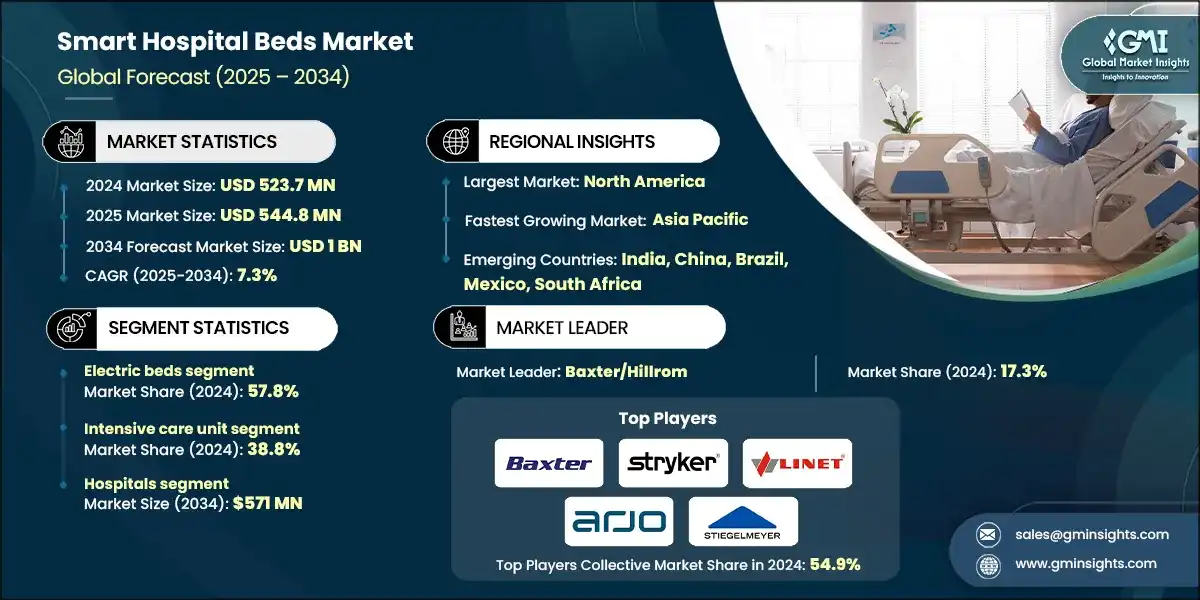
The global smart hospital beds market was valued at USD 523.7 million in 2024. The market is expected to reach from USD 544.8 million in 2025 to USD 1 billion in 2034, growing at a CAGR of 7.3% during the forecast period, according to the latest report published by Global Market Insights Inc. Increasing demand for patient-centered care, integration of IoT and AI technologies, and growing hospital automation drive smart hospital bed adoption.
Smart Hospital Beds Market Key Takeaways
Market Size & Growth
- 2024 Market Size: USD 523.7 Million
- 2025 Market Size: USD 544.8 Million
- 2034 Forecast Market Size: USD 1 Billion
- CAGR (2025–2034): 7.3%
Regional Dominance
- Largest Market: North America
- Fastest Growing Region: Asia Pacific
Key Market Drivers
- Rising geriatric population and chronic disease burden.
- Integration of IoT and AI in hospital infrastructure.
- Growing focus on patient safety and care efficiency.
- Expansion of home healthcare and telehealth services.
Challenges
- High initial procurement and maintenance costs.
- Interoperability and integration challenges.
Opportunity
- Emergence of wireless and cloud-connected smart beds.
- AI-powered predictive patient monitoring.
Key Players
- Market Leader: Baxter/Hillrom led with over 17.3% market share in 2024.
- Leading Players: Top 5 players in this market include Baxter/Hillrom, Stryker, LINET, Arjo, Stiegelmeyer, which collectively held a market share of 54.9% in 2024.
Get Market Insights & Growth Opportunities
The global smart hospital beds market offers hospitals, ambulatory surgical centres, and healthcare providers with an advanced solution that combines connectivity, automation, and patient monitoring devices. These beds improve clinical efficiency and optimize workflow by ensuring enhanced patient safety with IoT-enabled monitoring, automatic positioning, and transmitting real-time data. Key players in the market include Baxter/Hillrom, Stryker, LINET, Arjo, and Stiegelmeyer. These companies maintain a competitive edge through continuous technological innovation, strategic collaborations, global expansion, and substantial R&D investments aimed at meeting the burgeoning demand for connected healthcare solutions and consolidating their position in the emerging smart hospital infrastructure landscape.
The market has increased from USD 467 million in 2021 and reached USD 501.5 million in 2023. The growth of the smart hospital beds market is primarily driven by the increasing global focus on improving healthcare infrastructure, patient safety, and clinical efficiency. As healthcare systems shift toward value-based care models, hospitals and long-term care facilities are prioritizing technologies that reduce manual workload, enhance patient monitoring, and enable early detection of health deterioration. The rising prevalence of chronic illnesses, the aging global population, and the increasing number of patients requiring long-term or intensive care are further driving the demand for advanced hospital bed systems equipped with sensors and connectivity features.
Technological advancements such as Internet of Medical Things (IoMT) integration, cloud-based data analytics, and AI-powered patient monitoring are enabling healthcare professionals to make data-driven decisions and improve treatment accuracy. Moreover, the growing trend of hospital digitalization and smart healthcare ecosystems is boosting the adoption of automated and remote-controlled beds that support interoperability with hospital information system (HIS).
Government initiatives promoting healthcare modernization and smart hospital infrastructure, especially in emerging economies, are also fueling market growth. Additionally, rising healthcare expenditure, increasing awareness of infection control, and the need for improved ergonomics and comfort for both patients and caregivers are encouraging hospitals to upgrade traditional beds to intelligent, connected alternatives. The expanding adoption of smart beds in home healthcare settings driven by the rise in remote patient management and telehealth services further supports market expansion, making smart hospital beds an integral component of the modern digital healthcare environment.
Smart hospital beds are technologically advanced medical beds equipped with sensors, connectivity, and automation features that enable real-time patient monitoring, remote adjustments, and data integration with hospital systems. They enhance patient safety, comfort, and clinical efficiency by supporting functions like automatic positioning, fall detection, and vital sign tracking.
To get key market trends
Smart Hospital Beds Market Trends
The rising geriatric population and increasing prevalence of chronic diseases are key drivers propelling the growth of the smart hospital beds industry. Globally, the proportion of individuals aged 65 and above is rapidly increasing, leading to a higher incidence of age-related conditions such as cardiovascular diseases, diabetes, respiratory disorders, and mobility impairments.
- Elderly patients often require continuous monitoring, frequent repositioning to prevent pressure ulcers, and enhanced safety measures to reduce fall risks. Smart hospital beds equipped with advanced sensors, automated repositioning, and remote monitoring capabilities directly address these needs, improving patient outcomes and operational efficiency.
- Technological advancements have further strengthened this driver. Modern smart beds incorporate IoT connectivity, AI algorithms, and predictive analytics to monitor vital signs, detect early deterioration, and provide real-time alerts to healthcare providers.
- Integration with hospital information systems enhances care coordination, while features such as weight sensing, automated bed adjustments, and fall-prevention mechanisms reduce the workload on nursing staff and minimize complications for high-risk patients. The convergence of telehealth platforms with smart bed technology also enables remote patient monitoring, particularly beneficial for chronic disease management.
- From a macroeconomic perspective, rising healthcare expenditure, government initiatives to improve geriatric care, and expanding insurance coverage are fueling the adoption of advanced hospital infrastructure.
- At the microeconomic level, hospitals and long-term care facilities are investing in smart beds to optimize staff utilization, reduce hospital-acquired complications, and enhance patient satisfaction key performance indicators in value-based care models. Additionally, the growing emphasis on patient-centric care and hospital accreditation standards further incentivizes adoption.
- In summary, the combination of demographic shifts, chronic disease prevalence, technological innovation, and supportive economic policies positions the market for sustained growth, highlighting the critical role of intelligent solutions in modern healthcare delivery.
Smart Hospital Beds Market Analysis

Learn more about the key segments shaping this market
The global market was valued at USD 467 million in 2021. The market size reached USD 501.5 million in 2023, from USD 482.7 million in 2022.
Based on the product type, the smart hospital beds market is segmented into electric beds, semi-electric beds, and wireless beds. The electric beds segment has asserted its dominance in the market by securing a significant market share of 57.8% in 2024, this is attributed to the enhanced automation and motorized adjustments which improve patient comfort, reduce caregiver strain, and support critical care efficiency in hospitals. The segment is expected to exceed USD 576.1 million by 2034, growing at a CAGR of 7% during the forecast period.
On the other hand, the semi-electric beds segment is expected to grow with a CAGR of 7.2%. The growth of this segment can be attributed to the combination of manual and powered controls which offers affordability, flexibility, and moderate automation, catering to general wards and smaller healthcare facilities.
- The primary drivers for this segment include the growing demand for patient comfort, ease of use, and automation in clinical settings. Hospitals and long-term care facilities increasingly prefer fully electric beds because they allow caregivers to adjust bed height, head, and foot positions with minimal physical effort, reducing the risk of musculoskeletal injuries among staff.
- Integration with IoT platforms and patient monitoring systems enables real-time tracking of patient vitals and movement, supporting proactive care and enhancing patient safety.
- Additionally, rising adoption of advanced healthcare infrastructure in developed countries and private hospitals in emerging regions contributes to the growth of electric beds.
- The semi-electric beds segment held a revenue of USD 145 million in 2024, with projections indicating a steady expansion at 7.2% CAGR from 2025 to 2034. Semi-electric beds combine manual and electric features, offering partial automation at a lower cost than fully electric beds.
- The drivers for this segment include hospitals and homecare providers focus on cost-efficiency while still providing improved patient comfort and functionality. These beds allow motorized adjustment of the head or foot sections while requiring manual control for overall height adjustments, making them attractive for mid-sized healthcare facilities with budget constraints.
- Rising outpatient care services and expansion of home healthcare solutions also drive semi-electric bed adoption, as they provide essential support without the complexity or high procurement costs of fully electric beds. Technological integration, such as basic sensors for patient monitoring and wireless connectivity, enhances their usability.
- The wireless beds segment held a revenue of USD 76.1 million in 2024, with projections indicating a steady expansion at 8.4% CAGR from 2025 to 2034. Wireless beds represent a growing segment due to the integration of IoT, AI, and remote monitoring technologies. Key drivers include the rising emphasis on patient safety, fall prevention, and seamless data connectivity within smart hospital ecosystems.
- These beds allow wireless adjustments and can transmit real-time patient metrics to nurses stations or centralized monitoring systems, enabling proactive intervention and efficient resource allocation.
- The segment benefits from the global trend toward digitization and smart hospitals, where connected devices support telehealth and remote patient management. Additionally, the rise in home healthcare and aging-in-place initiatives encourages adoption of wireless beds in residential care and home settings.
Based on application, the smart hospital beds market is classified into intensive care unit, med-surg (general wards), long term care, and other applications. The intensive care unit segment dominated the market with a revenue share of 38.8% in 2024 and is expected to reach USD 408 million within the forecast period.
- The ICU segment dominates due to the critical need for continuous patient monitoring and rapid intervention. Smart beds in ICUs offer integrated sensors that track vital signs, detect patient movement, and prevent bedsores, significantly enhancing patient safety.
- The rising prevalence of critical illnesses, post-surgical care requirements, and increasing ICU admissions globally drive demand. Technological advancements such as IoT-enabled connectivity and AI-based predictive analytics allow healthcare staff to remotely monitor patients, optimize treatment, and reduce response times.
- Moreover, hospitals aim to improve operational efficiency and reduce nurse workload, which smart beds facilitate through automated alerts and repositioning features.
- The med-surg (general wards) segment held a revenue of USD 159.4 million in 2024, with projections indicating a steady expansion at 8% CAGR from 2025 to 2034. In general wards, smart beds help optimize patient turnover and improve comfort for non-critical patients. They provide automated alerts for patient mobility, fall prevention, and early detection of health deterioration.
- Growing hospital admissions, particularly among chronic disease patients, and increasing focus on reducing hospital-acquired complications drive demand. Technological integration with electronic health records (EHR) and nurse call systems improves workflow efficiency.
- Rising awareness among healthcare providers about enhancing patient experience and reducing staff fatigue further accelerates adoption.
- The long term care segment held a revenue of USD 96.3 million in 2024, with projections indicating a steady expansion at 6.4% CAGR from 2025 to 2034. Long-term care facilities face rising demand due to the aging population and increasing prevalence of chronic diseases. Smart beds improve patient comfort, support assisted mobility, and reduce the risk of falls and pressure ulcers.
- Features such as automated repositioning and remote monitoring enable caregivers to manage multiple patients efficiently, addressing staff shortages. Integration with telehealth systems allows continuous monitoring of elderly patients at home or in nursing facilities.
- Economic incentives and government policies supporting senior care infrastructure boost adoption.
Learn more about the key segments shaping this market
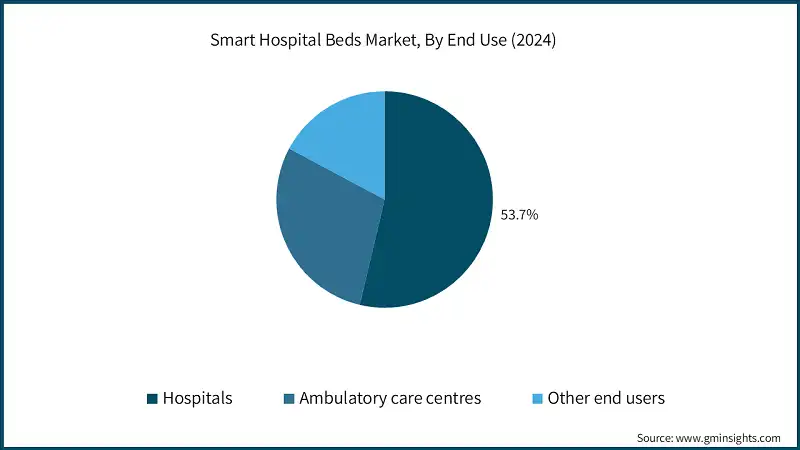
Based on end use, the smart hospital beds market is classified into hospitals, ambulatory care centres, and other end users. The hospitals segment dominated the market with a revenue share of 53.7% in 2024 and is expected to reach USD 571 million within the forecast period.
- The two largest segments account for over 82.8% of the total market value. Hospitals are the primary end users of smart hospital beds due to the high volume of patients requiring continuous monitoring and specialized care. The rising geriatric population and increasing prevalence of chronic diseases like cardiovascular disorders, diabetes, and respiratory illnesses drive the demand for technologically advanced beds that improve patient safety and comfort.
- Hospitals focus on reducing nurse workload and improving operational efficiency, making IoT-enabled and AI-integrated beds crucial for real-time patient monitoring, automated alerts, and fall prevention.
- The integration of electronic health records (EHR) with smart beds facilitates streamlined care, enabling better data-driven clinical decisions. Macro and microeconomic factors, such as increasing healthcare expenditure, government initiatives promoting digital health infrastructure, and the availability of reimbursement policies for advanced medical equipment, further propel market growth.
- The ambulatory care centres segment held a revenue of USD 152.4 million in 2024, with projections indicating a steady expansion at 6.9% CAGR from 2025 to 2034. Ambulatory care centres, including outpatient clinics and day-care facilities, are increasingly adopting smart beds to improve patient throughput and care quality.
- Drivers include the rising demand for minimally invasive procedures, enhanced patient comfort, and the need for beds that support rapid patient turnover without compromising safety.
- Integration of IoT and AI allows staff to remotely monitor vital signs, manage patient positioning, and optimize workflow efficiency.
Looking for region specific data?
North America Smart Hospital Beds Market
North America dominated the global smart hospital beds industry with the highest market share of 35.3% in 2024.
- North America dominates the global market, primarily driven by a highly developed healthcare infrastructure and increasing adoption of advanced medical technologies. The region has a growing geriatric population with a high prevalence of chronic diseases, such as cardiovascular disorders, diabetes, and respiratory illnesses, necessitating continuous monitoring and patient-centered care.
- Hospitals and long-term care facilities are increasingly investing in IoT-enabled, AI-integrated beds that improve patient safety, reduce the risk of falls, and enhance clinical workflow efficiency.
- Government initiatives and favorable reimbursement policies supporting the adoption of digital healthcare technologies further accelerate market growth. Technological advancements, including wireless monitoring, cloud-based connectivity, and predictive analytics for patient condition management, have strengthened market penetration.
- Additionally, the growing emphasis on patient comfort, shorter hospital stays, and reduction of hospital-acquired complications, such as pressure ulcers, motivates healthcare providers to integrate smart beds.
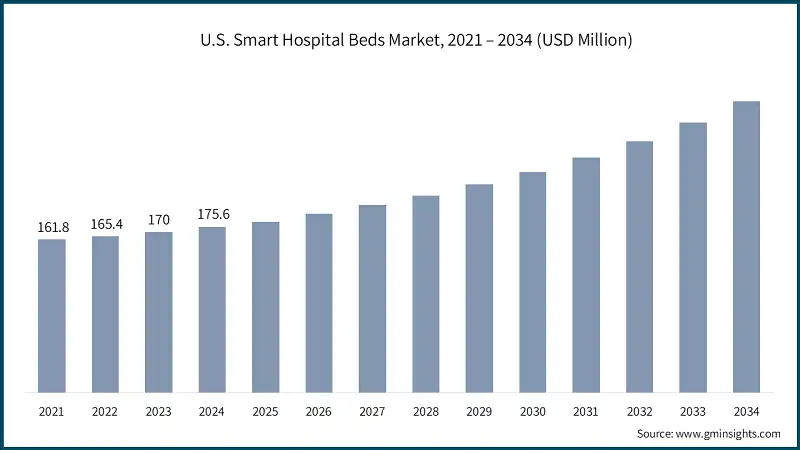
The U.S. smart hospital beds market was valued at USD 161.8 million and USD 165.4 million in 2021 and 2022, respectively. In 2024, the market size grew to USD 175.6 million from USD 170 million in 2023.
- The U.S. is the largest contributor to North America’s market, fueled by advanced healthcare infrastructure, high healthcare spending, and technological innovation.
- A significant driver is the aging population, with increasing incidences of chronic and lifestyle-related diseases demanding continuous patient monitoring and high-quality care.
- Hospitals are adopting smart beds integrated with IoT, AI, and electronic health records to optimize patient outcomes, automate vital sign monitoring, and prevent falls and bedsores. Government support through Medicare and Medicaid reimbursement programs encourages healthcare facilities to invest in smart medical equipment.
- The growing trend of value-based care and focus on improving patient satisfaction further drives adoption. Technological innovations, such as remote patient monitoring, pressure redistribution systems, and AI-powered predictive analytics, enhance clinical decision-making and operational efficiency.
- The rise of telehealth and home healthcare services also boosts demand for smart beds beyond hospital settings. Strong presence of major manufacturers, active R&D investments, and collaborations with healthcare providers strengthen market expansion.
Europe Smart Hospital Beds Market
Europe market accounted for USD 127.1 million in 2024 and is anticipated to show lucrative growth over the forecast period.
- The European smart hospital beds market is driven by the region’s rapidly aging population and rising prevalence of chronic diseases such as cardiovascular disorders, diabetes, and respiratory illnesses, increasing the demand for technologically advanced patient care solutions.
- Hospitals and long-term care facilities are focusing on improving patient safety, reducing nurse workload, and enhancing operational efficiency, which propels the adoption of smart beds equipped with IoT, AI, and sensor-based monitoring systems.
- Government initiatives promoting digital health infrastructure, smart hospital programs, and increased healthcare spending in countries like the UK, France, and Italy support market expansion.
- Technological advancements, including wireless bed monitoring, automated alerts, pressure-relief surfaces, and integration with electronic health records (EHR), enhance patient outcomes and streamline clinical workflows.
- Additionally, the growing emphasis on outpatient and home healthcare services in Europe encourages the adoption of portable and connected smart beds for remote patient monitoring.
Germany dominates the European smart hospital beds market showcasing strong growth potential.
- Germany, as Europe’s largest healthcare market shows strong adoption of smart hospital beds due to its well-established healthcare infrastructure and technologically advanced hospitals.
- The country’s aging population and rising chronic disease burden, including cardiovascular, orthopedic, and neurodegenerative conditions, necessitate enhanced patient monitoring, safety, and comfort. Hospitals and rehabilitation centres in Germany are increasingly investing in smart beds that integrate IoT sensors, AI-driven analytics, and automated monitoring systems to reduce nurse workload, prevent patient falls, and improve operational efficiency.
- Government initiatives promoting digital hospitals, telehealth, and smart medical device integration provide a regulatory and financial boost for market growth. The country’s high per capita healthcare expenditure and focus on patient-centered care encourage the adoption of beds with advanced features such as pressure redistribution, real-time vital monitoring, and seamless EHR connectivity.
- Additionally, Germany’s strong medical technology manufacturing base drives innovation and availability of sophisticated smart beds.
Asia Pacific Smart Hospital Beds Market
The Asia Pacific market is anticipated to grow at the highest CAGR of 8.8% during the analysis timeframe.
- The Asia Pacific smart hospital beds industry is witnessing robust growth due to a combination of demographic, technological, and economic factors. A rapidly aging population across countries like Japan, South Korea, and Australia is significantly increasing the demand for advanced hospital infrastructure that supports geriatric care and chronic disease management.
- Rising prevalence of chronic conditions such as diabetes, cardiovascular diseases, and respiratory disorders further fuels the need for smart beds equipped with IoT-enabled monitoring, fall prevention systems, and pressure redistribution technology.
- Increasing healthcare expenditure, coupled with government initiatives to modernize hospitals and adopt digital health solutions, strengthens market adoption. Technological advancements, including AI-driven patient monitoring, cloud-based data analytics, and connectivity with electronic health records, improve operational efficiency, patient safety, and care outcomes.
- Moreover, growing awareness among healthcare providers about the benefits of smart beds in reducing nurse workload, preventing hospital-acquired complications, and enhancing patient satisfaction is driving investment.
China smart hospital beds market is estimated to grow with a significant CAGR in the Asia Pacific market.
- China represents a critical growth market within the Asia Pacific region due to its vast population and increasing healthcare demands. The country’s rapidly aging population, with a growing proportion of individuals over 65 years, is driving demand for smart hospital beds to manage age-related chronic diseases and mobility issues.
- The rising prevalence of cardiovascular disorders, diabetes, and respiratory illnesses further increases the need for beds with real-time monitoring, fall detection, and automated alerts.
- Technological advancements in China including integration of AI, IoT, and cloud-based health management systems, are enabling hospitals to improve patient safety, optimize workflows, and reduce complications such as pressure ulcers.
- Government initiatives, such as the Healthy China 2030 plan, are promoting hospital modernization, telehealth integration, and digital healthcare infrastructure, creating a favorable environment for smart bed adoption.
- Increasing private healthcare investment, urbanization, and the expansion of tertiary hospitals support the demand for high-end hospital equipment.
Latin American Smart Hospital Beds Market
Brazil leads the Latin American market, exhibiting remarkable growth during the analysis period.
- Brazil leads the Latin American smart hospital beds industry due to its rapidly developing healthcare infrastructure and increasing government investment in digital health solutions. The country has witnessed a rising prevalence of chronic diseases, including cardiovascular disorders, diabetes, and respiratory illnesses, driving demand for advanced hospital equipment that improves patient monitoring and care quality.
- The aging population further fuels adoption, as geriatric patients require beds with features such as pressure redistribution, fall prevention, and automated alerts. Hospitals and private healthcare providers in Brazil are increasingly integrating IoT-enabled and AI-powered smart beds to enhance operational efficiency, reduce nurse workload, and enable real-time patient monitoring.
- Economic growth, rising healthcare expenditure, and supportive government policies promoting modernization of hospitals and telemedicine adoption also act as strong market drivers.
Middle East and Africa Smart Hospital Beds Market
Saudi Arabia market to experience substantial growth in the Middle East and Africa smart hospital beds industry in 2024.
- Saudi Arabia’s smart hospital beds market is driven by its ambitious healthcare transformation under the Saudi Vision 2030 initiative, which emphasizes modernization, digitalization, and patient-centric care. Significant government investment in building state-of-the-art hospitals and upgrading existing healthcare infrastructure has created a strong demand for technologically advanced medical equipment, including smart beds.
- Rising prevalence of chronic and lifestyle-related diseases, coupled with an increasing geriatric population, has led hospitals to adopt beds equipped with IoT and AI-enabled monitoring systems to improve patient safety, reduce complications, and enhance workflow efficiency.
- The integration of electronic health records with smart beds supports real-time patient monitoring and data-driven clinical decisions. Macro factors such as economic growth, rising healthcare expenditure, and supportive regulatory policies further propel market expansion.
- Additionally, the growing focus on home healthcare, telehealth services, and outpatient care, along with technological innovations such as wireless connectivity, cloud integration, and predictive patient analytics, strengthens adoption in Saudi Arabia.
Smart Hospital Beds Market Share
The global smart hospital beds industry is highly competitive, with leading medical technology companies focusing on technological innovation, IoT integration, AI-enabled patient monitoring, and strategic collaborations to strengthen their market positions. Rising demand for enhanced patient safety, growing geriatric populations, and increasing prevalence of chronic diseases are driving companies to leverage R&D investments, advanced bed designs, and predictive analytics to improve patient outcomes and operational efficiency.
Expanding healthcare infrastructure, government initiatives supporting digital hospitals, and increasing investments in smart hospital solutions also encourage players to develop scalable, connected, and patient-centric Smart Hospital Beds while expanding their presence in emerging markets.
Key players include Baxter/Hillrom, Stryker, LINET, Arjo, and Stiegelmeyer, collectively accounting for 54.9% of the global market. These companies maintain leadership through extensive product portfolios, clinical expertise, global distribution networks, and continuous innovation in smart bed features such as fall prevention, pressure redistribution, and remote monitoring. Their dominance is reinforced by strategic collaborations with healthcare institutions, technology providers, and academic centers to enhance accessibility and adoption of advanced Smart Hospital Beds solutions.
Smaller and niche players are also gaining traction by focusing on cost-efficient, specialized, and highly adaptable beds tailored to individual hospital and patient needs. Competitive differentiation is increasingly defined by the ability to deliver technologically advanced, reliable, and patient-centered solutions. As the market evolves, competition is expected to intensify, with both established leaders and emerging firms pursuing continuous innovation, clinical excellence, and strategic partnerships to capture greater market share and improve patient outcomes globally.
Smart Hospital Beds Market Companies
A few of the prominent players operating in the smart hospital beds industry include:
- Arjo
- Baxter/Hillrom
- Betten Malsch
- Drive DeVilbiss
- Famed
- Favero Health Projects
- Invacare
- Joerns Healthcare
- LINET
- Malvestio
- Paramount Bed
- Pardo
- Stiegelmeyer
- Stryker
- Baxter/Hillrom
Baxter/Hillrom leads the smart hospital beds market with a share of 17.3% in 2024. Baxter/Hillrom excels in smart hospital beds with advanced patient monitoring, IoT connectivity, and AI-enabled analytics. Their beds enhance patient safety, reduce nurse workload, and prevent complications like pressure injuries. Integration with hospital systems, remote monitoring, and ergonomic designs reinforce their leadership in improving operational efficiency and patient outcomes globally.
Stryker’s smart beds focus on patient-centric innovation, featuring automated positioning, fall prevention, and integrated digital monitoring. Their solutions optimize care efficiency, reduce caregiver burden, and support seamless hospital workflow. Leveraging R&D, connectivity, and customizable designs, Stryker delivers technologically advanced, reliable beds that enhance both clinical performance and overall patient safety.
Smart Hospital Beds Market Report Attributes
| Key Takeaway | Details |
|---|---|
| Market Size & Growth | |
| Base Year | 2024 |
| Market Size in 2024 | USD 523.7 Million |
| Market Size in 2025 | USD 544.8 Million |
| Forecast Period 2025 - 2034 CAGR | 7.3% |
| Market Size in 2034 | USD 1 Billion |
| Key Market Trends | |
| Drivers | Impact |
| Rising geriatric population and chronic disease burden | Increasing elderly and chronically ill patients drive demand for advanced beds that enhance monitoring, mobility, and long-term care management efficiency. |
| Integration of IoT and AI in hospital infrastructure | IoT- and AI-enabled beds improve clinical decision-making, automate patient monitoring, and enhance connectivity within digital healthcare ecosystems, driving modernization of hospital infrastructure. |
| Growing focus on patient safety and care efficiency | Smart beds reduce human error, prevent falls, and optimize workflow, improving patient outcomes while enhancing staff productivity and operational efficiency in hospitals. |
| Expansion of home healthcare and telehealth services | Rising adoption of remote patient care and home monitoring accelerates demand for smart beds with wireless connectivity and remote control capabilities. |
| Pitfalls & Challenges | Impact |
| High initial procurement and maintenance costs | The significant upfront investment and ongoing servicing expenses hinder adoption, particularly among small healthcare facilities and in cost-sensitive emerging markets. |
| Interoperability and integration challenges | Limited compatibility between smart bed systems and existing hospital information technologies restricts seamless data flow and full utilization of connected healthcare features. |
| Opportunities: | Impact |
| Emergence of wireless and cloud-connected smart beds | Wireless connectivity and cloud-based platforms will enable real-time patient data sharing, supporting predictive analytics and remote healthcare delivery in smart hospitals. |
| AI-powered predictive patient monitoring | Integration of AI algorithms will transform smart beds into proactive health management tools, predicting patient deterioration and preventing adverse events in clinical settings. |
| Market Leaders (2024) | |
| Market Leaders |
17.3% |
| Top Players |
Collective market share in 2024 is 54.9% |
| Competitive Edge |
|
| Regional Insights | |
| Largest Market | North America |
| Fastest growing market | Asia Pacific |
| Emerging countries | India, China, Brazil, Mexico, South Africa |
| Future outlook |
|
What are the growth opportunities in this market?
Smart Hospital Beds Industry News
- In June 2023, Baxter International Inc. launched the Hill-Rom Progressa+ bed in the U.S. ICU market. Featuring advanced technology, it enhances nurse efficiency and patient recovery. This innovation improved clinical workflow, strengthened patient care, and expanded Baxter’s customer base by providing hospitals with a high-tech, patient-centered ICU solution.
- In February 2023, Stryker launched the SmartMedic platform, enhancing ICU bed capabilities. The solution monitors patient weight, tracks turns from nurse stations, and enables in-ICU X-rays, reducing patient movement. It improves workflow efficiency, enhances patient safety, and supports critical care staff in delivering seamless, technologically advanced patient management.
- In August 2022, LINET Group acquired Pegasus Health Group, expanding its healthcare services portfolio to include physiotherapy, occupational therapy, and speech-language therapy. This strategic move allows LINET to offer comprehensive patient care solutions beyond hospital beds, strengthening its presence in healthcare facilities and enhancing value through integrated, multidisciplinary healthcare services.
- In February 2021, Stryker introduced the ProCuity wireless hospital bed in the EMEA region. Designed to reduce patient falls and enhance nurse workflow, it integrates seamlessly with nurse call systems without cables. This launch expanded Stryker’s product portfolio, offering technologically advanced, safe, and efficient hospital bed solutions across various patient acuity levels.
The smart hospital beds market research report includes an in-depth coverage of the industry with estimates and forecast in terms of revenue in USD Million from 2021 – 2034 for the following segments:
Market, By Product Type
- Electric beds
- Semi-electric beds
- Wireless beds
Market, By Application
- Intensive care unit
- Med-surg (General wards)
- Long term care
- Other applications
Market, By End Use
- Hospitals
- Ambulatory care centres
- Other end use
The above information is provided for the following regions and countries:
- North America
- U.S.
- Canada
- Europe
- Germany
- UK
- France
- Spain
- Italy
- Netherlands
- Asia Pacific
- China
- Japan
- India
- Australia
- South Korea
- Latin America
- Brazil
- Mexico
- Argentina
- Middle East and Africa
- South Africa
- Saudi Arabia
- UAE
Frequently Asked Question(FAQ) :
What is the market size of the smart hospital beds industry in 2024?
The market size was USD 523.7 million in 2024, with a 7.3% CAGR expected through 2034 driven by rising geriatric population, growing chronic disease burden, and increasing adoption of IoT- and AI-enabled hospital infrastructure.
What is the current smart hospital beds market size in 2025?
The market size is projected to reach USD 544.8 million in 2025.
What is the projected value of the smart hospital beds market by 2034?
The market size for smart hospital beds is expected to reach USD 1 billion by 2034, supported by advancements in patient monitoring, growing hospital digitalization, and rising demand for automated and connected bed systems.
How much revenue did the electric beds segment generate in 2024?
The electric beds segment held 57.8% market share in 2024, driven by demand for automation, improved patient comfort, and efficient motorized adjustments for critical and long-term care environments.
What was the valuation of the ICU application segment in 2024?
The ICU segment recorded a 38.8% revenue share in 2024, supported by the need for continuous monitoring, fall prevention, and rapid response systems in high-acuity care settings.
What is the growth outlook for the wireless beds segment from 2025 to 2034?
The wireless beds segment is projected to grow at an 8.4% CAGR through 2034, driven by IoT integration, remote monitoring capabilities, and rising adoption of fully connected hospital ecosystems.
Which region leads the smart hospital beds market?
The U.S. leads the North America market, reaching USD 175.6 million in 2024. The industry growth is supported by advanced healthcare infrastructure, strong adoption of AI- and IoT-enabled medical equipment, and favorable reimbursement policies.
What are the upcoming trends in the smart hospital beds industry?
Key trends include AI-powered predictive monitoring, IoT-based connectivity, wireless and cloud-enabled bed systems, digital twin integration, and increasing deployment of smart beds in home healthcare and telehealth environments.
Who are the key players in the smart hospital beds market?
Major players include Baxter/Hillrom, Stryker, LINET, Arjo, Stiegelmeyer, Invacare, Drive DeVilbiss, Malvestio, Favero Health Projects, Paramount Bed, and Pardo.
Smart Hospital Beds Market Scope
Related Reports