Summary
Table of Content

Smart Dust Market
Get a free sample of this report
Form submitted successfully!
Error submitting form. Please try again.
Thank you!
Your inquiry has been received. Our team will reach out to you with the required details via email. To ensure that you don't miss their response, kindly remember to check your spam folder as well!
Request Sectional Data
Thank you!
Your inquiry has been received. Our team will reach out to you with the required details via email. To ensure that you don't miss their response, kindly remember to check your spam folder as well!
Form submitted successfully!
Error submitting form. Please try again.
Smart Dust Market Size
The global smart dust market was estimated at USD 153.9 million in 2024. The market is expected to grow from USD 171.8 million in 2025 to USD 317.4 million in 2030 and USD 572 million in 2034, at a value CAGR of 14.3%, during the forecast period of 2025–2034, according to Global Market Insights Inc.
Smart Dust Market Key Takeaways
Market Size & Growth
- 2024 Market Size: USD 153.9 million
- 2025 Market Size: USD 171.8 million
- 2034 Forecast Market Size: USD 572 million
- CAGR (2025–2034): 14.3%
Key Market Drivers
- The miniaturization of sensors and electronics.
- Rising adoption in industrial IoT (IIoT).
- Advancements in wireless communication protocols.
- Healthcare and biomedical innovations.
- The growing environmental monitoring needs..
Challenges
- High Implementation and Integration Costs.
- Data Security and Privacy Concerns.
Opportunity
- Expansion in Industrial IoT and Smart Cities.
- Integration with AI and Edge Computing.
Key Players
- Market Leader: Analog Devices, Inc. led with over 15% market share in 2024.
- Leading Players: Top 5 players in this market include Analog Devices, Inc., Hitachi, Ltd., Cisco Systems, Inc., Moog Inc., BetaBatt, Inc., which collectively held a market share of 22.8% in 2024.
Get Market Insights & Growth Opportunities
- The growth of the smart dust market is attributed to factors such as the miniaturization of sensors and electronics, rising adoption in industrial IoT (IIoT), advancements in wireless communication protocols, healthcare and biomedical innovations, and the growing environmental monitoring needs.
- The development of miniaturized sensors and electronics is a key growth driver in the smart dust market. The U.S. federal programs are aggressively encouraging microelectronics research and development as well as the production that will facilitate ultra-miniature sensors. For instance, In July 2024, USD 6.7 million was awarded to Rogue Valley Microdevices through the CHIPS and Science Act, as per an announcement of the National Institute of Standards and Technology. Such investments highlight the fact that the government has been supporting those directly down the supply chain, which made microscale sensors technically feasible and economical.
- The rising adoption of Industrial IoT (IIoT) is a major catalyst for the smart dust market. For instance, there were 16.6 billion connected IoT devices by the end of 2023, which represents a growth of 15% over 2022 and surpassed 18.8 billion by the end of 2024, as stated by IoT analytics. Moreover, Eurostat stated that an average of 37% of enterprises already employ IoT devices for production process monitoring and logistics, with energy companies reaching 60% usage. These figures demonstrate growing institutional support and real-world uptake of distributed sensor technologies, creating strong demand for smart, granular sensing solutions like smart dust.
- Healthcare and biomedical innovations are emerging as a key growth driver for the smart dust market. Governments' investments in cutting-edge biomedical research are making it possible for micro-scale sensing technologies that translate precisely into smart dust capabilities. For instance, USD 3.3 billion of the FY 2023 budget was allocated by the U.S. National Institutes of Health (NIH) to nanotechnology, biosensors, and medical devices innovation. These applications assist in the development of ultra-miniaturized sensors that facilitate real-time physiological monitoring, drug delivery and detection of early stages of illnesses- areas that smart dust can be revolutionary.
- North America dominated the smart dust market and was valued at USD 60.6 million in the year 2024. The post-quantum cryptography and Smart Dust Continuum strategic integration is driving swift adoption of secure architectures in smart city and infrastructure projects in North America. By example, in July 2025, Patero integrates post-quantum encryption technology into the Syllego Distributed Universal Sensing Technology (DUST) platform, which supports cybersecurity, which is among the primary concerns of U.S. cities implementing smart dust solutions.

To get key market trends
Smart Dust Market Trends
- The integration of artificial intelligence (AI) and machine learning (ML) algorithms is a transformative trend, allowing smart dust devices to analyze data locally and make autonomous decisions. This development removes the communication requirement to external systems all the time, allowing real-time processing at the edge. AI-powered smart dust systems can perform predictive analytics, anomaly detection, and pattern recognition on their own. The trend improves efficiency in operations and minimizes bandwidth needs and latency concerns, increasing the feasibility of smart dust in industrial settings, environmental sciences and IoT deployments, in which real-time decision-making is essential. This pattern of early AI integration started in 2022-2023, and commercialisation proceeds in 2024-2025 as technologies of edge computing become more developed and miniaturisation becomes more advanced.
- Another significant trend in the market is the rapid integration of smart dust in the medical world to monitor health and with the implantation of Smart dust machines, vital signs monitoring, detecting pathogens and tracking of medication adherence is possible. Remote patient monitoring, customized healthcare intervention, and real-time collection of physiological information are all included in this trend. The medical uses of smart dust applications include continuous glucose monitoring of diabetics, cardiac rhythm or heart radiation, and post-surgery care monitoring.
- The technology is expected to revolutionize telemedicine and preventive care by delivering previously never-before seen granular data regarding the health status of patients, which can be used to intervene early and to lower healthcare expenses via proactive medical care. This trend began to rapidly adopt with healthcare apps appearing in research stage in 2020-2022, pilot programmes launched in 2023-2024, and wider clinical adoption anticipated in 2025-2027.
- Smart dust technology has proven to have extensive uses in the industrial, environmental, agricultural, and healthcare field to carry out real-time tracking of chemical species, organic compounds and radiation hazards. This trend entails the use of microscopic sensor networks to provide an overall environmental monitoring, optimization of industrial processes and management in agriculture. It is used to monitor air quality, chemical leaks, soil, crops, health, and the maintenance of industrial equipment. In industries, it helps track temperature, vibration, and humidity to improve efficiency and maintenance. This creates large sets of data that support predictive maintenance and better operations. The focus on environmental applications grew between 2021 and 2022, and industrial use increased significantly in 2023 and 2024. This trend is expected to become more common, especially in agriculture, as costs go down from 2024 to 2026.
Smart Dust Market Analysis
Learn more about the key segments shaping this market
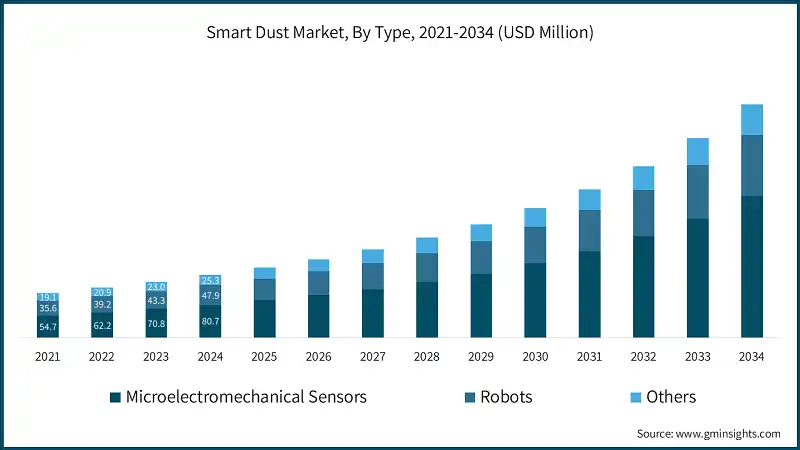
The smart dust market on the basis of type is segmented into microelectromechanical sensors, robots, and others.
- The microelectromechanical sensors was the largest market and was valued at USD 80.7 million in 2024. The growing demand for small, energy-efficient sensors in defense uses like navigation, guidance, and targeting is boosting the use of MEMS. These sensors improve situational awareness and accuracy in compact military devices.
- The increasing use of MEMS pressure sensors and microphones in unmanned aerial and ground systems helps improve environmental monitoring, situational awareness, and communication in challenging operational areas.
- Manufacturers need to focus on developing rugged, defense-grade MEMS that offer high sensitivity, durability, and low power use to win defense contracts and stand out from commercial products in a tough market.
- The robots market is anticipated to grow with a CAGR of 12.4% during the forecast period. The rising use of autonomous and semi-autonomous robots for surveillance, logistics, and explosive ordnance disposal is driving demand. Defense forces are focusing on protecting their personnel, improving operational efficiency, and reducing human risk in dangerous situations.
- The increased use of logistics and supply chain robots in military bases and combat zones is boosting efficiency, cutting down on manpower needs, and making sure critical supplies are delivered on time even in tough conditions.
- Manufacturers should focus on creating modular, AI-powered robotic systems that can handle various defense tasks. They also need to meet strict military standards to build strong partnerships with defense agencies and secure long-term contracts.
Learn more about the key segments shaping this market
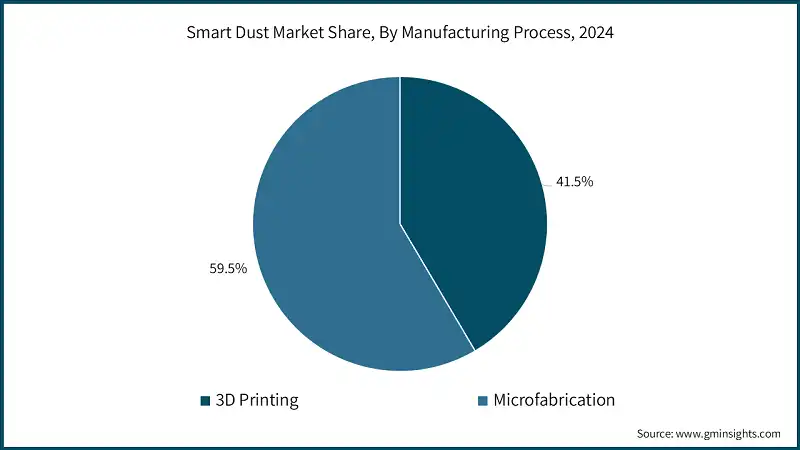
The smart dust market on the basis of manufacturing process is categorized into 3D printing and microfabrication.
- The microfabrication was the largest market and was valued at USD 90 million in 2024. The increasing miniaturized electronics, sensors and micro-optics demand in defense systems is driving a surge of microfabrication, enabling greater integration, accuracy and capability in the next generation military platforms and unmanned systems.
- Recent progress in microfabrication is enabling the development of miniature systems to generate energy and other micro devices, which will support the next generation soldier-worn electronics and autonomous sensors with extended operational lifespan in the harsh military environment.
- Smart dust manufacturers must invest in R&D for high-precision fabrication techniques tailored to defense microelectronics, ensuring reliability under extreme environments and compliance with military standards to strengthen long-term defense supply chain integration.
- The 3D printing is the fastest growing market and is anticipated to grow with a CAGR of 15.1% during the forecast period. Use of 3D printing for production of battlefield spare parts is growing rapidly, decreasing reliance on conventional supply chains and facilitating the real-time availability of mission-critical components in remote or contested defense environments.
- Increasing demand for quick prototyping and on-demand production of lightweight, intricate defense components is fuelling 3D printing adoption, allowing for accelerated design iteration, less logistics, and cost savings in readiness on the battlefield.
- Manufacturers must pursue the ability to manufacture deployable, transportable 3D printing systems, which can be used in the field, as it will give the military an upper hand in equipment maintenance and reducing downtimes in critical missions.
Looking for region specific data?
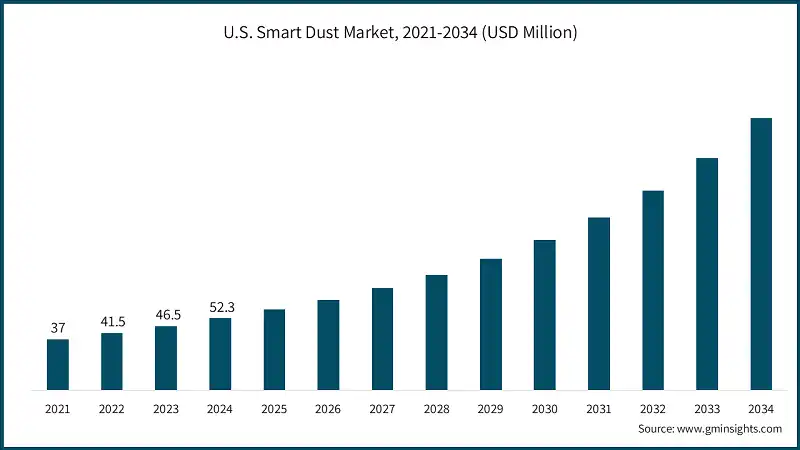
North America smart dust market was valued at USD 60.6 million in 2024 and is anticipated to grow with a CAGR of 14.1% during the forecast period of 2025 – 2034. North America's robust defense sector is a significant growth driver for the market. The U.S. and Canada are investing in smart dust technologies for surveillance, reconnaissance, and battlefield monitoring, enhancing situational awareness and operational efficiency.
- U.S. dominated the smart dust market and was valued at USD 52.3 million in the year 2024. The U.S. Department of Defense is investing heavily in smart dust technologies to support surveillance, reconnaissance, and battlefield observation. The U.S. military's continued investment in advanced technology to achieve strategic dominance is driving the United States' transition to smart dust. These micro-sensors allow for the collection of real-time data in hostile environments to give critical information without putting troops at risk.
- Manufacturers should concentrate on developing rugged, secure, and scalable smart dust solutions tailored for military applications.
- The smart dust market in Canada is anticipated to surpass USD 22.8 million by 2034. Canada is leveraging smart dust technologies for industrial monitoring and environmental applications, focusing on sectors like mining, agriculture, and environmental monitoring. Canada's vast natural resources and commitment to environmental stewardship are driving the adoption of smart dust. These sensors provide real-time data on environmental conditions, enabling proactive management of natural resources and compliance with environmental regulations. For instance, according to the U.S. International Trade Administration, Canada is a mature market for environmental technologies, ranking as the top export destination for U.S. environmental technology goods in 2022.
- Manufacturers should develop smart dust solutions that are adaptable to various industrial environments and compliant with Canadian environmental standards.
The smart dust market in Europe is anticipated to grow with a CAGR of 13.2% during the forecast period of 2025 – 2034. The European Union is investing in smart dust technologies to improve industrial applications, by focusing on sectors like manufacturing, logistics, and environmental monitoring.
- The Germany market was valued at USD 8.7 million in 2024. Industry 4.0 in Germany is growing to promote the utilization of smart dusts in the industrial automation process. Germany is a leading manufacturing powerhouse in Europe, and therefore, it is at the frontline in adopting smart dust in the manufacturing processes. These technologies support predictive maintenance, energy, and increased production efficiency.
- Manufacturers need to create strong and safe smart dust solutions specific to the German industrial market that meet the requirements of national standards and to establish collaborations with regional businesses.
- UK smart dust market is anticipated to surpass USD 18.7 million by 2034. The UK is in the process of considering the deployment of smart dust technologies for monitoring the environment and urban planning. The UK is using smart dust to measure air quality, traffic, and energy usage within cities, given rising concerns about environmental sustainability, to support policy making based on data.
- Manufacturers should create eco-friendly, energy-saving smart dust solutions in accordance with the UK's sustainability objectives and in association with governmental organizations for pilot programs.
The smart dust market in Asia Pacific is the fastest growing market and is anticipated to grow with a CAGR of 15.8% during the forecast period. The Asia-Pacific region's rapid urbanization and industrial growth are driving the demand for advanced sensor technologies like smart dust.
- China smart dust industry is projected to reach USD 95.6 million by the year 2034. China is utilizing smart dust technologies for environmental monitoring, with emphases on air quality and pollution management. China's dedication to enhancing environmental quality is reflected through its use of smart dust to monitor air pollutants in real-time. This is part of its overall drive to achieve environmental goals and improve public health. For instance, According to The U.S. International Trade Administration, China releases more than 40 million tons of sludge per year, of which only 20% is treated, making it necessary to have sophisticated monitoring tools such as smart dust.
- Manufacturers should design smart dust solutions that are China-compliant, providing real-time data collection and analysis functions to aid the national pollution control efforts.
- The smart dust market in Japan was valued at USD 6.2 million in 2024. Japan is incorporating smart dust technologies in automation of its industrial processes to make them more efficient and accurate. Japanese interest in Industry 4.0 is fuelling the use of smart dust in the manufacturing industries. These technologies allow to monitor machinery and processes in real-time and achieve high productivity and short downtime.
- Manufacturers should tailor their smart dust solutions to suit the manufacturing standards of Japan, which focus on reliability and precision, to fit the state of the art manufacturing in Japan.
- India smart dust market is anticipated to grow with a CAGR of over 17.1% during the forecast period. The Government of India is actively developing smart dust technologies in order to make the environment monitored and agricultural practice improved. India is taking the initiative of enhancing the quality of air and agricultural output as reflected in its use of smart dusts. The National Clean Air Programme (NCAP) is supposed to facilitate the decrease of levels of particulate matter in 131 cities and the Digital Agriculture Mission is going to encourage the usage of digital technologies in agriculture. The NCAP targets the 40 percent reduction of the PM10 level by 2025-26. Digital Agriculture Mission is dedicated to the process of introducing digital technologies into the farming process, paying much attention to the improvement of productivity and sustainability.
The smart dust market in Latin America was valued at USD 6.4 million in 2024. Latin American nations are increasingly embracing smart dust technologies for improving healthcare provision and industrial processes. In healthcare, smart dust facilitates real-time monitoring of patient vital signs and disease detection at early stages.
MEA market is projected to surpass USD 22.1 million by 2034. MEA nations are funding smart city initiatives and industrial automation to improve urban life and economic development. Smart dust technologies are significant in such activities by offering real-time information for infrastructure management, environmental monitoring, and resource optimization.
- South Africa smart dust industry was valued at USD 1.3 million in 2024. The South African government is concentrating on enhancing air quality and industrial performance. Incentives such as the National Air Quality Officer (NAQO) and Department of Environmental Affairs (DEA) are striving for better environmental standards. The Industrial Policy Action Plan (IPAP) focuses on increasing industrial development and competitiveness.
- Manufacturers should develop cost-effective, durable, and scalable smart dust solutions tailored for South Africa's diverse environmental and industrial sectors.
- The smart dust market in Saudi Arabia is projected to grow with a CAGR of 12.8% during the forecast period. Saudi Arabia is adopting smart dust technologies as part of its Vision 2030 to improve environmental monitoring and industrial sustainability. The Saudi Green Initiative consists of more than 85 initiatives to cut emissions and improve environmental sustainability, providing a proper environment for smart dust technologies.
- The market in UAE is anticipated to surpass USD 8.7 million by 2034. The UAE is utilizing smart dust technologies for assisting its smart city and AI-centric initiatives. The government of UAE has introduced the Smart Dubai 2021 Strategy, with an effort to position data as a strategic asset. Projects such as the Open Labs platform and AI-based planning cycles are promoting innovation. The UAE's Smart Dubai 2021 Strategy comprises 100 initiatives in different sectors to make urban living data-smart.
- Manufacturers must create sophisticated, scalable smart dust solutions that complement the UAE's smart city and AI goals.
Smart Dust Market Share
- The smart dust industry is a highly competitive and fragmented market with many big and small companies within the market. Analog Devices, Inc., Hitachi, Ltd., Cisco Systems, Inc., Moog Inc., and BetaBatt, Inc., are the key players in the market. These companies collectively account for 22.8% of the total market share in 2024.
- Analog Devices led the global smart dust market in 2024 with an 8.8% share. It is leading through its innovative MEMS-based micro- sensor technology delivering high-precision, low-power sensors used in industry, environmental, and defense applications. Sensor fusion, miniaturization, and signal processing are also part of the company, which makes adding smart dust to complicated IoT and monitoring systems quite simple.
- Hitachi attained a 6.2% market share in 2024 through its strength in delivering strong and scalable smart dust solutions to industrial automation, environmental, and urban infrastructure applications. Hitachi also strives towards energy saving sensors and reliable wireless data acquisition systems, which favor large-scale implementations. Hitachi has increased allure among municipal and enterprise customers in the smart dust market with smart city investments and collaborative R&D.
- Cisco owned a 4.1% market share in smart dust in 2024, applying its networking knowledge to incorporate smart dust devices into networked IoT environments. The company lays stress on high throughput and secure wireless communication protocols, and therefore real-time monitoring in industrial and urban applications. The Cisco cloud-based analytics of data and scalable network applications enable the smart dust implementations to run effectively in a complicated network infrastructure.
- In 2024, Moog had a market share of 2.6% with its ruggedized and high-precision smart dust devices suitable to aerospace, defense, and industrial monitoring. The company focuses on robustness and viability in its performance, and its sensors fit in the severe conditions. The tailored Moog smart dust products are offered to promote mission-critical systems where accuracy and the longevity of performance are required.
- BetaBatt achieved 1.1% market share of energy-efficient smart dust devices with embedded power solutions to the IoT, wearable, and remote health monitor. The innovation of micro-batteries and low-power consumption at BetaBatt ensures a long device life and ability to integrate into small spaces, which are proponent of niche applications of smart dusts to healthcare, agriculture, and logistics.
Smart Dust Market Companies
The top prominent companies operating in the smart dust industry include:
- Texas Instruments Inc.
- International Business Machines Corporation
- Analog Devices, Inc.
- Honeywell International Inc.
- Intel Corporation
- STMicroelectronics N.V.
- TE Connectivity Ltd.
- Broadcom Inc.
- ABB Ltd.
- Cisco Systems, Inc.
- EnOcean GmbH
- ARM Holdings plc
- Smartdust Solutions Ltd.
- BetaBatt, Inc.
- Moog Inc.
- NXP Semiconductors N.V.
- Bosch Sensortec GmbH
- Qualcomm Technologies, Inc.
- onsemi
- Lightricity Ltd.
- CubeWorks, Inc.
- Stiftelsen for industriell og teknisk forskning (SINTEF)
- Sonardyne International Limited
- General Electric Company
- Hitachi, Ltd.
Analog Devices, Inc., Texas Instruments Inc., Honeywell International Inc., Intel Corporation, STMicroelectronics N.V., Cisco Systems, Inc., and Hitachi, Ltd. are the prominent players and have enough experience in MEMS-based micro-sensor technologies, advanced digital signal processing and wireless communication solutions to develop a solid strategy to penetrate the smart dust market. The above companies have a proven track record and experience with MEMS-based micro-sensor technologies, and they will be leaders with unique capability to identify, create and capture new markets, at a time that will be measured in short years, with considerable pressure and demands accelerating the speed of change.
TE Connectivity Ltd., Broadcom Inc., NXP Semiconductors N.V., ABB Ltd., Qualcomm Technologies, Inc., and onsemi are recognized as challengers in the market. While these companies do not yet dominate market share, they are expanding rapidly through targeted investments, strategic alliances, and technology development. They focus on emerging applications such as industrial automation, smart cities, connected infrastructure, and energy-efficient IoT solutions.
IBM International Business Machines Corporation, ARM Holdings plc, Bosch Sensortec GmbH and General Electric Company (GE) are regarded as the followers in the market. Those companies deliver dependable and standardized smart dust solutions through adaptation innovations created by leaders and challengers. Their solutions tend to target integration with existing platforms, affordable solutions or incremental advances and not disruptive technology.
The niche players in the smart dust market include EnOcean GmbH, Smartdust Solutions Ltd., BetaBatt, Inc., Moog Inc., Lightricity Ltd., CubeWorks, Inc., Stiftelsen for industriell og teknisk forskning (SINTEF), and Sonardyne International Limited. These companies specialize in use cases or highly innovative products and are frequently aimed at a particular industry niche (wearables, environmental monitoring, precision agriculture, or aerospace).
Smart Dust Market Report Attributes
| Key Takeaway | Details |
|---|---|
| Market Size & Growth | |
| Base Year | 2024 |
| Market Size in 2024 | USD 153.9 million |
| Market Size in 2025 | USD 171.8 million |
| Forecast Period 2025 - 2034 CAGR | 14.3% |
| Market Size in 2034 | USD 572 million |
| Key Market Trends | |
| Drivers | Impact |
| The miniaturization of sensors and electronics | Drives 24% of market growth as advances in MEMS, nanotechnology, and low-power electronics enable ultra-small, energy-efficient smart dust devices. |
| Rising adoption in industrial IoT (IIoT) | Supports 22% growth by integrating smart dust into manufacturing, logistics, and energy systems for real-time asset tracking, predictive maintenance, and supply chain optimization |
| Advancements in wireless communication protocols | Contributes 20% to market expansion by enabling seamless connectivity of smart dust with IoT networks through protocols like LoRa, Zigbee, and 5G. |
| Healthcare and biomedical innovations | Accounts for 18% growth as smart dust technologies are adopted in implantable sensors, drug delivery systems, and remote health monitoring. |
| The growing environmental monitoring needs. | Adds 16% to market growth as governments and industries increasingly deploy smart dust for air quality assessment, pollution detection, and climate monitoring. |
| Pitfalls & Challenges | Impact |
| High Implementation and Integration Costs | Restrains 14% of market growth as the miniaturization of smart dust requires advanced nanofabrication, complex integration, and specialized wireless modules. |
| Data Security and Privacy Concerns | Limits 12% of growth as smart dust devices continuously collect sensitive data in industrial, healthcare, and defense applications. |
| Opportunities: | Impact |
| Expansion in Industrial IoT and Smart Cities | Will drive market growth as smart dust enables real-time asset tracking, predictive maintenance, and environmental monitoring across industrial ecosystems and urban infrastructure. |
| Integration with AI and Edge Computing | Will contribute significantly to market expansion by allowing smart dust devices to process data locally, reduce latency, and deliver actionable insights in real time. |
| Market Leaders (2024) | |
| Market Leaders |
Top 2 company accounts for 15% |
| Top Players |
Collective market share in 2024 is 22.8% |
| Competitive Edge |
|
| Regional Insights | |
| Largest Market | North America |
| Fastest Growing Market | Asia Pacific |
| Emerging Country | India, Brazil, Indonesia, South Africa, Mexico |
| Future Outlook |
|
What are the growth opportunities in this market?
Smart Dust Industry News
- In January 2024, Bosch Sensortec introduced a smart connected sensor platform at CES 2024, designed for full-body motion tracking. This all-in-one platform includes hardware, software, and a ready-to-use wearable reference design. It supports a wide range of applications, allowing smooth full-body motion tracking across wearables, hearables, and AR/VR headsets.
- In March 2024, the U.S. Defense Advanced Research Projects Agency (DARPA) made a big step forward in its SHIELD program by deploying airborne smart dust sensors for battlefield monitoring. These tiny sensors collect real-time environmental and motion data, sending encrypted information securely to central control centers to improve situational awareness.
The smart dust market research report includes in-depth coverage of the industry with estimates and forecasts in terms of revenue in (USD Million) from 2021 – 2034 for the following segments:
Market, By Type
- Microelectromechanical sensors
- Robots
- Others
Market, By Component
- Sensors
- Power supply units
- Analog and digital i/o modules
- Signal processing units
- Control circuitry
- Optical transmission modules
- Radio frequency modules
- Others
Market, By Manufacturing Process
- 3D printing
- Microfabrication
By End Use Application
- Military and defense
- Surveillance and reconnaissance
- Combat situational awareness
- Border monitoring and tracking
- Others
- Healthcare and life sciences
- Patient monitoring
- Biomedical research
- Others
- Manufacturing and industrial
- Process control automation
- Predictive maintenance
- Others
- Telecommunications and IT
- Energy and utilities
- Agriculture
- Aerospace and research institutions
- Others
The above information is provided for the following regions and countries:
- North America
- U.S.
- Canada
- Europe
- Germany
- UK
- France
- Spain
- Italy
- Netherlands
- Asia Pacific
- China
- India
- Japan
- Australia
- South Korea
- Latin America
- Brazil
- Mexico
- Argentina
- Middle East and Africa
- Saudi Arabia
- South Africa
- UAE
Frequently Asked Question(FAQ) :
What is the market size of the smart dust industry in 2024?
The market size for smart dust was valued at USD 153.9 million in 2024, with a CAGR of 14.3% expected through 2034 driven by advancements in wireless communication protocols.
What is the current smart dust market size in 2025?
The smart dust industry is projected to reach USD 171.8 million in 2025.
What is the projected value of the smart dust market by 2034?
The smart dust industry is expected to reach USD 572 million by 2034, fueled by miniaturization of sensors, industrial IoT adoption, and healthcare innovations.
How much revenue did the microelectromechanical sensors (MEMS) segment generate in 2024?
The MEMS segment generated USD 80.7 million in 2024, leading the market due to rising demand for energy-efficient sensors in defense and industrial applications.
What was the valuation of the microfabrication manufacturing process segment in 2024?
The microfabrication segment held the largest share with USD 90 million in 2024, driven by demand for miniaturized electronics and defense-grade sensors.
What is the growth outlook for 3D printing-based manufacturing from 2025 to 2034?
The 3D printing segment is projected to grow at a 15.1% CAGR through 2034, supported by demand for battlefield-ready spare parts and rapid prototyping in defense industries.
Which region leads the smart dust market?
The U.S. market was valued at USD 52.3 million in 2024. Strong defense investments in surveillance, reconnaissance, and battlefield monitoring drive U.S. leadership in the industry.
What are the upcoming trends in the smart dust industry?
Key trends include AI-powered edge analytics for autonomous decision-making, integration in healthcare for remote monitoring, and use in environmental and industrial applications such as pollution detection and predictive maintenance.
Who are the key players in the smart dust market?
Key companies include Analog Devices, Hitachi, Cisco Systems, Moog Inc., BetaBatt, Texas Instruments, Honeywell International, Intel, STMicroelectronics, and IBM.
Smart Dust Market Scope
Related Reports