Summary
Table of Content

Sleeping Bag Market
Get a free sample of this report
Form submitted successfully!
Error submitting form. Please try again.
Thank you!
Your inquiry has been received. Our team will reach out to you with the required details via email. To ensure that you don't miss their response, kindly remember to check your spam folder as well!
Request Sectional Data
Thank you!
Your inquiry has been received. Our team will reach out to you with the required details via email. To ensure that you don't miss their response, kindly remember to check your spam folder as well!
Form submitted successfully!
Error submitting form. Please try again.
Sleeping Bag Market Size
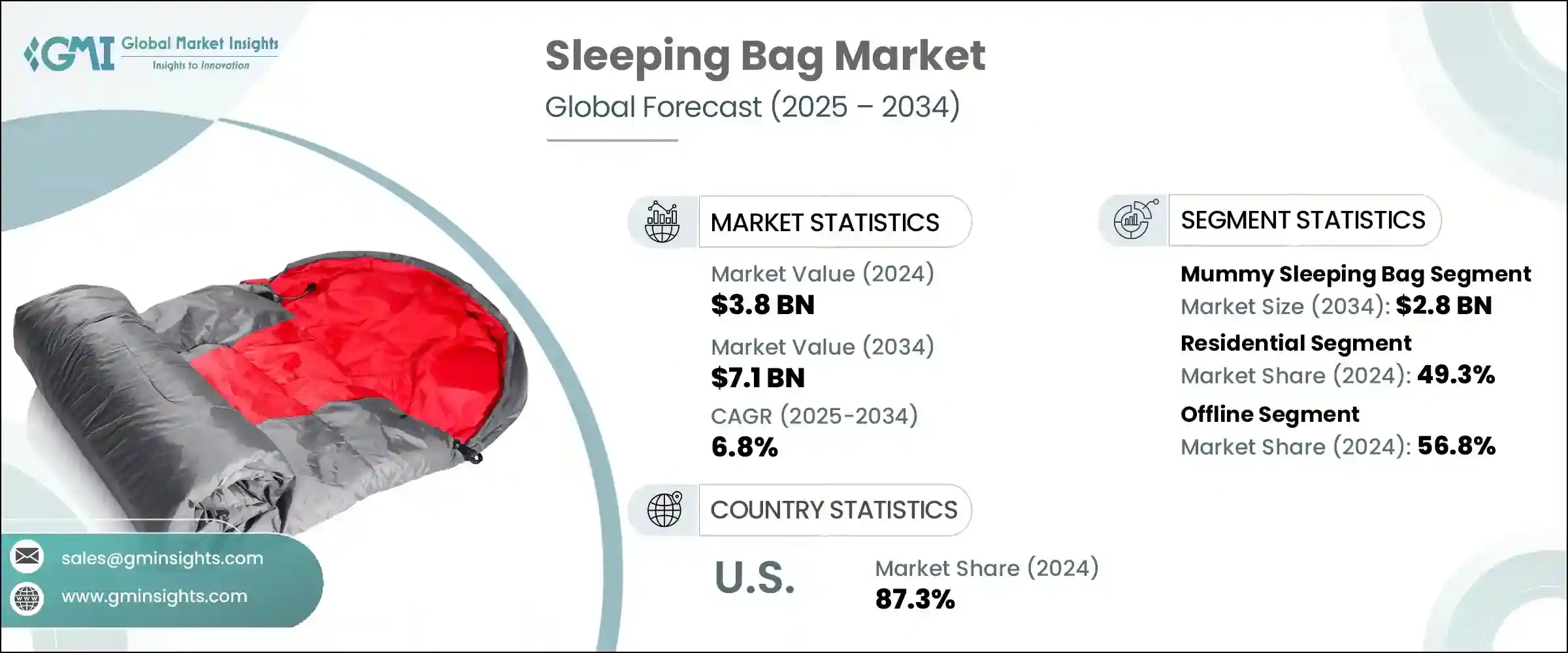
The sleeping bag market size was estimated at USD 3.8 billion in 2024 and is projected to grow at a CAGR of 6.8% between 2025 and 2034. The growing demand for outdoor activities is fueling growth in the sleeping bag industry. More and more people are hiking, camping, and trekking, particularly post-pandemic, and that has fueled the demand for high-quality outdoor equipment of high quality.
Sleeping Bag Market Key Takeaways
Market Size & Growth
- 2024 Market Size: USD 3.8 Billion
- 2034 Forecast Market Size: USD 7.1 Billion
- CAGR (2025–2034): 6.8%
Key Market Drivers
- Rising Popularity of Outdoor Activities.
- Consumer Preference for Sustainable and Eco-friendly Products.
- Increased Focus on Health and Wellness.
Challenges
- Sustainability of Down Feathers.
- Lack of Consumer Awareness in Emerging Markets.
Get Market Insights & Growth Opportunities
To get key market trends
The younger generation of consumers, millennials included, is most interested in outdoor lifestyles as they offer benefits for health as well as socially. National parks in the U.S. received more than 312 million recreational visits in 2022, which indicates a continued rise and recovery of outdoor recreation activity, the National Park Service reports. Adventure tourism is also increasing, driven by government and travel company initiatives to encourage eco-tourism and wilderness adventure.
Social media also helps as it displays outdoor activities, prompting individuals to purchase improved equipment. Along with this, more sophisticated camp facilities, such as adventure parks and trails, and more sophisticated designs that make sleeping bags lighter, less expensive, and more efficient, have simplified outdoor recreation for all. Therefore, the need for sleeping bags, particularly mummy bags with greater insulation and mobility, is increasing more and more.
Sleeping Bag Market Trends
- The market for sleeping bags is evolving through new customer needs, improved technology, and increased participation in outdoor activities by more people. Some of the trends include the use of green products. Most customers today opt for sleeping bags that are made from recycled or biodegradable materials.
- Companies are evolving using sustainable production methods and marking materials. Technology is enhancing sleeping bags. Among some of the recent additions are built-in heating systems, temperature-regulating fabrics, and warmth regulated by Bluetooth via mobile apps. Compact and lightweight sleeping bags are also sought after, particularly by campers and backpackers who require light and lightweight designs without compromising heat and longevity.
- The sleeping bag market is changing with new customer demands, better technology, and greater outdoor activity participation by an ever-increasing number of people. Some of the trends are using green products. Most customers these days would prefer sleeping bags that are recycled or biodegradable.
- Companies are changing with the application of sustainable manufacturing processes and labeling materials. Technology is making sleeping bags better. Among some of the recent introductions are built-in heaters, temperature-controlling fabrics, and heat controlled by Bluetooth through smartphone apps. Lightweight and compact sleeping bags are also in demand, especially among backpackers and campers who need lightweight and light models without compromising on heat and durability.
Trump Administration Tariffs
The Trump administration's tariffs have profoundly impacted the sleeping bag market, particularly within the outdoor equipment business. Imports from countries such as Vietnam and China had tariffs as high as 145%, stated the United States International Trade Commission (USITC). Tariffs have increased production costs for most of the outdoor companies with foreign manufacturing. Companies thus responded by passing along the added cost at the retail level through pricing increases.
These increased costs have resulted in some issues. First, buyers have diminished buying power, decreasing demand for sleeping bags and other camping equipment. Second, manufacturers and traders experience money issues, which can equate to fewer innovations and unemployment for the industry. To prevent such issues, some businesses are relocating manufacturing to foreign nations or planning for home-based production. Nevertheless, such alternatives come with their own set of challenges and expenses.
Sleeping Bag Market Analysis

Learn more about the key segments shaping this market
Based on the type, the sleeping bag market is segmented into mummy sleeping bags, rectangular sleeping bags, semi-rectangular sleeping bags, double sleeping bags, convertible sleeping bags, quilt sleeping bags, and others. The mummy sleeping bag segment witnessed significant growth from 2025 to 2034, emerging as the dominant force, generating a revenue of USD 1.4 billion in 2024 and is expected to reach USD 2.8 billion by 2034.
- Mummy sleeping bags dominate sleeping bag type as they are more efficient at heat retention and at eliminating empty air space. They hug the form of the human body, thereby keeping void air space to a minimum and keeping the individuals warm. They are ideal for cold-weather and high-altitude expeditions. Their lightweight and portability, which is gained, makes them most trekkers and backpackers.
- Based on government statistics utilizing data provided by the U.S. Department of Commerce, outdoor activities such as camping and hiking are increasingly popular among the younger generations and eco-friendly users. This has led to the growing need for sleeping bags that are efficient, dependable, and compact. As a result, mummy sleeping bags have become the top choice for amateur as well as professional outdoor activities and further entrenched their position in the market.
Learn more about the key segments shaping this market
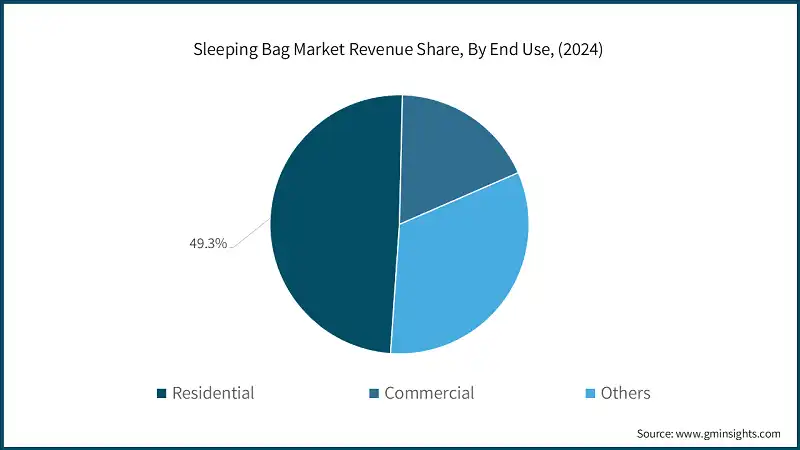
Based on the application, the sleeping bag market is segmented into residential and commercial and others. In 2024, the residential segment emerged as the market leader, commanding a 49.3% market share, and is anticipated to reach a valuation of USD 1.8 billion by 2034.
- Residential usage of sleeping bags is contributing to the growth of the sleeping bag market. Sleeping bags are currently utilized indoors by people for household camping, sleepovers for kids, and as additional bedding for overnight visitors. This indicates that sleeping bags are convenient and convenient to have in homes.
- As more individuals work from home and occupy less space, sleeping bags are increasingly becoming the in-thing. They are less expensive and easier to keep than conventional bedding, thereby making them a good option as far as conserving space is concerned.
- New single-family house sizes have decreased somewhat over recent years, as reported by the U.S. Census Bureau, indicating a trend towards decreasing living space. This is also in keeping with increased demand for space-saving items such as sleeping bags. As individuals continue to seek simple and easy arrangements, sleeping bags can be anticipated to expand further.
Based on the distribution channel, the sleeping bag market is segmented into online and offline. The offline segment is expected to hold a major share of 56.8% in 2024.
- Offline channels are leading the sleeping bag market because people like to see and feel the product before buying. In stores, customers can check important features like material, insulation, size, weight, and comfort, which are hard to judge online.
- Specialty outdoor shops, camping stores, and big sporting goods chains have trained staff to help customers choose the right product. Offline shopping also provides instant access to products, avoids shipping delays, and often has better return or exchange policies.
- According to the U.S. Census Bureau, offline retail sales still account for over 80% of total retail sales in the United States, even with the growth of online shopping. These benefits make offline shopping popular, especially for first-time buyers or expensive purchases. Physical stores also attract customers with in-store events, special deals, and trial areas, which help increase sales and customer satisfaction.
Looking for region specific data?
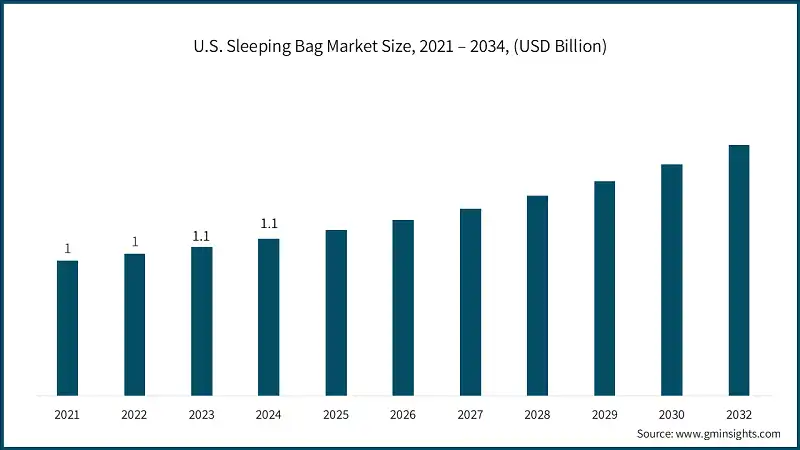
The U.S. dominated the sleeping bag market, with a share of 87.3% of the total market share in North America in 2024. This share is expected to grow at a CAGR of 7.4% during the forecast period.
- The sleeping bag market of North America is underpinned by a strong outdoor recreation culture, led by the United States and Canada. Hiking, backpacking, and camping are favored activities, supported by a solid trail, national park, and outdoor festival infrastructure. These consumers generally have high disposable incomes and are likely to spend on good quality performance-oriented sleeping bags. The availability of fashionable outdoor retail stores like REI, Bass Pro Shops, and Cabela's introduces exposure to diverse product lines. Consumers are now seeking gear that is environmentally friendly and produced ethically, which reflects wider environmental consciousness among North American consumers.
The sleeping bag market in China is expected to experience significant and promising growth from 2025 to 2034.
- In the Asia-Pacific market, the growth is fueled by a rapidly expanding middle class in China, India, Vietnam, and Indonesia. With higher disposable incomes, people are indulging in recreational activities such as camping, trekking, and glamping. Governments in the region are themselves promoting local holidays and green tourism, creating strong demand for sleeping bags and outdoor gear. Social media influence, particularly on urban youth, is also pushing outdoor lifestyle activities. Second, APAC is also a focal point for sleeping bag manufacturing, and that offers cost benefits and effective supply chains for local and international brands.
The sleeping bag market in Germany is expected to experience significant and promising growth from 2025 to 2034.
- Europe is a mature and technology-driven market for sleeping bags underpinned by a centuries-long outdoor sport culture of mountaineering, trekking, and camping. There is a well-established outdoor culture in Germany, France, the UK, and the Nordic countries underpinned by state-sponsored schemes and recreation infrastructure. European consumer culture is highly environmentally oriented and promotes demand for green materials and ethically produced sleeping bags. Seasonal field sports, festival breaks, and adventure breaks on the continent also provide constant demand for the product. There is also demand for light, high-technology, and highly insulated sleeping bags, particularly for alpine and cold climates.
Sleeping Bag Market Share
- The sleep bag industry is dominated by well-established global brands and specialty brands with space for innovation, and among the top brands with good brand reputation, product innovation, and brand positioning are The North Face, Marmot, Coleman, Big Agnes, and REI Co-op.
- The North Face dominates with frequent product innovation and product innovations such as Heatseeker insulation, providing high-performance sleeping bags for various climatic conditions. Marmot targets serious outdoor enthusiasts and professionals on the grounds of performance and reliability with proprietary technologies like Down Defender to offer greater protection from weather.
- Coleman serves mass consumers in terms of economy and family models with a diverse line of sleeping bags for everyday and recreational campers. Big Agnes competes in the hiking and backpacking category with very light and compressible sleeping bags with a tendency to incorporate sleeping pads for ease and comfort.
- REI Co-op, as both a retailer and manufacturer, provides high-quality sleeping bags on its private label that are performance-based but not costly. Its robust sustainability culture and community involvement also attract environmentally mindful consumers. They all embrace strategies that vary from technology and innovation to price and retail customer-focused strategies, and therefore they control the competitive market.
Sleeping Bag Market Companies
Major players operating in the sleeping bag industry are:
- Big Agnes
- Coleman
- Feathered Friends
- Kelty
- L.L.Bean
- Marmot
- Mountain Hardwear
- NEMO Equipment
- Rab
- REI Co-op
- Sea to Summit
- Sierra Designs
- Therm-a-Rest
- The North Face
- Western Mountaineering
Coleman is price- and recreational-camping-oriented, with mummy and rectangular bags available for family and everyday camping. Feathered Friends is a company that retails high-performance down sleeping bags made in Seattle for extreme weather and expeditions. Kelty has adaptive choices in synthetic and down fill, and its gear is for backpacking and camping. L.L. Bean has durable and warm sleeping bags in mummy and rectangular shapes and is suitable for bike tourers and campers.
Marmot is renowned for its ultralight and weatherproof mummy-style bags, best suited for mountaineers and backpackers. Mountain Hardwear creates technical down sleeping bags such as the Phantom™ series, used in alpine and expedition environments.
Sleeping Bag Market Report Attributes
| Key Takeaway | Details |
|---|---|
| Market Size & Growth | |
| Base Year | 2024 |
| Market Size in 2024 | USD 3.8 Billion |
| Forecast Period 2025 - 2034 CAGR | 6.8% |
| Market Size in 2034 | USD 7.1 Billion |
| Key Market Trends | |
| Growth Drivers |
|
| Pitfalls & Challenges |
|
What are the growth opportunities in this market?
Sleeping Bag Industry News
- March 2025, EXPED's launch of the DeepSleep Collection is a giant leap towards bringing together comfort, sustainability, and versatility in outdoor equipment. The new series of sleeping bags is meant to meet various adventures, ranging from light camping excursions to more strenuous outdoor activities. What differentiates the DeepSleep Collection is its focus on eco-friendliness—every sleeping bag is made of eco-friendly materials, such as recycled materials and insulation. This demonstrates EXPED's ongoing dedication to minimizing its environmental impact as it moves to address increasing consumer demand for green outdoor equipment.
- In March 2024, Sea to Summit introduced new sleeping bags and liners and three newly reimagined camp kitchen collections: Frontier, Detour, and Passage. The three collections demonstrate the brand's commitment to innovation and sustainability for its pursuit of perfecting the outdoor experience for outdoor consumers. The three camp kitchen collections received the 2023 Australian Good Design Award, which reflects the excellence of their design. Frontier series fits ultra-light backcountry men who possess small and rugged but lightweight dinnerware and cookware that are redefining standards for the ultra-light backcountry kitchen industry. Detour collection possesses high-quality, collapsible, and ready-to-cook equipment made for motorized travelers who prioritize ruggedness and mobility.
The sleeping bag market research report includes in-depth coverage of the industry with estimates & forecasts in terms of revenue ($ Mn/Bn) and shipment (Units) from 2021 to 2034, for the following segments:
Market, By Type
- Mummy sleeping bags
- Rectangular sleeping bags
- Semi-rectangular sleeping bags
- Double sleeping bags
- Convertible sleeping bags
- Quilt sleeping bags
- Others
Market, By Material
- Down
- Synthetic (polyester)
- Wool
- Cotton
- Others (silk)
Market, By Size
- Kids
- Single
- Double
- Queen/King
- Others (oversized)
Market, By End Use
- Residential
- Commercial
- Others
Market, By Distribution Channel
- Online
- Company website
- E-commerce
- Offline
- Supermarket / hypermarket
- Specialty store
- Others
The above information is provided for the following regions and countries:
- North America
- United States
- Canada
- Europe
- United Kingdom
- Germany
- France
- Italy
- Spain
- Russia
- Asia Pacific
- China
- Japan
- India
- South Korea
- Australia
- Latin America
- Brazil
- Mexico
- Middle East & Africa
- Saudi Arabia
- United Arab Emirates
- South Africa
Frequently Asked Question(FAQ) :
How big is the sleeping bag market?
The market size of sleeping bag was valued at USD 3.8 billion in 2024 and is expected to reach around USD 7.1 billion by 2034, growing at 6.8% CAGR through 2034.
What is the size of mummy sleeping bag segment in the sleeping bag industry?
The mummy sleeping bag segment generated over USD 1.4 billion in 2024.
How much sleeping bag market share captured by U.S. in 2024?
The U.S. market of sleeping bag held around 87.3% share in 2024.
Who are the key players in sleeping bag industry?
Some of the major players in the industry include Big Agnes, Coleman, Feathered Friends, Kelty, L.L. Bean, Marmot, Mountain Hardwear, NEMO Equipment, Rab, REI Co-op, Sea to Summit, Sierra Designs, Therm-a-Rest, The North Face, and Western Mountaineering.
Sleeping Bag Market Scope
Related Reports