Summary
Table of Content

Sleep Apnea Devices Market
Get a free sample of this report
Form submitted successfully!
Error submitting form. Please try again.
Thank you!
Your inquiry has been received. Our team will reach out to you with the required details via email. To ensure that you don't miss their response, kindly remember to check your spam folder as well!
Request Sectional Data
Thank you!
Your inquiry has been received. Our team will reach out to you with the required details via email. To ensure that you don't miss their response, kindly remember to check your spam folder as well!
Form submitted successfully!
Error submitting form. Please try again.
Sleep Apnea Devices Market Size
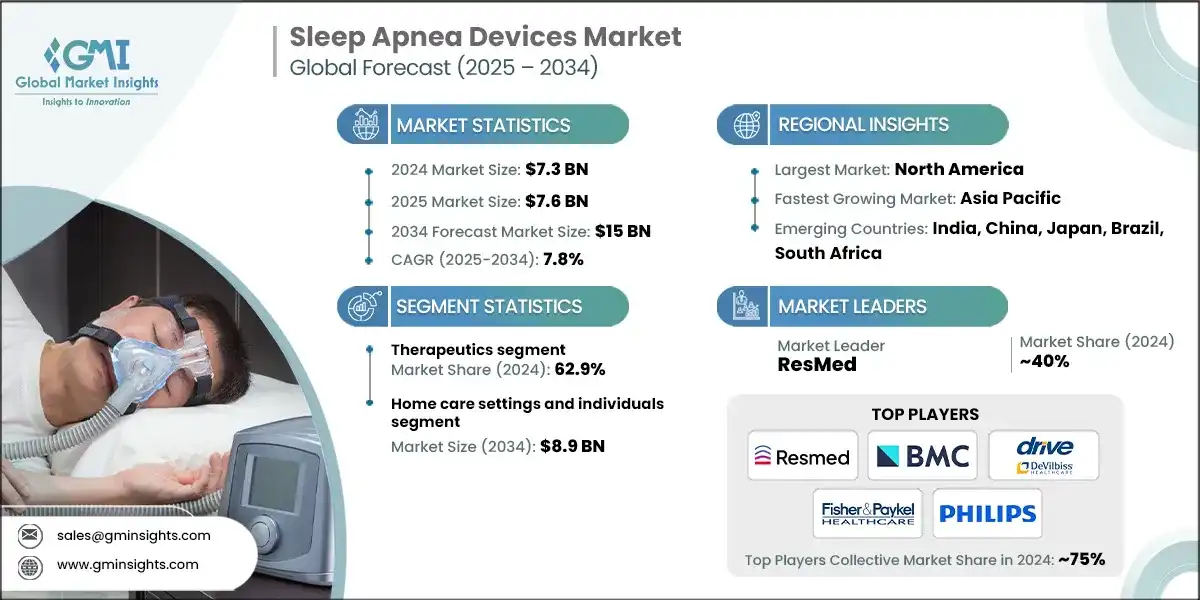
The global sleep apnea devices market was valued at USD 7.3 billion in 2024. The market is expected to grow from USD 7.6 billion in 2025 to USD 15 billion in 2034, at a CAGR of 7.8% from 2025 to 2034, according to the latest report published by Global Market Insights Inc. The high market growth is due to the rising prevalence of sleep apnea and associated comorbidities, increasing need for portable, high-quality sleep apnea solutions, rising awareness of sleep apnea and sleep disorders, and surging aging population driving demand, among others.
Sleep Apnea Devices Market Key Takeaways
Market Size & Growth
- 2024 Market Size: USD 7.3 Billion
- 2025 Market Size: USD 7.6 Billion
- 2034 Forecast Market Size: USD 15 Billion
- CAGR (2025–2034): 7.8%
Regional Dominance
- Largest Market: North America
- Fastest Growing Region: Asia Pacific
Key Market Drivers
- Increasing incidence of sleep apnea and related comorbidities.
- Growing demand for portable, high-performance sleep apnea solutions.
- Surging awareness of sleep apnea and sleep disorders.
- The rising aging population is amplifying demand.
- Technological advancements.
Challenges
- Lack of adherence to sleep apnea treatment.
- Product recalls and safety concerns.
Opportunity
- Expansion into emerging markets.
- AI and digital health integration.
Key Players
- Market Leader: ResMed led with over 40% market share in 2024.
- Leading Players: Top 5 players in this market include ResMed, BMC, Drive DeVilbiss, FISHER & PAYKEL, Philips, which collectively held a market share of 75% in 2024.
Get Market Insights & Growth Opportunities
Sleep apnea devices offer therapeutic and diagnostic treatment to address sleep-disordered breathing, mainly by maintaining airway patency and monitoring sleep. Key players are ResMed, BMC, Drive DeVilbiss, FISHER & PAYKEL, and Philips, among others, each with a variety of CPAP, BiPAP, and diagnostic systems designed for both clinical and home care applications.
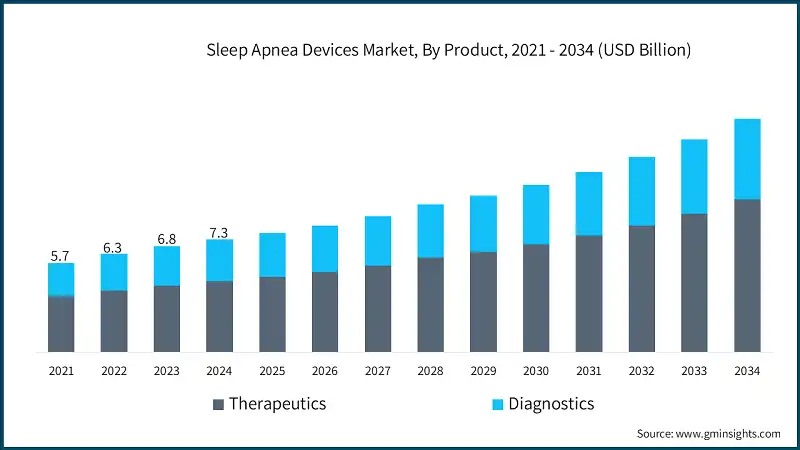
The market has increased from USD 5.7 billion in 2021 and reached USD 6.8 billion in 2023, with a historic growth rate of 8.9%. This growth was primarily driven by rising awareness of sleep disorders, increasing prevalence of obstructive sleep apnea, technological advancements in diagnostic and therapeutic respiratory devices, and a growing preference for home-based sleep care solutions.
Sleep apnea is a widespread condition, with studies estimating that millions of individuals worldwide are affected by it, many of whom remain undiagnosed. For instance, the National Institutes of Health suggests that an estimated 1 billion people suffer from sleep apnea globally, with an estimated 936 million cases of obstructive sleep apnea. Demographic drivers, like an increased proportion of elderly patients with changing lifestyles and obesity, have driven the increasing incidence of sleep apnea. As education on the health consequences of untreated sleep apnea, such as cardiovascular conditions, diabetes, and stroke, rises, so does the population seeking medical treatment, which translates to increased demand for sleep apnea devices.
Additionally, the growing awareness of sleep apnea symptoms like loud snoring, daytime sleepiness, and lack of concentration has stimulated more individuals to undergo medical assessment. Improved diagnostic methods, like home sleep testing and in-lab polysomnography, have facilitated easy identification of sleep apnea cases. With increasing numbers of people getting diagnosed with the condition, the market for sleep apnea devices, such as CPAP (continuous positive airway pressure) machines, BiPAP, and other treatment and diagnostic equipment, is on the rise.
Sleep apnea devices are therapeutic and diagnostic devices intended to detect and treat sleep apnea. These devices play a crucial role in mitigating the health risks associated with untreated sleep apnea, thereby enhancing patient outcomes and quality of life.
To get key market trends
Sleep Apnea Devices Market Trends
Technological advancements have significantly reshaped the market, driving innovation in both diagnostic and therapeutic solutions.
- Modern devices now incorporate features such as cloud connectivity, AI-powered analytics, and remote monitoring, enabling healthcare providers to track patient compliance and treatment efficacy in real time. These innovations not only improve clinical outcomes but also enhance patient engagement and comfort. For example, platforms like ResMed’s AirView and Philips’ DreamMapper allow seamless data sharing and personalized feedback, making therapy more interactive and effective.
- Moreover, with a growing preference for home-based healthcare and management of chronic conditions, patients are increasingly turning to portable sleep apnea devices that offer both comfort and effectiveness. Portable CPAP machines, BiPAP devices, and other sleep apnea solutions are becoming popular as they allow users to manage their condition without the need for frequent hospital visits. The convenience of home therapy is driving the demand for portable devices, particularly among those with mild to moderate sleep apnea who may not require in-hospital monitoring.
Sleep Apnea Devices Market Analysis
Learn more about the key segments shaping this market
Based on the product, the sleep apnea devices market is segmented into therapeutics and diagnostics. The therapeutics segment accounted for 62.9% of the market in 2024 due to its dominant role in managing sleep apnea through CPAP, BiPAP, and oral sleep apnea devices, which are widely adopted for both clinical and home care use. The segment is expected to exceed USD 9.8 billion by 2034, growing at a CAGR of 8.2% during the forecast period.
On the other hand, the diagnostics segment held a market share of 37.1% in 2024. The growth of this segment can be attributed to increasing awareness of sleep disorders, rising demand for early and accurate diagnosis, and the adoption of home sleep testing solutions. Technological advancements in portable diagnostic devices and AI-enabled sleep monitoring have further accelerated the segment’s expansion, making sleep apnea screening more accessible and efficient.
- CPAP and BiPAP machines, the primary therapeutic devices for obstructive sleep apnea (OSA), continue to dominate the market due to their proven efficacy in maintaining open airways during sleep.
- CPAP machines deliver a continuous flow of air through a mask, keeping the airway open, while BiPAP machines offer variable air pressure for inhalation and exhalation, providing a more comfortable solution for patients with complex sleep apnea. These devices are widely used across mild to severe cases of sleep apnea, contributing significantly to the market share of the therapeutics segment.
- Moreover, patient compliance is a critical factor in the success of sleep apnea therapy, and therapeutic devices have evolved to improve comfort, ease of use, and overall patient satisfaction. Innovations such as quieter machines, smaller, more comfortable masks, and advanced humidity settings have significantly improved user experience, driving higher adoption rates. As patient compliance with CPAP and BiPAP therapy improves, the therapeutics segment benefits from greater sales and market share, as more individuals with sleep apnea seek long-term, effective treatments.
Learn more about the key segments shaping this market
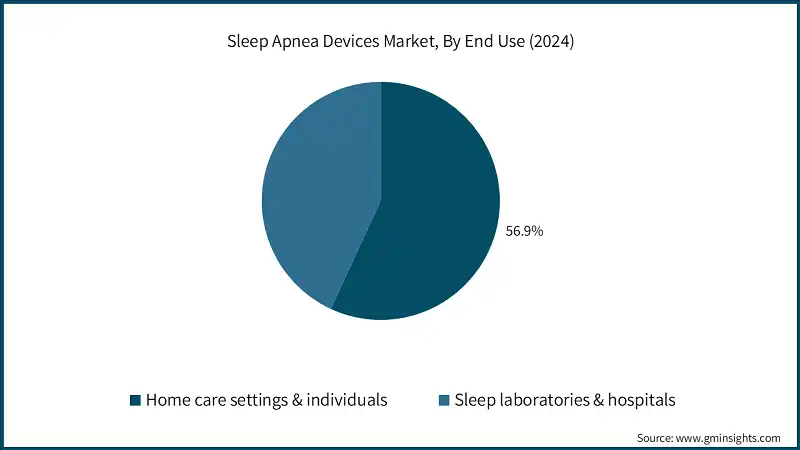
Based on end use, the sleep apnea devices market is classified into home care settings and individuals and sleep laboratories and hospitals. The home care settings and individuals segment dominated the market with a revenue share of 56.9% in 2024 and is expected to reach USD 8.9 billion within the forecast period.
- Home care is often a more cost-effective option compared to long-term treatment in healthcare facilities. This is particularly important in the region, where healthcare costs can be a barrier to accessing continuous treatment. By managing sleep apnea at home, patients can reduce expenses related to hospital stays and frequent doctor visits.
- Additionally, the availability of affordable sleep apnea devices and the expansion of insurance coverage for home-based treatments are making these options more accessible to a broader population.
- Furthermore, the expansion of telemedicine in the region is significantly boosting the demand for sleep apnea devices in home care settings. Through telemedicine, healthcare providers can remotely monitor patients' treatment progress and make timely adjustments to their therapy, enhancing the effectiveness of sleep apnea management.
- The sleep laboratories and hospitals segment was valued at approximately USD 3.1 billion in 2024, driven by the continued reliance on in-lab polysomnography for accurate diagnosis, availability of specialized sleep technicians, and the integration of advanced monitoring technologies that enhance diagnostic precision and patient care.
Looking for region specific data?
North America Sleep Apnea Devices Market
North America dominated the global market with the highest market share of 37.6% in 2024.
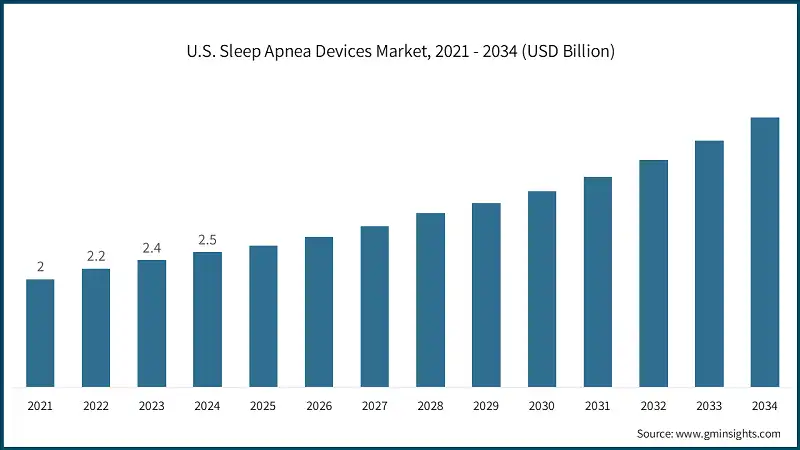
- The U.S. market was valued at USD 2 billion and USD 2.2 billion in 2021 and 2022, respectively. The market size reached USD 2.5 billion in 2024, growing from USD 2.4 billion in 2023, and is anticipated to grow at a CAGR of 7.4% between 2025 and 2034.
- North America holds a dominant position in the global sleep apnea devices market, driven by a high prevalence of sleep-disordered breathing, advanced healthcare infrastructure, and strong reimbursement frameworks. The region benefits from widespread awareness of sleep apnea and early adoption of both therapeutic and diagnostic technologies. Leading companies such as ResMed, BMC, and Drive DeVilbiss have a strong presence in the U.S. and Canada, offering a wide range of CPAP, BiPAP, and home sleep testing solutions. The integration of digital health platforms and remote monitoring tools has further strengthened the region’s leadership in sleep therapy innovation.
- The market in North America is also supported by a robust network of sleep clinics, hospitals, and home care providers, which ensures accessibility and continuity of care. Increasing focus on personalized treatment, AI-enabled diagnostics, and cloud-connected devices is expected to sustain growth in the coming years.
Europe Sleep Apnea Devices Market
Europe market accounted for USD 2.2 billion in 2024.
- Countries such as Germany, France, and the UK are key contributors, with strong investments in sleep laboratories and home-based care. The region has seen a rise in the adoption of portable CPAP devices and advanced diagnostic tools, driven by patient preference for convenience and comfort. Regulatory harmonization across the EU has also facilitated smoother market entry for global and regional players.
- The European market is characterized by a growing elderly population and a proactive approach to preventive healthcare, which supports early diagnosis and long-term management of sleep apnea. Technological innovation, particularly in wearable diagnostics and auto-adjusting therapy devices, is gaining traction. Moreover, partnerships between healthcare providers and device manufacturers are enhancing patient access and driving innovation in sleep therapy delivery.
Asia Pacific Sleep Apnea Devices Market
The Asia Pacific market is anticipated to grow at the highest CAGR of 9.2% during the analysis timeframe.
- Countries like China, India, Japan, and South Korea are witnessing rapid adoption of sleep apnea diagnostics and therapy solutions, particularly in urban centers. The shift toward home-based care and telemedicine is accelerating demand for portable and affordable CPAP devices, making sleep therapy more accessible to a broader population.
- Government initiatives to improve sleep health, coupled with growing investments in digital health and mobile diagnostics, are transforming the landscape in Asia Pacific. Local manufacturers and global players are expanding their footprint through strategic partnerships and product localization. As awareness continues to rise and healthcare access improves, the region is expected to play a pivotal role in shaping the future of the market.
Latin America Sleep Apnea Devices Market
The Latin America market is expected to experience robust growth over the analysis timeframe.
- Brazil and Mexico are the leading contributors, supported by expanding urban populations and rising demand for non-invasive treatment options. While the market is still developing, there is growing interest in home sleep testing and portable CPAP devices, especially among middle-income groups seeking affordable and convenient solutions.
- Challenges such as limited reimbursement coverage and uneven access to specialized care persist, but ongoing public health campaigns and private sector investments are helping bridge the gap. As diagnostic capabilities improve and awareness spreads beyond major cities, Latin America is expected to see steady growth in both therapeutic and diagnostic segments of the sleep apnea market.
Middle East and Africa Sleep Apnea Devices Market
The Middle East and Africa (MEA) market is expected to experience notable growth over the analysis timeframe.
- The region’s healthcare infrastructure is continually improving, particularly in urban areas where there is better access to specialized care. The availability of sleep centers and medical facilities equipped to diagnose and treat sleep apnea has facilitated the increased use of sleep apnea devices in the region.
Sleep Apnea Devices Market Share
Leading industry players such as ResMed, BMC, Drive DeVilbiss, FISHER & PAYKEL, and Philips hold around 75% of the market share in the competitive market. These companies maintain their leading position by combining strong product lines, business collaborations with healthcare providers, regulatory clearances, and consistent product innovation.
ResMed continues to lead the global sleep apnea devices market with its robust portfolio of cloud-connected CPAP and BiPAP systems, including the widely adopted AirSense and AirMini series. The company’s strategic focus on digital health integration, through platforms like myAir and AirView, enables remote monitoring, personalized therapy, and improved patient adherence.
BMC Medical has carved out a strong position in emerging markets by offering affordable, high-quality CPAP, BiPAP, and sleep diagnostic devices. Known for its compact and travel-friendly solutions, BMC is rapidly gaining traction as a cost-effective alternative to premium brands. The company’s emphasis on accessibility, combined with its expanding global distribution network, makes it a key player in democratizing sleep therapy.
Meanwhile, other key players such as NIHON KOHDEN, Cadwell, and Teleflex are reinforcing their market presence through specialized innovations and strategic expansion.
Sleep Apnea Devices Market Companies
A few of the prominent players operating in the sleep apnea devices industry include:
- Apnea Sciences
- Asahi KASEI
- BMC
- Cadwell
- Drive DeVilbiss
- DynaFlex
- FISHER & PAYKEL
- Glidewell
- natus
- NIHON KOHDEN
- Philips
- ResMed
- SomnoMed
- Teleflex
- WEINMANN
- ResMed
ResMed sets itself apart through its leadership in cloud-connected sleep therapy solutions and data-driven patient engagement. Its devices, such as the AirSense and AirMini series, are integrated with platforms like myAir and AirView, enabling real-time monitoring, personalized feedback, and remote therapy adjustments. ResMed’s commitment to digital health and AI-powered analytics supports improved adherence and long-term outcomes, while its global reach and scalable infrastructure make it a preferred choice across both clinical and homecare settings.
BMC Medical excels in delivering cost-effective, high-performance sleep apnea devices tailored for emerging markets and value-conscious consumers. Its product line includes compact CPAP and BiPAP systems with intuitive interfaces and auto-adjusting pressure capabilities. BMC’s emphasis on affordability, portability, and ease of use makes it a strong contender in regions with limited access to sleep therapy, while its expanding global distribution network reinforces its competitive positioning.
Drive DeVilbiss focuses on reliability and user-centric design in its sleep apnea solutions, offering a range of CPAP systems and accessories known for durability and simplicity. The company’s commitment to accessible sleep therapy and strong support infrastructure makes it a trusted provider in both institutional and homecare environments.
Sleep Apnea Devices Market Report Attributes
| Key Takeaway | Details |
|---|---|
| Market Size & Growth | |
| Base Year | 2024 |
| Market Size in 2024 | USD 7.3 Billion |
| Market Size in 2025 | USD 7.6 Billion |
| Forecast Period 2025 - 2034 CAGR | 7.8% |
| Market Size in 2034 | USD 15 Billion |
| Key Market Trends | |
| Drivers | Impact |
| Increasing incidence of sleep apnea and related comorbidities | Drives higher diagnosis rates and expands the patient pool for treatment. |
| Growing demand for portable, high-performance sleep apnea solutions | Boosts sales of compact CPAP/BiPAP devices and travel-friendly options. |
| Surging awareness of sleep apnea and sleep disorders | Encourages early screening and adoption of home-based diagnostic tools. |
| The rising aging population is amplifying demand | Increases prevalence of sleep apnea among the elderly, fueling device usage. |
| Technological advancements | Enhance device efficiency, comfort, and remote monitoring capabilities. |
| Pitfalls & Challenges | Impact |
| Lack of adherence to sleep apnea treatment | Reduces long-term therapy effectiveness and impacts market retention. |
| Product recalls and safety concerns | Undermines consumer trust and disrupts supply chains. |
| Opportunities: | Impact |
| Expansion into emerging markets | Unlocking new revenue streams through untapped patient populations. |
| AI and digital health integration | Enabling personalized therapy and improving diagnostic accuracy. |
| Market Leaders (2024) | |
| Market Leaders |
~40% market share |
| Top Players |
Collective Market Share ~75% |
| Competitive Edge |
|
| Regional Insights | |
| Largest Market | North America |
| Fastest growing market | Asia Pacific |
| Emerging countries | India, China, Japan, Brazil, South Africa |
| Future outlook |
|
What are the growth opportunities in this market?
Sleep Apnea Devices Industry News:
- In May 2023, Glidewell announced a new addition to its family of sleep solutions, the flexTAP mandibular advancement device (MAD). This product launch helped the company expand its business revenue.
- In June 2021, Cadwell announced a partnership with EnsoData, a healthcare artificial intelligence (AI) company dedicated to improving the lives of medical professionals and their patients. Cadwell integrated EnsoData’s EnsoSleep AI scoring solution by modifying its Easy III PSG software platform. This deeper integration enabled clinicians to spend less time on manual data analysis and focus more time on enhancing the patient care experience and improving treatment outcomes.
The sleep apnea devices market research report includes an in-depth coverage of the industry with estimates and forecasts in terms of revenue in USD Million and from 2021 - 2034 for the following segments:
Market, By Product
- Therapeutics
- Airway clearance systems
- Positive airway pressure (PAP) devices
- Continuous positive airway pressure (CPAP) devices
- Bilevel positive airway pressure (BiPAP) devices
- Automatic positive airway pressure (APAP) devices
- Adaptive servo-ventilation (ASV) devices
- Oral appliances
- Mandibular advancement devices
- Tongue-retaining devices
- Rapid maxillary expansion
- Mouth guards
- Other therapeutics
- Diagnostics
- Polysomnography (PSG) device
- Ambulatory PSG devices
- Clinical PSG devices
- Actigraphy systems
- Pulse oximeters
- Home sleep testing (HST) devices
- Type 2
- Type 3
- Type 4
- Respiratory polygraph
- Polysomnography (PSG) device
Market, By End Use
- Home care settings and individuals
- Sleep laboratories and hospitals
The above information is provided for the following regions and countries:
- North America
- U.S.
- Canada
- Europe
- Germany
- UK
- France
- Italy
- Spain
- Netherlands
- Asia Pacific
- China
- Japan
- India
- Australia
- South Korea
- Latin America
- Brazil
- Mexico
- Argentina
- Middle East and Africa
- South Africa
- Saudi Arabia
- UAE
Frequently Asked Question(FAQ) :
What is the market size of the sleep apnea devices market in 2024?
The market size was USD 7.3 billion in 2024, driven by the rising prevalence of sleep apnea, increasing demand for portable solutions, and growing awareness of sleep disorders.
What is the projected value of the sleep apnea devices market by 2034?
The market is expected to reach USD 15 billion by 2034, growing at a CAGR of 7.8% from 2025 to 2034, fueled by technological advancements and the aging population.
What is the projected size of the sleep apnea devices market in 2025?
The market is expected to reach USD 7.6 billion in 2025.
How much revenue did the therapeutics segment generate?
The therapeutics segment accounting for 62.9% of the market share, and is projected to exceed USD 9.8 billion by 2034.
What was the valuation of the home care settings and individuals segment?
The home care settings and individuals segment held a 56.9% market share, and is expected to reach USD 8.9 billion by 2034.
Which region leads the sleep apnea devices market?
North America dominated the market with a 37.6% share in 2024. The U.S. market alone was valued at USD 2.5 billion in 2024, driven by advanced healthcare infrastructure and high awareness levels.
What are the upcoming trends in the sleep apnea devices market?
Key trends include the integration of cloud connectivity, AI-powered analytics, and remote monitoring in devices, along with a growing preference for portable solutions for home-based care.
Who are the key players in the sleep apnea devices market?
Prominent players include Apnea Sciences, Asahi KASEI, BMC, Cadwell, Drive DeVilbiss, DynaFlex, Fisher & Paykel, Glidewell, Natus, Nihon Kohden, and Philips.
Sleep Apnea Devices Market Scope
Related Reports