Summary
Table of Content

Skincare Ingredients Market
Get a free sample of this report
Form submitted successfully!
Error submitting form. Please try again.
Thank you!
Your inquiry has been received. Our team will reach out to you with the required details via email. To ensure that you don't miss their response, kindly remember to check your spam folder as well!
Request Sectional Data
Thank you!
Your inquiry has been received. Our team will reach out to you with the required details via email. To ensure that you don't miss their response, kindly remember to check your spam folder as well!
Form submitted successfully!
Error submitting form. Please try again.
Skincare Ingredients Market Size
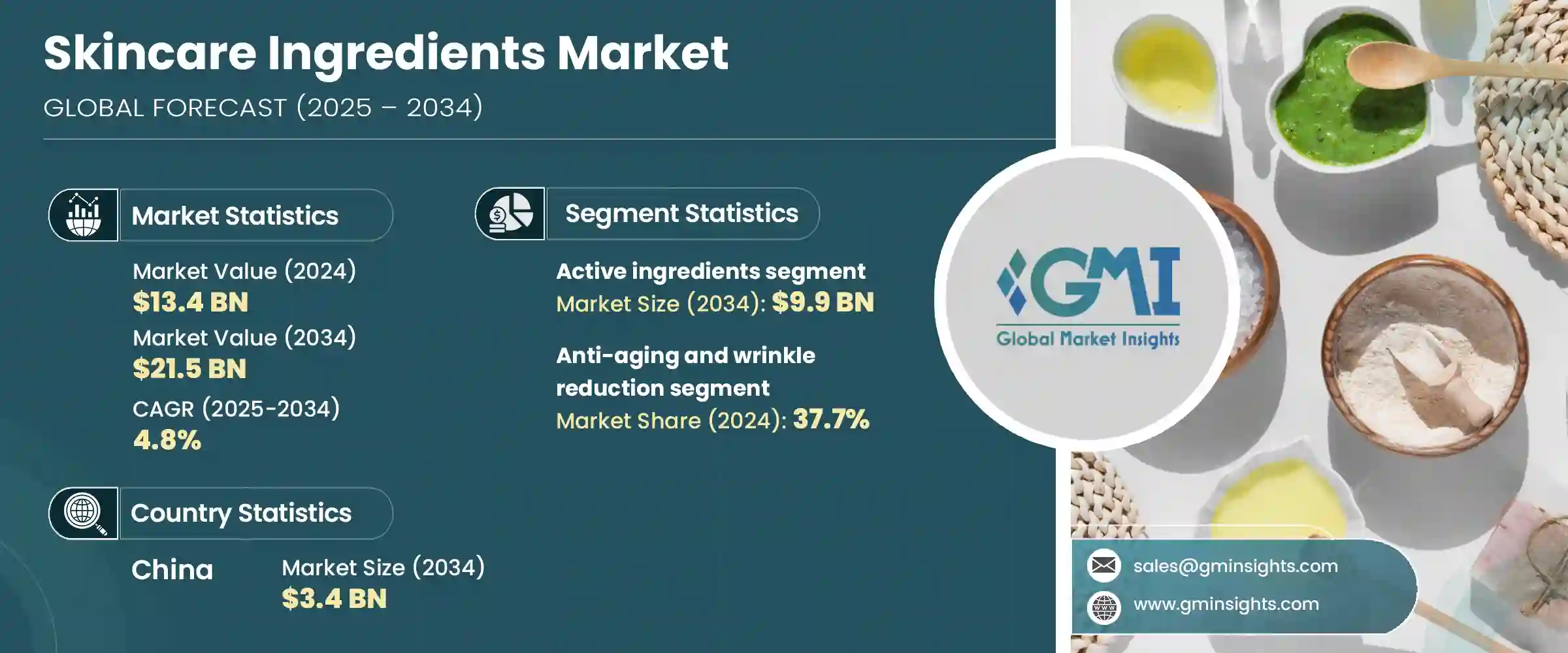
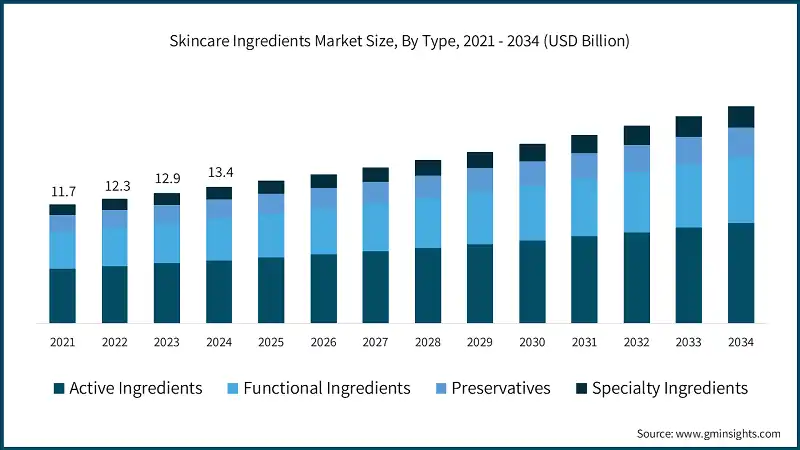
The global skincare ingredients market was estimated at USD 13.4 billion in 2024. The market is expected to grow from USD 14.1 billion in 2025 to USD 21.5 billion in 2034, at a CAGR of 4.8%. The remarkable growth indicates increasing demand for premium, multi-functional, and clean-label formulations in both developed and developing economies.
Skincare Ingredients Market Key Takeaways
Market Size & Growth
- 2024 Market Size: USD 13.4 Billion
- 2034 Forecast Market Size: USD 21.5 Billion
- CAGR (2025–2034): 4.8%
Key Market Drivers
- Rising demand for natural and clean label ingredients.
- Innovation in bioactive and functional skincare components.
- Expansion of personalized and targeted skincare solutions.
Challenges
- Complex regulatory compliance across global markets.
- High cost of advanced and biotech-derived ingredients.
Opportunity
- Growing demand for microbiome-friendly skincare.
- Rising adoption of sustainable and upcycled ingredients.
- Integration of AI and data analytics in ingredient formulation.
- Expansion into emerging markets with rising disposable incomes.
Key Players
- Market Leader: BASF SE led with over 11.3% market share in 2024.
- Leading Players: Top 5 players in this market include BASF SE, Croda International Plc, Evonik Industries AG, Symrise AG, Ashland Corporation, which collectively held a market share of 43.5% in 2024.
Get Market Insights & Growth Opportunities
The market growth is fueled by an increase in upgraded consumer spending, greater awareness of skin health, and an evident shift in preference towards more natural or biotechnologically formulated skin care products. The growth of personalized skincare options and science-based formulations is also contributing to market growth.
North America comprises about 28% of the overall global market value, supported by traditionally high consumer buying power, healthy cosmeceuticals/channel mix, and healthy innovation pipelines. Within the U.S. alone, the sophistication of dermatological products is high, with a strong per capita spend on skin care driving demand for ingredients.
The Asia Pacific region represents the fastest growing market and is estimated to be about 38% of the global amount of skin care products consumed. Countries such as South Korea, Japan, China, and India are seeing healthy growth for skin care products produced and purchased domestically, driving ingredient demand. The K-beauty and J-beauty trends have also popularized the use of innovative actives in the region.
Key growth drivers for the skincare ingredients market include increasing demand for natural and organic skincare actives, which have increased in usage share by over 50% since 2021, and over 40% uptake in use of biotechnology enabled peptides and encapsulated delivery forms as brands pivot to efficacy driven claims and cutting-edge penetration technologies.
The market is also experiencing positive growth thanks to the clean beauty and ingredient transparency movements with over 60% of new products launched this year incorporating "free-from" or minimalist ingredient claims. Additionally, the rise in digital-native consumers is leading to more INCI list research attention paid to cosmetic ingredients that drive brands to highlight and emphasize brands that include premium, safe, and clinically proven ingredients.
Looking ahead by 2034, the skincare ingredients industry is expected to ride a strong upward trend based on continued innovation and increased disposable incomes of emerging markets, continuing rise in consumer focus on temporary and functional skincare. Thus, making it a prominent market growth engine in the larger personal care marketplace with valuable opportunities for ingredient manufacturers along the value chain.
To get key market trends
Skincare Ingredients Market Trends
- Increase of biotechnology-derived ingredients: The compound skincare ingredients industry is seeing a large increase in biotechnology-determined actives growing at ~11% CAGR reaching greater than USD 12 billion by 2030. This growth is being driven by rising requests for lab-generated peptides, growth factors and probiotic ferments offering specific benefits including anti-aging, brightening and support for microbiome.
- Ingredient manufacturers are increasing investments in fermentation technologies and recombinant protein synthesis as consumers place increasing importance on clinical efficacy and proprietary molecules. This trend advanced quickly starting in 2018 and is expected to reach substantial adoption in the mainstream by 2028–2030 and thereby revolutionizing how lots of brands strategize for biotech within their skincare formulations.
- Clean label & ingredient transparency movement: Clean beauty and ingredient transparency continue to drive product development, with more than 60% of skincare new launches in 2024 promoting "clean," "free-from," or "reduced ingredient" INCI lists. Consumers are now proactively checking labels to avoid sulfates, parabens, silicones and microplastics, with 72% of consumers around the globe confirming they check for the safety of ingredients before purchasing. Eventually, regulatory changes will drive this, with the EU calling for reformulation due to REACH and the FDA increasing attention on regulation, brands will be forced to follow through the changes.
- Increased demand for hybrid and multifunctional ingredients: The market has also seen a strong shift toward hybrid and multifunctional ingredients now that nearly 68% of top sellers in skincare SKUs feature multifunctional or hybrid nature, changing the very philosophies of formulation. Given the strong desire for simpler routines, consumers are continuously looking for products that offer multiple benefits at once, such as, anti-aging, hydration, and barrier repair, to name a few; to eliminate multi-step routines.
- Brands are sourcing ingredients like niacinamide, ceramides, and adaptogens as they provide clinically validated multi-benefit results and they allow to command a premium price. Although the demand for multifunctional ingredients gained significant momentum during the post-pandemic era, beginning in 2021, demand will likely become standard conduct by 2027-2028 in terms of product formulation for efficient and effective outcomes.
- Growth of personalization and technology-based formulations: Personalized skincare is becoming a growing segment spending, and it seems to be taking off with the rise of ingredient customization platforms and DNA or skin microbiome based formulations which are expected to grow at a 14% CAGR by 2030. As a result, a new generation of consumers who are willing to pay more for personalized skin care are creating fast growth opportunity for brands - nearly 35% of those under 35 would like to pay more for products formulated for their unique skin care needs. From AI diagnostics to smart encapsulation and modular ingredient systems, tech start-ups and legacy cosmetic companies alike are capitalizing on the opportunity to grow the sector.
Skincare Ingredients Market Analysis
Learn more about the key segments shaping this market
Based on type, the market is divided into active ingredients, functional ingredients, preservatives, and specialty ingredients. Active ingredients segment generated a revenue of USD 6.2 billion in 2024 and USD 9.9 billion in 2034 at a CAGR of 4.8%.
- Active ingredients rule the operational market of skin-care ingredients because they have a quantity of measurable beneficial effects on skin health and aging and appearance.
- Everybody loves antioxidants and vitamins (vitamin C, E, and ferulic acid especially). Consumers are just loving these products and the potential of offering some level of protection/even-glow. And because of oxidation, these specific products are usually marked up heavily, as they require advanced forms of stabilization and encapsulation. There has been so much R&D around this as well. Pollution and skin stress = interesting times right now.
- Peptides and growth factor mimetics are at the forefront of high-efficacy given their utility in anti-aging and skin-firming products. As the cost of biotechnologically driven synthesis declines, the resin of peptides is increasing as a common ingredient, even at mass-market scale. Retinoids continue to be the gold standard of anti-aging; however, the consumer concerns of irritation have led many to search for more gentler products. This has led to innovations like granactive retinoids and bakuchiol to fill the void of irritation concerns.
- Ceramides and botanicals will grow on the flavor of trends like "skinimalism" and "microbiome-friendly". Clients want plants and plant-based extracts that will offer multi-functional benefits and functionality, and ceramides that will help to restore the skin barrier in addition to offering hydration benefits.
- In all, there is a wonderful variety, with clear clinical research demonstrating outcomes, but consumers can relate better to the active ingredients first, as we can better actualize product efficacy to outcomes they can see. Active ingredients will continue to capture the greatest market share; they work right into consumer experience.
Learn more about the key segments shaping this market
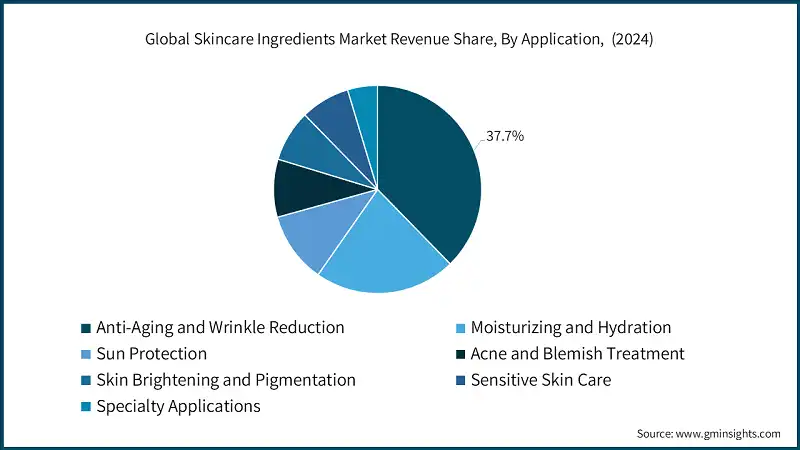
Based on application, the skincare ingredients market is divided into anti-aging and wrinkle reduction, moisturizing and hydration, sun protection, acne and blemish treatment, skin brightening and pigmentation, sensitive skin care, and specialty applications. In 2024, anti-aging and wrinkle reduction segment held major market share, accounting for 37.7% share.
- Demand in the anti-aging and wrinkle reduction market is the largest category in skincare ingredients. This segment is growing at an estimated CAGR of 6.1%, spurred by a growing aging demographic and younger consumers seeking to prevent signs of aging. In total, serums comprise approximately 42% of volumes in the anti-aging category by product type, typically with higher concentrations of actives and positioned at a premium.
- Face creams and moisturizers comprise a similar share at roughly 38%, also driven by daily use across all ages. When evaluating the market in the content of the PESTLE environment, socio-demographics factors are likely to sustain ongoing demand and contribute to escalating market opportunity. For example, the population over 50 years of age is expected to double by 2030. Environmental factors such as pollution and UV are increasingly penetrating to inform consumers to consider protective and reparative product formulations, further increasing interest in brands using antioxidants and peptides in anti-aging formulations.
- From a SWOT perspective, the market is in a translator of strong opportunity for multifunctional and dermo cosmetics positioned products, however, there are threats posed from consumer skepticism and queries concerning the longevity of claims, applying pressure and expectations for brands to provide true efficacy validation. Using Porter's framework, buyer power is moderate, but ingredient suppliers compete far more aggressively with each other.
- The competitive environment is attaching an extremely high level of importance and urgency to innovation in areas such as slow-release retinoids or biomimetic peptides which offer new and improved propositions relative to existing active ingredients. Overall, this activity, along with application trends and the demand for R&D of new delivery systems and clinically supported active ingredient profiles in specific categories, underlines ongoing or accentuated market leadership status of the anti-aging and wrinkle reduction market in the category of skincare ingredients.
Looking for region specific data?
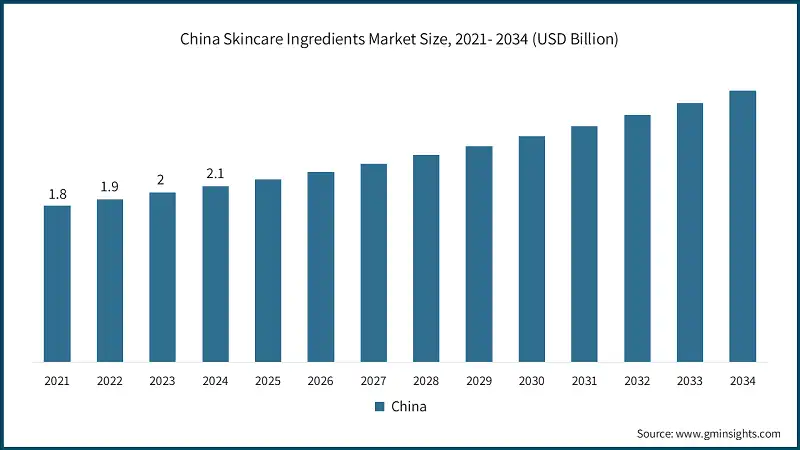
China skincare ingredients market generated a revenue of USD 2.1 billion in 2024. China market is projected to grow at a CAGR of 5% reaching USD 3.4 billion by 2034 as it is driven by increased the consumption.
- China's market is thriving as local brands gain traction, increasing to share more than 50% of the domestic personal care market by 2023. "C-Beauty" growth has boosted demand for indigenous, TCM-originated actives (for example, ginseng, pearl powder), favoring ingredient innovators and formulators. Sustainability and ingredient openness—due to CSAR rules—have driven investment in green chemistry and biotech. In addition, e-commerce through Xiaohongshu and livestreaming, now representing approximately 10% of beauty sales, continues to accelerate ingredient innovation and brand awareness.
- The top ingredient suppliers from China are Bloomage Biotech (hyaluronic acid), Kangmei Pharmaceutical (TCM actives), BASF China, Croda China, and Clariant China. These five players together command about 60–65% of the share of ingredients being sourced, indicating a close oligopoly among biotech and international suppliers. Bloomage's leadership traces its roots back to its early mass fermentation scale and FDA approvals for HA exports.
- Bloomage surpasses competitors with deep vertical integration—operating HA fermentation plants, clinical-grade cleanliness qualifications, and worldwide distribution. It focuses on export-grade compliance (e.g., US GRAS status), making it a stable global supplier. Kangmei takes advantage of China's TCM roots and familiar domestic regulation, providing herbal derivative actives in volume. These industry leaders stay ahead because of sheer size, regulatory expertise, and R&D early-mover benefits.
- Porter's Five Forces identifies moderate supplier power (limited number of biotech innovators), high buyer power (brands demanding efficacy and value for money), and intense rivalry. The top five markets continue to be fragmented but faces cost-efficiency pressure in mid-tier companies. The regulatory landscape is changing—CSAR imposes barriers to entry but frees up premium ingredients' growth, changing the rivalry from compliance to innovation.
The skincare ingredients market in the U.S. is expected to experience promising growth from 2025 to 2034 due to growth of increasing consumption within the country.
- In the U.S., the ingredients market for skin care is influenced by cosmeceuticals innovation, clean-labeling, and regulatory impact from MoCRA. The segment of cosmeceutical ingredients—peptides, retinol, and plant actives—matured to command over 80% of North America's market in 2024. Consumers look for clinically proven, dermatologist-recommended ingredients, spurring R&D and premium ingredient adoption.
- Key players are BASF, Dow, Croda, Clariant, and Evonik—leading five companies who, collectively, hold around 55% market share in the US personal-care ingredient sector. They rule with worldwide presence, deep portfolios, and technical service, while mid-scale biotech ingredient manufacturers and DTC ingredient brands control specialty niches.
- BASF and Dow use mass-scale production, innovative sustainable ingredient introductions, and alliances with beauty conglomerates. Croda emphasizes natural derivatives and bio-based innovation. These dominators reinvest in sustainability certifications, digital platforms, and clinical testing to protect margins and relevance.
- The U.S. market is moderately consolidated with five companies leading, but Porter's assessment finds high barriers due to regulation compliance (MoCRA), and high capital requirements for pilot-scale biotech—all benefiting incumbents. Yet smaller nimble biotech companies develop next-generation ingredients (AI-designed peptides, nano-encapsulation), selling innovation to large companies. The market is still open, but long-term consolidation towards R&D-capable, compliance-savvy companies is likely.
Skincare Ingredients Market Share
- The top 5 companies in the market are BASF SE, Croda International, Ashland Inc., Evonik Industries AG, and Symrise AG. Global market is moderately concentrated with few dominant players who are extremely competitive with excellent R&D capabilities, extensive ingredient portfolios, and international supply chains.
- Major manufacturers are always at the cutting edge when it comes to market presence and innovation. They remain competitive by creating multifunctional and adjustable ingredient solutions that are formulated for anti-aging, hydration, and skin protection end uses. Dominant players compete aggressively based on product performance, clean-label, technical support, and formulation expertise.
- Strategically, companies are vigorously pursuing mergers, acquisitions, and joint ventures to drive ingredient functionality and geographic expansion. For example, players are acquiring biotech companies to obtain access to advanced fermentation technologies and sustainable sourcing methodologies.
- Innovation remains a primary driver of competition—companies are launching new bioactive complexes, encapsulated actives, and multifunctional ingredients that align with changing clean beauty trends. Pricing strategies are increasingly aligned with ingredient purity, efficacy, and compliance, particularly in premium and cosmeceutical segments. The focus on natural, vegan, and eco-certified ingredients has also driven strategic collaborations between ingredient suppliers and beauty companies to co-develop proprietary actives, which reinforce long-term competitive positioning in the market.
Skincare Ingredients Market Companies
- BASF SE: BASF has a diversified personal care portfolio that includes actives, emulsifiers, UV filters, and polymers. BASF is focused on innovative sustainable ingredients and uses the title of "Care Creations" to show their commitment to collaboratively develop solutions with partners. BASF is well known for botanical actives such as Purisoft, and complex formulations for sensitive skin, targeted towards health-conscious consumers.
- Croda International Plc: Croda is committed to premium active ingredients through its subsidiaries, "Sederma" and "Iberchem". Croda emphasizes materials from biotechnology and sustainable chemistry, with several prominent products for antiaging peptides and enhancers for the skin barrier. Croda takes a stable approach to ethically sourced and transparent supply chains that prioritize clean beauty efforts.
- Evonik Industries AG: Evonik has a specialization in skin-compatible emulsifiers as well as an innovative delivery system. Evonik has some skin microbiome technologies and uses eco-friendly sustainable formulations under the "Care Solutions" umbrella. Evonik also put targeted investments into fermentation and AI product assessments to separate from others when it comes to functional and sensory ingredients.
- Symrise AG: Symrise uses active substances, UV protectants, and sensory enhancers, forms, and attractions from natural ingredient chemistry. The company has partnered with cosmetic brands to create solutions that are regional, while emphasizing speed-to-market, traceability, and natural efficacy that can meet changing customer needs.
- Ashland Corporation: Ashland emphasizes botanical and biofunctional components, supported by a solid dedication to innovation and transparency. Its line of preservatives, “Optiphen,” and actives, “Phyteq,” cater to the need for mild, multifunctional formulations. The company allocates resources to green science and consumer-focused research and development centers worldwide.
Skincare Ingredients Market Report Attributes
| Key Takeaway | Details |
|---|---|
| Market Size & Growth | |
| Base Year | 2024 |
| Market Size in 2024 | USD 13.4 Billion |
| Forecast Period 2025 - 2034 CAGR | 4.8% |
| Market Size in 2034 | USD 21.5 Billion |
| Key Market Trends | |
| Drivers | Impact |
| Rising demand for natural and clean label ingredients | Boosts growth in botanical extracts, organic actives, and eco-certified formulations |
| Innovation in bioactive and functional skincare components | Enhances product efficacy and drives premiumization across skincare categories |
| Expansion of personalized and targeted skincare solutions | Increases demand for customized ingredients and AI-driven formulation technologies |
| Pitfalls & Challenges | Impact |
| Complex regulatory compliance across global markets | Delays product launches and increases R&D and documentation burdens for manufacturers |
| High cost of advanced and biotech-derived ingredients | Limits scalability and accessibility, especially for mass-market and emerging brands |
| Opportunities: | Impact |
| Growing demand for microbiome-friendly skincare | Drives innovation in prebiotic, probiotic, and postbiotic ingredient formulations |
| Rising adoption of sustainable and upcycled ingredients | Encourages circular economy practices and appeals to environmentally conscious consumers |
| Integration of AI and data analytics in ingredient formulation | Enables hyper-personalized skincare solutions and faster product development cycles |
| Expansion into emerging markets with rising disposable incomes | Opens new revenue streams for ingredient suppliers targeting localized skin concerns and preferences |
| Market Leaders (2024) | |
| Market Leaders |
11.3% Market Share |
| Top Players |
Collective Market Share in 2024 is 43.5% |
| Competitive Edge |
|
| Regional Insights | |
| Largest Market | Asia Pacific |
| Fastest Growing Market | Asia Pacific |
| Emerging Countries | India, Vietnam, Philippines, Indonesia, Brazil, Egypt |
| Future outlook |
|
What are the growth opportunities in this market?
Skincare Ingredients Industry News
- In May 2023, BASF collaborated with BEAUTYSTREAMS to improve its D’lite digital service focused on innovation in personal care ingredients and trend prediction.
- In July 2023, Croda International purchased Solus Biotech, obtaining biotechnology-based actives for cosmetics and pharmaceuticals.
- In January 2023, Evonik established the Evonik Skin Institute focused on researching active compounds and cosmetic solutions, enhancing its R&D capabilities.
- In November 2023, Ashland launched Perfectyl biofunctional, an extract from chamomile aimed at easing facial lines, showcasing its commitment to plant-derived actives.
The skincare ingredients market research report includes in-depth coverage of the industry, with estimates & forecast in terms of revenue (USD Billion) & volume (Tons) from 2021 to 2034, for the following segments:
Market, By Type
- Active ingredients
- Anti-aging agents
- Retinoids and derivatives
- Peptides and proteins
- Alpha hydroxy acids (AHAS)
- Beta hydroxy acids (BHAS)
- Moisturizing agents
- Hyaluronic acid
- Ceramides
- Glycerin and humectants
- UV protection agents
- Chemical UV filters
- Physical UV filters
- Skin brightening agents
- Vitamin C and derivatives
- Niacinamide
- Kojic acid
- Acne treatment agents
- Anti-aging agents
- Functional ingredients
- Emulsifiers
- Surfactants
- Thickeners and rheology modifiers
- Emollients
- Conditioning agents
- Preservatives
- Traditional preservatives
- Parabens
- Phenoxyethanol
- Natural preservatives
- Multifunctional preservatives
- Traditional preservatives
- Specialty ingredients
- Botanical extracts
- Marine-derived ingredients
- Biotechnology-derived ingredients
- Probiotics and prebiotics
Market, By Source
- Natural and organic ingredients
- Plant-based extracts
- Marine-derived ingredients
- Mineral-based ingredients
- Certified organic ingredients
- Synthetic ingredients
- Laboratory-synthesized compounds
- Nature-identical ingredients
- Petrochemical-derived ingredients
- Biotechnology-derived ingredients
- Fermentation-derived ingredients
- Cell culture-derived ingredients
- Enzymatically produced ingredients
- Upcycled and circular ingredients
- Agricultural waste-derived
- Food industry by-products
- Marine waste utilization
Market, By Application
- Anti-aging and wrinkle reduction
- Face creams and serums
- Eye care products
- Neck and décolletage products
- Moisturizing and hydration
- Daily moisturizers
- Intensive hydration treatments
- Overnight repair products
- Sun protection
- Daily SPF products
- High protection sunscreens
- After-sun care
- Acne and blemish treatment
- Spot treatments
- Daily acne care
- Post-acne repair
- Skin brightening and pigmentation
- Dark spot correctors
- Overall brightening products
- Melasma treatment
- Sensitive skin care
- Gentle cleansing
- Barrier repair
- Redness reduction
- Specialty applications
- Dermocosmetics
- Men's skincare
- Baby and children's products
Market, By Distribution Channel
- Direct sales
- Manufacturer to brand direct
- Technical sales teams
- Key account management
- Distributors and wholesalers
- Regional distributors
- Specialty chemical distributors
- Multi-line distributors
- Online B2B platforms
- Specialized ingredient marketplaces
- Chemical trading platforms
- Direct manufacturer portals
- Trade shows and exhibitions
- In-cosmetics events
- Regional trade shows
- Virtual exhibition platforms
The above information is provided for the following regions and countries:
- North America
- U.S.
- Canada
- Europe
- Germany
- UK
- France
- Spain
- Italy
- Rest of Europe
- Asia Pacific
- China
- India
- Japan
- Australia
- South Korea
- Rest of Asia Pacific
- Latin America
- Brazil
- Mexico
- Argentina
- Rest of Latin America
- Middle East and Africa
- Saudi Arabia
- South Africa
- UAE
- Rest of Middle East and Africa
Frequently Asked Question(FAQ) :
What is the market size of the skincare ingredients industry in 2024?
The global market was estimated at USD 13.4 billion in 2024.
What is the projected value of the skincare ingredients market by 2034?
The market is expected to reach USD 21.5 billion by 2034, at a CAGR of 4.8%, driven by increasing demand for premium, multi-functional, and clean-label formulations.
What is the projected size of the skincare ingredients market in 2025?
The market is expected to reach USD 14.1 billion in 2025.
How much revenue did the active ingredients segment generate?
Active ingredients segment generated a revenue of USD 6.2 billion in 2024.
What was the market share of anti-aging and wrinkle reduction segment?
The anti-aging and wrinkle reduction segment held 37.7% market share in 2024.
What is the market size of China's skincare ingredients market?
China skincare ingredients industry generated a revenue of USD 2.1 billion in 2024 and is projected to reach USD 3.4 billion by 2034 at a CAGR of 5%.
What are the upcoming trends in the skincare ingredients industry?
Key trends include growth in biotechnology-derived ingredients, with biotechnology-determined actives growing at 11% CAGR reaching greater than USD 12 billion by 2030, driven by lab-generated peptides, growth factors, and probiotic ferments.
Who are the key players in the skincare ingredients market?
Key players include BASF SE, Croda International Plc, Evonik Industries AG, Symrise AG, and Ashland Corporation.
Skincare Ingredients Market Scope
Related Reports