Summary
Table of Content

Silicon Photonics for Vehicle Communication Market
Get a free sample of this report
Form submitted successfully!
Error submitting form. Please try again.
Thank you!
Your inquiry has been received. Our team will reach out to you with the required details via email. To ensure that you don't miss their response, kindly remember to check your spam folder as well!
Request Sectional Data
Thank you!
Your inquiry has been received. Our team will reach out to you with the required details via email. To ensure that you don't miss their response, kindly remember to check your spam folder as well!
Form submitted successfully!
Error submitting form. Please try again.
Silicon Photonics for Vehicle Communication Market Size
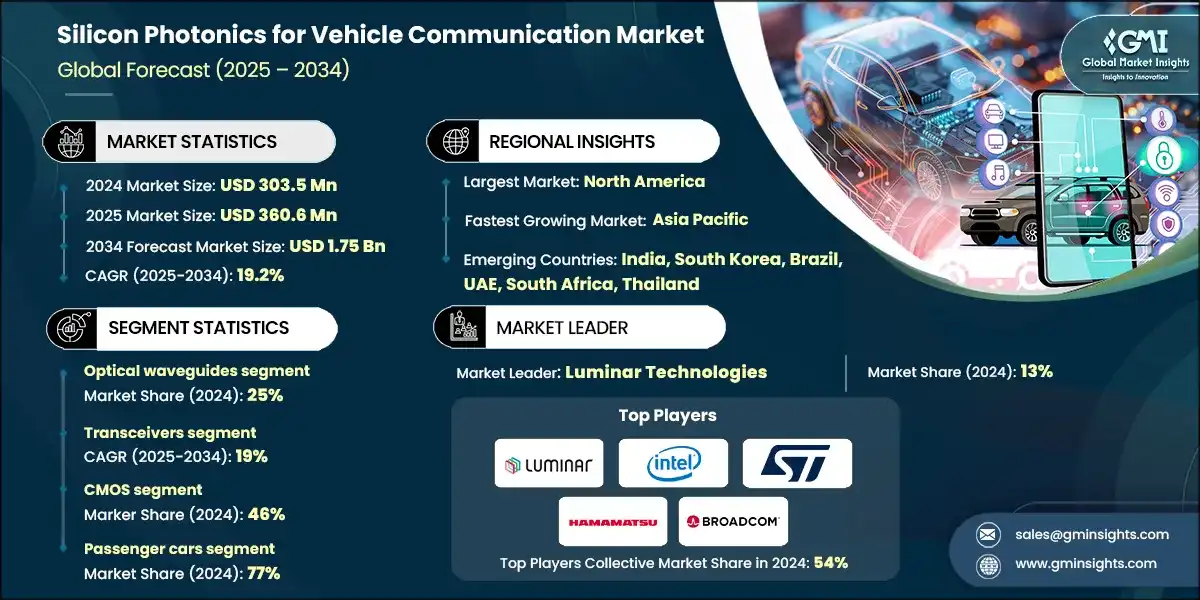
The global silicon photonics for vehicle communication market was estimated at USD 303.5 million in 2024. The market is expected to grow from USD 360.6 million in 2025 to USD 1.75 billion in 2034, at a CAGR of 19.2%, according to latest report published by Global Market Insights Inc.
To get key market trends
Silicon photonics is a technology that supports light-based devices such as lasers, modulators, and detectors on silicon chips. In automotive applications, silicon photonic devices are increasingly being used in components and communication systems for vehicles with both vehicle-to-vehicle (V2V), vehicle-to-infrastructure (V2I) and vehicle-to-everything (V2X) communication systems.
They are also being utilized to support LiDAR sensors and faster in-vehicle data transfer rates. All advanced developments around advanced driver assistance systems (ADAS) and autonomous driving are significant areas where silicon photonics provide a better bandwidth, lower latency and more energy efficiency than traditional electronic technologies.
The key factors driving this market are the expansion of autonomous and semi-autonomous vehicles, which need sophisticated sensing and communication devices. Silicon photonics-based LiDAR systems using frequency modulated continuous wave (FMCW) techniques provide greater range detection and velocity measurement compared to time-of-flight systems widely used today, which are particularly critical for high-speed driving and urban driving conditions.
Similarly, as bandwidth demand increases within vehicles (i.e., HD cameras, sensors and infotainment systems), automotive companies need to begin exploring photonic interconnects in place of copper wiring, which is heavier and limits the amount of data that can be sent over a wiring harness.
The market trends currently indicate a move to solid-state LiDARs that utilize silicon photonics for steering and detecting light, eliminating mechanical movement to create smaller, more rugged, and lower-cost sensor modules. An additional market trend is the integration of sensing and communication functions, with photonic devices being engineered to provide many functions, making systems simpler and facilitating speed in decision-making, which is especially valuable for autonomous driving.
North America continues to lead in the silicon photonics for vehicle communication market. Europe is also making significant strides, with substantial government-backed investments aimed at advancing next-generation photonics manufacturing and integrating photonics into the automotive industry. Meanwhile, the Asia-Pacific region particularly China is emerging as a major consumer and manufacturer of photonics-based automotive systems. Chinese OEMs have started incorporating LiDAR technology into their vehicles to support advanced navigation and enhanced safety features.
For instance, LightIC launched an FMCW LiDAR system for automotive applications with a metric detection range of over 300 meters as well as an instantaneous velocity measurement. Aeva Technologies produced a silicon photonics-based LiDAR solution with a processing chipset developed in-house that was going to be utilized by commercial vehicle manufacturers.
Silicon Photonics for Vehicle Communication Market Report Attributes
| Key Takeaway | Details |
|---|---|
| Market Size & Growth | |
| Base Year | 2024 |
| Market Size in 2024 | USD 303.5 Million |
| Market Size in 2025 | USD 360.6 Million |
| Forecast Period 2025 - 2034 CAGR | 19.2% |
| Market Size in 2034 | USD 1.75 Billion |
| Key Market Trends | |
| Drivers | Impact |
| Growing ADAS and autonomous systems need high-speed data transfer | Boosts demand for silicon photonics in sensor and processing systems. |
| V2X and in-vehicle networks require low-latency, high-reliability links | Accelerates adoption in automotive communication infrastructure. |
| Power-efficient communication is critical for EVs and connected cars | Increases value proposition of silicon photonics over traditional electronics. |
| Advancements in integration enable robust automotive-grade solutions | Reduces technical barriers, expanding market feasibility. |
| CASE (Connected, Autonomous, Shared, Electric) trends expand demand | Drives broad and sustained market growth across vehicle types. |
| Evolving safety and performance standards push tech adoption | Creates regulatory pull and faster OEM adoption cycles. |
| Pitfalls & Challenges | Impact |
| High development and manufacturing costs hinder scalability | Limits adoption to premium segments or delays mainstream rollout. |
| Integration and reliability challenges in harsh vehicle environments | Increases risk and slows down qualification timelines. |
| Opportunities: | Impact |
| LiDAR integration offers performance and cost improvements | Opens large-scale adoption potential in autonomous vehicle stacks. |
| Optical interconnects can simplify vehicle architecture | Enables cost, weight, and complexity reduction, improving system design. |
| Co-packaged optics enable compact, energy-efficient designs | Enhances performance while aligning with automotive packaging needs. |
| Regulatory and consumer push boosts demand for advanced comms | Drives market expansion through policy and brand differentiation. |
| Market Leaders (2024) | |
| Market Leaders |
13% market share |
| Top Players |
Collective market share in 2024 is 54% |
| Competitive Edge |
|
| Regional Insights | |
| Largest Market | North America |
| Fastest growing market | Asia Pacific |
| Emerging countries | India, South Korea, Brazil, UAE, South Africa, Thailand |
| Future outlook |
|
What are the growth opportunities in this market?
Silicon Photonics for Vehicle Communication Market Trends
The market for silicon photonics in vehicle communications is undergoing significant transformation, driven by advances in integration, efficiency and automotive network architectures. One of the most prominent trends is the shift towards production on an industrial scale.
Silicon photonics is moving from R&D to high-volume production, particularly through initiatives such as the EU-backed Starlight project. The program, led by STMicroelectronics, focuses on developing 300 mm silicon photonics production lines suitable for high-bandwidth automotive applications such as LiDAR and vehicle-to-everything (V2X) communications.
A parallel trend is the simplification of networks in vehicles. As modern vehicles become increasingly software-defined, the amount of data exchanged between sensors, control units and displays has grown exponentially. Manufacturers are actively exploring high-speed optical connections to reduce the weight, complexity and cost associated with traditional copper wiring. Companies such as Ethernovia and Marvell are working on high-speed Ethernet transceivers for cars that act as enablers for the widespread use of photonics.
Another major area of development is the integration of silicon photonics into advanced sensor systems, especially solid-state LiDAR. Photonic integrated circuits (PICs) are used to replace bulky optical assemblies, leading to smaller, more power-efficient and cost-effective solutions for vehicle perception systems. Solid-state LiDAR not only increases spatial resolution and range but also contributes to the long-term reliability of autonomous driving technologies.
In terms of performance and reliability, there is increasing emphasis on developing photonic devices that can operate under the harsh conditions typical of automotive environments – extreme temperatures, vibrations and electromagnetic interference. Considerable academic and industrial research is directed towards improvements in waveguide design, switching efficiency and energy consumption, all of which are essential to meet stringent automotive standards.
Silicon Photonics for Vehicle Communication Market Analysis
Learn more about the key segments shaping this market
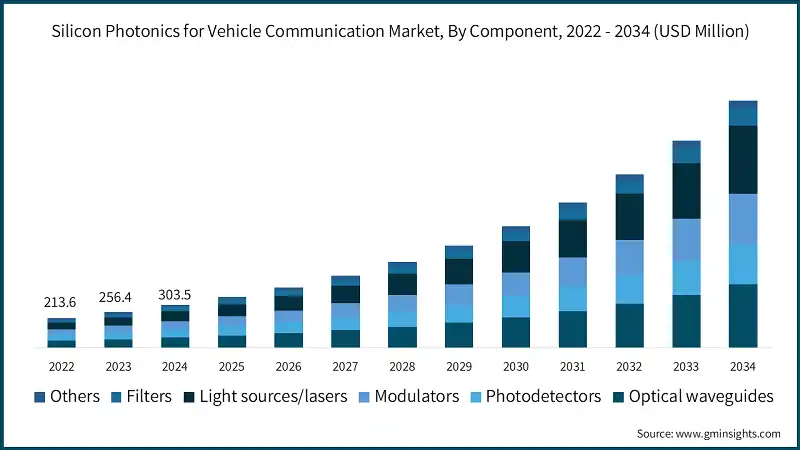
Based on component, the silicon photonics for vehicle communication market is divided among optical waveguides, photodetectors, modulators, light sources/lasers, filters, and others. The optical waveguides segment dominated the market, accounting for around 25% share in 2024 and is expected to grow at a CAGR of over 19.7% through 2025 to 2034.
- Optical waveguides segment dominates the market. Waveguides are the means for routing and confining optical signals among various components on a chip. In automotive applications, where performance, size, and reliability are essential design parameters, the waveguides become a low-loss medium for the high-speed intra-vehicle communications and advanced LiDAR-type sensor systems.
- Recent research has significantly expanded the design and performance for waveguides relative to automotive system constraints. Manufacturers developed silicon photonic wire waveguides with the capability of extremely tight bends, which facilitate compact optical layouts that are ideal for automotive packaging requirements.
- New hybrid waveguide platforms have emerged as an adequate solution to combine the optical waveguide transmission properties with improved signal loss and higher thermal performance capability required within vehicle environments with significant vibration, heat, and dust.
- Optical waveguides are the crucial parameter of the system, but other components such as photodetectors, modulators, light sources/lasers and filters also play important roles. Photodetectors have seen advancements in the form of graphene-enhanced detectors integrated with micro ring resonators that possess a high response and bandwidth, making them appropriate for high data rate optical links.
- Modulators, with the more commonly represented approaches utilizing thin-film lithium niobate and electro-optical polymers for making the data encoding processes faster and with less power consumption than recent systems and designs, however most approaches are still early in the deployment cycle.
- Light sources, with on-chip lasers being an area of interest, will remain a technical hurdle since silicon does not emit light. Hybrid integration approaches are advancing, but these approaches will also need to address thermal stability and lifetime issues under automotive conditions.
Learn more about the key segments shaping this market
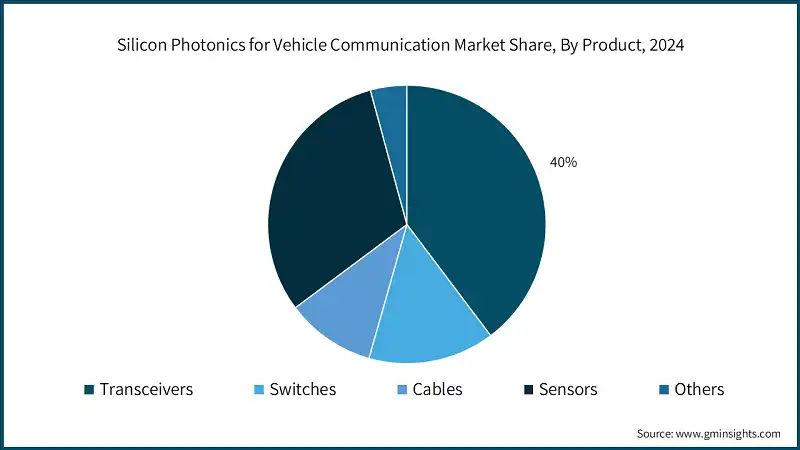
Based on product, the silicon photonics for vehicle communication market is segmented into transceivers, switches, cables, sensors, and others. Transceivers segment dominated the market with around 40% share in 2024, and the segment is expected to grow at a CAGR of 19% from 2025 to 2034.
- The transceivers segment is the largest segment of the silicon photonics market for vehicle communications because they are integral to high-speed, low-latency, and interference-free data transmission. With the need to transmit sizable amounts of data from sensors, cameras, radar, and LiDAR in modern vehicles and particularly in connected and autonomous vehicles, conventional electrical interconnection using copper is limited due to signal loss through the copper links, as well as limited bandwidth that is further restricted due to electromagnetic interference.
- By utilizing silicon photonic transceivers to convert electrical signals into optical signals, the data rate gets faster and more dependable as the electrical data transmission is extended throughout the vehicle.
- New developments enabled small, thermally stable transceivers to run in extreme automotive environments exceeding 100°C. Based on advanced platforms, silicon photonic transceivers integrate lasers, modulators, and detectors on one chip, to reduce the number of components, costs to manufacture, and improved overall reliability.
- Companies, such as Tower Semiconductor, have developed automotive-grade silicon photonics integrated circuits to be used in LiDAR systems that integrate silicon and silicon nitride waveguides, and in-built modulators and detectors, into a compact mechanism for 3D imaging. Other manufacturers, such as ST Microelectronics, are designing silicon photonic transceivers capable of exceeding 200 Gbps of data throughput, leveraging BiCMOS and SiPho design technologies.
- While transceivers are the dominant product segment, other product segments support the transceiver ecosystem to be deployed in automotive. For example, silicon photonics switches are not as advanced in automotive applications but are still in development for routing optical signals between modules, as well as routing optical signal communications to other zones in the vehicle.
- Optical cables and harnesses are equally important as they are the physical medium that carries optical signals in the zones of a vehicle. As an example, Sumitomo Electric has developed automotive optical harnesses capable of 10 Gbps transmissions, and that can help reduce overall weight of the vehicle while providing optical communication at high speeds.
- Sensors represent a vital and rapidly growing segment within silicon photonics. Advancements in photonic LiDAR, optical phased arrays, and imaging sensors are significantly improving the accuracy, range, and efficiency of optical sensing systems. These enhancements enable faster point-cloud generation, more precise positioning, and the creation of new image types.
- For instance, companies like Scantinel Photonics have developed LiDAR-on-chip solutions that integrate light sources and detectors on a single photonic platform. This integration allows for compact, coherent ranging systems that are cost-effective and well-suited for advanced driver-assistance systems (ADAS) and autonomous vehicle applications.
Based on technology, the silicon photonics for vehicle communication market is segmented among CMOS, hybrid silicon photonics, silicon-on-insulator (SOI) photonics, and silicon nitride photonics. The CMOS segment dominated the market with market share of 46% in 2024.
- The CMOS (Complementary Metal-Oxide-Semiconductor) segment leads the silicon photonics for vehicle communications market because of its maturity, scalability, and low cost. CMOS-compatible silicon photonics utilizes the same manufacturing infrastructure employed for integrated circuits that enables high volume and high-fidelity production.
- CMOS-compatible silicon photonics allows both photonic and electronic components (e.g., modulators, detectors, and control circuits) to be fabricated on the same substrate which reduces size, cost, and complexity. CMOS processes are also highly robust which guarantees the performance of the resulting devices in extreme conditions like high-temperature, vibration, and electromagnetic interference.
- The ability to integrate high-speed electronic control circuits with optical components is one of the primary value propositions of CMOS technology. A recent example of CMOS technology is in solid-state LiDAR-on-a-chip architectures combining silicon photonic components with CMOS-based control electronic components for ultra-compact and thermally stable LiDAR systems for in-vehicle advanced driver-assistance systems (ADAS) and autonomous driving.
- While CMOS is the market leader, other technologies are also gaining popularity. Hybrid silicon photonics combine silicon with other semiconductor materials such as indium phosphide or gallium arsenide to achieve efficient light production and amplification. Although this approach increases optical transmission performance, its high cost and manufacturing complexity limit its use in the automotive industry in the short term. Silicon-on-insulator (SOI) photonics, another major segment, offers better optical confinement and low-loss waveguides.
Based on vehicle, the silicon photonics for vehicle communication market is segmented into passenger cars, and commercial vehicles. Passenger cars dominate the market with share of around 77% in 2024.
- Passenger cars are the leading segment in the silicon photonics for vehicle communication market, mainly due to their higher production volume, growth in the acceleration of technology adoption, and growing preferences for advanced safety features and connectivity. The continual move towards developing systems for driver assistance, in-cabin sensing, applications in autonomous driving, and passenger vehicles has led to an increased speed of introducing silicon photonic technologies.
- The passenger cars rely heavily on high bandwidth data performance and systems based on communications between various LiDAR and optical sensing systems, data and communication networks in the vehicles. Silicon photonics provides the most compact, threshold, and trusted technologies, all essential in vehicle communication.
- The shorter product development cycle in the passenger vehicle segment is a key driver of adoption. Compared to commercial vehicles, passenger vehicles are replaced more frequently, influenced by rapid OEM innovation and heightened consumer interest. Within this segment, premium and luxury models often serve as early adopters of advanced technologies.
- For example, leading automakers have introduced flagship vehicles equipped with high-performance silicon photonics-based LiDAR systems designed for Level 3 autonomy. Once these systems gain consumer acceptance in high-end models, they typically scale down to mid-range vehicles, accelerating broader market penetration and adoption.
- Systems like adaptive cruise control, collision avoidance systems, and 360-degree vision systems that rely on fast, interference-free optical communication from multiple sensors. Compared to traditional electrical systems, silicon photonics deliver higher bandwidth and lower latency, which facilitate seamless data exchange within the car's ecosystem.
- In contrast, commercial vehicles like trucks, buses, and delivery vans are adopting silicon photonics more slowly. The applications are focused more on advanced driver assistance, long-distance sensing, and fleet communication for logistics and highway automation. Challenges in cost sensitivity, durability, and regulatory demands have slowed the widespread uptake of these systems in commercial vehicles.
Looking for region specific data?
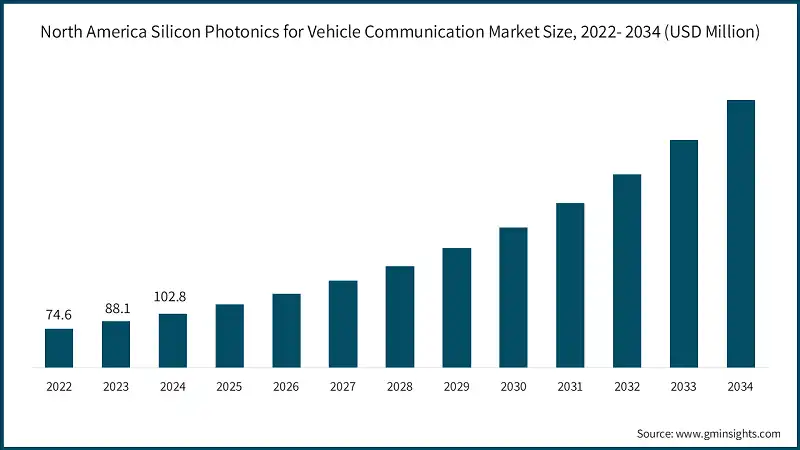
North America dominated the silicon photonics for vehicle communication market with around 34% share and generated around USD 102.8 million revenue in 2024.
- North America dominates the silicon photonics for vehicle communication market, owing to its robust research ecosystem, advanced manufacturing framework, and fast-paced technology adoption in the automotive and semiconductor sectors. Leadership in the region is bolstered by significant government funding, university research programs, and a host of semiconductor and photonic technology manufacturer presence.
- One of the major reasons North America is dominant is its government-backed innovation framework. Organizations, such as the Defense Advanced Research Projects Agency (DARPA), have established programs to develop ultra-high-bandwidth optical interconnects, such as its Photonics in the Package for Extreme Scalability (PIPES) program.
- These large programs strengthen the foundational research in photonic devices including lasers, modulators, and detectors which are critical to enable high-bandwidth vehicle communication. Similarly, U.S. research institutional projects are developing next generation optical detectors and integrated circuits that are designed for extreme environments, which aligns vertically with automotive needs.
- The region also benefits from strong collaboration between automotive manufacturers and photonics startups. Companies such as Aeva have introduced advanced 4D LiDAR-on-chip systems capable of high-resolution sensing and precise range detection, setting new standards for automotive-grade photonic sensors.
- Furthermore, North America is also a leader in the application of LiDAR and optical communications technologies in vehicles. The presence of electric vehicle manufacturers, autonomous driving technology developers, and premium automotive manufacturers has accelerated the adoption of photonic technologies in vehicle-to-vehicle (V2V) and vehicle-to-infrastructure (V2I) communication systems.
- These advancements are critical for enabling real-time data exchange, improving road safety, and supporting the broader deployment of connected and autonomous vehicles. As regulatory frameworks and smart infrastructure continue to evolve, North America remains at the forefront of integrating cutting-edge photonic solutions into next-generation transportation networks.
Europe silicon photonics for vehicle communication market accounted for USD 75.3 million in 2024 and is anticipated to show lucrative growth over the forecast period.
- Europe will see substantial growth in the silicon photonics for vehicle communications market in the coming years, strengthened by strong government initiatives, a robust research ecosystem and the presence of leading automotive manufacturers and semiconductor companies. The EU has recognized photonics as a key enabling technology under its Horizon Europe framework, which funds projects for sensors, LiDAR, and optical communication systems for enhanced mobility.
- Germany continues to be the leader of this growth given its strong industrial base and commitment to being a major auto producer. Leading car manufacturers, like BMW, Mercedes-Benz, Volkswagen and suppliers like Bosch and Infineon, are actively working on silicon photonics-based solutions for vehicle communication and sensing.
- The Fraunhofer Institute for Photonic Microsystems recently reported its demonstration of an integrated silicon photonic LiDAR prototype with thermal performance levels sufficient for automotive applications. This effort is an extension of Germany's national "Photonics Research Strategy," which calls for the integration of optical communication systems for connected and autonomous vehicles.
- In the UK, leading universities and high technology startups are driving quick technological advancement. The Engineering and Physical Sciences Research Council (EPSRC) sponsors research investigating photonics for autonomous and connected vehicles within projects at universities such as the University of Southampton, University College London and the University of Cambridge.
- Countries such as France and the Netherlands have also developed significant programs and are developing photonics technologies for mobility applications. The Institute of Photonics and Nanotechnologies (IFN) in Italy supports the industrialization of photonic sensors and interconnects, where in the Netherlands programs continue to build on their strong expertise in silicon and silicon nitride photonic waveguide technologies at research centers in Eindhoven.
Asia Pacific region accounted for market size of USD 94.8 million in 2024 and is anticipated to show fastest growth of 21.3% over the forecast period.
- Silicon photonics is rapidly gaining traction across Asia Pacific, and particularly in automotive applications, because of the industry’s need for fast, low-latency communications in automobiles. Silicon photonics has shown strong growth in meeting the demand by putting optical components inside electronic circuits at the chip level, improving both communication speed and power efficiency.
- China is making major advancements in the same field by developing a robust ecosystem around MIPI A-PHY, a high-speed serial interface standard for automotive applications. In 2025, Valens Semiconductor collaborated with several MIPI A-PHY silicon vendors, including Chinese silicon companies, to achieve successful interoperability testing.
- This partnership highlights China's commitment to promoting advanced communication technologies as part of its automotive agenda, enhancing the performance and safety of automotive communication networks and other subsystems.
- In Taiwan, National Taiwan University (NTU) is taking the lead on the technological shift. The Graduate Institute of Photonics and Optoelectronics at NTU, under the direction of Professor Gong-Ru Lin, is conducting world-class research to engineer advanced photonic devices for automotive applications with the explicit goal of improving vehicle communications due to the increasing complexity of the networks, and the growing need for more data.
- The developments represent the increasing investment and interest in silicon photonics in the Asia Pacific region. The partnership between universities, research institutes and government would provide momentum for the adoption of technology in vehicle communication systems. The growing connectivity and autonomy in automotive mobility necessitate silicon photonics to enable high-speed and reliable communication networks with capable energy-efficiency.
Latin America accounted for around USD 14.4 million in 2024 and is anticipated to show robust growth over the forecast period.
- The market for silicon photonics for vehicle communication in Latin America is projected to experience strong growth throughout the forecast period. Greater adoption of technology, intelligent mobility initiatives, and the ongoing proliferation of connected vehicles, among others, will support this projected growth.
- Vehicle-to-Everything (V2X) communication systems will become essential in the near future as transportation networks become more integrated, the introduction of 5G, usage of smart cities, and the improvement of mobility will all create a conducive environment for the adoption of silicon photonics.
- Several initiatives play an essential role in the integration of silicon photonics for vehicle communication. The establishment of BrPhotonics (the joint venture between thin-film polymer on silicon and silicon photonics) highlights Brazil's abilities within the new technology to manufacture high-speed optical interconnects that could be used for automotive applications like LiDAR and intra-vehicle communication.
- Mexico has significant opportunities, due to its well-developed automotive manufacturing environment and focus on smart mobility, along with rising investment in vehicle connectivity and electric vehicles, Mexico is expected to adopt photonics technologies in infotainment, sensor networks, and V2X (vehicle-to-everything) applications.
- Recent initiatives in the region, including the deployment of private 5G networks and pilot projects for Open RAN (open radio access networks) technology to support network slicing show the ongoing convergence of telecoms infrastructure and automotive communications is growing in the region. These developments will support V2N (vehicle-to-network-first) systems and V2I (vehicle-to-infrastructure) systems.
Middle East and Africa silicon photonics for vehicle communication market accounted for USD 16.2 million in 2024 and is anticipated to show lucrative growth over the forecast period.
- The Middle East and Africa (MEA) region is gradually developing as a target market for silicon photonics in vehicle communication, as a result of government-led mobility initiatives, investment in digital infrastructure, and the growing interest in smart cities and autonomous vehicles. Silicon photonics is continually being explored for higher-performance vehicle-to-everything (V2X) communication systems owing to its high data transmission speed, energy efficiency, and scalability, while traditional electrical systems appear to be reaching their operational limitations.
- Saudi Arabia is playing a leading role in the region’s transition. The country has announced a roadmap for the use of the 5.9GHz band to facilitate V2X communication, demonstrating significant regulatory support for intelligent transport systems.
- Saudi Arabia's interest in localizing electric vehicle production by companies like Ceer Motors working in advanced communication module and sensor integration capabilities. Investments in photonics-related R&D, such as automated multi-chip integration and optical components for data centers and defense, also lay a technical foundation for near future adoption into the automotive sector.
- Another important contributor is the United Arab Emirates (UAE). The country’s ambitions for autonomous mobility and intelligent urban infrastructure have stimulated active deployment of advanced driver-assistance systems (ADAS) and connected vehicle technologies.
- The ongoing rapid development of the country’s telecommunications infrastructure based on 5G and fiber optic also boosts increased use of silicon photonics not only in telecom and data centers but also vehicle-to-infrastructure (V2I) and vehicle-to-network (V2N) systems.
- Recent collaborations in Saudi Arabia, including local mobility technology companies’ partnerships with global autonomous driving software companies, illustrate a growing interest in implementing next-generation vehicle communication systems in the region.
- The objective of these collaborations is to create safe and reliable autonomous vehicle platforms which require high-performance communication links, including optical and photonic technologies for demanding data applications such as LiDAR, radar fusion, and real-time telemetry.
Silicon Photonics for Vehicle Communication Market Share
- The top 7 companies in the silicon photonics for vehicle communication industry are Luminar Technologies, Intel, STMicroelectronics, Hamamatsu Photonics, Broadcom, Marvell Technology, GlobalFoundries. These companies hold around 68% of the market share in 2024.
- Luminar Technologies is a company creating innovative LiDAR technologies for use in autonomous vehicles by using silicon photonics to improve resolution and range. Its novel photonic technologies allow accurate situational perception and dependable vehicle-to-vehicle communication. Luminar aims to build automotive-grade hardware and software solutions, helping automotive original equipment manufacturers deploy advanced driver assistance systems and autonomous features of vehicles.
- Intel is using its experience in silicon photonics to help innovate high-data communication in connected autonomous vehicles. Intel has created the Mobileye division of the company to integrate photonics into sensing and communication systems in vehicles that require low-latency high-bandwidth communications for advanced driver assistance systems (ADAS) and V2X.
- STMicroelectronics develops miniaturized photonic devices that improve in-vehicle communications, sensor fusion, and environmental mapping. Their presence in advanced driver-assistance systems (ADAS) and connected vehicle networking utility allows STMicroelectronics to assist original equipment manufacturers (OEMs) in developing advanced photonic systems with reduced latency, higher reliability, and improved interoperability.
- Hamamatsu Photonics is a leader in providing optoelectronic devices that facilitate photonic solutions for optical sensing and vehicle communications. Its silicon photonics solutions are specialized for rapid processing speed and optical LiDAR applications.
- Broadcom designs silicon photonics and optical interconnect solutions that operate at a high level and are commonly used in automotive communication networks. This technology offers a fast and energy-efficient way to transfer data for autonomous driving and connected vehicles. Broadcom optical modules and chipsets lower system latency and increase bandwidth requirements associated with processing large amounts of sensor data and vehicle-to-everything (V2X) data.
- Marvell Technology provides innovative semiconductor solutions, including silicon photonics-based interconnect solutions, for automotive edge and communication systems. Marvell Technology's optical transceivers and high-speed PHYs provide the necessary speeding requirements to support the increasing data needs of connected vehicles and real-time Vehicle-to-Everything (V2X) applications.
- GlobalFoundries offers foundry services for silicon photonics platforms that provide mass production of photonic integrated circuits for automotive applications. GlobalFoundries assists customers in developing optical interconnects and sensor modules for vehicle communication systems. With its automotive-grade photonic components utilizing specialized process technologies and packaging, GlobalFoundries provides an opportunity to scale the cost-effective manufacture and deployment of silicon photonics.
Silicon Photonics for Vehicle Communication Market Companies
Major players operating in silicon photonics for vehicle communication industry are:
- Broadcom
- Cisco Systems
- GlobalFoundries
- Infineon Technologies
- Intel
- Marvell Technology
- Nvidia
- NXP Semiconductors
- Qualcomm
- STMicroelectronics
- The silicon photonics for vehicle communication market is driven by a blend of global semiconductor leaders and highly focused emerging innovators, forming a dynamic yet still maturing competitive landscape. Key players such as Intel, Broadcom, GlobalFoundries, Infineon Technologies, Marvell Technology, Nvidia, NXP Semiconductors, Qualcomm, and STMicroelectronics are either actively investing in or strategically positioned to influence this evolving domain.
- These companies are leveraging their strengths in high-performance computing, semiconductor integration, automotive-grade manufacturing, and advanced packaging technologies to explore or enable silicon photonics-based communication for vehicles.
- Strategies include developing optical I/O chiplets, LiDAR SoCs, co-packaged optics, and next-generation Ethernet solutions tailored for the increasing bandwidth, safety, and latency demands of connected and autonomous vehicles.
- Intel, for example, is making significant headway by integrating photonic chiplets for optical interconnects and building automotive-grade LiDAR SoCs via Mobileye, while companies like Nvidia are collaborating on co-packaged optics as part of their AI and automotive compute roadmap.
- Infineon is expanding its role through acquisitions, such as Marvell’s automotive Ethernet business, to address in-vehicle networking demands where photonics could be a future enabler.
- These leaders are adopting multi-pronged strategies involving foundry partnerships, IP consolidation, AI-accelerated system design, and automotive ecosystem collaborations. Their focus is on creating scalable, robust, and energy-efficient photonic solutions that align with the software-defined vehicle (SDV) paradigm and V2X communication goals.
- In parallel, a wave of emerging photonic disruptors like Ayar Labs, Rockley Photonics, SiLC Technologies, and Lightmatter are introducing innovations in optical computing, FMCW LiDAR, and chip-scale photonic engines, with growing relevance to automotive applications.
- These companies, though smaller in scale, are often at the frontier of performance, miniaturization, and integration challenges, making them attractive partners or acquisition targets for established automotive semiconductor firms.
Silicon Photonics for Vehicle Communication Industry News
- In May 2025, Broadcom announced its third-generation co-packaged optics (CPO) technology with 200G per lane capability, showing advancement in optical engines, DSP/SerDes, and system readiness. This enhances optical interconnect performance in high-bandwidth environments, which is likely to influence in-vehicle or V2X communication hardware as automotive systems demand more data throughput.
- In March 2025, Soitec developed silicon photonics SOI (silicon-on-insulator) materials, contributing to accelerated development of integrated optical connectivity solutions for AI datacentres. It also joined the SEMI Silicon Photonics Industry Alliance. The material platforms and supply-chain developments are likely to reduce cost / improve scale, which helps adoption in automotive photonics over time.
- In September 2024, Intel announced it would shutter its internal FMCW LiDAR development unit by year-end 2024, impacting about 100 employees, as part of reorganizing its sensor strategy. This suggests shifts in how optical / photonic-based vehicle sensing and communication efforts are being prioritized.
- In July 2024, Luminar had acquired the laser module unit (EM4) from Gooch & Housego, as part of expanding its semiconductor and photonic operations.
- In March 2024, Luminar Technologies completed the acquisition of EM4 (the packaged photonic components and subsystems business of G&H) to bolster its semiconductor/photonic integration efforts.
The silicon photonics for vehicle communication market research report includes in-depth coverage of the industry with estimates & forecasts in terms of revenue ($ Mn) and volume (units) from 2021 to 2034, for the following segments:
Market, By Component
- Optical waveguides
- Photodetectors
- Modulators
- Light sources/lasers
- Filters
- Others
Market, By Product
- Transceivers
- Switches
- Cables
- Sensors
- Others
Market, By Technology
- CMOS
- Hybrid silicon photonics
- Silicon-on-insulator (SOI) photonics
- Silicon nitride photonics
Market, By Vehicle
- Passenger cars
- Hatchback
- Sedan
- SUV
- Commercial vehicles
- Light commercial vehicles (LCV)
- Medium commercial vehicles (MCV)
- Heavy commercial vehicles (HCV)
The above information is provided for the following regions and countries:
- North America
- US
- Canada
- Europe
- Germany
- UK
- France
- Italy
- Spain
- Nordics
- Russia
- Asia Pacific
- China
- India
- Japan
- Australia
- Indonesia
- Philippines
- Thailand
- South Korea
- Singapore
- Latin America
- Brazil
- Mexico
- Argentina
- Middle East and Africa
- Saudi Arabia
- South Africa
- UAE
Frequently Asked Question(FAQ) :
Which region led the silicon photonics for vehicle communication sector?
North America led the market with a 34% share, generating approximately USD 102.8 million in revenue in 2024. The region's dominance is attributed to its advanced research ecosystem, manufacturing capabilities.
Who are the major players in the silicon photonics for vehicle communication industry?
Major players include Broadcom, Cisco Systems, GlobalFoundries, Infineon Technologies, Intel, Marvell Technology, Nvidia, NXP Semiconductors, Qualcomm, and STMicroelectronics.
What are the key trends in the silicon photonics for vehicle communication market?
Trends include large-scale production, high-speed optical networks, silicon photonics in LiDAR, and durable photonic devices for automotive use.
What was the market share of the transceivers segment in 2024?
The transceivers segment dominated the market with a 40% share in 2024 and is set to expand at a CAGR of 19% till 2034.
What is the expected size of the silicon photonics for vehicle communication industry in 2025?
The market size is projected to reach USD 360.6 million in 2025.
What was the market share of the optical waveguides segment in 2024?
The optical waveguides segment accounted for approximately 25% of the market share in 2024 and is expected to witness over 19.7% CAGR from 2025 to 2034.
What was the market size of the silicon photonics for vehicle communication in 2024?
The market size was valued at USD 303.5 million in 2024, with a CAGR of 19.2% expected through 2034. The growth is driven by advancements in integration, efficiency, and automotive network architectures.
What is the projected value of the silicon photonics for vehicle communication market by 2034?
The market is poised to reach USD 1.75 billion by 2034, fueled by the adoption of high-speed optical connections, solid-state LiDAR, and V2X communication systems.
Silicon Photonics for Vehicle Communication Market Scope
Related Reports