Summary
Table of Content

Silicon Nanowire Battery Technology Market
Get a free sample of this report
Form submitted successfully!
Error submitting form. Please try again.
Thank you!
Your inquiry has been received. Our team will reach out to you with the required details via email. To ensure that you don't miss their response, kindly remember to check your spam folder as well!
Request Sectional Data
Thank you!
Your inquiry has been received. Our team will reach out to you with the required details via email. To ensure that you don't miss their response, kindly remember to check your spam folder as well!
Form submitted successfully!
Error submitting form. Please try again.
Silicon Nanowire Battery Technology Market Size
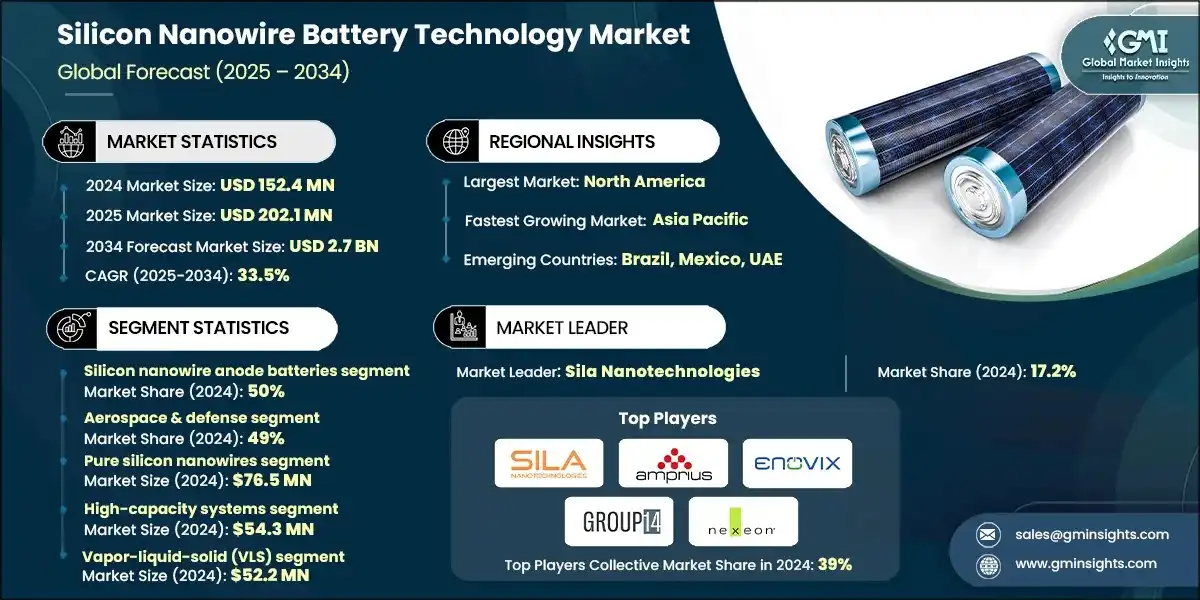
The global silicon nanowire battery technology market was valued at USD 152.4 million in 2024. The market is expected to grow from USD 202.1 million in 2025 to USD 2.7 billion in 2034, at a CAGR of 33.5%, according to latest report published by Global Market Insights Inc.
Silicon Nanowire Battery Technology Market Key Takeaways
Market Size & Growth
- 2024 Market Size: USD 152.4 Million
- 2025 Market Size: USD 202.1 Million
- 2034 Forecast Market Size: USD 2.7 Billion
- CAGR (2025–2034): 33.5%
Regional Dominance
- Largest Market: North America
- Fastest Growing Region: Asia Pacific
Key Market Drivers
- Rising Demand for High-Energy-Density Batteries.
- Advancements in Nanomaterial Engineering and AI-Based Material Optimization.
- Growth of Fast-Charging Infrastructure and High-Power Applications.
- Increasing Investments from Automotive OEMs and Battery Manufacturers.
Challenges
- High Production Costs and Scalability Challenges.
- Mechanical Instability and Degradation Risks.
Opportunity
- Expansion into Grid-Scale and Renewable Energy Storage Systems.
- Development of Circular-Economy-Aligned Recycling Technologies.
Key Players
- Market Leader: Sila Nanotechnologies led with over 17.2% market share in 2024.
- Leading Players: Top 5 players in this market include Sila Nanotechnologies, Amprius Technologies, ENOVIX, Group14 Technologies, Nexeon, which collectively held a market share of 39% in 2024.
Get Market Insights & Growth Opportunities
The silicon nanowire battery technology market is projected to witness substantial growth over the coming years, driven by the rising demand for high-energy-density storage systems, expansion of electric mobility, and increasing adoption of next-generation battery chemistries across automotive, consumer electronics, and energy storage sectors. As energy storage systems become more sophisticated in terms of performance requirements, durability, and fast-charging capabilities, manufacturers and technology providers are prioritizing advanced material engineering, scalable production processes, and digitally integrated development frameworks to ensure reliability and commercial readiness.
The growing integration of AI-powered material discovery tools, IoT-enabled performance monitoring, and cloud-connected battery management systems is redefining the nanomaterial-based battery development landscape. These technologies enable real-time tracking of electrochemical behavior, predictive analysis of degradation patterns, and seamless coordination between R&D labs, pilot manufacturing lines, and OEM integration teams. By leveraging digital twins, machine-learning-based modeling, and high-throughput experimentation, industry players can accelerate prototype validation, enhance lifecycle performance, and reduce overall development costs, supporting a shift toward intelligent, connected battery development ecosystems.
Digital transformation within the silicon-based battery domain is further accelerated by the deployment of robotics-assisted electrode fabrication systems, precision nanowire synthesis tools, and advanced SEI stabilization technologies. These solutions ensure improved structural integrity, minimize volumetric expansion challenges, and support reliable high-voltage operation. Integration between MES systems, laboratory informatics platforms, and cloud-based process analytics also strengthens supply chain transparency, sustainability tracking, and compliance with emerging global battery safety and recycling regulations.
For instance, in 2024, leading companies such as Amprius Technologies, OneD Battery Sciences, and Sila Nanotechnologies expanded their silicon-rich anode manufacturing capabilities with AI-driven material optimization, automated nanowire growth systems, and enhanced BMS integration tailored for high-silicon chemistries. Likewise, OEMs including Tesla, BMW, and Panasonic increased investments in silicon nanowire battery R&D, focusing on improving energy density, fast-charging performance, and cycle life to support next-generation EV platforms.
The silicon nanowire battery technology market is witnessing continuous technological advancement driven by the convergence of nanoscale engineering, AI-supported materials informatics, IoT-enabled testing platforms, and sustainable production frameworks. Industry stakeholders are increasingly prioritizing scalable nanowire fabrication, interoperable simulation environments, and resource-efficient recycling approaches aligned with circular economic principles. These innovations are redefining the market, enabling higher-density, safer, and more sustainable energy storage solutions that support global electrification and carbon-neutral mobility objectives.
To get key market trends
Silicon Nanowire Battery Technology Market Trends
The demand for advanced silicon nanowire battery technologies is rapidly increasing, driven by growing collaboration among battery manufacturers, material science companies, OEMs, and technology developers to enhance energy density, performance stability, and commercial scalability. These partnerships focus on developing high-capacity, data-driven, and interoperable battery ecosystems integrating AI-enabled material optimization, IoT-based performance monitoring, predictive electrochemical modeling, and cloud-connected battery management systems.
For instance, in 2024, Amprius Technologies and Sila Nanotechnologies initiated joint research initiatives to advance silicon-rich anode development using AI-driven material simulations and automated nanowire growth systems, improving structural stability and enhancing long-term battery performance. Similarly, Group14 Technologies and Nexeon Limited expanded collaborative pilot programs with leading automotive OEMs to deploy silicon-enhanced anode materials at scale, focusing on high-volume manufacturing, enhanced SEI stabilization, and integrated battery lifecycle analytics.
Regional localization of silicon nanowire battery production is also becoming a major trend. Key manufacturers including Amprius, ENOVIX, and Group14 are establishing region-specific production hubs in North America, Europe, and Asia to meet local regulatory standards, supply-chain sustainability requirements, and OEM integration demands. These facilities incorporate localized data infrastructure, cloud-based process-control systems, and automated quality-assurance platforms to deliver consistent performance, faster production cycles, and stronger alignment with regional industrial policies on clean energy and advanced battery manufacturing.
The emergence of specialized technology startups offering modular nanomaterial synthesis tools, AI-based electrochemical modeling platforms, and automated electrode manufacturing systems is reshaping the competitive landscape. Companies developing precision nanowire growth reactors, silicon stabilization technologies, and digital twin platforms for battery cells are offering scalable, cost-effective solutions that accelerate commercialization. These innovations enable both established battery manufacturers and new entrants to enhance material consistency, optimize production yield, and reduce time-to-market for high-performance silicon nanowire batteries.
Development of standardized, interoperable, and modular manufacturing architectures is transforming the silicon nanowire battery ecosystem. Leading players such as Group14 Technologies and Nexeon Limited are deploying cloud-integrated material production systems that support diverse lithium-ion cell formats, chemistries, and application requirements. These solutions improve supply chain visibility, enable real-time material traceability, and ensure compatibility across multiple OEM battery platforms. The growing adoption of modular, scalable architectures is reducing production costs, accelerating commercialization timelines, and fostering a future-ready, high-performance silicon nanowire battery landscape.
Silicon Nanowire Battery Technology Market Analysis
Learn more about the key segments shaping this market
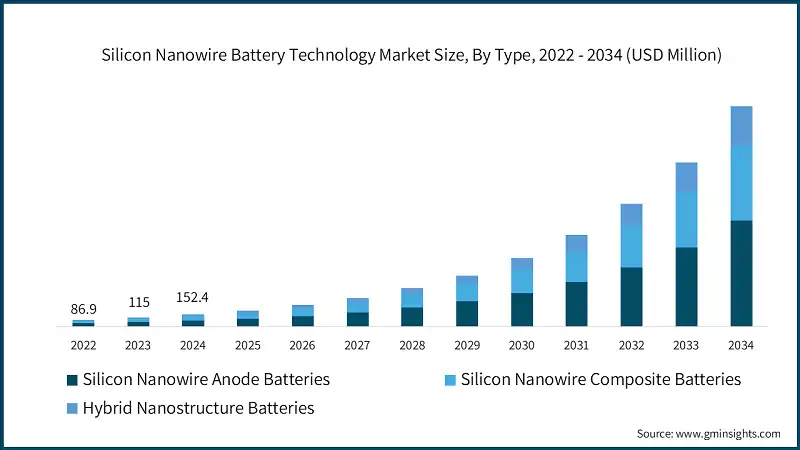
Based on type, the market is divided into silicon nanowire anode batteries, silicon nanowire composite batteries and hybrid nanostructure batteries. The silicon nanowire anode batteries segment dominated around 50% market share in 2024 and is expected to grow at a CAGR of over 32.9% from 2025 to 2034.
- Silicon nanowire anode batteries play a critical role in advancing next-generation energy storage performance, reliability, and fast-charging capability. This segment includes high-capacity anode structures engineered to overcome traditional graphite limitations by enabling superior lithium-ion absorption, improved conductivity, and enhanced structural resilience. The increasing demand for long-range EVs, high-performance consumer electronics, and aerospace applications has accelerated the adoption of pure silicon nanowire anodes. Their vertically aligned nanowire architecture minimizes mechanical stress, enhances cycle life, and supports ultra-fast charging, driving the need for advanced fabrication processes, precision nanomaterial engineering, and specialized production technologies.
- The silicon nanowire composite batteries segment is witnessing steady growth, driven by the rising need for enhanced structural stability, controlled volumetric expansion, and compatibility with existing lithium-ion manufacturing lines. These batteries integrate silicon nanowires with carbon matrices, polymer binders, or engineered composites to balance energy density with cycle durability. The increasing use of composite materials in EVs, grid-scale storage, and industrial power systems is creating strong demand for reliable, scalable production techniques and improved SEI stabilization methods.
- Meanwhile, the hybrid nanostructure batteries segment encompassing multi-layered nanowire systems, silicon-graphene blends, and silicon-carbon nanotube (CNT) hybrids is emerging as a key innovation driver. As batteries become more energy-dense and application-specific, manufacturers are integrating nanowire technologies with advanced hybrid materials to achieve improved mechanical buffering, thermal management, and electrochemical efficiency. These hybrid systems support high-performance features such as rapid charge acceptance, improved thermal stability, and extended cycle life.
Learn more about the key segments shaping this market
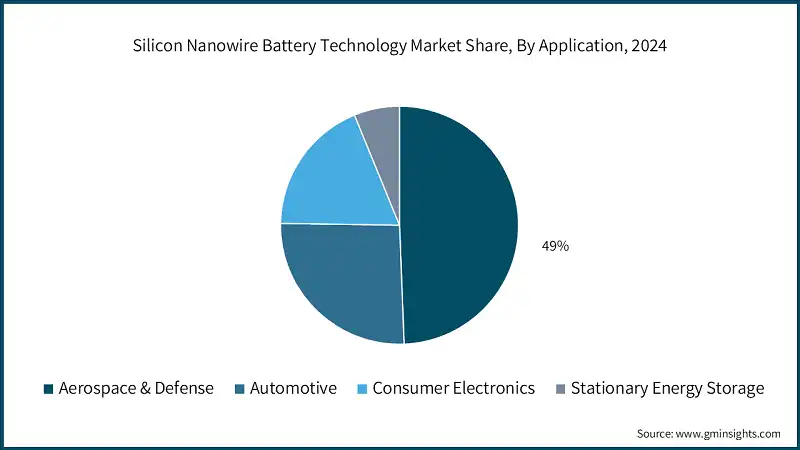
Based on applications, the silicon nanowire battery technology market is divided into aerospace & defense, automotive, consumer electronics and stationary energy storage. The aerospace & defense segment dominates the market accounting for around 49% share in 2024 and is expected to grow at a CAGR of over 33.1% from 2025 to 2034.
- The aerospace & defense segment dominates the market, driven by the need for ultra-lightweight, high-energy-density, and high-performance power solutions capable of operating under extreme environmental conditions.
- Silicon nanowire anodes enable superior power-to-weight ratios, rapid charging, and enhanced mission endurance, making them ideal for drones, UAVs, advanced avionics, and defense-grade portable energy systems. The sector’s strong investment in nanostructured materials, thermal-management technologies, and AI-enabled performance modeling continues to reinforce its leadership position in the market.
- The automotive segment is experiencing strong growth as EV and hybrid vehicle manufacturers accelerate the adoption of silicon nanowire batteries to achieve longer driving ranges, faster charging times, and improved lifecycle durability. OEMs are integrating silicon-rich anodes into next-generation electric powertrains supported by advanced BMS optimization, IoT-enabled battery monitoring, and predictive degradation analytics.
- Increasing production capacity, improved material stabilization, and advancements in nanowire fabrication are enabling broader commercialization across mainstream and premium EV platforms. Meanwhile, the consumer electronics segment is expanding steadily, driven by demand for compact, high-capacity batteries for smartphones, wearables, AR/VR devices, tablets, and IoT applications.
- The stationary energy storage segment is emerging as a high-potential application area as utilities, renewable-energy developers, and industrial operators invest in more efficient, long-life storage systems. Silicon nanowire technologies deliver improved cycling stability, higher charge efficiency, and enhanced thermal performance, supporting grid balancing, renewable integration, and distributed energy applications.
- Growing deployment of smart grids, microgrids, and long-duration storage systems is expected to accelerate demand for silicon-based storage solutions over the coming years, creating new opportunities across global energy infrastructure markets.
Based on material composition, the market is divided into pure silicon nanowires, silicon-carbon composites, silicon-oxide composites and silicon alloy nanowires. The pure silicon nanowires segment was valued at USD 76.5 million in 2024.
- The pure silicon nanowires segment dominated the silicon nanowire battery technology market, driven by its superior energy density, fast charging capabilities, and long cycle life. OEMs and battery manufacturers are increasingly leveraging pure silicon nanowire anodes to enhance EV range, performance, and overall battery efficiency.
- Integration of advanced diagnostics, thermal management systems, and AI-enabled predictive maintenance further supports reliability and operational safety, reinforcing the dominance of this segment in both electric vehicles and stationary energy storage applications.
- The silicon-carbon composites segment is witnessing steady growth as it balances high energy density with improved structural stability and cycle life. These composites are increasingly adopted in electric vehicle batteries and consumer electronics due to their reduced volume expansion and enhanced durability. Service providers and OEMs are deploying specialized monitoring, thermal regulation, and cloud-based management tools to ensure optimal performance and extended lifespan, driving consistent growth in this segment.
- The silicon-oxide composites and silicon alloy nanowires segments are emerging as promising alternatives, particularly in high-performance and next-generation battery applications. These materials offer improved mechanical stability, enhanced safety, and adaptability for hybrid and high-capacity battery systems. Investment in material innovation, high-voltage system diagnostics, and predictive maintenance solutions is enabling scalable adoption of these emerging compositions, positioning them as key contributors to the future growth of the silicon nanowire battery technology market.
Based on performance category, the market is divided into high-capacity systems, fast-charging systems, long-cycle life systems and cost-optimized systems. The high-capacity systems segment dominated the market and was valued at USD 54.3 million in 2024.
- The high-capacity systems segment dominated the silicon nanowire battery technology market, driven by growing demand for extended EV range, higher energy density, and superior performance in electric vehicles and energy storage applications. Manufacturers and service providers are deploying advanced battery management systems, AI-enabled diagnostics, and IoT-based monitoring to ensure safe operation, reliability, and optimized lifecycle management. The focus on high-capacity systems is reinforced by adoption in premium EVs, grid-scale storage solutions, and high-performance consumer electronics.
- The fast-charging systems segment is witnessing steady growth as OEMs and battery developers prioritize reduced charging times to enhance user convenience and operational efficiency. Integration of high-current management, thermal control technologies, and predictive maintenance platforms allows for safe and reliable fast-charging cycles. This segment is particularly relevant for commercial fleets, public charging infrastructure, and urban mobility applications, where rapid energy replenishment is critical.
- The long-cycle life and cost-optimized systems segments are emerging as important contributors to market growth. Long-cycle life systems are gaining traction in applications requiring extended battery longevity, such as stationary energy storage and hybrid EVs, while cost-optimized systems appeal to mass-market adoption by balancing performance with affordability. Investment in scalable manufacturing, AI-assisted performance monitoring, and modular design is enabling broader adoption of these segments, positioning them as key enablers of future market expansion.
Based on fabrication method, the silicon nanowire battery technology market is divided into vapor-liquid-solid (VLS) growth, metal-assisted chemical etching (MACE), chemical vapor deposition (CVD), solution-based growth methods and electrochemical deposition. The vapor-liquid-solid (VLS) segment dominated the market and was valued at USD 52.2 million in 2024.
- The vapor-liquid-solid (VLS) growth segment dominated the silicon nanowire battery technology market, driven by its ability to produce high-quality, uniform, and high-aspect-ratio silicon nanowires with superior electrochemical performance. This method is widely adopted by battery manufacturers and research institutions to enhance energy density, cycling stability, and fast-charging capabilities. Integration of VLS-fabricated nanowires into advanced battery systems is further supported by AI-enabled performance monitoring, thermal management tools, and predictive maintenance platforms, ensuring reliability, safety, and long-term operational efficiency.
- The metal-assisted chemical etching (MACE) and chemical vapor deposition (CVD) segments are witnessing steady growth as manufacturers explore scalable, cost-effective, and flexible fabrication methods for commercial battery production. MACE enables controlled surface structuring to improve cycle life, while CVD offers precise compositional control for hybrid or composite anodes. These methods are increasingly adopted for high-capacity, fast-charging, and long-cycle battery applications, supported by connected diagnostics, IoT-based monitoring, and cloud-integrated management systems.
- The solution-based growth and electrochemical deposition segments are emerging as promising alternatives, particularly for cost-sensitive or niche applications. These fabrication techniques allow lower-temperature processing, tunable material properties, and integration with silicon-carbon composites or alloy nanowires. Investments in process optimization, AI-assisted quality control, and predictive battery health assessment are enabling wider adoption of these methods, positioning them as key contributors to future market expansion and technological innovation.
Looking for region specific data?
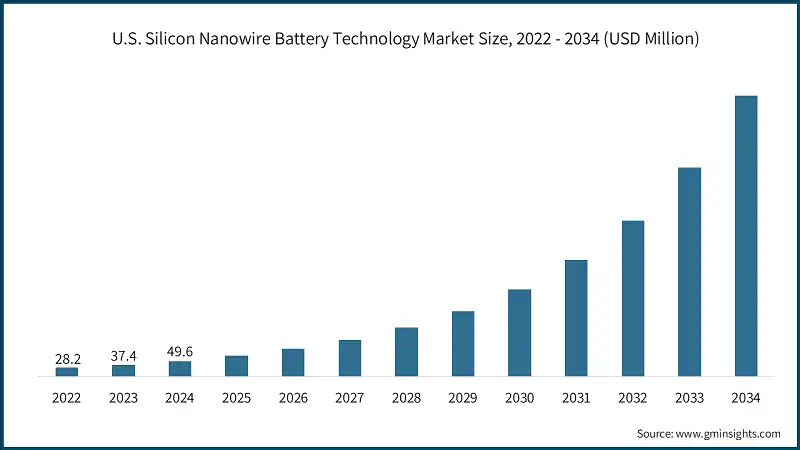
U.S. silicon nanowire battery technology market dominated around 88% share with USD 49.6 million in 2024.
- This growth led by the United States, which benefits from a strong EV and battery manufacturing ecosystem, advanced research capabilities, and a robust presence of leading nanomaterials and technology providers. The region has seen rapid adoption of high-capacity silicon nanowire batteries in electric vehicles, consumer electronics, and stationary energy storage systems. U.S.-based manufacturers and service providers are leveraging AI-driven battery diagnostics, IoT-enabled health monitoring, and cloud-connected battery management platforms to enhance performance, safety, and operational efficiency.
- Government policies promoting electric mobility, advanced materials research, and clean energy adoption are fueling market growth. Federal and state initiatives incentivize the development of high-capacity, fast-charging, and long-cycle silicon nanowire batteries, as well as the deployment of standardized testing, predictive maintenance, and sustainable recycling solutions. These measures enable manufacturers and service providers to improve battery lifespan, ensure safety compliance, and optimize production and repair processes.
- Key innovation hubs such as California, Michigan, and Texas are driving advancements in silicon nanowire battery technologies through collaborations among OEMs, battery developers, and technology firms. Leading companies including Sila Nanotechnologies, Amprius Technologies, ENOVIX Corporation, Group14 Technologies, and Nexeon Limited are expanding R&D, pilot production, and service capabilities in the U.S., providing high-performance nanowire battery solutions integrated with AI-based monitoring, IoT diagnostics, and predictive maintenance platforms.
Germany holds about 40% share of Europe silicon nanowire battery technology market in 2024, and it will grow tremendously between 2025 and 2034.
- Europe accounted for a significant share in 2024, driven by strong regulatory frameworks, advanced battery manufacturing capabilities, and the accelerating adoption of high-performance EV technologies. The region is witnessing steady growth as OEMs, battery developers, and service providers deploy AI-enabled diagnostics, IoT-connected battery monitoring, predictive maintenance platforms, and cloud-integrated management systems to optimize performance, ensure safety, and improve operational efficiency across silicon nanowire battery applications.
- Germany represents Europe’s largest silicon nanowire battery technology market, supported by its leadership in automotive manufacturing, materials research, and sustainable mobility initiatives. Key trends include the deployment of high-capacity nanowire batteries in EVs, advanced thermal management solutions, over-the-air (OTA) software updates, and predictive maintenance platforms. German manufacturers and service providers are leveraging scalable, modular, and AI-enabled platforms to ensure consistent battery performance, regulatory compliance with EU directives, and long-term reliability, positioning the country as the central hub for nanowire battery innovation in Europe.
- Other European markets, including France, the UK, and Italy, are also experiencing growth, driven by investments in connected diagnostics, battery recycling initiatives, and technician upskilling. France emphasizes high-capacity and long-cycle life batteries, the UK focuses on telematics-enabled monitoring and predictive maintenance, while Italy prioritizes high-voltage system integration and fleet-scale adoption. Despite challenges such as cost optimization and skills gaps, service providers across Europe are increasingly adopting intelligent, connected, and sustainable battery solutions, strengthening the overall regional market for silicon nanowire technology.
China holds share of 33% in Asia Pacific silicon nanowire battery technology market in 2024 and it is expected to grow tremendously between 2025 and 2034.
- Asia-Pacific holds a major share in 2024, supported by rapid growth in electric vehicle production, investments in high-performance battery technologies, and expanding adoption of connected energy storage systems. The region is witnessing steady growth as OEMs, battery manufacturers, and technology providers deploy AI-enabled diagnostics, IoT-connected battery monitoring, predictive maintenance platforms, and cloud-integrated management systems to enhance performance, reliability, and operational efficiency across both EV and stationary storage applications.
- China represents the largest market in Asia-Pacific, driven by strong demand from EV OEMs, energy storage developers, and technology providers for high-capacity, fast-charging, and long-cycle silicon nanowire batteries. Key trends include the deployment of AI-based battery health assessment tools, IoT-enabled monitoring of high-voltage systems, cloud-connected battery management platforms, and predictive maintenance solutions across passenger and commercial applications. Chinese manufacturers and service providers are investing heavily in modular, scalable, and interoperable battery systems to comply with national regulations, optimize battery performance, and support the rapid expansion of electric mobility and energy storage infrastructure across the country.
- Other Asia-Pacific markets, including Japan, South Korea, and India, are emerging as high-growth regions, supported by government incentives for electrification, advancements in energy storage infrastructure, and adoption of digitalized service platforms. These markets are focusing on connected diagnostics, predictive analytics, and remote monitoring of battery systems to enhance safety, improve operational efficiency, and enable large-scale deployment of reliable, cost-effective, and high-performance silicon nanowire battery solutions across automotive and stationary storage applications.
The silicon nanowire battery technology market in Brazil will experience significant growth between 2025 and 2034.
- Latin America holds a smaller but growing share of the silicon nanowire battery technology industry in 2024, supported by increasing adoption of connected diagnostics, AI-enabled predictive maintenance, cloud-integrated battery management platforms, and digitalized service solutions. Demand is primarily driven by OEMs, independent service providers, and battery technology developers seeking reliable, scalable, and intelligent systems to enhance high-performance battery servicing, high-voltage system maintenance, software updates, and overall operational efficiency while ensuring compliance with regional regulations.
- Brazil represents the largest market in Latin America, driven by strong investments in EV and energy storage digitalization, advanced diagnostic tools, and cloud-connected service platforms. OEM-authorized centers and service providers are deploying AI-powered battery health monitoring, IoT-enabled high-voltage system diagnostics, predictive maintenance platforms, and connected fleet management solutions to improve repair efficiency, reduce downtime, and ensure service quality. These capabilities enable real-time monitoring, regulatory compliance, and optimized lifecycle management for passenger and commercial EVs, reinforcing Brazil’s leadership in the regional market.
- Mexico is emerging as the fastest-growing market in the region, supported by early adoption of cloud-integrated service platforms, AI-assisted diagnostics, and modular repair solutions. Investments in technician training, EV infrastructure, and connected maintenance systems are driving rapid market development. Mexico complements Brazil’s established leadership, contributing to the overall growth of the Latin American silicon nanowire battery technology ecosystem.
The silicon nanowire battery technology market in UAE will experience significant growth between 2025 and 2034.
- Middle East & Africa (MEA) accounted for a modest share in 2024, supported by the growing adoption of connected diagnostics, AI-enabled predictive maintenance, cloud-based battery management platforms, and digitalized service solutions. The region is witnessing steady growth as OEMs, service providers, and technology vendors deploy intelligent, scalable, and secure systems for high-performance battery servicing, high-voltage system repairs, software updates, and fleet management, improving operational efficiency, safety, and regulatory compliance.
- The United Arab Emirates (UAE) dominated the MEA market, driven by strong demand from EV OEMs, fleet operators, and service providers for high-capacity, fast-charging, and AI-enabled battery technologies. Key trends include deployment of AI-powered battery health diagnostics, IoT-enabled high-voltage system monitoring, cloud-integrated battery management platforms, and predictive maintenance tools across passenger and commercial applications. UAE-based companies are leveraging modular, interoperable, and scalable solutions to optimize repair turnaround times, ensure safety and regulatory compliance, and support efficient lifecycle management of EVs and energy storage systems.
- A notable trend in the UAE market is the adoption of advanced digital platforms, telematics monitoring, AI-driven predictive analytics, and low-code/no-code service management systems. Automotive manufacturers, independent service providers, and technology vendors are increasingly deploying these solutions to enhance operational transparency, reduce downtime, and enable data-driven, sustainable, and efficient battery services. These initiatives are reinforcing the UAE’s position as the leading MEA market for silicon nanowire battery technology, setting benchmarks in performance, reliability, and connected service excellence.
Silicon Nanowire Battery Technology Market Share
The top 7 companies in the market are Amprius Technologies, Sila Nanotechnologies, ENOVIX, Group14 Technologies, OneD Battery Sciences, Nexeon and Enevate Corporation. These companies hold around 40% of the market share in 2024.
- Amprius Technologies develops high-energy-density silicon nanowire batteries for electric vehicles, aerospace, and energy storage applications. The company emphasizes advanced battery design, AI-assisted performance monitoring, and scalable manufacturing solutions to improve capacity, fast-charging capability, and cycle life. Amprius integrates predictive maintenance platforms, IoT-enabled health monitoring, and cloud-connected battery management systems to optimize battery reliability and operational efficiency.
- Sila Nanotechnologies specializes in silicon-dominant anode materials, delivering high-performance, long-cycle-life battery solutions for EVs and portable electronics. Sila focuses on AI-enabled diagnostics, thermal management systems, and modular battery designs to enhance energy density, safety, and serviceability. Its solutions support predictive maintenance, remote monitoring, and cloud-based analytics to ensure high operational performance across multiple applications.
- ENOVIX provides next-generation 3D silicon lithium-ion batteries designed for high-capacity and fast-charging applications. ENOVIX emphasizes advanced fabrication techniques, AI-driven battery health monitoring, and scalable production platforms. Integration with IoT-connected diagnostics, predictive maintenance tools, and cloud-based battery management systems allows for improved reliability, optimized lifespan, and operational safety across EV and consumer electronics applications.
- Group14 Technologies focuses on silicon-carbon composite anode solutions for EV and energy storage systems. The company integrates AI-enabled battery diagnostics, IoT-based performance monitoring, and predictive analytics into its materials and cell designs. Group14’s scalable and modular solutions enhance energy density, thermal stability, and lifecycle performance, supporting high-quality maintenance, reliability, and operational efficiency for OEMs and service providers.
- OneD Battery Sciences develops silicon-based battery materials and advanced nanostructured anodes for electric vehicles and high-performance energy storage. The company leverages AI-assisted performance monitoring, predictive maintenance platforms, and cloud-connected management systems to enhance battery efficiency, safety, and lifespan. Its solutions are designed for scalable adoption, modular integration, and reliable operation across passenger, commercial, and stationary energy storage applications.
- Nexeon provides silicon nanowire and silicon-carbon composite anode materials for high-energy-density battery solutions. Nexeon emphasizes AI-driven diagnostics, IoT-enabled monitoring, and predictive analytics for battery lifecycle management. Its modular, scalable platforms support fast-charging, high-capacity, and long-cycle battery applications, ensuring operational efficiency, reliability, and compliance with safety standards.
- Enevate specializes in fast-charging, high-energy-density silicon-dominant batteries for EVs and consumer electronics. Enevate integrates advanced thermal management, AI-enabled health monitoring, IoT-connected performance tracking, and cloud-based battery management solutions. Its technologies support predictive maintenance, improved safety, and extended cycle life, enabling reliable and efficient battery operation across multiple applications.
Silicon Nanowire Battery Technology Market Companies
Major players operating in the silicon nanowire battery technology industry include:
- Amprius Technologies
- BTR New Material
- Enevate
- ENOVIX
- Group14 Technologies
- Nexeon
- OneD Battery Sciences
- ShinEtsu Chemical
- Sila Nanotechnologies
- XG Sciences
- The silicon nanowire battery technology market is highly competitive, with leading developers, material suppliers, and technology innovators such as Amprius Technologies, Sila Nanotechnologies, ENOVIX Corporation, Group14 Technologies, Nexeon Limited, Enevate Corporation, OneD Battery Sciences, ShinEtsu Chemical, BTR New Material Group, and XG Sciences occupying key segments across high-capacity batteries, fast-charging systems, long-cycle life cells, and silicon nanowire anode solutions.
- Amprius Technologies, Sila Nanotechnologies, and ENOVIX Corporation lead the market with high-performance silicon nanowire and silicon-dominant anode batteries, integrating advanced fabrication techniques, AI-enabled performance monitoring, IoT-connected diagnostics, and predictive maintenance tools. These companies focus on enhancing energy density, cycle life, charging speed, and battery reliability across automotive, consumer electronics, and stationary energy storage applications.
- Group14 Technologies, Nexeon Limited, Enevate Corporation, OneD Battery Sciences, and XG Sciences specialize in modular, scalable, and composite silicon-based battery materials. Their solutions emphasize operational efficiency, thermal stability, fast-charging capability, and integration with cloud-connected battery management systems. These companies support OEMs, battery manufacturers, and independent service providers with interoperable technologies that enhance performance, safety, and sustainability across global EV and energy storage ecosystems.
- Overall, the market is characterized by rapid innovation, with companies continuously developing AI-driven diagnostics, IoT-enabled monitoring, cloud-integrated management platforms, and predictive maintenance solutions. Market players are focused on delivering high-capacity, long-cycle, and fast-charging silicon nanowire battery technologies that enable reliable, efficient, and sustainable energy storage for automotive and stationary applications worldwide.
Silicon Nanowire Battery Technology Market Report Attributes
| Key Takeaway | Details |
|---|---|
| Market Size & Growth | |
| Base Year | 2024 |
| Market Size in 2024 | USD 152.4 Million |
| Market Size in 2025 | USD 202.1 Million |
| Forecast Period 2025 – 2034 CAGR | 33.5% |
| Market Size in 2034 | USD 2.7 Billion |
| Key Market Trends | |
| Drivers | Impact |
| Rising Demand for High-Energy-Density Batteries | The shift toward longer-range EVs and high-performance consumer electronics is driving adoption of silicon nanowire anodes due to their significantly higher energy density compared to traditional graphite-based batteries. |
| Advancements in Nanomaterial Engineering and AI-Based Material Optimization | Integration of AI-driven modeling, digital twins, and high-throughput experimentation is accelerating the development of stable silicon nanowire structures, improving cycle life and manufacturability. |
| Growth of Fast-Charging Infrastructure and High-Power Applications | Silicon nanowire technology supports rapid charging and high-power output, aligning with global deployment of ultra-fast EV charging stations and high-demand energy storage systems. |
| Increasing Investments from Automotive OEMs and Battery Manufacturers | Leading OEMs and cell producers are investing heavily in silicon-rich technologies to differentiate next-generation EV platforms, reduce charging time, and meet carbon-neutral mobility goals. |
| Pitfalls & Challenges | Impact |
| High Production Costs and Scalability Challenges | Complex nanowire synthesis processes, expensive precursor materials, and limited large-scale production capacity continue to hinder widespread commercial adoption. |
| Mechanical Instability and Degradation Risks | Silicon’s natural volume expansion during charging cycles poses structural and SEI-related degradation challenges, requiring advanced stabilization techniques to maintain long-term performance. |
| Opportunities: | Impact |
| Expansion into Grid-Scale and Renewable Energy Storage Systems | The superior energy density and improved power performance of silicon nanowire batteries create significant opportunities in long-duration storage, renewable integration, and peak-load management. |
| Development of Circular-Economy-Aligned Recycling Technologies | Emerging recycling processes for silicon-rich anodes and nanomaterials will open avenues for cost reduction, sustainable production, and regulatory compliance across global battery ecosystems. |
| Market Leaders (2024) | |
| Market Leaders |
17.2% market share |
| Top Players |
Collective market share in 2024 is 39% |
| Competitive Edge |
|
| Regional Insights | |
| Largest Market | North America |
| Fastest growing market | Asia Pacific |
| Emerging countries | Brazil, Mexico, UAE |
| Future outlook |
|
What are the growth opportunities in this market?
Silicon Nanowire Battery Technology Market News
- In March 2025, Amprius Technologies announced the commercial launch of its next-generation high-capacity silicon nanowire anode batteries for electric vehicles and aerospace applications. The new cells incorporate AI-enabled performance monitoring and predictive maintenance tools, aiming to enhance energy density, fast-charging capability, and lifecycle reliability across passenger and commercial EV segments.
- In February 2025, Sila Nanotechnologies unveiled scalable silicon-dominant anode materials for EV and consumer electronics batteries, integrating IoT-based diagnostics, cloud-connected monitoring, and AI-driven battery health assessment platforms. The initiative supports improved cycle life, thermal management, and operational safety for high-performance battery systems.
- In January 2025, ENOVIX Corporation launched 3D silicon anode cells optimized for high-capacity, fast-charging, and long-cycle applications. ENOVIX’s new batteries feature modular designs and cloud-connected performance analytics, enabling predictive maintenance and enhanced reliability for automotive and stationary energy storage deployments.
- In December 2024, Group14 Technologies partnered with leading OEMs and energy storage providers to deploy silicon-carbon composite anodes with integrated AI-enabled diagnostics, predictive maintenance tools, and cloud-connected management systems. The collaboration aims to improve battery energy density, thermal stability, and service efficiency across global EV fleets and stationary storage applications.
- In October 2024, Enevate Corporation announced expansions in production and strategic collaborations with EV OEMs to deliver high-performance silicon nanowire and silicon-composite anodes. These initiatives focus on fast-charging capabilities, long-cycle life performance, and the integration of IoT-enabled monitoring and predictive maintenance platforms to enhance operational efficiency and reliability across automotive and energy storage sectors.
The silicon nanowire battery technology market research report includes in-depth coverage of the industry with estimates & forecasts in terms of revenue ($ Bn) and volume (units) from 2021 to 2034, for the following segments:
Market, By Type
- Silicon nanowire anode batteries
- Silicon nanowire composite batteries
- Hybrid nanostructure batteries
Market, By Fabrication Method
- Vapor-liquid-solid (VLS) growth
- Metal-assisted chemical etching (MACE)
- Chemical vapor deposition (CVD)
- Solution-based growth methods
- Electrochemical deposition
Market, By Performance Category
- High-capacity systems
- Fast-charging systems
- Long-cycle life systems
- Cost-optimized systems
Market, By Material Composition
- Pure silicon nanowires
- Silicon-carbon composites
- Silicon-oxide composites
- Silicon alloy nanowires
Market, By Application
- Aerospace & defense
- Automotive
- Consumer electronics
- Stationary energy storage
The above information is provided for the following regions and countries:
- North America
- US
- Canada
- Europe
- UK
- Germany
- France
- Italy
- Spain
- Belgium
- Netherlands
- Sweden
- Asia Pacific
- China
- India
- Japan
- Australia
- Singapore
- South Korea
- Vietnam
- Indonesia
- Latin America
- Brazil
- Mexico
- Argentina
- MEA
- South Africa
- Saudi Arabia
- UAE
Frequently Asked Question(FAQ) :
What is the market size of the silicon nanowire battery technology in 2024?
The market size was USD 152.4 million in 2024, with a CAGR of 33.5% expected through 2034 driven by rising demand for high-energy-density storage, expanding electric mobility, and adoption of next-gen battery chemistries.
What is the projected value of the silicon nanowire battery technology market by 2034?
The silicon nanowire battery technology market is expected to reach USD 2.7 billion by 2034, propelled by advancements in nanomaterial engineering, AI-based optimization, and increasing investments from automotive OEMs.
What is the current silicon nanowire battery technology market size in 2025?
The market size is projected to reach USD 202.1 million in 2025.
How much revenue did the silicon nanowire anode batteries segment generate in 2024?
Silicon nanowire anode batteries dominated with approximately 50% market share in 2024, representing around USD 76.2 million in revenue.
What was the valuation of the pure silicon nanowires segment in 2024?
Pure silicon nanowires segment was valued at USD 76.5 million in 2024, dominating the material composition category.
What is the growth outlook for the aerospace & defense segment from 2025 to 2034? The
aerospace & defense segment is projected to grow at a 33.1% CAGR till 2034, driven by demand for ultra-lightweight, high-energy-density power solutions for drones, UAVs, and defense-grade systems.
Which region leads the silicon nanowire battery technology market?
United states held 88% share with USD 49.6 million in 2024. Strong EV ecosystem, advanced research capabilities, and government policies fuel this dominance.
What are the upcoming trends in the silicon nanowire battery technology market?
Key trends include AI-driven material discovery, digital twin-based electrochemical modeling, IoT-enabled battery monitoring, automated nanowire synthesis, and development of circular-economy-aligned recycling technologies.
Who are the key players in the silicon nanowire battery technology market?
Key players include Amprius Technologies, Sila Nanotechnologies, ENOVIX, Group14 Technologies, Nexeon, OneD Battery Sciences, Enevate, BTR New Material, Shin-Etsu Chemical, and XG Sciences.
Silicon Nanowire Battery Technology Market Scope
Related Reports