Summary
Table of Content

Silicon Carbide (SiC) for Wireless EV Charging Market
Get a free sample of this report
Form submitted successfully!
Error submitting form. Please try again.
Thank you!
Your inquiry has been received. Our team will reach out to you with the required details via email. To ensure that you don't miss their response, kindly remember to check your spam folder as well!
Request Sectional Data
Thank you!
Your inquiry has been received. Our team will reach out to you with the required details via email. To ensure that you don't miss their response, kindly remember to check your spam folder as well!
Form submitted successfully!
Error submitting form. Please try again.
Silicon Carbide (SiC) for Wireless EV Charging Market Size
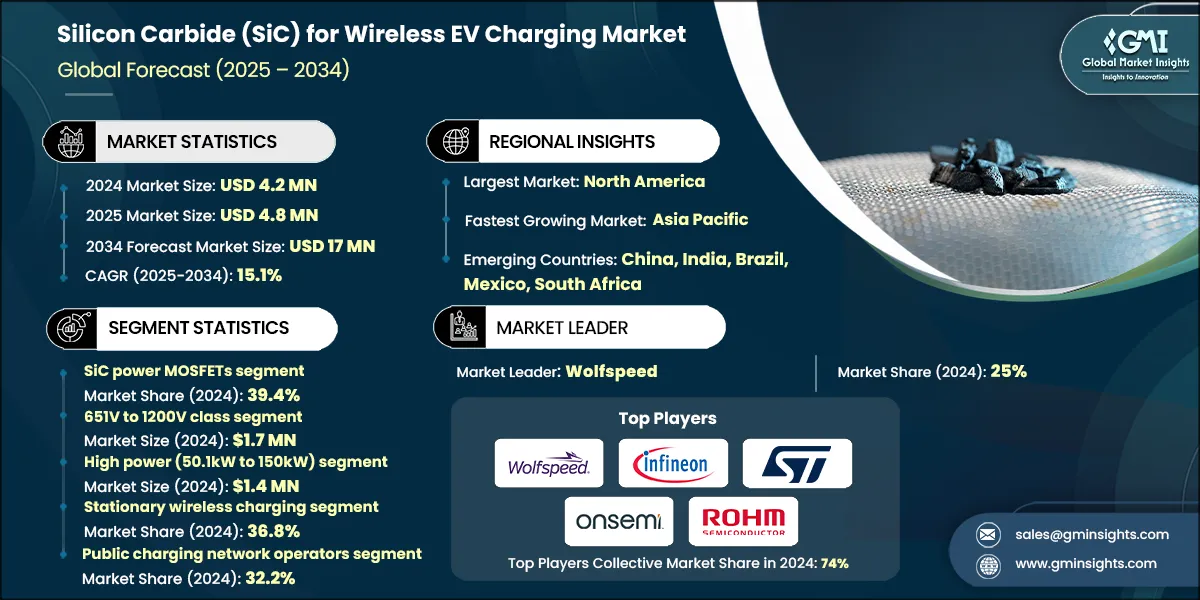
The global silicon carbide (SiC) for wireless EV charging market was valued at USD 4.2 million in 2024. The market is expected to grow from USD 4.8 million in 2025 to USD 17 million in 2034, at a CAGR of 15.1% during the forecast period, according to the latest report published by Global Market Insights Inc.
To get key market trends
The rapid increase in electric vehicle adoption worldwide is a major catalyst for the growth of silicon carbide (SiC) in wireless EV charging systems. As more consumers and fleets transition from internal combustion to electric powertrains, the demand for faster, more efficient, and convenient charging technologies intensifies. SiC devices offer superior power conversion efficiency and lower energy loss compared to traditional silicon components, making them ideal for high-frequency wireless charging. Their ability to operate at higher voltages and temperatures also supports compact, lightweight charger designs. This alignment with the evolving EV ecosystem strengthens SiC’s role as a key enabler of high-performance, next-generation charging infrastructure.
Silicon Carbide (SiC) for Wireless EV Charging Market Report Attributes
| Key Takeaway | Details |
|---|---|
| Market Size & Growth | |
| Base Year | 2024 |
| Market Size in 2024 | USD 4.2 Million |
| Market Size in 2025 | USD 4.8 Million |
| Forecast Period 2025 - 2034 CAGR | 15.1% |
| Market Size in 2034 | USD 17 Million |
| Key Market Trends | |
| Drivers | Impact |
| Growing adoption of electric vehicles (EVs) | Drives 35% surge in demand for SiC components to enhance charging efficiency and reduce energy losses. |
| Advancements in SiC semiconductor technology | Enables 30% improvement in power density and charging speed for wireless EV systems. |
| Rising government support for sustainable mobility | Accelerates SiC adoption by ~40% through incentives for high-efficiency charging infrastructure. |
| Increasing focus on fast and efficient wireless charging | Spurs 33% increase in SiC-based inverter and converter integration for optimized performance. |
| Pitfalls & Challenges | Impact |
| High cost of SiC materials and manufacturing | Limits scalability and increases production costs by up to 25%. |
| Complex fabrication and design requirements | Slows market adoption due to ~20% longer development cycles. |
| Opportunities: | Impact |
| Integration of SiC in next-generation high-efficiency wireless charging systems | Opens pathways for enhanced power transfer efficiency and reduced energy loss, strengthening SiCs position as a core material for premium charging infrastructure. |
| Expansion of public and commercial EV charging networks | Creates broad deployment opportunities for SiC-based power modules in both stationary and dynamic charging systems. |
| Market Leaders (2024) | |
| Market Leaders |
25% market share. |
| Top Players |
Collective market share in 2024 is 74% |
| Competitive Edge |
|
| Regional Insights | |
| Largest Market | North America |
| Fastest growing market | Asia Pacific |
| Emerging countries | China, India, Brazil, Mexico, South Africa |
| Future outlook |
|
What are the growth opportunities in this market?
Recent advancements in SiC semiconductor materials and manufacturing processes are accelerating the evolution of wireless EV charging. Innovations such as improved wafer quality, higher yield production, and refined device architectures have significantly enhanced SiC’s efficiency, thermal stability, and reliability. These developments enable higher switching frequencies and power densities, which are essential for efficient wireless energy transfer. Furthermore, advances in SiC MOSFETs and diodes are reducing energy losses and enabling smaller, more integrated charging systems. As a result, SiC technology not only meets the demanding requirements of wireless EV charging but also drives cost competitiveness and scalability, paving the way for widespread commercial and residential adoption.
Silicon Carbide (SiC) for Wireless EV Charging Market Trends
- Since 2021, the wireless EV charging market has shifted toward compact and modular charging pads. SiC-based components enable smaller, lighter systems with higher power density, meeting OEM demand for space-efficient, design-integrated charging solutions in both passenger and commercial EV segments.
- Beginning around 2020, the trend toward high-frequency resonant power converters has gained momentum. SiC’s superior switching speed and efficiency have made it central to this shift, allowing faster, more stable wireless power transfer and minimizing energy losses in dynamic charging environments.
- Starting in 2022, automakers have focused on integrating SiC-based inverters directly into vehicle powertrains. This trend enhances system interoperability between onboard and offboard components, simplifying wireless energy transfer and improving compatibility across multiple charging platforms and vehicle classes.
- From 2023 onward, the industry embraced intelligent, networked charging stations leveraging SiC technology for efficiency and performance monitoring. These systems integrate IoT, AI-based diagnostics, and adaptive power control, aligning wireless EV charging with broader smart grid and V2X developments.
Silicon Carbide (SiC) for Wireless EV Charging Market Analysis

Learn more about the key segments shaping this market
Based on the SiC product type, the global silicon carbide (SiC) for wireless EV charging market is divided into SiC power MOSFETs, SiC schottky barrier diodes, SiC power modules, and SiC discrete components. The SiC power MOSFETs segment accounted for 39.4% of the market in 2024.
- The adoption of SiC Power MOSFETs is accelerating as they deliver superior efficiency, reduced switching losses, and higher power density, enabling faster, more compact, and thermally efficient wireless EV charging systems suited for modern electric mobility infrastructure.
- Manufacturers should focus on enhancing device reliability, gate oxide stability, and packaging optimization to manage high-frequency operation. Collaborating with OEMs on integrated system designs can further ensure seamless performance and cost-effective scalability across charging platforms.
- The silicon carbide (SiC) for wireless EV charging market was valued at USD 0.5 million in 2024 and is projected to grow at a CAGR of 14.5% during the forecast period. The demand for SiC materials is driven by their superior efficiency, high thermal conductivity, and fast switching characteristics, which enable compact, lightweight, and energy-efficient wireless EV charging systems. SiC components significantly reduce power losses and enhance performance in both stationary and dynamic charging infrastructures.
- Manufacturers are encouraged to invest in advanced SiC wafer processing, epitaxial growth, and defect reduction technologies to improve device reliability and yield. Emphasizing automotive-grade certification, robust testing, and long-term performance validation will strengthen partnerships with EV manufacturers and accelerate the large-scale adoption of SiC-enabled wireless charging solutions globally.
Based on the voltage rating, the silicon carbide (SiC) for wireless EV charging market is segmented into up to 650V class, 651V to 1200V class, 1201V to 1700V class, and above 1700V class. The 651V to 1200V class segment dominated the market in 2024 with a revenue of USD 1.7 million.
- The 651V to 1200V Class SiC components dominate the market due to their suitability for mid- to high-power wireless charging in electric cars and light commercial vehicles, offering superior efficiency and thermal performance.
- Producers should invest in improving device robustness, gate reliability, and packaging integration for automotive-grade standards. Collaboration with OEMs on thermal modeling and inverter design can strengthen product positioning in wireless charging systems.
- The 651V to 1200V class is anticipated to witness growth at a CAGR of 16.1% over the analysis period, reaching USD 7.7 million by 2034.
- The 651V to 1200V class Silicon Carbide (SiC) devices are witnessing strong adoption in low to mid-power wireless EV charging systems, especially for passenger vehicles. Their compact structure, high energy efficiency, and cost-effectiveness make them ideal for residential, commercial, and workplace charging installations, promoting convenient and sustainable EV charging solutions.
- manufacturers should focus on improving low-voltage SiC device performance by optimizing switching speed, minimizing conduction losses, and enhancing thermal stability. Emphasizing cost reduction, scalable production, and design standardization will further support the integration of SiC technology into mainstream EV charging infrastructure and everyday consumer applications.
Based on the power level, the silicon carbide (SiC) for wireless EV charging market is segmented into low power (Up to 11kW), medium power (11.1kW to 50kW), high power (50.1kW to 150kW), and ultra-high power (above 150kW). The high power (50.1kW to 150kW) segment dominated the market in 2024 with a revenue of USD 1.4 million.
- The High Power (50.1kW to 150kW) SiC category is gaining momentum in public charging networks, enabling faster, more efficient wireless energy transfer for passenger vehicles while minimizing downtime and enhancing EV user convenience.
- Manufacturers should enhance SiC device packaging to manage higher current densities and thermal loads. Investing in interoperability testing and system-level optimization will ensure consistent performance across diverse public charging infrastructures.
- On the other hand, the ultra-high power (above 150kW) segment is anticipated to witness growth at a CAGR of 16%.
- The Ultra-High Power (Above 150kW) SiC segment is emerging for heavy-duty and long-range EVs, where high energy throughput and rapid wireless charging are critical to reducing fleet downtime and operational inefficiencies.
- Manufacturers should advance high-voltage SiC integration, focusing on superior insulation and cooling technologies. Strategic alliances with commercial transport operators can accelerate adoption of ultra-high-power wireless charging in industrial and transit applications.
Based on the application type, the silicon carbide (SiC) for wireless EV charging market is segmented into stationary wireless charging, dynamic wireless charging, quasi-dynamic wireless charging, and others. The stationary wireless charging segment dominated the market with a market share of 36.8% in 2024 and is anticipated to grow at a CAGR of 11.1% between 2025 – 2034.
- The Stationary Wireless Charging segment is witnessing strong growth as SiC technology enhances efficiency and reduces energy loss in fixed-location chargers for residential, commercial, and public EV applications, supporting reliable and user-friendly charging experiences.
- Manufacturers should focus on cost-effective SiC integration, standardization, and electromagnetic compatibility improvements. Strengthening partnerships with automakers and infrastructure providers will ensure smooth interoperability and broader deployment of stationary wireless charging systems globally.
- The dynamic wireless charging segment held the second-largest market share in 2024, with a revenue of USD 0.1 million.
- The Dynamic Wireless Charging segment is expanding as SiC components enable high-frequency, real-time power transfer for moving vehicles, enhancing range and reducing dependency on static charging infrastructure in long-distance and urban mobility applications.
- Producers should invest in durable, high-temperature SiC devices and embedded coil technologies. Collaborating with transport authorities and roadway system developers can accelerate pilot programs and commercialization of dynamic charging corridors.
Learn more about the key segments shaping this market
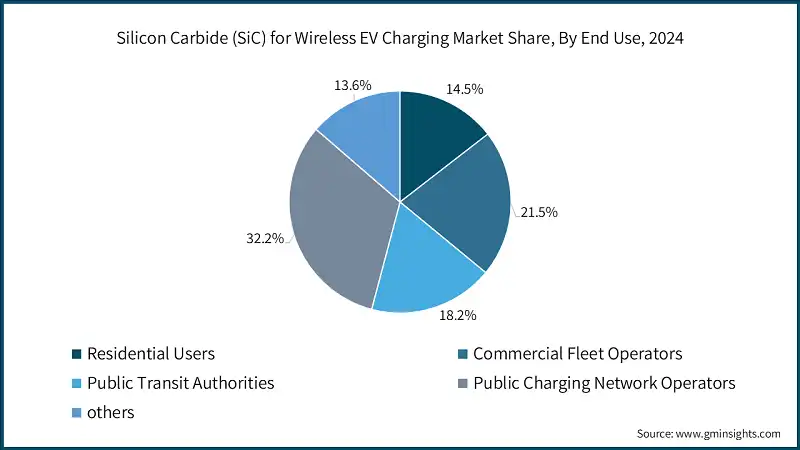
Based on the end use, silicon carbide (SiC) for wireless EV charging market is classified into residential users, commercial fleet operators, public transit authorities, public charging network operators, and others. The public charging network operators segment dominated the market in 2024 with a market share of 32.2%.
- Public Charging Network Operators are expanding SiC-based wireless charging infrastructure to attract EV users seeking convenient, fast, and reliable charging. Increasing urban EV adoption and government incentives to establish extensive charging networks support growth in this segment.
- Manufacturers should emphasize high-speed, interoperable SiC charging systems that can be deployed in urban and highway locations. Offering modular designs and software for usage analytics will enhance the value proposition for Public Charging Network Operators.
- Commercial Fleet Operators are increasingly adopting SiC-based wireless EV charging to minimize operational downtime and optimize fleet efficiency. The growing deployment of electric delivery vans and logistics vehicles necessitates rapid, high-performance charging infrastructure for continuous fleet operations.
- Manufacturers should prioritize scalable, high-capacity SiC charging solutions capable of supporting multiple vehicles simultaneously. Offering robust maintenance support and integration with fleet management software will enhance adoption among Commercial Fleet Operators.
Looking for region specific data?
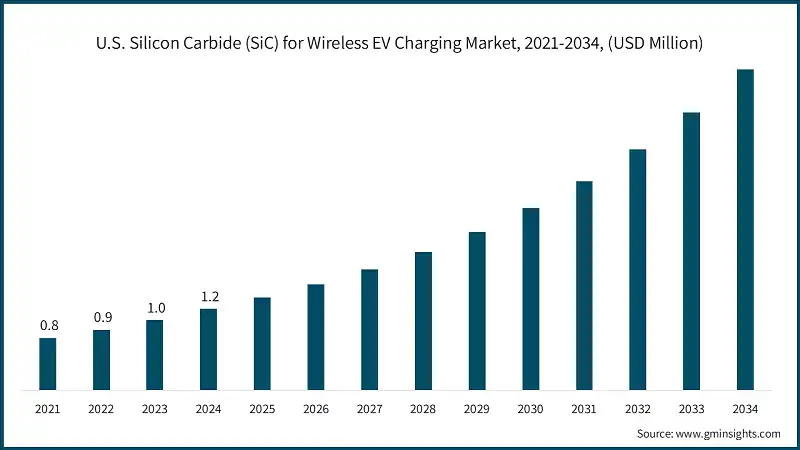
North America Silicon Carbide (SiC) for Wireless EV Charging Market The North America market dominated the global silicon carbide (SiC) for wireless EV charging market with a industry share of 34.5% in 2024. The U.S. silicon carbide (SiC) for wireless EV charging market was valued at USD 0.8 million and USD 0.9 million in 2021 and 2022, respectively. The market size reached USD 1.2 million in 2024, growing from USD 1 million in 2023. Europe market accounted for USD 0.9 million in 2024 and is anticipated to show lucrative growth over the forecast period. Germany dominates the Europe silicon carbide (SiC) for wireless EV charging market, showcasing strong growth potential. The Asia Pacific market is anticipated to grow at the highest CAGR of 30.6% during the analysis timeframe. China silicon carbide (SiC) for wireless EV charging market is estimated to grow with a significant CAGR, in the Asia Pacific market. Brazil leads the Latin American market, exhibiting remarkable growth during the analysis period. South Africa market to experience substantial growth in the Middle East and Africa Silicon Carbide (SiC) for wireless EV charging industry in 2024. The competitive landscape of the Silicon Carbide (SiC) for Wireless EV Charging industry is defined by strong innovation, technological advancement, and collaboration among leading semiconductor manufacturers and system developers. Top players such as Wolfspeed, Infineon Technologies, STMicroelectronics, onsemi, and ROHM Semiconductor hold a combined market share of approximately 74%, leveraging their expertise in SiC materials, power electronics, and EV charging solutions. These companies are heavily investing in R&D to improve SiC wafer quality, enhance switching efficiency, and reduce production costs. The market is also witnessing strategic partnerships, mergers, and collaborations with EV manufacturers and charging infrastructure providers to accelerate large-scale commercialization. In addition, smaller players are contributing through innovations in SiC device packaging, thermal management, and high-frequency design, fostering rapid technological progress and competitive differentiation. This dynamic environment is driving continuous performance improvements and expanding the adoption of SiC technology in wireless EV charging applications worldwide. Prominent players operating in the silicon carbide (SiC) for wireless EV charging industry are as mentioned below: Wolfspeed is a key player in the Silicon Carbide (SiC) for wireless EV charging market with a leading market share of ~25% The company is primarily known for its expertise in SiC materials and power semiconductors, delivering high-efficiency, low-loss devices that enable faster, more compact, and energy-efficient wireless charging solutions for next-generation electric vehicles. Infineon Technologies is a pioneer in Silicon Carbide (SiC) for wireless EV charging, known for its advanced SiC MOSFETs and diodes that deliver superior energy efficiency, thermal performance, and switching speed. The company’s innovative power semiconductor solutions enable compact, reliable, and high-performance wireless charging systems, supporting the global shift toward sustainable and intelligent electric mobility. STMicroelectronics is a key player in the Silicon Carbide (SiC) for wireless EV charging market, focusing on developing high-efficiency SiC power devices that enhance energy transfer, reduce losses, and improve system reliability. The company emphasizes innovation in SiC MOSFETs and diodes, enabling compact, cost-effective, and fast-charging solutions for electric vehicles and smart mobility infrastructure.Europe Silicon Carbide (SiC) for Wireless EV Charging Market
Asia Pacific Silicon Carbide (SiC) for Wireless EV Charging Market
Latin American Silicon Carbide (SiC) for Wireless EV Charging Market
Middle East and Africa Silicon Carbide (SiC) for Wireless EV Charging Market
Silicon Carbide (SiC) for Wireless EV Charging Market Share
Silicon Carbide (SiC) for Wireless EV Charging Market Companies
Silicon Carbide (SiC) for Wireless EV Charging Industry News
The silicon carbide (SiC) for wireless EV charging market research report includes in-depth coverage of the industry with estimates and forecast in terms of revenue in USD Million from 2021 – 2034 for the following segments:
Market, By SiC Product Type
- SiC power MOSFETs
- SiC schottky barrier diodes
- SiC power modules
- SiC discrete components
Market, By Voltage Rating
- Up to 650V class
- 651V to 1200V class
- 1201V to 1700V class
- Above 1700V class
Market, By Power Level
- Low power (Up to 11kW)
- Medium power (11.1kW to 50kW)
- High power (50.1kW to 150kW)
- Ultra-high power (Above 150kW)
Market, By Application Type
- Stationary wireless charging
- Dynamic wireless charging
- Quasi-dynamic wireless charging
- Others
Market, By End Use
- Residential users
- Commercial fleet operators
- Public transit authorities
- Public charging network operators
- Others
The above information is provided for the following regions and countries:
- North America
- U.S.
- Canada
- Europe
- Germany
- UK
- France
- Spain
- Italy
- Netherlands
- Asia Pacific
- China
- India
- Japan
- Australia
- South Korea
- Latin America
- Brazil
- Mexico
- Argentina
- Middle East and Africa
- South Africa
- Saudi Arabia
- UAE
Frequently Asked Question(FAQ) :
Who are the key players in the silicon carbide (SiC) for wireless EV charging industry?
Key players include Wolfspeed, Infineon Technologies, STMicroelectronics, onsemi (ON Semiconductor), ROHM Semiconductor, Mitsubishi Electric, Fuji Electric, WiTricity Corporation, InductEV Inc., and Qualcomm Technologies (Halo).
What are the upcoming trends in the silicon carbide (SiC) for wireless EV charging market?
Key trends include the integration of AI and IoT-enabled smart charging systems, adoption of high-frequency SiC components for efficient power transfer, and expansion of dynamic wireless charging networks for continuous EV operation.
Which region leads the silicon carbide (SiC) for wireless EV charging market?
The U.S. market led the global industry with a value of USD 1.2 million in 2024. Growth is driven by federal initiatives promoting electric mobility, strong public charging infrastructure, and adoption of SiC-based fast-charging technologies.
What was the valuation of the 651V to 1200V class segment in 2024?
The 651V to 1200V class segment generated USD 1.7 million in 2024, dominating the market due to its suitability for mid- to high-power wireless charging in electric cars and light commercial vehicles.
How much revenue did the SiC power MOSFETs segment generate in 2024?
The SiC power MOSFETs segment accounted for 39.4% market share in 2024, as these devices deliver superior efficiency, reduced switching losses, and higher power density for compact wireless charging systems.
What is the current silicon carbide (SiC) for wireless EV charging market size in 2025?
The market size is projected to reach USD 4.8 million in 2025, supported by growing demand for high-performance SiC components in next-generation EV charging infrastructure.
What is the projected value of the silicon carbide (SiC) for wireless EV charging market by 2034?
The market is expected to reach USD 17 million by 2034, driven by widespread EV adoption, advancements in SiC semiconductor technology, and expansion of public charging networks.
What is the market size of the silicon carbide (SiC) for wireless EV charging industry in 2024?
The market size was USD 4.2 million in 2024, with a CAGR of 15.1% expected through 2034, driven by increasing focus on fast and energy-efficient wireless charging solutions for electric vehicles.
Silicon Carbide (SiC) for Wireless EV Charging Market Scope
Related Reports