Summary
Table of Content

Shoe Packaging Market
Get a free sample of this report
Form submitted successfully!
Error submitting form. Please try again.
Thank you!
Your inquiry has been received. Our team will reach out to you with the required details via email. To ensure that you don't miss their response, kindly remember to check your spam folder as well!
Request Sectional Data
Thank you!
Your inquiry has been received. Our team will reach out to you with the required details via email. To ensure that you don't miss their response, kindly remember to check your spam folder as well!
Form submitted successfully!
Error submitting form. Please try again.
Shoe Packaging Market Size
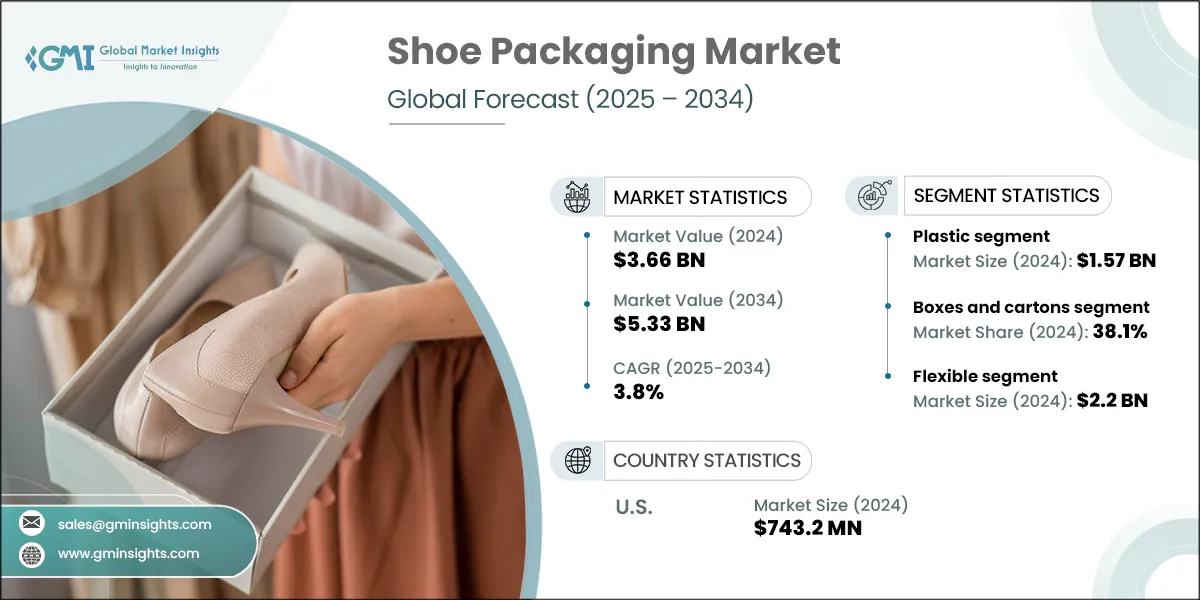
The global shoe packaging market was estimated at USD 3.66 billion revenue and 2,442 million volume units in 2024. The market is expected to grow from USD 3.81 billion in 2025 to USD 4.49 billion in 2030 and USD 5.33 billion revenue and 3,391 volume units by 2034, at a CAGR of 3.8% during the forecast period of 2025–2034.
Shoe Packaging Market Key Takeaways
Market Size & Growth
- 2024 Market Size: USD 3.66 Billion
- 2034 Forecast Market Size: USD 5.33 Billion
- CAGR (2025–2034): 3.8%
Regional Dominance
- Largest Market: Asia Pacific
- Fastest Growing Region: Asia Pacific
Key Market Drivers
- E commerce & Direct to Consumer Expansion.
- Surging Sustainability Pressure.
- Brand Differentiation & Customization.
- Smart & Interactive Packaging Technologies.
Challenges
- High Cost of Sustainable Packaging.
- Global supply chain inconsistency.
Opportunity
- Expansion in Emerging Markets.
- Adoption of Smart Packaging.
Key Players
- Market Leader: International Paper Company led with over 14.2% market share in 2024.
- Leading Players: Top 5 players in this market include International Paper Company, DS Smith Plc, Smurfit Kappa Group, WestRock Company, Mondi Group, which collectively held a market share of 53.6% in 2024.
Get Market Insights & Growth Opportunities
- It is anticipated that the E-commerce & direct to consumer expansion, surging sustainability pressure, brand differentiation & customization, monomaterial/ circular economy initiatives, will all support the shoe packaging.
- Opportunities for branding and customization are playing a major role in expanding the shoe packaging industry. Shoe brands & retailers are using customized shoe boxes & bags as low-cost advertising by applying their logos, mottos, & promotional images directly to the packaging. This converts plain packaging into marketing packaging that increases brand visibility, reinforces brand identity, & provides advertising recall.
- With the ability to customize packaging across a range of shapes, materials, finishes, and designs, all packaging differs by markets from luxury shoes to mass-market shoes. Leading brands like Nike & Adidas take advantage of high-quality, customized packaging to improve the unboxing experience, creating a feeling of exclusivity and value, building brand loyalty and increasing shoe packaging demand.
- The growing shift toward sustainable packaging, traditional shoe packaging materials especially corrugated cardboard and plastic still dominate due to their low production and distribution costs. For high-volume footwear businesses operating in price-sensitive markets, these conventional options remain the most cost-effective solution. According to the International Corrugated Case Association (ICCA), the Asia Pacific corrugated shipments were around 150 billion of square meters in 2022, which was around 54% of the total corrugated shipments globally.
- Advances in material science and printing technologies have provided ecofriendly shoe packaging alternatives, such as recyclable coated paperboard and biodegradable polymers, with the strength, stackability and aesthetics of traditional packaging. These developments keep manufacturers and retailers compliant with environmental regulations, and allow them to be cost effective, performance driven and help sustain market share and assist environmental sustainability goals. The Paper & Paperboard Packaging Environment Council states in 2023 that boxboard packaging use more than 30% of recycled materials for the packaging solutions which are extensively used in footwear packaging.
- Moreover, e-commerce growth in footwear is spurring packaging innovation for protection in transit, compact design and premium unboxing experience. Online brands and marketplaces are investing in tamper-evident, lightweight and sustainable packing that incorporates safety and customer experience. For examples Nykaa Fashion in India and Tmall (Alibaba Group) in China who have urged their partner footwear brands to bring sustainable and smart packaging formats to meet customer and delivery service expectations.
- Shoe brands like Adidas and Allbirds have moved to FSC-certified and recycled-content boxes to minimize environmental footprints. Trade associations like the Sustainable Packaging Coalition (SPC) encourage sustainable corrugated & paperboard design systems, while ECMA (European Carton Makers Association) encourages carton recycling and innovation. Distributors also maintain regulatory compliance by certification & enable ESG alignment for brands with operations spanning global markets.
To get key market trends
Shoe Packaging Market Trends
- Shoe packaging is changing due to circular economy models. Manufacturers and brands attempt to create packaging systems that are entirely recyclable or reusable and fit into closed loop recycling systems. For example, some companies are exploring modular shoe packaging designs that consumers return, refill or reuse instead of throwing away, creating less waste, and moving towards sustainability goals beyond material choice.
- Shoe brands are embracing packaging that excludes plastic wrapping, excess fillings, and multi-boxes, in order to minimize material consumption & environmental footprint. Apart from saving on costs, this also resonates with increasing consumers' preference for minimal, effective packaging solutions that generate less waste.
- Localization of packaging supply chains is becoming popular as companies try to enhance agility & minimize carbon footprints. Sourcing packaging materials & manufacturing from domestic players particularly in developing economies allows companies to decrease lead times, minimize transportation emissions, & observe local regulations more effectively. This regionalization trend is most prominent in Asia-Pacific and Latin America.
- Increasing interest in omni-channel packaging compatibility, is a significant trend driving the growth of the shoe packaging market. Consumers are opting for seamless experiences across online & offline channels, including physical stores, online websites, & social media. However, shoe manufacturers and packaging providers are making versatile and appealing packaging which are effective and optimized for social sharing. The trend presses innovation in material science, aesthetics, and structural design to deliver requirements for multi-channels.
Shoe Packaging Market Analysis
Learn more about the key segments shaping this market
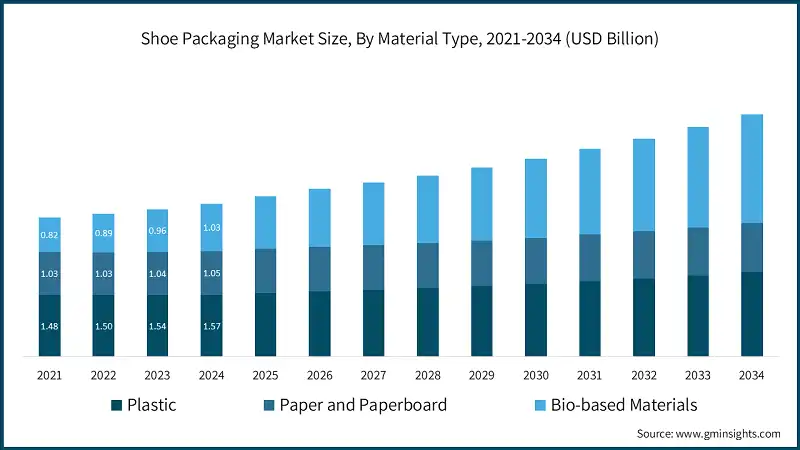
On the basis of the material type, the market is classified into plastic, paper & paperboard, and bio-based materials. The plastic market has the largest market share of 40.4%, followed by the bio-based materials market with a CAGR of 8.4% during the forecast period.
- The plastic segment is the largest and was valued at USD 1.57 billion in 2024. Plastic is still a durable material for shoe packaging, particularly for protective films, polybags, and wrapping used for shoes in shipping and retail displays. According to the Footwear Distributors & Retailers of America (FDRA), plastic packaging like PE films and bags is popular because it’s affordable, durable, & moisture-resistant, which helps protect products during shipping.
- The American Chemistry Council (ACC) notes that more companies are using post-consumer recycled (PCR) content in plastic shoe packaging. This trend matches the sustainability goals of major shoe brands. The ACC also supports retail initiatives that increase plastic recycling rates, like shoe bag drop-off programs, to help reduce landfill waste.
- The bio-based material market is the increasing segment, and it will be growing at a CAGR of 7.4% during the forecast period. Biobased materials used in shoe packaging are picking up momentum as international footwear companies react to mounting regulatory pressure & consumers call for greener packaging.
- The Sustainable Packaging Coalition (SPC) focuses on the growth of compostable & biodegradable packaging solutions in the footwear sector, like biobased paperboard coated with PLA or starch-based films applied in shoeboxes & protective coverings. Such focus will enhance the growth of the bio-based material for shoe packaging in the future.
Learn more about the key segments shaping this market
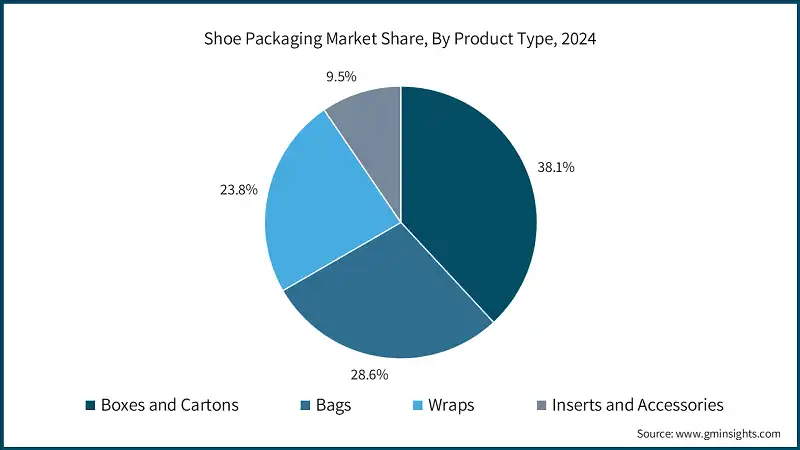
Depending on product type, the shoe packaging market is classified under boxes & cartons, bags, wraps and inserts & accessories.
- The boxes & cartons segment is the market leader in the shoe packaging industry with a 38.1% market share worth USD 1.4 billion in 2024. Growth in this segment is influenced by robust global distribution chains and the demand for organized, brandable packaging.
- Corrugated & paperboard shoeboxes provide greater stackability, printability, & protection while shipping shoe and displaying shoe brands. Large distributors and wholesalers are crucial in propelling sales, as they provide inventory management, logistics services, and bulk pricing, an essential consideration for institutional and retail procurement.
- The bags segment is the fastest growing and will grow at a CAGR of 5% during the forecast period. Rising online shoe sales, greater adoption of protective secondary packaging, and higher demand for custom-printed, lightweight bags among SMEs and D2C players are the key growth drivers.
- Shoe bags of LDPE, cotton, non-woven polypropylene, or biodegradable bio-plastics are typically applied for dust protection, gifting, and return packaging. As online shopping is on the rise, small businesses & shoe stores are ordering shoe bags in smaller volumes through online channels such as Amazon Business, Uline, and PacknWood, which provide quick access to eco-certified and tailor-made choices.
On the basis of type, the shoe packaging market is categorized into rigid and flexible. The flexible market holds the maximum market share of 60.1% whereas rigid segment is projected to have a CAGR of 1.5% during the forecast period.
- Flexible shoe packaging was the dominant category, contributing USD 2.2 billion in 2024. Flexible shoe packaging such as LDPE/HDPE polybags, biodegradable pouches, and vacuum-insulated wraps are in high demand in the mass footwear market, especially for sportswear, children's footwear, and leisure footwear. Such packaging format helps optimize inventory space, lowers the packaging-to-product weight ratio, and cuts handling costs which is important for bulk B2B shipments and fast-moving supply chains.
- The rigid segment is also expected to expand with a 1.5% CAGR during the forecast period. Rigid packaging is becoming more popular in luxury, formal, and heritage footwear as it offers a premium unboxing experience and helps in brand storytelling. Moreover, brands are trying out modular shoe boxes with different compartments to pack multiple pairs, mainly for high-end e-commerce influencers. Some brands are moving to single-material rigid packaging to make recycling easier and comply with new rules such as EU Green Deal and the U.S. FTC’s Green Guides.
Looking for region specific data?
The North America shoe packaging market held 26.3% market share in 2024 and is growing at a 2.5% CAGR. Strong demand from incumbent footwear brands that focus on premium & sustainable packaging is driving growth. Increased direct-to-consumer sales & e-commerce channels have spurred demand for packaging that strikes a balance between protection, branding, and sustainability.
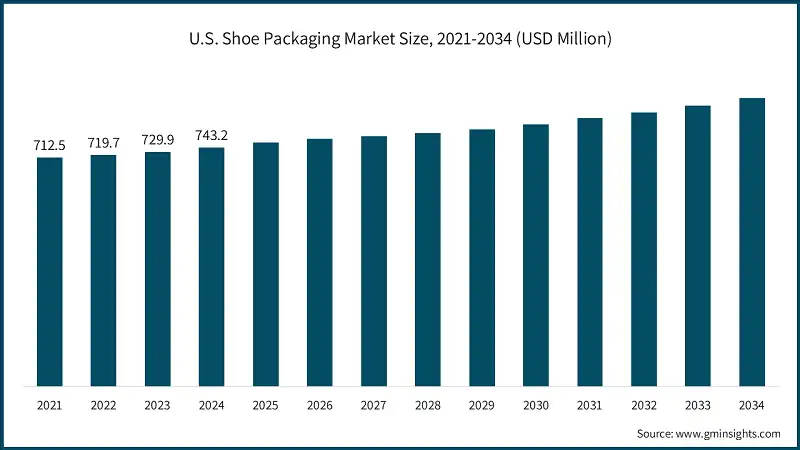
- The United States shoe packaging industry has been increasing steadily, achieving a CAGR of 1.9% and hitting USD 743.2 million in 2024. Reusable shoe boxes, modular packs, and the use of recycled materials are becoming increasingly popular in the U.S. producers such as WestRock and Mondi, which are heavily investing in sustainable packaging solutions designed for footwear. Companies are now leaning towards certified recyclable paperboard and inserts that are biodegradable to be responsive to consumer and regulatory pressures.
- In addition, the U.S. footwear packaging market is gaining traction from innovations in packaging technology, such as smart labels and anti-counterfeit properties, especially for high-end and sport shoes brands shielding their products in competitive markets.
- The Canada market is anticipated to grow significantly at a CAGR of 4.4% during the forecast period. The Canada market is led by growing consumer affinity for sustainable packaging & government-supported programs that promote circular economy principles. Urban centers such as Toronto & Vancouver are aggressively testing compostable footwear packaging in cooperation with footwear producers, which enhance the demand for shoe packaging in Canada.
Europe shoe packaging market held a share of 23.1% in 2024 with a CAGR of 3.1% during the forecast period. EU shoe brands and retailers are embracing sustainable packaging solutions, such as recycled paperboard, molded fiber inserts, & minimalist designs that minimize material use yet ensure product protection, driving the growth of the market.
- The Germany shoe packaging industry was worth USD 175.5 million in 2024 and is projected to grow at a CAGR of 1.9% during the forecast period. Demand for shoe packaging is rising due to solid performance in high-volume footwear production & premium retailing channels that increasingly need packaging that balances brand presentation with sustainability objectives. Manufacturers under regulatory codes such as the German Packaging Act (VerpackG) and the EU Green Deal are switching to recycled fiberboard, compostable tray inserts, & lightweight corrugated cartons to meet recyclability requirements and extended producer responsibility regulation.
- The UK market for shoe packaging will be USD 212.2 million by 2034. Driven by high growth in fast fashion, sportswear, and e-commerce footwear industries. Customers increasingly seek packaging that delivers footwear safely in transit and also provide a luxury unboxing experience. Specifically, eco-designed shoe boxes created from recycled cardboard using water-based inks are in popularity in both high-end and high-volume footwear markets.
Asia-Pacific shoe packaging dominated the market with 35.6% market share in 2024. APAC is facing a structural transformation in the shoe packaging sector catalyzed by regulatory changes, urban consumer interest in sustainability, and the rapid growth of e-commerce. Consequently, shoe companies in Asia Pacific are embracing lightweight, recyclable paperboard packaging boxes, plant-based cushioning, and low-ink printed cartons that minimize environmental footprints and maximize shipping efficiencies.
- China shoe packaging market was valued at USD 457.8 million in 2024 and it is anticipated to grow with a CAGR of 4.6% during the forecast period. China's evolving regulatory climate has rattled the shoe packaging ecosystem. Players such as Li-Ning, Anta, and 361 Degrees are moving towards using FSC-certified corrugated boxes, die-cut kraft packaging, and foldable recycled board sleeves for shoe packaging. For example, Li-Ning's limited-edition sneaker now ships in recyclable rigid boxes with magnetic flaps that can be reused or repurposed ultimately following the "eco-utility" concept. Such environment friendly solution is enhancing the growth of the shoe packaging in China.
- Japan market has been growing consistently, with a CAGR of 6.4% and a value of USD 163.8 million in 2024. The regulatory environment in Japan based on the Containers and Packaging Recycling Law and the Green Purchasing Law lays a strong focus on material separation, recyclability, and environmental design. The shoe packaging industry is rapidly shifting to minimal, modular pack design with mono-material cardboard, cellulose inserts and soy-based digital printing. Major shoe brands like Asics, Mizuno, and Onitsuka Tiger are beginning to release zero-plastic packaging lines. For example, the shoe boxes by Asics Gel-Kayano 30 are completely recyclable folding carton and embossed logos (no ink is used) with natural fiber cushioning.
- South Korea shoe packaging market accounted to USD 124.7 million in 2024 & is forecasted to grow at a CAGR of 7.3% during the forecast period. South Korea has strict eco-packaging regulations under the Act on the Promotion of Saving and Recycling of Resources, which specifically bans excessive packaging layers, requires recyclable labelling, and encourages voluntary compliance certifications. These regulations have transformed the shoe packaging for domestic and international footwear brands.
Latin America shoe packaging contributed 9.1% market share and was growing at a CAGR of 1.9%. The Latin American shoe packing market is experiencing moderate growth as a result of increasing e-commerce footwear retail and the awareness of sustainable practices increasing in the region. In Mexico, businesses are using multi-layered recycled paperboard packaging and branding to save costs and preserve the environment. Multinationals in the region, like Grupo Bimbo are establishing benchmarks by utilizing biodegradable materials and closed-loop collection systems, impacting the broader packaging and footwear industry.
Middle East & Africa shoe packaging market reached USD 213.5 million in 2024. Middle East & Africa market is driven by the growth in regional urbanization and luxury footwear demand, particularly in the Gulf Cooperation Council (GCC) nations. At the same time, South African companies are incorporating post-consumer recycled paperboard and Forest Stewardship Council (FSC) certified materials as retailers demand sustainability in packaging.
Shoe Packaging Market Share
The top five players International Paper Company, DS Smith Plc, Smurfit Kappa Group, Inc., WestRock Company, and Mondi Group together hold about 53.6% of the global shoe packaging industry. This shows that the market is quite concentrated. Strong customer relationships, patented packaging technologies, and advanced R&D facilities create significant barriers for new companies trying to enter the market.
- International Paper Company is the market leader with a 14.2% market share, fueled by a broad portfolio of shoe packaging offerings ranging from high-end recyclable, biodegradable, and recycled paperboard products. Their wide global manufacturing base & emphasis on sustainable innovations allow them to address multiple end-use markets like retail, e-commerce, & specialty footwear brands. Meeting strict environmental regulations further reinforces their leadership status globally.
- DS Smith Plc holds an 11.8% market share, which is known for its innovative and bespoke corrugated shoeboxes and paperboard packaging solutions. The firm focuses on sustainable packaging, using recycled and compostable materials, and works closely with major footwear companies to produce customized packaging that complements the experience of a brand. Their strong R&D and international supply chain capabilities have helped them gain a foothold in mature and developing footwear markets.
- Smurfit Kappa Group owns 10.5% of the shoe packaging market & is known for its high-quality, durable, & stylish shoeboxes. Their products feature biodegradable coatings and advanced printing techniques that help brands stand out and connect with customers. By focusing on affordable, sustainable packaging, Smurfit Kappa has gained a strong presence in the food service, retail, and footwear markets.
- Offering creative & durable packaging solutions for the diverse needs of the footwear industry is the specialty of ProSciTech, a niche player in the market. The company focuses on sustainable packaging materials such as recyclable & biodegradable paperboard and plastic-based composites. ProSciTech's innovative production processes & strict adherence to environmental norms have established the company as a dominant player in North American & European retail markets. Their branded, customized packaging options assist brands in improving product protection while also strengthening green credentials.
- Ted Pella, Inc. is renowned for producing high-end packaging supplies & accessories for the expertise in shoe packaging industry. Ted Pella specializes in offering protective wraps, cushioning products, & highly precise-engineered packaging inserts that guarantee product protection during shipping. Ted Pella's commitment to sustainable sourcing and meeting industry environmental standards furthers its established credibility among footwear manufacturers that seek green packaging operations. Its versatile supply chain & customer-focused philosophy allow for powerful partnerships throughout North America and certain global markets.
- As a global leader in environmentally friendly shoe packaging, DS Smith Plc offers a wide range of protective packaging, corrugated boxes, and paperboard shoeboxes that are designed to be both distinctive for brands and compliant with environmental standards. DS Smith integrates biodegradable materials & recovered content into its products while maintaining a strong emphasis on the principles of the circular economy. The company's innovation centers & collaborative design initiatives enable shoe manufacturers to optimize packaging for both consumer appeal & logistical efficiency.
Shoe Packaging Market Companies
Some of the prominent market participants operating in the shoe packaging industry include:
- Abdos Labtech Private Limited
- Agar Scientific Ltd.
- Heathrow Scientific
- Hurst Scientific
- International Paper Company
- Leica Biosystems Nussloch GmbH
- Molecular Biology Products Inc. (MBPS)
- ProSciTech
- Ted Pella, Inc.
- Thermo Fisher Scientific Inc.
- DS Smith Plc
- Smurfit Kappa Group
- WestRock Company
- Mondi Group
- Packaging Corporation of America
- Seaman Paper Company
- Stora Enso Oyj
- Graphic Packaging Holding Company
Shoe Packaging Market Report Attributes
| Key Takeaway | Details |
|---|---|
| Market Size & Growth | |
| Base Year | 2024 |
| Market Size in 2024 | USD 3.66 Billion |
| Forecast Period 2025 - 2034 CAGR | 3.8% |
| Market Size in 2034 | USD 5.33 Billion |
| Key Market Trends | |
| Drivers | Impact |
| E commerce & Direct to Consumer Expansion | Online footwear sales has driven a 25–30% increase in demand for durable and lightweight shoe packaging. |
| Surging Sustainability Pressure | Over 60% of global footwear brands have transitioned to partially or fully recyclable packaging, |
| Brand Differentiation & Customization | Customized packaging solutions have led to 20–25% higher brand recall |
| Smart & Interactive Packaging Technologies | Integration of QR/NFC codes has improved post-purchase engagement by 30–35% and reduced counterfeit returns by up to 22%. |
| Pitfalls & Challenges | Impact |
| High Cost of Sustainable Packaging | Increase expenses by 30–50%, restricting adoption by smaller brands. |
| Global supply chain inconsistency | Causes logistical challenges and compliance risks, hindering uniform packaging rollout. |
| Opportunities: | Impact |
| Expansion in Emerging Markets | Growing footwear demand in Asia-Pacific and Latin America |
| Adoption of Smart Packaging | Implementation of QR codes and NFC technology can reduce counterfeit products |
| Market Leaders (2024) | |
| Market Leaders |
14.2% market share in 2024 |
| Top Players |
Collective market share in 2024 is 53.6% |
| Competitive Edge |
|
| Regional Insights | |
| Largest Market | Asia Pacific |
| Fastest Growing Market | Asia Pacific |
| Emerging Countries | China, India, South Korea, UAE, and South Africa |
| Future outlook |
|
What are the growth opportunities in this market?
Shoe Packaging Industry News
- In July 2025, International Paper has completed the sale of five of its European corrugated box mills to PALM Group, which completes regulatory undertakings related to its acquisition of DS Smith Plc. The deal involves three mills in Normandy, France, one in Ovar, Portugal, and one in Bilbao, Spain. PALM, which is a top European packaging manufacturer, now has 33 corrugated box mills in Europe.
- In Feb 2025, Heathrow Scientific has gone into the surgical product industry by acquiring the assets and product lines of Whitney Medical Solutions' (WMS), as of February 18, 2025. This deal adds Heathrow's offerings with WMS's cutting-edge lab and surgery products, such as sterile No-Scratch Curettes and eShield covers. Heathrow will move WMS's operations to its environmentally friendly Vernon Hills, Illinois headquarters, where they will continue to be made in America and serve wider markets.
The shoe packaging market research report includes in-depth coverage of the industry with estimates and forecasts in terms of revenue in (USD billion & units) from 2021 – 2034 for the following segments:
Market, By Material Type
- Plastic
- PET (Polyethylene Terephthalate)
- HDPE (High-Density Polyethylene)
- LDPE (Low-Density Polyethylene)
- Recycled plastics
- Paper and paperboard
- Corrugated paperboard
- Kraft paper
- Coated paperboard
- Molded fiber
- Bio-based materials
- Mushroom packaging
- Pulp-based packaging
- Ocean plastic
- Cornstarch-based bioplastics
- Bagasse (sugarcane waste)
Market, By Product Type
- Boxes and cartons
- Bags
- Wraps
- Inserts and accessories
Market, By Type
- Flexible
- Rigid
Market, By Distribution Channel
- Online
- E-commerce platforms
- Direct-to-consumer (D2C) brand websites
- Offline
- Shoe retail stores
- Department stores
- Specialty packaging stores
- Wholesale distributors
The above information is provided for the following regions and countries:
- North America
- U.S.
- Canada
- Europe
- Germany
- UK
- France
- Spain
- Italy
- Netherlands
- Asia Pacific
- China
- India
- Japan
- Australia
- South Korea
- Latin America
- Brazil
- Mexico
- Argentina
- Middle East and Africa
- Saudi Arabia
- South Africa
- UAE
Frequently Asked Question(FAQ) :
What is the market size of the shoe packaging market in 2024?
The market size for shoe packaging was valued at USD 3.66 billion in 2024 driven by growth in e-commerce, sustainability initiatives, and customization demands.
What is the projected value of the shoe packaging market by 2034?
The market is expected to reach USD 5.33 billion by 2034, growing at a CAGR of 3.8% due to increasing demand for eco-friendly and customizable packaging.
How much revenue did the plastic segment generate in 2024?
The plastic segment generated USD 1.57 billion in 2024, accounting for the largest share (40.4%) of the shoe packaging market due to its affordability and durability.
What is the fastest-growing material segment in the shoe packaging industry?
The bio-based material segment is the fastest-growing, projected to grow at a CAGR of 7.4% from 2025 to 2034.
What was the valuation of boxes and cartons in 2024?
The boxes and cartons segment led the product type category with a market share of 38.1%, valued at USD 1.4 billion in 2024.
What is the growth outlook for bags in the shoe packaging market?
The bags segment is projected to grow at a 5% CAGR from 2025 to 2034.
What was the market size of the U.S. shoe packaging industry in 2024?
The U.S. shoe packaging market reached USD 743.2 million in 2024 with a CAGR of 1.9%. growth was driven by rising footwear demand and eco-friendly packaging trends.
What are the key trends influencing the shoe packaging industry?
Major trends include sustainable packaging initiatives, brand customization, modular and reusable packaging designs, and omni-channel packaging compatibility for physical and digital retail.
Who are the key players in the global shoe packaging market?
Leading players include International Paper Company, DS Smith Plc, Smurfit Kappa Group, WestRock Company, and Mondi Group, collectively holding over 53.6% market share in 2024.
Shoe Packaging Market Scope
Related Reports