Summary
Table of Content

Shipment Tracking Platform Market
Get a free sample of this report
Form submitted successfully!
Error submitting form. Please try again.
Thank you!
Your inquiry has been received. Our team will reach out to you with the required details via email. To ensure that you don't miss their response, kindly remember to check your spam folder as well!
Request Sectional Data
Thank you!
Your inquiry has been received. Our team will reach out to you with the required details via email. To ensure that you don't miss their response, kindly remember to check your spam folder as well!
Form submitted successfully!
Error submitting form. Please try again.
Shipment Tracking Platform Market Size
The logistics industry is being transformed and revolutionized with new and advanced technologies that significantly empower the logistics operations as well as let users track their shipments live. Many logistics companies have already adopted real-time tracking platforms that give customers the best experience.
Shipment Tracking Platform Market Key Takeaways
Market Size & Growth
- 2025 Market Size: USD 2.61 Billion
- 2026 Market Size: USD 2.75 Billion
- 2035 Forecast Market Size: USD 5.62 Billion
- CAGR (2026–2035): 8.3%
Regional Dominance
- Largest Market: North America
- Fastest Growing Region: Asia Pacific
Key Market Drivers
- Rising e-commerce and online retail growth.
- Increasing demand for real-time shipment visibility.
- Growing adoption of IoT and smart logistics solutions.
- Need for supply chain optimization and efficiency.
Challenges
- Data security and privacy concerns.
- Lack of standardized tracking protocols.
Opportunity
- Emerging markets with growing e-commerce penetration.
- Advancements in AI and predictive analytics.
- Expansion of last-mile delivery solutions.
- Strategic partnerships with logistics and courier companies.
Key Players
- Market Leader: Project44 led with over 9.2% market share in 2025.
- Leading Players: Top 5 players in this market include AfterShip, FourKites, Project44, Shippo, Sendcloud, which collectively held a market share of 18.5% in 2025.
Get Market Insights & Growth Opportunities
According to the World Shipping Council (WSC), every year around 1,200 containers are being lost based on a 10-year average. In 2024, the count is reduced to 576 containers lost. As containers are based on risk and still moving towards smart tracking platform integration, the lost count will be declined.
Shipment tracking platforms are improving with the use of IoT, cloud computing, and real-time data analytics. These technologies provide full visibility across global supply chains. Logistics companies are focusing on solutions that track both location and conditions like temperature, humidity, and shock to improve reliability and reduce risks.
GPS and IoT sensors are becoming more popular. GPS tracking is the most used in live package tracking because it provides accurate location data and works well with mobile devices.
Businesses are using advanced tracking technologies more often, especially in industries like pharmaceuticals, perishables, and high-value electronics. These industries need detailed tracking beyond just knowing where a shipment is. IoT technology now allows predictive analytics and early alerts, which help improve operations.
In June 2025, Etihad Cargo launched SmartTrack, a real-time tracking solution for air cargo. It provides detailed location and condition data for shipments. SmartTrack uses smart labels with cellular, GPS, Wi-Fi, and Bluetooth connectivity to monitor temperature, humidity, shock, tilt, and light exposure.
Investors are showing confidence in the shipment tracking market. Recent funding for tracking technology companies shows belief in the market’s growth. In July 2025, TrackChain secured USD 2 million to revolutionize end-to-end logistics with its intelligent unified platform This funding helps improve research and helps in expansions.
North America and Europe are leading in using tracking technologies for digital logistics. The Asia-Pacific region is growing fast because of e-commerce and cross-border trade. Better telecommunications and 5G networks are expected to make tracking more accurate and reduce delays, even in remote areas.
The global shipment tracking platform market was valued at USD 2.61 billion in 2025. The market is expected to grow from USD 2.75 billion in 2026 to USD 5.62 billion in 2035 at a CAGR of 8.3%, according to latest report published by Global Market Insights Inc.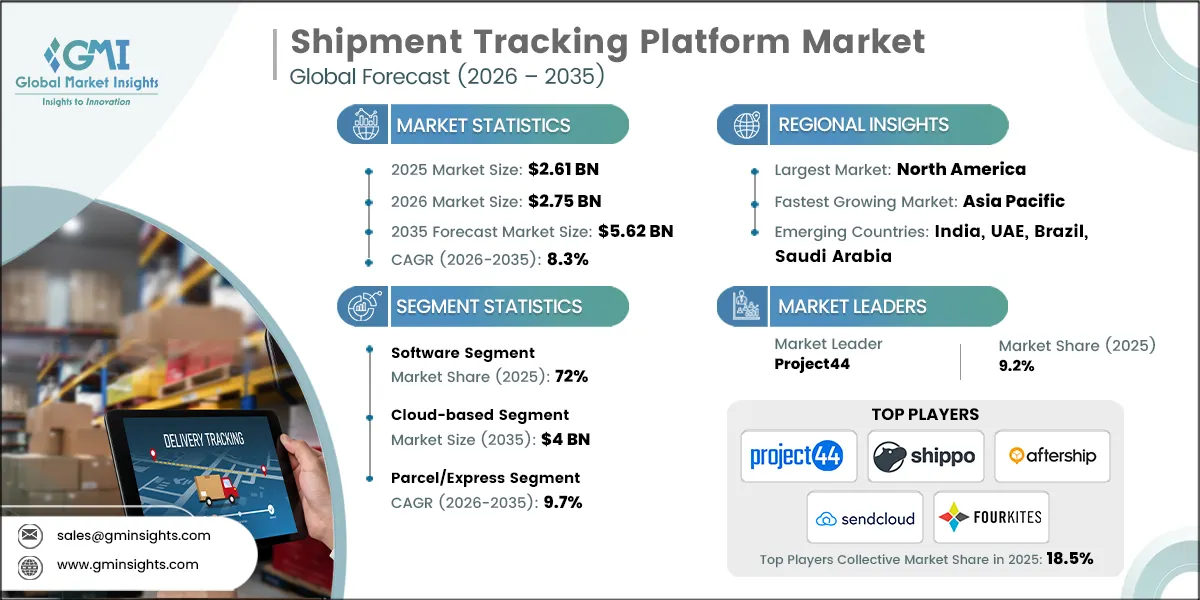
To get key market trends
Shipment Tracking Platform Market Trends
Companies are replacing separate carrier portals with unified systems that show all shipment events in one place. These systems work across road, ocean, rail, air, and parcel networks. They also add details like delays, port congestion, and route history. Teams using a single view with accurate predictive ETAs see 25–35% fewer “where is my order” calls and a 15–20% improvement in on-time deliveries because they can fix problems earlier.
In the short to medium term, as data improves, benefits are already clear in B2C parcels and retail. These benefits will grow in B2B freight as ocean and rail data become more detailed. This trend shows that companies are spending more on visibility tools instead of TMS upgrades because the savings and benefits are easier to measure.
Cloud/SaaS platforms are now the first choice for system deployment. They are popular because they deliver results faster. These platforms handle busy times automatically, update features every month and follow local data rules. Hybrid and on-premises systems are still used for some regulated tasks, but most companies are moving to the cloud. Small businesses switch quickly because of subscription pricing.
Mid-sized companies adopt API-based setups, and large companies move in steps as they replace old systems. Cloud-based systems are improving faster in analytics, coordination, and partnerships compared to older systems.
The cost of sensors that track temperature, humidity, light, tilt, and shock has dropped from USD 300–500 per device in 2018 to an expected USD 25–75 by 2025. This makes them affordable for more uses. In industries like pharmaceuticals and food, these sensors help meet regulations (like FDA 21 CFR Part 11 and EU GDP), reduce disputes, and cut temperature-related issues by 60–70% when paired with alerts.
AI/ML Improves Predictive ETAs and Solves Issues Faster AI models now use past data to predict arrival times, avoid delays, and find problems. Systems using AI deliver 20–30% more on-time shipments, reduce manual work by 40–50%, and lower customer questions by 25–30% with automatic updates. Even if predictions are not perfect, actions like auto rebooking, service upgrades, and updated ETAs help save money.
Shipment Tracking Platform Market Analysis
Learn more about the key segments shaping this market
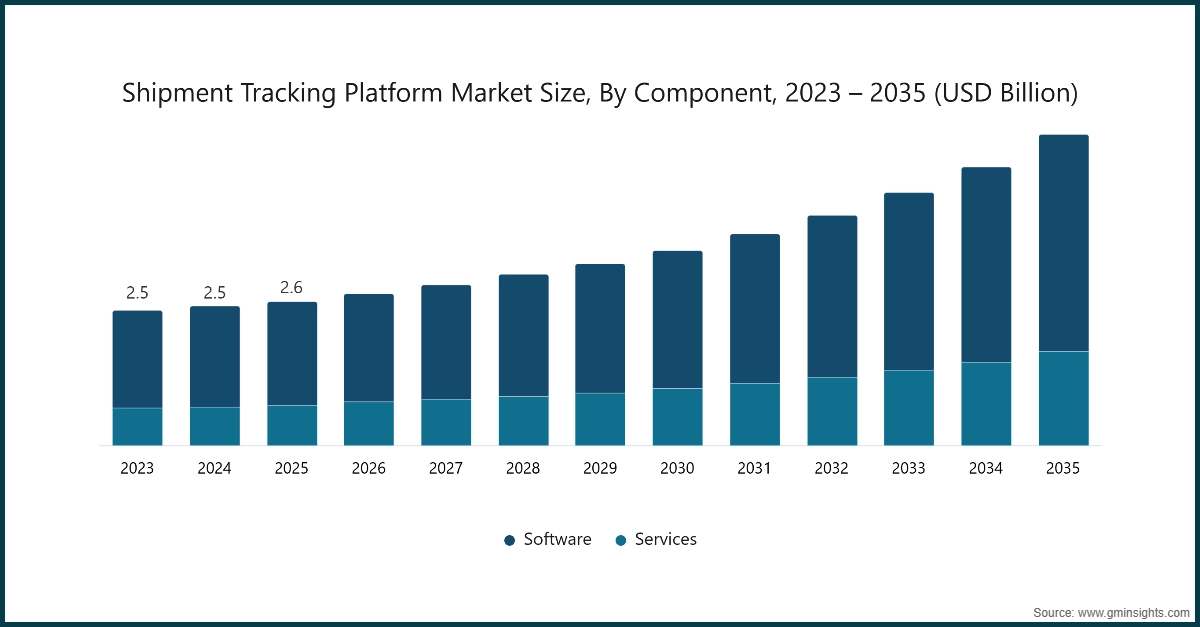
Based on component, the market is divided into software and services. The software segment dominated around 72% market share and generated revenue of USD 1.9 billion in 2025.
- In 2025, software segment made up about 72% of the market value, while services accounted for 28%. Services are growing faster because rollouts are becoming more complex. Software revenue comes from SaaS subscriptions, API event pricing, and tiered modules. These modules include predictive ETAs, sustainability reporting, and collaboration tools, helping buyers customize their systems without making them too complicated.
- Platform differences now depend on carrier coverage, ETA accuracy, and integrations with systems like TMS, WMS, ERP, and e-commerce. These features make setups faster and improve data accuracy. Services focus on two main areas: onboarding multiple carriers and managing exceptions.
- Vendors or partners handle routine tasks like carrier coordination and monitoring, allowing shippers to focus on other work. In industries like healthcare, public services, and cross-border trade, stricter rules make security features (like encryption and audit trails) and data residency important factors in choosing solutions.
- Buyers want solutions that give quick and clear results, like fewer customer calls, better inventory management, and lower shipping costs. This has made analytics and automation tools more popular.
- Software is still the main value driver, but services are becoming more important as businesses grow and deal with more carriers, regions, and shipping methods. Large companies with global operations often use professional and managed services for complex setups and ongoing improvements. Smaller businesses benefit from ready-made connectors and simple onboarding solutions that save time.
Learn more about the key segments shaping this market
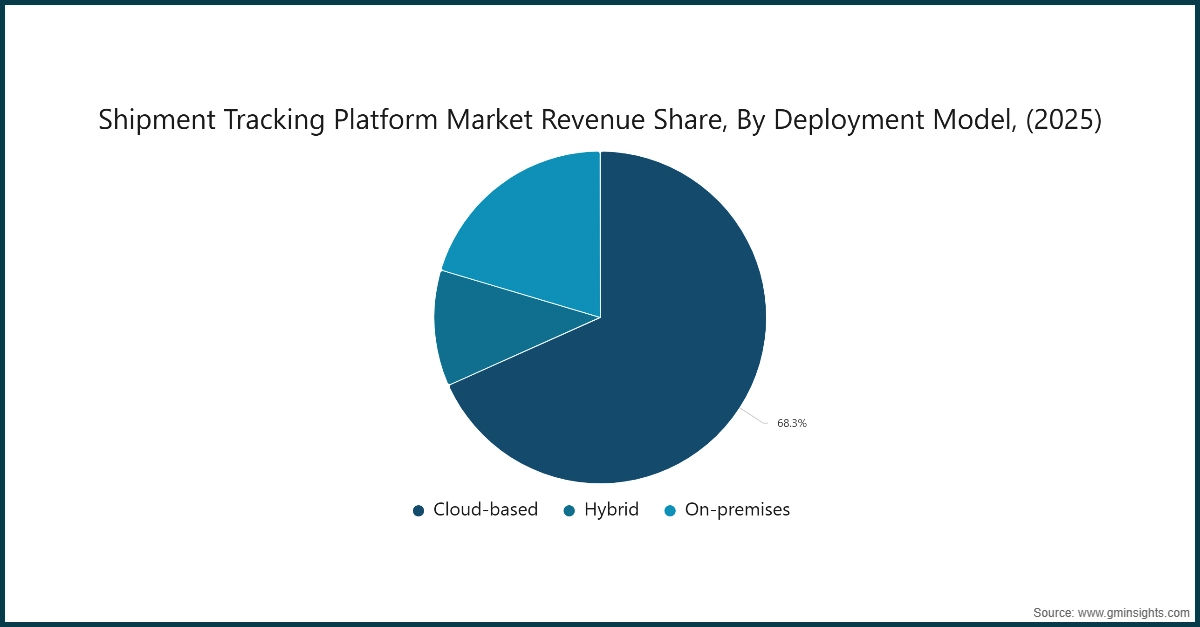
Based on deployment model, the shipment tracking platform market is divided into cloud-based, hybrid and on-premises. The cloud-based segment accounted for over 68.3% market share in 2025 and is expected to reach USD 4 billion by 2035.
- In 2025, most enterprises preferred cloud-based platforms because of features like flexible scaling, automatic updates, and built-in API systems. Hybrid models are still used when local storage is needed, but most analytics are now done in the cloud. Fully on-premises setups are only used for strict compliance or low-latency needs.
- Data rules in the EU and China pushed vendors to create region-specific data centers, giving businesses compliant options without slowing innovation. Pricing models like subscriptions and usage-based fees help with budgeting, while advanced features like AI ETAs and carbon calculators bring in more revenue when they show clear results.
- According to the European Union, 66.78% of medium-sized businesses used cloud services in 2025, compared to 59.09% in 2023. This shows that more businesses are moving to cloud tools to improve their processes.
- In coming years, cloud usage is expected to keep growing, with hybrid models used for specific needs like data sovereignty. On-premises setups will likely shrink to only highly regulated industries. The goal is for platforms to become smarter over time, using shared data to make better predictions.
Based on transportation mode, the shipment tracking platform market is divided into multi-modal, road/ground transportation, ocean/maritime, air freight and parcel/express. The parcel/express segment is expected to grow at a CAGR of 9.7% between 2026 and 2035.
- The parcel/express segment’s fastest growing nature is the result of the rise in global e-commerce and direct-to-consumer shipments. Parcel shipments involve large volumes, quick deliveries, and frequent updates, making real-time tracking very important. Tracking systems are now a key part of last-mile delivery and customer service. Clear delivery updates improve customer satisfaction, returns, and retailer performance.
- Road/ground transportation is the largest part of the shipment tracking platform market. It handles most global freight and supports first-mile, middle-mile, and last-mile deliveries. Road freight is important for domestic shipping, regional trade, and cross-border transport, which keeps the demand for tracking systems high. This segment leads because GPS tracking, telematics, and carrier integrations are widely used by trucking fleets, 3PLs, and shippers.
- Road freight has frequent shipments and changing routes, so real-time tracking and ETA predictions are very useful. GPS and mobile connectivity are common, making it easy to use tracking technology. Additionally, road transport connects directly with warehouses, ports, and airports, making it a key part of multimodal tracking systems. These factors make tracking platforms more widely used in road transport than in other modes.
Looking for region specific data?
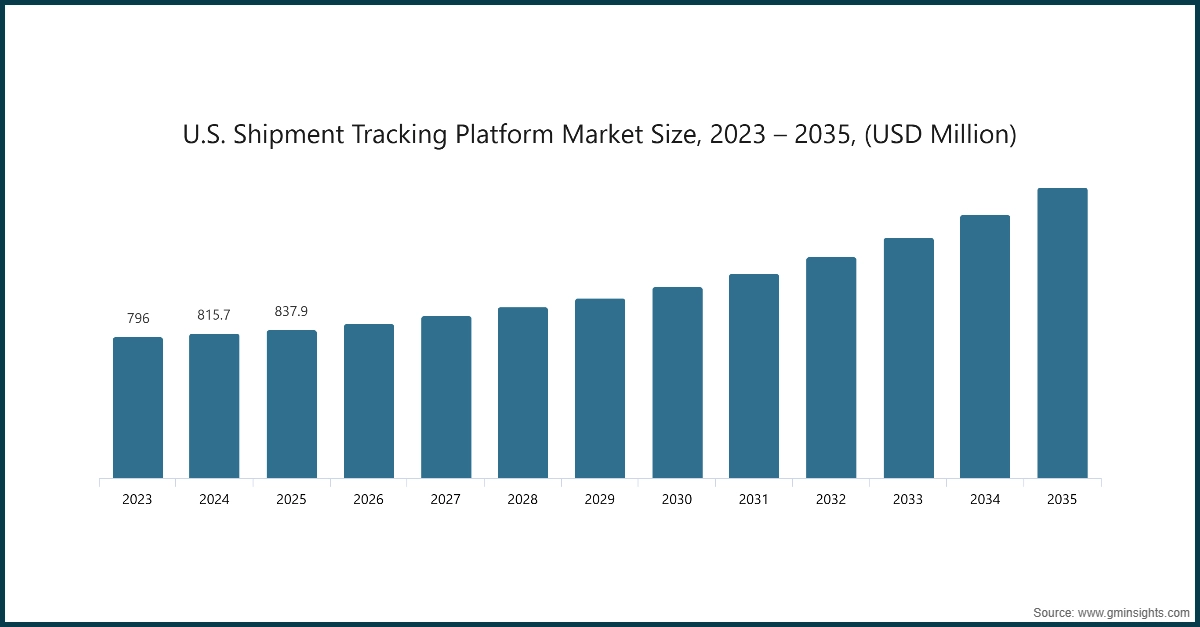
The US shipment tracking platform market reached USD 837.9 million in 2025, growing from USD 815.7 million in 2024.
- As of 2025, the U.S. is the biggest market for tracking platforms. In the third quarter of 2025, U.S. retail e-commerce sales were USD 299.6 billion, a 2.2% increase from the second quarter of 2025. This was a 5.2% increase from the third quarter of 2024. Total retail sales increased by 4.2% during the same period. E-commerce accounted for 15.8% of total sales in the third quarter of 2025.
- Tracking has become a necessity for all retailers, whether small or big. Primarily, big businesses utilize these platforms the most, followed by small and medium-sized businesses that are transitioning to cloud-based solutions. These cloud solutions are faster to implement, reducing the time frame from months to mere days. Because U.S. shippers employ multiple carriers, consolidating them into one solution benefits the customer experience.
- Telematics, aided by regulations such as the ELD mandate, ensures accurate road information. This enhances the creation of delivery milestones and enhances truck ETA estimates. Because of intricate last-mile delivery infrastructure and high customer demands, functionalities such as branded tracking pages and proactive notifications are now a requirement.
- Big businesses demand greater security, including SOC 2/ISO 27001 compliance, SSO/MFA, and continuous monitoring. They also demand solutions that leverage KPIs to minimize urgent shipments and enhance service reliability. Many Fortune 500 firms are already utilizing advanced tracking platforms, which is fueling the market for automation. This includes automated rebooking, service enhancements, and notifications when AI identifies potential risks.
The North America shipment tracking platform market is estimated to reach USD 1.95 billion by 2035 and is expected to grow at a CAGR of 7.2% between 2026 and 2035.
- In North America, companies in retail, logistics, and manufacturing are using digital tools and real-time tracking systems. They are using cloud systems, predictive analytics, and IoT sensors to track shipments, improve delivery times, and solve problems quickly.
- This trend is growing because e-commerce is increasing, and customers want more transparency in deliveries. In the U.S., many companies are leading in using these technologies in logistics.
- Shippers and third-party logistics providers (3PLs) in North America use platforms that bring together data from carriers, warehouses, and transportation management systems (TMS). These platforms help companies see shipment details in one place, automate tasks, send alerts about risks, and follow tracking rules.
- North America is the largest market for shipment tracking platforms, making up over 38% of the global market. It is expected to stay the leader in the coming years. The U.S. market benefits from strong carrier networks and advanced telematics, which give real-time updates for road and parcel shipments.
- Canada’s market is growing because of cross-border e-commerce and shared supply chains in North America. This growth is supported by USMCA trade agreements and shared technology. The region also benefits from high spending on enterprise software and advanced APIs that make integration easier.
The Europe region holds 26% of the shipment tracking platform market in 2025 and is expected to grow at a CAGR of 6.4% between 2026 and 2035.
- In Europe, e-commerce is growing quickly, and this is increasing the use of shipment tracking platforms. Statista estimates that by 2026, the eCommerce market in Europe will reach USD 702.3 billion in revenue. This growth is creating a need for better shipment tracking systems.
- Logistics companies in Europe are using AI tools to make deliveries more accurate and solve problems faster. Machine learning helps predict delivery times, find issues, and warn about delays. Systems that combine data from different carriers across countries are fixing handover problems and improving teamwork. This is very helpful for e-commerce and cross-border shipments.
- These companies are also using digital tools to follow strict rules and meet sustainability goals. The EU and national governments require companies to track supply chains, automate customs, and monitor emissions. This is increasing the use of tracking platforms with features like audit trails and dashboards. These rules, along with a focus on green logistics and digital standards for international trade, are driving the need for strong tracking systems for all types of freight.
- The market includes both big companies and many smaller regional players, which makes integration harder. Investments in intermodal infrastructure and sustainability reporting are also influencing how companies choose tracking platforms.
Germany's shipment tracking platform market is growing quickly in Europe, with a CAGR of 5.9% between 2026 and 2035.
- Germany is the top country in Europe’s shipment tracking platform because of its strong export industry and advanced manufacturing. Accurate delivery times are very important for just-in-time and just-in-sequence operations. Exports make up about 47% of Germany’s GDP, showing the need for smooth cross-border shipping. Industries like automotive, chemicals, and machinery use predictive delivery times to stay on schedule and avoid delays.
- Germany’s strict data protection rules, like GDPR, increase the need for privacy-focused platforms. Companies prefer platforms that store EU data locally and provide clear records and consent options. These features meet the needs of employee councils and purchasing teams. The carrier network includes both large European companies and many small and medium-sized businesses. Platforms with strong digital connections in Germany and nearby areas are adopted faster.
The Asia Pacific shipment tracking platform market is expected to grow at a CAGR of 10.9% between 2026 and 2035.
- In the Asia Pacific region, the rise of e-commerce and the need for accurate tracking information have increased the adoption of tools like shipment tracking. For example, in September 2025, Teleport worked with Shipsy to use an AI-powered tracking system in Southeast Asia, improving last-mile tracking and automation in countries like Malaysia, Singapore, the Philippines, Thailand, and Indonesia.
- Many logistics systems now include features that connect shipment tracking with order management and compliance. For example, Jettainer started using Trackonomy’s IoT tracking technology for its air cargo fleet. This gives constant tracking of assets and helps improve planning by fixing common tracking issues.
- Customers now want more detailed shipment updates, like estimated delivery times, alerts for specific areas, and data dashboards. This is especially important in industries like cold-chain pharmaceuticals, e-commerce, and international shipping. To meet this demand, WiseTech Global and Hapag-Lloyd started a pilot program.
China is estimated to grow with a CAGR of 9.6% between 2026 and 2035, in the Asia Pacific shipment tracking platform market.
- DHL Global Forwarding China has launched new shipping services for cross-border e-commerce. These services help exporters and merchants track shipments from China to other countries with real-time updates.
- The systems work easily with online marketplaces and shipping networks. Merchants can use APIs and portals to share shipment updates with customers. For example, DHL’s MyDHLi platform now offers real-time tracking and route updates. This makes work easier for logistics teams and reduces manual work.
- Mobile tools like DingTalk’s tracking feature also help. Drivers can share their location and task updates using smartphones. This gives logistics managers real-time updates without needing extra devices. These services meet the need for faster, clearer, and eco-friendly deliveries in China’s busy cities.
Latin America shipment tracking platform market is estimated to reach USD 299 million by 2035 and is anticipated to show lucrative growth over the forecast period.
- In the region, companies based in countries like Brazil, Mexico and Argentina are revolutionizing their supply chains. They are investing in cloud-based platforms and IoT tracking to get real-time updates and respond faster. This shows how businesses are using technology to handle challenges like scattered networks and different infrastructure.
- Regional logistics stakeholders are increasingly using tracking data to optimize delivery routes, predict ETAs, and monitor key performance metrics such as on-time delivery rates and exception handling. Tools like predictive analytics and real-time dashboards help find delays, improve last-mile deliveries, and give customers clear updates. This builds trust and helps e-commerce and retail logistics grow in the region.
Brazil is estimated to grow with a CAGR of 7.7% between 2026 and 2035, in the Latin America shipment tracking platform market.
- In Brazil, over 60% of freight in Brazil moves by road, and more carriers are adopting technology. Telematics and connected sensors are now common for tracking cargo conditions and vehicle locations in real time. These tools help reduce delays, theft, and risks over long distances. This trend shows how Brazilian logistics companies are working to improve control and speed, especially as e-commerce grows across the country.
- Logistics companies in Brazil are moving from separate tracking tools to unified digital platforms. These platforms include tracking, route planning, data analysis, and automated decisions. Cloud-based systems are popular because they allow real-time data sharing and support remote operations.
- The growth of e-commerce in Brazil is changing delivery needs and driving new logistics ideas. Customers now expect faster deliveries, like same-day or next-day services. Shipment tracking platforms are improving to give more accurate delivery times and support different delivery methods, such as intermodal and last-mile options. Digital transformation and new logistics needs, like sustainable routes and following transport rules, are also shaping how tracking platforms are made and used by carriers and third-party providers.
The Middle East and Africa shipment tracking platform market was worth USD 221.5 million in 2025 and is anticipated to show lucrative growth over the forecast period.
- Middle East based countries like the UAE and Saudi Arabia are spending on IoT systems and GPS tracking for containers and freight. At ports like Jebel Ali, digital tracking helps keep track of cargo even in tough weather and transit conditions. These technologies improve cold chain goods' quality and make transport routes clearer.
- In Africa, digital tools are improving cross-border logistics and last-mile delivery. More people are using smartphones, apps, and mobile payments, making shipment tracking easier. These tools help with customs, border crossings, and moving goods from ports to inland areas.
- Trade agreements and better infrastructure are also improving shipment tracking. Platforms now give real-time updates, digitized documents, and tracking across different transport modes in countries like Nigeria, Kenya, and South Africa.
UAE to experience substantial growth in the Middle East and Africa shipment tracking platform market in 2025.
- Global carriers in the UAE are using technologies that do more than just show shipment status. For example, they offer dashboards with predictive analytics to warn about possible problems before they happen. These solutions give UAE businesses better control over shipments and allow them to act quickly in high-value supply chains.
- Logistics companies in the UAE now let customers see live updates on delivery progress and vehicle locations during the final delivery stage. Tests of these features, which use machine-learning and advanced navigation data, show how companies are working to make deliveries more accurate and build customer trust in cities and suburbs.
- UAE import/export companies are also using container tracking platforms with cellular and satellite connectivity and real-time dashboards to keep shipments transparent throughout their journey.
Shipment Tracking Platform Market Share
The top 7 companies in the shipment tracking platform industry are AfterShip, FourKites, Narvar, Project44, Sendcloud, Shippeo and Shippo contributing 20.6% of the market in 2025.
- AfterShip combines delivery updates from over 1,200 carriers into one dashboard and API. It provides real-time shipment updates, branded tracking pages, automated notifications, and delivery insights to help e-commerce brands improve post-purchase communication.
- FourKites tracks shipments in real-time across road, rail, ocean, air, and parcel. It uses predictive ETAs and analytics to help companies check shipment status, handle issues, and track performance during transportation.
- Narvar Track gives retailers a customizable tracking page that shows real-time delivery updates and estimated arrival times. It also sends automatic notifications to keep customers informed and engaged.
- Project44 offers real-time tracking and detailed shipment data through APIs. It covers multiple transport modes and carrier networks, helping shippers track shipments, predict delivery times, and reduce manual status checks.
- Sendcloud combines carrier tracking, branded notifications, and delivery updates in one platform. It helps merchants track shipments, automate communication, and manage issues with support for multiple carriers.
- Shippeo tracks shipments in real-time across different transport modes. It uses data from carriers and sensors to provide updates, predict delivery times, send alerts about delays, and show performance metrics in one dashboard.
- Shippo provides an API-based shipping and tracking tool. It simplifies label creation, multi-carrier tracking, address validation, and notifications, helping merchants manage shipments and track deliveries in one place.
Shipment Tracking Platform Market Companies
Major players operating in the shipment tracking platform industry are:
AfterShip
- ClickPost
- FourKites
- Narvar
- Parcel Perform
- Project44
- Sendcloud
- Shippeo
- Shippo
- ShipStation
- Project44 leads with one of the largest real-time visibility networks, deep carrier and system integrations, and advanced predictive analytics tailored for complex global supply chains.
- AfterShip is strong in multi-carrier e-commerce tracking, branded customer notifications, and returns management, helping retailers enhance post-purchase experience with broad carrier support.
- FourKites excels in end-to-end multimodal shipment visibility with predictive ETAs and machine learning, widely used by enterprise customers across freight types and regions.
- Narvar focuses on branded post-purchase tracking and engagement, enabling retailers to boost loyalty with configurable tracking pages and multi-channel notifications.
- Sendcloud integrates shipping, tracking, and automation features with extensive carrier and e-commerce platform support, streamlining fulfillment for online sellers.
- Shippeo delivers real-time, multimodal visibility and highly accurate ETAs, backed by a broad carrier and TMS integration network.
- Shippo offers scalable shipping and tracking tools with multi-carrier support and developer-friendly APIs to simplify shipping and notifications for businesses.
Shipment Tracking Platform Market Report Attributes
| Key Takeaway | Details |
|---|---|
| Market Size & Growth | |
| Base Year | 2025 |
| Market Size in 2025 | USD 2.61 Billion |
| Market Size in 2026 | USD 2.75 Billion |
| Forecast Period 2026-2035 CAGR | 8.3% |
| Market Size in 2035 | USD 5.62 Billion |
| Key Market Trends | |
| Drivers | Impact |
| Rising e-commerce and online retail growth | Accelerates demand for shipment tracking platforms by increasing shipment volumes, delivery complexity, and customer expectations for transparency across domestic and cross-border logistics networks. |
| Increasing demand for real-time shipment visibility | Drives platform adoption as shippers and customers require live tracking, proactive alerts, and improved delivery reliability to enhance satisfaction and reduce service-related disputes. |
| Growing adoption of IoT and smart logistics solutions | Enhances tracking accuracy and automation through connected sensors, enabling real-time data capture, predictive insights, and improved asset utilization across transportation and warehousing operations. |
| Need for supply chain optimization and efficiency | Encourages adoption of tracking platforms to reduce delays, improve route planning, minimize losses, and enhance decision-making through end-to-end shipment visibility. |
| Pitfalls & Challenges | Impact |
| Data security and privacy concerns | Limits platform adoption as enterprises remain cautious about sharing sensitive shipment and customer data, increasing compliance costs and slowing cloud-based deployment decisions. |
| Lack of standardized tracking protocols | Creates integration challenges across carriers and regions, leading to inconsistent data formats, reduced interoperability, and increased implementation complexity for global shipment tracking platforms. |
| Opportunities: | Impact |
| Emerging markets with growing e-commerce penetration | Presents strong growth potential as rising online retail activity increases demand for affordable, scalable shipment tracking solutions supporting expanding logistics infrastructures. |
| Advancements in AI and predictive analytics | Enables proactive shipment monitoring, delay prediction, and automated decision-making, enhancing platform value and differentiation through intelligent insights and performance optimization. |
| Expansion of last-mile delivery solutions | Creates demand for advanced tracking platforms to manage delivery density, optimize routes, and provide accurate delivery status updates to end customers. |
| Strategic partnerships with logistics and courier companies | Strengthens market reach and platform adoption by enabling seamless integration, broader carrier coverage, and value-added services through collaborative logistics ecosystems. |
| Market Leaders (2025) | |
| Market Leader |
9.2% market share |
| Top Players |
Collective market share in 2025 is 18.5% |
| Competitive Edge |
|
| Regional Insights | |
| Largest Market | North America |
| Fastest growing market | Asia Pacific |
| Emerging countries | India, UAE, Brazil, Saudi Arabia |
| Future outlook |
|
What are the growth opportunities in this market?
Shipment Tracking Platform Industry News
- In February 2026, WiseTech Global, a company that develops logistics software and supply chain solutions, partnered with Hapag-Lloyd. They are testing the use of Internet of Things (IoT) technology to improve container tracking and data collection in real time.
- In February 2026, AfterShip added 7 new carriers to its platform. It now supports 1,274 carriers, making shipping easier for businesses. This update lets users manage shipments from one dashboard and provide accurate tracking information to customers.
- In November 2025, Schneider National launched Schneider Fast Track, a service for shippers with urgent and high-priority freight. It combines Schneider’s truckload and intermodal services with rail partnerships to create fast and reliable shipping routes.
- In June 2025, Etihad Cargo introduced SmartTrack, which gives customers real-time updates on shipment location and condition. This makes Etihad Cargo the first carrier to use such advanced tracking technology in air freight.
- In July 2024, parcello launched its app for iOS and Android in the USA. The app tracks shipments from carriers like USPS, FedEx, UPS, DHL, and Amazon Logistics. It predicts delivery times and solves issues automatically using an algorithm based on five years of data.
The shipment tracking platform market research report includes in-depth coverage of the industry with estimates & forecasts in terms of revenue ($ Mn/Bn) from 2022 to 2035, for the following segments:
Market, By Component
- Software
- Standalone tracking platforms
- Integrated logistics/TMS platforms
- Multi-carrier shipping platforms
- Post-purchase experience platforms
- Real-time transportation visibility platforms (RTTVP)
- Services
- Professional services
- Managed services
Market, By Deployment Mode
- Cloud-based
- Hybrid
- On-premises
Market, By Transportation Mode
Multimodal
- Road/ground transportation
- FTL (Full Truckload) tracking
- LTL (Less Than Truckload) tracking
- Last-mile delivery tracking
- Ocean/maritime
- Air freight
- Parcel/express
Market, By Organization Size
- SMEs
- Large enterprises
Market, By End Use
- Retail & e-commerce
- Third-Party Logistics (3PL) & contract logistics
- Manufacturing
- Healthcare & pharmaceuticals
- Automotive
- Freight forwarding & shipping
- Others
The above information is provided for the following regions and countries:
- North America
- US
- Canada
- Europe
- Germany
- UK
- France
- Italy
- Spain
- Czech Republic
- Belgium
- Russia
- Netherlands
- Asia Pacific
- China
- India
- Japan
- South Korea
- Australia
- Singapore
- Malaysia
- Indonesia
- Vietnam
- Thailand
- Latin America
- Brazil
- Mexico
- Argentina
- Colombia
- MEA
- South Africa
- Saudi Arabia
- UAE
Frequently Asked Question(FAQ) :
What is the market size of the shipment tracking platform in 2025?
The market size was USD 2.61 billion in 2025, with a CAGR of 8.3% expected through 2035, driven by increasing demand for real-time shipment visibility, and growing adoption of IoT and smart logistics solutions.
What is the projected value of the shipment tracking platform market by 2035?
The shipment tracking platform market is expected to reach USD 5.62 billion by 2035, propelled by advancements in AI and predictive analytics, expansion of last-mile delivery solutions, and increasing integration of IoT sensors across global supply chains.
What is the current shipment tracking platform market size in 2026?
The market size is projected to reach USD 2.75 billion in 2026.
How much revenue did the software segment generate in 2025?
The software segment dominated the market with approximately 72% market share, generating around USD 1.9 billion in 2025, driven by SaaS subscriptions, API event pricing, and tiered modules including predictive ETAs and sustainability reporting.
What was the market share of the cloud-based deployment segment in 2025?
The cloud-based deployment segment accounted for 68.3% of the market in 2025 and is expected to reach USD 4 billion by 2035, driven by flexible scaling, automatic updates, and built-in API systems preferred by enterprises.
What is the growth outlook for the parcel/express transportation mode segment from 2026 to 2035?
The parcel/express segment is projected to grow at the fastest CAGR of 9.7% through 2035, fueled by the surge in global e-commerce, direct-to-consumer shipments, and rising customer demand for real-time last-mile delivery tracking.
Which region leads the shipment tracking platform market?
North America leads the market, accounting for over 38% of the global market in 2025, supported by strong carrier networks, advanced telematics, high enterprise software spending, and widespread adoption of cloud-based tracking solutions.
What are the upcoming trends in the shipment tracking platform market?
Key trends include increasing integration of AI and predictive analytics for proactive delay forecasting, proliferation of IoT sensors for environmental condition monitoring, adoption of unified multimodal visibility platforms, and expansion of 5G connectivity enabling ultra-low latency real-time shipment data streaming.
Who are the key players in the shipment tracking platform market?
Key players include AfterShip, ClickPost, FourKites, Narvar, Parcel Perform, Project44, Sendcloud, Shippeo, Shippo, and ShipStation, with the top 7 players collectively contributing 20.6% of the market share in 2025.
Shipment Tracking Platform Market Scope
Related Reports