Summary
Table of Content

Shape Memory Ceramics for Actuator Applications Market
Get a free sample of this report
Form submitted successfully!
Error submitting form. Please try again.
Thank you!
Your inquiry has been received. Our team will reach out to you with the required details via email. To ensure that you don't miss their response, kindly remember to check your spam folder as well!
Request Sectional Data
Thank you!
Your inquiry has been received. Our team will reach out to you with the required details via email. To ensure that you don't miss their response, kindly remember to check your spam folder as well!
Form submitted successfully!
Error submitting form. Please try again.
Shape Memory Ceramics for Actuator Applications Market Size
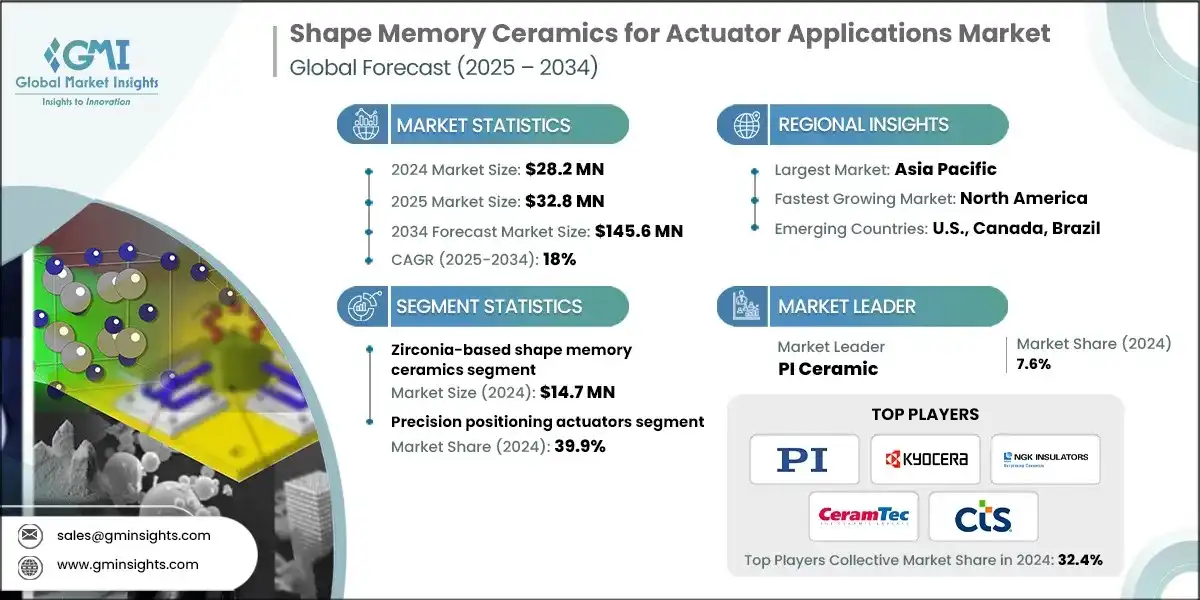
The global shape memory ceramics for actuator applications market was valued at USD 28.2 million in 2024. The market is expected to grow from USD 32.8 million in 2025 to USD 145.6 million in 2034, at a CAGR of 18%, according to latest report published by Global Market Insights Inc.
To get key market trends
- The development of shape memory ceramics for actuator applications represents a radical innovation in smart materials characterized by the ability to deform to different shapes under the influence of external stimuli imposing such stimuli upon them, such as temperature or stress or electric fields. Such property made these ceramics extremely efficient and reliable actuators in different industries like aerospace, defense, healthcare, and automotive.
- While the market for these advanced ceramics is accelerating due to the increasing demand for lightweight, durable, and energy-efficient actuation systems, these ceramics present properties like thermal stability, corrosion resistance, and long-term operational stability over and above the capabilities of conventional metallic actuators. The trend towards automation and robotics with the advent of smart materials makes the scenario worse since sectors are vying for the development of high-performance products that can withstand strenuous operational environments.
- Shape memory ceramics and their increasing significance are underscored by the growing application scope-from MEMS and biomedical devices, such as minimally invasive surgical tools. In addition, government programs initiated to inspire innovation in advanced manufacturing and material science have lent an impetus to R&D efforts in this regard, indirectly enhancing the market growth.
- Technological advancements, demand from the industry for highly efficient alternatives, and favorable government policies are converging toward the expansion of a global shape memory ceramics market in actuator applications, demonstrating a promising trajectory as they continue to innovate and respond to changing application needs.
Shape Memory Ceramics for Actuator Applications Market Report Attributes
| Key Takeaway | Details |
|---|---|
| Market Size & Growth | |
| Base Year | 2024 |
| Market Size in 2024 | USD 28.2 million |
| Market Size in 2025 | USD 32.8 million |
| Forecast Period 2025 - 2034 CAGR | 18% |
| Market Size in 2034 | USD 145.6 million |
| Key Market Trends | |
| Drivers | Impact |
| Aerospace industry demand for high-performance actuators | The increasing demand in aerospace enhances the market growth of shape memory ceramics due to their high-temperature and durability capabilities |
| Miniaturization trends in mems & microactuator systems | The trend toward miniaturization accelerates the adoption of compact, lightweight shape memory ceramic actuators in advanced electronic devices |
| Superior chemical & corrosion resistance properties | The exceptional chemical and corrosion resistance of these ceramics expands their application scope in harsh environments, boosting market expansion |
| Pitfalls & Challenges | Impact |
| High manufacturing costs & complex processing requirements | Elevated production expenses hinder widespread adoption of shape memory ceramics in cost-sensitive applications |
| Brittleness & fracture toughness limitations | The inherent brittleness restricts the durability and reliability of shape memory ceramics in dynamic actuator systems |
| Opportunities: | Impact |
| Hybrid metal-ceramic composite development | Developing hybrid composites can enhance toughness and processability, opening new avenues for advanced actuator designs |
| Lead-free ferroelectric systems for environmental compliance | Eco-friendly, lead-free ferroelectric ceramics can meet regulatory standards and expand market opportunities in sustainable applications |
| Market Leaders (2024) | |
| Market Leaders |
7.6% |
| Top Players |
Collective market share in 2024 is 32.4% |
| Competitive Edge |
|
| Regional Insights | |
| Largest Market | Asia Pacific |
| Fastest Growing Market | North America |
| Emerging Country | U.S., Canada, Brazil |
| Future Outlook |
|
What are the growth opportunities in this market?
Shape Memory Ceramics for Actuator Applications Market Trends
- Improved manufacture processes, especially added manufacture and advanced sintering techniques, are impacting the development of form memory ceramics especially since they allow the manufacture of complex geometries with certain property enhancements such as fatigue and thermal stability that are important for actuator performance. Since manufacture becomes more precise and scalable, the intended reduction in costs of high-quality ceramics produced and their widespread use in different sectors will come about.
- The industry is shifting towards using shape memory ceramics in smart systems of the next generation with capabilities of allowing autonomy in operation. Such actuators would be superior to current alternatives because of their incorporation of embedded sensors and control units that allow for real time responsiveness and adaptability in application to robotics and aerospace. Multifunctional ceramics, which entails a combination of shape memory properties with other functionalities such as piezoelectricity, will be the key focus of development and will promise a performance upgrade and versatility against the evolving marketplace.
- The increased safety awareness, dependability, and environmental considerations of advanced ceramics have led to formulating new standards and regulations to be followed in the use of these materials. All these constraints ensure that shape memory ceramics have quality, durability, and environmental friendliness levels in a common mode of use. The standardization of the different parameters increases end-user confidence, and thus new products can find their way into the market and subsequently facilitate growth.
Shape Memory Ceramics for Actuator Applications Market Analysis
Learn more about the key segments shaping this market
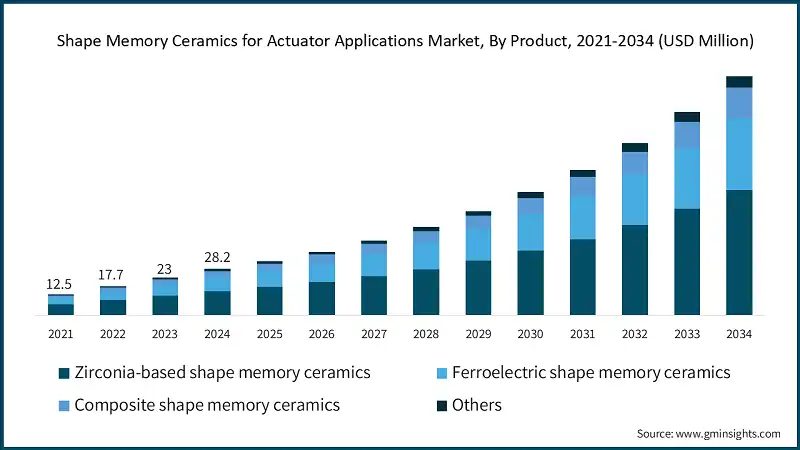
Based on product, market is segmented into zirconia-based shape memory ceramics, ferroelectric shape memory ceramics, composite shape memory ceramics and others. Zirconia-based shape memory ceramics generated USD 14.7 million in 2024.
- Zirconia-based dominates due to their exceptional thermal stability and tensile strength, thereby becoming a preferred choice in application contexts that require the material to perform at elevated temperatures in aerospace and industrial environments. Compared with all the other ceramics, it has outstanding fracture toughness which in itself addresses the issue of brittleness while still managing to ensure that the material retains its shape memory characteristics.
- Ferroelectric shape memory ceramics which include both lead-based and lead-free compositions. These ceramics show high actuation strains induced by field-induced phase transition, particularly the antiferroelectric compositions that exhibit promising performance characteristics. Ferroelectric systems are providing digital actuation along with low energy consumption.
- Composite shape memory ceramics are formed of a ceramic matrix accompanied with metallic or polymeric phase to develop mechanical features. These materials overcome brittleness at the same time while retaining the advantages of thermal stability and chemical resistance. Tailored features such as better fracture toughness and electrical conductivity may be achieved using composite approaches.
Learn more about the key segments shaping this market
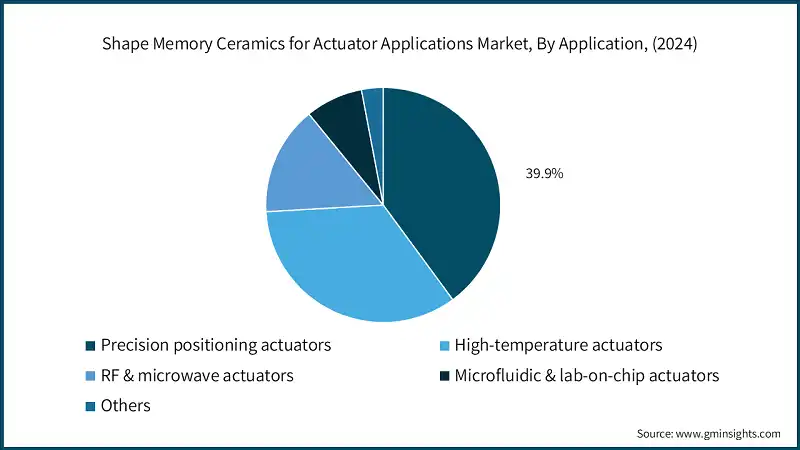
Based on application, the shape memory ceramics for actuator applications market is segmented precision positioning actuators, high-temperature actuators, RF & microwave actuators, microfluidic & lab-on-chip actuators and others. Precision positioning actuators made up 39.9% of the market share in 2024.
- Precision positioning actuators leads due to the requirements expressed by the semiconductor manufacturing, optical systems, and scientific instruments. The need for sub-micrometer positioning accuracy, as well as long-term stability in the applications.
- For high-temperature actuators, the final target is in aerospace and industrial applications. These systems will operate quite effectively in temperatures above 300°C where metallic shape memory alloys do not work effectively. At very high temperatures, ceramic materials function perfectly as actuators.
- Aerospace applications are primary consumers of high-temperature actuators in adaptive surface control, some engine parts, environmental control systems. Operating without cooling systems makes the system less complex and lighter, a factor that becomes very critical in aerospace applications.
- RF & microwave actuators, enablers of telecommunication and radar systems, require accurate mechanical adjustments for antenna positioning filter tunings and signal routings as well. Hence, excellent electrical insulation properties and, most importantly, dimensional stability, place ceramic actuators as impeccable material for RF applications.
- Microfluidic & lab-on-chip actuators, demonstrates the broadening applications in medical diagnostics and pharmaceutical research, require miniaturization, and biocompatibility, making ceramics lead over metals in these applications.
Based on end use industry, the shape memory ceramics for actuator applications market is segmented into aerospace & defense, automotive, industrial automation & robotics, electronics & semiconductors, medical & biomedical and others.
- Aerospace and defense dominates due to growing demand for high-performance actuators in extreme environments. Military and aerospace applications require reliable materials under extreme temperature variations. Shape memory ceramics fulfils these requirements and better possess properties such as resistance to corrosive chemicals or electromagnetic interference.
- For defense applications, consider precision guidance systems, adaptive camouflage, and unmanned vehicles control systems. The ability not to use external heating systems would confer tactical advantages on stealth applications where thermal signatures must be minimized.
- Automotive applications also show increasing adoption in advanced driver assistance systems, adaptive lighting, and active suspension components. Automotive applications need the solutions to be cost-effective, highly reliable, and have an extended life in service. Ceramic actuators meet these requirements while affording new functionalities in the autonomous vehicle systems.
- EV adoption stimulates more demand for ceramic actuators in battery management systems, thermal control, and energy recovery applications. Industrial automation and robotics are applied in precision manufacturing and process control.
Looking for region specific data?
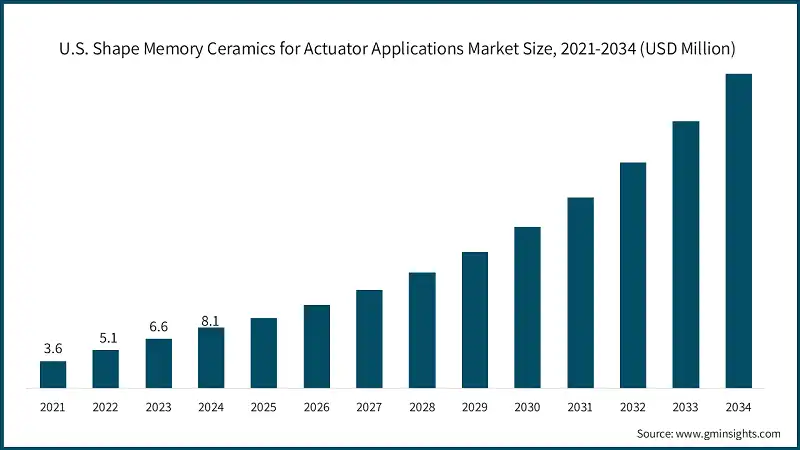
The shape memory ceramics for actuator applications market in North America will grow at a CAGR from approximately 18.1% between 2025 and 2034.
- The major driving forces for market growth were the increasing demand for precise and reliable actuator solutions from industries such as aerospace, automotive, and medical devices. Further innovations in ceramic formulations improved durability and response times, as these materials are now apt for extreme operational environments.
- Faster mechanisms with repeated motion become essential due to widespread automation and use of robotics in manufacturing; The advanced actuator materials being developed. Changes in manufacturing processes have allowed for economical production of shape-memory ceramic actuators with complex shapes.
- Most miniature actuator components with better performance are in demand mainly due to the rise of smart systems and IoT-enabled devices across various industrial applications. The increasing use of automation and robotics in manufacturing, coupled with the ever-growing demand for precision control systems in medical and industrial applications, continued to bolster market development. Rising emphasis on energy efficiency and sustainability thus promote the evolution of green ceramic materials.
The shape memory ceramics for actuator applications markets in Europe, especially in a few countries like Germany, are expected to grow with a rapid pace in the coming years, especially from 2025 to 2034.
- The high-precision manufacturing process in the region, particularly in the aerospace and medical fields, increased the demand for shape-memory ceramic actuators that were reliable under rigorous conditions.
- Advances in ceramic material sciences and developments in miniaturization and integration into complex systems aided market growth. Players began to pursue the development of customizable, high-performance actuators with superior fatigue resistance and response speed.
- Sustainable and eco-minded practices further spurred the adoption of recyclable ceramic material and environmentally friendly production measures, corresponding to larger industry trends toward green innovation.
The shape memory ceramics for actuator applications market in China and India is expected to have lucrative growth between 2025 and 2034.
- With rising automation in manufacturing and with expansion of aerospace and healthcare sectors, high-precision and durable ceramic actuators were in demand. Increasing adoption of industrial robotics and smart devices complemented this even more.
- Increasing investments in research and development aimed at upgrading ceramic properties for example, fatigue life and response times led to a spurt in new actuator solutions designed for high-tech industries.
- Growing middle-class population and rising disposable incomes increased the adoption of advanced industrial and consumer electronics that called for compact high-performance ceramic actuators.
Between 2025 and 2034, the market for shape memory ceramics for actuator applications in the UAE and the Middle East is projected to grow significantly during this period.
- Industrialization, especially in manufacturing and energy sectors, has boosted demand for reliable high-performance ceramic actuators applicable to extreme conditions.
- Infrastructure developments and smart city projects have provided an opportunity for the incorporation of advanced actuator systems in building automation, healthcare, and transportation projects.
- Increased activity in the aerospace and defense sectors has further fueled the demand for high-temperature, corrosion-resistant shape-memory ceramic actuators.
Brazil and Argentina are expected to witness promising growth for the shape memory ceramics for actuator applications sector between 2025 and 2034.
- Sustainable manufacturing practices are becoming a high priority. This is pushing local manufacturers to develop eco-friendly ceramic formulations with enhanced performance characteristics.
- The increased infrastructure projects and defense programs allowed a foothold for high-performance ceramic actuators in urban centers, where pilot projects are already underway to use advanced actuator solutions for industrial automation and aerospace.
Shape Memory Ceramics for Actuator Applications Market Share
- Shape memory ceramics for actuator applications market is moderately consolidated with players like PI Ceramic, Kyocera Corporation, NGK Insulators, CeramTec Group and CTS Corporation accounts for 32.4% market share.
- The shape memory ceramics for actuator applications market consists of such leading companies, operating mostly in their regional areas. Their long years of experience with ceramics allow these companies to maintain a strong market position worldwide. Their product offerings are diverse and majorly supported by production capacities and distribution networks, which can serve the increasing demand for shape memory ceramics for actuator applications in various regions.
Shape Memory Ceramics for Actuator Applications Market Companies
Major players operating in the shape memory ceramics for actuator applications market includes:
- Advanced Ceramic Material
- CeramTec Group
- CTS Corporation
- FUJI CERAMICS CORPORATION
- Kyocera Corporation
- Morgan Advanced Materials
- NGK Insulators
- Niterra Co., Ltd.
- PI Ceramic
- Piezo Direct
- TAIYO YUDEN CO., LTD.
- Tosoh Corporation
PI Ceramic is leading in the area of precision actuator systems and piezoelectric ceramics. The portfolio of PI Ceramic combined with its capabilities in system integration becomes a competitive advantage in the service of demanding applications. Continuous investments in R&D by PI Ceramic foster innovation in lead-free compositions and advanced processing techniques.
Kyocera Corporation is ceramic manufacturers, having capabilities across materials development, processing, and system integration. The advanced ceramics division has decades of experience in piezoelectric materials and actuator systems. Vertical integration by Kyocera from raw material to final product leads to cost benefits and greater quality control throughout the value chain.
NGK Insulators applies its operating experience to the actuator market. Its capabilities in ceramic processing and materials engineering help develop economically attractive solutions for automotive and industrial applications. The global manufacturing footprint provides local support to regional markets while maintaining quality standards.
CeramTec Group, manufacturers of technical ceramics, has decades of involvement in providing technical solutions for automotive, medical, and industrial applications. The extended technology platform of the company contains advanced oxide ceramics, silicon-based ceramics, and composite materials related to actuator applications. CeramTec's global manufacturing network along with application engineering capabilities serve customized solutions for regional market requirements.
CTS Corporation expertise in miniaturization and integration fits in with the market trend towards MEMS-based actuator systems. A large scale of manufacturing and optimization of costs with respect to this technology therefore helps CTS penetrate price-sensitive applications while adhering to the quality standards required for precision systems
Shape Memory Ceramics for Actuator Applications Industry News
- March 2025, PI Ceramic GmbH under the leadership of Patrick Pertsch, considerably shortened its lead times for its PICMA Stack multilayer piezo actuators. According to this announcement, these actuators would be extremely stiff and also highly reliable in extreme conditions and useful for even the most demanding high-tech applications.
- January 2025, Kyocera joined the funding round for TactoTek with a USD 5.4 million investment, furthering the development of their HAPTIVITY haptics solution by combining piezoceramic actuators with IMSE parts to create thin tactile HMI surfaces that enhance force sensing and tactile feedback for intuitive user experience design.
The shape memory ceramics for actuator applications market research report includes an in-depth coverage of the industry with estimates and forecast in terms of revenue in USD Million and volume in terms of Kilo Tons from 2021–2034 for the following segments:
Market, By Product
- Zirconia-based shape memory ceramics
- Ceria-doped zirconia (CeO2-ZrO2)
- Yttria-stabilized tetragonal zirconia
- Modified zirconia with aliovalent dopants
- Ferroelectric shape memory ceramics
- Lead zirconate titanate (PZT)
- Lead-free ferroelectric ceramics
- Hafnium oxide (HfO2) thin film
- Composite shape memory ceramics
- Metal matrix composites
- Zirconia-toughened alumina (ZTA)
- Hybrid organic-inorganic composites
- Others
Market, By Application
- Precision positioning actuators
- Nanometer-scale optical positioning systems
- MEMS & microactuator applications
- Fast-steering mirrors & optical pointing
- High-temperature actuators
- Aerospace engine control systems
- Deep borehole & extreme environment applications
- Industrial high-temperature process control
- RF & microwave actuators
- Reconfigurable antenna systems
- Metamaterial & metasurface applications
- CubeSat & space communication systems
- Microfluidic & lab-on-chip actuators
- Microvalves & micropump systems
- Microrobotic applications
- Biomedical device integration
- Others
Market, By End Use Industry
- Aerospace & defense
- Aircraft morphing wing structures
- Spacecraft deployable mechanisms
- Military precision optical systems
- Automotive
- Engine thermal management systems
- Adaptive suspension & vibration control
- Battery thermal management
- Industrial automation & robotics
- Precision manufacturing equipment
- Robotic system actuators
- Process control & flow management
- Electronics & semiconductors
- MEMS & microelectromechanical systems
- Optical switching & fiber positioning
- Semiconductor processing equipment
- Medical & biomedical
- Surgical instrument actuators
- Lab-on-chip diagnostic devices
- Biocompatible actuation systems
- Others
The above information is provided for the following regions and countries:
- North America
- U.S.
- Canada
- Europe
- Germany
- UK
- France
- Spain
- Italy
- Rest of Europe
- Asia Pacific
- China
- India
- Japan
- Australia
- South Korea
- Rest of Asia Pacific
- Latin America
- Brazil
- Mexico
- Argentina
- Rest of Latin America
- Middle East and Africa
- Saudi Arabia
- South Africa
- UAE
- Rest of Middle East & Africa
Frequently Asked Question(FAQ) :
Who are the key players in the shape memory ceramics for actuator applications market?
Major companies include PI Ceramic, Kyocera Corporation, NGK Insulators, CeramTec Group, CTS Corporation, Morgan Advanced Materials, and TAIYO YUDEN Co., Ltd., focusing on hybrid composites, eco-friendly ceramics, and advanced actuator integration technologies.
What is the growth outlook for the shape memory ceramics for actuator applications market in North America?
The market is expected to grow at a CAGR of 18.1% from 2025 to 2034, driven by strong aerospace demand and rapid automation adoption.
What are the emerging trends in the shape memory ceramics for actuator applications industry?
Key trends include the rise of additive manufacturing and hybrid metal-ceramic composites, development of lead-free ferroelectric systems, and integration of multifunctional ceramics with embedded sensors for autonomous and adaptive actuation systems.
What was the market share of precision positioning actuators in 2024?
Precision positioning actuators accounted for 39.9% of the market share in 2024, driven by rising use in semiconductor manufacturing, optical systems, and scientific instrumentation requiring sub-micrometer precision.
What is the market size of the shape memory ceramics for actuator applications industry in 2024?
The market size was USD 28.2 million in 2024, with a forecast CAGR of 18% from 2025 to 2034, driven by aerospace industry demand for high-performance actuators and increasing adoption of lightweight, durable materials.
What is the current shape memory ceramics for actuator applications market size in 2025?
The market size is projected to reach USD 32.8 million in 2025, reflecting initial commercialization and early integration of shape memory ceramics in advanced aerospace and industrial applications.
How much revenue did the zirconia-based shape memory ceramics segment generate in 2024?
The zirconia-based segment generated USD 14.7 million in 2024, dominating the market due to exceptional thermal stability, fracture toughness, and reliability under high-temperature conditions.
What is the projected value of the shape memory ceramics for actuator applications market by 2034?
The market is expected to reach USD 145.6 million by 2034, fueled by miniaturization trends in MEMS devices, robotics, and sustainable actuator technologies.
Shape Memory Ceramics for Actuator Applications Market Scope
Related Reports