Summary
Table of Content

Self-healing Waterproofing Materials Market
Get a free sample of this report
Form submitted successfully!
Error submitting form. Please try again.
Thank you!
Your inquiry has been received. Our team will reach out to you with the required details via email. To ensure that you don't miss their response, kindly remember to check your spam folder as well!
Request Sectional Data
Thank you!
Your inquiry has been received. Our team will reach out to you with the required details via email. To ensure that you don't miss their response, kindly remember to check your spam folder as well!
Form submitted successfully!
Error submitting form. Please try again.
Self-healing Waterproofing Materials Market Size
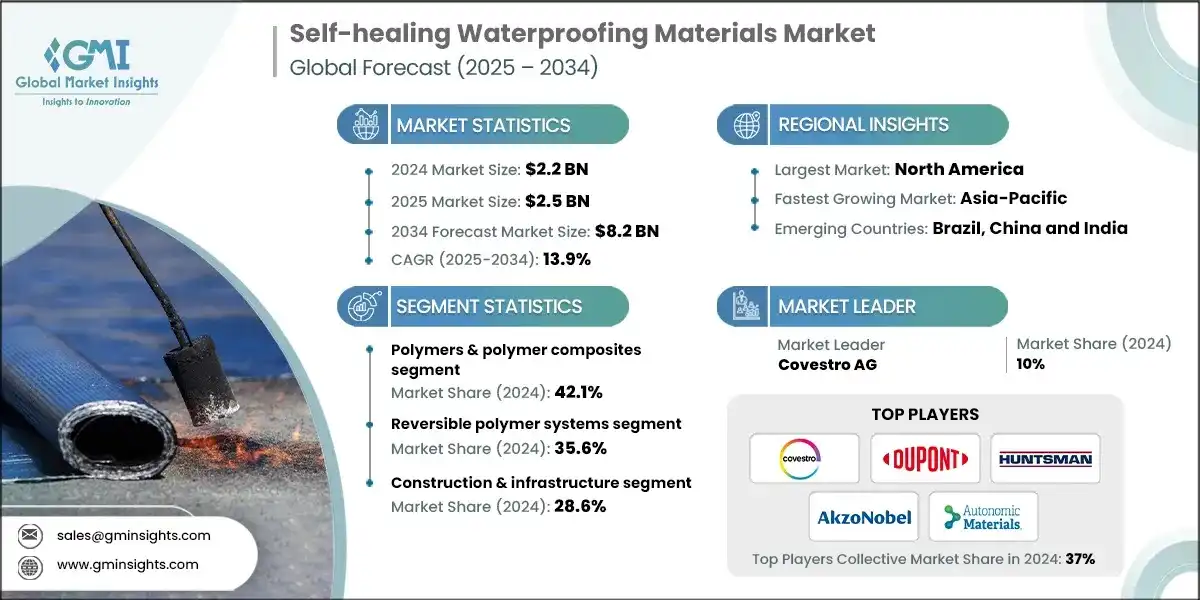
The global self-healing waterproofing materials market was estimated at USD 2.2 billion in 2024. The market is expected to grow from USD 2.5 billion in 2025 to USD 8.2 billion in 2034, at a CAGR of 13.9%, according to latest report published by Global Market Insights Inc.
To get key market trends
- The self-healing waterproofing materials is gaining momentum in industries which are focused on long term durability with less maintenance. Such materials are being utilized in construction, automotive, and electronics applications, where moisture and environmental stresses threaten their performance. Self-healing concrete and coatings are being adopted in construction to improve structural integrity and lifecycle costs. The automotive sector is also looking at corrosion-resistant paints and surface treatments that can autonomously repair minor damage to prolong vehicle life.
- Innovations such as microencapsulation, vascular networks, and shape memory polymers to fashion much more efficient self-repair mechanisms will be shaping the market. Other innovations include integration of sensor systems, in order to provide real-time monitoring and activation of healing processes. Yet a number of challenges still exist regarding cost-effectiveness and scalability, especially in areas with budget constraints or low technical infrastructure. Meanwhile, regulatory frameworks are slowly maturing towards standardization and commercialization of these advanced materials.
- Regionally, Asia-Pacific self-healing waterproofing materials market is witnessing fast growth due to urbanization, expanding infrastructure, and an increasing demand for resilient building solutions. While global players focus on localization strategies to adapt their product lines for regional needs, North America and Europe keep funding research and development to pursue sustainability targets and repair aging infrastructure. Meanwhile, cross-sector collaboration is becoming imperative, especially in smart city ventures and green construction projects, where self-healing waterproofing materials can play an instrumental role in the long-term management of assets.
Self-healing Waterproofing Materials Market Report Attributes
| Key Takeaway | Details |
|---|---|
| Market Size & Growth | |
| Base Year | 2024 |
| Market Size in 2024 | USD 2.2 Billion |
| Market Size in 2025 | USD 2.5 Billion |
| Forecast Period 2025 - 2034 CAGR | 13.9% |
| Market Size in 2034 | USD 8.2 Billion |
| Key Market Trends | |
| Drivers | Impact |
| Growing infrastructure maintenance costs & repair frequency reduction needs | Demanding materials that reduce maintenance venture and baggage life extension are pushed into application |
| Aerospace industry demands lightweight, self-repairing composites | This will further encourage the research and development of multifunctional self-healing waterproofing solutions in various applications |
| Automotive industry push for scratch-resistant & self-healing coatings | Expanding the scope of self-healing technologies in exterior and interior applications |
| Pitfalls & Challenges | Impact |
| High initial material costs & manufacturing complexity | Limit adoption in cost-sensitive construction and consumer markets |
| Limited standardized testing protocols & performance validation | It creates uncertainty in performance benchmarking and regulatory approval |
| Opportunities: | Impact |
| Emerging applications in renewable energy systems | Present new use cases for durable self-repairing waterproof layers in harsh environmental conditions |
| Medical device integration & biocompatible self-healing materials | Open pathways to biocompatible self-healing materials with waterproofing capabilities in sensitive applications |
| Market Leaders (2024) | |
| Market Leaders |
10% |
| Top Players |
Collective Market Share of 37% in 2024 |
| Competitive Edge |
|
| Regional Insights | |
| Largest Market | North America |
| Fastest Growing Market | Asia-Pacific |
| Emerging Country | Brazil, China and India |
| Future Outlook |
|
What are the growth opportunities in this market?
Self-healing Waterproofing Materials Market Trends
- The self-healing materials market moves from experimental research toward practical deployment. The autonomous repair mechanism innovations support this transition. Microencapsulation and reversible polymer chemistry realigned repetitive healing materials that do not lose their performance in high tension situations. Further, shape memory materials that distinguish their pre-deformation and post-deformation physical geometry enhance recovery and programming in a few harsh yet core areas of application, such as aerospace and cars.
- Sustainability is where most phenomenal changes can happen in a self-healing changing market. Self-healing contributes to reduced consumption of resources and increased lifespan of the product. Bio-based and sustainable manufacturing processes become very attractive, particularly when it comes to areas like construction, where self-healing concrete provides essential components of green buildings. These materials also find commonality and reference in principles of circular economy and against the regulatory frameworks on carbon emissions reduction and long-term infrastructure resilience.
- The incorporation of smart materials with IoT technologies is continuing to promote further development of intelligent systems that offer real-time damage detection and adaptive healing. Smart systems provide embedded sensors integrated with machine-learning algorithms to monitor performance and optimize response to repair. Multifunctional materials containing self-healing with other properties like conductivity and thermal management are emerging to broaden applications further in electronics, energy systems, and healthcare. Tailoring to market-specific needs also speeds up the quick adoption of these materials, which also benefit from the evolution of their certification standards and performance validation.
Self-healing Waterproofing Materials Market Analysis
Learn more about the key segments shaping this market
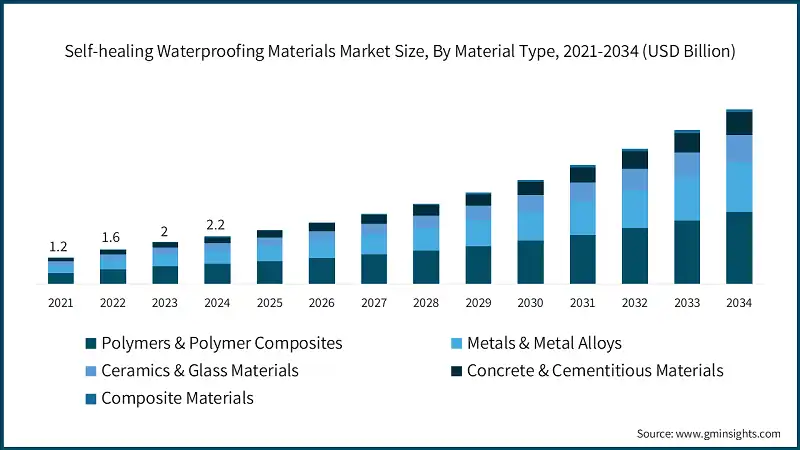
Based on material type, the market is segmented into polymers & polymer composites, metals & metal alloys, ceramics & glass materials, concrete & cementitious materials, composite materials. Polymers & polymer composites dominated the market with an approximate share of 42.1% in 2024 and is expected to grow with the CAGR of 13.6% by 2034.
- Polymers and polymer composites are poles apart from others-self healing materials dominating and holding more than half of the market share due to their broad versatility and mature manufacturing infrastructure. Moreover, they can use variety of healing processes. Thus, applications cover many areas such as automotive, electronics, and construction. Furthermore, these innovative technologies in bio-based polymers and sustainable healing agents along with continued R&D investments make these materials favorites in eco-regulated markets.
- The second-largest group is metals and metal alloys, which mainly serve in aerospace and automotive industries, where strength and temperature resistance are paramount. They take advantage of shape memory and phase transformation technologies mainly to perniciously heal fatigue and mechanical damage. Next are ceramics and glass materials whose applications bear high temperatures and protective environments like energy systems and turbine components. This has been brought by advances towards ceramic matrix synthesis as well as healing behavior.
- Concrete and cementitious materials have attracted enormous attention largely due to their excellent performance in terms of infrastructure and fit within the goals of sustainable construction objectives. Self-healing concrete is promoted for use in highways, airports, and marine structures, strongly supported through initiatives from the government. While low in share, composite materials are on a steady upward trajectory for applications in aerospace and automotive markets for lightweight solutions with impact resistance. The developmental driver is advanced fiber-matrix interfaces and structural integration.
Learn more about the key segments shaping this market
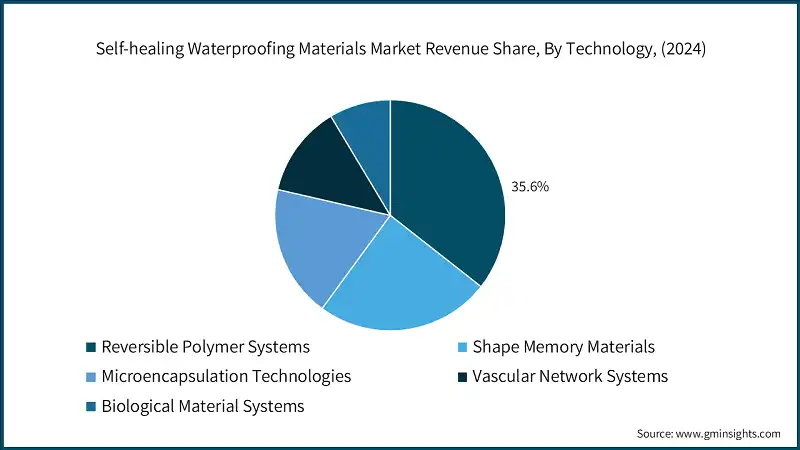
Based on technology, the self-healing waterproofing materials market is segmented into reversible polymer systems, shape memory materials, microencapsulation technologies, vascular network systems, biological material systems. Reversible polymer systems hold the largest market share of 35.6% in 2024 and are expected to grow at a CAGR of 13.7%.
- The reversible polymer systems predominate in the segment of self-healing materials technologies, command the greatest market share because of the many cycles of healing that they might engineer without considerable damage to performance. Under dynamic covalent and non-covalent bonding, the mechanical properties are restored in these systems and, therefore, they become a good for stressed or damaged applications cyclically. They are accepted due to their easy commercial availability and compatibility with existing manufacturing runs, thus ensuring their acceptance in large amounts throughout industries such as construction, electronics, and automobile, etc.
- The shape memory materials, which have dual functionality in terms of damage recovery and shape recovery at their own choice. Such materials are best suited in scenarios where structural integrity matters, and form retention is essential, such as aerospace and biomedical fields. Microencapsulation techniques have also gained tremendous importance by providing localized healing functionality to embedded agents activated upon damage. Such systems are very attractive concerning coating and sealants in infrastructure and industrial applications due to their easy incorporation in existing manufacturing systems.
- Emerging segments focusing on specific applications are the vascular network systems and biological material systems. Under such vascular systems, continuous healing may occur through the activation of embedded channels under large-scale damage scenarios. Biological systems mimicking natural healing processes are gaining attraction in sustainable and biomedical applications. These show an increasing diversification of self-healing materials, wherein each system developed is to meet certain performance requirements and environmental conditions.
Based on end use, the self-healing waterproofing materials market is segmented into construction & infrastructure, automotive & transportation, aerospace & defense, healthcare & biomedical, electronics & semiconductors, energy & power systems. Construction & infrastructure hold the largest market share of 28.6% in 2024 and is expected to grow at a CAGR of 14.2%.
- Construction and infrastructure are needed to provide longevity and reduced maintenance of public assets. Self-healing concrete and coatings are being used in bridges, tunnels, and marine structures and thus suffice for sustainability and modernization programs facilitated by governments. These materials promise reduced life cycle costs and serve as evidence in green certifications for building projects; they then are very attractive for large infrastructure projects.
- Self-healing materials have been extended into automotive and aerospace applications to sustain surface integrity and structural performance against mechanical and thermal stresses. Automotive applications emphasize coatings and composites that resist scratching and degradation from environmental exposure. Some aerospace systems leverage shape-memory and thermoplastic technologies to achieve dual-function materials for damage repair and shape recovery.
- Biocompatible self-healing polymers are being adopted by the healthcare and biomedical sectors for implants, wound care, and drug delivery systems - as advances towards personalized medicine and regenerative medicine. High prospects are evident among several segments of electronics and energy systems. Self-healing materials in electronics address repair of conductivity and structural integrity in flexible devices and sensors, thus reducing failures and increasing reliability.
Looking for region specific data?
The North America self-healing waterproofing materials market dominated the global market with a market share of 38.2% in 2024.
- High government R&D investments, world-class research infrastructure, and early commercial adoption in critical applications make North America the global leader. Negative demand drivers for intelligent self-healing materials, such as the large sectors of aerospace and defense driving demand for high-performance self-healing materials and the financial support from NASA and the Department of Defense for technology development and validation according to Global Market Insights Inc., sustain the market in those places. New universities and research institutions continually feed the pipeline of innovative technologies that established chemical companies can manufacture and market.
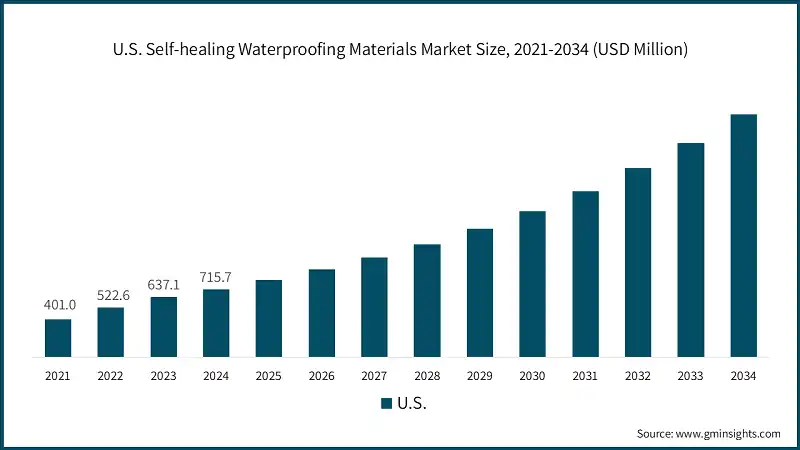
U.S. dominates the North America self-healing waterproofing materials market, showcasing strong growth potential with market size USD 715.7 million in 2024.
- The complex research apparatus and regulatory framework that the United States has in place for advanced materials development make huge strides toward leading the domestic activities of this market. Canada adds research and natural resources, while Mexico contributes manufacturing capabilities and an increasing base of demand from industry. Regional strength in the market is also bolstered by strong protection of intellectual property rights, easy accessibility to venture capital, and well-established supply chains that go into nurturing the commercialization of technology.
Europe self-healing waterproofing materials market accounted for USD 629.6 million in 2024 and is anticipated to show lucrative growth over the forecast period.
- Lot of development in Europe comes from intense partnerships between the industry and academia and provides government funding programs that complement materials research-for example, the regulatory environment of the region for sustainable technologies and long-term thinking that associate with the value proposition of self-healing materials. Little impact was felt from Brexit due to continuing research collaboration and established supply chains.
Germany dominates the European self-healing waterproofing materials market, showcasing strong growth potential.
- Apart from being driven by the demands of the automotive industry, extensive internal manufacturing capabilities propel Germany into top positioning in activity across the European market, while the Netherlands and the United Kingdom add to the wealth of research and development capabilities, as stated by the Royal Institution of Chartered Surveyors.
The Asia Pacific self-healing waterproofing materials market is anticipated to grow at the CAGR of 14.3% as of 2034.
- Asia Pacific accounts for 27.1% in the world market, and it is expected to grow faster than all other regions because of rapid industrialization, infrastructure development, and increasing manufacturing capabilities. Government infrastructure spending in augmenting environmental awareness and improving manufacturing capabilities contributes to regional growth. Large-scale construction projects and increased production in automobiles are substantial opportunities for self-healing material adoption in the region. Technology transfer through established markets and greater domestic R&D capabilities are expected to drive long-term improvements in market development.
China self-healing waterproofing materials market is estimated to grow with a significant CAGR, in the Asia Pacific self-healing waterproofing materials.
- Currently, China tops the regional activity through massive infrastructure investments and developing research capabilities, while India provides quite significant demand growth and emerging manufacturing states. Japan provides advanced technology development and high-valued applications in the electronics sector as well as in the automotive.
Latin America self-healing waterproofing materials market accounted for 5.9% in 2024 and is anticipated to show lucrative growth over the forecast period.
- Latin America contributes to 3.8% of the world market with Brazil as the leader in the region due to its investments into infrastructure development and growing industrial base. Market growth in the region would further be promoted through the increase in construction and the growing automotive manufacturing industries. The stimulus for the market would be increased government infrastructure investment and international development funding.
Middle East & Africa self-healing waterproofing materials market is anticipated to show lucrative growth at the CAGR of 12.4% as of 2034.
- In the Middle East and Africa, 2.6% of the market value is driven by growth due to infrastructure development projects and increasing industrial activity. The harsh environmental conditions prevalent in the region particularly create value for self-healing materials in construction and energy applications. Market development in some key countries is supported by government diversification initiatives and international investment.
Self-healing Waterproofing Materials Market Share
The top 5 companies in self-healing waterproofing materials industry include Covestro AG, DuPont de Nemours Inc., Huntsman Corporation, Akzo Nobel N.V., Autonomic Materials Inc. These are prominent companies operating in their respective regions covering 37% of the market share. These companies hold strong positions due to their extensive experience in self-healing waterproofing materials market. Their diverse product portfolios, backed by robust production capabilities and distribution networks, enable them to meet the rising demand across various regions.
- Covestro AG has developed polymer-based self-healing coatings and membranes for use in construction and automotive applications that are able to be integrated into scaling processes. Focuses on microencapsulation and reversible polymer systems for waterproofing applications that support better long term durability and lower maintenance.
- DuPont de Nemours Inc. provides liquid waterproofing systems with self-repair characteristics based on advanced polymers for commercial infrastructure use. Covers air and water barrier performances with vapor permeability, thus supporting the energy efficiency and sustainability goals under which building envelopes are formed.
- Huntsman Corporation manufactures polyurethane-based self-healing materials with applications in coatings and sealants formulated for infrastructure and transportation. With research and development centric activities on thermoplastic systems and nanocomposites: targeting improving performance under mechanical and thermal stresses during waterproofing.
- Akzo Nobel N.V. pioneering in developing self-healing protective coatings meant to corrosion resist for both architectural and industrial surfaces. Heavily employs microencapsulation and shape-memory techniques for waterproofing along marine, automotive, and construction industries.
- Autonomic Materials Inc. provides self-healing additives for coatings and sealants that repair damage in waterproof layers. Works with manufacturers to integrate healing agents into other chemistries, which have corrosion prevention and a longer life in more severe environments.
Self-healing Waterproofing Materials Market Companies
Major players operating in the self-healing waterproofing materials industry include:
- Covestro AG
- DuPont de Nemours Inc.
- Huntsman Corporation
- Akzo Nobel N.V.
- Autonomic Materials Inc.
- Acciona S.A.
- PPG Industries Inc.
- Applied Thin Films Inc.
- Avecom N.V.
- Critical Materials S.A.
- Devan Chemicals NV
- Sensor Coating Systems Ltd.
- Tnemec Company, Inc.
Self-healing Waterproofing Materials Industry News
- January 2025, Akzo Nobel N.V. announced a completion of the Phase 2 trials for its bio-based self-healing marine coatings, with improvements in corrosion resistance by 40% over conventional systems.
- December 2024, DuPont de Nemours Inc. received FAA certification of COASTALUME self-healing composite materials for use in commercial aircraft interior applications, which include cabin panels and structural components, thus representing a significant market expansion opportunity in the aerospace markets.
- October 2024, Research done at the Pacific Northwest National Laboratory has shown that self-healing concrete applied in the U.S. infrastructure could save $3.4 billion annually. The study further validates the commercial viability, thereby supporting government initiatives to fund advanced materials research, as documented by the Pacific Northwest National Laboratory.
This self-healing waterproofing materials market research report includes in-depth coverage of the industry, with estimates & forecasts in terms of revenue (USD Billion) and volume (Kilo tons) from 2025 to 2034, for the following segments:
Market, By Material Type
- Polymers & polymer composites
- Metals & metal alloys
- Ceramics & glass materials
- Concrete & cementitious materials
- Composite material
Market By Technology
- Reversible polymer systems
- Shape memory materials
- Microencapsulation technologies
- Vascular network systems
- Biological material systems
Market, By End Use
- Construction & infrastructure
- Automotive & transportation
- Aerospace & defense
- Healthcare & biomedical
- Electronics & semiconductors
- Energy & power systems
The above information is provided for the following regions and countries:
- North America
- U.S.
- Canada
- Europe
- Germany
- UK
- France
- Spain
- Italy
- Rest of Europe
- Asia Pacific
- China
- India
- Japan
- Australia
- South Korea
- Rest of Asia Pacific
- Latin America
- Brazil
- Mexico
- Argentina
- Rest of Latin America
- Middle East and Africa
- Saudi Arabia
- South Africa
- UAE
- Rest of Middle East and Africa
Frequently Asked Question(FAQ) :
Who are the key players in the self-healing waterproofing materials market?
Key players include Covestro AG, DuPont de Nemours Inc., Huntsman Corporation, Akzo Nobel N.V., and Autonomic Materials Inc., collectively accounting for 37% market share in 2024.
Which region leads the self-healing waterproofing materials market?
The U.S. market dominated the global landscape with a value of USD 715.7 million in 2024. North America leads due to robust R&D investment, advanced material innovation, and government support for sustainable and long-lasting infrastructure materials.
What are the upcoming trends in the self-healing waterproofing materials industry?
Key trends include integration of smart materials with IoT sensors for real-time monitoring, growth of bio-based and sustainable polymers, and rising use of microencapsulation and shape-memory technologies in coatings and membranes.
What was the share of the construction & infrastructure end-use segment in 2024?
The construction & infrastructure segment held 28.6% market share in 2024.
What is the market size of the self-healing waterproofing materials industry in 2024?
The market size was USD 2.2 billion in 2024, with a CAGR of 13.9% expected through 2034, driven by the rising demand for durable and self-repairing materials across construction and automotive industries.
What is the current self-healing waterproofing materials market size in 2025?
The market size is projected to reach USD 2.5 billion in 2025.
How much revenue did the polymers & polymer composites segment generate in 2024?
The polymers & polymer composites segment held 42.1% market share in 2024.
What was the valuation of the reversible polymer systems segment in 2024?
The reversible polymer systems technology segment accounted for 35.6% share in 2024.
What is the projected value of the self-healing waterproofing materials market by 2034?
The self-healing waterproofing materials market is expected to reach USD 8.2 billion by 2034, supported by rapid infrastructure development, aerospace innovations, and the push for sustainable construction solutions.
Self-healing Waterproofing Materials Market Scope
Related Reports