Summary
Table of Content

Self-Healing Polymers for Aerospace Applications Market
Get a free sample of this report
Form submitted successfully!
Error submitting form. Please try again.
Thank you!
Your inquiry has been received. Our team will reach out to you with the required details via email. To ensure that you don't miss their response, kindly remember to check your spam folder as well!
Request Sectional Data
Thank you!
Your inquiry has been received. Our team will reach out to you with the required details via email. To ensure that you don't miss their response, kindly remember to check your spam folder as well!
Form submitted successfully!
Error submitting form. Please try again.
Self-Healing Polymers for Aerospace Applications Market Size
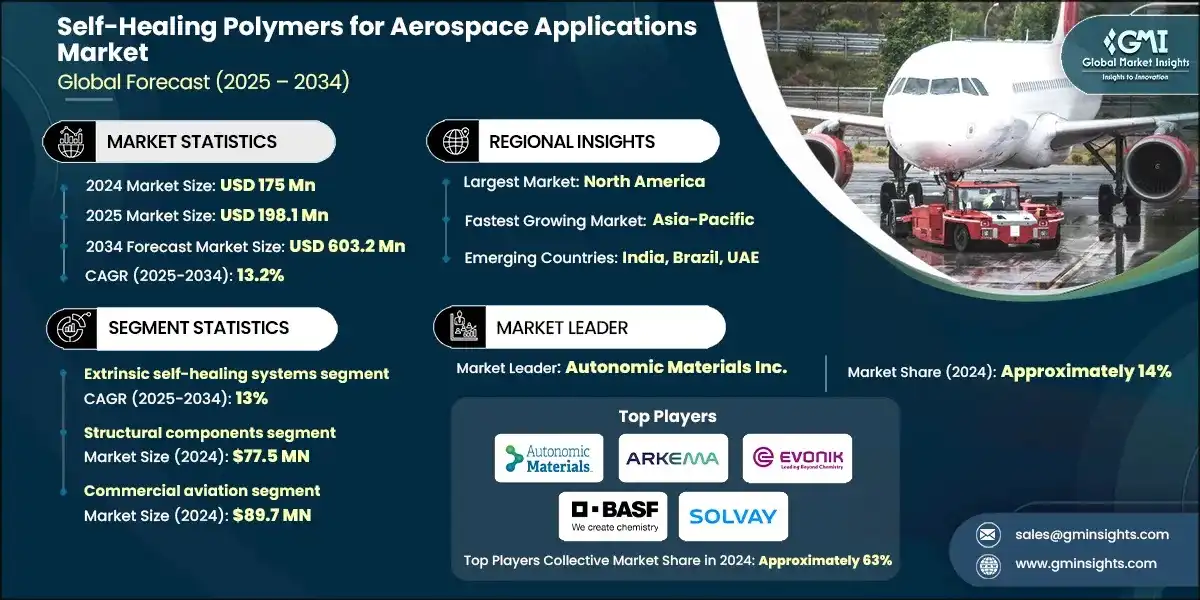
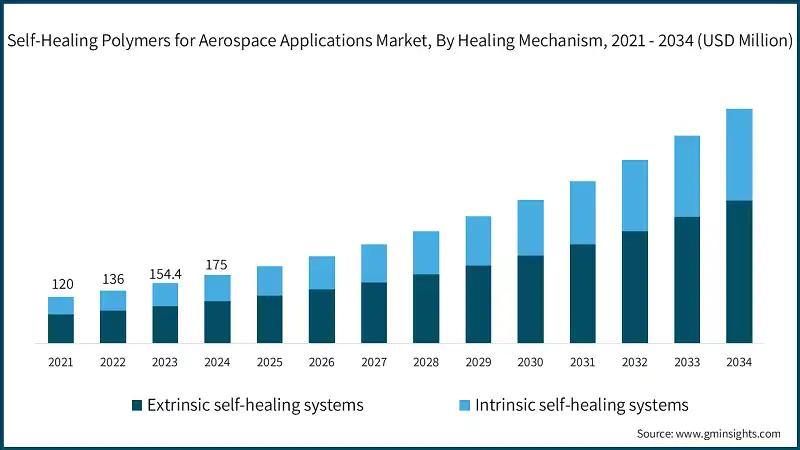
The global self-healing polymers for aerospace applications market were estimated at USD 175 million in 2024. The market is expected to grow from USD 198.1 million in 2025 to USD 603.2 million by 2034, growing at a CAGR of 13.2%, according to latest report published by Global Market Insights Inc.
To get key market trends
- In half a decade, self-healing polymers moved from theoretical constructs to realities. In the years 2019 to 2022, self-healing polymers accompanied by the title “self-healing polymer + aerospace” in Scopus peer-reviewed articles grew from 87 to 145 (a 66% increase). During the same period, relevant CPC class patent filings at the USPTO increased from 42 to 83 (a 98% increase).
- This increase in research is currently a supply to capsule-filled epoxies, vascular CFRPs, and dynamic covalent thermoplastics engineered to seal micro-cracks before inspectors see them. For airframers, such technology is a compelling value proposition, especially when seeking to meet target maintenance intervals.
- The situation provided by the pandemic also increased commercial opportunities. Composite demand diminished when Airbus deliveries fell from 863 jets in 2019 to 566 in 2020, but this demand returned when deliveries increased to 661 in 2022. The supply chain, which had been starving during the pandemic, had also increased in need of differentiation. Self-healing technologies offer differentiation in composite materials where every twin-aisle aircraft contains 20-25t polymer matrix.
- Space launch frequency is also a factor, especially with self-mending, cryo-tolerant resins required to withstand -250°C tank cycles in reusable boosters. Funding as well as regulations speed up adoption. The budget for Advanced Materials & Manufacturing at NASA increased from $139M in FY-2019 to $212M in FY-2022. Also, the consortia of the EU Horizon-2020 projects HealMat and RePAIR funded research for reversible resins for a total of €38M. At the same time, the fatigue tolerance rules EASA’s Part 26 and the FAA’s maintenance prescriptions based on "in-use" condition of the relics made a positive shift and rewarded the materials that "self erase" micro damages and allow a cut in scheduled A-checks, cut Scope-3 emissions in the paint shop, and made an accountable ESG win for the airlines. Self-Healing Polymers for Aerospace Applications Market Report Attributes
Key Takeaway Details Market Size & Growth Base Year 2024 Market Size in 2024 USD 175 Million Market Size in 2025 USD 198.1 Million Forecast Period 2025 - 2034 CAGR 13.2% Market Size in 2034 USD 603.2 Million Key Market Trends Drivers Impact Rising composite content in modern aircraft Boosts demand for advanced self-healing matrices Escalating maintenance cost pressure on airlines Triggers adoption to cut inspection turnaround time Sustainability and ESG regulations favouring longevity Encourages material choices lowering lifecycle emissions Pitfalls & Challenges Impact Certification complexity under aerospace safety standards Slows qualification and market entry timelines Higher upfront cost versus conventional polymers Limits uptake among cost-sensitive tier suppliers Opportunities: Impact Rapid growth of reusable space launch platforms Creates demand for cryo-resistant, reparative resins Aftermarket retro-fit of self-healing coatings Expands revenue via fleet-wide surface upgrade programs Market Leaders (2024) Market Leaders - Autonomic Materials Inc.
Approximately 14%Top Players - Autonomic Materials Inc.
- Arkema
- Evonik Industries AG
- BASF SE
- Solvay SA
Collective market share in 2024 is Approximately 63%Competitive Edge - Pioneer microcapsule technology; field-proven aerospace coatings; agile collaborations with OEMs accelerate custom solutions, rapid deployment.
Regional Insights Largest Market North America Fastest growing market Asia-Pacific Emerging countries India, Brazil, UAE Future outlook - Mainstream adoption expected across secondary structures; certification hurdles easing; aftermarket retrofits and reusable space vehicles drive robust, diversified growth forward.
What are the growth opportunities in this market?
Self-Healing Polymers for Aerospace Applications Market Trends
- Transitioning From Coatings to Structural Self Integration: Self-healing technology is advancing from thin-film erosion coatings to load-bearing composite parts. Airbus’ MISA demonstrator flew a vascular carbon-fiber wing panel in 2022, validating multi-cycle crack closure without weight penalty. Pre-impregnated composite manufacturers Hexcel and Boeing have prepreg trials aimed at the nacelle inner barrels which suggests a wider industry focus on embedding self-healing polymers directly into primary structures.
- Revived Interest in Self-healing Thermoplastics: The ability to be welded and reprocessed, PEEK and PEKK, thermoplastics will fuel renewed interest in self-healing intrinsic systems. Evonik’s PEKK grade with reversible Diels–Alder bonds endured 3,000 fatigue cycles at 120 °C during NASA’s HiCAM tests, while Toray is co-extruding ionomer interlayers that reconnect micro-cracks during routine hot-press repairs, which cuts scrap rates in wing-box assembly.
- Synergy From AI and Predictive Maintenance: Self-healing composites and onboard strain sensors have been paired with digital twin analytics aimed at extending time between scheduled maintenance and repairs. Delta TechOps reported a 22% drop in unscheduled rudder inspections after fitting capsule-based skins on two test A321 aircraft and feeding strain-rate data into its Skywise dashboard, illustrating predictive maintenance with self-healing structures and autonomous repair.
- Sustainability and Circularity Push: As the regulators focus on the end-of-life impact, the appeal for dynamic covalent networks with the properties of depolymerization and mouldability becomes stronger. The latest EU 2023 Sustainable Aviation Materials roadmap sets targets of 50% composite recyclability by 2035; Arkema to these targets with the development of a bio-based epoxy that self-heals at 80 °C and can be dissolved in benign solvents, thus facilitating closed-loop scrap recovery of interior panels and fairings.
Self-Healing Polymers for Aerospace Applications Market Analysis
Learn more about the key segments shaping this market
Based on healing mechanisms, the market is segmented into Extrinsic self-healing systems, and Intrinsic self-healing systems. The Extrinsic self-healing systems segment was valued at USD 108 million in 2024, and it is anticipated to expand with 13% CAGR during 2025-2034.
- Airframers are focusing on hybrid self-healing architectures that integrate capsule, vascular, and intrinsic systems. This framework provides a comprehensive approach to self-healing systems durability, manufacturability, and weight. Demonstrated on control-surface skins, the approach achieves a 15% reduction in scheduled inspections. As a result, tier one composite suppliers are securing long-term contracts in anticipation of production line inclusion on next-gen narrow-body aircraft, set to roll out in 2028, and expected to exceed global volumes of 500 units annual.
- Investment focus has shifted to scalable microencapsulation and 3-D vascular networks that can withstand autoclave cycles. Arkema, Hexcel, and BASF's Nebraska plant co-funding, set to be completed in 2026 and expected to increase healing agent production by four times, was a response to the anticipated investment. In the meantime, defense contractors are sponsoring cryogenic intrinsic resin fabrication for reusable launch systems which, in addition to civil aviation, affect the future market size of the industry.
The structural components segment was valued at USD 77.5 million in 2024, and it is anticipated to expand to 12.5% of CAGR during 2025-2034.
- Airframers are focusing on hybrid self-healing architectures that integrate capsule, vascular, and intrinsic systems. This framework provides a comprehensive approach to self-healing systems durability, manufacturability, and weight. Demonstrated on control-surface skins, the approach achieves a 15% reduction in scheduled inspections. As a result, tier one composite suppliers are securing long-term contracts in anticipation of production line inclusion on next-gen narrow-body aircraft, set to roll out in 2028, and expected to exceed global volumes of 500 units annual.
- Investment focus has shifted to scalable microencapsulation and 3-D vascular networks that can withstand autoclave cycles. Arkema, Hexcel, and BASF's Nebraska plant co-funding, set to be completed in 2026 and expected to increase agent production by four times, was a response to the anticipated investment. In the meantime, defense contractors are sponsoring cryogenic intrinsic resin fabrication for reusable launch systems which, in addition to civil aviation, affect the future market size of the industry.
Learn more about the key segments shaping this market
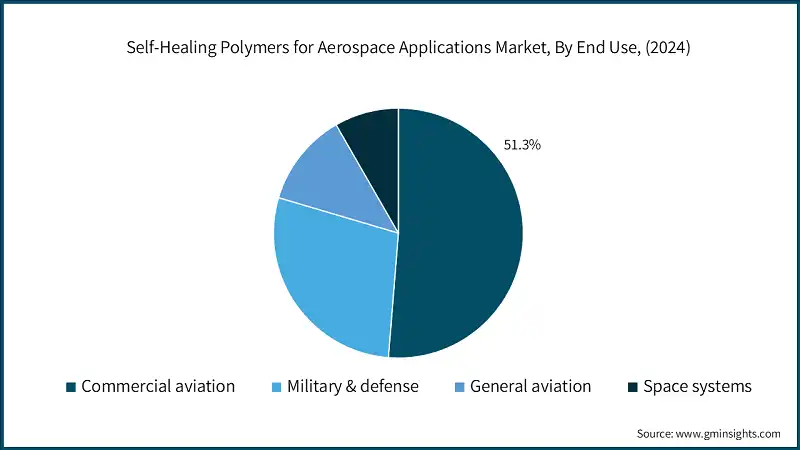
The commercial aviation segment was valued at USD 89.7 million in 2024, contributing 51.3% in total market and it is anticipated to expand to 12.6% of CAGR during 2025-2034.
- OEMs are integrating self-healing technologies into structural composites fuselage skirts, spars, nacelle inner barrels during initial stages of production rather than considering it days or weeks later. This integration is influenced by production-rate increases, digital twin fatigue models, and accelerated damage-tolerance regulations. This has led tier-one prepreg suppliers to offer bundled resin, fiber, and healing agent systems, allowing for predictable cure cycles and costed lifecycle savings for fleet planners.
- In addition, interior surfaces and erosion-resistant coatings are aftermarket products that airlines, MROs, and lessors, effectively removing downtime, are eager to acquire, realizing significant cosmetic and durability benefits. Roll-on retrofit kits are available for capsule-rich clearcoats, scratch-healing sidewalls, and redone films, while supramolecular resins, which are recyclable, are used for fairings and access panels, meeting cradle-to-grave sustainable mandates. These products offer a complete cradle-to-grave value proposition that is attracting hedge-fund capital for aggressive growth bets.
Looking for region specific data?
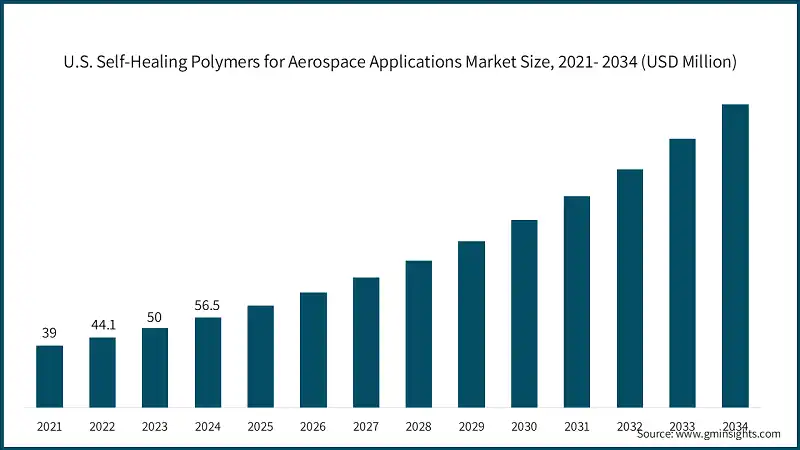
North America will remain the largest and the most valuable market, from USD 65.9 million in 2024 and USD 219.8 million in 2034. Primary market drivers will remain the aerospace market and the value-adding maintenance-cost reduction programs. The U.S. market was valued in 2024 at USD 56.5 million, expanding at 12.6 % CAGR from 2025-2034 periods.
- The robust commercial production of composite-rich aircraft, and the U.S. Pentagon's push for condition-based maintenance accelerates the adoption of mid-system and vascular systems across the fuselage, wing, and UAV components, underpinning sustained domestic demand.
- Tax incentives for advanced materials, ample R&D grants, and a thriving MRO network promote suppliers, i.e. Hexcel, 3M, and Autonomic Materials to ramp up North American manufacturing, which shortens lead times and increases the region's competitive advantage in the export market.
Europe comes in second, from USD 45.7 million in 2024 to USD 160 million in 2034, mainly the result of drone warfare and sustainability measures across the continent. Germany’s market was valued at USD 9.1 million in 2024 and is projected to expand at a 13.1 % CAGR from 2025-2034.
- German OEMs and Tier-1s such as Airbus, Premium AEROTEC, and MT Aerospace, are incorporating self-healing resins into the lightweight winglets and fairings as per self-healing resin demonstrations co-funded by the EU Clean Aviation projects. These demonstrations are positioning self-healing resin applications for certification.
- Demand for self-healing resins is further supported by national hydrogen-flight roadmaps. Cryogenic tanks use PEKK matrices that self-heal and close cracks when heated, resulting in thermal cycling. Chemical manufacturers such as Evonik and BASF have responded to this increasing self-healing resin demand by expanding their facilities in North-Rhine-Westphalia.
The Asia pacific region is growing the fastest, going from USD 42.3 million in 2024 to USD 148.7 million in 2034, driven by the region’s increase in aircraft production and expansions in the space sector. China’s market in 2024 is worth 16.9 million USD. It is expected to grow to 13.8% CAGR from 2025 to 2034.
- Self-healing composites are being produced in higher volumes by COMAC as the prototypes for their C919 and CR929 bring high-volume production opportunities. This is reinforced by the self-healing composites being used in radomes and cabin interiors as capsule technologies are integrated with state sponsored technology.
- China’s commercial space sector is being supported by the state. It is led by CASC and i-Space, who are testing reusable boosters with intrinsic boronic-ester matrices. This increase has led to multinational suppliers establishing joint ventures in Jiangsu and Guangdong for the Chinese market.
In Latin America, the growth forecast increases from USD 12.1 million in 2024 to USD 39.9 million by 2034 due to the aircraft fleet renewals and the composite repairs needed in extreme environments. The Brazilian market size was USD 6.0 million in 2024 and is expected to expand at 12.5% CAGR in the 2025-2034 period.
- Embraer’s new turboprop aircraft and KC-390 modernization programs include leading edge erosion control self- healing coatings to mitigate Amazonian rainfall erosion, forming anchor demand from regional suppliers and fostering collaboration with university partners in São José dos Campos.
- Large MRO in São Paulo and Bogotá introduce capsule based patch kits to reduce fuselage repair turnarounds, and national oil-and-gas helicopter fleet to cabin interiors to extend cabin refurb cycle and reduce downtime costs.
In the Middle East and Africa region, MRO revenue increases from USD 9.1 million in 2024 to USD 34.9 million in 2034. Aggressive fleet growth combined with wear and tear from desert environments drives this growth. The region was USD 2.7 million in 2024. The MRO sector in UAE is expected to grow at 14.8% from 2025 to 2034.
- In Dubai, wide body aircraft heavy maintenance centers use self-healing erosion control films to withstand sand and silica abrasion. This is in sync with the Emirates expectation to reduce paint shop visits for the A350 and 777X fleets by 50% by 2030.
Self-Healing Polymers for Aerospace Applications Market Share
- Arkema, Evonik, BASF, and Solvay together hold 56% of the market in self-healing polymers, while the rest of the players, primarily specialty formulators and composite fabricators, take up the remaining 44%. This uneven distribution of market share suggests high barriers to entry in the industry such as advanced chemistry know-how, aerospace-grade QC systems, and multi-year FAA/EASA qualification cycles. Volume tends to go to companies able to maintain the considerable certification and global supply assurance necessary to funnel resources into aerospace.
- Autonomic Materials leads the market with a 14% share. The company specializes in drop-in microcapsule additives, designed for blending into standard epoxy prepregs with little new processing steps required. Arkema (12%) focuses on reverse-chemistry resins and adhesive combinations and wins long-term contracts with airlines, primarily with Airbus. Arkema and their Sartomer and Bostik units operate within the scope of their range of services. Evonik (11%) focuses on PEKK/PEEK intrinsic systems which provides differentiation and captures value. Their Marl’s captive monomer production provides cost predictability despite volatile feedstock.
- Following closely, BASF (10%) and Solvay (9%) utilize scale and vertical integration, BASF via economies of scale in isocyanate production, Solvay through in-house carbon-fiber prepreg lines—for aggressive price-matching against new entrants. Both engage in co-development: BASF with Hexcel on dispersion uniformity in capsules; Solvay with Boeing on vascular wing skins. Discussions of mergers and acquisitions indicate that larger chemical firms might acquire niche innovators to close technology gaps and protect their margins.
Self-Healing Polymers for Aerospace Applications Market Companies
The top 5 prominent players in self-healing polymers for aerospace applications industry are:
- Autonomic Materials Inc.
- Arkema
- Evonik Industries AG
- BASF SE
- Solvay SA
- Autonomic Materials Inc.
holds around 14% of the market and has FAA cleared radome coating since 2023. The new dispersion plant in Illinois which opened in February 2024 increases output capacity by 30%. They also commercialize ready-mixed microcapsule additives that can be added to epoxy and polyurethane lines and cure schedules do not need to be altered. - Arkema
also holds about 12% of the market through its Sartomer and Bostik business units. They currently possess reversible Diels-Alder resin-adhesive bundles that are already specified on Airbus demonstrators. At JEC 2024 Arkema introduced the Hexcelis epoxy series and co-announced a $40 million microcapsule facility in Nebraska slated for 2026 to secure North American aerospace supply. - Evonik Industries AG
controls around 11% of the market by using their patented VESTAKEEP PEKK and PEEK grades which have dynamic covalent bonds. NASA’s HiCAM program tested and reported 3,000 crack healing cycles in 2023, and in 2024, Evonik partnered for a chemistry adaptation on the C919 wing-box ribs. - BASF SE
has just under 10% of the market. They partnered with Hexcel in 2023 and proved uniform healing on the 27 meter A350 spars. BASF is expanding their Ludwigshafen Verbund to increase aerospace grade polyurethanes capacity by 5 kt/year to meet new OEM build rate which is 5% increase. Lower tier OEM s are also increasing build rate significantly. - Solvay SA
provides 9% of the world’s carbon-fiber prepregs, self-adhesive cyanate-ester matrices, and reversible bond- finishing technologies. By the end of 2023, the company had contracted with Boeing to supply self-healing vascular wing skins. Brindisi’s 2025 operational line will increase their self-healing prepreg production to 1,200 tons.
Self-Healing Polymers for Aerospace Applications Industry News
- April 2024: Arkema and Hexcel announced a collaboration to invest in a 40 million dollar facility in Nebraska to mass manufacture aerospace grade microcapsules to help 'Support next generation self-healing composites programs on commercial and defense aircraft’ as well as 'Strengthen self-healing composites supply chains within North America'.
- November 2023: 'For advanced wing structures of Boeing aircraft, Solvay will supply vascular self healing prepreg materials for which Boeing established a multiyear supply contract'. Solvay’s Brindisi line expansion will support this contract and is expected to triple production capacity by 2025.
- June 2023: Autonomic Materials Inc. is now able to deploy their capsule based self-healing radome coating. The self-healing coating is now approved by the FAA for commercial airline use. This marks the first self-healing polymer system approved to protect primary aerospace surfaces.
The self-healing polymers for aerospace applications market research report includes in-depth coverage of the industry with estimates & forecast in terms of revenue (USD Million) & (Tons) from 2021 to 2034, for the following segments:
Market, By Healing Mechanism
- Extrinsic self-healing systems
- Capsule-based systems
- Vascular systems
- Intrinsic self-healing systems
- Reversible covalent bonds
- Supramolecular / non-covalent bonds
Market, By Application
- Structural components
- Fuselage and airframe panels
- Wing structures
- Control surfaces
- Engine nacelles
- Non-structural & semi-structural components
- Interior components
- Radomes
- Fairings and access panels
- Coatings & surfaces
- Erosion and corrosion resistant coatings
- Scratch-resistant & aesthetic coatings
- Functional components
Market, By End Use
- Commercial aviation
- Narrow-body aircraft
- Wide-body aircraft
- Regional jets
- Military & defense
- Fighter jets
- Transport & cargo aircraft
- Unmanned aerial vehicles (UAVs)
- General aviation
- Business jets
- Private aircraft
- Space systems
The above information is provided for the following regions and countries:
- North America
- U.S.
- Canada
- Europe
- UK
- Germany
- France
- Italy
- Spain
- Rest of Europe
- Asia Pacific
- China
- India
- Japan
- South Korea
- Australia
- Rest of Asia Pacific
- Latin America
- Brazil
- Mexico
- Argentina
- Rest of Latin America
- MEA
- UAE
- Saudi Arabia
- South Africa
- Rest of Middle East and Africa
Frequently Asked Question(FAQ) :
Who are the key players in the self-healing polymers for aerospace applications market?
Key players include Autonomic Materials Inc., Arkema, Evonik Industries AG, BASF SE, and Solvay SA.
What are the upcoming trends in the self-healing polymers for aerospace applications industry?
Key trends include the adoption of cryo-resistant resins for reusable space vehicles, aftermarket retrofits for fleet-wide upgrades, and easing certification hurdles for broader adoption.
Which region leads the self-healing polymers for aerospace applications market?
North America led the market with USD 65.9 million in 2024, projected to reach USD 219.8 million by 2034. The region's dominance is fueled by a strong aerospace industry and maintenance cost reduction programs.
What was the valuation of the structural components segment in 2024?
The structural components segment was valued at USD 77.5 million in 2024, with a projected CAGR of 12.5% during 2025-2034.
What is the growth outlook for the commercial aviation segment from 2025 to 2034?
The commercial aviation segment is anticipated to grow at a CAGR of 12.6% during the forecast period, driven by its 51.3% market contribution in 2024 and increasing demand for advanced materials.
What is the current self-healing polymers for aerospace applications market size in 2025?
The market size is projected to reach USD 198.1 million in 2025.
What is the projected value of the self-healing polymers for aerospace applications market by 2034?
The market is expected to reach USD 603.2 million by 2034, driven by advancements in reusable space platforms and aftermarket retrofits.
How much revenue did the extrinsic self-healing systems segment generate in 2024?
The extrinsic self-healing systems segment generated USD 108 million in 2024, leading the market with significant adoption in aerospace applications.
What is the market size of the self-healing polymers for aerospace applications industry in 2024?
The market size was USD 175 million in 2024, with a CAGR of 13.2% expected through 2034, driven by rising composite content in aircraft and sustainability-focused material choices.
Self-Healing Polymers for Aerospace Applications Market Scope
Related Reports