Summary
Table of Content

Self-Healing Concrete Market
Get a free sample of this report
Form submitted successfully!
Error submitting form. Please try again.
Thank you!
Your inquiry has been received. Our team will reach out to you with the required details via email. To ensure that you don't miss their response, kindly remember to check your spam folder as well!
Request Sectional Data
Thank you!
Your inquiry has been received. Our team will reach out to you with the required details via email. To ensure that you don't miss their response, kindly remember to check your spam folder as well!
Form submitted successfully!
Error submitting form. Please try again.
Self-Healing Concrete Market Size
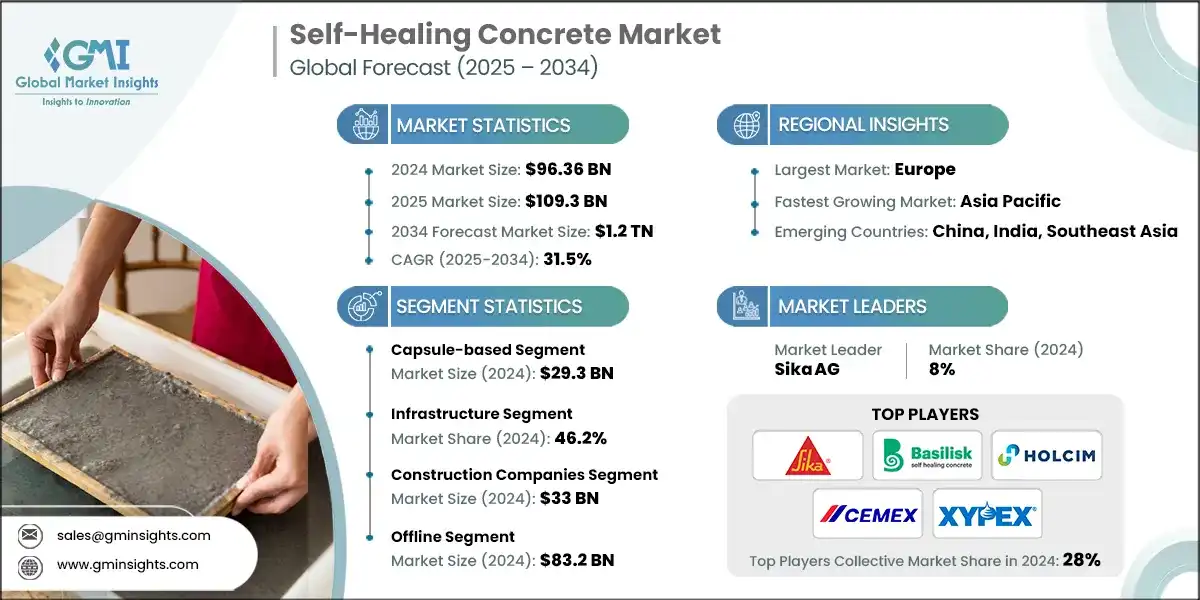
The global self-healing concrete market was estimated at USD 96.36 billion in 2024. The market is expected to grow from USD 109.3 billion in 2025 to USD 1.2 trillion by 2034, growing at a CAGR of 31.5%, according to latest report published by Global Market Insights Inc.
Self-Healing Concrete Market Key Takeaways
Market Size & Growth
- 2024 Market Size: USD 96.36 Billion
- 2025 Market Size: USD 109.3 Billion
- 2034 Forecast Market Size: USD 1.2 Trillion
- CAGR (2025–2034): 31.5%
Regional Dominance
- Largest Market: Europe
- Fastest Growing Region: Asia Pacific
Key Market Drivers
- Infrastructure development & urbanization.
- Advancements in healing technologies (bacterial, capsule, vascular, polymer).
- Sustainability and lifecycle cost reduction.
- Rising maintenance costs of aging infrastructure.
Challenges
- High initial cost of self healing solutions.
- Limited awareness and regulatory standards, especially in emerging markets.
Opportunity
- Smart city & green infrastructure investments.
- Public-private partnerships (PPPs) in infrastructure projects.
- Integration with IoT/sensing (e.g., Giatec’s smart concrete).
- Expansion in repair and restoration of heritage structures.
Key Players
- Market Leader: Sika AG led with over 8% market share in 2024.
- Leading Players: Top 5 players in this market include Sika AG, Basilisk (Green Basilisk BV), Holcim, CEMEX S.A.B. de C.V., Xypex Chemical Corporation, which collectively held a market share of 28% in 2024.
Get Market Insights & Growth Opportunities
- Due to the outbreak of the COVID-19 pandemic, the market face major effects such as projects delays, construction site closures, labour shortages, supply chain disruptions, budget constrains and slowed market awareness. These challenges slowed down the adoption of new innovative materials as the industry are shifted their focus to immediate recovery and essential infrastructure.
- The exponential growth in the demand for smart and sustainable construction materials leads to reduce long-term maintenance costs. The government and companies worldwide promoted net-zero and green building certifications and self-healing concrete for the change as a sustainable alternative to traditional repair-intensive materials.
- North America and Europe dominate the global market, these regions are highly advanced in research & development, high-awareness level and regulatory framework to promotes sustainable building practises. Also, U.S., Germany and Netherlands are also leading in self-healing concrete technologies, includes public infrastructures such as bridges, tunnels and water treatment plants.
- The infrastructure segment holds the largest share of the market due to wide use of concrete in roads, tunnels and dams. These structures are extreme environmental stress; self-healing technology provide a cost-effective solution to extend their service life. Also, the commercial and residential building segment are also increasing adoption, in the regions where crack resistance and self-repair capabilities are critical.
To get key market trends
Self-Healing Concrete Market Trends
- The increased uptake of self-healing technologies in construction projects has resulted in a rapid scaling in locations with aging infrastructures that thrive to be more sustainable. Many developed countries face the struggles of bridges, tunnels, and highways that were built decades ago, requiring constant repair. Traditional methods of repair can be uneconomical, time-consuming and disruptive. as such self-healing concrete offers a paradigm shift in the approach to infrastructure repair by providing automatic crack repair, longevity of the structure, and reduced maintenance.
- The market's growth from innovations in technology leads to advance forms of self-healing capabilities. Technologies such as Microbial-induced Calcite Precipitation (MICP), encapsulated healing agents, and nanotechnology are used to aid in more efficient, economical, and sustainable construction practices.
- Modern self-healing concrete are becoming smart as the sensors are used in materials that continually monitor the structure and check for stress, cracks and moisture changes. AI and internet of things are used in the system that can detect issues early and track the self-healing process in real-time. This approach leads to safer maintenance and long-lasting structure.
- Regulatory bodies and developers are increasing prioritizing the sustainability to align with self-healing concrete by reducing frequency, lowering material waste and cutting carbon emission across lifestyle. It adds value in green building certification and meets environmental mandates.
Self-Healing Concrete Market Analysis
Learn more about the key segments shaping this market
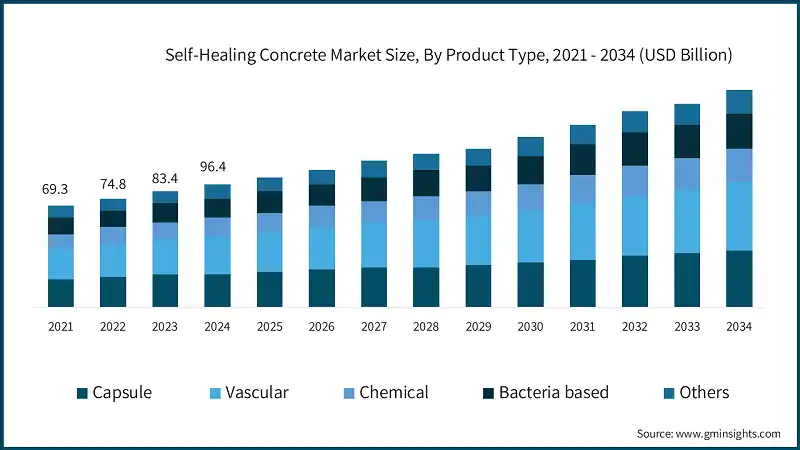
Based on product type, the market is segmented into capsule-based, vascular-based, bacteria-based, chemical-based and others (hybrid, enzyme-based, etc.). The capsule-based segment was valued at USD 29.3 billion in 2024 and is anticipated to expand to 32.2% of CAGR during 2025 to 2034.
- Capsule-based self-healing concrete is currently dominating the self-healing concrete market due largely to its established success and practical application. Microcapsules, which release self-healing agents when they burst, to heal cracks are a familiar solution for large infrastructure projects.
- Vascular-based self-healing concrete involves higher complexity with its network of tubes placed in concrete in order to achieve healing through continuous delivery of healing agents, a feature that plays an important role in preventing expensive repairs in the long run with many high-value applications for concrete structures, like bridges, etc., despite higher upfront costs.
- Bacteria-based self-healing concrete is also gaining considerable attention as a sustainable way to build - using dormant bacteria that are activated by water to precipitate limestone in order to fill cracks is gaining popularity with the growth of sustainable construction.
- Chemical-based self-healing concrete, whether directly applied or through capsules, relies on reactive agents, such as polymers or expanding minerals, to achieve quick sealing of cracks. self-healing through chemical agents can provide strong repairs, often quickly.
- The others category consisting of hybrid systems and enzyme-based systems is at the forefront of research, using more than one mechanism of action or premised on innovative biological processes intended to overcome the limitations described and provide more total and specialized healing solutions for concrete applications in the future.
Based on form type, the self-healing concrete market is categories into intrinsic self-healing concrete, capsule-based self-healing concrete and vascular-based self-healing concrete). The capsule-based segment was valued at USD 43.8 billion in 2024 and is anticipated to expand to 31.9% of CAGR during 2025 to 2034.
- Intrinsic self-healing concrete helps to leverages the inherent natural healing capabilities of concrete through autogenous healing. This method takes advantage of the natural autogenous healing properties of concrete, where un-hydrated cement particles and calcium hydroxide interact with moisture to seal small cracks. This method is easy to implement and inexpensive, which makes it a basic benefit, as no external agents are required. While it is limited to small cracks and rely's on moisture, sustainable practices and the role of mitigating damage early in life provide a niche for autogenous healing methods in the market, especially in projects or applications that are preferred to be left untreated, and in resistance to cracking in foundations.
- Capsule-based self-healing concrete, this method consists of embedding microcapsules containing healing agents (or polymeric materials or even bacteria) into the concrete mix. Once a crack develops the microcapsules burst and release the agent to repair the crack. Significant advantages of this method include protection of the healing agent from the concrete's environment, controlled release of the agent, and improved ability to heal larger cracks. A large portion of the growth of this method is the relative ease of integration to existing construction methods and the healing effect has been proven to be effective, which explains why it captures a large portion of the market for repairing common cracks in residential and commercial buildings.
- Vascular-based self-healing concrete, this growing and emerging concept involves a system of hollow tubes or capillaries embedded in concrete that provide the continuous delivery of healing agents to cracks. Obviously, this concept value proposition is based on its persistent delivery of healing agents. Specifically, it can provide healing repeated times to one or many cracks during the matrix of the structure’s lifespan. Even though this technology may be more complicated and potentially more expensive, its potential use case in stunning applications such as bridges and dams for infrastructure - given the importance of life cycle analysis and long-term value - are driving its expected growth, as research continues to align the cost dimension and performance of the delivery network for greater commercialization opportunity.
Learn more about the key segments shaping this market
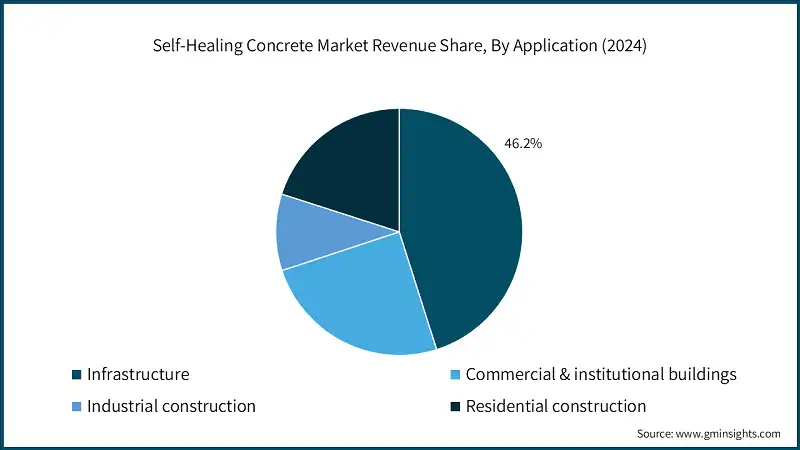
Based on application, the self-healing concrete market is categories into residential, commercial & institutional buildings, industrial construction and infrastructure. The infrastructure segment was valued at USD 44.5 billion and has a market share of 46.2% in 2024.
- The residential sector of self-healing concrete is an emerging application area. The drivers in this sector are owners or developers who are interested in costs related to long-term maintenance and extended service life. Self-healing concrete can mitigate micro-cracks that inevitably form in residential buildings when the house settles, temperature fluctuates, or due to normal usage and wear and tear. The cost of repair is often expensive and inconvenient, especially if the family cannot continue to use the house or specific rooms until a repair is completed.
- The commercial and institutional segment of the market, including office towers, shopping centres, hospitals, schools, and hotels, is another tremendous opportunity for self-healing concrete. These buildings fall into the category of uses that experience high levels of constant use and have complex designs that make traditional repairs difficult, complicated and costly. Self-healing concrete boasts advantages such as improved structural integrity, less downtime for maintenance and, in most cases, more aesthetically pleasing in that cracks do not appear on the concrete finish. Here the focus will be less on the structure and more on the operational aspect as the owners will want to run their business without negative impacts on their ability to provide service to their customers. Owners and developers in this area of the market expect their large investments to last, to meet codes for safety and durability, and to meet operational efficiency. Self-healing concrete will help owners achieve all of these objectives.
- It encompasses of factories, warehouses, power-plants and other heavy duty-facilities. Concrete is subjected to extreme loads, chemical exposure and temperature variations which lead to rapid degradation. Self-healing concrete is particularly valuable for its ability to autonomously repair, enhance operational safety within industrial complexes.
- This segment holds the largest share in the self-healing concrete market and is projected to experience growth. This category involves vital public such as bridges, roads, and tunnels. These assets are continuously exposed to severe weather conditions, heavy traffic loadings and aggressive environment. The global push for sustainable infrastructure development is a primary driver for the adoption of self-healing concrete in this crucial sector.
Based on end-use, the market is segmented into construction companies, Government & public authorities, infrastructure developers, real estate developers and research institutes & universities. The construction companies were valued at USD 33 billion in 2024 and is anticipated to expand to 30.6% of CAGR during 2025 to 2034.
- Construction companies are critical end-users as they will be the ultimate users of self-healing concrete in a project. Benefits that would incentivize a construction company for adoption could be the ability to define themselves from other services, lower liabilities of maintenance years after completing a structure, and ultimately provide a more reliable and sustainable structure to their clients. While the initial costs of the materials may be higher to introduce, the potential long-term benefits of lower maintenance, stronger structural integrity, and better reputation on projects are strong incentives
- Self-healing concrete helps to ensure the assets last longer, which improves public expense-accountability, minimizes interruptions to public services due to repair work, and increases public safety and resilience. Governments are also increasingly aligned to green building and sustainable development goals; therefore, self-healing concrete is appealing as a way to minimize the environmental footprint of public works. Policies and funding for resilient infrastructure, further foster their uptake of self-healing concrete.
- Infrastructure developers, both public and private developers, are key end-users investing heavily in self-healing concrete. Developers will most likely be focused on making long-lasting, robust infrastructure project which will withstand environmental stressors, excessive use and even natural disasters. For projects such as smart cities, critical transportation networks, and coastal defences – self-healing concrete's capability of repairing itself without external assistance is estimated to offer considerable long term cost savings, reduced operation costs, and overall increased reliability.
- Real estate developers are a growing segment in the self-healing concrete sector, particularly in commercial and high-end residential development, as developers can use self-healing concrete to provide higher quality and lower-maintenance properties that provide a greater market value. The appeal of less cracking and longer durability in real estate assets give a greater aesthetic appeal and lower future operational costs for property owners and tenants.
- Research institutes and universities are fundamental participants in the self-healing concrete ecosystem, and they contribute primarily by developing innovation and technology. They lead the industry in developing new healing mechanisms, improving existing technology, and testing the long-term performance of self-healing concrete in everyday conditions.
Based on distribution channel, the self-healing concrete market is segmented into offline and online channel. The offline distribution channel was valued at USD 83.2 billion in 2024 and is anticipated to expand to 29.7% of CAGR through 2034.
- The offline mode of self-healing concrete distributes the vast majority of self-healing concrete. This usually involves a direct sale using manufacturers' self-healing concrete sold to large construction companies, infrastructure developers, or government for great projects. Retailers of building materials and specialized distributors were also significant in distributing self-healing concrete, because those retailers engaged established networks of contractors and smaller construction projects. Indexing freight and purchase orders through the offline channel is a highly tailored management style with customer engagement, technical support, unlimited quantities, and logistics.
- Online sales channels for self-healing concrete are still developing but are slowly taking shape. These channels are typically limited to manufacturer websites, B2B ecommerce platforms and online marketplaces for construction materials. Selling bulk self-healing concrete online is a rare occurrence due to requiring consultation by experts and also logistical challenges - though online channels are still an important outreach, informational, product showcase, and lead in collector channels. They allow customers to take the first step by investigating the product, accessing technical specifications and case studies, and opening communication with the manufacturer.
Looking for region specific data?
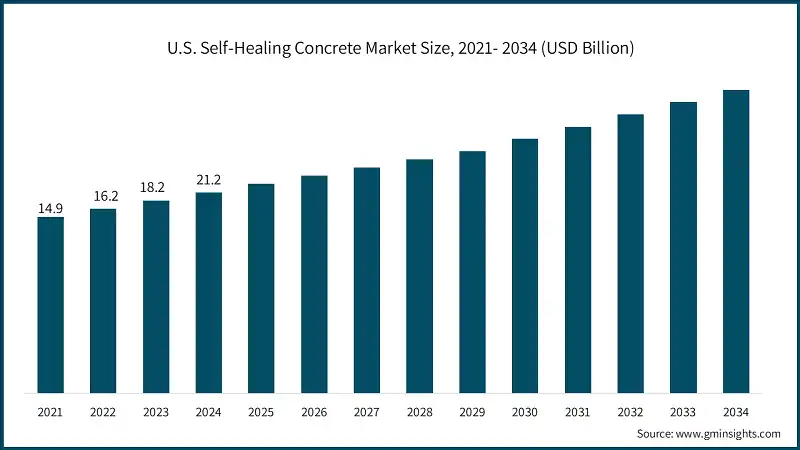
U.S. self-healing concrete market was valued at USD 21.2 billion in 2024 and expected to grow at a 32.3% CAGR from 2025 to 2034.
- North America is a mature but still developing market in the self-healing concrete with an anticipated share of approximately 25% of the world share in 2024. The U.S. continues to be the largest contributor to the region, and there has been significant federal infrastructure stimulus available through the Infrastructure Investment and Jobs Act that will help to boost the demand for long-life, sustainable materials in roads, bridges and public buildings.
- Canada is also exploring, investigating and requiring sustainable solutions during construction (in ice/snow climate zones) that promote durability, environmentally friendly construction, long service and durability (crack resistant). It is worth also highlighting the region's extensive ecosystem of research institutions, along with construction technology companies, that are lagging behind some regions considering their potential.
- Residential construction has taken longer to develop due to costs, but we are seeing some adoption of self-healing materials by public sector projects, and larger contractors are beginning to offer such technologies.
Europe holds the largest share of the world self-healing concrete market. This is due to the availability of government support for sustainable construction practices, dedication to research and development, and early adoption of advanced building materials.
- The front-running countries in this field such as Germany, the UK and the Netherlands are primary forerunners as they want to reduce their carbon footprint, reduce the impact of their infrastructure, and minimize operational and long-term maintenance of aging infrastructure.
- Smart infrastructure initiatives and net-zero building pledges in the UK also sustain demand for innovation. In Europe, the systematic collaboration is not lost on universities, private industry and government entities to commercialize emerging self-healing technologies.
The self-healing concrete market is expected to experience the fastest growth rate in the Asia-Pacific region. This rapid growth is already being driven by the many large infrastructure development projects and rapid urbanization in countries such as China, India, and Japan, as well as increasing awareness towards sustainable practices and sustainable construction.
- Countries in Southeast Asia such as Vietnam, Indonesia, and the Philippines are also emerging as growth hot spots in the future because of rapid activity in construction and the growing understanding of climate-resilient infrastructure.
- Local contractors and regional governments are starting to cooperate with international materials technology facilitating further opportunities for technology transfer and expansion into a developing market. Growth in the region aligns closely with the need for cost-effective, low-maintenance infrastructure in a variety of climates.
Latin America currently only represents 6% of the global self-healing concrete market. As a result of urbanization, gaps in infrastructure, and modernization of multiple communities recommended by governments, there is an opportunity for growth in the market.
- Brazil is a region where there are a variety of opportunities for self-healing concrete despite being the largest in the area through the use of resilient construction materials for very large transportation and housing projects. The deterioration of concrete is magnified in Brazil because of the tropical climate and the demand in the regions of heavy precipitation increases the demand of durable solutions.
- Mexico, due to significant cross border industrial traffic, is also a large market in relation to self-healing concrete through government investment in the advancement of road and rail infrastructure in the area.
- Chile has also begun to consider advanced concrete technologies, as the region is at risk from earthquakes so the demand for earthquake resistant buildings is great. Adoption of self-healing concrete is conservatively low due to less relative development than in other parts of the world.
The Middle East & Africa (MEA) region is expected to realize a much smaller market share of the global self-healing concrete approximately 7.7% in 2024, it is a developing area with long-term growth potential.
- Due to high temperatures, tough weather conditions and rapidly increasing infrastructure requirements in the region, there is an urgent need for low maintenance long-lived construction materials. In the United Arab Emirates and Saudi Arabia, mega-projects such as NEOM, Expo City Dubai and the Vision 2030 infrastructure plans have created interest in smart construction technologies (including self-healing concrete), given the key emphasis on sustainability, material longevity and innovation.
- There is also limited uptake in South Africa (with the most uptake in moderate applications such as transport and energy infrastructure), with international funding often requiring a sustainable construction standard.
Self-Healing Concrete Market Share
- In 2024, the Prominent players include BASF SE, CEMEX S.A.B. de C.V., Sika AG, Xypex Chemical Corporation, Wacker Chemie AG, Green-Basilisk BV. These companies hold the major share and are actively engaged in R&D, strategic partnerships and acquisition to enhance their product portfolios and expand their global market.
- The self-healing concrete market is undergoing rapid growth, with a variety of reports confirming projected notable growth for the existing market conditions. This growth is driven by higher levels of investment in many countries' infrastructures, increasing global standards for sustainability, and significant demand for smart, robust, and low-maintenance building materials.
- The self-healing capability of a concrete structure can autonomously repair cracking and greatly extend the life cycle of the structure, detracts expensive human labor effort for repairs and greatly reduces carbon impact upon construction overall.
- Europe is the dominant presence in the self-healing concrete market and is projected to have the largest share of the market in 2024. This leadership can be attributed to government backing initiatives for green building, significant R&D funding, and the early adoption of sustainable-building systems. North America has a significant market as well, prompted by the need to update aging infrastructure and building resiliently.
Self-Healing Concrete Market Companies
The top global key players in the self-healing concrete industry are:
- Acciona
- Akzo Nobel N.V
- BASF SE
- Buzzi Unicem USA
- CEMEX S.A.B. de C.V.
- Devan
- Fescon
- Green-Basilisk BV (Basilisk Self-Healing Concrete)
- Kryton International Inc.
- Heidelberg Materials
- Holcim
- Master Builders Solutions
- Sika AG
- Wacker Chemie AG
- Xypex Chemical Corporation
- Sika AG is a global developer and manufacturer of specialty chemicals. Sika is a market leader in construction materials, although they may not explicitly call it self-healing concrete in the same way others may, given their expertise in durable concrete solutions, concrete admixtures, synonyms of self-healing, and waterproofing systems, Sika has a lot of opportunity to adopt self-healing concrete products.
- CEMEX is a global building materials company providing cement, ready-mix concrete, and aggregates. CEMEX is one of the largest concrete producers in the world and is engaged in innovation and sustainability solutions promoting the use of sustainable and innovative concrete solutions. CEMEX's sustainable practices often include the use of innovative chemical admixtures involving specific proportions of concrete constituents to obtain performance-based durability.
- Holcim and Heidelberg Cement (now Heidelberg Materials) rank among the world's largest cement and concrete manufacturers. Both companies have made significant investments in sustainable construction, low-carbon cement, and advances in concrete technology. Holcim and HeidelbergCement have research programs related to the development of new materials, and self-healing capabilities, and therefore enhanced durability in concrete is a possibility in their materials research.
- Green-Basilisk BV is a company that specializes in bacteria-based self-healing concrete, branded as Basilisk Self-Healing Concrete, and was born out of a research project from TU Delft. The self-healing technology utilized limestone-producing microorganisms (bacteria) that are activated by the presence of moisture and oxygen at the opening of a crack, then autonomously facilitates the fracture repair.
- Xypex Chemical Corporation is recognized for its crystalline waterproofing technology, which is a type of intrinsic or chemical self-healing. Their proprietary chemical admixtures react with water, and un-hydrated cement particles, to form insoluble crystalline structures that can fill and seal capillaries and micro-cracks (up to 0.4 mm) and can be quantified as leaking or penetrating water from the outside.
Self-Healing Concrete Market Report Attributes
| Key Takeaway | Details |
|---|---|
| Market Size & Growth | |
| Base Year | 2024 |
| Market Size in 2024 | USD 96.36 Billion |
| Market Size in 2025 | USD 109.3 Billion |
| Forecast Period 2025 - 2034 CAGR | 31.5% |
| Market Size in 2034 | USD 1.2 Trillion |
| Key Market Trends | |
| Drivers | Impact |
| Infrastructure development & urbanization | High impact: spurs demand for durable, low maintenance construction materials |
| Advancements in healing technologies (bacterial, capsule, vascular, polymer) | High impact: broadens applications and improves performance |
| Sustainability and lifecycle cost reduction | High impact: aligns with eco friendly construction and long term cost savings |
| Rising maintenance costs of aging infrastructure | High impact: governments and developers are increasingly turning to self-healing concrete to reduce long-term repair and rehabilitation expenses. |
| Pitfalls & Challenges | Impact |
| High initial cost of self healing solutions | Major constraint: slows adoption, particularly in cost-sensitive projects |
| Limited awareness and regulatory standards, especially in emerging markets | Moderate to high impact: adoption lag due to low familiarity and few regulations |
| Opportunities: | Impact |
| Smart city & green infrastructure investments | Strong opportunity: government backed projects prioritize long lasting, sustainable materials |
| Public-private partnerships (PPPs) in infrastructure projects | Strong opportunity: Many governments are leveraging PPP models to finance large-scale infrastructure. |
| Integration with IoT/sensing (e.g., Giatec’s smart concrete) | Significant upside: enabling predictive maintenance and increased value |
| Expansion in repair and restoration of heritage structures | There is growing interest in using self-healing concrete for restoring and preserving historical and heritage buildings, where traditional repair methods are costly and intrusive. |
| Market Leaders (2024) | |
| Market Leaders |
8% market share |
| Top Players |
Collective market share in 2024 is 28% |
| Competitive Edge |
|
| Regional Insights | |
| Largest Market | Europe |
| Fastest growing market | Asia Pacific |
| Emerging countries | China, India, Southeast Asia |
| Future outlook |
|
What are the growth opportunities in this market?
Self-Healing Concrete Market News
- On June 18,2025, Sika inaugurated new factories in China, Brazil, and Morocco, reinforcing its "local-for-local" production strategy and establishing further global reach for its concrete admixtures and mortar systems.
- On Nov 4, 2024, Xypex Chemical Corporation Expands Global Operations Acquires Xypex Australia and National Concrete Solutions. This will drive further growth while creating more value to our customers, employees and stakeholders. The new combined business will ensure our delivery of quality products and solutions to customers while controlling costs and future investments.
- On July 11, 2022, CEMEX completes acquisition of a 53% majority stake in ProStein GmbH & Co. KG, a leading producer and distributor of aggregates in Germany.
- This acquisition is part of CEMEX's existing strategy that has focused on growth via bolt-on investments in developed markets.
The self-healing concrete market report includes in-depth coverage of the industry, with estimates & forecast in terms of revenue (USD Billion) & volume (Kilo Tons) from 2021 to 2034, for the following segments:
Market, By Product Type
- Capsule based
- Vascular based
- Chemical based
- Bacteria based
- Others (hybrid, enzyme-based, etc.)
Market, By Form
- Intrinsic
- Capsule based
- Vascular
Market, By Application
- Residential construction
- Commercial & institutional buildings
- Industrial construction
- Infrastructure
Market, By End Use
- Construction companies
- Government & public authorities
- Infrastructure developers
- Real estate developers
- Research institutes & universities
Market, By Distribution Channel
- Offline
- Online
The above information is provided for the following regions and countries:
- North America
- U.S.
- Canada
- Europe
- UK
- Germany
- France
- Italy
- Spain
- Rest of Europe
- Asia Pacific
- China
- India
- Japan
- South Korea
- Australia
- Rest of Asia Pacific
- Latin America
- Brazil
- Mexico
- Argentina
- Rest of Latin America
- MEA
- UAE
- Saudi Arabia
- South Africa
- Rest of Middle East and Africa
Frequently Asked Question(FAQ) :
What is the market size of the self-healing concrete in 2024?
The market size was USD 96.36 billion in 2024, with a CAGR of 31.5% expected through 2034 driven by rising demand for smart and sustainable construction materials that reduce long-term maintenance costs.
What is the projected value of the self-healing concrete market by 2034?
The self-healing concrete market is expected to reach USD 1.2 trillion by 2034, propelled by infrastructure development, advancements in healing technologies, and sustainability initiatives.
What is the current self-healing concrete market size in 2025?
The market size is projected to reach USD 109.3 billion in 2025.
How much revenue did the capsule-based segment generate in 2024?
The capsule-based segment generated USD 29.3 billion in 2024 and is anticipated to expand at 32.2% CAGR from 2025 to 2034.
What was the valuation of infrastructure application segment in 2024?
Infrastructure applications held 46.2% market share and generated USD 44.5 billion in 2024, representing the largest application segment.
What is the growth outlook for construction companies end-use segment from 2025 to 2034?
Construction companies segment was valued at USD 33 billion in 2024 and is projected to grow at a 30.6% CAGR through 2034, led by differentiation opportunities and reduced maintenance liabilities.
Which region leads the self-healing concrete market?
U.S. self-healing concrete market was valued at USD 21.2 billion in 2024 and expected to grow at a 32.3% CAGR from 2025 to 2034.
What are the upcoming trends in the self-healing concrete market?
Key trends include integration with IoT sensors for smart monitoring, advancements in MICP and nanotechnology, AI-driven real-time tracking of self-healing processes, and alignment with green building certifications and net-zero goals.
Who are the key players in the self-healing concrete market?
Key players include Sika AG, CEMEX S.A.B. de C.V., Holcim, Basilisk (Green-Basilisk BV), Xypex Chemical Corporation, BASF SE, Wacker Chemie AG, Heidelberg Materials, Kryton International Inc., Acciona, Akzo Nobel N.V., Buzzi Unicem USA, Devan, Fescon, and Master Builders Solutions.
Self-Healing Concrete Market Scope
Related Reports