Summary
Table of Content

Self-healing Adhesives Market
Get a free sample of this report
Form submitted successfully!
Error submitting form. Please try again.
Thank you!
Your inquiry has been received. Our team will reach out to you with the required details via email. To ensure that you don't miss their response, kindly remember to check your spam folder as well!
Request Sectional Data
Thank you!
Your inquiry has been received. Our team will reach out to you with the required details via email. To ensure that you don't miss their response, kindly remember to check your spam folder as well!
Form submitted successfully!
Error submitting form. Please try again.
Self-healing Adhesives Market Size
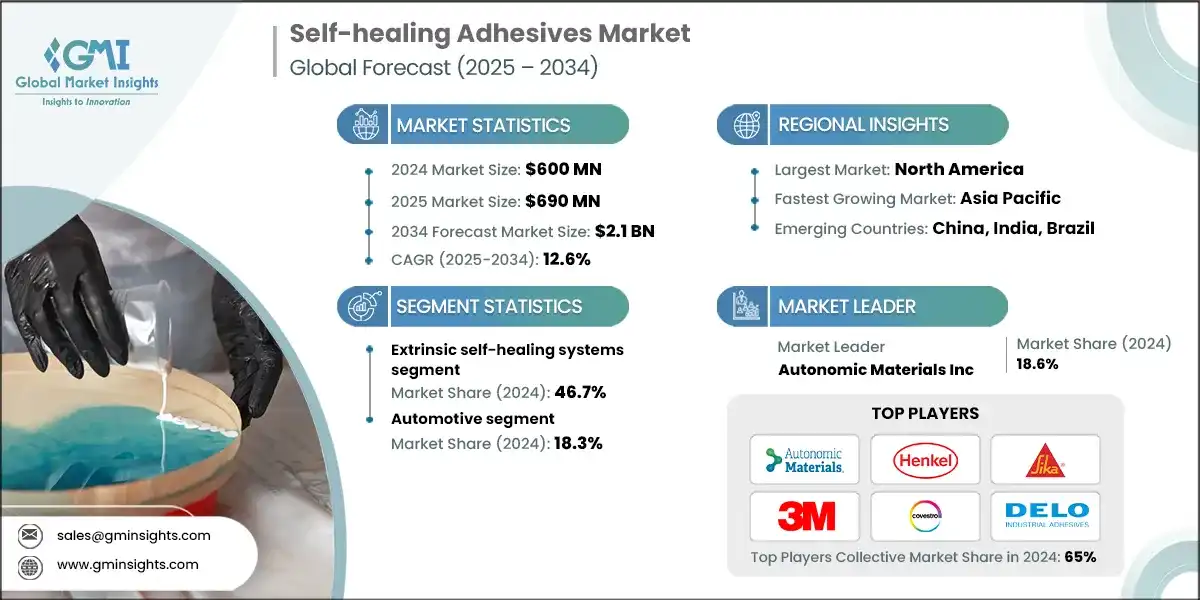
The global self-healing adhesives market was estimated at USD 600 million in 2024. The market is expected to grow from USD 690 million in 2025 to USD 2.1 billion in 2034, at a CAGR of 12.6% according to latest report published by Global Market Insights Inc.
Self-healing Adhesives Market Key Takeaways
Market Size & Growth
- 2024 Market Size: USD 600 Million
- 2025 Market Size: USD 690 Million
- 2034 Forecast Market Size: USD 2.1 Billion
- CAGR (2025–2034): 12.6%
Regional Dominance
- Largest Market: North America
- Fastest Growing Region: Asia Pacific
Key Market Drivers
- Breakthrough advances in smart materials technology.
- Rising demand for maintenance-free solutions.
- Technological advancement in bio-based healing systems.
Challenges
- Complex manufacturing processes and high material costs.
Opportunity
- Growing electronics miniaturization and semiconductor applications.
Key Players
- Market Leader: Autonomic Materials Inc led with over 18.6% market share in 2024.
- Leading Players: Top 5 players in this market include Autonomic Materials Inc,, Henkel AG,, Sika, 3M Company,, Covestro AG,, DELO Industrial Adhesives, which collectively held a market share of 65% in 2024.
Get Market Insights & Growth Opportunities
- The demand for durable and long-lasting adhesives in construction, automotive, and electronics sectors has spurred the market's expansion. The construction and infrastructure applications hold an 18% market share in 2024 at a steady growth rate of 9.3% CAGR in the forecasted period, whereas automotive applications maintain an 18.3% market share in 2024 with a growing rate of 10.2% CAGR in the coming years.
- Increased focus on reducing maintenance costs while maintaining product longevity has fostered the use of self-healing adhesives which account for approximately 7% worth of impact on the overall growth of the market. Technology addresses urgent needs in aerospace applications, where composite repair and structural integrity are paramount.
- Limited long-term performance data and the reliability issues attached to self-healing adhesives eroded consumer confidence towards long-term application and extremely slow penetration of the market. Some technical hurdles also include having low healing agent quantities in microcapsules that result in restrictions on the magnitude and frequency of repair, whilst microcapsules rupturing often leads to an irreversible and non-repeatable healing process under cyclic mechanical stress.
To get key market trends
Self-healing Adhesives Market Trends
- Sustainable Material Innovation: Milestones in transforming adhesives to one that is sustainable and environmental-friendly are emerging from rising demands from environmental regulation as well as consumer demands. The bio-based self-healing systems are gaining momentum, bio-based systems take a 10.3% market share of total sales in 2024 and are predicted to show a growth at CAGR 21.2% through 2034. Research from Oak Ridge National Laboratory demonstrates breakthrough autonomous healing adhesives that function underwater and on dusty surfaces without primers indicating significant technological advancement in sustainable formulations.
- Electronics and Automotive Integration: Increased integration of self-healing adhesives in electronic and automotive industries will increase product durability, thus increasing market expansion. The electronics and semiconductors segment take a market share of 13.3% at present but will grow quickly at 18.4% in CAGR, spurred by miniaturization trend and flexible electronics demand. H.B. Fuller's Smart Vehicle series shows an industry's interest in ADAS sensors, battery management systems, and thermal management.
- Advanced Polymer Technology: Research conducted by North Carolina State University has tackled historic hurdles in self-healing polymers, including development of new engineering methods to restore mechanical integrity closer to original properties, fast healing kinetics at useable temperatures and working without stringent external stimuli. Most recent advances include the MXene nanosheets integration achieving 96% strength recovery within minutes.
Self-healing Adhesives Market Analysis
Learn more about the key segments shaping this market
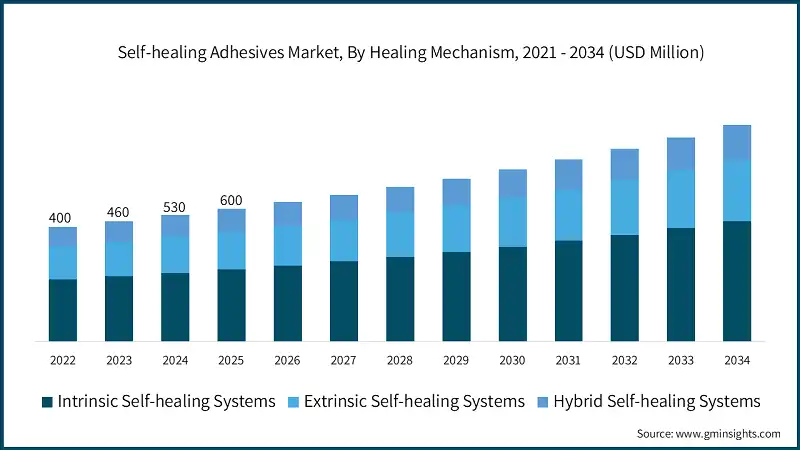
The healing mechanism segmentation displays distinctive technology maturity levels and growth trajectories determining competitive positions and market opportunities. Extrinsic self-healing systems dominate today with a market share of 46.7% worth USD 280.2 million in market value in 2024. These systems employ microcapsules or vascular networks with healing agents that initiate once the healing mechanism is activated due to damage, demonstrating reliable performances for structural applications with healing efficiencies of around 75-90% for neat epoxy systems.
Despite being in a leading position in the self-healing adhesives market, extrinsic systems grow slowly at a 7.3% CAGR, which shows not only the maturity of technology but also the competition rising against advanced alternatives. Among the advantages are tried-and-true manufacturing routes, demonstrated reliability in aerospace and automotive applications, and compatibility with currently utilized adhesive formulations; disadvantages include finite capacity for healing agent, irreversible healing once a microcapsule is ruptured, and possible compromise of mechanical properties due to inclusion effects.
Intrinsic self-healing systems cover 31.7% of the total market share in 2024 and show stronger growth at 13.9% CAGR, indicating increasing acceptance of reversible chemistry approach by the market. This system employs dynamic covalent bonds, supramolecular interactions, and hydrogen bond-based autonomous repair without the addition of external healing agents. Technology promises advantages such as repeated healing without loss of mechanical properties and ease of manufacture. The recent advancements in dynamic covalent chemistry and supramolecular design have improved healing efficiency and broadened temperature operating ranges.
On the other hand, the self-healing adhesives market from hybrid self-healing systems are the fastest-growing category at 17.2% CAGR, although they occupy only 21.7% of the market share. This advanced formulation combines intrinsic and extrinsic mechanisms to achieve the optimum in healing performance, mechanical property, and versatility of application. Research shows reparatory schemes called close-then-heal, where shape-memory polymers are combined with thermoplastic particles to exhibit repeated healing with first-cycle efficiencies of 91% and gradually decline to 82.5% by the third cycle. Superior performance characteristics and wide application scope command premium pricing and hasten adoption in high-value sectors.
Learn more about the key segments shaping this market
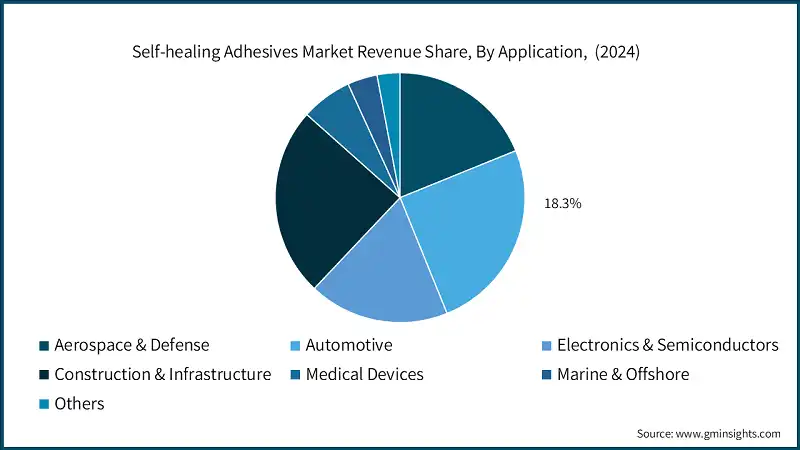
The various market dynamics revealed in the segmentation analysis on Application involves different requirements for the industry, the adoption of technology at different rates, and performance criteria. The self-healing adhesives market from automotive segment is at the forefront with an 18.3% market share (USD 109.8 million in 2024), which is expected to grow at a 10.2% CAGR through 2034. This segment includes body panel adhesives, structural bonding applications, battery assembly for electric vehicles, and interior components attachment. A mature market with growing competition from traditional alternatives inherently internalizes this growth into a modest pace.
Construction and infrastructure applications, representing 18% market share in 2024 and at 9.3% CAGR, denote the characteristics of a mature market wherein almost all adoption is based on structural repair, weatherproofing, and crack sealing applications. With rising infrastructure investment and increased consciousness regarding lifecycle cost advantages, the segment is expected to charge ahead. Self-healing concrete additives and structural adhesives for bridge and tunnel works bolster relatively steady demand increases.
Electronics and semiconductors ascend as the highest emerging application from which to date with respect to 18.4% CAGR in growth potential, with current market share of 13.3% in 2024. This section solves the urgent problems of flexible electronics, wearable devices, thermal interface materials, and device assembly. The phenomenal growth is commensurate with quickening trends for miniaturization, increasing device complexity, and durable next-generation electronics.
The self-healing adhesives market in aerospace and defense, applications occupy 13.8% of the market share and are growing at a CAGR of 12.4%, spurred by the performance demands and the high economic value of the applications involved. This category comprises composite repair, structural bonding, and protective coating applications where efficiencies in healing of 75-90% and extensive fatigue-life extensions of more than 20-30× offer significant operating advantages. The moderate growth rate reflects long qualification cycles typical to these applications and the conservative adoption patterns of aerospace applications.
Medical devices, with a market share of 4.8%, constitute a niche segment of high growth, with an impressive CAGR of 16.4%. Applications include biocompatible adhesives for implantable devices, wound healing systems, and drug delivery platforms. The elderly population, increase in the number of surgery procedures, and demand for less invasive medical technologies have pushed up growth in this area.
Material base segmentation showcases the technological and strategic variations employed in performance optimization across a multitude of applications and industries. Leading with an overwhelming 32.8% market share in 2024, epoxy-based systems are worth USD 196.8 million in the 2024 market and are expected to grow at a CAGR of 12.8%. These systems tend to have excellent mechanical properties, chemical resistance, and stability at high temperatures, thereby making them the preferred choices for structural applications in the aerospace, automotive, and construction sectors.
Epoxy formulations typically incorporate microcapsule healing agents, which contain dicyclopentadiene (DCPD) and Grubbs' catalyst for ring-opening metathesis polymerization (ROMP) healing mechanisms. Concurrently, several advanced formulations show healing efficacy as high as 91% for dual microcapsule epoxy/amine systems, with microcapsule sizes varying widely from 50-460 μm, depending on application needs. The technology maturation and proved performance continue to keep the company in leadership despite its increasing competition from alternative chemistries.
Polyurethane-based systems, with 21.7% of the self-healing adhesives market share in 2024 and 11.6% CAGR, are characterized by flexibility, weather durability, and impact resistance, putting them at a competitive edge in most applications requiring elastomeric properties, such as automotive sealing, flexible electronics, and building envelopes. Polyurethane formulations usually employ thermoplastic healing agents along with shape memory components to obtain enhanced healing performance.
Looking for region specific data?
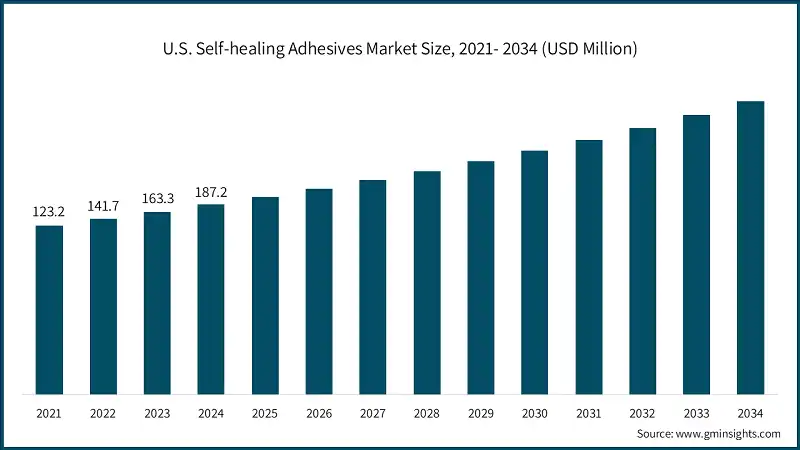
- The U.S. self-healing adhesives market is valued at USD 187.2 million in 2024 and is likely to expand to almost USD 667.4 million by 2034. The U.S. market accounts for the most part of North America because of the high demand from Boeing, Lockheed Martin, and other aerospace manufacturers who need advanced composite repair solutions. The market consists of the very high demand for battery assembly and thermal management adhesives from the automotive industry, such as the electric vehicle production by Tesla and the electrification efforts by traditional OEMs. Electronics applications drive the adoption of flexible and wearable device adhesives, supported by technology companies such as Apple, Google, and others.
- Europe self-healing adhesives market has the largest regional growth rate at 13.4% CAGR, with a 31.5% share in 2024 due to various reasons, notably stringent environmental regulations, circular economy initiatives, and a strong automotive industry presence. The projected USD 112.9 million market value for 2024 in Germany leads Europe in adopting this technology and is projected to reach USD 247.1 million by 2034 at 8.2% CAGR. The key focus by region in development projects prompts bio-based system adoption and recyclable adhesive developments.
- European automakers such as Volkswagen, BMW, and Mercedes-Benz are increasingly opting for solutions that upgrade their lightweighting and electric vehicle applications. These drive demand in the renewable energy sector in the region, especially in wind turbine manufacturing. Self-healing composite repair systems are demanded for this application in the region. Advanced healing technologies are needed in aerospace applications that benefit from Airbus and most defense contractors.
- Asia Pacific self-healing adhesives market is expected to account for 12.6% CAGR in the forecasted period with 22.4% share in 2024 as it exhibits rapid industrialization and growing electronics manufacturing base. This is reflected in the market projected at USD 134.4 million in 2024 and would largely arise from the US automotive production, electronics produced in South Korea, and advanced materials research in Japan. China's market for electric vehicles, significantly led by BYD, NIO, and other manufacturers, generates increasing demand for battery assembly and thermal management adhesives.
- South Korea's electronics industries, including those of Samsung and LG, are the main drivers for adopting flexible display and wearable device adhesives. Early adoption and innovation in next-generation healing mechanisms would be promoted because of Japan's advanced materials research. This includes some of the developments that have occurred at RIKEN and other institutions.
- Latin America and the Middle East and Africa are an emerging area, but both show strong growth prospects in the order of 14.8% and 15.2% in 2024, respectively. These regions have realized strong increases because of industrialization advancements, infrastructure development, and technology transfer from mature markets.
Self-healing adhesives Market Share
The competition landscape in the self-healing adhesives industry is greatly oligopolistic in the sense that market-leading material science companies are relying on their technological expertise and a global distribution network to maintain their market leadership. The top five players in this market collectively own 61% market share in 2024, indicating a moderate concentration level for balancing competitive dynamics with innovation investment capacity.
It is estimated that in 2024, 3M Company will contribute about 90 million USD revenue toward self-healing adhesives applications from approximately 15% market share, making it the leading company in the self-healing adhesives market. 3M's leadership comes from its high materials science portfolio, a plethora of patents covering a broad range of technologies, and good ties in the areas of aerospace, automotive, and electronics consumption. Those unique competitive advantages are advanced microencapsulation technologies, proven healing agent formulations, and cost-effective manufacturing scale capabilities for developing specific healing systems.
3M has a whole suite of self-healing adhesive offerings, including aerospace composite repair systems, automotive structural bonding applications, and electronics assembly solutions. As of continuing innovation within microcapsule size optimization, healing agent chemistry, and activation mechanisms, 3M has proven healing efficiencies in the range of 75-90% for neat epoxy systems. Use of its global manufacturing footprint and technical service enables the company to generate competitive advantage to serve its multinational clients in very diverse applications.
Henkel AG is consolidating its position as one of the most dynamic players in the market by drawing on its deep technological expertise in adhesives and its rich linkages within the automotive industry. Its market strategy is directed toward applications that need superior mechanical properties, environmental resistance, and durability. Its innovation pipeline shall include bio-based healing systems, hybrid mechanism formulations, and application-specific solutions for electric vehicle assembly and electronics miniaturization trends.
Autonomic Materials Inc. is actually an indication of its specialized technology leadership in self-healing systems, with a focus on newer advanced healing mechanisms and novel application development. It offers proprietary technologies that involve vascular network systems, advanced healing agent chemistries, and hybrid intrinsic-extrinsic formulations. Autonomic Materials is much smaller in market share relative to these diversified materials companies but commands premium price and high-value niche applications primarily in aerospace, defense, and advanced electronics sectors.
Self-healing Adhesives Market Companies
Major players operating in the self-healing adhesives industry are:
- Autonomic Materials Inc
- Henkel AG & Co. KGaA
- Sika
- 3M Company
- Covestro AG
- DELO Industrial Adhesives
- Henkel AG & Co. KGaA leads the German market for self-healing adhesives with automotive and electronics as the strongest application fields. The central location provides an excellent opportunity for collaboration between automotive and electronics manufacturers, which in turn create demand for self-healing adhesive solutions.
- Sika is strong in the German market with its wide-ranging portfolio of construction and automotive adhesives. Their expertise in structural bonding and sealing applications put them in good stead with respect to self-healing adhesive opportunities on the construction and automotive sectors where long-term durability is of utmost importance.
- 3M, With its global R&D capabilities and materials science expertise, it has been able to compete in the market for self-healing adhesives in Germany. The company's innovative work in the field of microencapsulation technologies and polymer chemistry lays down a competitive platform for advanced self-healing formulations of various applications.
- Covestro AG brings its position as a leading German chemical company with profound expertise in high-performance polymers and materials science to the self-healing adhesives market. The company's sustainable solution focus and circular economy principles fit well with the trends of the market toward environmentally friendly self-healing formulations.
- DELO Industrial Adhesives specializes in high-performance bonding solutions for electronics and automotive applications. Their experience in precision dispensing and curing technology advantages the development of self-healing adhesives for demanding industrial applications.
Self-healing Adhesives Market Report Attributes
| Key Takeaway | Details |
|---|---|
| Market Size & Growth | |
| Base Year | 2024 |
| Market Size in 2024 | USD 600 Million |
| Market Size in 2025 | USD 690 Million |
| Forecast Period 2025 - 2034 CAGR | 12.6% |
| Market Size in 2034 | USD 2.1 Billion |
| Key Market Trends | |
| Drivers | Impact |
| Breakthrough advances in smart materials technology | Hybrid self-healing systems enabling superior damage recovery with enhanced durability |
| Rising demand for maintenance-free solutions | Autonomous repair capabilities reducing lifecycle costs and improving system reliability |
| Technological advancement in bio-based healing systems | Sustainable and environmentally friendly healing mechanisms driving adoption in green applications |
| Pitfalls & Challenges | Impact |
| Complex manufacturing processes and high material costs | Specialized production requirements and premium pricing limiting widespread market penetration |
| Opportunities: | Impact |
| Growing electronics miniaturization and semiconductor applications | Increasing demand for self-repairing adhesives in high-value electronic assemblies and microelectronics |
| Market Leaders (2024) | |
| Market Leaders |
18.6% market share |
| Top Players |
Collective market share is 65% in 2024 |
| Competitive Edge |
|
| Regional Insights | |
| Largest Market | North America |
| Fastest growing market | Asia Pacific |
| Emerging country | China, India, Brazil |
| Future outlook |
|
What are the growth opportunities in this market?
Self-healing Adhesives Industry News
- In April 2023, Lohmann launched the two electrically conductive single-sided adhesive foams, DuploCOLL 28502 EC and 28504 EC, which are meant for grounding and contact in electronics, thus enabling innovative solutions in e-mobility, medical tech, printed electronics, and smart home applications.
- In September 2022, Henkel inaugurated its Inspiration Center Düsseldorf, an ultra-modern innovation hub with 30 labs and 4 technology centers, levelled at sustainable adhesive solutions, collaborative innovation, and consolidated its global leadership in adhesives, sealants, and coatings, for an investment of USD 143 million.
- The self-healing adhesives market research report includes in-depth coverage of the industry, with estimates & forecast in terms of revenue (USD Million) and volume (Kilo Tons) from 2021 to 2034, for the following segments:
Market, By Healing Mechanism
- Intrinsic self-healing systems
- Extrinsic self-healing systems
- Hybrid self-healing systems
Market, By Application
- Aerospace & defense
- Composite repair systems
- Protective coatings
- Automotive
- EV battery sealing & thermal management
- Structural bonding & body assembly
- Electronic component protection
- Electronics & semiconductors
- Device assembly & encapsulation
- Thermal interface materials
- Flexible electronics & wearables
- Construction & infrastructure
- Structural repair systems
- Weatherproofing & sealing
- Maintenance & renovation
- Medical devices
- Marine & offshore
- Others
Market, By Material Base
- Epoxy-based systems
- Polyurethane-based systems
- Silicone-based systems
- Acrylic-based systems
- Bio-based systems
The above information is provided for the following regions and countries:
- North America
- U.S.
- Canada
- Europe
- UK
- Germany
- France
- Italy
- Spain
- Rest of Europe
- Asia Pacific
- China
- India
- Japan
- South Korea
- Australia
- Rest of Asia Pacific
- Latin America
- Brazil
- Mexico
- Argentina
- Rest of Latin America
- Middle East & Africa
- UAE
- Saudi Arabia
- South Africa
- Rest of Middle East & Africa
Frequently Asked Question(FAQ) :
What is the market size of the self-healing adhesives industry in 2024?
The market size was USD 600 million in 2024, with a CAGR of 12.6% expected through 2034 driven by the rising demand for maintenance-free adhesive solutions in construction, automotive, and electronics industries.
What is the current self-healing adhesives market size in 2025?
The market size is projected to reach USD 690 million in 2025.
What is the projected value of the self-healing adhesives market by 2034?
The self-healing adhesives market is expected to reach USD 2.1 billion by 2034, driven by advancements in hybrid healing systems, sustainable material innovation, and growing use in high-tech manufacturing sectors.
How much revenue did the extrinsic healing mechanism segment generate in 2024?
The extrinsic self-healing systems segment generated USD 280.2 million in 2024, leading the market with 46.7% share.
What was the valuation of epoxy-based material segment in 2024?
Epoxy-based systems accounted for USD 196.8 million in 2024, representing 32.8% share of the global market.
What is the growth outlook for hybrid self-healing systems from 2025 to 2034?
Hybrid self-healing systems are projected to grow at a 17.2% CAGR through 2034.
Which region leads the self-healing adhesives market?
The U.S. market dominated with USD 187.2 million in 2024, projected to reach around USD 667.4 million by 2034. Growth is driven by strong demand from aerospace manufacturers such as Boeing and Lockheed Martin and the expanding EV production ecosystem led by Tesla.
What are the upcoming trends in the self-healing adhesives industry?
Key trends include development of bio-based healing systems, integration into flexible electronics, and advances in MXene nanosheet technology enabling near-complete strength recovery within minutes.
Who are the key players in the self-healing adhesives market?
Key players include Autonomic Materials Inc., Henkel AG & Co. KGaA, Sika, 3M Company, Covestro AG, and DELO Industrial Adhesives.
Self-healing Adhesives Market Scope
Related Reports