Summary
Table of Content

Secure Access Service Edge Market
Get a free sample of this report
Form submitted successfully!
Error submitting form. Please try again.
Thank you!
Your inquiry has been received. Our team will reach out to you with the required details via email. To ensure that you don't miss their response, kindly remember to check your spam folder as well!
Request Sectional Data
Thank you!
Your inquiry has been received. Our team will reach out to you with the required details via email. To ensure that you don't miss their response, kindly remember to check your spam folder as well!
Form submitted successfully!
Error submitting form. Please try again.
Secure Access Service Edge Market Size
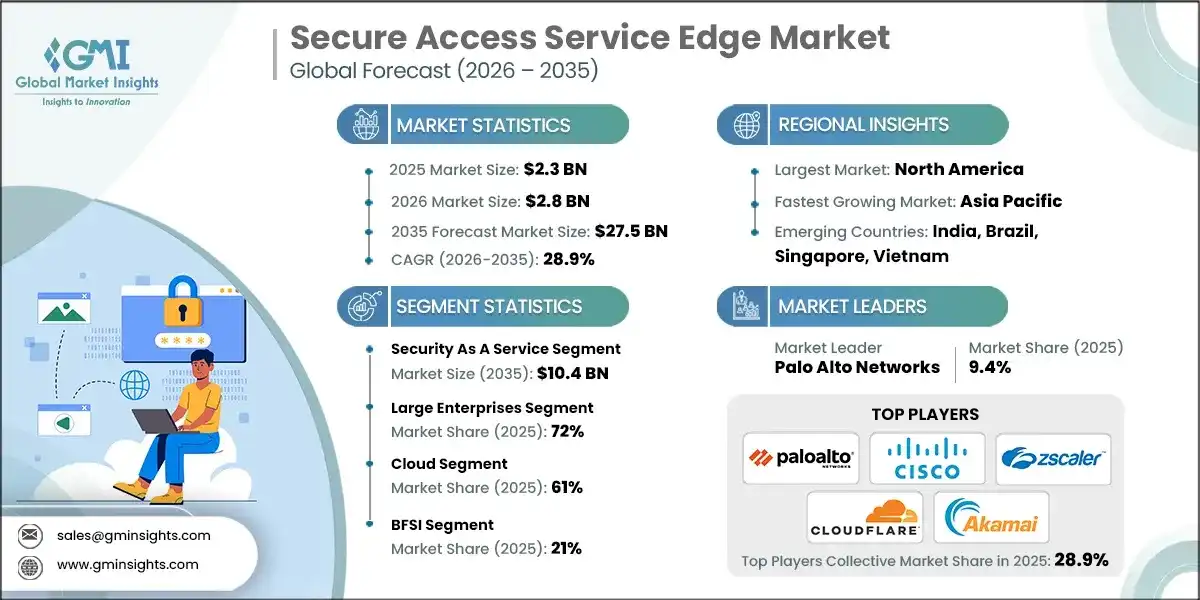
The global secure access service edge market was estimated at USD 2.3 billion in 2025. The market is expected to grow from USD 2.8 billion in 2026 to USD 27.5 billion in 2035, at a CAGR of 28.9% according to latest report published by Global Market Insights Inc.
Secure Access Service Edge Market Key Takeaways
Market Size & Growth
- 2025 Market Size: USD 2.3 Billion
- 2026 Market Size: USD 2.8 Billion
- 2035 Forecast Market Size: USD 27.5 Billion
- CAGR (2026–2035): 28.9%
Regional Dominance
- Largest Market: North America
- Fastest Growing Region: Asia Pacific
Key Market Drivers
- Rapid cloud and SaaS adoption.
- Expansion of remote and hybrid workforces.
- Rising cybersecurity threats and attack sophistication.
- Need to reduce security complexity and vendor sprawl.
- Acceleration of zero-trust security frameworks.
Challenges
- Integration challenges with legacy infrastructure.
- Concerns over data privacy and vendor lock-in.
Opportunity
- Expansion into SMB and mid-market segments.
- Growing demand for AI-driven threat detection.
- Increasing adoption of edge computing applications.
- Multi-cloud and hybrid-cloud modernization initiatives.
Key Players
- Market Leader: Palo Alto Networks led with over 9.4% market share in 2025.
- Leading Players: Top 5 players in this market include Palo Alto Networks, Cisco, Zscaler, Cloudfare, Akamai, which collectively held a market share of 28.9% in 2025.
Get Market Insights & Growth Opportunities
Organizations are increasingly adopting cloud-based software as a service (SaaS) applications and growing enterprise adoption of cloud-based software as a service (SaaS) application. Enabling secure, scalable, and unified access to the use of cloud-based software as a service (SaaS) application, organizations are transitioning away from traditional perimeter-based security models toward cloud-enabled SASE architectures.
Dispersed users/devices should have access to the same consistent level of security and optimized connectivity through policy-driven security methodology; thus, organizations will be forced to develop cloud-based SASE solutions with central management capabilities and highly secure access to these SASE solutions from anywhere in the world.
Disparate security solutions add complexity and cost for the organization; by leveraging an integrated approach to networking and security solutions, organizations can modernize their IT infrastructure, minimize complexity by providing a unified approach to IT operations, and streamline their vendor management processes to a single platform.
As more organizations implement Zero Trust models, the use of SASE's integrated ZTNA, identity-based access control mechanisms, and continuous identity verification techniques are helping provide organizations with improved protection against lateral movement and credential-based attacks.
On March 2024, AWS announced the launch of the Verified Access Service, which is a native zero trust service designed to eliminate the need for the traditional use of VPNs, and provide tight integration with AWS Identity and Networking services. The introduction of Verified Access creates a significant threat to third-party SASE vendors as it further validates the viability of a cloud-native zero trust architectural model.
With the number of cyber-attacks, data breaches, and growing regulatory requirements, organizations are being required to adopt SASE, which provides continuous security inspection capabilities, encrypted traffic visibility, and a compliance-oriented architecture to safeguard the organization’s users, applications, and data across multiple environments.
To get key market trends
Secure Access Service Edge Market Trends
Organizations increasingly leverage integrated, cloud-delivered SASE architectures to address visibility of data, simplify the process of managing multiple security and connectivity products as well as support growing populations of distributed employees/users and the applications used by them.
AI is being increasingly integrated into SASE solutions for improved threat Detection, automated policy management, Optimized route selection, and reduced costs associated with the operation of the Security Architecture in rapidly changing environments, allowing businesses to respond more effectively and efficiently to issues.
Identity-based access management is being extended to include contractors, branch users, devices, workloads & more. Hence, Continuous Authentication and Contextual Access Control are becoming integral pieces of the SASE architecture.
On April 2024, HPE will add Axis Security to the Aruba EdgeConnect platform allowing for an improved integration of ZTNA capabilities, which will provide a single point of management for both SD WAN and ZTNA services through Aruba Central. The integration will facilitate support for hybrid work environments and reinforce HPE's overall strategy of edge-to-cloud architecture.
SSE or security service edge is typically the first step taken by organizations on the journey to SASE, with a focus on deploying Cloud-delivered Security Functions such as secure web gateway (SWG), cloud access security broker (CASB), and zero trust network access (ZTNA), prior to deploying SD-WAN to achieve complete convergence of Security and Networking.
The rapid growth of cloud computing, edge computing, and remote work forces organizations seek security solutions that are scalable, location agnostic, and deliver the best possible performance at the edge, while providing Global low-latency and the same level of protection regardless of location.
On May 2024, CISA released a Technical Implementation Guide that provides a universal set of evaluation requirements designed to allow the federal government to streamline the process of adopting SASE. As a result of this guide, 40% of all civilian agencies are now conducting SASE assessments after the guide was released.
Secure Access Service Edge Market Analysis
Learn more about the key segments shaping this market
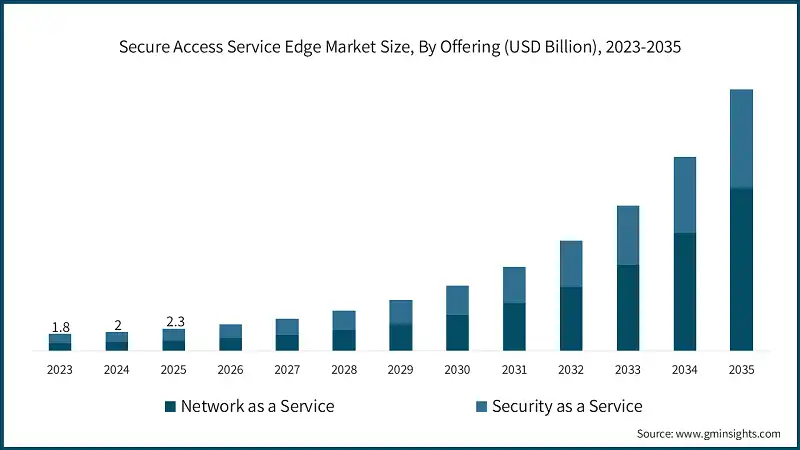
Based on offering, secure access service edge market is segmented into network as a service and security as a service. The security as a service segment dominates the market with 52% share in 2025 and is expected to reach USD 10.4 billion by 2035.
- Enterprises increasingly deploy security as a service within SASE frameworks by integrating zero trust network access and cloud-native security controls to replace legacy perimeter models, reducing attack surface while supporting hybrid work and multicloud environments.
- SASE providers embed artificial intelligence and machine learning into security as a service offering to enable real-time threat detection, predictive analytics, and automated response, enhancing resilience against sophisticated attacks and reducing manual operational overhead.
- NaaS supplies Cloud-based WAN with SD-WAN, optimized routing and last-mile connectivity, instead of MPLS, through a flexible, policy-based connection model. The growth of NaaS is supported by reduced MPLS expenditures, increased demands for cloud performance, simplified operations.
- Innovations in NaaS such as dynamic traffic steering, application acceleration and zero-touch provisioning continue to drive growth in the NaaS market. Vendors leverage their networking experience and the infrastructure of their worldwide point-of-presence (PoP) locations to provide improved low-latency, optimized connectivity and a strong differentiator in an increasingly competitive market.
- NaaS is used by businesses for connectivity to their branch offices, remote workers, retail locations and temporary sites. Businesses in retail and financial services have shown strong growth with NaaS because of the associated cost benefits, performance demands and regulatory compliance for high-volume, distributed networks.
Learn more about the key segments shaping this market
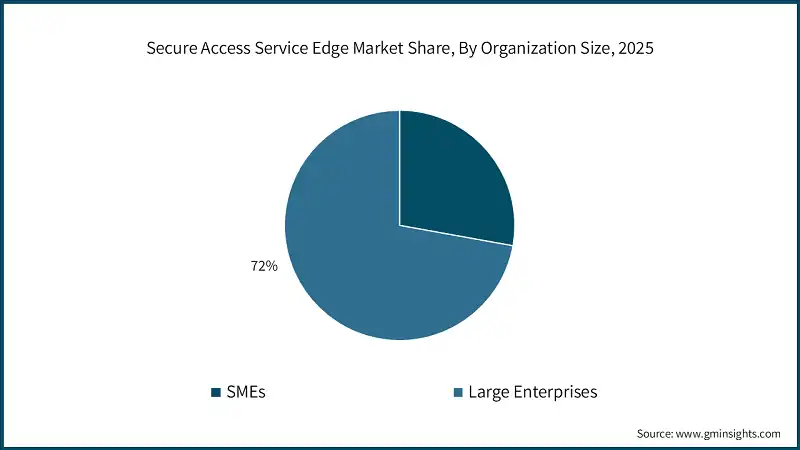
Based on organization size, the market is bifurcated into SMEs and large enterprises. The large enterprises segment dominates with 72% market share in 2025 and is estimated to reach USD 18.3 billion by 2035.
- Large companies are utilizing the SASE model to address their intricate worldwide deployment requirements, advanced security mandates, and the need to integrate with diverse systems, as well as the lengthy timeframe required for implementing the SASE solution, which typically spans 24 to 36 months from the time the pilot is launched until the solution is fully deployed.
- Large companies prefer to implement SASE solutions that are extremely scalable and offer 99.99% uptime, granular policy enforcement, extensive API integration, highly customizable solutions, and strict service level agreements. Three companies currently leading the way in terms of offering solutions for SASE implementation in large enterprises are Palo Alto Networks, Cisco, and Zscaler.
- The financial services, retail, healthcare, manufacturing, and technology verticals have become the fastest-growing verticals for SASE implementations among large enterprises. Banks have implemented SASE as a means of protecting their branch offices, supporting telecommuting employees, connecting third-party providers, and remaining in compliance with regulatory requirements.
- The Adoption of SME businesses' SASE solutions is growing rapidly as these solutions have a lower total cost of ownership, allow small and mid-sized enterprises access to enterprise-level security, provide ease of management and maintenance, are billed based on consumption, and have an outsourced service model for detection and response, due to the limited number of available security personnel within the company.
Based on deployment mode, the market is segmented into cloud, hybrid, and on-premises. The cloud segment dominates with 61% market share in 2025 and is anticipated to reach USD 19.6 billion by 2035.
- The supporting technology for Cloud-based SASE is the global cloud infrastructure, which eliminates the requirement for buying any hardware; due to the elastic scalability of Cloud Infrastructure. Global Points of Presence (PoPs) reduce latency across cloud infrastructure, enabling vendors to deliver SASE functionality up to 45% faster than appliance-based alternatives, with time-to-value compressed to approximately 4–8 weeks.
- In addition, Cloud-based SASE can also help to get automatic software updates, as well as the ability to elastic scale, simplified disaster recovery, and usage-based pricing with minimal IT involvement. The leading cloud-based vendors like cloudflare and zscaler take advantage of the purpose-built global infrastructure that they have developed, which supports the highest degree of SASE efficiency.
- Cloud-based SASE is an ideal fit for Remote Workers, SaaS Security, Large Branch Networks, and Greenfield Locations. Many Technology Companies and Professional Services firms are adopting Cloud-based SASE solutions due to their inherent Cloud-First Strategies and the nature of their Distributed Workforce.
- Hybrid SASE identifies the best of both worlds: The use of On-Premises Infrastructure, which allows for the use of the existing Local SD-WAN, combined with the cloud-based Security that is available for protecting Internet and SaaS Traffic.
- Hybrid SASE provides a general migration approach for the introduction of Cloud Security by allowing for the use of a Unified Policy to Integrate both On-Premises and Cloud Components into one Comprehensive Solution for SASE Adoption as the organization builds confidence to begin to migrate Sensitive Traffic. Cisco and Palo Alto Networks are recognized leaders in Hybrid SASE Solutions.
Based on end use, the secure access service edge market is divided into BFSI, IT & telecom, retail, healthcare, government, manufacturing, energy & utilities, education and others. The BFSI segment held a market share of 21% in 2025 and is projected to grow at a CAGR of 28.3% from 2026 to 2035.
- The BFSI sector is adopting SASE to meet the demands of its increasingly distributed workforce, strict regulatory rules, increasing threat of cyber attacks, and growth of digital banking. While the financial institutions within BFSI are continuously under siege from malicious attackers and need to maintain secure, resilient connections among their branches, ATMs, and digital offerings.
- To provide the level of protection required by financial services institutions (FSIs) from malicious actors, a comprehensive SASE for BFSI must include strong DLP capabilities, advanced threat prevention, granular access controls, and comprehensive audits, with the expectation of 99.99% availability and a low latency environment. The largest players in the banking sector are now deploying SASE solutions to enable secure branch connections, work-from-home environments, and vendor access. The telecom and IT sectors were the first to begin evaluating and deploying SASE due to their relative technical strengths in evaluating the architecture, APIs, and security characteristics of SASE solutions. Approximately 67% of IT and telecom service providers have already deployed or are evaluating SASE as an internal use offering or as a service for their customers.
- Retail SASE is also rapidly growing as the need for POS (point of sale) secure payment processing, development of omnichannel operations, and the need to provide secure payment processing over large franchises creates an urgency to deploy SASE. Retailers are leveraging SASE to provide enhanced security for payment data, mitigate the effects of ransomware attacks, capacity scale, and help reduce the cost of running their networks.
Looking for region specific data?
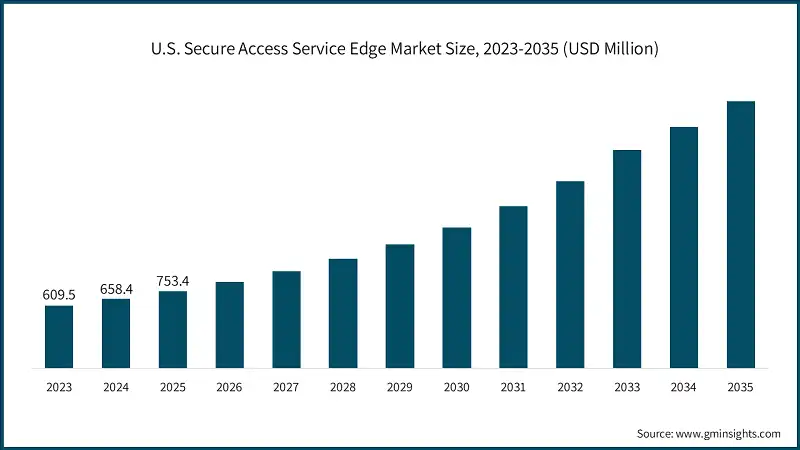
The U.S. secure access service edge market was valued at USD 753.4 million in 2025 and is expected to experience significant and promising growth from 2026 to 2035.
- U.S. organizations have speed up their adoption of secure access service edge (SASE) solutions as they modernize their security architecture and replace legacy VPNs with newer versions that meet the requirements of federal zero-trust initiatives, all driven by the rise of remote workforces, the growth of multi-cloud environments, rising levels of cyberthreats, and the need for integrated secure cloud solutions. Many enterprises are also interested in using cloud-native SASE platforms that include SD-WAN, ZTNA, SWG, and CASB technologies to enable them to deploy and scale quickly and to improve the user experience of distributed users who rely on mission critical cloud apps.
- More U.S. businesses are deploying artificial intelligence (AI) capabilities within their SASE frameworks to automate the identification of cyber threats and to reduce the burden on security analysts while providing them with faster response times to sophisticated attacks directed at critical infrastructures and regulated industries such as healthcare and finance.
- To accomplish this goal, U.S. businesses are replacing their MPLS networks with SD-WAN and NaaS solutions to reduce their operating expenses, be more agile, and enable high-bandwidth, low-latency connections for their cloud-first environments and remote workers.
North America region in the secure access service edge market held a market revenue USD 1.1 billion in 2025 and is anticipated to grow at a CAGR of 27.2% during 2026 to 2035.
- Enterprises in North America are leading in their global adoption of SASE solutions because of the following factors—they have upgraded digital infrastructures better than most regions around the world, and they spend more money on cyber security per organization compared to other countries—there are many converged-based cloud security solutions needed to facilitate or support hybrid workplaces as well as multi-cloud environments that require large, distributed organizations to operate.
- The adoption of SSE-first deployment strategies is gaining more support from organizations seeking to deploy, implement, and adopt ZTNA, SWG, CASB and are waiting until they have fully adopted these services prior to implementing sd-wan services this allows organizations to incrementally upgrade, modernize, and remain in compliance with regulatory guidelines.
- The increased number of organizations using AWS, azure, and google cloud is creating a demand for unified policies across multi-cloud environments using SASE to create a single identity for all users and to provide consistent inspection of cloud environments.
- Because of the regulatory framework for healthcare, banking, and critical infrastructure in the US, enterprises have a greater need for zero trust models and cloud-based security models which will lead them towards adopting a mature sase model based on solid audit capability and compliance reporting.
Europe secure access service edge market accounted for USD 419.9 million in 2025 and is anticipated to show growth of 25.1% over the forecast period.
- Due to stringent GDPR requirements for Data Protection, companies are turning to SASE to ensure provision of localized processing, granular policy control and compliance aligned to GDPR for cross-border data flow throughout the diverse European marketplace.
- In an effort to standardize security and networking operations for their multinational enterprise IT infrastructures across multiple countries, large organizations are implementing SASE, ultimately enabling them to reduce the amount of operational complexity imposed by differing regulatory environments and/or varying levels of Infrastructure Maturity.
- The continued growth of Hybrid SASE implementations is also occurring as a result of a combination of significant investments in on-premise infrastructure to-date, a tendency for companies to remain within controlled environments culturally, and slower rates of cloud migration within certain EU countries.
- Sustainability initiatives will accelerate the uptake of cloud-based SASE offerings, resulting in reductions in hardware footprints, overall hardware energy use, and lifecycle emissions throughout the multiple site branch networks.
Germany dominates the Europe secure access service edge market, showcasing strong growth potential, with a CAGR of 26.4% from 2026 to 2035.
- Hybrid SASE architectures leverage local storage to comply with Germany’s strict data residency laws, while offering tenant isolation and cloud-based security services over the internet for SaaS. As a result, German businesses seek out SASE solutions with robust compliance, strong identity integration and assurance encryption as well as extensive auditing capability to fulfil their significant regulatory obligations within the banking, manufacturing and critical infrastructure sectors.
- While many companies are still in the early stages of cloud adoption and are therefore experiencing slow rates of SASE uptake, organizations are undertaking extensive technical analyses of their SASE solution options and tend to prefer phased implementations facilitated by local telco providers.
- With the rise of increased cyber-attacks on both the manufacturing and automotive industries, there is also an increasing need for companies to have a high-quality secure connection between their operational technology (ot) environments, suppliers and collaboratively operate from anywhere in the world through SASE enabled access to production and service delivery platforms.
Asia Pacific region leads the secure access service edge market, exhibiting remarkable growth of 33.6% during the forecast period of 2026 to 2035.
- Rapid digital transformation and the growing use of cloud-based services are contributing to the rapid momentum of SASE in the APAC region as many businesses modernise their distributed operations across multiple countries that have different regulatory frameworks and compliance requirements.
- With a high level of mobile workforce penetration throughout the region, businesses are adopting SASE on a cloud-delivered basis to enable their employees to work securely in BYOD environments from multiple geographic locations.
- The expansion of regional hyper-scale data centres by major Cloud Service Providers (CSPs) supports the operation of SASE, by delivering lower latency, increased availability, and increased consistency of security policy across the APAC region.
- The increasing threat of ransomware and State-sponsored Cyber Crime is driving APAC enterprises to implement Zero Trust frameworks and sophisticated SASE-related security capabilities that protect their mission-critical digital assets.
China to experience substantial growth in the Asia Pacific secure access service edge market in 2025. The market in China is expected to reach USD 3.1 billion by 2035.
- As a result of China's stringent data sovereignty regulations, enterprises in China will be moving towards SASE architectures that meet their need for localized data processing, adherence to local laws, and the ability to provide regulatory-compliant connectivity between countries while adhering to China's national Cybersecurity Standards.
- With the increase in development of domestic Cloud Providers, and the current acceleration of Digital Transformation in both Manufacturing and Finance sectors throughout China, companies will continue to adopt SASE to secure their rapidly growing, Cloud-Based infrastructure.
- As Mobile and Remote Workforces become the majority of the workforce, businesses will require ZTNA-driven Secure Access to Corporate Resources and Optimal Performance of their Remote Connections from various Provinces and International Locations.
- Due to the rise of Cyber-Espionage, Cyber Industrial Attacks, and the rise of Advanced Persistent Threats, the adoption rate of SASE Security Analytics and Integrated Threat Prevention, powered by Artificial Intelligence, will continue to grow.
Latin America secure access service edge market was valued at USD 181.9 million in 2025 and is expected to experience substantial growth during the forecast period from 2026 to 2035.
- To address issues caused by limited on-premises infrastructure while enhancing security and connectivity across multiple locations within poorly performing networked areas, Latin America has adopted Secure Access Service Edge (SASE). The rise of cloud adoption in Brazil, Mexico, and Chile has created demand for Unified SASE Architecture Solutions, as they provide secure, low-latency access to cloud services.
- Securing Financial, Retail, and Government sectors has heightened the need for LATAM organizations to adopt zero-trust security models found in SASE, along with continuous scanning. Many LATAM companies choose cloud-based SASE solutions as they can provide cost savings, fewer capital costs and less dependence on hardware-based security solutions.
MEA secure access service edge market was valued at USD 246 million in 2025 and is expected to experience substantial growth during the forecast period from 2026 to 2035.
- Organizations in MEA are utilizing SASE technology, which stands for Secure Access Service Edge, for various reasons including accelerated digital transformation, remote security, and poor infrastructure using cloud-based security services to leverage cloud computing networks.
- The data sovereignty regulations of the UAE & other GCC countries will drive the requirements for Hybrid SASE solutions that incorporate an in-country local data processing capability while allowing for inspection of data via cloud-based tools for global usage.
- The ongoing increase of cybercrime occurrences which are targeting both the O&G (Oil & Gas) and government sectors, as well as the financial services sector, will cause an increased need for more advanced SASE capabilities, such as ZTNA (Zero Trust Network Access) and threat prevention.
- Investment by organizations in smart city initiatives and large-scale digital transformation will create a landscape that requires scalable and secure SASE architectures to accommodate IoT (Internet of Things) devices and distributed workloads.
Secure Access Service Edge Market Share
- The top 7 companies in the secure access service edge industry are Palo Alto Networks, Cisco, Zscaler, Cloudfare, Akamai, Broadcom, Fortinet, Forcepoint, Netskope contributed around 34.1% of the market in 2025.
- Palo Alto Networks has combined its next-generation firewall technology and Prisma SASE to provide comprehensive threat prevention, autonomous user experience management, and A.I.-driven security analytics designed for large organizations looking to consolidate platforms and consistently enforce policies across hybrid, cloud, and remote environments.
- Cisco is leading SASE adoption through Secure Access and using its extensive network footprint and SD-WAN capabilities to provide companies with strategic, phased migration plans as they transition from on-premises technology to modern cloud-based technology while continuing to leverage their current technology investments
- Zscaler has enabled SASE adoption with a completely cloud-based, Zero Trust Exchange architecture and is able to deliver performance benefits across 150+ data centers and processing capabilities, providing enhanced community intelligence, latency reduction, and secure access to organizations with the ability to operate at scale.
- Cloudflare operates one of the world's largest global networks(300+ cities) and has established high-performance SASE services with low-latency security inspection and resilient connectivity for organizations prioritizing speed, ease of use, and global reach as digital natives.
- Akamai is evolving its CDN capabilities into a SASE platform through the acquisition of Guardi core. Akamai will rely on Guardicore's micro segmentation and zero-trust capabilities, and their East-West traffic control mechanisms, to support the application security transformation of underlying enterprise infrastructure for hybrid/cloud environments.
- Broadcom is leveraging VMware's existing SD-WAN position with VeloCloud to drive the adoption of SASE for those companies who invested heavily in virtualization and who seek a viable path forward through the seamless integration of security and networking using the established VMware infrastructure.
- Fortinet approach includes utilizing the FortiGate firewall and Security Fabric architecture to provide lower-cost SASE offerings that appeal primarily to SMB and mid-size organizations that want bundled security and networking solutions that run on the same hardware with an easily predictable cost structure.
Secure Access Service Edge Market Companies
Major players operating in the secure access service edge industry are:
- Palo Alto Networks
- Cisco
- Zscaler
- Cloudfare
- Akamai
- Broadcom
- Fortinet
- Forcepoint
- Netskope
- Cisco leverages its dominant position in networking, its strong enterprise relationships and extensive partner ecosystem to promote secure access. By the combination of Talos threat intelligence with the integrated umbrella, duo, any connect, and thousand eyes portfolio enables cisco to provide businesses with powerful identity security, SD-WAN and observability solutions within the framework of a unified SASE environment.
- Zscaler is at the forefront of the Cloud-Native Secure Access Services Edge (SASE) market by way of its Zero Trust Exchange which is comprised of 150+ data centres, processing 300+ billion transactions daily. Zscaler's multi-tenant architecture provides an extremely low latency of less than 10 milliseconds, by leveraging the company's SaaS and ZTNA capabilities and a commitment to continual innovation, Zscaler has attracted many cloud-first organizations seeking an entirely zero trust architecture.
- Cloudflare leverages its expansive global network of over 300 cities to provide its customers with very low latency SASE, as well as developer friendly tooling and its aggressive pricing model. That combined with Cloudflare One platform which combines SWG, ZTNA, FWaaS and DLP has made it an attractive solution for Digital Native and midmarket customers seeking a scalable cloud security solution.
- Through its Prisma SASE platform, Palo Alto Networks offers enterprise-grade security and consolidated platforms for businesses with the integration of Next Gen Firewall and Threat Prevention with AI, ZTNA, and Autonomously Managed Experiences. It boasts global presence (100+ Global Points of Presence), as well as a large customer base (85000+ customers), and its use of Precision AI and unit 42 intelligence provides unmatched enterprise-level security and platform consolidation advantages.
Secure Access Service Edge Market Report Attributes
| Key Takeaway | Details |
|---|---|
| Market Size & Growth | |
| Base Year | 2025 |
| Market Size in 2025 | USD 2.3 Billion |
| Market Size in 2026 | USD 2.8 Billion |
| Forecast Period 2026-2035 CAGR | 28.9% |
| Market Size in 2035 | USD 27.5 Billion |
| Key Market Trends | |
| Drivers | Impact |
| Rapid cloud and SaaS adoption | Enterprises shifting workloads to cloud environments need scalable, unified security, accelerating SASE adoption for consistent protection and performance across distributed applications. |
| Expansion of remote and hybrid workforces | Distributed user bases require secure, identity-driven access from any location, driving organizations toward SASE for unified policy enforcement and optimized connectivity. |
| Rising cybersecurity threats and attack sophistication | Growing ransomware, phishing, and cloud-based attacks push enterprises to adopt SASE’s continuous inspection, zero-trust controls, and integrated threat protection. |
| Need to reduce security complexity and vendor sprawl | SASE consolidates multiple security tools into one platform, lowering operational overhead and improving visibility, driving strong enterprise demand. |
| Acceleration of zero-trust security frameworks | SASE’s native ZTNA and identity-centric controls support enterprise zero-trust strategies, accelerating implementation and strengthening protection for multi-cloud environments. |
| Pitfalls & Challenges | Impact |
| Integration challenges with legacy infrastructure | Migrating from traditional VPNs and perimeter-based architectures can be complex, slowing SASE adoption for organizations with deeply entrenched legacy systems. |
| Concerns over data privacy and vendor lock-in | Centralized cloud security raises compliance worries, while dependence on a single provider can limit flexibility and delay adoption decisions. |
| Opportunities: | Impact |
| Expansion into SMB and mid-market segments | Growing need for simplified, cost-effective security creates strong SASE opportunities as SMBs adopt cloud-based, all-in-one platforms. |
| Growing demand for AI-driven threat detection | Integrating AI into SASE enhances automation and analytics, enabling vendors to deliver differentiated, high-value security capabilities. |
| Increasing adoption of edge computing applications | Edge workloads require low-latency, distributed security, creating opportunities for SASE providers with strong global edge networks. |
| Multi-cloud and hybrid-cloud modernization initiatives | As enterprises diversify cloud providers, demand grows for a unified SASE fabric delivering consistent access and security across multi-cloud environments. |
| Market Leaders (2025) | |
| Market Leaders |
held 9.4% Market Share in 2025 |
| Top Players |
|
| Competitive Edge |
|
| Regional Insights | |
| Largest Market | North America |
| Fastest growing market | Asia Pacific |
| Emerging countries | India, Brazil, Singapore, Vietnam |
| Future outlook |
|
What are the growth opportunities in this market?
Secure Access Service Edge Industry News
- In November 2024, Palo Alto Networks introduced AI-driven experience management to Prisma SASE and enhanced DLP to allow for more robust monitoring of data associated with the use of generative AI tools. This measure will help address enterprise concerns about data leakage and also provide enhanced visibility, control, and productivity within environments where tools like ChatGPT and similar solutions evolve.
- During October 2024, Cisco completed its acquisition of Splunk, valued at $28 billion, which has brought together the company's SIEM and analytics products with their incident response platform, as well as their Secure Access product lines. The result will be a unified observability platform across networking, security, and application environments that includes AI-powered threat detection and an automated response mechanism.
- In September 2024, Zscaler expanded their Zero Trust Exchange platform by introducing a Private Service Edge for IoT and OT security. This will extend the use of Zero Trust to manufacturing, healthcare and retail industries. Additionally, Zscaler was granted FedRAMP High status which will allow them to deploy in regulated environments, specifically U.S. Federal.
- In August 2024, Cloudflare announced the availability of its Magic WAN Connector hardware that simplifies branch onboarding through zero-touch provisioning and enhances SASE connectivity. This transition of Cloudflare signifies their movement from purely cloud-based integration to offering customers a more pragmatic hybrid model.
- In July 2024, Microsoft became the third major player to enter the SASE marketplace through the addition of Entra Internet Access and Microsoft Defender as their initial offerings. Analysts have expressed that Microsoft's approach of leveraging its size and bundling strategy will present an impressive amount of pressure on other independent vendors competing within this space.
The secure access service edge market research report includes in-depth coverage of the industry with estimates & forecasts in terms of revenue (USD Mn) from 2022 to 2035, for the following segments:
Market, By Offering
- Network as a Service
- Security as a Service
Market, By Deployment model
- Cloud
- On-premises
Market, By Organization size
- Large enterprises
- SMEs
Market, By End Use
- BFSI
- IT & Telecom
- Retail
- Healthcare
- Government
- Manufacturing
- Energy & utilities
- Education
- Others
The above information is provided for the following regions and countries:
- North America
- US
- Canada
- Europe
- Germany
- UK
- France
- Italy
- Spain
- Russia
- Nordics
- Portugal
- Croatia
- Benelux
- Asia Pacific
- China
- India
- Japan
- Australia
- South Korea
- Singapore
- Thailand
- Indonesia
- Vietnam
- Latin America
- Brazil
- Mexico
- Argentina
- Colombia
- MEA
- South Africa
- Saudi Arabia
- UAE
- Turkey
Frequently Asked Question(FAQ) :
What is the market size of the secure access service edge in 2025?
The market size was USD 2.3 billion in 2025, with a CAGR of 28.9% expected through 2035 driven by rising adoption of cloud-based SaaS applications across enterprises and expansion of remote workforces.
What is the projected value of the secure access service edge market by 2035?
The secure access service edge market is expected to reach USD 27.5 billion by 2035, propelled by rapid cloud adoption, rising cybersecurity threats, and acceleration of zero-trust security frameworks.
What is the current secure access service edge market size in 2026?
The market size is projected to reach USD 2.8 billion in 2026.
How much revenue did the security as a service segment generate in 2025?
Security as a service segment dominated the market with 52% share in 2025 and is expected to reach USD 10.4 billion by 2035.
What was the market share of large enterprises segment in 2025?
Large enterprises segment dominated with 72% market share in 2025 and is estimated to reach USD 18.3 billion by 2035.
What is the growth outlook for Asia Pacific region from 2026 to 2035?
Asia Pacific is the fastest growing region, exhibiting remarkable growth of 33.6% CAGR during 2026 to 2035, driven by rapid digital transformation, cloud adoption, and mobile workforce penetration.
Which region leads the secure access service edge market?
North America dominated with USD 1.1 billion in 2025 and is anticipated to grow at a CAGR of 27.2%. Strong digital infrastructure, high cybersecurity spending, and hybrid workplace adoption fuel the region's leadership.
What are the upcoming trends in the secure access service edge market?
Key trends include acceleration of zero-trust architectures, AI-driven automation for threat detection and policy management, edge security integration, SSE-first deployment strategies, and vendor consolidation for unified platforms.
Who are the key players in the secure access service edge market?
Key players include Palo Alto Networks, Cisco, Zscaler, Cloudflare, Akamai, Broadcom, Fortinet, Forcepoint, Netskope, Juniper Networks, Aruba Networks HPE, Verizon, AT&T Cybersecurity, Check Point Software Technologies, IBM Security, McAfee Enterprise Trellix, BT Group British Telecom, SonicWall, Barracuda Networks, WatchGuard Technologies, Sophos, Sangfor Technologies, Cyberoam, SecPod, T-Systems, Cato Networks, Versa Networks, Aryaka, Perimeter 81, Tailscale, and Axis Security.
Secure Access Service Edge Market Scope
Related Reports