Summary
Table of Content

Seaweed-Based Fertilizers Market
Get a free sample of this report
Form submitted successfully!
Error submitting form. Please try again.
Thank you!
Your inquiry has been received. Our team will reach out to you with the required details via email. To ensure that you don't miss their response, kindly remember to check your spam folder as well!
Request Sectional Data
Thank you!
Your inquiry has been received. Our team will reach out to you with the required details via email. To ensure that you don't miss their response, kindly remember to check your spam folder as well!
Form submitted successfully!
Error submitting form. Please try again.
Seaweed-Based Fertilizers Market Size
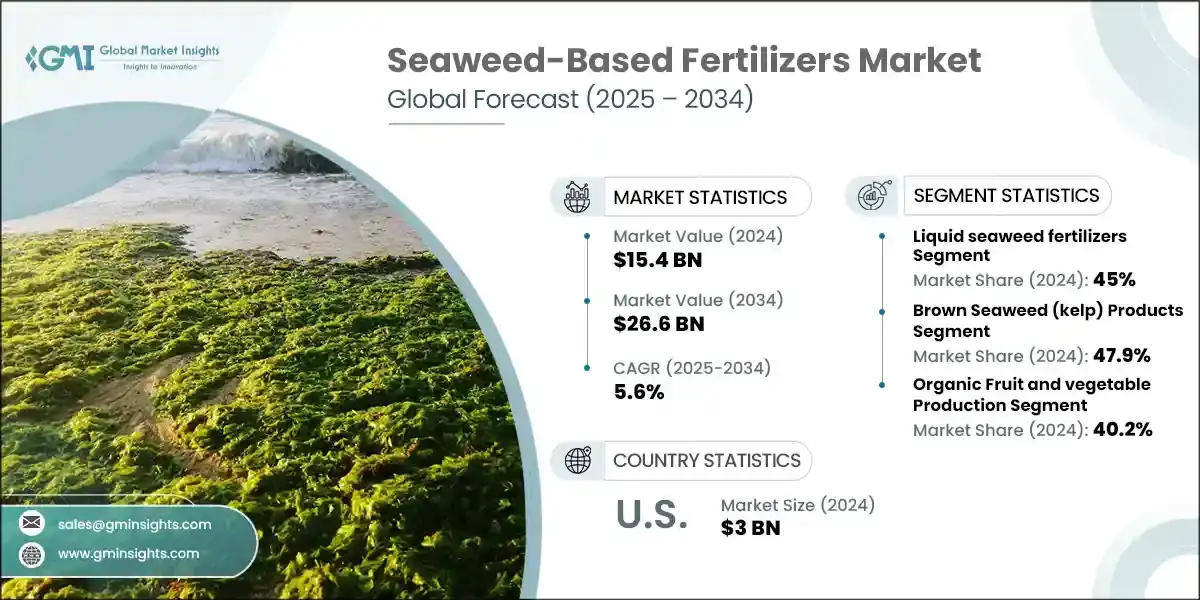
The global seaweed-based fertilizers market size was estimated at USD 15.4 billion in 2024. The market is expected to grow from USD 16.2 billion in 2025 to USD 26.6 billion in 2034, at a CAGR of 5.6%.
Seaweed-Based Fertilizers Market Key Takeaways
Market Size & Growth
- 2024 Market Size: USD 15.4 Billion
- 2034 Forecast Market Size: USD 26.6 Billion
- CAGR (2025–2034): 5.6%
Regional Dominance
- Largest Market: Asia Pacific
- Fastest Growing Region: North America
Key Market Drivers
- Increasing demand for organic and sustainable agriculture.
- Environmental concerns and chemical fertilizer alternatives.
- Soil health and microbiome enhancement focus.
- Climate change mitigation and carbon sequestration.
Challenges
- Higher cost vs traditional chemical fertilizers.
- Limited seaweed supply and harvesting capacity.
Opportunity
- Emerging organic agriculture market growth.
- Precision agriculture and technology integration.
- Value-added processing and product development.
- Government incentives and sustainability programs.
Key Players
- Market Leader: Acadian Seaplants Limited led with over 14% market share in 2024.
- Leading Players: Top 5 players in this market include Acadian Seaplants Limited, Seasol International Pty Ltd., Maxicrop USA, Inc., Kelpak (Kelp Products International), Biostadt India Limited, which collectively held a market share of 42% in 2024.
Get Market Insights & Growth Opportunities
- Seaweed-based fertilizers is an extremely important and rapidly growing segment in the field of sustainable agricultural input, leveraging the natural extracts of different species of seaweed that improve crop growth, soil health, and environmental resilience.
- The increase in organic and sustainable agriculture is the most significant growth driver, with farmers increasingly adopting seaweed fertilizers to cater to the demand for chemical-free and nutrient-rich produce. For instance, Seasol International developed formulations that increase microbial diversity in soils.
- The greater emphasis on soil health and improvement in microbe habitation pushes the use of seaweed-based fertilizers. In their natural state, bioactive compounds serve as sources of benign soil-friendly communities responsible for enhancing nutrient cycling, moisture retention and disease resistance.
- The role of seaweed fertilizers in climate change and carbon sequestration is becoming popular. They increase the amount of organic carbon in soils and improve crop resilience with abiotic stresses, thus lowering carbon footprints, addressing sustainability globally with agriculture.
- Asia Pacific is the largest market since it has a very strong agricultural base, strong initiatives from the governments and vast seaweed resources enhancing large production and consumption.
- North America is the fastest emerging region in the market, driven by stringent regulations favoring organic farming, increased demand from consumers for sustainably grown food and attractive government subsidies supporting green practices in farming.
To get key market trends
Seaweed-Based Fertilizers Market Trends
- Technological advances in extraction processes bring about some innovative technologies that improve efficiencies and qualities of seaweed-based fertilizers. For example, full automation of harvesting and enzymatic schemes of leading firms has been producing highly concentrated biofertilizers, which have better retention of nutrients. Innovations from Van Iperen would also put such drives into evidence with the development of high-performance foliar sprays that bring together nutrition with bio stimulation.
- Increasingly, liquid forms and foliar sprays are popular because of their ease of application, rapid nutrient uptake and compatibility with modern irrigation systems.
- The increasing use of IoT sensors, data analytics and automated application systems enables properly timed, site-specific seaweed fertilization, avoiding wastage and maximizing response to crop production. For instance, manufacturers such as Acadian Seaplants Ltd. integrates these smart solutions into several pilot projects together with various large farms to enhance nutrient and water management.
- The shift towards sustainable and organic farming practices serves to propel seaweed fertilizers at the heart of input businesses, especially with rising regulatory pressure against chemical fertilizers. Incentives in the U.S. and Europe, for example, warrant key adoption among both smallholders and commercial growers for vegetables and fruits.
- The value of seaweed-based fertilizers is curving more to bio-stimulants, i.e., they improve plant stress tolerance, promote beneficial soil microbes, and enhance soil structure. For instance, companies such as Seasol International and Maxicrop produce some type of specialty formulations tagged for all crops and area-specific geographic regions to improve yields and remediate soil.
- Continued research and marketing urgings point to seaweed fertilizers' potential for helping agriculture ameliorate climate change and increase soil carbon storage. For example, field trials in Europe confirmed their efficacy in enhancing soil organic carbon and building crop resilience under changing weather patterns.
Seaweed-Based Fertilizers Market Analysis
Learn more about the key segments shaping this market
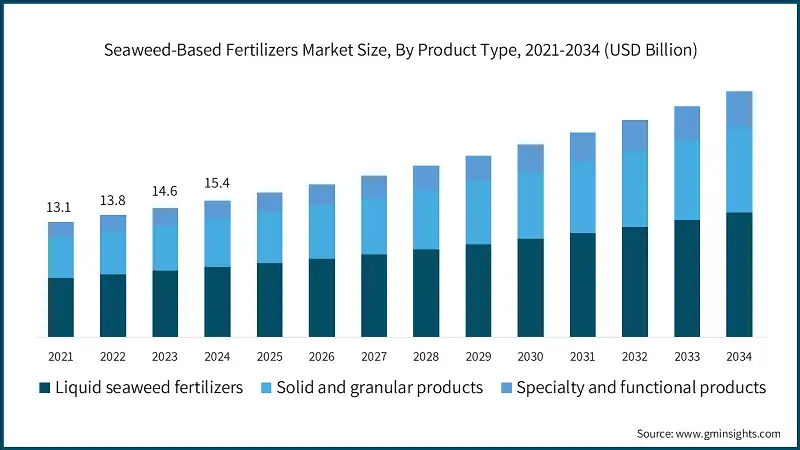
Based on product type, the seaweed-based fertilizers market is segmented into liquid seaweed fertilizers, solid and granular products and specialty and functional products. Liquid seaweed fertilizers dominated the market with an approximate share of 45% in 2024 and is expected to grow with the CAGR of 5.7% by 2034.
- Liquid seaweed fertilizers dominate the market due to their rapid absorption, easy application and versatility for foliar and soil drenching, making them a popular choice for organic and precision agriculture across the globe.
- Solid and granular seaweed products cover slow-release granules to powders, allowing growers to get a controlled nutrient release suitable for longer-term soil amendment and broad-acre crops. These products are appreciated for improving soil structure and organic content over time and are used widely in conventional and organic farming practices. Powdered ones have an obvious appeal to small-scale or home gardens discerning easy storage and minimal spoilage.
- Specialty and functional seaweed-based fertilizers represent an entirely new category in the market. Such products include those developed for specific crop requirements, biostimulants mixed with micronutrients or beneficial microbes, and purposefully functional formulations aimed at relieving stress from climatic impacts or at soil remediation.
Learn more about the key segments shaping this market
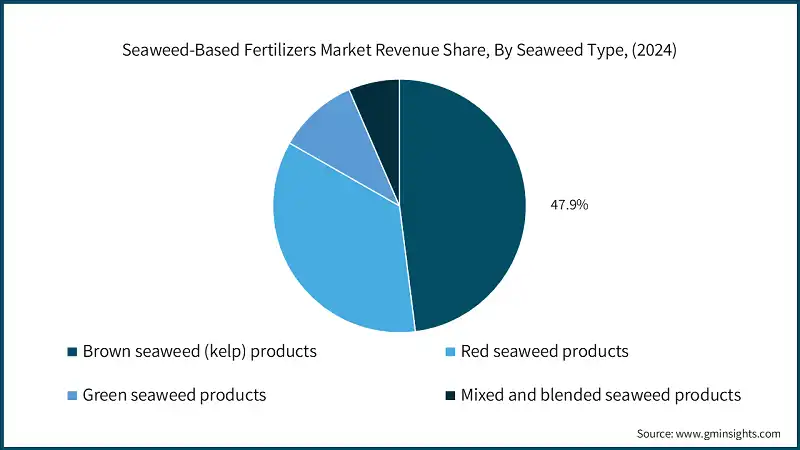
Based on seaweed type, the seaweed-based fertilizers market is segmented into brown seaweed (kelp) products, red seaweed products, green seaweed products, and mixed and blended seaweed products. Brown seaweed (kelp) products hold the largest market share of 47.9% in 2024 and are expected to grow at a CAGR of 5.6%.
- Brown seaweed (kelp) products claim the largest share of the market as they contain the greatest amount of natural plant growth hormones, alginates and micronutrients. The main brown seaweed used in crop sciences, especially for improving crop yield, drought resistance, and soil health, are Ascophyllum nodosum and Laminaria.
- Red seaweed products are quickly rising to become growing niche inputs, because of the unique profiles of carrageenan, amino acids, and minerals. These act as boosters of disease resistance and nutrient efficiency especially in high-value horticulture systems and hydroponic production systems.
- Green seaweed products are known for high content of growth-promoting polysaccharides and phytohormones, particularly ulvans obtained from Ulva species. They are usually marketed for turf management and vegetable production with the added attraction of eco-friendliness and rapid nutrient early uptake to appeal to organic farmers as well as sustainable landscaping operations.
- Mixed and blended seaweed products are extracts from two or more seaweed species combined, these become synergistic with respect to their diverse bioactive compounds. These mixtures are designed to embody multiple benefits, such as enhancing plant vigor and resistance to abiotic stresses, as well as making nutrients more available.
Based on applications, the seaweed-based fertilizers market is categorized into organic fruit and vegetable production, field crop and grain production, specialty and high-value crops, and aquaculture and marine applications. Organic fruit and vegetable production hold the largest market share of 40.2% in 2024 and is expected to grow at a CAGR of 5.8%.
- Organic fruits and vegetables hold the most significant portion of market share, resulting from the increase in organic farming in different parts of the world, making consumers more concerned with obtaining chemical-free produce and regulations promoting as support for sustainable crop inputs.
- Field crops and grains tend to be a robust segment because seaweed extracts are now added to nutrient management plans by large-scale producers to improve soil health, enhance water retention, and increase crop resilience to environmental vicissitudes. Generally, this fertilizer enhances tillering and filling in grains of crops such as wheat, rice, and maize and is finding greater acceptance into both conventional and sustainable systems of grain production.
- Specialty and high-value crops such as berries, vineyards, nuts, and products grown in greenhouses benefit from seaweed fertilizers' biostimulants effects, extends to these crops, which improve their color, flavor, post-harvest shelf life, and even disease tolerance. This added value finds its way into the pockets of producers targeting export or even high-end gourmet markets for premium price realizations and better market differentiation.
Looking for region specific data?
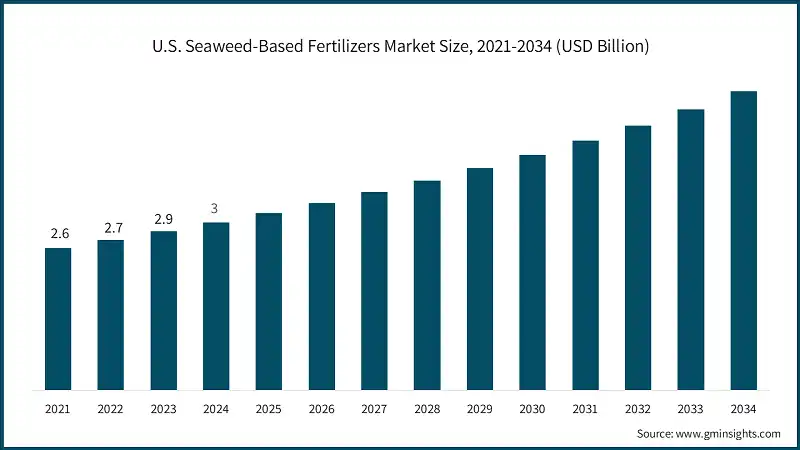
In the seaweed-based fertilizers market, U.S. accounts the major share in North America by accounting USD 3 billion in 2024 and is expected to grow at a CAGR of 4.7% by 2034.
- The leadership of the U.S. market gained from strong organic agriculture embrace, advanced crop management practices, and fast-tracked investment in sustainable farming innovations especially liquid seaweed-based biostimulants and functional blends for soil and foliar applications. Another factor solidifying its leadership are advanced production infrastructure, synergy between agri-tech innovators, and rapid pacing into precision agriculture.
- Canada is emerging as another pertinent adjacent market due to eco-conscious farming communities, growing government support for sustainable inputs, and broadening retail and e-commerce accessibility for organic gardening and agriculture products. Expansion of seaweed processing facilities—like those by Acadian Seaplants in Nova Scotia—boosts both domestic and export capacity.
The seaweed-based fertilizers market in the Germany is expected to experience significant and promising growth from 2025 to 2034.
- In 2024, Europe hold nearly 20% of the market for seaweed-based fertilizers. Such regional expansion is primarily attributed to legislation requirements on environmental compliance, consumers' preference toward organic-certified farm inputs and growing investments in sustainability practices from both public and private players.
- Germany is the largest market in Europe, with farmers applying kelp-based and blended fertilizers for organic vegetable and specialty crop production. Strong regulatory procedures for agricultural inputs and government incentives for sustainable farming stimulate the adoption and innovation where German and Nordic seaweed-processing industries collaborate on advanced extraction and traceability technologies.
The seaweed-based fertilizers market in China is expected to experience significant and promising growth from 2025 to 2034.
- In Asia, China has the largest seaweed fertilizer market. The coastal provinces have major seaweed cultivation industries, providing high growth rates under strong support from the government for organic and sustainable agricultural inputs, with domestic production capacities growing fast.
- The region is poised to grow at a market CAGR of 5.9% due to bulging demand from intensive fruit and vegetable cultivation sectors, ever-increasing use in greenhouse and infield crops. In technology, seaweed farming and premium product development take the front seat in Japan and South Korea whereby high-quality extracts are produced for sale in the domestic market and offshore market.
The seaweed-based fertilizers market in Brazil is expected to experience significant and promising growth from 2025 to 2034.
- Brazil leads in adoption and integration of seaweed fertilizers in specialty and broad-acre crop production to improve yield, drought tolerance, and sustainable soil management in Latin America.
- Argentina extract and export their natural marine resource to harvest seaweed locally. Mexico's increasing awareness of organic and ecological farming practices ensures that demand continues to grow steadily, driven further by modernization in retail and agri-inputs.
The seaweed-based fertilizers market in South Africa is expected to experience significant and promising growth from 2025 to 2034.
- The MEA region steadily expands at a CAGR of 4.9%. Strong since the early colonization years, commercial agriculture is now helping South Africa cement its place as a regional leader, with fertilizer blending operations and need for environmentally friendly inputs to counter soil degradation.
- Increased import demand and local formulation for seaweed-based fertilizers are rapidly supported by the commercial initiatives within the Gulf Cooperation Council (GCC) markets. UAE and Saudi Arabia’s increased disposable income, agritech investments, greenhouse farming, and food security initiatives are few reason for this growth.
Seaweed-Based Fertilizers Market Share
The top 7 companies in the seaweed-based fertilizers industry include Acadian Seaplants Limited, Seasol International Pty Ltd., Maxicrop USA, Inc., Kelpak (Kelp Products International), Biostadt India Limited, Haifa Group and AlgaEnergy S.A. These are prominent companies covering 52% of the market share. These companies have been around long enough to carve a strong position across the globe in the seaweed-based fertilizer market. Having diverse product portfolios combined with their production capacity and distribution strength allows them to meet rising demands across different regions.
- Acadian Seaplants is leading the seaweed-based fertilizers market with innovative scientific research and a strong commitment to sustainability. Their Ascophyllum nodosum-based biostimulants enjoys this distinction as they gained a robust peer-reviewed backed presence, all with a keen focus on increasing crop yields and soil health under the global guidelines of sustainability. In June 2025, Acadian designed an approach of climate-smart agriculture and fertilizer-use efficiency which breed proven-side-to-field trial capabilities.
- Seasol International is a major player with advanced line of high concentration liquid seaweed extracts that come with a very well-supported public education initiative for the horticulture-from-commercial- to-home-garden-doers.
- Maxicrop is a key player with the Arctic kind of seaweed extract fertilizers, characterized foremost by superior sourcing in Norway and consistent high-potency formulas.
- Kelpak specializes in plant health and promoting stress-related increasing yield, focusing on liquid seaweed fertilizers derived from cold-water species uniquely designed for production and disease stress areas. Their products are outfitted to address the exigencies of specific crops ready for export, on top of which is a robust international program. In Nov 2024, Kelpak adds to its list of global certifications with the European Union's CE Mark.
- Biostadt India has over the years been serving the rapidly growing fertilizer business in India and the rest of Asia with its India-specific seaweed-fabricated fertilizers through its very vast distribution setup, catering to the small-scale farmers to the biggest.
- Haifa is well recognized in the advanced seaweed biofertilizer system in seaweed-based farming. Their precision agriculture strategy promotes synergy between seaweed-based biostimulants and other fertility agents to improve the crop potential of soil and plant health. In 2025, Haifa announced it was successfully able to integrate seaweed fertilization trials in European greenhouse vegetable production.
- AlgaEnergy' strength lies in exporting biotechnology, with its high-value microalgae and seaweed-based mixtures personalized to a sustainable agriculture outlook with them. Continuous capital investments avoid product stagnation, leading to an incessant innovation of the biostimulants, especially in stress-adaption formulations. In 2022, AlgaEnergy showed enhanced water and nitrogen use efficiency validated in AlgaEnergy’s Genergy Program.
Seaweed-Based Fertilizers Market Companies
Major players operating in the seaweed-based fertilizers market include:
- Acadian Seaplants Limited
- AlgaEnergy S.A.
- Bioiberica S.A.U.
- Biostadt India Limited
- Brandt Consolidated, Inc.
- Chase Organics GB Ltd.
- COMPO EXPERT GmbH
- Grow More, Inc.
- Haifa Group
- Kelpak (Kelp Products International)
- Leili Marine Bioindustry Inc.
- Maxicrop USA, Inc.
- Seasol International Pty Ltd.
- West Coast Marine Bio-Processing Corp.
Seaweed-Based Fertilizers Market Report Attributes
| Key Takeaway | Details |
|---|---|
| Market Size & Growth | |
| Base Year | 2024 |
| Market Size in 2024 | USD 15.4 Billion |
| Forecast Period 2025 - 2034 CAGR | 5.6% |
| Market Size in 2034 | USD 26.6 Billion |
| Key Market Trends | |
| Drivers | Impact |
| Increasing demand for organic and sustainable agriculture | Hasten the acceptance of seaweed-based fertilizers. |
| Environmental concerns and chemical fertilizer alternatives | Generates interest in eco-friendly alternatives to chemical fertilizers. |
| Soil health and microbiome enhancement focus | Stimulate the market for bio-based soil amendments. |
| Climate change mitigation and carbon sequestration | Help minimize climate change by supporting carbon sequestration in soils. |
| Pitfalls & Challenges | Impact |
| Higher cost vs traditional chemical fertilizers | Limit competitiveness compared to traditional chemical fertilizers. |
| Limited seaweed supply and harvesting capacity | Restricts market development. |
| Opportunities: | Impact |
| Emerging organic agriculture market growth | Creates new demand for natural fertilizers. |
| Precision agriculture and technology integration | Enables efficient application of seaweed products. |
| Value-added processing and product development | Expand product offerings and profitability. |
| Government incentives and sustainability programs | Will grow potential for more products and profit. |
| Market Leaders (2024) | |
| Market Leaders |
14% |
| Top Players |
Collective share of 42% in 2024 |
| Competitive Edge |
|
| Regional Insights | |
| Largest Market | Asia Pacific |
| Fastest growing market | North America |
| Emerging countries | U.S., Germany, Brazil, Canada and South Africa |
| Future outlook |
|
What are the growth opportunities in this market?
Seaweed-Based Fertilizers Industry News
- In February 2025, Ocean Rainforest acquired 60% of a Mexican company, Alamarsa, renowned for its biostimulants and food products derived from giant kelp and other seaweed species.
- In January 2025, Acadian Plant Health and Koppert, two of the world's leading innovators in the field of sustainable agriculture, announced the expansion of the partnership in terms of increasing the global footprint of biocontrol and biostimulants technologies.
- In August 2024, ICL Fertilizers concluded acquisition of Custom Ag Formulators in the United States. This strategic acquisition will enhance ICL's product portfolio in responsive, customized biofertilizer solution offerings, including a whole range of seaweed-based products designed for consumers.
This seaweed-based fertilizers market research report includes in-depth coverage of the industry, with estimates & forecasts in terms of revenue (USD Million) and volume (Kilo Tons) from 2025 to 2034, for the following segments:
Market, By Product type
- Liquid seaweed fertilizers
- Concentrated liquid extracts
- Ready-to-use spray solutions
- Solid and granular products
- Dried seaweed meal
- Granulated and pelletized fertilizers
- Specialty and functional products
- Biostimulant formulations
- Blended and enhanced products
Market, By Seaweed type
- Brown seaweed (kelp) products
- Ascophyllum nodosum
- Laminaria and kelp species
- Red seaweed products
- Gracilaria and porphyra species
- Green seaweed products
- Ulva and chlorella applications
- Mixed and blended seaweed products
Market, By Application
- Organic fruit and vegetable production
- Organic fruit orchards
- Apple, citrus, and stone fruit
- Berry and small fruit production
- Tropical and exotic fruit cultivation
- Organic vegetable farming
- Leafy greens and salad crops
- Root vegetables and tubers
- Tomatoes and nightshade crops
- Organic fruit orchards
- Field crop and grain production
- Organic grain and cereal crops
- Wheat, corn, and rice production
- Specialty and ancient grains
- Legume and pulse crops
- Pasture and forage crops
- Grass and hay production
- Livestock feed and grazing
- Organic grain and cereal crops
- Specialty and high-value crops
- Organic herb and spice production
- Ornamental and landscape applications
- Aquaculture and marine applications
- Fish and shellfish production
The above information is provided for the following regions and countries:
- North America
- U.S.
- Canada
- Europe
- Germany
- UK
- France
- Spain
- Italy
- Rest of Europe
- Asia Pacific
- China
- India
- Japan
- Australia
- South Korea
- Rest of Asia Pacific
- Latin America
- Brazil
- Mexico
- Argentina
- Rest of Latin America
- Middle East and Africa
- Saudi Arabia
- South Africa
- UAE
- Rest of Middle East and Africa
Frequently Asked Question(FAQ) :
What is the market size of the seaweed-based fertilizers in 2024?
The market size was USD 15.4 billion in 2024, with a CAGR of 5.6% expected through 2034. The growth is driven by the increasing adoption of sustainable agricultural inputs and advancements in seaweed extraction technologies.
What is the projected value of the seaweed-based fertilizers market by 2034?
The market is poised to reach USD 26.6 billion by 2034, fueled by the rising demand for organic farming practices, bio-stimulant properties of seaweed fertilizers, and regulatory support for sustainable agriculture.
What was the market share of liquid seaweed fertilizers in 2024?
Liquid seaweed fertilizers held a dominant market share of approximately 45% in 2024 and is expected to witness over 5.7% CAGR till 2034.
What was the market share of brown seaweed (kelp) products in 2024?
Brown seaweed (kelp) products accounted for the largest market share of 47.9% in 2024 and is set to expand at a CAGR of 5.6% through 2034.
What is the growth outlook for organic fruit and vegetable production from 2025 to 2034?
Organic fruit and vegetable production held a market share of 40.2% in 2024 and is likely to grow at a CAGR of 5.8% up to 2034.
Which region leads the seaweed-based fertilizers sector?
The U.S. market accounting for USD 3 billion in 2024. The growth is attributed to strong adoption of organic agriculture, and advanced crop management practices.
What are the upcoming trends in the seaweed-based fertilizers market?
Trends include advanced extraction tech, liquid and foliar fertilizers, IoT-driven precision farming, sustainable practices, and seaweed fertilizers for climate resilience and soil health.
Who are the key players in the seaweed-based fertilizers industry?
Key players include Acadian Seaplants Limited, AlgaEnergy S.A., Bioiberica S.A.U., Biostadt India Limited, Brandt Consolidated, Inc., Chase Organics GB Ltd., COMPO EXPERT GmbH, Grow More, Inc., and Haifa Group.
Seaweed-Based Fertilizers Market Scope
Related Reports