Summary
Table of Content

Safety Valves Market
Get a free sample of this report
Form submitted successfully!
Error submitting form. Please try again.
Thank you!
Your inquiry has been received. Our team will reach out to you with the required details via email. To ensure that you don't miss their response, kindly remember to check your spam folder as well!
Request Sectional Data
Thank you!
Your inquiry has been received. Our team will reach out to you with the required details via email. To ensure that you don't miss their response, kindly remember to check your spam folder as well!
Form submitted successfully!
Error submitting form. Please try again.
Safety Valves Market Size
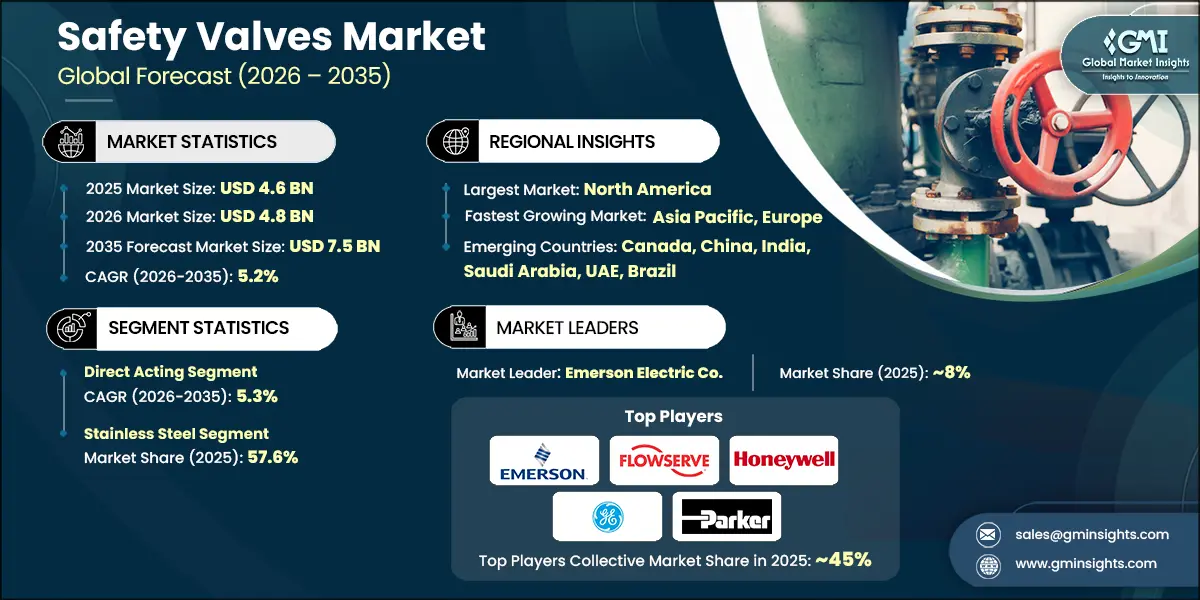
The safety valves market was estimated at USD 4.6 billion in 2025. The market is expected to grow from USD 4.8 billion in 2026 to USD 7.5 billion in 2035, at a CAGR of 5.2% according to latest report published by Global Market Insights Inc.
Safety Valves Market Key Takeaways
Market Size & Growth
- 2025 Market Size: USD 4.6 Billion
- 2026 Market Size: USD 4.8 Billion
- 2035 Forecast Market Size: USD 7.5 Billion
- CAGR (2026–2035): 5.2%
Regional Dominance
- Largest Market: North America
- Fastest Growing Region: Asia Pacific, Europe
Key Market Drivers
- Rising cost of advanced safety valve systems.
- Growing availability of diverse safety valve technologies and application‑specific systems.
- Increasing need to reduce financial burden on industrial operators.
Challenges
- Government subsidies for industrial modernization and equipment upgrades.
- Lack of standardized regulations and process‑safety frameworks.
Opportunity
- Increasing adoption of digital and precision based safety technologies.
- Expansion of digital platforms and on demand industrial safety services.
Key Players
- Market Leader: Emerson Electric Co. led with over market share of ~8% in 2025.
- Leading Players: Top 5 players in this market include Emerson Electric Co., Flowserve Corporation, Honeywell Corporation, GE Measurement & Control Solutions, Parker Hannifin Corporation, which collectively held a market share of 45% in 2025.
Get Market Insights & Growth Opportunities
The global market for safety valves has experienced consistent and sustained growth during the last several years, mainly fueled by increasing requirements for safety and compliance, infrastructure technology updates, and the growth of high-pressure processing systems used in key industries like oil and gas, power plants, chemicals, petrochemicals, and water treatment plants. The increasing complexity of industries and the tightening of standards and regulations prompt increased attention and demand for the use of safety valves, as they remain the line of defense against potential over pressurization issues.
Consequently, the industry now recognizes the ability of safety or pressure-relieving systems to ensure the safe and unabated operation of plants and facilities, making the use of such systems inevitable in addressing issues of plant safety and reliability. The growing need for process safety systems, the increasing scale of aging plant fleets in the industry, and the current trend of infrastructure upgrades are observed to foster the rapid growth of pilot-operated safety valve systems, high-pressure direct-acting safety valve systems, and bellows sealed safety valve systems worldwide. The integration of the latest and most technologically advanced systems will currently remain a challenge in the rapidly evolving industry, considering the cost of facilities and the scale.
The continuously expanding realm of valve technologies-from the most severe service valves for corrosive environments to cryogenic valves for LNG applications-keeps the scope of the market ever-widening. For example, currently, safety valve manufacturers are offering solutions designed for high-temperature steam, toxic chemical media, abrasive slurries, cryogenic gases, and ultra-high-pressure systems that enable operators in a number of industries to ensure reliability while minimizing failure risks.
As it is, the integration of digital tools-such as continuous pressure-tracking sensors, leak-detection systems, automated calibration platforms, and AI-driven performance monitoring-has greatly led to huge improvement in operational efficiencies. These advances will thereby contribute to less downtime, better lifecycle management, and more predictable safety performances at industrial facilities.
The other key factor driving growth in safety valves and monitoring systems is risk reduction. Operating conditions fluctuate greatly, inducing corrosive environments, pressure surges, thermal cycling, and increasing the threat of equipment failures associated with aging assets. Plants, especially small ones, are found to be at a financial disadvantage where capital access is at a premium, yet large investments in specialized infrastructure are necessary.
Consequently, many companies are moving to less expensive options like shared calibration centers, third-party maintenance contracts, rental test equipment, and subscription-based services for monitoring. All these options support industrial users to manage operational risks while keeping capital expenditure in check.
The growth of this market is also being triggered by the implementation of government initiatives across various industrialized and emerging economies, which include policy support for modernization in industries, workers' safety, emissions control, and conformity with international standards such as ASME, API, ISO, and PED. Initiatives in this regard include grants, subsidies, technical training, and long‑term industrial development programs to achieve improved plant safety and strengthening process‑safety frameworks.
Additionally, the global drive for sustainable industrial operations centered around lower emissions, leak incidents, and optimal energy consumption continues to accelerate the growth of high‑performance safety valves. Increased efficiency, durability, and compliance requirements are very much part of the general trend toward digitalization, automation, and sustainability in industrial systems. Advanced valve technologies offer improved pressure management, lower fugitive emissions, longer maintenance intervals, and higher system reliability. The sum of these trends collectively evidences the central importance of safety valves in order to ensure the protection of industrial assets and to ensure compliance with regulations.
To get key market trends
Safety Valves Market Trends
- The strong growth momentum in the global safety valves industry is driven mainly by rapid technological innovation and digitalization, coupled with a growing momentum of shifting toward automated and precision-based safety systems in industry.Perhaps the most major of these trends is the integration into safety valve operations of advanced monitoring, IoT‑enabled sensing, AI‑based diagnostics, and predictive maintenance tools.
- Most modern industrial facilities are adopting smart safety valves, especially in oil & gas, petrochemicals, power generation, and chemical processing plants that can provide real‑time pressure tracking, leak detection sensors, automated pop‑test capabilities, and cloud‑connected performance dashboards. These technologies are allowing operators to make systems more reliable, since many OEMs and technology providers now offer digital valve monitoring platforms with subscription‑based, leasing, or pay‑per‑use financial models, reducing the financial barrier to small and mid‑scale plants.
- The development of these digital valve management systems and the array of mobile-based industrial monitoring applications also promises to transform the safety valve business. These systems offer plant operators real-time visibility to their installed base, reports on pressure condition status, predictive notifications for future valve wear, digital-based schedule and compliance documentation support for ASME, API, and PED standards, and online maintenance workflow automation. The digitalization of the process for managing valve-based infrastructures promises to enhance the level of transparency and continuum that exists in the way these infrastructures operate, making it easier for industrial operations plagued by labor shortages and a lack of trained and qualified personnel directly located on site to benefit from the level of operator empowerment these systems offer.
- The market is also witnessing a significant shift towards shared economy and pay-for-use solutions, with a focus on safety valve testing, calibration, and maintenance activities, especially in regions with plant capacities lying on smaller scales or with higher cost constraints. Some of these shared testing facilities, community-based valve maintenance facilities, shared calibration facilities, valve as a service (VaaS), and rotating test equipment rental services will enable multiple industry players to share advanced technology solutions with minimal capital constraints.
Safety Valves Market Analysis
Learn more about the key segments shaping this market
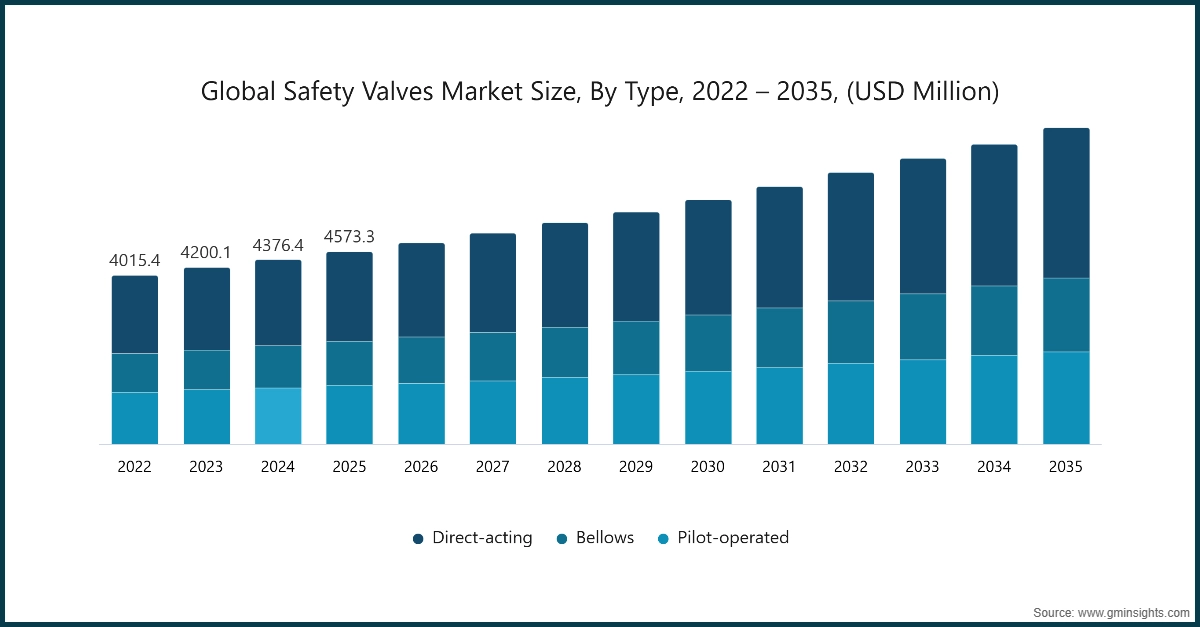
Based on type, the safety valves market is segmented into direct‑acting, bellows, and pilot‑operated safety valves. Direct‑acting valves dominated the market, generating USD 2.1 billion in 2025, and are projected to grow at a CAGR of 5.3% from 2026 to 2035.
- Direct‑acting safety valves hold the largest share due to their simple design, high reliability, and broad applicability across low‑to‑medium pressure industrial systems.
- Their suitability for steam boilers, compressed air applications, water systems, and general industrial utilities makes them the primary choice for maintenance, repair, and replacement cycles.
- As industries adopt stricter plant‑safety regulations and shift toward standardized overpressure protection, direct‑acting valves continue to be the preferred category for operators seeking cost‑effective and dependable protection solutions. - Ongoing improvements in spring technology, seat materials, and corrosion‑resistant components enhance durability and reduce leak incidents—further supporting the segment’s dominance.
- The rising need for modular, easy‑to‑install safety solutions in small and mid‑scale facilities also strengthens demand for direct‑acting valves across global markets
Learn more about the key segments shaping this market
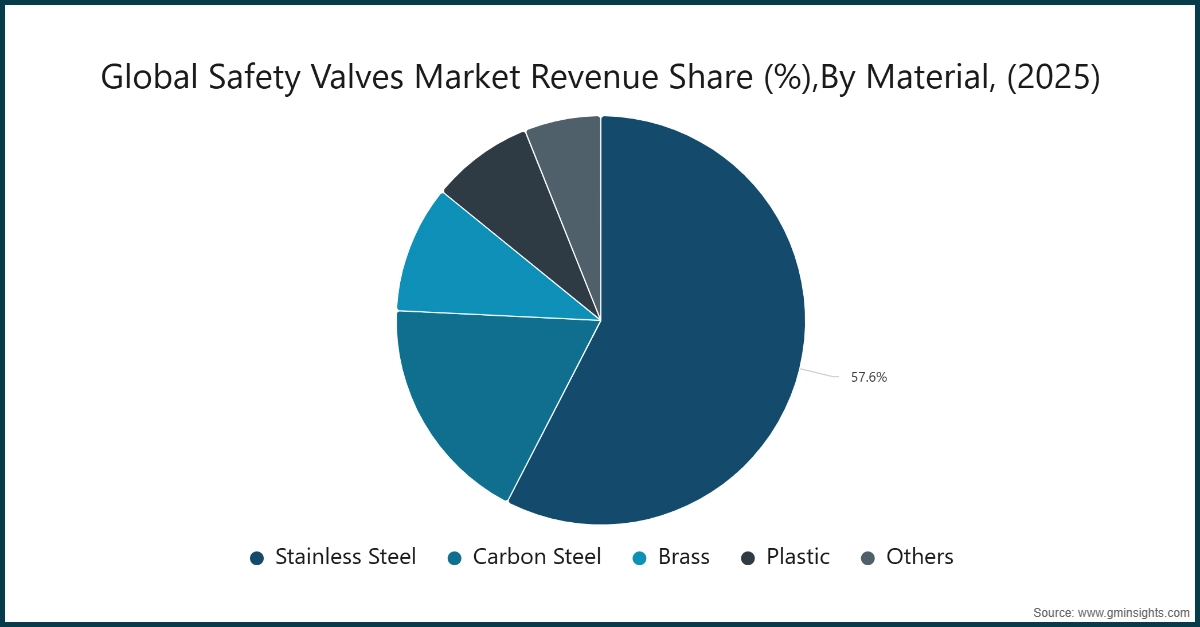
Based on material, the safety valves market is divided into Stainless Steel, Carbon Steel, Brass, Plastic, and Other specialty alloys. Stainless Steel emerged as the largest segment with a market share of 57.6%, valued at USD 2.6 billion in 2025, and is expected to grow at a CAGR of 5.3% from 2026 to 2035.
- Stainless steel valves dominate due to their exceptional corrosion resistance, temperature tolerance, and structural durability, making them essential for chemical processing, oil & gas, power generation, and marine applications.
- The material’s ability to withstand aggressive fluids, high salinity, and extreme operating environments makes it the preferred choice for industries with demanding safety and compliance requirements.
- Growing installation of high‑pressure and high‑temperature systems, especially in refineries, petrochemical complexes, and LNG facilities, is driving adoption of stainless steel safety valves globally.
- Additionally, regulatory pressure to reduce fugitive emissions and operational risks is increasing the shift toward premium‑grade materials with extended service life and lower maintenance needs.
- The growing availability of advanced stainless alloys, precision finishing, and improved anticorrosion protective treatments further enhances performance, making stainless steel the most commercially important material segment in the global safety valves industry.
North America Safety Valves Market
Looking for region specific data?
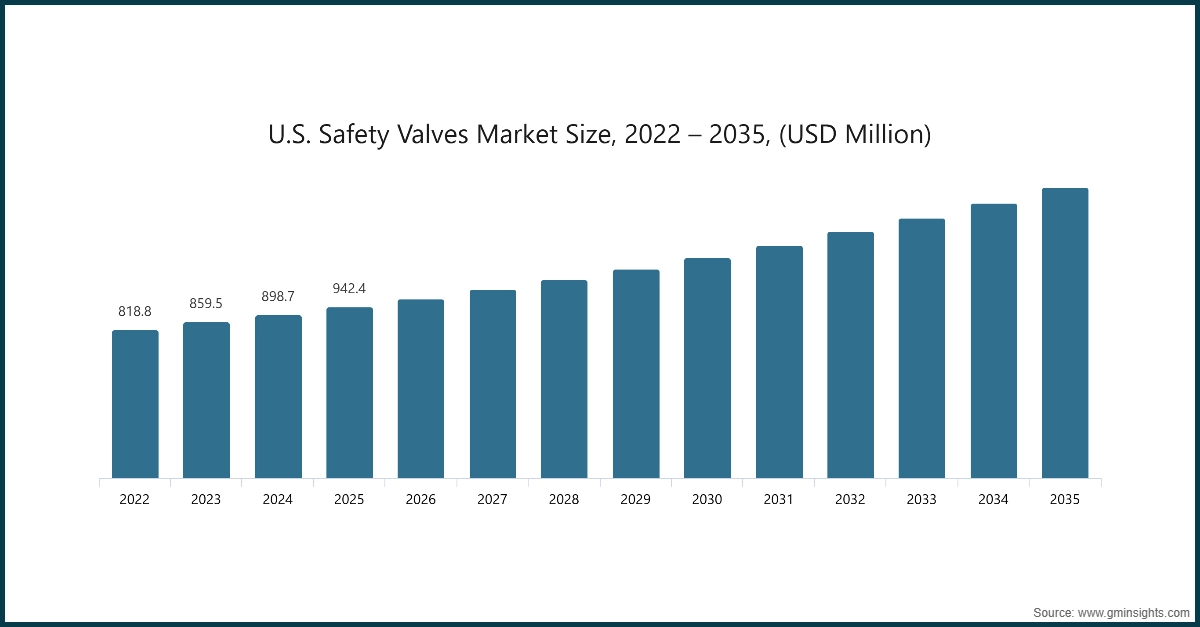
The U.S. dominates the overall North America safety valves market, valued at USD 942.4 million in 2025, and is projected to expand at a CAGR of 5.4% from 2026 to 2035.
- North America’s demand is anchored by oil & gas, water & wastewater, and power sectors. Replacement of aging assets, ongoing maintenance cycles, and refinery/petrochemical upgrades continue to support steady order volumes for direct‑acting and pilot‑operated valves.
- Stricter process safety and compliance regimes and the need for traceability and documentation are encouraging buyers to prioritize certified, reliable, and corrosion‑resistant materials (notably stainless steel) and reputable OEMs.
- End users are increasingly open to digital monitoring, predictive maintenance, and service agreements to minimize downtime and ensure valve reliability under high‑pressure, high‑temperature, and corrosive conditions.
- Purchasing is gradually shifting toward direct OEM relationships for large projects, while distributors remain vital for aftermarket and MRO demand across utilities and municipal water.
Europe Safety Valves Market
In the European safety valves industry, the U.K. is expected to register notable growth from 2026 to 2035, supported by plant modernization and tighter safety expectations across process industries
- Europe’s valve demand is driven by chemicals, power, water infrastructure, and refineries, alongside a rising focus on emissions control (flare, vent, and boiler protection) and compliance with rigorous regional standards.
- Producers and EPCs are emphasizing efficiency and lifecycle cost, favoring valves with longer service intervals, modular internals, and better availability of spares.
- As energy systems evolve (e.g., gas/LNG peakers, waste‑to‑energy, district heating upgrades), the need for precision relief and overpressure protection is expected to support steady adoption, particularly in stainless and specialty alloys for corrosive service.
- Workforce constraints and rising labor costs continue to spur interest in pre‑assembled skids, offsite testing, and responsive service networks capable of short lead times.
Asia Pacific Safety Valves Market
In the Asia Pacific safety valves industry, China held the largest share of 39% in 2025 and is projected to grow at a CAGR of 5.2% from 2026 to 2035.
- Asia Pacific remains the largest regional engine for safety valves demand, driven by new build and expansion across oil & gas, chemical processing, power generation, industrial manufacturing, and municipal water.
- China leads in installed capacity additions and upgrades, requiring high volumes of relief/over‑pressure protection devices across refineries, petrochemicals, gas processing, and utilities.
- India shows rising demand tied to infrastructure buildout, industrial parks, and water & wastewater treatment expansion—supporting broad adoption across 1–6" sizes and stainless materials.
- Regional buyers increasingly specify reliable set‑pressure accuracy, tight blowdown control, and resistance to corrosion/fouling, with a gradual shift toward pilot‑operated solutions in high‑pressure and critical service.
Middle East and Africa Safety Valves Market
In the Middle East & Africa safety valves industry, Saudi Arabia held a substantial 20.8% share in 2025, with growth expected through 2035 as the country continues to invest in energy and industrial capacity.
- The region’s valve demand is underpinned by oil & gas production, refining & petrochemical complexes, gas processing, and desalination projects.
- Large, centralized assets require high‑pressure, high‑temperature, and erosion/corrosion‑resistant solutions (stainless and specialty alloys) with robust aftermarket service for turnaround cycles.
- Mega‑projects and long‑term maintenance contracts drive a preference for direct procurement channels for project lots, with distributors serving fast‑moving spares and MRO across utilities.
- Water scarcity in parts of MEA sustains valves demand in desalination and water treatment, where reliability under saline and scaling conditions is critical
Safety Valves Market Share
Emerson Electric Co., Flowserve Corporation, Honeywell International Inc., Parker Hannifin Corporation, and GE Measurement & Control Solutions—collectively accounted for approximately 45% of global revenue. Across the sector, companies recognize safety valves as critical assets for industrial protection, regulatory compliance, and operational reliability, especially within oil & gas, petrochemicals, power generation, chemical processing, and water treatment.
ValvTechnologies, Inc. maintains its competitive advantage by continuously investing in high‑performance, severe‑service valve technologies and reliability‑focused solutions.The company emphasizes innovations in extreme‑pressure metallurgy, zero‑leakage sealing technologies, and service‑life extension systems designed for demanding applications in power generation, mining, refining, and chemical processing.
Safety Valves Market Companies
Major players operating in the safety valves industry include:
- Burkert Fluid Control Systems
- Cameron
- Crane Co.
- Emerson Electric Co.
- Flowserve Corporation
- GE Measurement & Control Solutions
- Honeywell International Inc.
- Moog Inc.
- Parker Hannifin Corporation
- Pentair plc
- Rotork Plc
- Schneider Electric SE
- Spirax Sarco Limited
- ValvTechnologies, Inc.
- Watts Water Technologies, Inc.
Emerson Electric Co., a major player in the safety valve industry, introduced a new line of digital safety valves incorporating advanced sensors and diagnostics for improved reliability and performance monitoring in industrial applications.
Schlumberger, a global oilfield services company, announced the acquisition of a specialized safety valve manufacturer to enhance its offerings in the oil and gas sector, strengthening its position in wellhead safety systems.
Alfa Laval, a Swedish company known for its heat transfer, separation, and fluid handling technologies, announced a partnership with a tech startup to develop Internet of Things (IoT) enabled safety valves, aiming to enhance predictive maintenance and remote monitoring capabilities.
Safety Valves Market Report Attributes
| Key Takeaway | Details |
|---|---|
| Market Size & Growth | |
| Base Year | 2025 |
| Market Size in 2025 | USD 4.6 Billion |
| Market Size in 2026 | USD 4.8 Billion |
| Forecast Period 2026-2035 CAGR | 5.2% |
| Market Size in 2035 | USD 7.5 Billion |
| Key Market Trends | |
| Drivers | Impact |
| Rising cost of advanced safety valve systems | The high capital investment required for IoT‑enabled monitoring platforms, pilot‑operated high‑pressure valves, automated test benches, and digital diagnostics is pushing industries toward shared testing centers, outsourced maintenance, and valve‑as‑a‑service (VaaS) models. |
| Growing availability of diverse safety valve technologies and application‑specific systems | A wider mix of technologies—including severe‑service valves, cryogenic valves, corrosion‑resistant alloys, smart actuators, and automated calibration tools—attracts operators across oil & gas, chemicals, power, water treatment, and manufacturing. |
| Increasing need to reduce financial burden on industrial operators | Access‑based models, shared calibration labs, leased diagnostic equipment, and subscription‑based valve monitoring platforms allow industries to maintain compliance and safety without bearing high ownership and maintenance costs. |
| Pitfalls & Challenges | Impact |
| Government subsidies for industrial modernization and equipment upgrades | Subsidies for refinery upgrades, boiler replacements, and industrial safety improvements make safety valve ownership more affordable, reducing dependence on shared or leased service models in supported regions. |
| Lack of standardized regulations and process‑safety frameworks | Weak enforcement of pressure‑equipment rules, inconsistent certification norms, and limited oversight increase operational risks, leading to valve failures, safety incidents, and higher losses for service providers. |
| Opportunities: | Impact |
| Increasing adoption of digital and precision based safety technologies | Industries seek short term access to IoT sensors, automated pop test systems, AI based diagnostics, and cloud connected valve health platforms instead of investing in full scale systems. |
| Expansion of digital platforms and on demand industrial safety services | Mobile based asset monitoring, online maintenance platforms, and subscription driven safety tools enhance operational transparency, improve regulatory compliance, and simplify access to high tech systems. |
| Market Leaders (2025) | |
| Market Leader |
Market share of ~8% |
| Top Players |
Collective market share of ~45% |
| Competitive Edge |
|
| Regional Insights | |
| Largest Market | North America |
| Fastest growing market | Asia Pacific, Europe |
| Emerging countries | Canada, China, India, Saudi Arabia, UAE, Brazil |
| Future outlook |
|
What are the growth opportunities in this market?
Safety Valves Industry News
- In January 2024, Emerson Electric Co. introduced its next‑generation industrial safety valve diagnostics platform, engineered to enhance set‑pressure accuracy and predictive maintenance capabilities across oil & gas, chemical processing, and power applications. The platform integrates AI‑driven lift‑event analytics, real‑time emission detection, and automated blowdown optimization, developed in collaboration with advanced control‑system partners. Emerson reported that the system reduces unplanned shutdowns by up to 30% and improves maintenance scheduling through machine‑learning‑based degradation modelling across refinery and LNG facilities.
- In February 2025, Flowserve Corporation announced a major upgrade to its SmartValve™ digital ecosystem, scheduled for global rollout in the 2026 operating cycle. The new generation features edge‑based pressure‑relief monitoring, adaptive seal‑wear detection, and fully autonomous test‑cycle execution to support hazardous‑service environments. Flowserve noted that SmartValve 2.0 significantly enhances performance in high‑pressure steam systems and corrosive chemical circuits, using predictive modelling to identify pressure fluctuations and seat‑leak conditions before they escalate.
- In March 2025, Schneider Electric SE unveiled its EcoSafe Relief Control Suite, an integrated hardware‑software solution designed to support industrial decarbonization and safety compliance. The suite includes high‑resolution valve‑health imaging, automated calibration checks, and environmental impact tracking, allowing operators to maintain regulatory compliance with emerging global pressure‑equipment standards. Schneider’s engineering division also confirmed improvements to its emergency shutdown (ESD) response integration, enabling 15–20% faster over‑pressure mitigation in critical facilities.
- In June 2025, Honeywell International Inc. announced its roadmap for a fully modernized safety‑valve automation architecture to be deployed across key markets beginning in 2026. The upgrade incorporates energy‑efficient actuation systems, advanced fugitive‑emission control elements, and cloud‑connected reliability dashboards offering unified oversight of valve performance, blowdown behavior, and operational stress indicators. Honeywell also revealed enhancements to its high‑integrity pressure protection systems (HIPPS), supporting safer operations in deep‑well, LNG, and petrochemical assets worldwide.
- In September 2025, Parker Hannifin Corporation introduced its high‑durability alloy‑grade safety valve line, optimized for ultra‑high‑pressure environments such as hydrogen production, aerospace test rigs, and advanced manufacturing. The series leverages proprietary corrosion‑resistant metallurgy, precision actuator tuning, and thermal stability enhancements to extend valve life under extreme cyclic loading. Parker indicated that early testing shows up to 40% longer operating cycles compared to traditional stainless‑steel alternatives.
- In October 2025, Rotork Plc launched its digital actuator‑integrated safety valve control module, enabling synchronized operation of relief valves across distributed plant networks. The system includes automated torque‑curve verification, remote pop‑test support, and cybersecurity‑hardened communication layers aligned with global industrial security standards. Rotork highlighted that the solution reduces manual intervention during high‑risk operations and supports safer and more efficient valve management across refineries and power plants.
- In December 2025, Valv Technologies, Inc. announced its ZeroLeak extreme‑service valve upgrade series, specifically designed for severe‑service applications including slurry, high‑temperature steam, and abrasive chemical environments. The upgraded platform integrates diamond‑hard coating technologies, self‑adjusting polymer seat systems, and improved trunnion support geometry, delivering enhanced shutoff reliability. Field trials indicate major reductions in leak‑related downtime and improved safety performance in mining and process‑chemical plants.
The safety valves market research report includes in-depth coverage of the industry, with estimates & forecast in terms of revenue and volume (USD Billion) (Thousand Units) from 2022 to 2035, for the following segments:
Market, By Type
- Direct acting
- Bellows
- Pilot-operated
Market, By Material
- Stainless Steel
- Carbon Steel
- Brass
- Plastic
- Others (Inconel, etc.)
Market, By Size
- Up to 1"
- 1" to 6"
- 6" to 25"
- 25" to 50"
- 50" and Larger
Market, By Pressure Range
- < 35MPa
- 35 – 70 MPa
- 70 – 110 MPa
- 400 MPa
- 700 MPa
- 20 kpsi
- 60 kpsi
Market, By End User
- Oil & Gas
- Water & Wastewater Treatment
- Power Industry
- Chemical Industry
- Others
Market, By Distribution Channel
- Direct Sales
- Indirect Sales
The above information is provided for the following regions and countries:
- North America
- U.S.
- Canada
- Europe
- Germany
- UK
- France
- Italy
- Spain
- Asia Pacific
- China
- Japan
- India
- South Korea
- Australia
- Latin America
- Brazil
- Mexico
- MEA
- Saudi Arabia
- UAE
- South Africa
Frequently Asked Question(FAQ) :
What was the market size of the safety valves in 2025?
The market was valued at USD 4.6 billion in 2025, growing at a CAGR of 5.2% till 2035. The market is driven by increasing safety and compliance requirements, infrastructure upgrades, and the expansion of high-pressure processing systems in key industries.
What is the projected value of the safety valves market by 2035?
The market is poised to reach USD 7.5 billion by 2035, fueled by technological advancements and the adoption of smart safety systems.
What is the expected size of the safety valves industry in 2026?
The market size is expected to reach USD 4.8 billion in 2026.
How much revenue did the direct-acting valves segment generate in 2025?
The direct-acting valves segment generated USD 2.1 billion in 2025 and is projected to grow at a CAGR of 5.3% up to 2035.
What was the valuation of the stainless steel segment in 2025?
The stainless steel segment accounted for USD 2.6 billion in 2025, holding a 57.6% market share, and is set to expand at a CAGR of 5.3% through 2035.
What is the growth outlook for the U.S. safety valves sector?
The U.S. market, valued at USD 942.4 million in 2025, is anticipated to observe around 5.4% CAGR till 2035.
What are the upcoming trends in the safety valves market?
Key trends include IoT-enabled sensing, AI-driven diagnostics, predictive maintenance, real-time monitoring, cloud dashboards, and valve-as-a-service (VaaS) adoption.
Who are the key players in the safety valves industry?
Key players include Burkert Fluid Control Systems, Cameron, Crane Co., Emerson Electric Co., Flowserve Corporation, GE Measurement & Control Solutions, Honeywell International Inc., Moog Inc., Parker Hannifin Corporation, and Pentair plc.
Safety Valves Market Scope
Related Reports