Download free PDF

Rock Breaker Market Size & Share 2026-2035

Market Size – By Type (Hydraulic, Pneumatic, Others), By Product (Premium, Non-premium), By Equipment Size (Light Duty (Up to 500 Kg), Medium Duty (501–1200 Kg), Heavy Duty (Above 1200 Kg)), By Application (Quarrying, Demolition, Tunneling, Scaling, Others), By End Use (Construction, Mining, Government, Private), Growth Forecast.

Report ID: GMI11930
   |
Published Date: April 2026
 | 
Report Format: PDF

Download Free PDF

Rock Breaker Market Size

The global rock breaker market was estimated at USD 3.2 billion in 2025. The market is expected to grow from USD 3.5 billion in 2026 to USD 6.7 billion in 2035, at a CAGR of 7.5%, according to latest report published by Global Market Insights Inc.

Rock Breaker Market Key Takeaways

Market Size & Growth

  • 2025 Market Size: USD 3.2 Billion
  • 2026 Market Size: USD 3.5 Billion
  • 2035 Forecast Market Size: USD 6.7 Billion
  • CAGR (2026–2035): 7.5%

Regional Dominance

  • Largest Market: Asia Pacific
  • Fastest Growing Region: Asia Pacific

Key Market Drivers

  • Increasing infrastructure development projects worldwide.
  • Rising demand in mining and quarrying sectors.
  • Technological advancements in rock breaking equipment.
  • Government investments in infrastructure and mining industries.

Challenges

  • High initial investment and operating costs.
  • Economic downturns reducing construction and mining demand.

Opportunity

  • Growth in underground construction and tunnelling projects.
  • Adoption of electric and low-emission construction equipment.
  • Integration with smart construction and digital ecosystems.
  • Increasing demand for customized and application-specific breakers.

Key Players

  • Market Leader: Caterpillar led with over 8.8% market share in 2025.
  • Leading Players: Top 5 players in this market include Caterpillar, Komatsu, Epiroc, Sandvik, Furukawa Rock Drill, which collectively held a market share of 39.2% in 2025.

The rock breaker market volume was estimated at 80,200 units in 2025. The market is projected to grow from 86,800 units in 2026 to 1,31,754 units by 2035, registering strong double-digit growth over the forecast period.

The rapid expansion of mining, quarrying, and infrastructure development activities is significantly transforming the rock breaker market. Traditionally used for basic demolition and secondary rock breaking, rock breakers are now becoming essential for high-efficiency material fragmentation across modern construction and mining operations. With increasing project scale and complexity, these machines play a critical role in improving productivity, reducing manual intervention, and ensuring operational safety, thereby directly influencing project timelines, cost efficiency, and worker protection.

Rising demand for faster and more precise excavation in urban construction and large-scale mining projects is further strengthening the importance of advanced rock breaking solutions. Applications such as road construction, tunneling, trenching, and demolition are driving the adoption of high-performance hydraulic breakers equipped with enhanced impact energy and durability. At the same time, manufacturers are focusing on lightweight yet robust materials and improved design structures to enhance equipment efficiency while minimizing wear and maintenance requirements.

For instance, in February 2025, Sandvik announced the launch of a new generation of intelligent hydraulic breakers equipped with real-time monitoring capabilities and automated performance adjustment, aimed at improving productivity and reducing downtime in mining and construction operations.

The increasing focus on infrastructure development, particularly in emerging economies, along with the expansion of mining activities, is accelerating the demand for technologically advanced rock breakers. Governments are investing heavily in transportation networks, smart cities, and energy projects, which require efficient rock excavation and material handling solutions. As a result, construction and mining companies are shifting toward high-capacity and versatile rock breakers capable of operating across diverse environments and material conditions.

Innovation in design and technology is reshaping the competitive landscape of the market. Advanced features such as noise and vibration reduction systems, energy recovery mechanisms, and automated lubrication systems are gaining widespread adoption. In addition, manufacturers are integrating telematics and IoT-enabled monitoring systems that provide real-time data on equipment performance, usage patterns, and maintenance needs, helping operators optimize productivity and reduce operational costs.

Electrification and sustainability trends are also influencing rock breaker development. While hydraulic breakers continue to dominate, there is growing interest in electrically powered and hybrid-compatible systems, especially for urban construction projects where emissions and noise regulations are stringent. Manufacturers are increasingly focusing on energy-efficient designs and environmentally friendly manufacturing processes to align with global sustainability goals.

Application-specific customization is becoming a key trend across different end-use sectors. In mining, rock breakers are designed to handle high-impact and continuous operations in harsh environments, often integrated with stationary boom systems for primary breaking. In construction and demolition, compact and versatile breakers are preferred for precision work in confined urban spaces. Additionally, the growing use of rock breakers in recycling applications, such as concrete and asphalt processing, is expanding their market scope.

North America and Europe represent mature and high-value markets for rock breakers, driven by established construction industries, stringent safety regulations, and the adoption of advanced equipment technologies. The presence of major OEMs and increasing renovation and infrastructure upgrade projects further support demand for high-performance and low-noise rock breaking solutions.

Asia-Pacific is the fastest-growing rock breaker market due to rapid urbanization, large-scale infrastructure investments, and expanding mining activities. China dominates the regional market with extensive construction and mining operations, while India, Japan, and South Korea are witnessing rising demand driven by government infrastructure initiatives and industrial growth. Increasing adoption of cost-effective, durable, and high-efficiency rock breakers is supporting strong market expansion across the region.

Rock Breaker Market Research Report

Rock Breaker Market Trends

The rock breaker market is increasingly adopting smart and connected technologies to enhance operational efficiency and reduce downtime. Modern breakers are equipped with IoT sensors and telematics systems that monitor parameters such as impact frequency, temperature, and wear levels in real time. This data enables predictive maintenance, preventing unexpected failures and extending equipment lifespan. Integration with fleet management systems also allows operators to optimize utilization and improve productivity, especially in large-scale mining and infrastructure projects where continuous performance is essential.

Hydraulic rock breakers dominate the market due to their superior power, efficiency, and adaptability across various applications. Manufacturers are focusing on improving energy transfer mechanisms to maximize impact force while minimizing energy loss. Enhanced designs also reduce vibration and noise, improving operator comfort and equipment longevity. These advancements result in faster material breaking, lower fuel consumption, and reduced operational costs. Their ability to handle diverse materials and harsh environments makes them a preferred choice in construction, demolition, and mining industries.

For example, in January 2025, Sandvik AB launched an advanced digital rock breaker system integrated with IoT-enabled sensors and telematics, allowing real-time monitoring of performance metrics such as impact energy and component wear, enabling predictive maintenance and reducing unplanned downtime in mining operations.

Increasing urbanization and stringent environmental regulations are driving the demand for quieter and less disruptive rock breaking solutions. Manufacturers are developing advanced enclosure designs, shock absorption systems, and optimized impact technologies to reduce noise and vibration levels. This is particularly important for construction activities in densely populated areas where regulatory compliance is critical. Lower vibration also reduces operator fatigue and minimizes structural damage to surrounding areas, making these solutions more sustainable and suitable for sensitive infrastructure projects.

Automation is becoming a key trend in the rock breaker market, especially in mining and large-scale construction operations. Modern systems are being equipped with remote-control and semi-autonomous capabilities, allowing operators to control equipment from a safe distance. This reduces exposure to hazardous environments such as unstable rock formations and underground sites. Automation also improves precision and consistency in operations, leading to higher productivity. Additionally, it helps address labor shortages and enhances overall safety and efficiency in demanding working conditions.

The rapid growth of infrastructure and mining activities in emerging economies is significantly boosting demand for rock breakers. Governments are investing heavily in transportation networks, energy projects, and urban development, all of which require efficient rock excavation. Simultaneously, increasing demand for minerals and raw materials is driving mining operations. Countries in Asia-Pacific, Latin America, and the Middle East are witnessing strong adoption of cost-effective and durable equipment, supporting market expansion and creating new growth opportunities for manufacturers and suppliers.

Rock Breaker Market Analysis

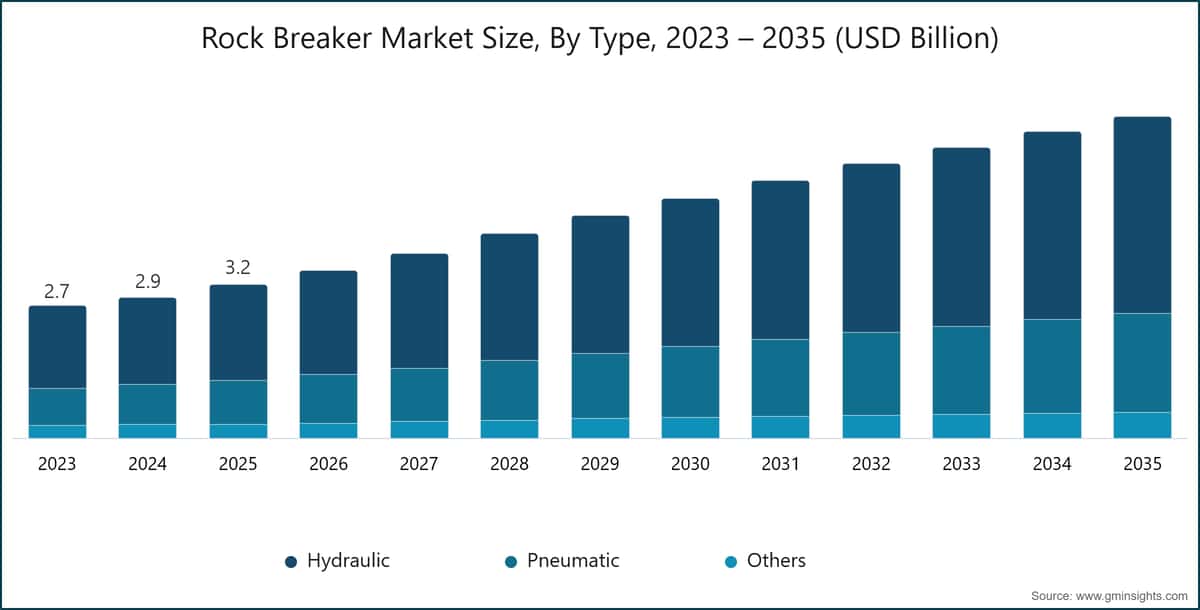
Chart: Rock Breaker Market Size, By Type, 2023 – 2035 (USD Billion)

Based on type, the market is divided into hydraulic, pneumatic, and others. The Hydraulic segment dominated the market, accounting for around 62.3% in 2025 and is expected to grow at a CAGR of more than 7.3% through 2035.

  • The rock breaker industry is largely dominated by hydraulic systems, driven by their superior efficiency, precision, and versatility compared to other types of breakers. Hydraulic rock breakers offer high impact energy and force, making them ideal for breaking hard rocks and concrete in construction, mining, and quarrying applications. Their ability to deliver consistent performance under heavy duty and continuous operations makes them highly preferred by contractors and mining companies seeking productivity and durability.
     
  • Furthermore, hydraulic breakers provide advantages such as lower noise, reduced vibration, and better control, which enhance operator safety and compliance with environmental regulations. Technological advancements, including integration with telematics, automated operation, and energy-efficient designs, are further accelerating the adoption of hydraulic breakers globally. These factors collectively make hydraulic systems the dominant choice in the rock breaker market.
     
  • For example, in March 2026, Komatsu Ltd. showcased its latest range of hydraulic attachments, including the JMHB80H, JMHB130H, and JMHB230V hydraulic breakers with advanced automatic greasing and variable speed technologies to improve breaking efficiency and reduce downtime across construction and demolition tasks.
     
  • The pneumatic segment is expected to experience a faster growth of more than 8.3% over the forecast period, driven by its lightweight design, ease of operation, and cost-effectiveness in small- to medium-scale rock breaking and demolition applications. Pneumatic rock breakers are highly suitable for tasks where mobility, quick setup, and reduced maintenance are essential, making them ideal for urban construction, tunneling, and quarrying projects. Their relatively lower upfront cost compared to hydraulic systems also encourages adoption among small contractors and rental companies.
    Chart: Rock Breaker Market Revenue Share, By Product, (2025)

Based on product, the market is categorized into premium, and non-premium. The premium segment dominates the market accounting for around 64.1% share in 2025, and the segment is expected to grow at a CAGR of over 8% from 2026-2035.

  • The rock breaker market is primarily led by the premium segment due to increasing demand for high-performance, durable, and technologically advanced equipment across construction, mining, and quarrying applications. Premium rock breakers offer superior impact energy, precision, and efficiency, making them ideal for heavy-duty and continuous operations. Companies and contractors prefer premium solutions for their reliability, longer service life, and lower maintenance requirements, which ultimately reduce operational costs and improve productivity in large-scale projects.
     
  • The premium segment benefits from technological innovations such as automated operation, remote control, telematics integration, and energy-efficient designs. These advanced features ensure better safety, compliance with environmental standards, and improved operational control. The rising adoption of premium rock breakers in developed regions such as North America and Europe, along with growing infrastructure and mining investments in emerging markets, is further driving the dominance of this segment in the global market.
     
  • For example, in April 2025, Furukawa Rock Drill Co. Ltd. unveiled its new heavy‑duty hydraulic breaker model FX800 QTv designed for large excavators with enhanced energy efficiency, reinforced durability, soundproofing, and higher breaking performance reflecting the premium breaker trend for demanding applications.

Based on equipment size, the global rock breaker market is divided into light duty (up to 500 kg), medium duty (501-1200 kg), and heavy duty (above 1200 kg). The medium duty (501-1200 Kg) segment held the major market share in 2025. 

  • The medium-duty (501–1200 kg) segment is the largest market segment in the market due to its versatility and suitability for a wide range of construction, mining, and quarrying applications. This segment strikes an optimal balance between breaking power and equipment mobility, making it ideal for medium-sized excavators, skid-steer loaders, and backhoe loaders. Contractors and operators prefer medium-duty breakers because they deliver sufficient impact energy for most urban construction, tunneling, and mining tasks while remaining easier to handle and transport compared to heavy-duty units.
     
  • Medium-duty rock breakers are cost-effective in terms of purchase and maintenance, offering durability and performance for continuous operations without the excessive operational costs of larger units. Their adaptability to various rock hardness levels, improved energy efficiency, and compatibility with compact hydraulic systems further reinforce their dominance in the global market, making them the preferred choice for both developed and emerging regions.
     
  • For instance, in November 2025, Hanon Systems showcased its latest thermal management technologies, including aluminum heat exchanger modules, at the AAPEX 2025 expo, reinforcing its leadership in advanced cooling and HVAC solutions for both OEM and aftermarket applications.
     
  • The light-duty (up to 500 kg) segment is expected to grow with a CAGR of more than 8.3% due to its increasing adoption in small-scale construction, residential projects, and urban infrastructure applications. These breakers are highly valued for their compact size, portability, and ease of operation, making them ideal for confined spaces, minor demolition tasks, and small-scale excavation projects. Contractors and rental companies favor light-duty units for their low upfront costs, reduced maintenance requirements, and quick setup capabilities, which allow for faster project completion and greater operational flexibility.

Based on application, the market is divided into quarrying, demolition, tunneling, scaling, and others. The radiators segment dominated the rock breaker market.

  • The quarrying segment dominates the market due to the high demand for efficient rock fragmentation and material handling in mining and stone extraction operations. Quarrying involves breaking large rocks into smaller, manageable sizes for construction aggregates, cement production, and other industrial uses, which requires powerful, durable, and reliable rock breakers. Companies operating in quarries prefer advanced hydraulic and pneumatic breakers that can withstand continuous heavy-duty operations, provide consistent performance, and reduce downtime, making this segment a major revenue contributor in the market.
     
  • Furthermore, the growth of construction and infrastructure projects globally is fueling the need for high-quality aggregates, which directly supports the adoption of rock breakers in quarrying operations. Technological innovations, such as vibration reduction, energy-efficient designs, and automated operation features, are enhancing productivity, operational safety, and cost-effectiveness. These factors make the quarrying application segment the dominant force driving rock breaker demand.
     
  • For example, in April 2025, Toku America Inc. introduced its STRIKER Rock Breaker System, including heavy‑duty, mid‑range, and mobile hydraulic breaker options designed to improve safety, productivity, and blockage reduction in crushers and aggregate/quarry operations.
     
  • The Tunneling segment is expected to grow with a CAGR of more than 9% due to the increasing demand for underground infrastructure development and urban expansion projects worldwide. Rapid urbanization, metro rail networks, and utility tunnels in major cities are driving the need for efficient and precise rock breaking solutions capable of operating in confined underground spaces. Tunneling applications require specialized rock breakers that can deliver high impact energy while ensuring safety, minimal vibration, and controlled fragmentation, making them essential for modern civil engineering projects.

    Chart: China Rock Breaker Market Size, 2023 – 2035, (USD Million)

    China dominated the rock breaker market in Asia Pacific with around 64.2% share and generated USD 817.5 million in revenue in 2025.

  • China’s market is experiencing robust growth due to the country’s large-scale infrastructure development and extensive mining activities. Continuous investments in highways, high-speed rail networks, urban transit systems, and energy projects are driving strong demand for efficient rock excavation equipment. Additionally, China’s dominance in global mining output, particularly in coal and metal extraction, is further accelerating the adoption of high-performance rock breakers across quarrying and mining operations.
     
  • Furthermore, the increasing shift toward mechanization and advanced construction technologies is boosting the adoption of hydraulic and intelligent rock breaker systems. Domestic manufacturers are focusing on cost-effective production and technological improvements, while stricter environmental and safety regulations are encouraging the use of low-noise, energy-efficient equipment. The growing presence of local and international players, combined with export-oriented manufacturing, is strengthening China’s position as a key market and production hub.
     
  • For example, in March 2025, Xuzhou Construction Machinery Group (XCMG) expanded its portfolio of intelligent and electric-powered mining equipment in China, supporting large-scale infrastructure and mining projects while improving operational efficiency and reducing emissions.
     
  • India is projected to grow at a significant CAGR in the rock breaker market due to rapid infrastructure development and increasing government investments in large-scale construction projects. Initiatives such as highways, metro rail expansion, smart cities, and renewable energy projects are driving strong demand for efficient rock excavation equipment. Additionally, the expansion of mining activities to support rising demand for coal, metals, and minerals is further contributing to the adoption of advanced rock breakers across the country.​

The rock breaker market in Germany is expected to experience significant and promising growth from 2026 to 2035.

  • Europe accounts for over 22.4% of the rock breaker industry in 2025 and is expected to grow at a CAGR of around 6.2% due to the region’s well-established construction and mining industries, along with continuous investments in infrastructure modernization and renovation projects. The presence of advanced equipment manufacturers and strong demand for high-performance machinery in countries such as Germany, the UK, and France are supporting steady market growth.
     
  • Germany is a strong rock breaker market leader due to its highly developed construction and infrastructure sector, supported by continuous investments in transportation networks, urban redevelopment, and energy projects. The country’s focus on modernization of roads, railways, and underground utilities is driving steady demand for efficient and high-performance rock breaking equipment. Additionally, Germany’s engineering-intensive industries require precision-driven excavation solutions, further boosting the adoption of advanced rock breakers across construction and specialized applications.
     
  • Furthermore, Germany is home to several leading construction equipment manufacturers and technology providers, which strengthens innovation and early adoption of advanced machinery. Strict environmental and safety regulations are encouraging the use of low-noise, energy-efficient, and technologically advanced rock breakers. The growing emphasis on automation, digital integration, and sustainable construction practices is also supporting market growth, positioning Germany as a key hub for both demand and technological advancement in Europe.
     
  • For example, in January 2025, Liebherr Group announced the development of next-generation hydraulic attachments, including high-performance rock breakers, designed to improve efficiency, reduce vibration, and meet stringent European environmental standards.
     
  • The UK is emerging as a strong growth market for rock breakers due to increasing investments in infrastructure development and urban redevelopment projects. Government initiatives focused on upgrading transportation networks, including railways, highways, and tunnel systems, are driving the demand for efficient rock excavation equipment. Additionally, the rise in residential and commercial construction activities, particularly in urban areas, is further supporting the adoption of advanced rock breakers for demolition and site preparation.

The rock breaker market in U.S. is expected to experience significant and promising growth from 2026-2035.

  • North America accounts for over 26.9% of the rock breaker market in 2025 and is expected to grow at a CAGR of around 6.7% between 2026 and 2035 owing to strong investments in infrastructure development, mining activities, and energy projects. The region’s focus on upgrading aging infrastructure, including highways, bridges, and rail networks, is driving steady demand for efficient rock excavation equipment. Additionally, ongoing expansion in quarrying and mineral extraction activities is further supporting market growth.
     
  • The U.S. is the market leader in the rock breaker segment due to its extensive construction, mining, and infrastructure development activities. Significant investments in highway expansion, bridge rehabilitation, and large-scale energy and utility projects are driving strong demand for efficient rock excavation equipment. In addition, the presence of vast mining operations, including aggregates, coal, and metal extraction, further supports the adoption of high-performance rock breakers across various applications.
     
  • Furthermore, the US benefits from the presence of major construction equipment manufacturers and a high level of technological adoption. Contractors increasingly prefer advanced hydraulic breakers equipped with automation, telematics, and remote operation capabilities to enhance productivity and safety. Strict regulatory standards related to workplace safety and environmental impact are also encouraging the use of low-noise, energy-efficient equipment, reinforcing the country’s leadership in the rock breaker market.
     
  • For example, in September 2025, Epiroc AB highlighted the use of its hydraulic rock breaker solutions in a power plant deconstruction project in Gelsenkirchen, Germany, demonstrating improved efficiency and safety in heavy demolition and rock excavation applications.
     
  • Canada is becoming one of the fastest-growing markets in the rock breaker sector due to the expansion of mining activities and increasing investments in infrastructure development. The country’s rich reserves of minerals such as gold, copper, and nickel are driving continuous exploration and extraction activities, creating strong demand for efficient rock breaking equipment. Additionally, government spending on transportation networks, energy projects, and urban infrastructure is further supporting the adoption of advanced rock breakers across construction and quarrying applications.

The rock breaker market in Brazil is expected to experience significant and promising growth from 2026 to 2035.

  • Latin America holds around 6.4% of the rock breaker market in 2025 and is growing steadily at a CAGR of around 7.3% between 2026 and 2035 due to expanding mining activities and increasing infrastructure development across key countries such as Brazil, Chile, and Peru. The region’s abundant reserves of copper, iron ore, and other minerals are driving continuous demand for efficient rock excavation and breaking equipment in large-scale mining operations.
     
  • Brazil dominates the rock breaker market in Latin America due to its extensive mining sector and strong presence of natural resources, including iron ore, bauxite, and gold. The country is one of the world’s leading producers and exporters of minerals, which drives continuous demand for efficient rock excavation and breaking equipment. Large-scale mining operations and quarrying activities require high-performance rock breakers to ensure productivity, durability, and cost efficiency.
     
  • Additionally, Brazil’s ongoing investments in infrastructure development, including transportation, energy, and urban construction projects, are further supporting market growth. The increasing adoption of advanced construction equipment, along with the presence of global and domestic manufacturers, is enhancing accessibility to modern rock breaker solutions. Growing focus on operational efficiency, coupled with gradual technological advancements, is reinforcing Brazil’s leadership in the regional market.
     
  • For example, in January 2026, Sandvik AB expanded its collaboration with Vale in Brazil through the deployment of AutoMine-enabled drilling solutions, highlighting the growing adoption of automated and high-efficiency rock excavation technologies in the country’s mining sector.
     
  • The rock breaker market in Mexico is experiencing high growth due to the rapid expansion of mining activities and increasing investments in infrastructure development across the country. Mexico’s mining sector remains a key economic pillar, with rising production of metals and minerals driving continuous demand for heavy-duty excavation and rock breaking equipment. In addition, large-scale projects in roads, ports, and urban construction are further boosting the need for efficient rock fragmentation solutions.

The rock breaker market in UAE is expected to experience significant and promising growth from 2026-2035.

  • MEA holds around 4.5% of the rock breaker industry in 2025 and is growing steadily at a CAGR of around 5.4% between 2026 and 2035 due to increasing investments in infrastructure development and expanding mining activities across the region. Countries in the Middle East are heavily investing in mega construction projects such as smart cities, transportation networks, and energy infrastructure, which are driving strong demand for efficient rock excavation equipment.
     
  • The UAE dominates the MEA rock breaker market due to its strong focus on large-scale infrastructure and urban development projects. The country continues to invest heavily in mega projects such as smart cities, transportation networks, commercial complexes, and tourism infrastructure, all of which require efficient rock excavation and demolition solutions. Additionally, the presence of complex geological conditions in certain construction zones further drives the need for high-performance rock breakers to ensure speed and precision in project execution.
     
  • Furthermore, the UAE’s advanced construction ecosystem and early adoption of modern technologies support the widespread use of high-efficiency hydraulic rock breakers. The presence of global construction equipment manufacturers and rental companies enhances equipment availability and accessibility. Strict regulations related to safety, noise control, and environmental sustainability are also encouraging the use of advanced, low-emission, and low-noise rock breaking solutions, reinforcing the country’s leadership in the regional market.
     
  • For example, in July 2025, Caterpillar Inc., Komatsu Ltd., and Volvo Construction Equipment were highlighted as leading players in the UAE construction equipment market, reflecting strong regional demand for heavy machinery and attachments used in excavation and rock breaking applications amid booming infrastructure activity.
     
  • Saudi Arabia is expected to grow at the fastest CAGR in the MEA rock breaker market due to its ambitious infrastructure development plans and mega-project initiatives under Vision 2030. The country is investing heavily in transportation networks, urban development, industrial zones, and energy projects, all of which require efficient rock excavation and breaking equipment. Expanding mining operations, particularly in minerals such as phosphate, gold, and bauxite, are further driving the demand for high-performance rock breakers in both construction and mining applications.

Rock Breaker Market Share

  • The top 7 companies in the rock breaker industry are Caterpillar, Komatsu, Epiroc, Sandvik, Furukawa Rock Drill, Soosan Heavy Industries, and NPK Construction, contributed around 39.2% of the market in 2025.
     
  • Caterpillar focuses on integrating advanced hydraulic rock breakers with its heavy machinery, emphasizing energy efficiency, durability, and reduced maintenance. Caterpillar leverages telematics and IoT solutions to offer predictive maintenance, operational monitoring, and performance optimization for mining, quarrying, and construction applications. Strategic partnerships and localized support networks enhance customer service and equipment uptime globally.
     
  • Komatsu prioritizes innovation in hydraulic breaker technology with energy-efficient designs, smart automation, and vibration reduction features. Komatsu integrates breakers with its excavators and loaders for optimized performance. Expansion into emerging markets and collaboration with local distributors strengthens accessibility. The company emphasizes aftermarket support, operator training, and sustainable solutions to meet urban and mining project demands.
     
  • Epiroc uses a technology-driven strategy, focusing on high-performance hydraulic and pneumatic breakers with remote operation, automation, and durability for mining and tunneling. Epiroc invests in IoT-enabled solutions for predictive maintenance and efficiency. Sustainability, energy-efficient designs, and strong service networks are central to its market approach, targeting both large-scale quarries and urban construction projects.
     
  • Sandvik emphasizes integration of rock breakers with drilling rigs, loaders, and tunneling equipment, focusing on high efficiency, long service life, and low operational costs. Sandvik’s strategy includes automation, remote monitoring, and vibration control to enhance productivity. Expansion in fast-growing markets and a strong after-sales service network ensures reliability and rapid adoption of advanced breakers.
     
  • Furukawa Rock Drill concentrates on high-performance hydraulic breakers for mining, quarrying, and tunneling. The strategy includes continuous R&D for vibration reduction, energy efficiency, and operator safety. Furukawa strengthens global distribution networks and provides robust aftersales services, positioning its breakers as reliable solutions for heavy-duty and medium-duty applications worldwide.
     
  • Soosan Heavy Industries focuses on producing durable, cost-effective hydraulic breakers with high impact energy for construction and quarrying projects. Soosan emphasizes modular designs, lightweight units, and improved operator ergonomics. Expansion into emerging markets, strong distributor partnerships, and competitive pricing are key strategies to capture small- and medium-scale construction and mining segments.
     
  • NPK Construction Equipment uses a product diversification strategy, offering hydraulic breakers compatible with various excavators and skid-steer loaders. NPK prioritizes durability, efficiency, and ease of maintenance. The company emphasizes aftermarket support, rental partnerships, and innovations in lightweight and mid-range hydraulic breakers to serve both urban construction and mining markets effectively.

Rock Breaker Market Companies

Major players operating in the rock breaker industry are:

  • Caterpillar
  • DEVELON
  • Epiroc
  • Furukawa Rock Drill
  • Hitachi
  • JCB
  • Komatsu
  • NPK Construction
  • Sandvik
  • Soosan Heavy Industries
  • Volvo

  • Strategic collaborations are driving growth. Leading construction and mining equipment OEMs are partnering with hydraulic, pneumatic, and automation technology providers to develop high-performance rock breakers and integrated excavation solutions. These collaborations aim to improve energy efficiency, reduce operational downtime, enhance operator safety, and expand market presence globally, while combining expertise in materials, hydraulics, and control systems for advanced rock-breaking performance.
     
  • Regulatory pressures are shaping market strategies. Stricter environmental regulations, noise restrictions, and workplace safety standards are encouraging manufacturers to adopt energy-efficient and low-noise hydraulic and pneumatic rock breakers. Compliance with emission and vibration standards is accelerating innovation in breaker design, material selection, and control systems, reflecting the industry’s commitment to sustainability, safe operations, and regulatory adherence across mining and construction sites.
     
  • Innovation remains a key market driver. Companies are investing in advanced hydraulic systems, lightweight and durable materials, vibration-dampening technologies, and intelligent control systems for predictive maintenance. These innovations enhance operational efficiency, extend equipment life, reduce maintenance costs, and improve precision in rock fragmentation, highlighting the growing focus on R&D and technologically advanced rock-breaking solutions across global construction, quarrying, tunneling, and mining applications.

Rock Breaker Industry News

  • In March 2026, Epiroc launched its next-generation intelligent breaker platform featuring AI-based control systems, real-time performance optimization, and cloud-connected telematics. The new platform automatically adjusts impact frequency and energy based on material characteristics, improving efficiency by 15% and component life by 25%, with remote diagnostics and predictive maintenance capabilities.
     
  • In February 2026, Caterpillar announced an electric hydraulic breaker development program compatible with emerging electric excavator platforms. Targeted for commercial launch in 2028, the initiative focuses on medium-duty breakers for urban demolition and construction, supporting zero-emission equipment adoption in environmentally sensitive projects.
     
  • In January 2026, Komatsu invested USD 50 million to expand its Indian manufacturing facility, increasing rock breaker production capacity by 40%. The expansion includes advanced manufacturing equipment, testing facilities, and workforce training, serving domestic and export markets across South Asia and the Middle East.
     
  • In December 2025, Sandvik acquired an industrial IoT platform provider to enhance digital connectivity in its rock breaker and construction equipment offerings. Integration enables telematics, remote monitoring, and predictive maintenance for Rammer products, improving productivity and uptime while advancing digital and service-based business models.
     
  • In November 2025, Furukawa Rock Drill introduced a remote-controlled hydraulic breaker for underground mining scaling operations, allowing operators to work from safe positions up to 100 meters away. Early deployments in Australia and Canada improved productivity by 30% while eliminating operator exposure to high-risk environments.
     
  • In October 2025, NPK Construction Equipment opened a major distribution center in Singapore serving Southeast Asian markets. The facility includes parts warehousing, technical training, and customer service operations to support growing demand in Indonesia, Thailand, Vietnam, Philippines, and Malaysia.
     
  • In September 2025, Soosan Heavy Industries achieved ISO 14001 environmental management certification for its rock breaker manufacturing operations, recognizing systematic energy efficiency, waste reduction, and sustainable production practices. The certification strengthens the company’s position in environmentally conscious markets.
     
  • In August 2025, Indeco launched a specialized hydraulic underwater breaker for marine construction and dam maintenance. Features include corrosion-resistant materials, enhanced sealing systems, and external compressed air supply, targeting applications such as bridge pier demolition and underwater concrete repair.
     
  • In July 2025, Volvo Construction Equipment partnered with an autonomous system developer to develop self-operating excavators with integrated rock breakers. The collaboration combines AI, computer vision, and autonomous navigation for commercial deployment in quarries and mining by 2028.

The rock breaker market research report includes in-depth coverage of the industry with estimates & forecasts in terms of revenue ($Bn), and shipment (Units) from 2022 to 2035, for the following segments:

Market, By Type

  • Hydraulic
  • Pneumatic
  • Others

Market, By Product

  • Premium
  • Non-premium

Market, By Equipment Size

  • Light Duty (Up to 500 Kg)
  • Medium Duty (501-1200 Kg)
  • Heavy Duty (Above 1200 Kg)

Market, By Application

  • Quarrying
  • Demolition
  • Tunneling
  • Scaling
  • Others

Market, By End Use

  • Construction
  • Mining
  • Government
  • Private

The above information is provided for the following regions and countries:

  • North America
    • US
    • Canada
  • Europe
    • Germany
    • UK
    • France
    • Italy
    • Spain
    • Russia
    • Belgium
    • Netherlands
  • Asia Pacific
    • China
    • India
    • Japan
    • Australia
    • South Korea
    • Philippines
    • Indonesia
  • Latin America
    • Brazil
    • Mexico
    • Argentina
  • MEA   
    • South Africa
    • Saudi Arabia
    • UAE
Authors: Preeti Wadhwani, Aishvarya Ambekar

Frequently Asked Question(FAQ) :
What was the market size of the global rock breaker in 2025?
The market size was USD 3.2 billion in 2025, with a CAGR of 7.5% expected through 2035, driven by infrastructure development and mining activities.
What is the projected value of the global rock breaker industry by 2035?
The global rock breaker market is expected to reach USD 6.7 billion by 2035, fueled by advancements in hydraulic systems and increased demand in construction and mining sectors.
What is the expected market size of the global rock breaker market in 2026?
The market size is projected to reach USD 3.5 billion in 2026.
What was the market share of the hydraulic segment in 2025?
The hydraulic segment accounted for 62.3% of the market in 2025 and is expected to grow at a CAGR of over 7.3% through 2035.
What is the growth outlook for the pneumatic segment from 2026 to 2035?
The pneumatic segment is projected to grow at a CAGR of more than 8.3% during the forecast period, driven by its lightweight design and cost-effectiveness.
Which product segment dominated the market in 2025?
The premium segment dominated the market with a 64.1% share in 2025 and is expected to grow at a CAGR of over 8% from 2026 to 2035.
Which equipment size segment held the largest market share in 2025?
The medium-duty (501–1200 kg) segment held the largest market share in 2025, owing to its versatility and suitability for a wide range of applications.
Which region led the rock breaker market in Asia Pacific in 2025?
China dominated the Asia Pacific rock breaker market with a 64.2% share, generating USD 817.5 million in revenue in 2025.
Who are the key players in the global rock breaker market?
Key players include Caterpillar, DEVELON, Epiroc, Furukawa Rock Drill, Hitachi, JCB, Komatsu, NPK Construction, Sandvik, Soosan Heavy Industries, and Volvo.
Rock Breaker Market Scope
  • Rock Breaker Market Size
  • Rock Breaker Market Trends
  • Rock Breaker Market Analysis
  • Rock Breaker Market Share
Authors: Preeti Wadhwani, Aishvarya Ambekar
Explore Our Licensing Options:
Premium Report Details:

Base Year: 2025

Companies covered: 28

Tables & Figures: 317

Countries covered: 23

Pages: 272

Download Free PDF

We use cookies to enhance user experience. (Privacy Policy)