Summary
Table of Content

Robotic Packaging System Market
Get a free sample of this report
Form submitted successfully!
Error submitting form. Please try again.
Thank you!
Your inquiry has been received. Our team will reach out to you with the required details via email. To ensure that you don't miss their response, kindly remember to check your spam folder as well!
Request Sectional Data
Thank you!
Your inquiry has been received. Our team will reach out to you with the required details via email. To ensure that you don't miss their response, kindly remember to check your spam folder as well!
Form submitted successfully!
Error submitting form. Please try again.
Robotic Packaging System Market Size
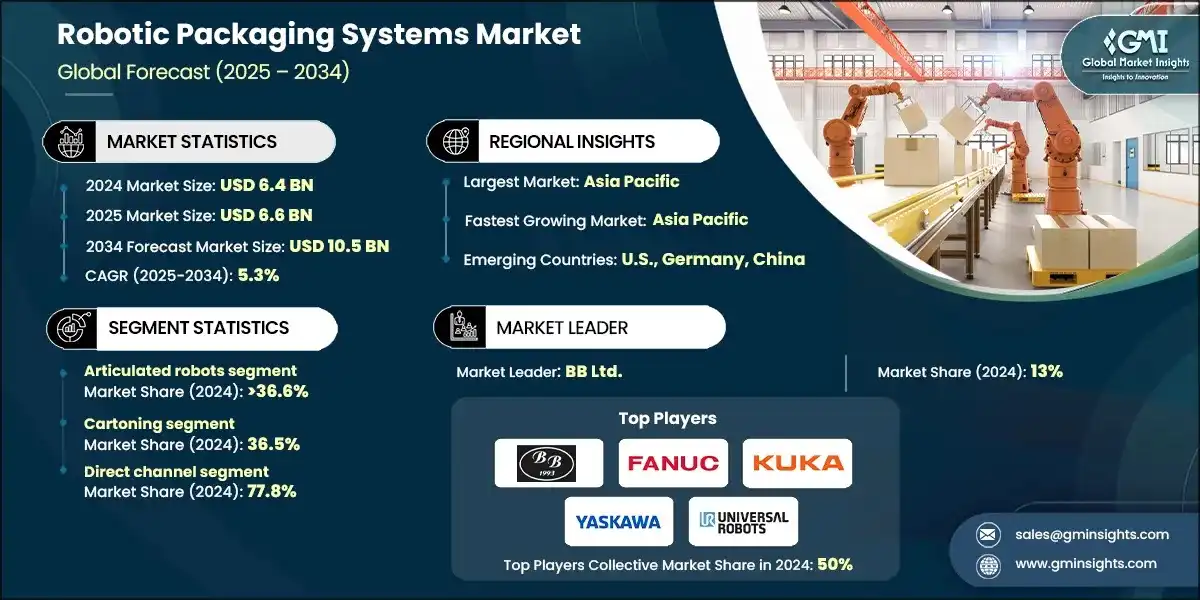
The global robotic packaging systems market was estimated at USD 6.4 billion in 2024. The market is expected to grow from USD 6.6 billion in 2025 to USD 10.5 billion in 2034, at a CAGR of 5.3% according to latest report published by Global Market Insights Inc.
Robotic Packaging System Market Key Takeaways
Market Size & Growth
- 2024 Market Size: USD 6.4 Billion
- 2025 Market Size: USD 6.6 Billion
- 2034 Forecast Market Size: USD 10.5 Billion
- CAGR (2025–2034): 5.3%
Regional Dominance
- Largest Market: Asia Pacific
- Fastest Growing Region: Asia Pacific
Key Market Drivers
- Rising labor costs & labor shortage.
- Need for efficiency, quality, speed & scalability.
- Technological advancement & automation push.
Challenges
- High initial investment & capital cost.
- Integration complexity & legacy systems/workforce skill gap.
- Variability in product/pack formats & flexibility needs.
Opportunity
- Rapid market growth in packaging robotics.
- Expanding use in food, beverage, and consumer goods sectors.
- Rising demand for flexible, modular, and cost-efficient systems.
Key Players
- Market Leader: BB Ltd. led with over 13% market share in 2024.
- Leading Players: Top 5 players in this market include BB Ltd., FANUC Corporation, KUKA AG, Yaskawa Electric/Motoman, Universal Robots, which collectively held a market share of 50% in 2024.
Get Market Insights & Growth Opportunities
- Based on available estimates, an increasing number of installations of industrial robots across geographies supports this market growth. According to industry data, an estimated total of more than 550,000 industrial robots has been installed across geographies. The packaging automation market accounts for nearly 48% of the overall automation market, indicating that the demand for robotic solutions is strong in this sector.
- The regional distribution of the market is represented by the Asia Pacific holding the largest share valued at USD 2.8 billion in 2024, North America accounted for USD 1.6 billion, and Europe accounted for USD 1.3 billion. According to industry analysis by Towards Packaging, the distribution represents the concentration of manufacturing activities and the different degrees of automation adoption across regions.
- Consistent with such factors, the market for robotic packaging systems represents a sector of steady growth within the broader industrial automation environment, with a compound annual growth rate of 5.3% through 2034. This growth rate is considered conservative compared to some other segments of emerging technology but reflects the maturity of the robotics industry and a more measured adoption pattern typical in industrial equipment that is capital-intensive.
- Calculation of the market size includes different system components, such as robotic arms, end-effectors, vision systems, control software, and integration services. The total addressable market contains both new installations and retrofit applications, while replacement cycles generally fall in a range from 8-12 years, depending on application intensity and technological advances. This information is based on FANUC Corporation documentation.
- Companies are increasingly considering the use of robotic packaging systems that can ensure consistency in throughput in light of increasing labor costs and challenges associated with hiring and training personnel for various manufacturing, logistics, and packaging operations. According to the Bureau of Labor Statistics, compensation expenses increased 1.2% in Q1 2024, resulting from a 1.1% hike in wages and salaries.
- While the pressure of volumes, proliferation of SKUs, fast product turnover, and quality control continues unabated for industries like e-commerce, food & beverages, and pharmaceuticals, robotic systems will help improve cycle times with fewer errors and consistent packaging by operating 24/7.
- Advancements in robotics, including machine vision, AI/ML capabilities, flexible grippers, and collaborative robots, along with the wider Industry 4.0 movement, are making robotic packaging systems more competent, versatile, and, thus, increasingly acceptable. Advanced sensor-integrated IoT connectivity provides predictive maintenance and real-time optimization, according to scientific literature published in ScienceDirect.
To get key market trends
Robotic Packaging System Market Trends
- Rise of Collaborative Robots (Cobots) in Packaging Applications: Cobots are types of robots that can work safely alongside humans without heavy guarding and find their place in secondary packaging, palletizing, and picking operations. These collaborative systems can be flexibly deployed across multiple production lines and ensure worker safety, according to ABB official documentation. The segment for cobots has seen remarkable growth as manufacturers look to deploy adaptable automation solutions that can be easily reprogrammed for various packaging tasks, says the Association for Advancing Automation.
- Integration of AI, Machine Vision, IoT and Data Analytics: Modern packaging robotic systems provide state-of-the-art vision for product recognition, AI/ML algorithms for workflow optimization, IoT connectivity for remote monitoring and maintenance, and cloud-based analytics for performance optimization. This convergence enables predictive maintenance capabilities and allows real-time process adjustment to improve overall equipment effectiveness.
- Flexibility, Modular Design & High SKU/Format Variations: With product lifecycles shortening and the proliferation of SKUs, packaging lines need to change over more frequently. Depending on reports sourced by Packaging World, a few of the trends in robotic systems are modular, reconfigurable solutions that can handle multiple product and pack sizes with minimal or no downtime. This is particularly important in e-commerce fulfillment operations, where a very wide range of products needs to be processed efficiently.
Robotic Packaging System Market Analysis
Learn more about the key segments shaping this market
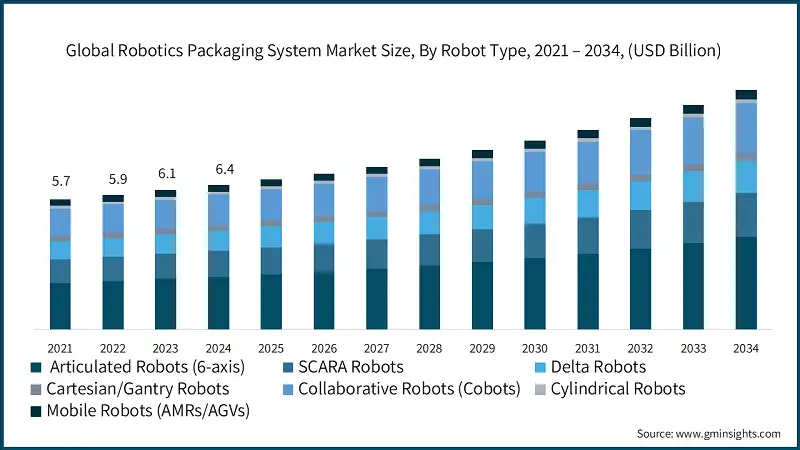
Based on robot type, the market is segmented into articulated robots (6-axis), SCARA robots, delta robots, cartesian/gantry robots, collaborative robots (Cobots), cylindrical robots, and mobile robots (AMRs/AGVs). The articulated robots segment accounted for over 36.6% market share in 2024 and is estimated to grow at a CAGR of around 5.9% from 2025 to 2034.
- Articulated robots are ideal for complex packaging tasks that require several degrees of freedom, such as case packing, product assembly, and palletizing. Further, their flexibility offers the ability to handle varied product sizes and geometries within a single system, hence becoming ideal for manufacturers with diverse product portfolios. The CAGR value of 5.9% for articulated robots reflects the steady growth driven by their adaptability to evolving packaging requirements, according to official ABB documentation.
- SCARA robots are particularly effective in pick-and-place operations, small product assembly, and applications requiring consistent cycle times. Their horizontal work envelope and high repeatability make them suitable for electronics packaging, pharmaceutical applications, and food processing operations according to FANUC Corporation publications.
- Cobots are increasingly being deployed in packaging operations where it is very advantageous to have human-robot collaboration, such as quality inspection, flexible packaging lines, and operations with frequent changeovers. According to Universal Robots documentation, Cobots hold a lower barrier to entry and fewer safety infrastructure requirements, thus are very attractive for small and medium enterprises.
Learn more about the key segments shaping this market
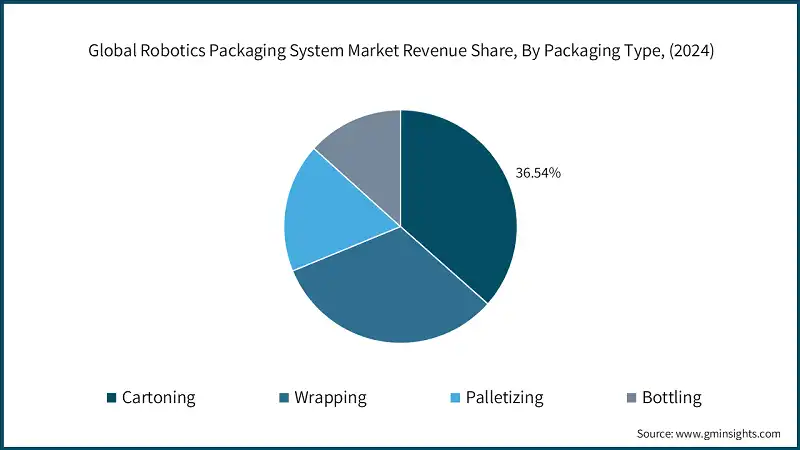
Based on packaging type, the global robotic packaging system market is categorized into cartoning, wrapping, palletizing, and bottling. The cartoning segment held around 36.5% of the total market share in 2024 and is anticipated to grow at a CAGR of 5.8% from 2025 to 2034.
- The robotic packaging systems market is dominated by secondary packaging applications, including cartoning operations at the largest share of $2.3 billion and growing at a CAGR of 5.8%. According to official documentation by Syntegon Technology, the carton robots used cartons to compile cartons, inserting the product inside the cartons, and sealing cartons for food & beverages, pharmaceuticals, and other consumer goods.
- This is evident through the prevalence of cartoning applications that are arising due to the universal need for protective packaging and a rather complex manual operation of cartoning. Robotic cartoning systems offer consistent quality, labor cost reduction, and higher throughput compared to manual operations. Advanced cartoning robots incorporate vision systems to inspect carton integrity and verify products, according to Krones AG technical publications.
- Wrapping applications make up the second-largest fraction at USD 2.1 billion with 5.6% CAGR, including stretch wrapping, shrink wrapping, and protective film. The applications considered herein are indispensable in logistics and distribution operations where product protection during transport cannot be afforded to be compromised. Robotic wrapping systems apply consistent wrap tension, reduce material waste, and enhance load stability according to Lantech industry documentation.
- Bottling operations, though small, at USD 0.8 billion, are growing steadily at 3.3% CAGR, led by automation in the beverage industry and pharmaceutical packaging needs. The bottle handling, filling support, capping, and labeling operations in robotic bottling systems are performed with a high level of precision and hygiene as per Sidel technical documentation.
Based on the distribution channel, global robotic packaging system market is categorized as direct and indirect. The direct channel segment held around 77.8% of the total market share in 2024.
- Within the robotic packaging systems market, direct sales channels are dominant, holding up to USD 5 billion and 78% market share, with a CAGR of 5.9%. Such a distribution approach results from the nature of robotic packaging systems, which are complex and customized and thus require far-reaching technical consultation, system integration, and continuous support services.
- The direct sale allows the manufacturers to maintain close relations with the end users, providing custom solutions targeted at addressing the packaging requirements and operational constraints. This approach is essential in large-scale installations where system integration, training, and support services are critical success factors. According to their official documentation, key robotics companies such as ABB, FANUC, and KUKA sell mainly via direct sales channels in packaging applications.
- The direct sale allows the manufacturers to maintain close relations with the end users by providing custom solutions that are targeted at addressing the packaging requirements and operational constraints.
Looking for region specific data?
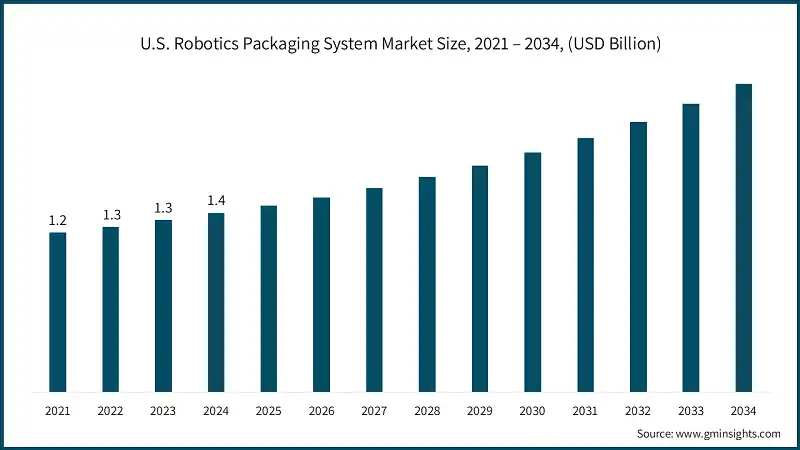
- North America robotic packaging system market represented USD 1.6 billion at 5.5% CAGR, with e-commerce growth, labor shortages, and reshoring initiatives in play. The U.S. dominates regional demand due to the high volume of its food processing and manufacturing of pharmaceuticals and consumer goods. Increasing labor costs coupled with low availability of packaging workers fuel the automation adoption rate across a wide range of industries, says the U.S. Bureau of Labor Statistics.
- The Asia Pacific robotic packaging system market accounted for USD 2.8 billion, 44% of market share, with a CAGR of 5.7%, due to high manufacturing output, government initiatives toward automation, and growing labor costs. China dominates the regional demand with extensive production units in industries such as electronics, automotive, and consumer goods. Advanced packaging automation is also recorded according to Chinese government policies on industrial development.
- The strong support provided by governments of the region for automation and Industry 4.0 initiatives, wherein countries like China, Japan, and South Korea have policies encouraging the adoption of robotics, is boosting this market. The "Made in China 2025" initiative targets robotics and automation as strategic industries, providing support to market development through subsidies and tax incentives per NDRC government documentation.
- Japan holds a significant position in the Asia Pacific market as both a consumer and a producer of robotic packaging systems. Japanese robotics manufacturers, such as FANUC, Yaskawa, and Mitsubishi Electric, hold leading positions in robotics technologies, while domestic demand is driven by concerns of aging workforce demographics and labor shortages, according to data by the Japan Robot Association.
- Europe represents the second-largest regional market in the world, with mature rates of automation and high-quality requirements valued at $1.3 billion while growing at a CAGR of 5%. Germany represents the largest European demand owing to its strong manufacturing base and attention being paid to Industry 4.0 implementation. However, increasingly, European markets are concerned about sustainability and energy efficiency. This has led to increased demand for advanced robotic systems that cut down on waste and energy consumption, according to industry association VDMA reports.
- European regulatory requirements, especially for food and pharmaceutical packaging, drive the adoption of hygienic robotic systems with advanced cleaning features and compliance capabilities. The region's emphasis on worker safety and ergonomics also supports collaborative robot adoption in packaging applications, according to European Union regulatory documentation.
Robotic Packaging System Market Share
The robotic packaging systems industry is at a highly consolidated stage, with the top five players holding almost 50% of the total market share, which indicates the specialized nature of packaging automation and a high requirement for technical expertise with integration capabilities. ABB Ltd. leads the market with a share of 13% due to its broad portfolio of robotics and strong presence in industrial automation.
- ABB maintains its market leadership with a wide product portfolio of articulated robots, delta robots, and collaborative systems with vast application experience in packaging operations.
- FANUC Corporation, with about 11%, based on the company's reputation for reliability backed up by comprehensive service support. FANUC has variants of packaging robots that have been designed for specialized segments such as handling food, pharmaceutical applications, and general packaging applications. Its focus on long-term reliability and minimum maintenance requirements seems to be the exact needs of packaging operations that need to ensure uptime, according to FANUC Corporation.
- KUKA AG retains about 9% market share, especially in specific automotive and general industrial packaging applications. For a long time, the company's robots have been at the top, renowned for high precision and high payload capacity; hence, they are suitable for heavy-duty packaging operations and complex assembly tasks. Recently, KUKA has focused on collaborative robotics and digital services to give them their due position in emerging market segments.
- Yaskawa Electric/Motoman represents about 8% market share, strong in palletizing and material handling applications. Motoman robots are also deployed on a wide scale in packaging operation, with high payload capacity, and extended reach applications. The company's integration expertise and application-specific solutions support its competitive position, states Yaskawa technical documentation.
- Universal Robots commands around 7% market share, mainly through leading in collaborative robotics. Smaller in terms of overall packaging market terms, Universal Robots leads the segment of Cobots, with over 40% share of collaborative robot installations around the world. The company is focused on ease of use and flexible deployment models that appeal to the small and medium enterprises entering packaging automation, according to documentation from Universal Robots.
- Merger and acquisition activity continues to reshape the competitive landscape as larger players acquire specialized technological companies and regional integrators to extend capabilities and market reach. Recent examples, according to Packaging World industry publications, include strategic investments in AI and vision technology companies to enhance robotic packaging system capabilities. The capital-intensive nature of robotic packaging systems and the prime importance of established customer relationships, technical support capabilities, and proven reliability in industrial applications are well reflected in the market share distribution. According to the analysis by Credence Research, new entrants face considerable barriers in terms of the need for extensive application expertise, global service networks, and proven track records in mission-critical packaging operations.
Robotic Packaging System Market Companies
Major players operating in the robotic packaging system industry are:
- ABB Ltd.
- Brenton Engineering
- Doosan Robotics
- FANUC Corporation
- Krones AG
- KUKA AG
- Mitsubishi Electric
- Omron Corporation
- Schneider Electric
- Standard Bots
- Stäubli
- Syntegon Technology
- TechMan Robot
- Universal Robots
- Yaskawa Electric / Motoman
The robotic packaging systems market represents a diverse ecosystem that includes long-established robotics manufacturers, specialized packaging equipment providers, and emerging technology companies, each uniquely capable and serving distinct market segments.
- FANUC Corporation remains a leader in technology. The packaging robot portfolio of the company comprises the M-410 series for palletizing, LR Mate series for compact packaging applications, and CRX collaborative robots for flexible packaging operations. FANUC provides overall solutions for packaging automation, combining robots, controllers, and software, according to FANUC Corporation publications.
- Drawing on extensive experiences gained in automobile production, KUKA AG constructs robust packaging solutions for challenging industrial jobs. Heavy-duty packaging applications are covered under the KR QUANTEC series, while applications requiring high-speed precision should be approached with the KR AGILUS series. New emphasis on digital services and Industry 4.0 integration will help position the company to address emerging market demands according to KUKA official documentation.
• Yaskawa Electric/Motoman targets material handling and palletizing jobs with the Motoman series of robots. Stronger applications involving high payload and extended reach provide a very good fit in end-of-line packaging applications. Focusing on application-specific solutions and integration expertise, Yaskawa keeps a very strong competitive position, according to technical documentation from Yaskawa. - Universal Robots leads the collaborative robotics segment, with its UR series cobots being extensively utilized in packaging applications. The company has democratized access to packaging automation for small and medium enterprises by concentrating on ease of use, safety, and various flexible deployment models. With certified accessories and integration partners, Universal Robots promotes an ecosystem approach and has facilitated fast deployment of Universal Robots documentation.
- Mitsubishi Electric provides complete automation solutions that include robots, controllers, and vision systems for packing applications. Its MELFA series of robots covers a wide range of packaging needs-from simple, high-speed pick-and-place operations to more complex assembly processes. Mitsubishi's integrated approach enables optimized performance and simplified programming according to Mitsubishi Electric technical publications. Stäubli designs robots for cleanroom and hygienic packaging applications in food, pharmaceutical, and medical device packaging.
Robotic Packaging System Market Report Attributes
| Key Takeaway | Details |
|---|---|
| Market Size & Growth | |
| Base Year | 2024 |
| Market Size in 2024 | USD 6.4 Billion |
| Market Size in 2025 | USD 6.6 Billion |
| Forecast Period 2025 – 2034 CAGR | 5.3% |
| Market Size in 2034 | USD 10.5 Billion |
| Key Market Trends | |
| Drivers | Impact |
| Rising labor costs & labor shortage | Increasing wages and workforce shortages push manufacturers to adopt robotic packaging to reduce dependency on manual labor. |
| Need for efficiency, quality, speed & scalability | Robots enable consistent, high-speed operations with fewer errors, meeting modern production and customization demands. |
| Technological advancement & automation push | Innovations in AI, sensors, and cobots make robotic packaging more capable, reliable, and accessible across industries. |
| Pitfalls & Challenges | Impact |
| High initial investment & capital cost | The upfront expense of robotic systems and integration remains a barrier, especially for small and mid-sized firms. |
| Integration complexity & legacy systems/workforce skill gap | Existing equipment and limited technical expertise make automation integration difficult and slow. |
| Variability in product/pack formats & flexibility needs | Constant changes in packaging design and materials require adaptable robots, increasing engineering complexity. |
| Opportunities: | Impact |
| Rapid market growth in packaging robotics | Strong global demand for automation creates expansion potential for new solutions and suppliers. |
| Expanding use in food, beverage, and consumer goods sectors | Hygiene, accuracy, and throughput needs are driving wider adoption of robotic packaging. |
| Rising demand for flexible, modular, and cost-efficient systems | Scalable, easy-to-deploy robots appeal to mid-sized manufacturers and emerging markets. |
| Market Leaders (2024) | |
| Market Leaders |
13% market share |
| Top Players |
Collective market share in 2024 is 50% |
| Competitive Edge |
|
| Regional Insights | |
| Largest Market | Asia Pacific |
| Fastest growing market | Asia Pacific |
| Emerging countries | U.S., Germany, China |
| Future outlook |
|
What are the growth opportunities in this market?
Robotic Packaging System Industry News
- January 2025: ABB launched its new platform OmniCore automation, likely up to 25% faster processing and 20% more energy efficiency compared to its predecessors. As per the company, the platform features advanced AI functions for predictive maintenance and adaptive control in packaging applications.
- December 2024: FANUC introduced the CRX-25iA, which is a collaborative robot that can handle a payload of 25kg; it is designed for packaging and palletizing. According to the news released by FANUC Corporation, the system comes with built-in vision features and an easy-to-use programming interface for rapid implementation.
- In November 2024, Universal Robots announced the UR30 collaborative robot for heavy-duty packaging applications; with a payload capacity of 30kg and a reach of 1300mm, according to Universal Robots, the UR30 is intended for tasks that have traditionally been handled by industrial robots.
- October 2024: Syntegon Technology introduced the newest AI-driven packaging inspection system. It merges machine vision with robotic handling to support pharmaceutical packaging. Syntegon Technology said the system detects defects with an accuracy of 99.9% while keeping high throughput rates.
- September 2024: Premier Tech unveiled a collaborative TOMA palletizing system, incorporating FANUC CRX-30iA robots with dedicated software to the front lines of flexible packaging. Paperwork from Premier Tech describes that this system uses rapid changeovers from one product type to another and changes pallet patterns.
The robotic packaging system market research report includes in-depth coverage of the industry with estimates & forecasts in terms of revenue ($ Bn/Mn) and volume (Thousand Units) from 2021 to 2034, for the following segments:
Market, By Robot Type
- Articulated robots (6-axis)
- SCARA robots
- Delta robots
- Cartesian/gantry robots
- Collaborative robots (Cobots)
- Cylindrical robots
- Mobile robots (AMRs/AGVs)
Market, By Packaging Type
- Cartoning
- Wrapping
- Palletizing
- Bottling
Market, By Application
- Pick & place operations
- Palletizing & depalletizing
- Case packing & tray packing
- Material handling
- Filling & dispensing
- Sealing & capping
- Labeling & coding
- Inspection & quality control
Market, By End Use Industry
- Food & beverage
- Pharmaceuticals & healthcare
- Consumer goods & cosmetics
- Automotive
- Electronics & electrical
- Logistics & e-commerce
- Chemicals & industrial
Market, By Distribution Channel
- Direct
- Indirect
The above information is provided for the following regions:
- North America
- U.S.
- Canada
- Europe
- UK
- Germany
- France
- Italy
- Spain
- Russia
- Asia Pacific
- China
- India
- Japan
- Australia
- South Korea
- Latin America
- Brazil
- Mexico
- Argentina
- MEA
- UAE
- South Africa
- Saudi Arabia
Frequently Asked Question(FAQ) :
What is the market size of robotic packaging systems in 2024?
The market size was USD 6.4 billion in 2024, with a CAGR of 5.3% expected through 2034 driven by rising deployment of industrial robots across global manufacturing facilities and increasing labor costs.
What is the projected value of the robotic packaging systems market by 2034?
The robotic packaging systems market is expected to reach USD 10.5 billion by 2034, propelled by technological advancements in AI, machine vision, IoT integration, and growing demand for efficiency and automation.
What is the current robotic packaging systems market size in 2025?
The market size is projected to reach USD 6.6 billion in 2025.
How much revenue did the articulated robots segment generate in 2024?
Articulated robots (6-axis) dominated with approximately 36.6% market share in 2024, leading the robot type segment due to their flexibility in handling complex packaging tasks.
What was the valuation of the cartoning segment in 2024?
Cartoning held around 36.5% market share and generated USD 2.3 billion in 2024, dominating the packaging type segment.
What is the growth outlook for articulated robots from 2025 to 2034?
Articulated robots are projected to grow at a CAGR of 5.9% till 2034, due to their adaptability to evolving packaging requirements and ability to handle varied product sizes and geometries.
Which region leads the robotic packaging systems market?
North America robotic packaging system market was USD 1.6 billion in 2024, with a CAGR of 5.5% expected through 2034, due to the high volume of its food processing and manufacturing of pharmaceuticals and consumer goods
What are the upcoming trends in the robotic packaging systems market?
Key trends include rise of collaborative robots (cobots), integration of AI and machine vision, IoT connectivity for predictive maintenance, and demand for flexible, modular designs to handle high SKU variations.
Who are the key players in the robotic packaging systems market?
Key players include ABB Ltd., Brenton Engineering, Doosan Robotics, FANUC Corporation, Krones AG, KUKA AG, Mitsubishi Electric, Omron Corporation, Schneider Electric, Standard Bots, Stäubli, Syntegon Technology, TechMan Robot, Universal Robots, and Yaskawa Electric/Motoman.
Robotic Packaging System Market Scope
Related Reports