Summary
Table of Content

Rich Communication Services Market
Get a free sample of this report
Form submitted successfully!
Error submitting form. Please try again.
Thank you!
Your inquiry has been received. Our team will reach out to you with the required details via email. To ensure that you don't miss their response, kindly remember to check your spam folder as well!
Request Sectional Data
Thank you!
Your inquiry has been received. Our team will reach out to you with the required details via email. To ensure that you don't miss their response, kindly remember to check your spam folder as well!
Form submitted successfully!
Error submitting form. Please try again.
Rich Communication Services Market Size
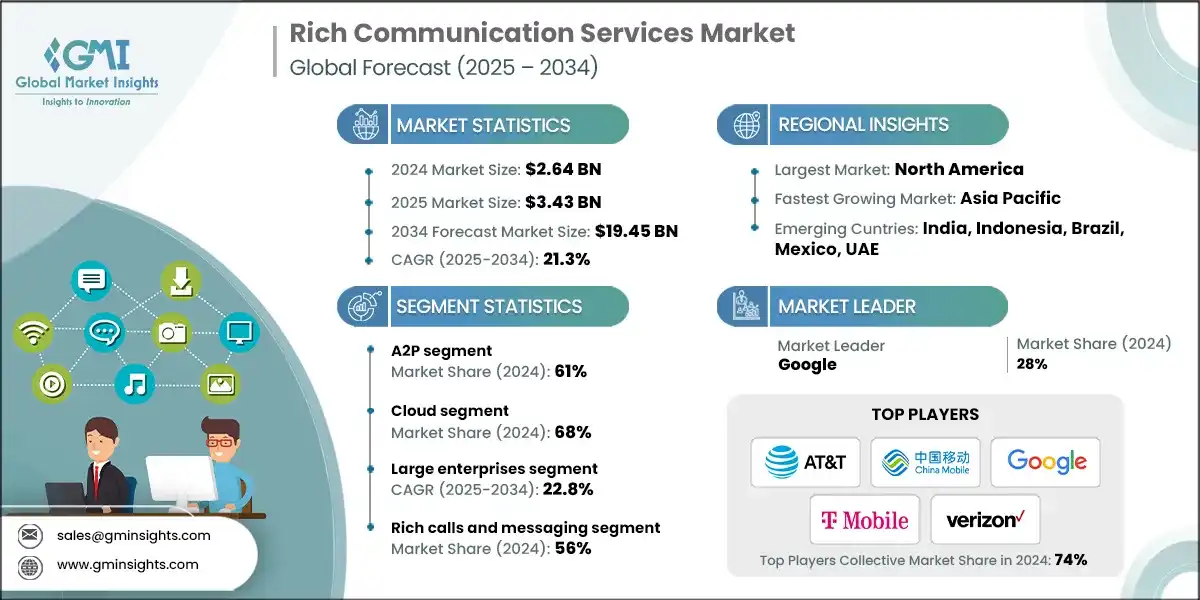
The global rich communication services market was valued at USD 2.64 billion in 2024. The market is expected to grow from USD 3.43 billion in 2025 to USD 19.45 billion in 2034 at a CAGR of 21.3%, according to latest report published by Global Market Insights Inc.
Rich Communication Services Market Key Takeaways
Market Size & Growth
- 2024 Market Size: USD 2.64 Billion
- 2025 Market Size: USD 3.43 Billion
- 2034 Forecast Market Size: USD 19.45 Billion
- CAGR (2025–2034): 21.3%
Regional Dominance
- Largest Market: North America
- Fastest Growing Region: Asia Pacific
Key Market Drivers
- Smartphone penetration.
- 5G network expansion.
- Enterprise adoption of A2P messaging.
- Shift from SMS to rich messaging.
Challenges
- Interoperability Challenges.
- User Privacy Concerns.
Opportunity
- E-commerce & retail engagement.
- Banking & financial services.
- Travel & hospitality services.
- Regional market expansion (MEA & APAC).
Key Players
- Market Leader: Google led with over 28% market share in 2024.
- Leading Players: Top 5 players in this market include AT&T, China Mobile, Google, T-Mobile US, Verizon Communications, which collectively held a market share of 74% in 2024.
Get Market Insights & Growth Opportunities
Rising global smartphone use is driving the growth of rich messaging systems, allowing RCS to reach large numbers of users. People switch from basic phones to smartphones with better connectivity and operating system features, RCS adoption speeds up. This is due to its support for multimedia messaging, interactive elements, and app-like communication experiences.
The growing range of devices encourages operators to deploy RCS, improves businesses’ outreach, and boosts the overall commercialization of RCS services in both developed and emerging markets. The rollout of 5G networks brings the speed, bandwidth, and low-latency environment needed to improve the performance and reliability of RCS messaging.
With better connectivity, RCS features like high-resolution media sharing, real-time updates, interactive chatbots and branded messaging can work more smoothly and be more widely available. As telecom operators upgrade to 5G, companies get the chance to provide richer customer interactions, speeding up RCS adoption. In turn, 5G expansion supports global growth, enhances user experience, and creates new revenue opportunities for carriers.
Businesses are increasingly choosing RCS over SMS for A2P communication because it allows for richer engagement, higher conversion rates and interactive messaging features. Companies in retail, banking travel and telecom are using RCS to send branded messages, product carousels, secure alerts and conversational commerce experiences.
To get key market trends
Rich Communication Services Market Trends
The growing global penetration of smartphones is pushing the rapid growth of rich messaging ecosystems, allowing RCS to expand its available user base significantly. The shift of users move from basic phones to smartphones with connectivity and OS that support RCS, adoption will increase because of the benefits of multimedia messaging, interactive features, and app-like communication experiences. The device ecosystem will continue to drive operator deployments, grow enterprise outreach potential, and enhance the commercialization of RCS services in both developed and developing markets.
The deployment of 5G networks gives speed, bandwidth and low-latency conditions to encourage the performance and reliability of RCS messaging. Higher-quality connectivity will allow RCS features such as high-resolution sharing of media, real-time updates, interactive chatbots, or branded messaging to become more seamless and available. 5G upgrades for telecom operators will facilitate opportunities for enterprises to deliver richer interactions with customers and subsequently accelerate RCS adoption. 5G will also encourage the potential for global scalability and added user experience while enabling carrier monetization.
Organizations are utilizing RCS instead of SMS for application-to-person (A2P) communication because RCS enables richer experience, higher conversion rates and interactivity. Retail, banking, travel, and telecom businesses all utilize RCS to communicate branded messages, product carousels/recommendations, alerts, and answer questions through conversational commerce. The enterprise A2P shift to rich messaging supports enhanced customer satisfaction and measurable returns on investment and ensures enterprise invest even more in RCS platforms. As enterprise communication strategies mature, RCS will be at the center of digital marketing, automated customer support, and customer lifecycle management.
Consumer demand for interactive, visually appealing, immediate access to communication continues to push the global shift from traditional SMS to rich messaging. RCS provides more extensive capabilities for read receipts, typing bubbles, carousels, suggested actions, and branded messaging, bringing more value to both personal and business messaging. Consumers like app-like experiences in native messaging apps and helping both operators and enterprises, embrace RCS to stay competitive. This shifts the market by trying to modernize aging SMS messaging infrastructures, while providing higher-value communication in all industries.
Rich Communication Services Market Analysis
Learn more about the key segments shaping this market
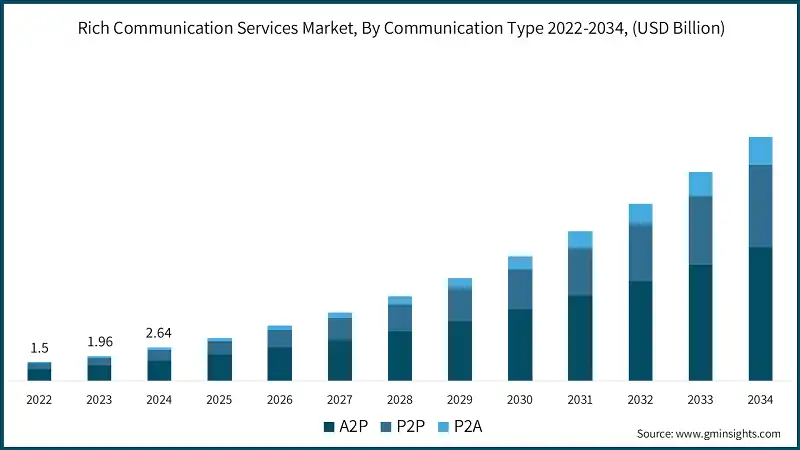
Based on communication type, the market is divided into A2P, P2A and P2P. The A2P segment dominated the rich communication services market, accounting for 61% in 2024 and is expected to grow at a CAGR of over 19% through 2025 to 2034.
- A2P RCS is popular in retail, banking, travel and healthcare for interactive campaigns, secure alerts, and deep customer contact. Its recognition by the FCC as an emergency communication pathway adds to its legitimacy, while CPaaS (Communications Platform as a Service) providers such as Twilio, Infobip, and Sinch have enabled and encouraged the ease of enterprise integration for A2P communications. The combination of adding visuals and interactivity makes A2P the most commercially mature area of RCS.
- In 2024, P2P RCS revenues were valued at USD 1.6 billion, pushed by the introduction of RCS support in iOS 18 for rich messaging between Android and iPhone environments. Consumers are embracing P2P provision for sharing high-resolution media, improved group chat capabilities, and secure encrypted exchanges. GSMA Universal Profile 3.0 will accelerate P2P growth across the RCS messaging environment by establishing standard end-to-end encryption for security in the global messaging environment.
- P2A RCS has the highest growth rate of the three market segments, with a CAGR of 26.9% from 2025 to 2034, mainly because of AI-enabled chatbots fielding customer inquiries, completing transactions, and performing self-service tasks utilizing web applications. Enterprises are taking up P2A rapidly as a cost-savings strategy, along with personalization strategies integrated with CRMs. Growing consumer preference for asynchronous messaging is boosting demand, which creates expansion opportunities. P2A is potentially the highest CAGR segment with the most opportunities for long-term growth.
Learn more about the key segments shaping this market
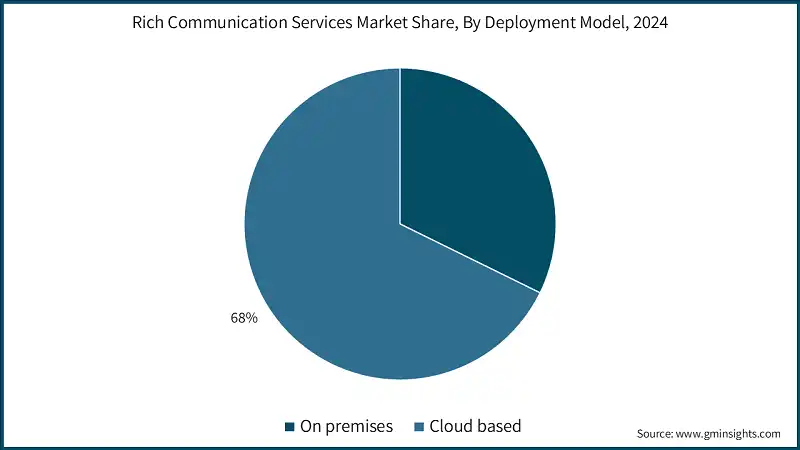
Based on deployment model, the rich communication services market is segmented by cloud and on-premises. Cloud segment dominates the market with 68% share in 2024, and the segment is expected to grow at a CAGR of 24.1% from 2025 to 2034.
- Cloud-based solutions are valued at USD 1.79 billion in 2024 with these deployments, typified by Google’s Jibe solution, deliver a scalable, low-latency messaging infrastructure with support for A2P campaigns, an elastic capacity to handle demand, and automatic feature updates. Providers of CPaaS (communication platform as a service), such as Twilio, Infobip and Sinch, have turned RCS into an RCS-as-a-Service offering via simple APIs to simplify adoption by enterprises.
- The on-premises deployment model will continue to be relevant for operators with regulatory and data sovereignty. Hybrid deployments are gaining momentum by blending on-premises core systems with cloud infrastructure for capacity, disaster recovery and geographic expansion.
- Cloud models are favored for their cost-benefit performance, interoperability within a multi-vendor ecosystem and overall adoption by enterprises tends to be quicker, while on-premises deployments exist primarily for specialized needs or by regulatory mandate.
Based on organization size, the rich communication services market is segmented by large enterprises and SMEs. The large enterprises segment dominates the market with 78% share in 2024, and the segment is expected to grow at a CAGR of 22.8% from 2025 to 2034.
- Large enterprises are valued at USD 1.60 billion in 2024 with the main contributors being RCS adoption by large enterprises with their large customer bases, marketing technology teams, and budgets for "next generation" messaging capabilities. Large enterprises can deploy RCS in A2P campaigns, transactional alerts, or interactive customer engagement “in the moment.”
- Use cases for RCS include retail, banking and financial services, travel and hospitality, and telecom. Having a dedicated CPaaS platform makes deployment simple and provides immediate value to multiple areas for synergy. North America and Europe are among the world leaders in RCS monetization.
- SMEs is growing at a CAGR of 18.7% from 2025 to 2034, due to the emergence of RCS as a service or RCS as a service platform. Most models include relatively easy to implement consumer-facing RCS functionality utilizing self-service and consumption-based pricing and drag-and-drop builders. Depending on the industry, SMEs utilize RCS functionality for use cases like customer service, appointment reminders, reservations, local marketing, etc.
Based on application, the rich communication services market is segmented into rich calls and messaging, cloud storage, marketing and advertising campaign, content delivery and others. The rich calls and messaging segment is expected to dominate the rich global communication services market with a share of 56% in 2024, driven by strong brand trust, integrated solutions, and extensive communication capabilities.
- Rich calls and messaging facilitate two-way (P2P) interaction for consumers and is also utilized by enterprises for application-to-person (A2P) engagement. Consumers are using it for sharing media, coordinating events, and interactive messaging that goes beyond SMS. Enterprises use RCS for customer service, transaction notifications, and conversational commerce.
- For marketing purposes, companies are using RCS to create interactive promotions, product launches, seasonal campaigns and call-to-action messages. Features such as carousels, rich cards and verified sender branding help in user engagement and trust in the message channel.
- RCS helps in rich formatting to share media, documents and information. Use cases include news alerts with video, sports highlights, entertainment previews and educational content such as assignments and content notifications. Improved media capabilities increase engagement and timeliness of information and encourage both consumer and institutional communication that is interactive and visually engaging.
Looking for region specific data?
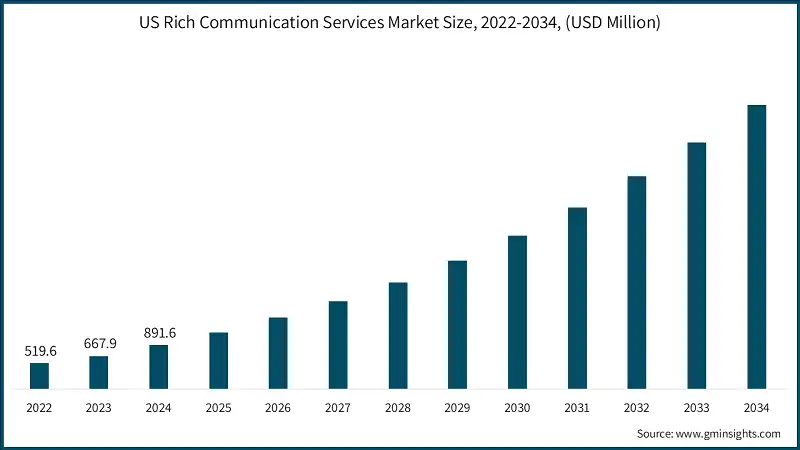
The US rich communication services market reached USD 891.6 million in 2024, growing from USD 667.9 million in 2023.
- US RCS market is supported by a robust penetration of smartphones among consumers, a nascent and advanced rollout of 5G, and strong use cases in enterprise adoption across the retail, BFSI, and telecom verticals. An increase in A2P messaging, the use of AI-enabled chatbots, and the proliferation of brand-verified messaging has all made RCS-based customer engagement highly plausible, accelerating its acceptance among many leading enterprises in the US, especially among retail enterprises.
- Verizon and AT&T, among the other Majors, deploy cloud-based RCS platforms that help ease the career burden of interoperability and complexities of deployment within these platforms. Collectively, these platforms facilitate the development of the RCS ecosystem while helping enterprises deploy secure RCS and engage in branded marketing media messaging without disrupting their position to migrate away from SMS/MMS capabilities, and leverage RCS rich media messaging capabilities for marketing automation, customer support, and interactive service delivery.
- The recent US regulatory focus on consumer protection and data privacy impacts enterprise messaging strategies as it pushes enterprises to adopt secure RCS-enabled communication. Enterprises are increasingly moving to RCS as a secure platform to deliver transactional alerts, marketing journeys, and conversational experiences. These trends indicate that the US is one of the most advanced RCS markets in the world.
North America dominated the rich communication services market with a market size of USD 1.02 billion in 2024.
- The proliferation of 5G connectivity, prevalence of mobile broadband use, and continued digital transformation of enterprises are notable advantages for North America. Large enterprises across various sectors, such as the banking industry, e-commerce, and travel, have begun to embrace and implement rich communication services (RCS) as a method to improve customer engagement, achieve conversions, and bolster their omni-channel communication strategy without deep-hubbing channels or platforms into their existing ecosystem coupled with AI-enabled automation.
- Telecom operators, collaborative or otherwise, utilize RCS platform providers to improve interoperability across mobile network operators and assure quality messaging experience across multiple platforms and applications. Improvements of RCS reliability across messaging services and channels from combinations of industry research, platform providers, and MNOs will spur larger and broader uses of RCS messaging by marketers or application developers to enhance the maturity of the ecosystem to scale to market opportunities in the US and Canada.
- Growth is also fueled by enterprises migrating quickly to the cloud-based infrastructure, and, as messaging systems become cloud-based, enterprises in North America are utilizing new analytics, rich-media templates, and transactional or conversational RCS messaging applications that achieve meaningful improvements in customer retention and providing a competitive approach to modernization of the messaging systems, contributing to enhanced status of the region as a future center of innovation for the future of business messaging.
Europe rich communication services market accounted for a share of 28.7% and generated revenue of USD 757.9 million in 2024 and is anticipated to show lucrative growth over the forecast period.
- Initiatives on digital transformation and regulatory frameworks in Europe are encouraging protected and standardized communication that is fostering RCS growth in key markets like Germany, France, the UK and Spain. Foreign telecom operator support and cross-border work to promote interoperability is speeding enterprise adoption for consistent rich messaging functionality.
- Enterprises including retail, travel, automotive and banking sectors are users of RCS for personalized customer engagement, transactional alerts and AI enabled conversational experiences. Europe's huge smartphone penetration and mobile internet penetration support accelerated deployment of rich interactive messaging across consumer-facing industries.
- Operators in Europe are continuing to integrate cloud-based and CPaaS-enabled rich messaging platforms to help address deployment complexity. This is facilitating the rise of RCS to be scalable in countries with varying levels of telecom readiness, helping strengthen its status as a fast-growing RCS market in Europe that has high demand from enterprises.
Germany dominates the rich communication services market, showcasing strong growth potential, with a CAGR of 19.1% from 2025 to 2034.
- Germany's significant regulatory focus on data privacy (GDPR) contributes to enterprise need for safe and verified RCS communication. As German enterprises adopt RCS for customer interaction with banking, automotive, retail, and manufacturing, they can deliver more interactive and compliant messaging engagements with customers within national cybersecurity regimes.
- The pace of 5G rollout in Germany along with a strong telecom infrastructure and a high degree of smartphone penetration are all favorable conditions for the adoption of RCS. Local operators are teaming up with global RCS providers to ensure network readiness, and to give their customers’ use of interactive messaging as a customer experience option, as they continue to improve engagement with customers across digital native verticals.
- In June 2025, METRO Germany launched METRO Chat, an RCS-based communication channel, in partnership with LINK Mobility, Vodafone, Telekom, O2 Telefónica, and Google.
- RCS is used by retailers, automotive, and logistics categories in Germany to send interactive promotions or alerts about shipment tracking, or a more conversational form of product selection guidance. This is leading to strong enterprise adoption of RCS and makes Germany one of the leading European countries for RCS commercialization and enterprise messaging innovation.
The Asia Pacific rich communication services market is anticipated to grow at the highest CAGR of 24.9% from 2025 to 2034 with a revenue of USD 500 million in 2024.
- An array of mobile-first consumers and the rapid uptake of 4G/5G connectivity in Asia Pacific has ensured the rapid uptake of RCS messaging is a driving force. Emerging countries like India, and Japan, as well as South Korea, and Australia, are using rich messaging more often in enterprise communications signaling an accelerated expansion of ecosystems across industries.
- Telecom operators in Asia Pacific are collaborating with RCS platform providers to enhance interoperability with integration with other networks, to reduce fragmentation. These efforts improve reliability of services and spur take up from banks, retailers, and travel companies looking to offer their consumers a more interactive experience.
- The exploding e-commerce market in Asia Pacific also supports the use of RCS to promote products, offer delivery updates, and provide instant, personalized shopping assistance to enterprises. Deploying a cloud-based model also allows for a cost-effective scale in developing markets with an expanding base of smartphone users.
China rich communication services market is estimated to grow with a CAGR of 25.4% from 2025 to 2034.
- The vast mobile internet population in China and its advancement of 5G means the conditions are highly favorable for RCS to thrive. RCS is utilized by Chinese companies to deliver rich interactive messaging that deepens customer experiences across e-commerce, fintech, and mobility ecosystems.
- Local telecommunications giants have incorporated RCS into their existing architectures with AI, chatbots, and sophisticated analytics to provide premium personalized messaging experiences. Businesses are now embracing RCS because it allows for high-volume transactional messaging, promotional alerts, and conversational commerce to respond to the market in alignment with the strength of China's large digital economy.
- The e-commerce and super-app culture in China sets up the need for enhanced messaging capabilities. RCS helps industries to engage users outside of the app ecosystem, where users can engage with brands, customer service and automated guided journeys into transactional opportunities, driving penetration into urban and semi-urban areas in China.
Latin America rich communication services market shows lucrative growth over the forecast period.
- The expansion of RCS-based enterprise communication is fueled by Latin America's growing digital ecosystem, and as smartphone adoption increases. It has become typical for retailers, FinTech startups, and telecom operators to leverage RCS for innovative and branded messaging experiences in key regional markets, including Brazil, Mexico, and Colombia.
- Cloud-based deployments improve market penetration amongst budget-conscious enterprises. Service operators are partnering with CPaaS providers to deliver a unified rich messaging solution, enabling them to offer RCS to support their increasing A2P communication demand in the region.
- Latin America's high growth in e-commerce drives demand for this interactivity in channels. Enterprises began to adopt RCS for promotions or support automation, and transactional updates, moving Latin America towards an emerging market for rich messaging.
Brazil rich communication services market is estimated to grow with a CAGR of 20.1% from 2025 to 2034 and reach USD 450 million in 2034.
- The expansion of smartphone uses and an active ecosystem for mobile commerce in Brazil, are supporting increased enterprise use of RCS. Retailers and fintech companies already use RCS to support interactive promotions, notifications with security and conversational engagement, improving customer experience.
- Brazilian telecom operators are directing money towards RCS infrastructure specifically to increase the capabilities of A2P messaging. Enterprises begin to rapidly adopt RCS as they integrate RCS into different AI chatbots in the cloud, adding enhanced capabilities for mobile communication.
- Digital transformation in banking, travel and public services is creating demand for advanced messaging. Demand for RCS will continue to grow as enterprises switch from SMS to rich-media communication to offer personalized, trusted, and interactive user experiences.
The Middle East and Africa rich communication services market accounted for USD 158 million in 2024 and is anticipated to show lucrative growth over the forecast period.
- MEA markets are seeing growing mobile penetration and expanding 4G/5G networks, which offer increasing opportunities for RCS adoption. While telecoms are adopting rich messaging to support enterprise engagement in mobile-first economies, enterprises are developing rich messaging use cases across telecom in general, and in retail, travel, and banking sectors.
- Increasing investments in digital transformation, especially in GCC countries, are accelerating the migration from SMS to RCS. Cloud-based deployments allow businesses in emerging markets with limited telecom infrastructure to scale their adoption.
- Enterprises use RCS to provide interactive product information, alerts, and support-based services. The growing e-commerce and fintech sector contributed highly to demand for RCS, making region a high-potential emerging market opportunity.
UAE market is expected to experience substantial growth in the Middle East and Africa rich communication services market, with a CAGR of 21.7% from 2025 to 2034.
- UAE 5G development and Vision 2030 digital transformation projects help in the groundwork for RCS adoption. Businesses use rich messaging to engage customers in every sector, such as banking, retail, travel, and public services, to provide better service and automation.
- Telecommunication operators collaborate with global RCS providers to provide interoperability and offer more advanced features including verified messaging, which helps in enterprise adoption and helps in boosting consumer confidence in digital communications.
- Governments are offering more smart services, and the number of digital payments is growing, which increase the demand for secure and interactive messaging. Enterprise adoption of RCS is increasing with enterprise demand for engaging and media rich communications.
Rich Communication Services Market Share
- The top 7 companies in the rich communication services industry are Google, AT&T, Verizon Communications, China Mobile, T-Mobile US, Huawei Technologies and Deutsche Telekom contributing 83% of the market in 2024.
- Google runs Jibe, a cloud-connected RCS hub designed to help carriers worldwide deploy and manage rich messaging, without having to build their own backend system. Jibe connects directly to Google Messages which, among other things, helps push RCS features like "read" receipts, encryption, high-quality media sharing, and business messaging across operators.
- AT&T offers RCS as part of its Advanced Messaging service, which allows carriers and customers richer messaging experiences such as group chats, notifications, and large media file transfers. In recent years, AT&T has moved to a cloud-based RCS backend using Google's Jibe platform, allowing for greater interoperability with other U.S. carriers. This advancement strengthens customer experience, increases the speed to market for new features, and lays the foundation for the use of RCS by enterprises.
- Verizon has completely embraced the industry-standard RCS model and implemented Google’s Jibe platform to provide consistent, unified RCS experience on Android devices. By moving its messaging services to a universal infrastructure, Verizon improves reliability, consistency in features, and interoperability across networks.
- China Mobile is one of the largest telecom carriers in the world and the largest RCS contributor under its “5G Messaging” program. As a large carrier with a significant amount of 5G infrastructure already in place, China Mobile can deploy multimedia-rich messaging at greater scale for consumer and enterprise communications. It can deliver A2P and P2A messaging at considerable scale with its very large customer base.
- T-Mobile US has made a successful move with its integration of RCS services using Google's Jibe platform bringing RCS to all android users across its footprint with widespread RCS compatibility. RCS addresses the key messaging features of better-quality media, typing indicators, group messaging and branded business messaging with universal reliability.
- Huawei is a global player for RCS through both its telecom infrastructure solutions and its smartphone ecosystem, both of which leverage GSMA's RCS Universal Profile. Huawei will facilitate RCS adoption through RCS-ready devices and RCS-support network equipment.
- Deutsche Telekom is recognized as a prominent European telecom operator leading the way for RCS adoption in Germany and coordinated across several European markets. The operator supports GSMA Universal Profile and collaborates with technology partners to deploy enhanced RCS services for both consumers and enterprises. Utilizing its strong 4G and expanding 5G networks, Deutsche Telekom is enabling richer, more interactive ways for communication to occur, including for business messaging, verified sender identity, and multimedia-rich experiences, which are improving the regional ecosystem for next-generation messaging services.
Rich Communication Services Market Companies
Major players operating in the rich communication services industry are:
- AT&T
- China Mobile
- Deutsche Telekom
- Huawei Technologies
- KDDI
- NTT DOCOMO
- T-Mobile US
- Verizon Communications
- Vodafone
- Google's Jibe platform boosts global RCS adoption with a cloud backend. This improvement enhances interoperability and messaging features. AT&T partners with Jibe to offer full RCS experiences that support rich media communication for businesses. Verizon uses RCS to upgrade messaging with a unified platform. This platform allows quality, interactive experiences across devices.
- China Mobile leads RCS deployment with its 5G Messaging initiative as it has large subscriber base to improve its business messaging capabilities with multimedia. Both operators play an important role in providing rich messaging experiences that go beyond traditional messaging. T-Mobile US is rolling out cloud-based RCS infrastructure to evolve messaging.
- Huawei supplies telecom equipment and RCS-enabled devices to boost RCS potential, especially in emerging markets. Both companies contribute significantly to improving RCS access and performance across various devices and networks.
- Deutsche Telekom supports RCS growth in Europe with strong network capabilities and partnerships with businesses. NTT DOCOMO advances next-gen messaging in Japan by using top networks and participating in global standards. Both companies promote interactive, multimedia customer communications through rich messaging systems and encourage market readiness.
- KDDI fosters RCS innovation in Japan through device integration and network services, working to enhance rich messaging availability. Vodafone improves rich messaging and customer engagement on global communication platforms and leads RCS adoption in various regions. Together, they show a strong commitment to enhancing messaging capabilities with multimedia, interactive, and secure features.
Rich Communication Services Market Report Attributes
| Key Takeaway | Details |
|---|---|
| Market Size & Growth | |
| Base Year | 2024 |
| Market Size in 2024 | USD 2.64 Billion |
| Market Size in 2025 | USD 3.43 Billion |
| Forecast Period 2025 - 2034 CAGR | 21.3% |
| Market Size in 2034 | USD 19.45 Billion |
| Key Market Trends | |
| Drivers | Impact |
| Smartphone penetration | Growing smartphone adoption expands RCS user base, enabling richer messaging experiences and higher enterprise engagement globally. |
| 5G network expansion | High-speed networks enhance multimedia messaging quality, enabling RCS adoption and boosting operator revenues worldwide. |
| Enterprise adoption of A2P messaging | Businesses leverage RCS for personalized customer engagement, increasing demand and market growth. |
| Shift from SMS to rich messaging | Users and businesses prefer interactive, branded messaging, driving migration from traditional SMS to RCS globally. |
| Pitfalls & Challenges | Impact |
| Interoperability Challenges | Fragmented operator support may delay RCS adoption, limiting global scalability and enterprise uptake. |
| User Privacy Concerns | Data security and compliance issues can hinder trust, slowing adoption among users and businesses. |
| Opportunities: | Impact |
| E-commerce & retail engagement | Interactive messaging drives sales, improves conversions, and strengthens customer-brand relationships. |
| Banking & financial services | RCS enables secure transaction alerts and chat-based support, increasing adoption in BFSI. |
| Travel & hospitality services | Real-time updates, booking confirmations, and support via RCS enhance customer experience and retention |
| Regional market expansion (MEA & APAC) | Untapped markets with rising mobile penetration offer significant growth potential for RCS adoption. |
| Market Leaders (2024) | |
| Market Leaders | 28% market share |
| Top Players |
Collective market share in 2024 is 74% |
| Competitive Edge |
|
| Regional Insights | |
| Largest Market | North America |
| Fastest growing market | Asia Pacific |
| Emerging countries | India, Indonesia, Brazil, Mexico, UAE |
| Future outlook |
|
What are the growth opportunities in this market?
Rich Communication Service Industry News
- In September 2024, Apple announced RCS support in iOS 18 for cross-platform rich messaging for iPhone and Android users. An update included high-resolution media sharing, read receipts, typing indicators, and improved group messaging capabilities, helping to dramatically increase the number of RCS users worldwide and facilitate enterprise adoption.
- In October 2024, Apple advanced its RCS Business Messaging with the iOS 18.1 beta release that helped enterprises to send rich interactive A2P messages to iPhone users. This Support for verified senders, multimedia formats and action buttons for unified A2P campaign capabilities across Android and iOS for global enterprise use.
- In December 2024, Verizon discontinued its Message+ application and moved subscribers to Google Messages for RCS Support. The move focused a clear operator migration towards standardized messaging platforms where interoperability is addressed, development costs are reduced, and consistent RCS experiences across carrier networks are enabled.
- In December 2024, Boost Mobile introduced iPhone RCS support through the iOS 18.x updates, allowing its subscribers to enjoy rich messaging features on Apple devices. This rollout shows smaller carriers embracing RCS to remain competitive, providing options for high-quality media sharing, better group chats, and modern messaging options comparable to larger operators.
The rich communication services market research report includes in-depth coverage of the industry with estimates & forecasts in terms of revenue ($ Mn/Bn) from 2021 to 2034, for the following segments:
Market, By Communication Type
- A2P
- P2A
- P2P
Market, By Deployment Model
- Cloud
- On-premises
Market, By Organization Size
- Large enterprises
- SME
Market, By Application
- Rich calls and messaging
- Cloud storage
- Marketing and advertising campaign
- Content delivery
- Others
Market, By Industry Vertical
- Retail
- Media & Entertainment
- BFSI
- Healthcare
- Travel & Tourism
- Government
- IT & Telecom
- Others
The above information is provided for the following regions and countries:
- North America
- US
- Canada
- Europe
- Germany
- UK
- France
- Italy
- Spain
- Russia
- Nordics
- Poland
- Romania
- Asia Pacific
- China
- India
- Japan
- South Korea
- ANZ
- Vietnam
- Indonesia
- Latin America
- Brazil
- Mexico
- Argentina
- MEA
- South Africa
- Saudi Arabia
- UAE
- Iran
Frequently Asked Question(FAQ) :
What is the market size of the rich communication services industry in 2024?
The rich communication services (RCS) market was valued at USD 2.64 billion in 2024, with a CAGR of 21.3% expected through 2034 driven by expanding 5G rollouts and rapid migration from SMS to multimedia-rich messaging.
What is the current rich communication services market size in 2025?
The market size is projected to reach USD 3.43 billion in 2025, supported by growing smartphone penetration and accelerated enterprise adoption of A2P and conversational messaging.
What is the projected value of the rich communication services market by 2034?
The market size for rich communication services is expected to reach USD 19.45 billion by 2034, driven by 5G network expansion, rich media engagement, and rising use of AI-driven customer interaction models.
How much revenue did the A2P communication type segment generate in 2024?
The A2P segment accounted for 61% of the market in 2024. Strong enterprise usage in retail, BFSI, travel, and telecom fuels A2P dominance through interactive alerts, high-conversion campaigns, and AI-enabled messaging workflows.
What is the growth outlook for the cloud deployment model from 2025 to 2034?
Cloud deployment is projected to grow at a 24.1% CAGR through 2034. Growth is enabled by enterprise shifts to cloud CPaaS, interoperability improvements, and the need for low-cost, high-capacity messaging infrastructure.
Which region leads the rich communication services market?
The U.S. market reached USD 891.6 million in 2024. Growth is driven by high smartphone penetration, rapid 5G deployment, and strong enterprise adoption of RCS for retail, BFSI, and telecom communication automation.
What are the upcoming trends in the rich communication services industry?
Key trends include support for cross-platform RCS with iOS adoption, 5G-enabled high-resolution multimedia messaging, AI-powered conversational commerce, and rising use of interactive branded messaging for customer engagement.
Who are the key players in the rich communication services market?
Key players include Google, AT&T, Verizon Communications, China Mobile, T-Mobile US, Huawei Technologies, Deutsche Telekom, KDDI, NTT DOCOMO, and Vodafone.
Rich Communication Services Market Scope
Related Reports