Summary
Table of Content

Renewable Feedstock Chemicals Market
Get a free sample of this report
Form submitted successfully!
Error submitting form. Please try again.
Thank you!
Your inquiry has been received. Our team will reach out to you with the required details via email. To ensure that you don't miss their response, kindly remember to check your spam folder as well!
Request Sectional Data
Thank you!
Your inquiry has been received. Our team will reach out to you with the required details via email. To ensure that you don't miss their response, kindly remember to check your spam folder as well!
Form submitted successfully!
Error submitting form. Please try again.
Renewable Feedstock Chemicals Market Size
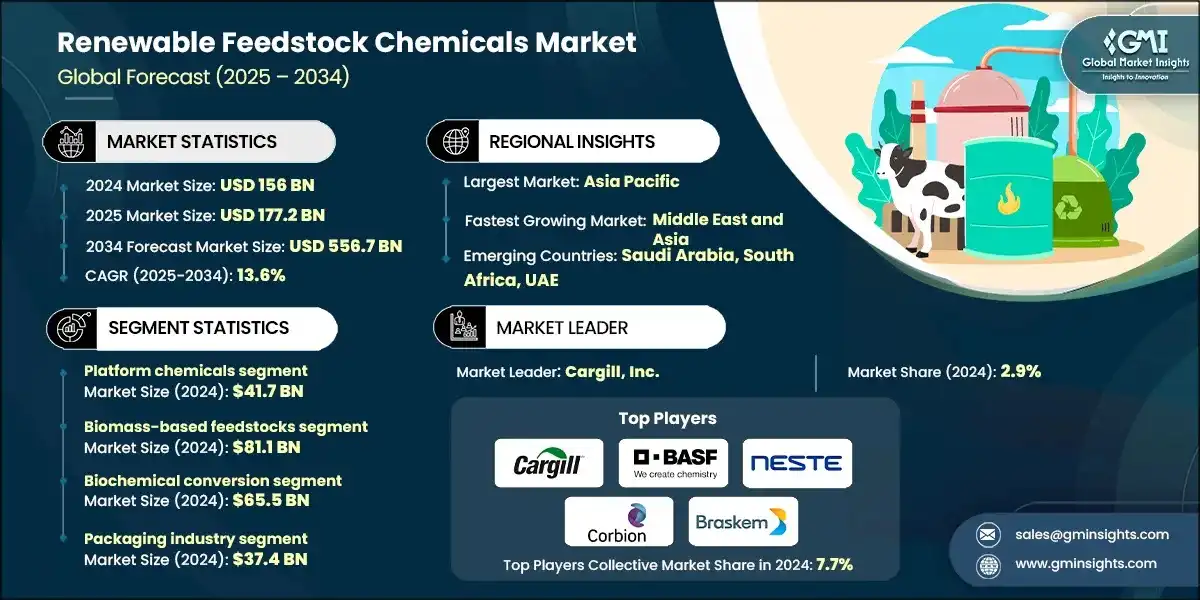
The global renewable feedstock chemicals market was valued at USD 156 billion in 2024. The market is expected to grow from USD 177.2 billion in 2025 to USD 556.7 billion in 2034, at a CAGR of 13.6%, according to the latest report published by Global Market Insights Inc.
Renewable Feedstock Chemicals Market Key Takeaways
Market Size & Growth
- 2024 Market Size: USD 156 Billion
- 2025 Market Size: USD 177.2 Billion
- 2034 Forecast Market Size: USD 556.7 Billion
- CAGR (2025–2034): 13.6%
Key Market Drivers
- Growing adoption of bio-based polymers & drop-in chemicals.
- Advancements in biochemical & thermochemical technologies.
- Expanding availability of waste & residue feedstocks.
Challenges
- High production costs limit competitiveness.
- Inconsistent product quality.
Opportunity
- Integration with circular economy solutions.
- Development of specialty bio-based chemicals.
- Leveraging digital traceability for premium products.
Key Players
- Leading Players: Top 5 players in this market include Cargill, Inc., BASF SE, Neste Corp., Corbion N.V., Braskem S.A., which collectively held a market share of 7.7% in 2024.
Get Market Insights & Growth Opportunities
- Renewable feedstock chemicals are chemicals derived from sustainable raw, non-fossil materials such as biomass, agricultural residues, organic waste, and bio-based intermediates. In contrast to traditional petrochemical products, these design for reducing carbon footprint, resource-efficient processing, and overall mandating for sustainability at the global level. This plays a crucial role in the movement towards greener industrial processes and circular value chains.
- The market has shown a tremendous development, driven by the biotechnological, bioprocessing, and thermochemical conversion method innovations. Enzymatic conversion and precision fermentation techniques, gasification, waste-to-chemicals platforms, and many others increase yield efficiency while diversifying the feedstocks availability.
- Growing demand for sustainable materials from end-user industries such as packaging, automotive, construction, consumer goods, and textiles is playing a vital role in the growth of market.
- Companies are adopting drop-in bio-based materials that interchange with the existing manufacturing infrastructure which is further helping to minimize carbon footprints without disruptions in their operations. In addition, supportive regulatory frameworks, corporate ESG commitments, and consumer trends preferring green products are strengthening this shift.
To get key market trends
Renewable Feedstock Chemicals Market Trends
- Industries increasingly use bio-based chemicals in place of fossil-based to reduce carbon footprints and achieve sustainability targets. Bioplastics, green solvents, and biodegradable polymers attract considerable demand in packaging, textiles, personal care, and construction sectors.
- The emerging market capitalizes more into circular economy principles by converting agricultural residues, industrial wastes, and captured CO2 into feedstocks for chemicals. Besides increasing profitability, valorization of these by-products also serves as a measure in minimizing environmental impacts and improving sustainability credentials.
- Sustainability and decarbonization have gained increasing global prominence and the renewable feedstock chemicals market is driven by this development. Leading companies are replacing fossil-based chemicals by bio-based alternatives such as bioplastics, green solvents, and specialty polymers across these segments - packaging, personal care, textiles, and construction.
- Innovative developments in biotechnology, enzyme engineering, fermentation, and catalytic processes are changing the dimension with the efficiency and up-scaling of renewable chemical production. Modular and flexible biorefineries wherein digital monitoring and AI process optimization drive improvements in yield and lowering costs are helping companies, as the technology thus introduces flexibility to source diverse feedstock.
- Government incentives including grants, tax benefits, carbon reduction mandates, and sustainability certification have really fuelled the pace for renewable feedstock chemicals use.
Renewable Feedstock Chemicals Market Analysis

Learn more about the key segments shaping this market
The renewable feedstock chemicals by product type are segmented into platform chemicals, biopolymers & resins, bio-based aromatics & olefins, diols & diacids, fatty acids & derivatives, specialty chemicals and bio intermediates. Platform chemicals held the largest market value of USD 41.7 billion in 2024.
- Platform chemicals support extensive downstream chemical production in branched bio-based building blocks. In addition, sustainability-oriented regulations promote the adoption of biopolymers and resins as a means of packaging renewables. As production efficiency improves along with the establishment of pathways for sustainable plastics production, bio-based aromatic and olefin compounds become important strategic materials. More importantly, diols and dicarboxylic acids continue to gain traction due to their role in bio-based polyesters and value-added materials.
- Fatty acids & derivatives are emerging slowly in the market as one of the renewable raw materials for cosmetics, lubricants, and surfactants. Increasingly in application are renewable special chemicals termed as high-value custom solutions from renewable raw materials for a very niche industrial application. Bio intermediates are proving their significance as the conversion molecules that make it easier to scale the entire value chain for renewable chemicals at a lower cost.
The renewable feedstock chemicals market by feedstock type are segmented into biomass-based feedstocks, waste-derived feedstocks, recycled carbon feedstocks, captured carbon feedstocks. Biomass-based feedstocks held the largest market value of USD 81.1 billion in 2024.
- Biomass is the standard renewable material as feedstock that complies with diverse pathways in which it can serve different biochemical and biofuel pathways. Waste-derived feeds are emerging in the circular economy strategies that turn municipal, agricultural, and industrial waste into valuable waste.
- Recycled carbon feedstock is emerging as a transition bridge technology that restructures waste-carbon-rich residues into new chemical products. Captured carbon feedstocks will continue to grow and get recognition as the true carbon-neutral options with advancements in carbon capture and carbon conversion technologies.
Learn more about the key segments shaping this market
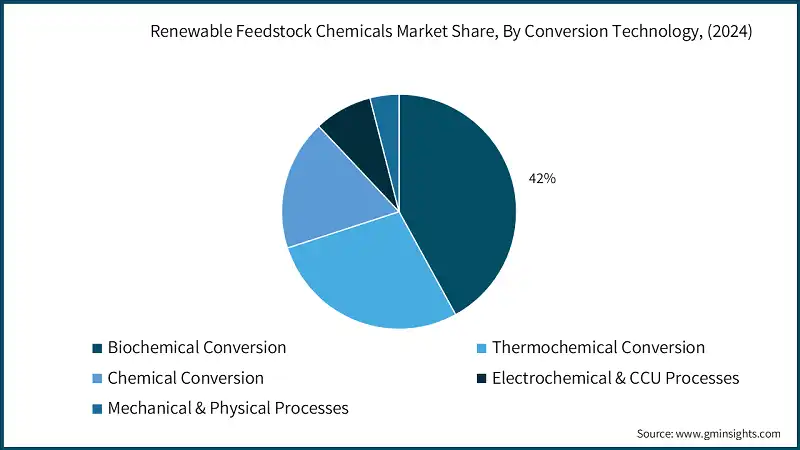
The renewable feedstock chemicals market by conversion technology is segmented into biochemical conversion, thermochemical conversion, chemical conversion, electrochemical & CCU processes and mechanical & physical processes. Biochemical conversion held the largest market value of USD 65.5 billion in 2024.
- Biochemical conversion is gaining importance in processing renewable feedstocks due to the efficient production of high-value chemicals from biomass using fermentation and enzymatic pathways. Thermochemical conversion is being explored as a versatile means to produce syngas, bio-oils, and advanced fuels from different feedstock sources. Chemical conversion methods increasingly facilitate accurate molecular transformations that further improve performance and yield of products.
- Electrochemical & CCU processes are developing high-potential technologies that use renewable electricity and capture carbon to produce ultra-low-carbon chemicals. Physical and mechanical processes are still essential for the pre-treatment and upgrading stages in support of higher conversion efficiencies of all other technology pathways.
The renewable feedstock chemicals market by end-user industry is segmented into packaging industry, automotive industry, textile & apparel industry, construction industry, food & beverage industry, pharmaceuticals & healthcare industry, personal care & cosmetics industry, paints & coatings industry, agriculture industry, chemical industry, electronics industry and oil & gas industry. Packaging industry held the largest market value of USD 37.4 billion in 2024.
- The packaging industry is the biggest user of renewable feedstock–based materials with increasing trends of brands shifting into biodegradable, recyclable, and low-carbon solutions. The automotive sector is moving ahead with introducing bio-based polymers, composites, and lubricants to decrease the weight and carbon footprint of vehicles. The textile and apparel industry embraces renewable fibers and bio-based dyes at a rapid pace due to sustainability demands. The construction industry looks forward to bio-derived, resins, as well as insulation materials and binders, to reduce embodied carbon within buildings. The food & beverage industry widens the scope of use regarding bio-based packaging and processing aids to meet regulations and meet consumer expectations.
- The renewable feedstocks are adopted by the pharmaceuticals & healthcare industry for more Greener APIs, Excipients, and Medical Polymers. Bio-based surfactants, emollients, and actives took the lead in the conversion of personal care & cosmetics companies as they joined the clean-label trends. Bio-resins and solvents made their way into the formulation of paints & coatings in efforts to minimize VOC emissions. Agriculture uses renewable feedstock-derived fertilizers, biostimulants, and crop protection chemicals. Renewable intermediates are ever-more commonly being used by the chemical industry to decarbonize their portfolios. The electronics sector sets new topologies through exploring the development of bio-based polymers and solvents in the production of lower impact, safer manufacturing processes. The integrated renewable feedstocks for the lubricant, additive, and low-carbon fuels blend segment of diversification making by the oil & gas sector.
Looking for region specific data?
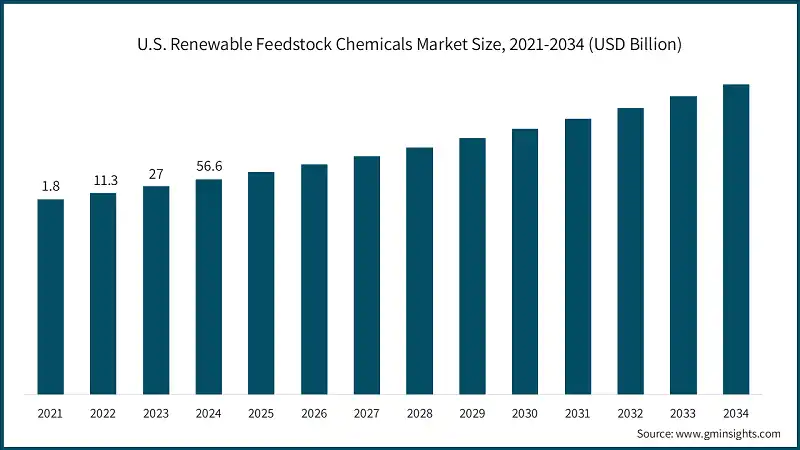
The U.S. renewable feedstock chemicals market accounted for USD 56.6 billion in 2024.
- In North America, sustainable feedstock initiatives are expanding steadily because of high sustainability targets and growing industrial transitions into bio-based materials thus resulting in the growth of the market. Regulatory support in the region, along with corporate decarbonization commitments, will further boost investments in advanced and circular feedstock. U.S. is encouraging federal incentives and private-sector demand, biopolymers, renewable intermediates, and carbon-negative processes, hence making U.S. as one of the major forces in the expansion of the North American market.
The market in the Germany is projected to experience robust growth from 2025 to 2034.
- Europe remains worldwide in the adoption of renewable feedstocks, with stringent regulations and circular economy frame. Industries in Europe are utilizing low-carbon materials for packaging, automotive, and specialty chemical applications at a fast pace. With strong R&D and chemical manufacturing bases, Germany is pushing advancement in bio-aromatics, waste-based feedstocks, and carbon capture-recognized technologies, marking it as a key player in European innovation.
The renewable feedstock chemicals market in China is anticipated to experience significant growth from 2025 to 2034.
- Asia Pacific is the one of the growing regions for renewable feedstock usage, stimulated by rapid industrialization and increasing environmental pressure. Growing consumer markets and manufacturing strength create high demand for sustainable materials. In China, biopolymer production as well as biomass-based chemicals and renewable intermediates grow at an accelerated pace backed by government initiatives and a rapid scale-up of biorefineries.
UAE market is expected to experience notable growth from 2025 to 2034.
- Latin America is strengthening its position in the global renewable feedstock supply chain by capitalizing on massive availability of agricultural biomass and competitive production costs. The continent, in turn, is expanding its abilities to convert biomass to sustainable materials. In Brazil, leadership in sugarcane-based ethanol and bio-industrial processes is fueling the development of platform chemicals, organic acids, and bioplastics, making it the powerhouse market in Latin America.
Brazil is expected to experience a prominent growth from 2025 to 2034.
- The gradual progression toward renewable and circular feedstock systems within the region is a long-term strategy for economic diversification and decarbonization. Investments are increasing along low-carbon chemical pathways and waste-to-value technologies. In the UAE, national sustainability programs and industrial innovation are rapidly advancing carbon capture utilization, bio-based specialty chemicals, and waste-derived feedstocks, establishing the country as a regional leader.
Renewable Feedstock Chemicals Market Share
- Renewable feedstock chemicals markets are moderately consolidated with players like Cargill, Inc., BASF SE, Neste Corp., Corbion N.V., Braskem S.A. holding 7.7% market share and BASF SE being the market leader holding the market share of 2.9% in 2024.
- In the renewable feedstock industry, companies are adopting advanced conversion technologies to ensure that the materials remain sustainable and retain their natural appeal with enhanced performance.
- The market is increasing for products that link traditional ecological practices with scientific justification since industries, and consumers now expect products that are environmentally responsible, ethically safe and technically valid. Enabling companies to trace a sustainable journey, measurement of all life-cycle assessments, emissions, and transparency and verification are gradually gaining confidence in mainstream partners.
- Renewable feedstocks have multiple forms that are aligned with different needs of industries to render higher strength to packaging, durability to automobile components, less carbon-intensive chemicals, and easier degradation to consumer goods. This could thereby increase fuel, resins, intermediates, coatings, and special materials in its feedstock tailored into its composition either as biomass, waste, or carbon capture.
- Branding stories and sustainability communication are fast becoming critical differentiators. Clients effectively communicate how feedstocks are collected, what kind of processing is undertaken, and which environmental benefits will become stronger forces in the marketplace. The better a buyer can know through the feedstock story about specific regions, recovery methods, or circular processes, the more environmental value can be understood.
- Customizing renewable feedstock solutions to the local industrial needs, regulatory requirements, and resource availabilities has become a strategic differentiator, as the regions are different when it comes to waste streams, biomass supplies, and emission reduction goals. Companies that have adaptability for those quickly changing types of feedstocks and processing routes consistent with evolving sustainability standards would continue to remain ahead on demand shifts and policy changes.
Renewable Feedstock Chemicals Market Companies
Major players operating in the renewable feedstock chemicals industry are:
- Amyris, Inc.
- Axens
- Avantium N.V.
- BASF SE
- Braskem S.A.
- Cargill, Incorporated
- Corbion N.V.
- Covation Bio
- dsm-firmenich
- Genomatica, Inc.
- India Glycols Limited
- NatureWorks LLC
- Neste Corporation
- Novamont S.p.A.
- Qore - Cargill/HELM Joint Venture
- Roquette
- Toray Industries
- UPM Biochemicals
Cargill, Inc. is a global agribusiness with food ingredients and bioindustrial solutions. Cargill leverages this extensive agricultural operation to produce renewable feedstocks and ingredients for its customers in the packaging, personal care, chemicals, and coatings industries. In the future, the company will focus on holding out sustainability in the production with scalable solutions to meet the emerging demand for environmentally friendly solutions.
BASF SE is a chemical company, developing innovative solutions through the whole chemicals, materials, and industrial applications portfolio. BASF is increasingly producing bio-based intermediates, polymers, and specialty chemicals from renewable feedstock and closing the loops in its different production processes through circular chemistry. Sustainability is a way of serving the world.
Neste Corp. is a Finnish-based enterprise focusing on renewable and circular solutions that leverage waste, residues, and biomass to manufacture low-carbon products. These sustainable feedstocks provide Neste with a basis upon which it prospects in assisting industries to reduce their environmental impact and transition towards a circular economy in such areas as chemicals, polymers, and fuel.
Corbion N.V. focuses its business on biochemicals and food ingredients, such as lactic acid, bioplastics, and functional preservation solutions. Based in the Netherlands, Corbion produces renewable feedstocks through fermentation technologies that are used to produce sustainable materials in food, healthcare, and industrial chemicals. Corbion works with innovations on its product development and product improvements.
Braskem S.A. established in Brazil, deals in petrochemical and chemical industries which is heavily investing in sustainable and bio-based solutions. The company has been recognized internationally for its manufacture of polymers and plastics based on renewable sources, mainly sugarcane-based ethanol, as part of its green product portfolio.
Renewable Feedstock Chemicals Market Report Attributes
| Key Takeaway | Details |
|---|---|
| Market Size & Growth | |
| Base Year | 2024 |
| Market Size in 2024 | USD 156 Billion |
| Market Size in 2025 | USD 177.2 Billion |
| Forecast Period 2025 - 2034 CAGR | 13.6% |
| Market Size in 2034 | USD 556.7 Billion |
| Key Market Trends | |
| Drivers | Impact |
| Growing adoption of bio-based polymers & drop-in chemicals | Industries like packaging, automotive, and textiles are increasingly using bio-based alternatives compatible with existing systems. |
| Advancements in biochemical & thermochemical technologies | Progress in fermentation, gasification, pyrolysis, and enzymatic conversion is improving yields and lowering production costs. |
| Expanding availability of waste & residue feedstocks | Municipal waste, agricultural residues, and biogenic CO2 streams are becoming scalable, low-cost inputs for renewable chemical production. |
| Pitfalls & Challenges | Impact |
| High production costs limit competitiveness | Renewable feedstock chemicals often cost more than petrochemicals due to complex conversion and purification processes. |
| Inconsistent product quality | Variations in biomass or waste feedstocks can lead to inconsistent chemical purity or performance. |
| Opportunities: | Impact |
| Integration with circular economy solutions | Turning agricultural residues, food waste, or industrial by-products into chemical feedstocks can open profitable waste-to-value streams. |
| Development of specialty bio-based chemicals | High-value products like bio-solvents, bio-lubricants, and biopolymers offer higher margins than bulk chemicals. |
| Leveraging digital traceability for premium products | Blockchain or IoT systems can prove sustainability claims, enabling products to fetch higher prices in conscious markets. |
| Market Leaders (2024) | |
| Market Leaders |
2.9 % |
| Top Players |
Collective market share of 7.7% in 2024 |
| Competitive Edge |
|
| Regional Insights | |
| Largest Market | Asia Pacific |
| Fastest Growing Market | Middle East and Asia |
| Emerging Country | Saudi Arabia, South Africa, UAE |
| Future Outlook |
|
What are the growth opportunities in this market?
Renewable Feedstock Chemicals Industry News
- In September 2024, AM Green Technology and Solutions B.V., part of India's Greenko Group, acquired Finnish biorefining technology firm Chempolis Oy and its Indian and Fortum 3 B.V. subsidiaries. Chempolis' multi-product lignocellulosic platform allows for the efficient conversion of 2G feedstocks into high-value chemicals such as ethanol, furfural, and lignin.
- In December 2024, Neste announced expansion on renewable feedstock for chemicals. It has introduced a co-processed variant of its Neste RE feedstock for the polymers and chemicals industry. This feedstock is made by blending renewable raw materials, such as used cooking oil, with fossil crude oil at its Porvoo refinery. This co-processed Neste RE offers a lower overall carbon footprint to that of the respective conventional fossil feedstock while remaining a drop-in solution for plastics and chemical manufacturing.
The renewable feedstock chemicals market research report includes an in-depth coverage of the industry with estimates and forecast in terms of revenue in USD Billion and volume in terms of kilo tons from 2021–2034 for the following segments:
Market, By Product Type
- Platform chemicals
- Alcohols
- Ethanol (bioethanol, cellulosic ethanol)
- Methanol (bio-methanol)
- Butanol (bio-butanol)
- Organic acids
- Lactic acid
- Succinic acid
- Citric acid
- Itaconic acid
- Glycerol & polyols
- Glycerol (glycerin)
- Sorbitol
- Xylitol
- Alcohols
- Biopolymers & resins
- Biodegradable polymers
- Polylactic acid (PLA)
- Polyhydroxyalkanoates (PHA)
- Starch-based polymers
- Drop-in biopolymers
- Bio-polyethylene (Bio-PE, Bio-HDPE, Bio-LDPE)
- Bio-polyethylene terephthalate (Bio-PET)
- Bio-ethylene vinyl acetate (Bio-EVA)
- Biodegradable polymers
- Bio-based aromatics & olefins
- Aromatics (BTX)
- Bio-benzene
- Bio-toluene
- Bio-xylene (Bio-PX)
- Aromatics from lignin
- Olefins
- Bio-ethylene
- Bio-propylene
- Aromatics (BTX)
- Diols & diacids
- Diols
- Monoethylene glycol (Bio-MEG)
- propylene glycol (1,2-propanediol)
- 1,3-propanediol
- 1,4-butanediol (Bio-BDO)
- Isosorbide
- Diacids
- Furandicarboxylic acid (FDCA)
- Adipic acid
- Sebacic acid
- Azelaic acid
- Diols
- Fatty acids & derivatives
- Fatty acids
- Fatty acid derivatives
- Dimer fatty acids
- Fatty alcohols
- Fatty acid esters (FAME, FAEE)
- Specialty chemicals
- Bio-solvents
- Surfactants
- Polyols for polyurethanes
- Lubricants
- Biointermediates
- Liquid biointermediates (Biocrude, Bio-oil)
- Gaseous biointermediates (Syngas, Biogas)
- Solid/Semi-solid biointermediates (Sugars, FFA, Lactide)
Market, By Feedstock Type
- Biomass-based feedstocks
- Agricultural feedstocks
- Starch crops (Corn, Grain Sorghum, Barley)
- Sugar crops (Sugarcane, Sugar Beets, Sweet Sorghum)
- Oil crops (Soybean, Canola, Camelina, Palm)
- Agricultural residues
- Corn stover
- Wheat straw
- Bagasse & molasses
- Forest-derived feedstocks
- Logging residues
- Mill residues (Sawdust, Bark, Black Liquor)
- Dedicated energy crops
- Switchgrass & miscanthus
- Short-rotation woody crops
- Algae & marine biomass
- Agricultural feedstocks
- Waste-derived feedstocks
- Municipal & organic waste (MSW, Food Waste)
- Industrial waste (UCO, Tallow, Distillers Oils)
- Agricultural & animal waste (Manure, Litter)
- Biogas (Landfill, Digesters)
- Recycled carbon feedstocks
- Mechanical recycling
- Chemical recycling (pyrolysis, gasification)
- Captured carbon feedstocks
- Atmospheric/Direct air capture (DAC)
- Industrial point sources (Flue Gases, Off-Gases)
- Biogenic CO2 (Fermentation, Anaerobic Digestion)
Market, By Conversion Technology
- Biochemical conversion
- Fermentation (Alcoholic, Lactic Acid, Advanced)
- Enzymatic hydrolysis
- Anaerobic digestion
- Thermochemical conversion
- Gasification
- Pyrolysis (Fast, Slow)
- Thermocatalytic conversion (BioTCat)
- Chemical conversion
- Transesterification
- Hydrotreatment/hydrotreating
- Fischer-tropsch synthesis
- Dehydration
- Methanol-to-olefins/Aromatics (MTO/MTA)
- Electrochemical & CCU Processes
- Electrolysis (Renewable hydrogen production)
- Co2 electrochemical reduction
- Co2 + h2 synthesis
- Mechanical & physical processes
- Mechanical recycling
- Chemical recycling
Market, By End Use Industry
- Packaging industry
- Automotive industry
- Textile & apparel industry
- Construction industry
- Food & beverage industry
- Pharmaceuticals & healthcare industry
- Personal care & cosmetics industry
- Paints & coatings industry
- Agriculture industry
- Chemical industry
- Electronics industry
- Oil & gas industry
The above information is provided for the following regions and countries:
- North America
- U.S.
- Canada
- Europe
- Germany
- UK
- France
- Spain
- Italy
- Rest of Europe
- Asia Pacific
- China
- India
- Japan
- Australia
- South Korea
- Rest of Asia Pacific
- Latin America
- Brazil
- Mexico
- Argentina
- Rest of Latin America
- Middle East and Africa
- Saudi Arabia
- South Africa
- UAE
- Rest of Middle East & Africa
Frequently Asked Question(FAQ) :
What is the market size of the renewable feedstock chemicals industry in 2024?
The market size was USD 156 billion in 2024, with a CAGR of 13.6% expected through 2034, supported by strong transition toward sustainable and bio-based chemical production.
What is the current renewable feedstock chemicals market size in 2025?
The market size is projected to reach USD 177.2 billion in 2025, driven by rising demand for low-carbon polymers, resins, and bio-intermediates.
What is the projected value of the renewable feedstock chemicals market by 2034?
The market size for renewable feedstock chemicals is expected to reach USD 556.7 billion by 2034, supported by rapid growth in biochemical, thermochemical, and carbon-capture-enabled pathways.
How much revenue did the platform chemicals segment generate in 2024?
Platform chemicals generated USD 41.7 billion in 2024, making it the largest product category. Increasing use of bio-based building blocks in downstream chemical manufacturing fuels its dominance.
What was the valuation of biomass-based feedstocks segment in 2024?
Biomass-based feedstocks accounted for USD 81.1 billion in 2024. Their widespread availability and suitability across fermentation, enzymatic, and thermochemical routes drive segment growth.
What is the growth outlook for biochemical conversion technologies from 2025 to 2034?
Biochemical conversion, valued at USD 65.5 billion in 2024, is expected to witness strong expansion through 2034. Growth is driven by efficiency gains in fermentation, enzymatic processing, and sustainable biomass utilization.
Which region leads the renewable feedstock chemicals market?
The U.S. renewable feedstock chemicals industry recorded USD 56.6 billion in 2024, making it the leading regional market. Growth is driven by federal incentives, bio-polymer adoption, and industrial decarbonization initiatives.
What are the upcoming trends in the renewable feedstock chemicals industry?
Key trends include rising adoption of biodegradable polymers, expansion of waste-derived and recycled carbon feedstocks, and accelerated investments in modular biorefineries and CCU technologies.
Who are the key players in the renewable feedstock chemicals market?
Major players include Cargill, BASF SE, Neste Corp., Corbion N.V., Braskem S.A., Avantium, Axens, NatureWorks, Genomatica, UPM Biochemicals, and other biotechnology and chemical innovators.
Renewable Feedstock Chemicals Market Scope
Related Reports