Summary
Table of Content

Remote Operated Vehicle Market
Get a free sample of this report
Form submitted successfully!
Error submitting form. Please try again.
Thank you!
Your inquiry has been received. Our team will reach out to you with the required details via email. To ensure that you don't miss their response, kindly remember to check your spam folder as well!
Request Sectional Data
Thank you!
Your inquiry has been received. Our team will reach out to you with the required details via email. To ensure that you don't miss their response, kindly remember to check your spam folder as well!
Form submitted successfully!
Error submitting form. Please try again.
Remote Operated Vehicle Market Size
Institutions and governments in marine sciences are funding ROVs to use in deep-sea exploration, habitat mapping, monitoring coral reefs, and researching on climate change. ROVs fitted with high-resolution imaging and sensors gather important data about the environment at depths that cannot be accessed by divers. This motivates the use of ROV in ecological research, oceanography, and biodiversity survey to promote sustainable policies, conservation programs, and international environmental programs.
Remote Operated Vehicle Market Key Takeaways
Market Size & Growth
- 2025 Market Size: USD 1.9 Billion
- 2026 Market Size: USD 2.1 Billion
- 2035 Forecast Market Size: USD 3.9 Billion
- CAGR (2026–2035): 7.2%
Regional Dominance
- Largest Market: North America
- Fastest Growing Region: Europe
Key Market Drivers
- Expansion of offshore oil & gas exploration.
- Rapid growth of offshore wind energy.
- Rising defense and naval modernization programs.
- Growth in subsea telecom and power cable infrastructure.
- Technological advancements in robotics and AI integration.
Challenges
- High capital and operational costs.
- Skilled operator shortage.
- Harsh offshore operating environments.
- Dependency on offshore energy cycles.
Opportunity
- Expansion of deep-sea mining activities.
- Growth in marine research and environmental monitoring.
- Rising aquaculture and offshore farming operations.
- Integration with autonomous underwater vehicles (AUVs).
Key Players
- Market Leader: Oceaneering led with over 37% market share in 2025
- Leading Players: Top 5 players in this market include Deep Trekker, Ocean Modules, Oceaneering, Saab Seaeye Ltd, TechnipFMC, which collectively held a market share of 67% in 2025.
Get Market Insights & Growth Opportunities
Major players operating in ROV market are engaged in various inorganic growth strategies such as new product launch, mergers & acquisitions, partnership to stay competitive in the market. For instance, In August 2024, Next Geosolutions Europe (NextGeo) declared it has acquired Subonica, an Italian company adding underwater surveying with remotely operated vehicles (ROVs), to improve its own assets in the renewable energy sector. The purchase involved a new ten meters coastal ship and three observation-type remote operated vehicles that enabled NextGeo to enhance the process of surveying and inspecting the coastal waters and shallow waters.
Due to the growth of offshore oil, gas and renewable energy facilities underwater inspection, maintenance and subsea construction are in high demand. ROVs provide access to deepwater environments that is cost effective and safe and reduce human risk. Their accuracy in underwater operations, real-time data acquisition and distance control make their projects faster, making them more widely accepted in the energy industries that need continuous and consistent operations underwater.
The world is witnessing the use of ROVs by the naval and coast guard forces as a mine countermeasure, port security, hull inspection, and underwater reconnaissance. ROVs minimize the risk to people operating in hostile or dangerous environments and increase situational awareness through sonar and sensor systems. Emerging budgets on autonomous and remote systems enhance the demand in the ROV market in support of the maritime security operation, which is persistent and cost-effective.
The commercial aquaculture and offshore facilities such as underwater pipelines and telecommunication cables promote the use of ROVs to inspect, repair, and manage biofouling. Operators use ROVs in order to guarantee integrity of assets and maximize production efficiency. As the automation and AI inclusion enhance the operational uptime, ROVs provide accuracy and scalability, propelling its usage in the private and industrial subsea maintenance industries.
The high-rate market development of the ROV is driven by ambitious application of offshore wind energy, especially in the North Sea and Baltic region. Energy companies and governments focus a lot on renewable, and such undertakings demand regular sea inspections, laying cables and maintenance tasks. New oceanographic studies are encouraged through strict environmental laws and research grants. The synergistic development of renewable infrastructure and regulatory attention is accelerating the adoption of ROV in the industries.
The domination of North America can be explained by the large offshore oil and gas operations in the Gulf of Mexico and Arctic waters whereby ROVs are required in the exploration, drilling support, and integrity management. Local OEMs offer advanced technological innovation, high defense spending and business models that rely on services which make regions stronger. Such combination of industry demand, engineering leadership and capital investment helps North America to maintain a large share of the market.
The global remote operated vehicle market was estimated at USD 1.9 billion in 2025. The market is expected to grow from USD 2.1 billion in 2026 to USD 3.9 billion in 2035, at a CAGR of 7.2% according to latest report published by Global Market Insights Inc.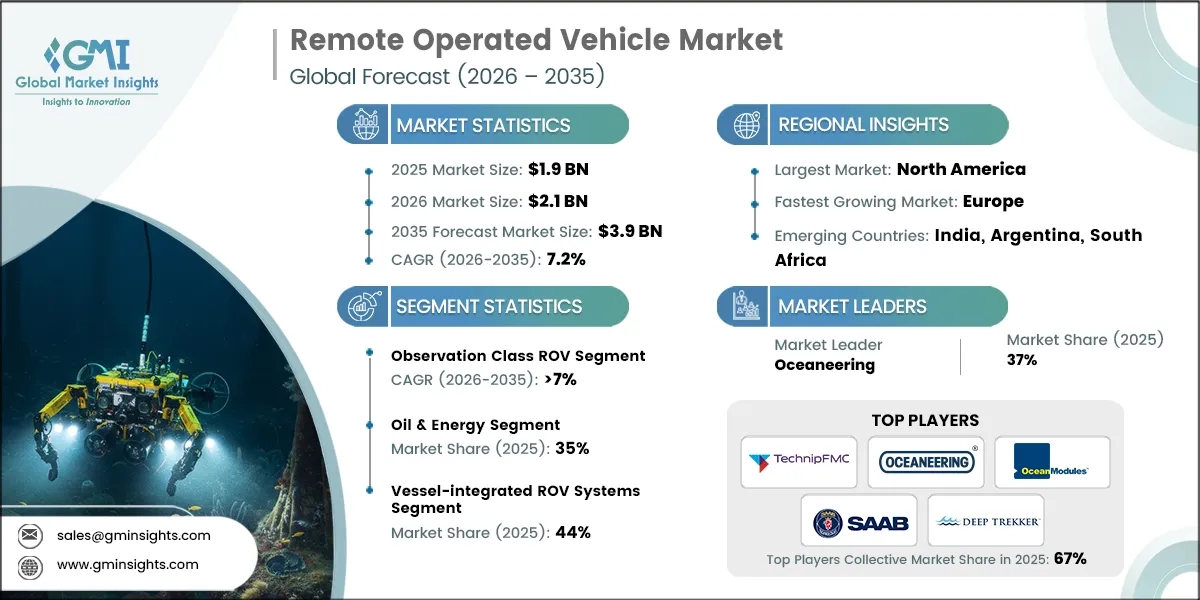
To get key market trends
Remote Operated Vehicle Market Trends
There is a growing demand in remote operated vehicles, especially the large-scale offshore wind farms as expansion of offshore renewable energy projects continues to grow. ROVs have been extensively employed in conducting seabed surveys, cable laying support, turbine foundation inspections, and maintenance support. As the offshore installations are progressing to deeper and more hostile environments, operators are employing advanced ROV to keep their operations safe, minimize downtime and improve operational efficiency within the renewable energy assets.
Continued deepwater and ultra-deepwater offshore oil and gas exploration leads to the continued use of ROV. These systems assist in the operations of drilling, installation of equipment at the sea, inspection of wellhead as well as monitoring of pipeline integrity. ROVs can be used in comparison with diver-based operations because they are safer, less costly to operate, and provide real-time diagnostics. The growing attention to the lifespan of assets and efficient development of the field supports the long-term market demand even more.
Increased defense spending in modernization and maritime security is hastening the use of ROVs in defence operations. Mine countermeasures, underwater reconnaissance, port security inspection, and hull inspection are the purposes of ROVs. This increases the strategic value as they can work in high-risk or conflict waters without losing lives. The growth of underwater demand is being strengthened by increasing geopolitical tensions and growing defense budgets.
The high proliferation of underwater infrastructure such as telecommunications cables, pipelines and offshore production networks has created the need for routine examination and maintenance. High-definition cameras, sonar, and robotic manipulators on ROVs allow faults to be detected and fixed with a high level of accuracy. The growing digital connectivity and transportation of energy over oceans necessitates the use of reliable underwater networks that make ROVs crucial in predictive maintenance and infrastructure reliability.
The increasing focus on marine studies and related environmental surveillance is contributing to the use of ROV technology in academic and government organizations. These are used to explore the deep seas, map the habitats, measure biodiversity, and determine the effects of climate change. Since ROVs are equipped with increased sensor integration and real-time data transmission, they enable researchers to explore deep ocean locations without any risk, which can be used to promote global sustainability efforts and ocean conservation programs.
Commercial aquaculture is shifting into offshore and deepwater areas that are generating fresh demand on underwater inspection solutions. The uses of ROVs include monitoring of fish cages, identifying the structural damage, managing biofouling, and evaluation of seabed conditions. With the increase in consumption of sea food products across the world, operators are trying to automate the products to enhance efficiency and minimize the risk of overworking. This transition towards the use of technology in carrying out aquaculture activities is boosting market development in the long run.
Remote Operated Vehicle Market Analysis
Learn more about the key segments shaping this market
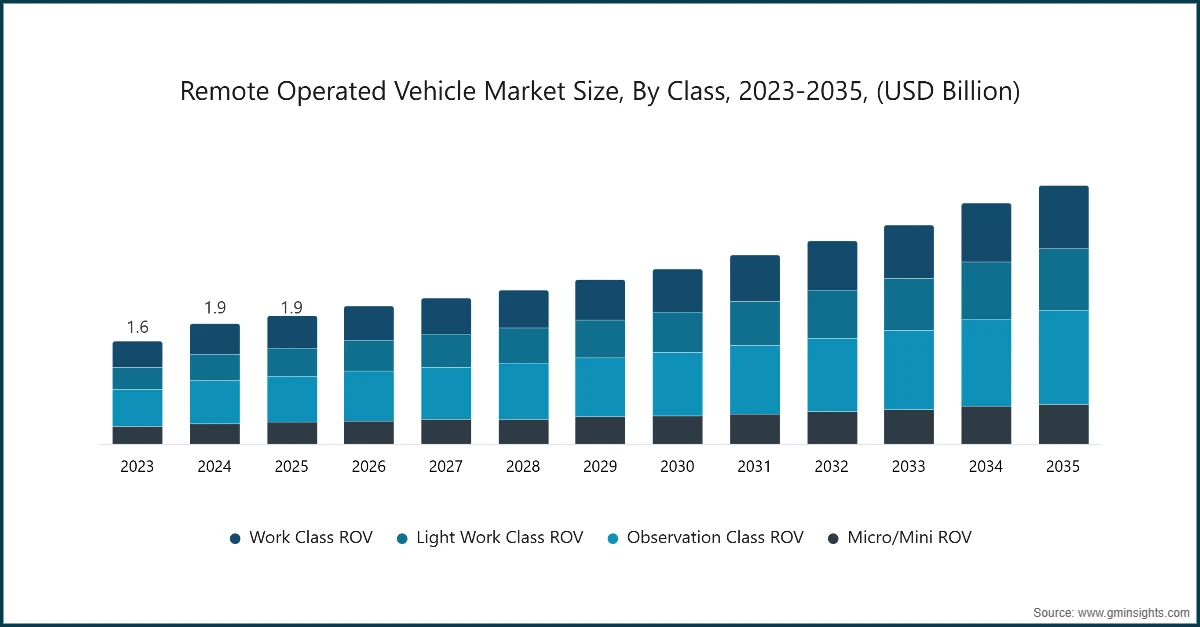
Based on class, the remote operated vehicles market is divided into work class ROV, light work class ROV, observation class ROV, and micro/mini ROV. The observation class ROV segment dominated the market accounting for around 35% in 2025 and is expected to grow at a CAGR of over 7% from 2026 to 2035.
- Observation class ROVs are becoming more common in the routine underwater inspections in the energy, telecom and maritime industries. They are low cost and easily maneuvered making perfect in visual status examination of underwater structures, pipelines and cables. The need to maintain the integrity of assets and meet regulatory standards in industry makes observation ROVs increasingly demanded in all parts of the world as visual data that is accurate and of high resolution.
- Increasing environmental surveillance and research programs evoke the demand of the observation class ROVs. The systems are used by governments and marine institutes to catalogue the marine ecosystems, biodiversity surveys, and coral reefs. Their small size can be deployed by smaller research vessels, which can enable scientists to gather important images and sensor data in both shallow and deep waters, thereby enabling scientists to adopt them faster in ecological and climatic studies.
- ROVs of observation class are popular in offshore wind farm operations to conduct regular seabed inspection, checks on cables and foundation checks. Network operators are demanding more and more visual information at regular timings in order to provide structural integrity and maintenance planning assurance. In renewable energy industries that are growing rapidly all around the world, these ROVs offer efficient remote imaging, lessening reliance on costly manned dives, and facilitate safer and cost-efficient maintenance of assets.
- The emergence of aquaculture and sub-sea farming enhances the requirement to have affordable underwater monitoring. The ROVs of observation class help to check fish cages, feeding systems, moorings, and net conditions using real-time video. The structural problems or environmental changes can be spotted by farmers fast, which enhances the efficiency of operations. The scale of sustainable production of seafood makes these ROVs essential tools because of the opportunity to make underwater observation constant and low risk.
- There is an investment in observation class ROVs by port and coastal security agencies to monitor the underwater environment, hull and threat detection. These ROVs can be deployed quickly and easily by patrol boats, and they also offer real-time images of any underwater objects and lower the risk of the drivers. Their combination with sonar and camera systems improves the level of situational awareness, improving maritime safety requirements and reducing risks underwater.
- ROVs of observation classes are being applied more and more in salvage and underwater archaeology operations. Their high-definition cameras, low-cost of operation, and high level of control enable the researchers and salvage crews to record the sites of the wreck, map features and the condition of the artifacts without disturbing the delicate environment. Due to the increased interest in underwater heritage preservation, these ROVs facilitate accurate and non-invasive exploration and documentation of underwater cultural resources
Learn more about the key segments shaping this market
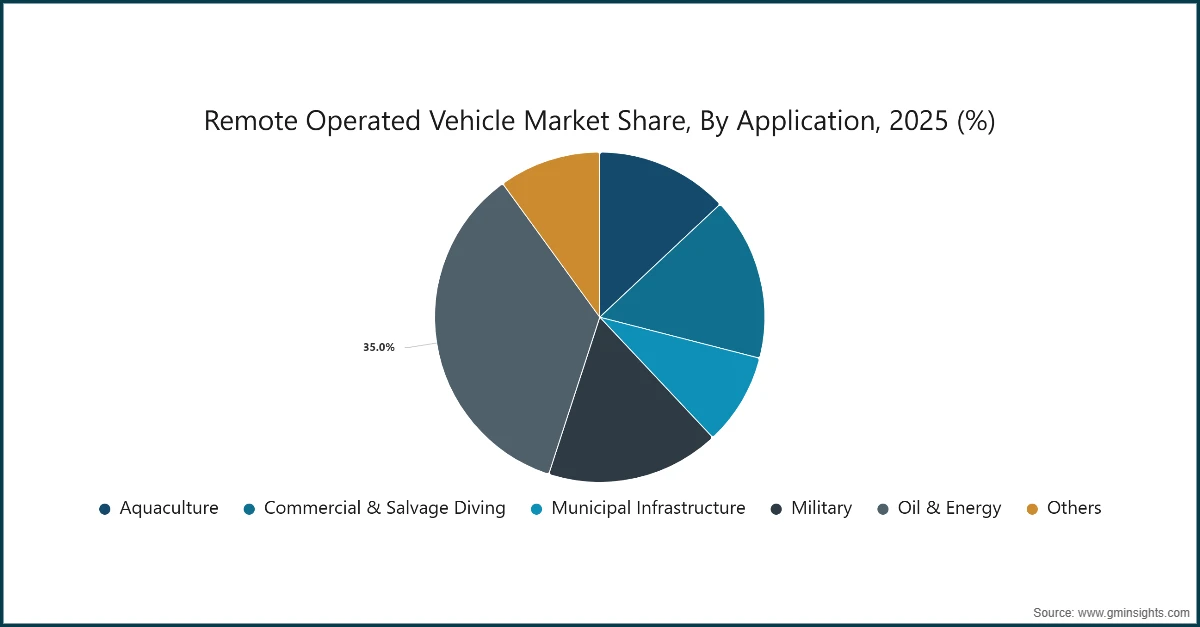
Based on application, the remote operated vehicles market is segmented into aquaculture, commercial & salvage diving, municipal infrastructure, military, oil & energy, and others. The oil & energy dominate the market with 35% share in 2025, and the segment is expected to grow at a CAGR of over 6.5% from 2026 to 2035.
- The exploration of the offshore oil and gas, especially in deepwater and ultra-deepwater basins, contributes greatly to the demand for ROVs. Operators use ROVs in supporting the drilling process, checking the blowout preventers, installing subsea equipment and monitoring the pipelines. ROVs offer safer and cost-effective and high-precision intervention solutions that are technically difficult to achieve in reservoirs as they are increasingly challenging to sustain operational continuity and high hydrocarbon recovery rates.
- The international development of offshore wind energy programs boosts the ROV use to carry out seabed surveys, cable support installation, foundation surveys, and maintenance. The growing size of turbines as well as underwater planting necessitates sound underwater robotics that could guarantee structural integrity. ROVs help the operators reduce the downtimes, maximize safety compliance, and sustain performance of the assets in the speedily growing renewable energy portfolios.
- The old infrastructure in the mature basins is also posing a stiff demand on the inspection, repair, and maintenance services. ROVs facilitate corrosion evaluation, structural analysis and life-extension of subsea resources. With operators aiming to make the most out of the available fields, there is a risk that continuous subsea observation is invaluable, therefore, leading to the use of ROVs over the long term in oil and energy fields that require continuous maintenance.
- The decommissioning of offshore platforms and subsea installations is coming out as a significant catalyst of growth. ROVs are important in well plugging, structure dismantling and clearing operations on the seabed. Safe and environmentally responsible decommissioning regulatory requirements augment the use of accurate underwater robotics, which expands the use of ROVs during end-of-life offshore energy endeavors.
- Offshore operations can be better integrated through digitalization of offshore operations which leads to ROV integration with data analytics programs, remote monitoring and predictive maintenance systems. Automated subsea inspection programs are gaining more and more popularity among energy companies to minimize operational risks and enhance efficiency. ROVs fitted with modern sensors and AI-enhanced diagnostics enhance data-driven decision-making, which will speed up the implementation in technologically advanced projects in offshore oils and renewable energy sources.
- Recent trends in subsea tieback and marginal field developments are creating a need to find solutions to the intervention at low cost. ROVs aid larger subsea manifold installations, umbilical connections and flowline inspections in smaller, distributed fields. ROVs have become important enabling factors of effective development of subsea production systems in response to flexible and lower-capex development plans by the operators.
Based on depth rating, the market is segmented into shallow water ROVs (≤1,000 msw), mid-water ROVs (1,000–3,000 msw), deepwater ROVs (3,000–6,000 msw), and ultra-deepwater ROVs (more than 6,000 msw). The deepwater ROVs (3,000–6,000 msw), dominated the market, accounting for share of 28% in 2025.
- Ultra-deepwater exploration operations like pre-salt basins and frontier offshore operations have high capacity ROV systems that are rated 3,000-6,000 meters. These settings require designs that are resistant to pressure and sophisticated navigation. Demand of the special deep water ROV platforms is also on the increase as the discovery of hydrocarbons moves in deeper waters.
- High-voltage power distribution and fibre optic tether systems promote high-voltage technological innovation in deepwater ROVs performance. A high thrust capacity, better manipulators and improved tooling systems are capable of complex construction and intervention at extreme depths. These innovations increase the range of operations, and offshore operators will use deep-rated ROVs on more difficult operations.
- New opportunities of deepwater offshore wind and floating energy development open new applications of high-depth ROV systems. Deep-sea production units and subsea cable networks should be monitored and repaired by water. Deepwater ROVs are useful solutions in promoting structural integrity as well as long-term performance of energy assets.
- The expanding deep-sea mineral exploration programs are raising the usage of heavy ROVs which can work in depths of more than 3,000 meters. Seabed mapping, sampling and environmental assessment are carried out by these systems. With increasing demand of critical minerals in the world, deepwater capable ROVs are increasingly becoming important tools to accompany the offshore resources exploration programs.
- The new safety and regulation standards of deepwater oil and gas operations demand constant checking of the equipment under the sea. Deepwater ROVs are used to give real-time view of wellheads, risers and systems underwater production. They will be effective in high-pressure offshore settings because their capability to carry out remote interventions diminishes the exposure of risks, which enhances their strategic value.
Based on system architecture, the market is divided into vessel-integrated ROV systems, modular containerized ROV systems, and fully containerized ROV systems. vessel-integrated ROV systems dominates with 44% market share in 2025.
- The increasing demand for integrated offshore service models is a factor contributing to the uptake of vessel integrated ROV systems. The direct integration of ROVs into dedicated support vessels positively impacts operational efficiency, minimizes the time spent on mobilization, and allows the cruise of the subsea. There is a rising trend by energy operators to use turnkey vessels as a combination of crew, equipment, and robotics in single services contracts.
- Increases in offshore wind farm maintenance work are driving a need to demand specific services in operation vessels with inbuilt ROV services. These ships carry out regular inspection, cable survey, and structure survey without the need of special mobilization. This is a combined model that enhances the uptime of assets and minimization of the complexity of operations.
- Development of technological innovations within the dynamic positioning systems and onboard power management enhance compatibility of ROVs with multipurpose offshore vessels. Increased integration guarantees constant launching and recovery operations under extreme sea conditions. This consistency leads to increased rates of use and a wider adaption of vessel-based ROV deployment models.
- The growing inspection demands on telecom cables and energy pipelines under the sea are encouraging owners to adopt integrated vessels that can undergo the response missions quickly. ROVs systems that have vessels can be deployed immediately in case of maintenance or emergency and they reduce the downtime and save important networks of underwater infrastructure facilities.
Looking for region specific data?
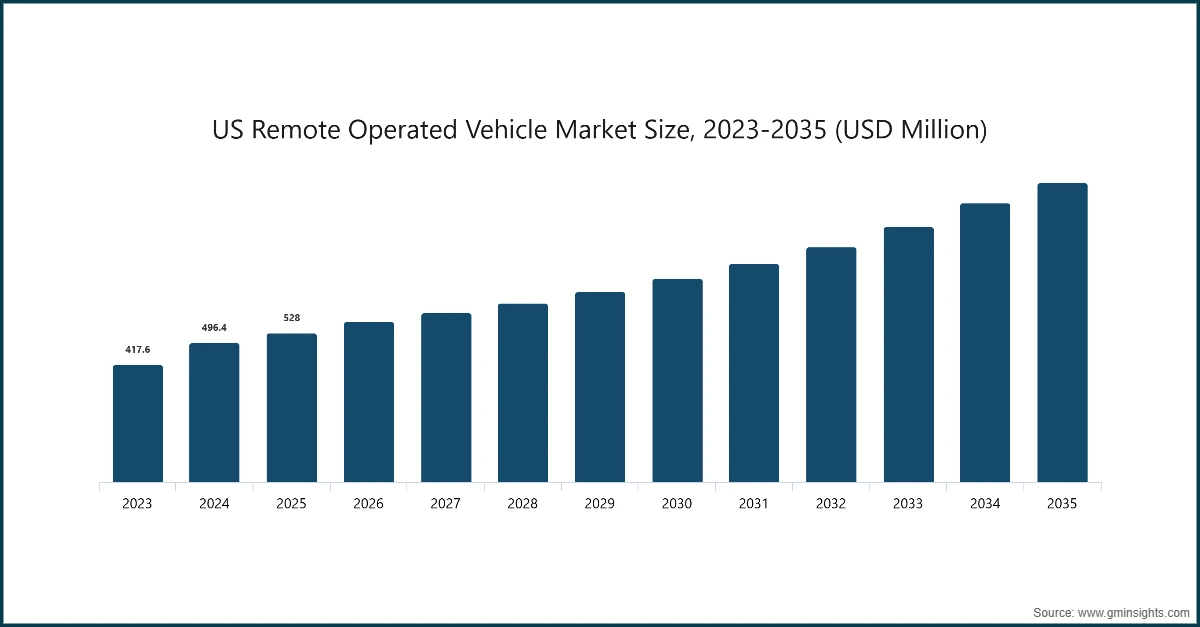
US dominated the remote operated vehicle market in North America with around 71% share and generated USD 528 million in revenue in 2025.
- The ROV demand in the US is greatly fueled by the sustained offshore oil and gas operation in the Gulf of Mexico. The inspection and intervention of platform maintenance, deepwater drilling and subsea tiebacks are job categories that demand sophisticated work-class ROV systems. With operators committed to maximizing the exploitation of mature assets, in-service monitoring and life-extension schemes reinforce long-term exploitation of the fleet.
- ROVs to survey the seabed, lay the cables, and inspect the foundations of the turbines. Big developments are promoted by federal leasing rounds and clean energy targets, which provide steady demand of robotics underwater robotics throughout the construction and commissioning stages of the projects and long-term operations and maintenance.
- High level of naval and defense expenditure improves the uptake of ROVs in the underwater surveillance, countermeasures of mines and in port security operations. The U.S Navy has incorporated modern remotely operated systems to minimize the risk of divers and enhance operational preparedness. The ongoing programs of modernization and the maritime security need contribute to the consistent purchasing of high-performance underwater robotic systems.
- There are large networks of subsea telecom cables linking North America to other world markets that must be inspected and repaired on a regular basis. ROVs assist in fault detection, burial appraisal and service of vital underwater data infrastructure. The increasing digital connectivity and cloud-based solutions strengthen the necessity of trustworthy cloud services monitoring initiatives based on subsea cables.
- Domestic innovation is encouraged by technological leadership, and the availability of well-established manufacturers and service providers of ROV. Robotization, AI inspection systems, and enhanced sensor systems enhance efficiency. The underwater robotics competitive edge of the United States has been maintained through the strong ecosystem of offshore engineering experience and research houses.
The Germany remote operated vehicle market reached over USD 69 million in 2025, driven development of offshore wind energy in the North and Baltic Seas.
- High-precision ROV systems and electric innovation is backed by innovation in advanced engineering facilities and a solid base in maritime technology. German companies focus on energy efficiency propulsion, automation and digital control systems, and make them more reliable and extend their use in offshore renewable and marine research fields.
- Tough environmental policies and sustainability objectives promote large-scale marine surveillance. The role of ROVs in compliance with regulation is becoming more important in seabed mapping, habitat protection, and environmental impact assessment in relation to offshore infrastructure projects.
- The strategic positioning of Germany in the subsea power and communication network in Europe facilitates cable inspection and maintenance services demand. Cross-border energy interconnectors and fiber-optic networks are important in ensuring that the economy in the region is stable and therefore ROVs help protect these infrastructures.
- The research institutions and the offshore industries collaborate in underwater robotics to create technology. The investment in marine research by governments encourages the use of compact sensor-rich ROVs to support scientific discovery and oceanography research.
The remote operated vehicle market in China is projected to grow at a strong CAGR of 6% from 2026 to 2035. The South China Sea provides the swift offshore oil and gas exploration by China leading to the high demand of deepwater ROV systems.
- Extensive offshore wind development in the eastern coast of China hastens the use of ROVs to survey the seabed, lay offshore cables and clear up foundation inspections. Unmanned underwater robotic services have a long-term demand due to government-supported renewable energy goals.
- The increased investment in the home shipbuilding and underwater engineering sector fortifies the production of ROVs in China. The introduction of ROV systems in the offshore support vessels that are in the region also increases the operational efficiency and less dependency on the international suppliers.
- The governmental priorities related to deep-sea exploration and marine resources development of China promote the application of the heavy-duty ROVs in mapping the seabed and evaluating the mineral resources. Technology is also boosted by national oceanographic programs and scientific missions.
- The growth of undersea telecom cables that facilitate the growth of digital infrastructure increases the inspection and repair solutions. The ROVs are very essential in supporting the connectivity of the regional and international data transmission networks.
The remote operated vehicle market in Brazil reached significant scale in 2025. The ultra-deepwater pre-salt projects under development in Santos and Campos basin of Brazil demand high-specification work-class and deepwater ROVs in large quantities.
- The continuous deployment of FPSOs in offshore fields upgrades the demands of subsea connectivity such as risers, manifolds and umbilicals. ROVs are very important in checking installation, tieback support, and structural observation. Since Brazil is extending the floating production capacity, the underwater robotics are required to ensure flow efficiency and continuity of production.
- The offshore pipeline decommissioning in Brazil is slowly growing, especially in the mature shallow-water property. Safe well abandonment regulatory requirements, removal of subsea equipment, and regulatory requirements on environmental compliance add more service pressure to dismantling and seabed clearance activities through ROV support, which is not part of active production fields.
- Growth of subsea fiber-optic cable networks between Brazil and North America, Europe and Africa enhances the necessity of underwater inspection and repair solutions. ROVs are used in the burial evaluation, fault monitoring, and cable security maintenance, making sure that digital infrastructure is resistant to increased data traffic and connectivity reliance.
- New applicability of seabed surveys and foundation inspections is being provided by emerging offshore wind feasibility studies along the coastlines of Brazil, both to the south and northeast. With the development of renewable projects toward the commercialization stage, the use of ROV is expected to vary not only with hydrocarbons but also contributes to the expansion of the markets in the long term.
The remote operated vehicles market in Saudi Arabia is projected to grow at a CAGR 4% from 2026 to 2035. The comprehensive offshore oil and gas infrastructure in the Arabian Gulf and Saudi Arabia makes unlimited inspection and maintenance requirements of ROV. Subsea pipeline networks, jackets, and production platforms are large objects in need of routine structural evaluation, corrosion inspection, and repair services that serve the purpose of guaranteeing the production reliability and adherence to stringent safety regulations.
- Continuous offshore field expansion programs (such as new wellhead platforms, subsea tiebacks, etc) augment installation and commissioning needs. ROVs facilitate the installation of equipment under sea, locating flow lines, and conducting tests on the operations, which explains their significance in the growth of hydrocarbons capacity.
- The increase in the interest of the Kingdom in offshore gas development to serve domestic energy-transition increases the need in the systems of interventions under the sea. The expansion projects of gas fields demand the use of accurate underwater robots to monitor the high-pressure underwater installations and offer operational integrity in high-tech constrained environments.
- The increased investment in maritime security and offshore assets protection improves the use of ROVs to monitor the underwater area, conduct hull inspection, and detect threats. Securing strategic energy systems and shipping canals is a factor that has led to the use of dependable remotely operated systems in the defense and security services.
- The localization of Vision 2030 promotes the creation of local subsea engineering capacities and cooperation with the foreign services. This emphasis of technology transfer and industrial diversification can help incremental growth of the national ROV ecosystem to enhance market expansion in the long term inside Saudi Arabia.
Remote Operated Vehicle Market Share
- The top companies in the ROV industry are Oceaneering, TechnipFMC, Saab Seaeye, Halma/Deep Trekker, Ocean Modules, VideoRay, and Seamor, collectively contributing a significant share of the global market in 2025.
- Oceaneering is a company that is always ahead of the pack with detailed fleet modernization, automation upgrades and state-of-the-art tooling integration to intervene in deepwater operations. The firm invests in online subsea solutions, real-time data analytics, and remote operation centers to enhance efficiency. The reinforcement of its dominance in global services is by the long-term agreements with large offshore energy operators and the growth into renewable energy checking services.
- TechnipFMC is able to offer ROV services along with integrated subsea engineering, procurement and construction facilities to increase its competitiveness. Vertical integration by the firm enables provision of bundled field development solutions, which shorten the project timelines and cost. The value proposition of its digital twin technologies and subsea production optimization enhances the value and compliments the complex deepwater and ultra-deepwater projects.
- The Saab Seaeye specializes in electric ROVs with high performance, control software and modular payload. The sustained innovation in smart autonomy, military-level reliability, and hybrid cars technology allow the company to grow in the naval, offshore energy, and scientific research markets. The technology differentiation and international credibility is facilitated by the wider expertise in defense that Saab possesses.
- Halma, with Deep Trekker, focuses on small, small, and affordable observation-grade ROVs to the inspection, aquaculture, and public safety and infrastructure markets. The firm focuses on easy-to-use interfaces, ability to integrate with modules, and deploying quickly. Diversified product lines and global distribution systems are useful in enhancing competitiveness across the commercial and urban environment.
- Ocean Modules also differentiate with strong electric work-class ROVs that would be applicable to challenging offshore oil, gas, and renewable missions. The company has invested in high thrust systems, flexibility of hydraulic tooling and flexible configurations. Its presence in niche markets in the subsea construction markets is maintained by strategic partnerships with offshore contractors and emphasis on performance reliability in difficult environments.
- VideoRay competes by providing small, mission-configurable ROVs that are commonly used in the field of defense, security and inspection missions. The company focuses on modular architecture, high speed deployment, and hi-tech navigation systems. Alliances with military and government systems as well as ongoing software and sensor upgrades enhance their dominance in portable professional-grade ROV systems.
- Seamor specializes in lightweight, configurable ROVs that are used in inspection, aquaculture and ocean research. The company makes investment in modular tooling options, intuitive control systems and flexible configurations to suit different operational needs. Customer support and the specific targeting of industrial and environmental monitoring applications enhance its competitiveness.
Remote Operated Vehicle Market Companies
Major players operating in the remote operated vehicle industry include:
- Forum Energy Technologies
- Halma/Deep Trekker
- Ocean Modules
- Oceaneering
- Saab Seaeye
- Saipem
- Seamor
- SLB (Schlumberger)
- TechnipFMC
- VideoRay
- The market of ROV is very competitive, and it is represented by the international subsea engineering companies, the special manufacturers of ROVs, and the special providers of the offshore services. The major corporations work on the areas of modernization of the fleet and automation improvements and integration of the more sophisticated sensors to improve efficient operation and reliability. Long term contracts with offshore oil, gas and renewable energy operators offer consistent revenues. Businesses are also venturing into offshore wind, deep-sea exploration and defense applications to branch out of the usual hydrocarbon markets.
- The mid-sized and niche competitors have been competing based on product innovation, modular system design and cost-effective observation-class solutions serving inspection, aquaculture research, and security industries. Competitive differentiation is becoming transformed because of growing focus on digitalization, analytics powered by AI, and remote operations centers. The competition is further enhanced by the partnerships, vessel integration approaches, and geographic expansion in the new offshore markets and the customization, ability to deploy swiftly, and aftersales services support are the key factors that play the role in the long-term market positioning.
Remote Operated Vehicle Market Report Attributes
| Key Takeaway | Details |
|---|---|
| Market Size & Growth | |
| Base Year | 2025 |
| Market Size in 2025 | USD 1.9 Billion |
| Market Size in 2026 | USD 2.1 Billion |
| Forecast Period 2026-2035 CAGR | 7.2% |
| Market Size in 2035 | USD 3.9 Billion |
| Key Market Trends | |
| Drivers | Impact |
| Expansion of offshore oil & gas exploration | Increasing deepwater and ultra-deepwater projects require ROVs for drilling support, subsea installation, and pipeline inspection, strengthening demand for advanced work-class and observation-class ROV systems. |
| Rapid growth of offshore wind energy | Offshore wind farms need regular seabed surveys, cable monitoring, and turbine foundation inspections, accelerating adoption of compact and heavy-duty ROVs across Europe and Asia Pacific. |
| Rising defense and naval modernization programs | Increased use of ROVs for mine countermeasures, port security, underwater surveillance, and hull inspections boosts procurement across naval forces globally. |
| Growth in subsea telecom and power cable infrastructure | Expansion of undersea fiber-optic and energy transmission networks drives frequent inspection and maintenance activities, supporting steady ROV deployment. |
| Technological advancements in robotics and AI integration | Integration of high-definition imaging, sonar systems, automation, and real-time data analytics enhances operational efficiency and expands commercial applications. |
| Pitfalls & Challenges | Impact |
| High capital and operational costs | Advanced ROV systems require significant investment, limiting adoption among small operators and research institutions in developing markets. |
| Skilled operator shortage | Complex ROV operations demand highly trained personnel, creating workforce gaps and increasing training costs. |
| Harsh offshore operating environments | Extreme water depths, pressure conditions, and unpredictable weather increase equipment wear and operational risk. |
| Dependency on offshore energy cycles | Market demand fluctuates with oil price volatility and offshore project investments. |
| Opportunities: | Impact |
| Expansion of deep-sea mining activities | Exploration of seabed minerals and rare earth elements creates new demand for heavy-duty ROV systems. |
| Growth in marine research and environmental monitoring | Increased funding for climate research and ocean biodiversity projects supports observation-class ROV adoption. |
| Rising aquaculture and offshore farming operations | Underwater inspection of cages, nets, and seabed conditions opens recurring revenue streams. |
| Integration with autonomous underwater vehicles (AUVs) | Hybrid ROV-AUV solutions improve operational flexibility and reduce intervention costs. |
| Market Leaders (2025) | |
| Market Leader |
37% market share |
| Top Players |
Collective Market Share in 2025 is 67% |
| Competitive Edge |
|
| Regional Insights | |
| Largest Market | North America |
| Fastest growing market | Europe |
| Emerging countries | India, Argentina, South Africa |
| Future outlook |
|
What are the growth opportunities in this market?
Remote Operated Vehicle Industry News
- In September 2025, Coratia Technologies to sell ROV to Indian Navy. Coratia Technologies, substantiated that it signed a USD 7.5 million contract with the Indian Navy. This is the first large-scale introduction of India-made UWROVs into operational service, and the signing of the agreement, which was performed in the presence of senior Indian Navy officials, is witness to this fact.
- In Feb 2025, UK based Forum Energy Technologies (FET) unveiled its ultra-heavy-duty work-class remotely operated vehicle (ROV) aimed at improving operations at the sea-level with more payloads and control features. FET claims that the XLX EVO III ROV has bigger thrusters to make it more effective as a through-water vehicle, a new buoyancy package allowing the 500-kg load, and CNC machined frame to allow easier maintenance access and tooling.
- In November 2024, N-Sea declared that it will have expanded its fleet with a new hybrid support vessel, which will be named Geo Master, a survey and remotely operated vehicle (ROV) support vessel that will be delivered in 2026. The vessel is a long-term charter agreement to Mainport Shipping and is going to be constructed by Neptune Construction in the Netherlands, and designed to the most recent requirements in both fuel efficiency and emissions.
- In September 2024, Vay Technology collaborated with Bayanat to improve the growth of its remotely controlled vehicles business in the Middle East and Africa. The CGM is expected to develop teledriving technology by combining geospatial data with AI whereby the Bayanat AI-enabled platform is used to enhance the decision-making and situational awareness of Vay remote teledrivers.
The remote operated vehicle market research report includes in-depth coverage of the industry with estimates & forecasts in terms of revenue ($ Mn/Bn) and shipment (Units) from 2022 to 2035, for the following segments:
Market, By Class
- Work class ROV
- Light work class ROV
- Observation CLASS ROV
- Micro/mini ROV
Market, By Application
- Aquaculture
- Commercial & salvage diving
- Municipal INFRASTRUCTURE
- Military
- Oil & Energy
- Others
Market, By Depth Rating
- Shallow water ROVs (≤1,000 msw)
- Mid-water ROVs (1,000–3,000 msw)
- Deepwater ROVs (3,000–6,000 msw)
- Ultra-deepwater ROVs (more than 6,000 msw)
Market, By System Architecture
- Vessel-integrated ROV systems
- Modular containerized ROV systems
- Fully containerized ROV systems
The above information is provided for the following regions and countries:
- North America
- US
- Canada
- Europe
- UK
- Germany
- France
- Italy
- Spain
- Russia
- Netherlands
- Nordics
- Asia Pacific
- China
- India
- Japan
- South Korea
- Australia
- Southeast Asia
- Latin America
- Brazil
- Mexico
- Argentina
- MEA
- UAE
- South Africa
- Saudi Arabia
Frequently Asked Question(FAQ) :
What was the market size of the remote operated vehicle in 2025?
The market size was USD 1.9 billion in 2025, with a CAGR of 7.2% expected through 2035. Increased funding for marine sciences and advancements in ROV technology are driving market growth.
What is the projected value of the remote operated vehicle market by 2035?
The market is poised to reach USD 3.9 billion by 2035, driven by demand from offshore renewable energy projects, oil and gas exploration, and defense applications.
What is the expected size of the remote operated vehicle industry in 2026?
The market size is projected to reach USD 2.1 billion in 2026.
What was the market share of the observation class ROV segment in 2025?
The observation class ROV segment accounted for approximately 35% of the market in 2025 and is expected to grow at a CAGR of over 7% till 2035.
What was the market share of the oil & energy sector in 2025?
The oil & energy sector held a 35% market share in 2025 and is set to expand at a CAGR of over 6.5% through 2035.
What was the market share of deepwater ROVs in 2025?
Deepwater ROVs (3,000–6,000 msw) accounted for 28% of the market in 2025, led by ultra-deepwater exploration operations requiring high-capacity systems.
Which region dominated the remote operated vehicle sector in 2025?
The United States dominated the North American market with a 71% share, generating USD 528 million in revenue in 2025. This was fueled by sustained offshore oil and gas operations in the Gulf of Mexico.
What are the upcoming trends in the remote operated vehicle market?
Trends include offshore renewable expansion, defense adoption, advanced underwater maintenance, and rising use in marine research and aquaculture.
Who are the key players in the remote operated vehicle industry?
Key players include Forum Energy Technologies, Halma/Deep Trekker, Ocean Modules, Oceaneering, Saab Seaeye, Saipem, Seamor, SLB (Schlumberger), TechnipFMC, and VideoRay.
Remote Operated Vehicle Market Scope
Related Reports