Summary
Table of Content

Redox Flow Battery Storage Market
Get a free sample of this report
Form submitted successfully!
Error submitting form. Please try again.
Thank you!
Your inquiry has been received. Our team will reach out to you with the required details via email. To ensure that you don't miss their response, kindly remember to check your spam folder as well!
Request Sectional Data
Thank you!
Your inquiry has been received. Our team will reach out to you with the required details via email. To ensure that you don't miss their response, kindly remember to check your spam folder as well!
Form submitted successfully!
Error submitting form. Please try again.
Redox Flow Battery Storage Market Size
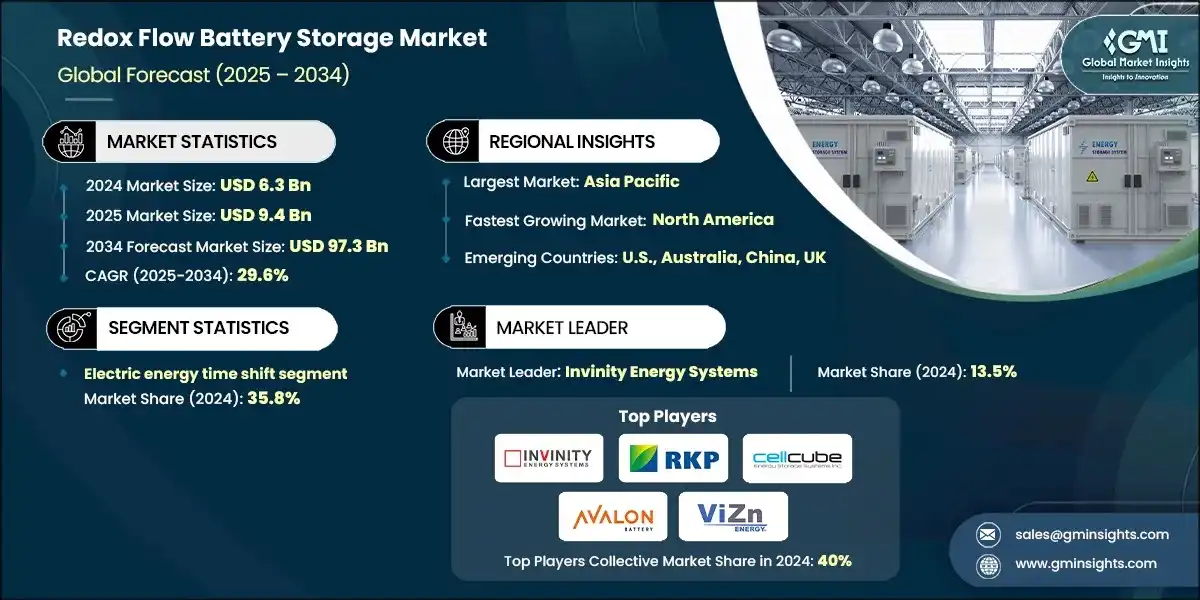
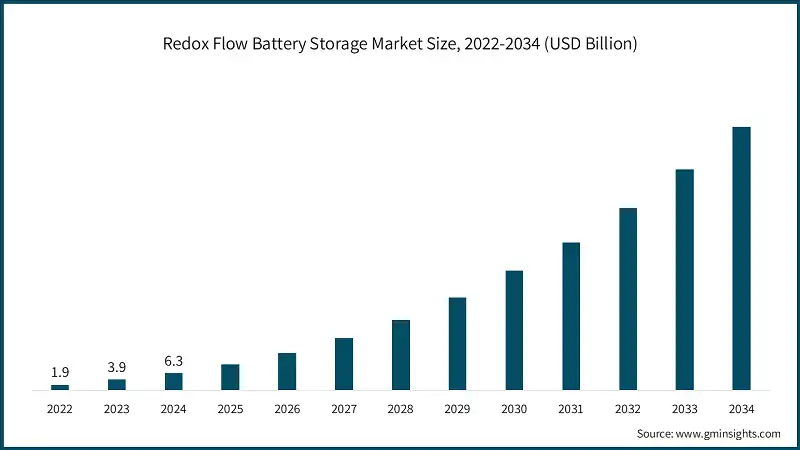
The global redox flow battery storage market was valued at USD 6.3 billion in 2024. The market is expected to grow from USD 9.4 billion in 2025 to USD 97.3 billion by 2034, at a CAGR of 29.6%, according to Global Market Insights Inc.
Redox Flow Battery Storage Market Key Takeaways
Market Size & Growth
- 2024 Market Size: USD 6.3 Billion
- 2025 Market Size: USD 9.4 Billion
- 2034 Forecast Market Size: USD 97.3 Billion
- CAGR (2025–2034): 29.6%
Key Market Drivers
- Growth in the renewable energy sector.
- Favorable regulatory framework.
Challenges
- Safety concerns.
Opportunity
- Grid-scale renewable integration.
- EV charging infrastructure support.
Key Players
- Market Leader: Invinity Energy Systems led with over 13.5% market share in 2024.
- Leading Players: Top 5 players in this market include Invinity Energy Systems, Rongke Power, CellCube Energy Storage Systems, Avalon Battery, ViZn Energy Systems, which collectively held a market share of 40% in 2024.
Get Market Insights & Growth Opportunities
- The surge in solar and wind installations globally is driving demand for long-duration energy storage. Redox flow batteries (RFBs) offer scalable discharge durations (4–24 hours), making them ideal for managing renewable intermittency. Their ability to store excess energy and release it during low production periods supports grid stability and enhances the reliability of renewable energy systems.
- For instance, in September 2025, BESSt, a U.S.-based startup, unveiled a zinc–polyiodide redox flow battery with an energy density of 320 Wh/L—20 times higher than conventional vanadium systems. Developed in collaboration with Pacific Northwest National Laboratory, the battery is tailored for solar and hybrid renewable projects. Its compact footprint and extended-duration storage capabilities make it ideal for round-the-clock renewable integration.
- Governments and utilities are investing in grid upgrades to accommodate decentralized energy sources. RFBs play a key role in these efforts by providing flexible, modular storage solutions that support load balancing, frequency regulation, and voltage control. Their deep discharge capabilities and long cycle life make them suitable for modern smart grids.
- Unlike lithium-ion batteries, RFBs decouple power and energy components, allowing independent scaling. This makes them ideal for applications requiring multi-hour storage, such as peak shaving and load shifting. As energy systems transition to renewables, the need for 8–12-hour storage windows is increasing, positioning RFBs as a preferred solution.
- RFBs are inherently safer than lithium-ion batteries due to their low risk of thermal runaway and chemical fires. Their electrolytes are recyclable and non-flammable, aligning with environmental and sustainability goals. These features make them attractive for deployment in densely populated or sensitive areas.
- Industries such as manufacturing, data centers, and mining are adopting RFBs for backup power and energy management. Their reliability, scalability, and ability to handle deep discharge cycles make them suitable for mission-critical operations. Commercial facilities benefit from reduced energy costs and enhanced power quality.
- Supportive policies like the U.S. Infrastructure Investment and Jobs Act and Section 45X manufacturing credits are accelerating RFB deployment. These incentives reduce capital costs and promote domestic manufacturing, making RFBs more accessible to utilities and private developers.
- Innovative financing models, such as vanadium leasing, lower upfront costs for RFB systems. This capital-light approach enables broader adoption, especially in emerging markets. It also supports circular economy principles by promoting electrolyte reuse and recycling.
- For instance, in July 2025, Largo Physical Vanadium Corp. validated its leasing model through a 48 MWh flow battery project in Texas. Partnering with Storion Energy and TerraFlow, the agreement enables vanadium electrolyte leasing, reducing upfront costs and accelerating commercialization. The Bellville project showcases how leasing transforms stored vanadium into revenue-generating assets while supporting U.S. energy resilience.
To get key market trends
Redox Flow Battery Storage Market Trends
Learn more about the key segments shaping this market
- RFBs are increasingly being deployed in modular, containerized formats, simplifying installation and scalability. These plug-and-play systems are ideal for remote or off-grid locations and can be expanded as energy needs grow. Over 620 modular systems were deployed globally in 2024.
- Ongoing R&D is improving RFB efficiency, reducing costs, and expanding electrolyte options beyond vanadium. Iron-chromium and zinc-bromine chemistries are emerging as cost-effective alternatives. These innovations enhance performance and broaden application potential.
- Global efforts to reduce carbon emissions are driving investment in clean energy storage. RFBs support decarbonized grids by enabling renewable integration and reducing reliance on fossil fuel-based peaker plants. Their long life and recyclability further contribute to sustainability.
- For instance, in July 2025, Sumitomo Electric secured its third redox flow battery order for Kashiwazaki City, Japan, supporting its decarbonization initiative. The new 8,000 kWh system will be installed at Nishiyama Sports Park, adding to two existing RFB installations. These systems store solar energy during the day and discharge during peak demand, enhancing renewable utilization.
- Vanadium-based RFBs benefit from secure supply chains, with many countries possessing domestic vanadium reserves. This reduces dependence on imported lithium and cobalt, which are subject to geopolitical risks. Supply chain resilience is becoming a key factor in energy storage decisions.
- For example, in September 2025, Invinity Energy Systems announced a strategic partnership with a Chinese manufacturer to secure vanadium supply and reduce costs. The move supports vertical integration and mitigates risks associated with lithium-ion supply chains, which are dominated by a single country. This partnership enables Invinity to scale domestic production of vanadium redox flow batteries, enhancing energy resilience and supporting U.S. goals for secure, diversified battery supply chains.
- RFBs are gaining traction in developing regions with unreliable grids and high renewable potential. Government-backed microgrid projects and rural electrification programs are deploying RFBs to ensure energy access and resilience.
- As electric vehicle adoption grows, RFBs are being used to support charging hubs. Their ability to provide stable, long-duration power makes them ideal for buffering grid loads and ensuring uninterrupted charging services.
- Venture capital and corporate investments in battery startups are fueling innovation in semi-solid technologies. These funds support R&D, pilot production, and commercialization, accelerating time-to-market. As investor confidence grows, more resources are being directed toward scaling semi-solid battery solutions.
- With solid-state and lithium-silicon technologies advancing, semi-solid state batteries are gaining attention as a near-term solution. Their hybrid nature offers a practical balance between performance and manufacturability. As competition intensifies, companies are adopting semi-solid designs to stay ahead in the race for battery innovation.
- For reference, in October 2025, HyperStrong integrated vanadium redox flow batteries into a 100 MW/200 MWh EV charging hub in China’s Yunnan Province. The system supports grid-forming capabilities and avoids costly grid upgrades. This “Storage + X” model enables tailored energy storage for EV stations, mining, and data centers. HyperStrong’s approach is expanding across Asia-Pacific, offering scalable, fire-safe, and long-duration storage for high-demand EV infrastructure.
Redox Flow Battery Storage Market Analysis
Learn more about the key segments shaping this market
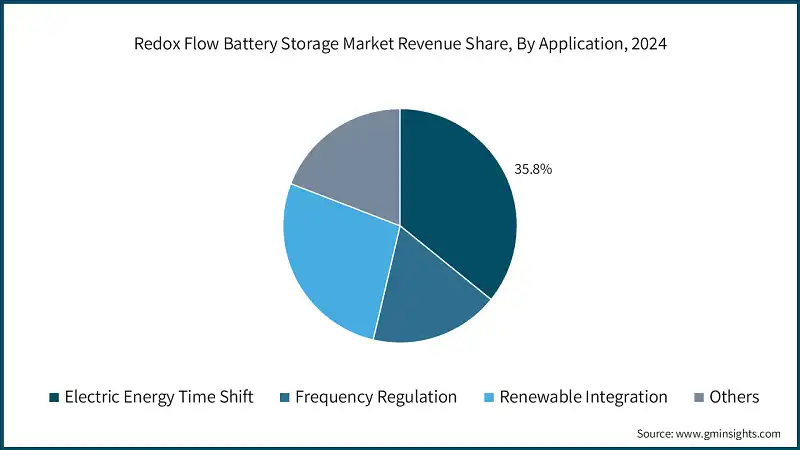
- Based on application, the industry is segmented into electric energy time shift, frequency regulation, renewable integration, and others. The electric energy time shift segment accounted for around 35.8% market share in 2024 and is expected to grow at a CAGR of 29.7% through 2034.
- Electric energy time shift is a key application where RFBs excel due to their ability to store energy during low-demand periods and discharge during peak hours. This helps utilities reduce peak load stress and optimize energy pricing. For instance, vanadium redox flow batteries are increasingly used in solar-plus-storage systems to shift midday solar generation to evening demand. Their long discharge durations (up to 12 hours) and deep cycling capabilities make them ideal for time-shifting applications, especially in regions with dynamic pricing models and high renewable penetration.
- RFBs are gaining traction in frequency regulation due to their fast response times and ability to maintain grid stability. Unlike lithium-ion batteries, RFBs can cycle thousands of times without significant degradation, making them suitable for continuous frequency balancing. Utilities are deploying RFBs to manage grid fluctuations caused by intermittent renewables. Their modular design allows for precise control of power output, supporting real-time grid frequency adjustments.
- Renewable energy integration is one of the strongest growth drivers for RFBs. As solar and wind installations surge globally, the need for long-duration storage to manage intermittency becomes critical. RFBs offer scalable energy capacity and stable performance over time, making them ideal for smoothing renewable output and minimizing curtailment. For illustration, in 2024, over 39% of new utility-scale projects in Asia used RFBs for solar and wind storage. Their ability to decouple power and energy components allows tailored solutions for diverse renewable setups, supporting grid reliability and decarbonization goals.
- RFBs are increasingly used for load leveling and peak shaving in commercial and industrial settings. These applications involve storing energy during off-peak hours and discharging during peak demand to reduce grid stress and lower electricity costs. RFBs’ long cycle life and deep discharge capabilities make them ideal for daily cycling in facilities with variable energy loads. Data centers, manufacturing plants, and hospitals are adopting RFBs to manage energy costs and ensure uninterrupted operations. This trend is supported by rising energy tariffs and demand charges, especially in regions with deregulated electricity markets.
- RFBs are well-suited for microgrid and off-grid applications due to their safety, scalability, and long-duration capabilities. In rural and remote areas, RFBs provide reliable backup and renewable integration without the fire risks associated with lithium-ion systems. Government-backed programs in Asia, Africa, and Latin America are deploying RFBs in community microgrids to enhance energy access and resilience. Their modular design allows easy expansion, and their recyclable electrolytes align with sustainability goals.
- Emergency backup is a growing application for RFBs, especially in critical infrastructure like hospitals, data centers, and military bases. Their ability to deliver consistent power over extended periods makes them ideal for resilience planning. Unlike diesel generators, RFBs offer clean, quiet, and low-maintenance backup solutions. Utilities are also using RFBs to support emergency response during outages caused by extreme weather.
- As electric vehicle adoption grows, RFBs are being integrated into EV charging hubs to buffer grid loads and ensure stable power supply. Their long-duration discharge and modular scalability make them suitable for high-demand charging stations. In China and Europe, RFBs are used in “Storage + X” models to support EV infrastructure without requiring costly grid upgrades. These systems help manage peak loads and reduce strain on local transformers, enabling faster deployment of charging networks.
- Industries with energy-intensive processes are adopting RFBs to optimize energy use and reduce operational costs. Applications include load balancing, power quality improvement, and integration with on-site renewables. Mining, manufacturing, and chemical sectors benefit from RFBs’ ability to handle deep discharge cycles and provide stable power over long durations. Their durability and low maintenance requirements make them cost-effective for continuous operations. As industrial decarbonization accelerates, RFBs are emerging as a key enabler of clean energy transitions in heavy-duty sectors.
- RFBs provide stable voltage and frequency support, helping maintain consistent power quality. Their ability to respond quickly to fluctuations and deliver clean energy makes them ideal for sensitive equipment. As industries digitize and automation increases, the demand for reliable power grows. RFBs, with their long cycle life and minimal degradation, offer a sustainable solution for maintaining high-quality power in complex electrical environments.
- RFBs are increasingly used to defer costly upgrades to transmission and distribution infrastructure. By installing RFBs near load centers, utilities can manage peak demand locally, reducing the need for new substations or transmission lines. This is particularly valuable in urban areas where expansion is expensive and logistically challenging. RFBs’ modularity and long-duration capabilities allow utilities to optimize grid investments while enhancing reliability.
Looking for region specific data?
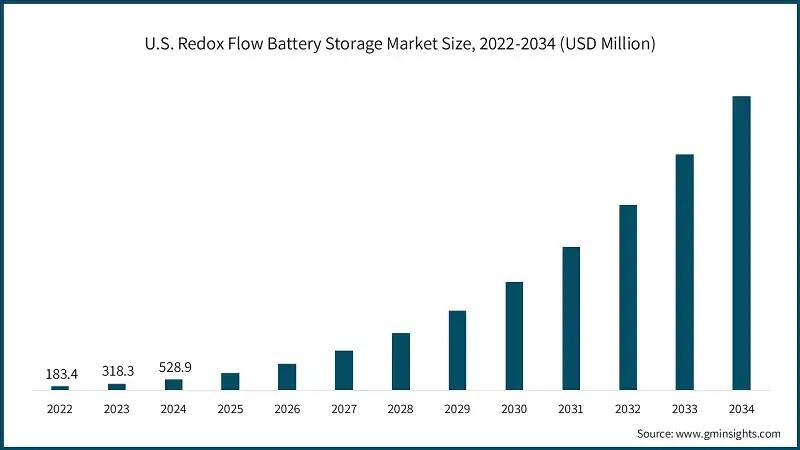
- The U.S. redox flow battery storage market is set to reach USD 14.5 billion by 2034, propelled by a strong policy framework that prioritizes energy resilience, decarbonization, and domestic innovation. These policies encourage startups and national labs to develop advanced chemistries and scalable systems. Additionally, the U.S. grid’s increasing vulnerability to climate-induced disruptions is driving demand for safe, long-duration storage solutions like RFBs, which offer deep cycling, modularity, and fire-safe operation—ideal for critical infrastructure and renewable integration.
- North America’s redox flow battery market is driven by policy support, grid modernization, and renewable integration. For instance, the U.S. Department of Energy allocated USD 2.5 billion for battery manufacturing and recycling under the Infrastructure Investment and Jobs Act. Canada and Mexico are also investing in long-duration storage to support decarbonization. Vanadium leasing models and Section 45X credits reduce entry barriers. FERC Order 841 enables revenue stacking for storage assets. Industrial users and utilities are adopting RFBs for backup power and peak shaving. The region’s emphasis on energy security and supply chain resilience supports continued growth.
- Europe’s redox flow battery storage market is expanding rapidly due to aggressive decarbonization goals and energy security concerns. Countries like Germany, France, and the UK are deploying vanadium redox flow batteries to balance intermittent renewables. Strict environmental regulations favor non-flammable, recyclable technologies like RFBs. Government-backed R&D and pilot projects are improving efficiency and reducing costs. Europe’s aging grid infrastructure is being modernized with long-duration storage, and RFBs are central to this transition.
- Germany and France are leading RFB adoption in Europe through national energy transition programs. Germany’s Energiewende and France’s REPowerEU initiatives prioritize grid stability and renewable integration. RFBs are being deployed in solar and wind parks to manage variability and reduce curtailment. Local manufacturers like Invinity and Enerox are scaling production. Research institutions are improving membrane durability and electrolyte efficiency. These countries are also investing in circular economy models, with RFBs offering recyclable components and long lifespans.
- The UK is emerging as a hub for RFB innovation and deployment. Invinity Energy Systems, based in Scotland, is leading commercial rollouts of vanadium redox flow batteries. The UK government’s Net Zero Strategy includes funding for long-duration storage technologies. RFBs are being integrated into EV charging hubs, solar farms, and municipal microgrids. Their safety and scalability make them ideal for urban applications. Universities and startups are collaborating on hybrid chemistries and modular designs.
- Asia Pacific is the fastest-growing region for RFBs, driven by massive renewable investments and manufacturing scale. China leads in vanadium production and flow battery deployment, with projects like Dalian Rongke’s 100 MW system. Japan and South Korea are investing in R&D and commercial rollouts. Australia is piloting RFBs in solar microgrids and mining operations. Government incentives, grid modernization, and industrial demand are fueling growth.
- Governments in China and South Korea actively support semi-solid battery commercialization through subsidies, pilot projects, and industrial policy. These efforts accelerate market readiness and global competitiveness.
- China and India are driving RFB adoption through national energy strategies. China’s 14th Five-Year Plan includes large-scale storage targets, with vanadium flow batteries deployed in wind and solar parks. India is exploring RFBs for rural electrification and grid balancing. Domestic manufacturing and vanadium reserves support cost-effective deployment. Chinese firms like Rongke Power and VRB Energy are scaling production and exporting systems. India’s Make in India initiative supports local assembly and R&D. Both countries are integrating RFBs into smart grid and EV infrastructure, addressing intermittency and enhancing energy access.
- Emerging markets in the Middle East, Africa, and South America are adopting RFBs for energy access and grid stability. Saudi Arabia’s Tdafoq Energy partnered with Delectrik Systems to build a GWh-scale vanadium flow battery plant. South Africa is investing in vanadium beneficiation and local assembly. Brazil and Chile are deploying RFBs in solar microgrids and industrial zones. These regions benefit from abundant solar resources and growing demand for clean backup power. International partnerships and donor-funded projects are accelerating adoption. RFBs offer safe, scalable, and sustainable solutions for off-grid and utility-scale applications.
Redox Flow Battery Storage Market Share
- The top 5 companies in the redox flow battery storage industry are Invinity Energy Systems, Rongke Power, CellCube Energy Storage Systems, Avalon Battery, and ViZn Energy Systems contributing around 40% of the market in 2024.
- ViZn Energy Systems offers safe, non-toxic, and recyclable energy storage solutions for utility, commercial, industrial, and microgrid applications. ViZn’s batteries deliver both high-power and long-duration services, with a robust 20-year design and minimal degradation across full charge cycles. Their systems are engineered for extreme environments and offer superior ROI through multiple revenue streams. ViZn’s commitment to safety, reliability, and sustainability positions it as a key player in the long-duration energy storage market.
- Invinity Energy Systems is a global leader in vanadium redox flow battery (VRFB) technology. Headquartered in London, the company manufactures modular, utility-grade systems optimized for long-duration storage. Its flagship product line, Endurium™, supports up to 500+ MWh deployments with 30+ years of asset life and zero degradation. Invinity’s batteries are non-flammable, fully recyclable, and ideal for grid-scale renewable integration. With manufacturing facilities in Scotland and Canada, and strategic partnerships including Siemens Gamesa, Invinity is driving the transition to 24/7 clean energy.
Redox Flow Battery Storage Market Companies
- Rongke Power reported over 3.5 GWh of global installations by mid-2025. The company is a leading developer of vanadium redox flow batteries (VRFBs), headquartered in Dalian, China. With over 500 patents and a 1 GW annual production capacity, Rongke Power supplies utility-scale energy storage systems for grid stabilization and renewable integration. Its recent 100 MW/400 MWh project in Northwest China and a strategic rollout in Northern Ireland highlight its global reach. Rongke’s water-based, non-flammable electrolyte design ensures safety and longevity, while its vertically integrated model supports mass deployment across Asia, Europe, and the Middle East.
- Everflow operates under the SCHMID Group and has deployed scalable vanadium redox flow battery systems across Europe and Asia. Founded in 2015 and headquartered in Freudenstadt, Germany, Everflow specializes in stationary energy storage solutions for telecom, commercial, and utility sectors. Its portfolio includes modular containers, building-integrated systems, and multi-MWh installations. Everflow’s water-based electrolyte offers unlimited cycling, deep discharge capability, and zero fire risk. Backed by SCHMID’s industrial expertise and global manufacturing footprint, Everflow is advancing safe, recyclable, and long-duration storage technologies. Strategic deployments in EV charging hubs and neighborhood grids position Everflow as a key enabler of decentralized energy infrastructure.
- CellCube Energy Storage Systems has deployed over 130 vanadium flow battery units globally. Headquartered in Austria and operating under Enerox GmbH, CellCube offers scalable, long-duration storage solutions for commercial, industrial, and utility sectors. Its systems deliver up to 24 hours of energy with 20,000+ cycles and zero degradation. In 2024, CellCube secured USD 19 million in U.S. federal funding for military microgrid projects. The company’s modular design, real-time monitoring, and turnkey service model make it ideal for renewable integration and grid stability. With operations in Europe and North America, CellCube is a key player in sustainable energy storage.
Major players operating in the redox flow battery storage market are:
- Avalon Battery
- CellCube Energy Storage Systems
- Elestor
- ESS
- Everflow
- Invinity Energy Systems
- Largo
- Primus Power
- Rongke Power
- Sumitomo Electric
- ViZn Energy Systems
- Voltstorage
- VRB Energy
Redox Flow Battery Storage Market Report Attributes
| Key Takeaway | Details |
|---|---|
| Market Size & Growth | |
| Base Year | 2024 |
| Market Size in 2024 | USD 6.3 Billion |
| Market Size in 2025 | USD 9.4 Billion |
| Forecast Period 2025 - 2034 CAGR | 29.6% |
| Market Size in 2034 | USD 97.3 Billion |
| Key Market Trends | |
| Drivers | Impact |
| Growth in the renewable energy sector | The redox flow battery market is expanding rapidly due to the rising integration of renewable energy sources like solar and wind. These batteries offer scalable, long-duration storage, ideal for managing intermittent power supply |
| Favorable regulatory framework | Supportive policies in North America, including DOEs Long Duration Storage Shot and UL/IEEE standards, are fostering redox flow battery adoption. These frameworks promote safety, performance, and grid integration |
| Pitfalls & Challenges | Impact |
| Safety concerns | Despite their safety advantages, redox flow batteries face pitfalls such as electrolyte leakage, complex system maintenance, and limited energy density, which can pose operational and environmental concerns in large-scale deployments |
| Opportunities: | Impact |
| Grid-scale renewable integration | Redox flow batteries enable stable, long-duration energy storage, helping utilities manage solar and wind intermittency. Their scalability and safety make them ideal for decarbonized grid infrastructure worldwide |
| EV charging infrastructure support | RFBs support high-demand EV charging hubs by buffering peak loads and reducing grid upgrade costs. Their modular design and fire-safe operation suit urban deployments and fast-growing electric mobility networks. |
| Market Leaders (2024) | |
| Market Leaders |
13.5% market share |
| Top Players |
Collective market share in 2024 is 40% |
| Competitive Edge |
|
| Regional Insights | |
| Largest Market | Asia Pacific |
| Fastest Growing Market | North America |
| Emerging Country | U.S., Australia, China, UK |
| Future Outlook |
|
What are the growth opportunities in this market?
Redox Flow Battery Storage Industry News
- In February 2025, Largo Clean Energy Corp. and Stryten Critical E-Storage have successfully completed the formation of Storion Energy, a joint venture aimed at developing vanadium flow batteries for long-duration energy storage. Storion Energy will combine Largo’s access to vanadium from its mine in Brazil with Stryten's US-based electrolyte production, creating a vertically integrated supply chain for vanadium redox flow batteries (VRFBs).
- In October 2024, VRB Energy has broken ground on a new industrial base for vanadium flow battery energy storage, with an ambitious goal of producing 3 GWh of capacity. This large-scale facility will focus on manufacturing vanadium redox flow batteries (VRFBs), which are designed to support grid-scale energy storage applications. The project is a major step forward in VRB Energy’s efforts to expand its presence in the renewable energy and energy storage markets.
- In October 2024, CellCube Inc. received USD 19 million in funding for a megawatt-scale vanadium redox flow battery (VRFB) system by the U.S. Department of Defense Innovation Unit (DIU). This funding will support the development and deployment of a large-scale energy storage system, designed to enhance the integration of renewable energy into the grid. The system is expected to offer reliable, long-duration energy storage, which is crucial for stabilizing grids powered by intermittent renewable sources like solar and wind.
- In September 2024, ESS Inc. has partnered with Energy Storage Industries (ESI) to establish a manufacturing site in Maryborough, Queensland, Australia, which will produce long-duration energy storage solutions using iron flow battery technology. The project aims to create 3.2 GWh of annual energy storage capacity, with an initial target of 1.6 GWh by 2026, and expansion to 3.2 GWh by 2029.
The redox flow battery storage market research report includes in-depth coverage of the industry with estimates & forecast in terms of volume (MW) & revenue (USD Million) from 2021 to 2034, for the following segments:
Market, By Application
- Electric Energy Time Shift
- Frequency Regulation
- Renewable Integration
- Others
The above information has been provided for the following regions and countries:
- North America
- U.S.
- Canada
- Mexico
- Europe
- UK
- France
- Germany
- Italy
- Russia
- Spain
- Asia Pacific
- China
- Australia
- India
- Japan
- South Korea
- Rest of World
Frequently Asked Question(FAQ) :
What is the market size of the redox flow battery storage in 2024?
The redox flow battery storage market was valued at USD 6.3 billion in 2024, driven by rapid renewable energy integration and growing demand for long-duration energy storage solutions.
What is the projected market size of the redox flow battery storage industry by 2034?
The global market is projected to reach USD 97.3 billion by 2034, expanding at a 29.6% CAGR due to adoption in grid-scale renewable integration and industrial energy management.
What is the expected market size in 2025?
The market size is projected to reach USD 9.4 billion in 2025.
Which application segment held the largest share in 2024?
The electric energy time shift segment led the market with around 35.8% share in 2024, as utilities used redox flow batteries for peak load management and energy price optimization.
Which region is expected to grow the fastest through 2034?
The U.S. redox flow battery market will reach USD 14.5 billion by 2034, supported by strong policies supporting energy resilience, decarbonization, and advanced battery innovation.
What are the upcoming trends in the redox flow battery storage market?
Key trends include vanadium leasing models, modular containerized systems, hybrid chemistries like zinc-bromine, and integration into EV charging hubs and smart grids.
Who are the top players in the redox flow battery storage market?
Key players include Invinity Energy Systems, Rongke Power, CellCube Energy Storage Systems, Avalon Battery, and ViZn Energy Systems, collectively accounting for about 40% of the market in 2024.
Redox Flow Battery Storage Market Scope
Related Reports