Summary
Table of Content

Recycled Metal Market
Get a free sample of this report
Form submitted successfully!
Error submitting form. Please try again.
Thank you!
Your inquiry has been received. Our team will reach out to you with the required details via email. To ensure that you don't miss their response, kindly remember to check your spam folder as well!
Request Sectional Data
Thank you!
Your inquiry has been received. Our team will reach out to you with the required details via email. To ensure that you don't miss their response, kindly remember to check your spam folder as well!
Form submitted successfully!
Error submitting form. Please try again.
Recycled Metal Market Size
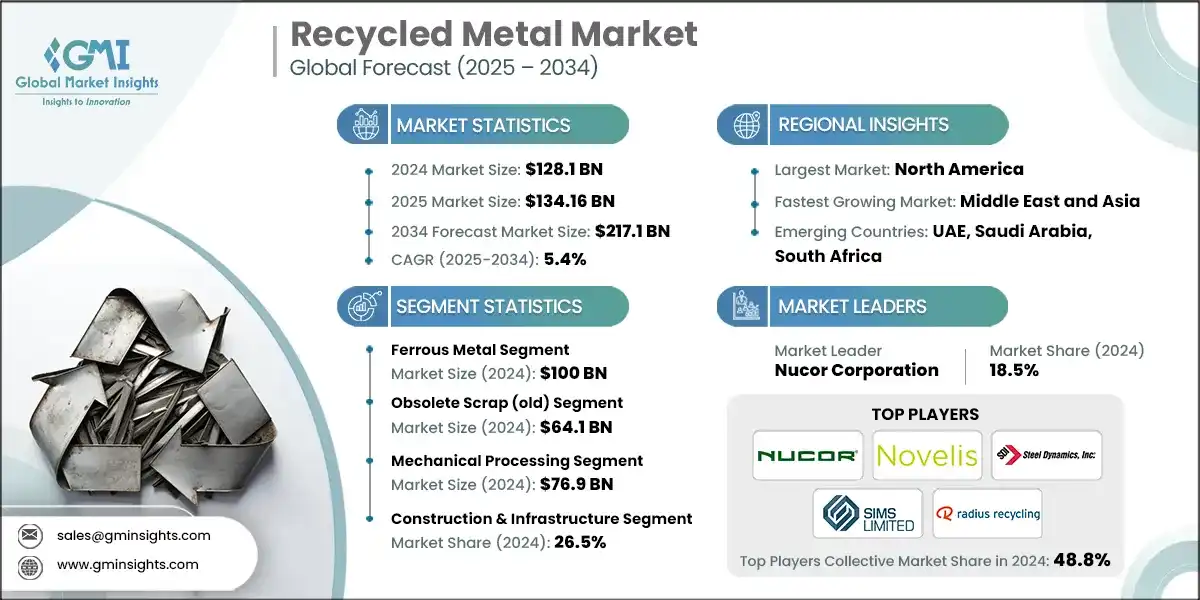
The global recycled metal market was valued at USD 128.1 billion in 2024. The market is expected to grow from USD 134.16 billion in 2025 to USD 217.1 billion in 2034, at a CAGR of 5.4%, according to the latest report published by Global Market Insights Inc.
To get key market trends
- Recycled metal market involves collecting, processing and reusing of used metal products into new raw materials. Instead of mining and refining virgin ores, this market is mainly focused on recovering metals from end-of-life goods including vehicles, buildings, electronics, and packages.
- The process of recycling metals helps in saving natural resources, reduce energy use, and reduces greenhouse gas emissions. Metals such as aluminium, steel, copper, and zinc have the capability to be recycled endlessly without losing quality as a result the industry contributes a huge amount in environmental sustainability and a circular economy.
- There has been a tremendous change in the recycling industry, where there is technological advancements in recycled metal market such as in sorting, shredding, and smelting processes. Artificial intelligence, robotics, and sensor-based sorting systems are mostly used in recycling plants for improving the precision and efficiency of metal recovery.
- Automated separation techniques and low-emission furnaces are similarly adopted technologies, to reduce the amount of waste and energy consumption. Furthermore, the introduction of digital tracking and blockchain enhance transparency in the supply chain and contribute to traceability and authenticity in recycled materials making it feasible for manufacturers and consumers to follow their purchases back through the chain.
- The challenges facing the market are fluctuation of scrap prices, inefficiencies in collection, and poor segregation of metal wastes. Despite these hurdles, persistent investments and collaboration between the public and private sectors are aimed at strengthening the recycling networks and thereby increasing material recovery rates.
- Increasing adoption of electric vehicles and renewable energy systems is expected to contribute to greater demand for recycled metals, especially for copper and aluminium. Hence, the recycled metal market is positioned as a notable contributor towards achieving global sustainability and carbon reduction targets.
Recycled Metal Market Report Attributes
| Key Takeaway | Details |
|---|---|
| Market Size & Growth | |
| Base Year | 2024 |
| Market Size in 2024 | USD 128.1 Billion |
| Market Size in 2025 | USD 134.6 Billion |
| Forecast Period 2025 - 2034 CAGR | 5.4% |
| Market Size in 2034 | USD 217.1 Billion |
| Key Market Trends | |
| Drivers | Impact |
| Growing industrial and construction activities | Rapid urbanization, infrastructure development, and industrial expansion are increasing the demand for metals. Recycled metals offer a cost-effective and sustainable alternative for industries such as construction, automotive, and manufacturing, boosting overall market demand. |
| Technological advancements in recycling processes | Innovations in metal sorting, shredding, and smelting such as sensor-based sorting, automation, and energy-efficient furnaces have improved recovery rates and reduced processing costs. These technologies are making recycling operations more profitable and environmentally friendly. |
| Increasing demand from automotive and electronics sectors | The growing production of electric vehicles (EVs) and electronic devices has heightened the need for metals like aluminum, copper, and nickel. Recycling provides a sustainable supply of these critical materials, supporting industry growth while mitigating raw material shortages. |
| Pitfalls & Challenges | Impact |
| Fluctuating scrap metal prices | The market is highly sensitive to changes in global metal prices. Volatility in the prices of primary metals can directly affect the profitability of recycling operations, making it difficult for recyclers to maintain consistent margins and plan long-term investments. |
| Lack of efficient collection and segregation systems | Ineffective waste collection and improper sorting of scrap materials reduce the quality and quantity of recoverable metals. In many regions, inadequate infrastructure and limited public awareness hinder the efficient flow of recyclable materials into the formal recycling chain. |
| Opportunities: | Impact |
| Integration of digital technologies and automation | The adoption of smart technologies such as artificial intelligence (AI), robotics, and Internet of Things (IoT) systems can greatly enhance operational efficiency. Digital tracking, automated sorting, and predictive maintenance offer new business models and help optimize the value chain in metal recycling. |
| Rising demand for secondary raw materials in green industries | The expansion of renewable energy projects such as wind turbines, solar panels, and electric vehicle infrastructure is increasing the need for metals like copper, aluminium, and steel. This shift provides recyclers with new opportunities to supply sustainable raw materials to the growing green energy sector. |
| Product innovation and recycled metal-based manufacturing | Manufacturers are increasingly incorporating recycled metals into their product designs to meet sustainability goals and consumer preferences. This creates opportunities for recyclers to collaborate directly with producers and develop high-quality, customized recycled metal products. |
| Market Leaders (2024) | |
| Market Leaders |
18.5% market share |
| Top Players |
Collective market share of 48.8% in 2024 |
| Competitive Edge |
|
| Regional Insights | |
| Largest Market | North America |
| Fastest growing market | Middle East and Asia |
| Emerging country | UAE, Saudi Arabia, South Africa |
| Future outlook |
|
What are the growth opportunities in this market?
Recycled Metal Market Trends
- Industries and governments greater emphasis is on sustainability and resource efficiency therefore recycled metal industry is shaped by circular economy practices. Companies are prioritizing closed-loop systems, where valuable materials are reused and waste is avoided. This helps in growth of recycled metal market.
- Competitive recycling and sorting technologies have transformed the process in the recovery of metals and thus driving the market. Sensor-based sorting, artificial intelligence, and automation have improved material identification and accuracy of separation as well as speed of processing.
- Adoption of modern technologies like smelting and low-emission furnaces have also helped to reduce carbon output and operating costs which supports the market growth. The innovations not only increase recovery rates, but they also make reclaimed metals become more competitive with primer metals, which position recycling as an integral part of industrial supply chains.
- The other main technological transformation affecting the recycled metals market is digitization and data-driven operation. New digital platforms are being used by several recyclers to track scrap flows as well as optimize logistics and material traceability in the recycling value chain.
- Blockchain and IoT-enabled systems helps in increasing transparency and authenticity of recycled content which further address consumer and regulatory demands for accountability in material sourcing. This digital transformation will facilitate the collaboration among recyclers, manufacturers, and policymakers.
Recycled Metal Market Analysis
Learn more about the key segments shaping this market
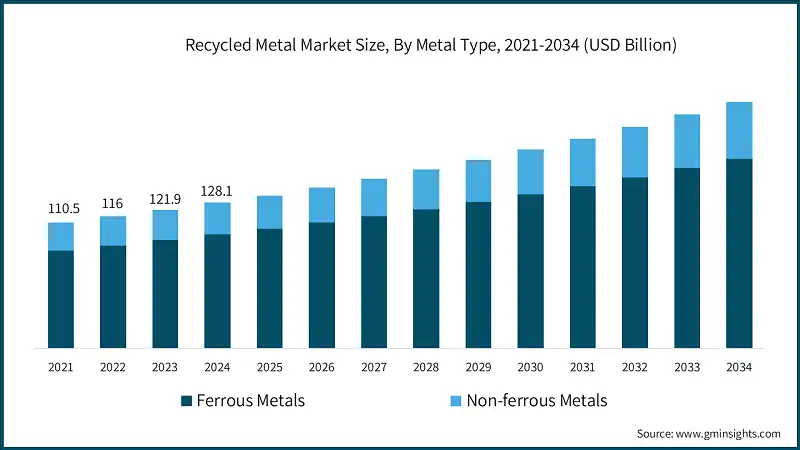
The market by metal type is segmented into ferrous metals and non-ferrous metals. Ferrous metal holds the largest market value of USD 100 billion in 2024.
- The ferrous metals segment consists of steel and iron which contributes significantly and remains the largest part of the market for recycled metals. Ferrous metals are used very heavily in construction, in infrastructures, and within industrial applications. Due to the large recyclability of steel and cost effectiveness, the ferrous metal segment shows a steady demand.
- Aluminum, copper, zinc, etc., are some examples of the non-ferrous metals that are growing faster. The growth is due to increasing demand in areas such as automotive, electronics, and renewable energy because of properties such lightweight, corrosion resistant, and conductive. Hence, they are being used to build electric vehicles, solar panels, and electronic devices. The growing focus on sustainability and the increasing number of technological applications drive rapid penetration and uptake of recycled non-ferrous metals, making this segment a rapidly growing segment in the market.
The recycled metal market by scrap source is segmented into industrial scrap (prompt), obsolete scrap (old), home scrap (new). Obsolete scrap (old) holds the largest market value of USD 64.1 billion in 2024.
- The Obsolete Scrap (Old) is growing at the fastest rate in the recycled metal industry. This is due to the end-of-life products, such as vehicles taken off the road, antiquated machinery, and decaying infrastructure, being increasingly collected and recycled. Environmental awareness is, therefore, vastly increasing among industries and consumers willing to recycle metals from obsolescent scrap, rather than relying on new scrap or more industrial sources. This has been driven by a change in waste management regulations with the shared global vision of a circular economy.
- Prompt scrap which is an industrial scrap, is still a steady supplier due to the regular flow of scrap through manufacturing and production processes, but its growth is relatively stable as compared to that of obsolete scrap. Home scrap (new scrap) contributes to a lesser extent in the market via small-scale household activities providing scrap flow. In general, the growth of the market is heavily driven by the collection and recycling of obsolete metals.
Learn more about the key segments shaping this market
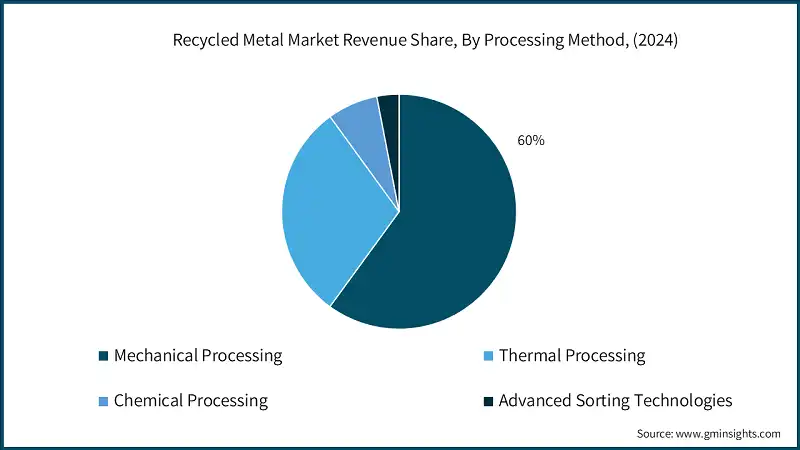
The recycled metal market by processing method is segmented into mechanical processing, thermal processing, chemical processing and advanced sorting technologies. Mechanical processing holds the largest market value of USD 76.9 billion in 2024.
- Mechanical processing remains popular in the recycled metal industry due to its efficiency in shredding, cutting, and preparing scrap metals for further application. It is further followed by thermal processing, especially for fetching metals from complex and contaminated scrap. This method works by melting and separating metals at high temperature, enabling high-purity recovery thus producing recycled metal valuable for industrial application.
- Chemical processing is still an emergent field, especially on non-ferrous metals like copper and nickel where precision extraction is required. This process can recover metals from batteries, electronics, and other very specific scrap, thus enabling increasement in demand for critical and very high-value metals. Technologies that are sensor-based and AI-based-are rapidly gaining traction as a method to integrate higher efficiency, purity, and automation into the recycling process. These technologies allow recyclers to meet quality demands and minimize operational cost thus constituting a key trend for the future of the recycled metal market.
Based on end use industry, the market is segmented into construction & infrastructure, automotive & transportation, manufacturing & industrial machinery, electrical & electronics, packaging & containers, energy & utilities, aerospace & defence, consumer products & appliances, chemical & process industries, marine & shipbuilding and others. Construction & infrastructure operations hold the highest market share of 26.5% in 2024.
- Construction and infrastructure accounts for the largest market is because higher demand for steel and aluminium for construction and civil-engineering applications. Automotive and transportation are now growing fast due to adoption of electric and lightweight vehicles, as manufacturing and industrial machinery still depend on recycled metal in producing cost-effective equipment. Electronics and electrical are increasingly depending on recycled metals for circuits, wiring, and e-waste recycling. On the other hand, packaging and containers use sustainable metals in cans and packaging, and energy & utilities are using recycled metals in renewable energy infrastructure and grid systems.
- Aerospace & defence uses recycled metals in lightweight and high-strength alloys in an aircraft and defence equipment. Consumer products & appliances recovered metals from household items and electronics. There might be a process though where actual chemical & process industries have their recycled metals incorporated into facility equipment and machinery. On the other hand, marine & shipbuilding recycle steel as raw material for vessels and repairs to ships. Others include niche applications such as furniture, art, or specialized industrial functionality to complete the diverse end-use landscape of the market.
Looking for region specific data?
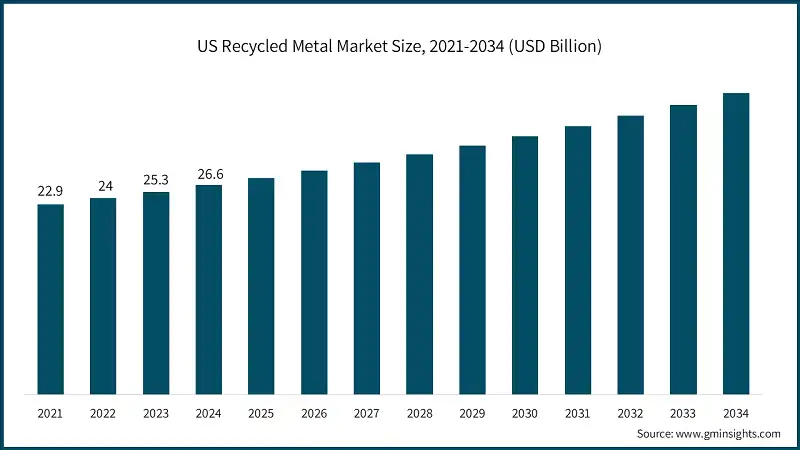
The U.S. recycled metal market accounted for USD 26.6 billion in 2024.
- In North America, the growth of recycled metal industry is driven by increasing demand from both the automotive and construction industries. In the U.S., demand for recycled aluminum and steel is increased due to the shift towards electric vehicles and energy-efficient infrastructure, while Canada is moving towards metal recovery from both industrial and obsolete scrap because of sustainable manufacturing and circular economy initiatives.
The market in the Germany is expected to experience significant and promising growth from 2025 to 2034.
- Europe a matured market still exploring, mainly because of Germany's advanced recycling infrastructure and stringent environmental regulations. The trend towards green building standards, renewable energy projects, and automotive electrification has brought about high demand in both ferrous and non-ferrous recycled metals. Such countries in Europe, like France and the U.K., have also introduced policies advocating landfill waste diversion while promoting scrap metal collection, thus making Europe a significant region of sustainable metal recovery.
The recycled metal market in China is expected to experience significant and promising growth from 2025 to 2034.
- APAC is the fastest-growing region in the market and includes China, India, and Japan. Being the major manufacturing center in the world, demand in China for recycled metals is to a large degree in automotive, electronics, and packaging sectors supported by government regulations foster resource efficiency. In India and Japan, such recycling initiatives are also expected to develop to meet the growing demand from industries and sustainability targets. Advanced technologies in sorting and processing activities are promoting efficient scaling of operations in this region.
UAE recycled metal market is expected to experience significant and promising growth from 2025 to 2034.
- Increasingly urbanization, infrastructure projects, and industrial modernization become the main factor contributing to the demand in the Middle East and Africa for recycled metals. The UAE is into advanced recycling and sorting technologies to further improve efficiency. Meanwhile, recycled metals are expected to meet rising demand in industries and construction markets across South Africa and Saudi Arabia. The regional initiatives on sustainability and resource conservation also play a vital role in the reliable growth in the market for MEA.
Brazil is expected to experience significant and promising growth from 2025 to 2034.
- Latin America, mainly Brazil, Mexico, and Argentina, is experiencing gradual advancement attributable to industrialization and infrastructure development. Most of the recycled metals are being used in building and automotive industries within Brazil to save costs and reduce environmental risks. Moreover, Mexico and Argentina are improving their scrap collection and recycling programs, which support domestic manufacturing and promote sustainable use of metals across the region.
Recycled Metal Market Share
- Recycled Metal markets are moderately consolidated with players like Nucor Corporation, Novelis Inc., Steel Dynamics Inc., Sims Limited, Schnitzer Steel (Radius Recycling) holding 48.8% market share and Nucor Corporation being the market leader holding the market share of 18% in 2024.
- In the recycled metal industry, the leading players maintain a significant competitive edge through the continued investment in advanced processing and sorting technologies. Targeting production of high-purity recycled metals to satisfy the most stringent quality requirements in heavy industrial sectors such as automotive, construction, and electronics, innovations in sensor-based separation, automation, and melting processes are allowing recyclers to improve upon recovery rates, handle increasingly diverse scrap sources, and assure materials approximated in performance to virgin metals.
- Sustainability is an underlying driver in shaping competitive strategy. Firms are optimizing processes to minimize energy consumption, carbon emissions, and environmental impact, while at the same time appealing to industries and consumers interested in circular economy practices. The efficiency and scalability of recycling not only reduce costs but enhance the environmental credibility of recycled metals, giving recyclers leverage where compliance to regulation and conscious sourcing is demanded.
- Environmental legislation, industry standards, and traceability requirements define another boundary within which competitive advantage is maintained. Compliance with legal frameworks and international standards fosters a climate of assurance with end-users wishing to promulgate their activities into new regions and positions them as trusted suppliers of sustainable metals. These factors, comprised of transparent practices, high-quality outputs, and proactive market-based regulatory alignment, contribute highly to creating a difference between the leaders in the recycling sector and the growing competition.
Recycled Metal Market Companies
Major players operating in the recycled metal industry are:
- Ace Green Recycling Inc.
- Asahi Holdings Inc.
- Batx Energies Private Limited
- Befesa S.A.
- European Metal Recycling Limited
- GFG Alliance
- Hensel Recycling GmbH
- Kuusakoski Group
- Lohum Cleantech Pvt Ltd
- Metaloop GmbH
- Nucor Corporation
- Novelis Inc
- Redwood Materials Inc.
- ScrapBees GmbH
- Radius Recycling Inc.
- Sims Metal Management Limited
- Sortera Technologies Inc
- Steel Dynamics Inc.
- Triple M Metal LP
Nucor Corporation deals in producing steel and is one of the America’s largest recycler. It operates a system of Electric Arc Furnace (EAF) mills that feed 100% recycled scrap as input in its production of steel. Its core values for business include sustainability, cost-effective, and vertical integration-from scrap collection to steel production to the manufacture of finished products. Its recycled steel has been extensively used for construction, automotive, and industrial applications both as a contribution for circular economies and as reduced greenhouse gas emission levels compared to traditional process steelmaking.
Novelis Inc. is the producer of flat-rolled aluminum products. It has besides 13 recycling and rolling facilities around North America, Europe, Asia, and South America, which remove billions of used beverage cans and industrial scrap every year. Novelis directly incorporates recycling into its manufacturing chain through the inclusion of up to 63% recycled content in its aluminum products, supplying important sectors of the economy-automotive, packaging, and consumer products. Circular manufacturing and reduction of carbon footprint are evident in the closed-loop recycling systems installed by the major OEMs.
Steel Dynamics Inc. is a well-known steel producer based in the United States. It is engaged in recycling metals operations, particularly through its OmniSource division, known for being among the largest scrap processors in North America. Steel makes use of Electric Arc Furnace technology in running all its steel mills. Most of the steel produced in SDI is from recycled metal. The company's model emphasizes efficiency in operation, vertical integration, and sustainable procurement across construction, manufacturing, and energy sectors. Its strategic investment in recycling infrastructures also serves raw material security and environment-friendly manufacturing processes.
Sims Limited is a prominent international metal recycling and resource recovery company that operates in North America, Europe, and Australasia. The company processes billions of tons of both ferrous and non-ferrous scrap every year, feeding into steel mills and foundries with recycled raw materials. However, in addition to traditional scrap recycling, Sims is also investing in e-waste recycling and data center decommissioning as a way of adapting to rising trends in demand for resource sustainability management. The commitment to decarbonization and principles of the circular economy gives Sims a rather futuristic view in the global recycled metal industries.
Radius Recycling, Inc. is recycler and steel manufacturer based in the U.S. The company deals in ferrous and non-ferrous scrap metal processing. Radius Recycling runs a vast recycling and manufacturing network across North America for the conversion of end-of-life products into high-quality recycled steel products using Electric Arc Furnace technology. The company operate in construction, automotive, and industrial sectors under strong commitments to sustainability and circular economy principles.
Recycled Metal Industry News
- In July 2025, Toyota Tsusho America Inc. (TAI), a subsidiary of Toyota Tsusho Corp and part of the Toyota Group, acquired Radius Recycling Inc. formerly Schnitzer Steel Industries. Radius has an electric arc furnace steel mill in Oregon and operates more than 50 recycling facilities across North America. This acquisition strengthens the circular economy initiatives of Toyota Tsusho, providing higher access to recycled steel resources of high quality, as well as sustainable supply towards carbon neutrality goals. Radius will retain its management, brand, and headquarters in Portland, Oregon.
- In August 2025, FalconPoint Partners has announced acquiring SMS, one of the leading providers of outsourced managed steel mill and scrap management services across the United States, Europe, and South America. The U.S. investment positions Falconpoint to further enhance SMS growth in operations, technology infrastructure, and sustainability initiatives.
The recycled metal market research report includes an in-depth coverage of the industry with estimates and forecast in terms of revenue in USD Billion and volume in terms of kilo tons from 2021–2034 for the following segments:
Market, By Metal Type
- Ferrous metals
- Steel scrap
- Iron scrap
- Cast iron
- Non-ferrous metals
- Aluminum
- Primary aluminum scrap
- Secondary aluminum alloys
- Copper
- Copper wire & cable
- Copper tubing & pipe
- Lead
- Battery lead
- Sheet lead
- Precious metals
- Gold recovery
- Silver recovery
- Platinum group metals
- Specialty metals
- Titanium
- Nickel
- Rare earth elements
- Aluminum
Market, By Scrap Source
- Industrial scrap (Prompt Scrap)
- Manufacturing waste streams
- Processing facility byproducts
- Obsolete scrap (Old Scrap)
- End-of-life vehicles
- Demolished buildings & infrastructure
- Electronic waste (E-waste)
- Appliances & consumer goods
- Home scrap (New Scrap)
- Steel mill revert
- Foundry returns
Market, By Processing Method
- Mechanical processing
- Shredding & size reduction
- Magnetic separation
- Density separation
- Thermal processing
- Electric arc furnace (EAF)
- Induction furnace
- Pyrometallurgical processing
- Chemical Processing
- Hydrometallurgical extraction
- Electrorefining
- Solvent extraction
- Advanced sorting technologies
- AI-powered optical sorting
- Sensor-based separation
- Laser-induced breakdown spectroscopy (LIBS)
Market, By End Use Industry
- Construction & infrastructure
- Structural steel applications
- Reinforcement materials
- Government infrastructure projects
- Automotive & transportation
- Body & frame components
- Engine & drivetrain parts
- Electric vehicle components
- Manufacturing & industrial machinery
- Heavy equipment
- Industrial tools & components
- Electrical & electronics
- Wiring & conductors
- Electronic components
- Battery applications
- Packaging & containers
- Food & beverage packaging
- Industrial packaging
- Energy & utilities
- Power generation equipment
- Renewable energy infrastructure
- Grid & transmission systems
- Aerospace & defense
- Aircraft components
- Defense applications
- Consumer products & appliances
- Chemical & process industries
- Marine & shipbuilding
- Others
The above information is provided for the following regions and countries:
- North America
- U.S.
- Canada
- Europe
- Germany
- UK
- France
- Spain
- Italy
- Rest of Europe
- Asia Pacific
- China
- India
- Japan
- Australia
- South Korea
- Rest of Asia Pacific
- Latin America
- Brazil
- Mexico
- Argentina
- Rest of Latin America
- Middle East and Africa
- Saudi Arabia
- South Africa
- UAE
- Rest of Middle East & Africa
Frequently Asked Question(FAQ) :
How much revenue did the ferrous metal segment generate in 2024?
The ferrous metals segment held the largest market value of USD 100 billion in 2024, driven by strong demand from construction, automotive, and industrial manufacturing sectors where steel and iron are extensively used.
Who are the key players in the recycled metal market?
Key players include Nucor Corporation, Novelis Inc., Steel Dynamics Inc., Sims Limited, Radius Recycling Inc., European Metal Recycling Limited, and Befesa S.A., among others leading the global recycled metal industry.
What are the upcoming trends in the recycled metal industry?
Key trends include the integration of AI and sensor-based sorting, digital tracking through blockchain, and low-emission furnaces. Increasing investments in advanced recycling and circular manufacturing models are also shaping the market’s growth.
What was the valuation of the obsolete scrap segment in 2024?
The obsolete scrap segment accounted for USD 64.1 billion in 2024, dominating the market due to growing collection of end-of-life vehicles, aging infrastructure, and regulatory emphasis on waste metal recovery.
Which region leads the recycled metal market?
U.S. accounted for USD 26.6 billion in 2024, leading the market with strong recycling infrastructure and advanced metal recovery technologies. Growth is driven by rising adoption of recycled aluminum and steel in EVs and green construction.
What is the current recycled metal market size in 2025?
The market size is projected to reach USD 134.6 billion in 2025.
What is the projected value of the recycled metal market by 2034?
The market size for recycled metal is expected to reach USD 217.1 billion by 2034, supported by rising adoption of recycling technologies, growing use of secondary raw materials, and global sustainability initiatives.
What is the market size of the recycled metal industry in 2024?
The market size was USD 128.1 billion in 2024, with a CAGR of 5.4% expected through 2034, driven by growing industrial and construction activities and the increasing shift toward circular economy practices.
Recycled Metal Market Scope
Related Reports