Summary
Table of Content

Recycled Lead Market
Get a free sample of this report
Form submitted successfully!
Error submitting form. Please try again.
Thank you!
Your inquiry has been received. Our team will reach out to you with the required details via email. To ensure that you don't miss their response, kindly remember to check your spam folder as well!
Request Sectional Data
Thank you!
Your inquiry has been received. Our team will reach out to you with the required details via email. To ensure that you don't miss their response, kindly remember to check your spam folder as well!
Form submitted successfully!
Error submitting form. Please try again.
Recycled Lead Market Size
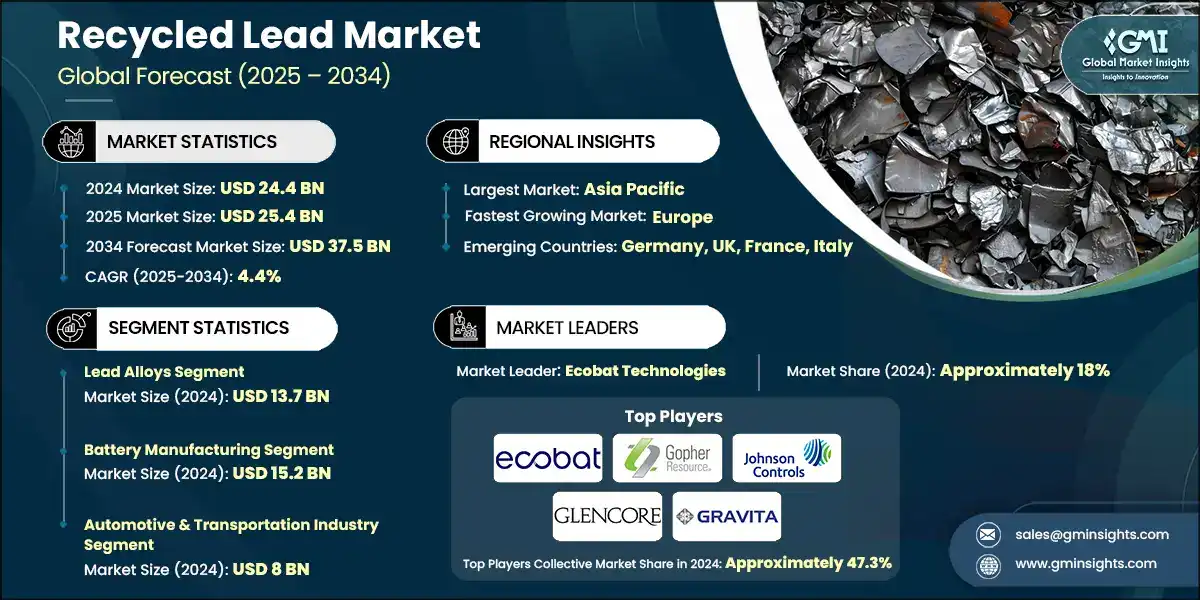
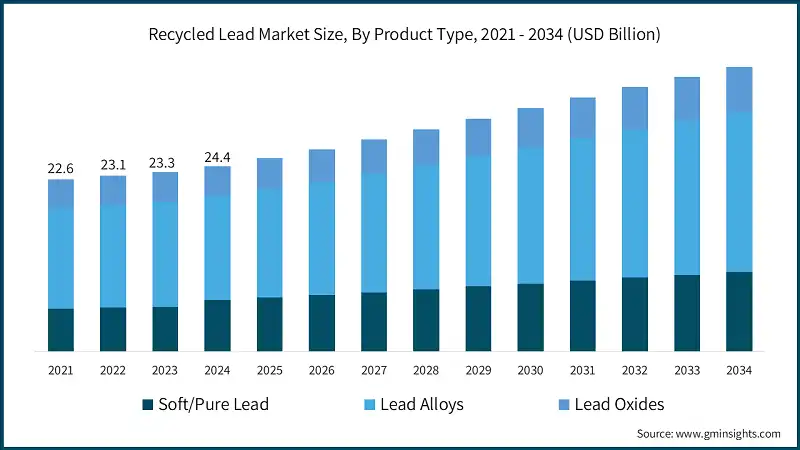
The global recycled lead market was valued at USD 24.4 billion in 2024. The market is expected to grow from USD 25.4 billion in 2025 to USD 37.5 billion in 2034, at a CAGR of 4.4%, according to latest report published by Global Market Insights Inc.
Recycled Lead Market Key Takeaways
Market Size & Growth
- 2024 Market Size: USD 24.4 Billion
- 2025 Market Size: USD 25.4 Billion
- 2034 Forecast Market Size: USD 37.5 Billion
- CAGR (2025–2034): 4.4%
Regional Dominance
- Largest Market: Asia Pacific
- Fastest Growing Region: Europe
Key Market Drivers
- Battery manufacturing demand.
- Environmental regulations & sustainability.
- Circular economy initiatives.
Challenges
- Lead price volatility.
- Collection and logistics challenges.
Opportunity
- Electric vehicle infrastructure growth.
- Advanced recycling technologies.
Key Players
- Market Leader: Ecobat Technologies led with over 18% market share in 2024.
- Leading Players: Top 5 players in this market include Ecobat Technologies, Gopher Resource, Johnson Controls International, Glencore (Britannia Refined Metals), Gravita India Limited, which collectively held a market share of 47.3% in 2024.
Get Market Insights & Growth Opportunities
- Recycled lead represents a critical component of the circular economy, derived primarily from spent lead-acid batteries and other lead-containing products. The recycling process recovers lead through pyrometallurgical and hydrometallurgical methods, producing high-quality secondary lead that matches the performance characteristics of primary lead. With increasing environmental regulations and sustainability mandates, manufacturers are prioritizing recycled lead to reduce their carbon footprint and comply with stringent environmental standards. The automotive industry's shift toward electric vehicles paradoxically increases demand for recycled lead in energy storage applications and grid stabilization systems.
- The battery manufacturing sector drives the largest demand for recycled lead, accounting for over 60% of market consumption. Lead-acid batteries remain essential for automotive starting, lighting, and ignition systems, as well as backup power applications in telecommunications and data centers. The superior recyclability of lead-acid batteries, with recycling rates exceeding 95%, creates a robust closed-loop system that ensures consistent supply of recycled lead materials. This circular approach reduces dependency on primary lead mining while maintaining cost competitiveness and supply chain reliability.
- Stringent environmental regulations regarding lead mining and processing are accelerating the adoption of recycled lead across industries. Governments worldwide are implementing policies that favor secondary lead production due to its significantly lower environmental impact compared to primary lead extraction. The recycling process generates 65% fewer greenhouse gas emissions and requires 35% less energy than primary lead production. These environmental benefits, combined with regulatory compliance requirements, are driving manufacturers to increase their utilization of recycled lead materials in various applications.
To get key market trends
Recycled Lead Market Trends
- Technological advancement in recycling processes is transforming the industry through implementation of advanced pyrometallurgical techniques, automated sorting systems, and AI-driven quality control mechanisms. Modern recycling facilities are achieving higher recovery rates while reducing energy consumption and emissions. The development of hybrid recycling processes combining pyrometallurgical and hydrometallurgical methods enables more efficient processing of diverse lead-containing materials and improved purity levels in final products.
- Strengthening regulatory frameworks globally are establishing mandatory recycling quotas and extended producer responsibility programs for lead-containing products. Government policies promoting circular economy principles and penalizing improper lead disposal are creating favorable market conditions for recycled lead producers. These regulations are standardizing collection systems, improving feedstock quality, and ensuring consistent supply chains while driving investment in recycling infrastructure and technology upgrades.
- Evolving automotive industry dynamics are reshaping demand patterns as electric vehicle adoption accelerates alongside continued internal combustion engine production. While EV growth reduces traditional automotive battery demand, it simultaneously creates new opportunities in charging infrastructure, grid storage, and auxiliary power systems. The automotive sector's sustainability commitments are driving preferences for recycled materials, supporting long-term market stability despite changing vehicle technologies.
- Expanding applications in renewable energy and grid modernization are opening new market segments for recycled lead products. Energy storage systems, backup power solutions for telecommunications, and grid stabilization applications require reliable lead-acid battery systems. The integration of renewable energy sources necessitates robust energy storage infrastructure, creating sustained demand for recycled lead in utility-scale applications and distributed energy systems.
Recycled Lead Market Analysis
Learn more about the key segments shaping this market
Based on product type, market is segmented into soft/pure lead, lead alloys and lead oxides. Lead alloys generated USD 13.7 billion revenue in 2024 and is anticipated to expand at a CAGR of 4.3% during 2025 to 2034, holding a market share of 56% in 2024.
- Lead alloys dominate the recycled lead market due to their superior performance characteristics and widespread industrial applications. The advantages of lead alloys stem from their enhanced mechanical properties, improved corrosion resistance, and optimized electrical conductivity achieved through precise alloying with antimony, tin, calcium, and other metals. These properties make lead alloys particularly suitable for automotive batteries, industrial applications, and specialized energy storage systems where durability and performance reliability are critical requirements.
- Lead alloys have established market leadership through their versatility in meeting diverse application requirements across multiple industries. By incorporating specific alloying elements, manufacturers can tailor properties such as hardness, castability, and electrochemical performance to match exact customer specifications. This customization capability has enabled lead alloys to capture approximately 56% of the total recycled lead market, significantly outperforming pure lead alternatives in demanding applications.
- Industrial applications comprise automotive battery grids and terminals, industrial battery systems, and specialized components for telecommunications and backup power systems. The automotive sector represents the largest consumption area, utilizing lead-antimony and lead-calcium alloys for enhanced battery performance and extended service life. Energy storage applications include stationary batteries for renewable energy systems, uninterruptible power supplies, and grid stabilization systems where alloy performance characteristics ensure reliable operation under varying load conditions.
Learn more about the key segments shaping this market
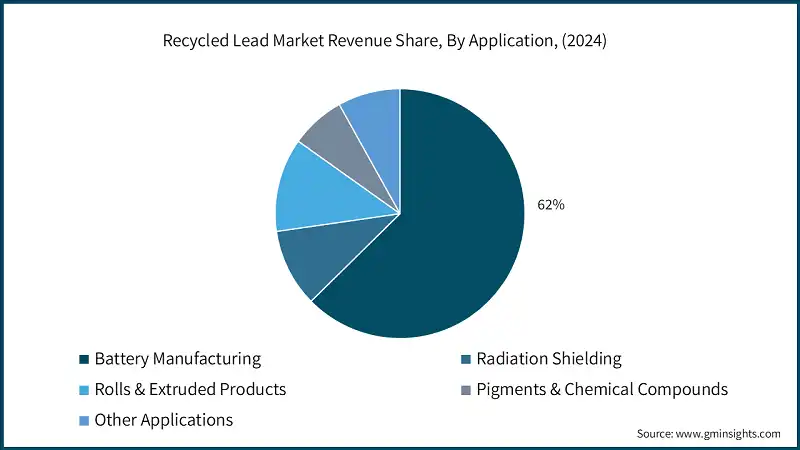
Based on application, market is segmented into battery manufacturing, radiation shielding, rolls & extruded products, pigments & chemical compounds and other applications. Battery manufacturing generated USD 15.2 billion revenue in 2024 and is anticipated to expand at a CAGR of 4.2% during 2025 to 2034, holding a market share of 62.4% in 2024.
- Battery manufacturing dominates the recycled lead market due to the critical role of lead-acid batteries across automotive, industrial, and energy storage sectors. The advantages of recycled lead in battery applications stem from its identical electrochemical properties to primary lead while offering significant cost advantages and environmental benefits. Lead-acid batteries maintain their position as the most recycled consumer product globally, with recycling rates exceeding 95%, creating a robust closed-loop system that ensures consistent supply for battery manufacturers worldwide.
- Battery manufacturing has established market leadership through the automotive industry's continued reliance on lead-acid batteries for starting, lighting, and ignition systems, even as electric vehicle adoption accelerates. The superior recyclability of lead enables battery manufacturers to maintain cost-competitive production while meeting stringent environmental regulations. This application segment benefits from established collection networks, proven recycling technologies, and strong regulatory frameworks that support circular economy practices in the battery industry.
- Industrial applications comprise automotive starter batteries, backup power systems for telecommunications and data centers, uninterruptible power supplies, and stationary energy storage for renewable energy integration. The automotive sector represents the largest consumption area, utilizing recycled lead for manufacturing millions of replacement batteries annually. Energy storage applications include grid-scale systems, residential solar battery storage, and industrial backup power solutions where lead-acid batteries provide reliable, cost-effective energy storage with proven performance characteristics and established recycling infrastructure.
Based on end use industry, recycled lead market is segmented into automotive & transportation industry, energy & power generation industry, industrial manufacturing industry, construction & infrastructure industry, healthcare & medical industry, electronics & telecommunications industry and other industries. Automotive & transportation industry generated USD 8 billion revenue in 2024 and is anticipated to expand at a CAGR of 4.5% during 2025 to 2034, holding a market share of 32.8% in 2024.
- Automotive & transportation industry dominates the recycled lead market due to the essential role of lead-acid batteries in vehicle starting, lighting, and ignition systems across both conventional and hybrid vehicles. The advantages of recycled lead in automotive applications stem from its proven reliability, cost-effectiveness, and established supply chain infrastructure that supports the global automotive manufacturing ecosystem. Despite the transition toward electric vehicles, the automotive sector maintains strong demand for recycled lead through replacement battery markets, commercial vehicle fleets, and auxiliary power systems in electric and hybrid vehicles.
- Automotive & transportation industry has established market leadership through the sector's mature recycling infrastructure and regulatory compliance requirements that favor sustainable material sourcing. The industry benefits from well-established collection networks for spent automotive batteries, enabling efficient closed-loop recycling systems that reduce costs and environmental impact. This end-user segment leverages recycled lead's identical performance characteristics to primary lead while meeting increasingly stringent corporate sustainability targets and regulatory mandates for circular economy practices.
- Industrial applications comprise starter batteries for passenger vehicles, commercial vehicle battery systems, marine and recreational vehicle batteries, and backup power systems for automotive manufacturing facilities. The passenger vehicle segment represents the largest consumption area, utilizing recycled lead for manufacturing replacement batteries for the global vehicle fleet exceeding 1.4 billion units. Commercial transportation applications include heavy-duty truck batteries, bus fleet power systems, and specialized batteries for construction and agricultural equipment where recycled lead provides reliable performance under demanding operational conditions.
Looking for region specific data?
The recycled lead market in North America will grow at a CAGR from approximately 4.5% between 2025 and 2034.
- Rising awareness at the corporate level about sustainable manufacturing practices and circular economy principles influences the regional drive for recycled materials in automotive, energy storage, and industrial applications. At the same time, increasing concerns for environmental protection have been commencing optimistic trends for advanced lead recycling technologies to gradually replace primary lead production and conventional extraction methods.
- Unique recycling systems and process innovations epitomize the technical evolution into enhanced efficiency of lead recovery processes together with safety and cost-saving benefits, making the industrial future of sustainable manufacturing, e.g., in the upcoming era of electric vehicle infrastructure, renewable energy storage, and green building applications.
The recycled lead markets in Europe, especially in a few countries like Germany, are expected to grow with a rapid pace in the coming years, especially from 2025 to 2034, with CAGR of 4.8%.
- Stringent environment-friendly regulations along with established knowledge of sustainable recycling methods have observed an incline in secondary lead preference; such incline further augurs well for the recycled lead market.
- R&D explorations of better recycling technologies and process optimization in pyrometallurgical and hydrometallurgical modes have surged forth with admittable efficiency and expanded recycled lead applications, especially in automotive batteries and industrial energy storage.
- The European market propagated by the circular economy program only certifies recycled lead in sustainable manufacturing formulations and in the process widens market opportunities in a broad spectrum of sectors. Higher investment in R&D and in clean energy infrastructure development is expanding the product applications of recycled lead materials.
The recycled lead market in China and India is expected to have lucrative growth between 2025 and 2034, with CAGR 3.7% in the Asia Pacific region.
- Demand is fueled with a burgeoning automotive sector and spurt in industrial manufacturing, looking for high-quality recycled lead materials produced through advanced recycling technology.
- On-going government policies toward greener technologies and sustainable manufacturing practices further pour in capital investment for the clean production methods with lead recycling facilities.
- Due to the increasing automotive electrification and energy storage markets, Asia Pacific continues utilizing such technologies, with counting on classes in the battery manufacturing and industrial applications.
Between 2025 and 2034, the recycled lead market in the Middle East is projected to grow significantly during this period with CAGR of 4.2%.
- The high rate of infrastructure development, construction sector, and industrial manufacturing demands for high-quality, sustainable, and cost-effective materials using the recycled lead processing methods.
- It rides upon regional government programs, which will recommend sustainable development and green manufacturing, thus integrating recycled lead with the automotive, construction, and energy storage markets.
Between 2025 and 2034, a promising expansion of the recycled lead sector is foreseen in the Latin America with CAGR of 4.1%.
- High industrial growth already enjoys their consideration for sustainable and cost-effective materials as interest-worthy, encouraging the use of recycled lead technology.
- Awareness is multiplying for the benefits of circular economy through recycled lead technology, and it is now gaining considerable industrial understanding, much in automotive manufacturing and energy infrastructure.
- The tremendous boost to recycled lead technology by laws aimed at encouraging sustainable manufacturing and eco-friendly methods of material sourcing, everything appears to be nothing but optimism in the development for that technology in Latin America.
Recycled Lead Market Share
In 2024, the global recycled lead industry was led by a diverse group of battery recyclers, metal smelters, and specialty lead processing companies, where the top five companies collectively accounted for approximately 47.3% of the market share in 2024, including Ecobat Technologies, Gopher Resource, Johnson Controls International, Glencore (Britannia Refined Metals), and Gravita India Limited. These companies hold strong market positions due to their advanced pyrometallurgical processing technologies, large-scale recycling facilities, precision lead recovery systems, and strategic partnerships with automotive manufacturers, enabling efficient lead-acid battery recycling, scaling, and secondary lead production optimization.
- Gravita India Limited is a leading global recycling company headquartered in Rajasthan, India, specializing in lead-acid battery recycling with an annual collection capacity exceeding 205,000 metric tonnes across 70+ countries. The company operates advanced pyrometallurgical processing facilities producing high-purity lead products, lead alloys, and specialized recycling equipment while expanding into aluminum recycling operations in Ghana, positioning itself as a pioneer in sustainable metal recovery and circular economy practices.
- Glencore (Britannia Refined Metals) operates one of the world's largest integrated lead refining facilities in Kent, UK, with annual processing capacity of approximately 180,000 tonnes per annum, handling both primary and secondary lead materials. The company recently invested USD 53.9 million in advanced copper sampling technology and maintains global mine-to-market operations, serving as a critical component of Glencore's integrated metals portfolio with established customer relationships across automotive, industrial, and specialty applications sectors.
- Gopher Resource is a premier North American lead-acid battery recycling company based in Minnesota, USA, processing approximately 23 million spent batteries annually through specialized pyrometallurgical facilities. The company focuses exclusively on comprehensive battery recycling operations, maintaining advanced environmental compliance systems and established collection networks that enable efficient closed-loop recycling systems supporting the regional automotive and industrial battery markets.
Recycled Lead Market Companies
The major players operating in recycled lead industry include:
- Ecobat Technologies
- Gopher Resource
- Glencore (Britannia Refined Metals)
- Gravita India Limited
- Cimbar Performance Minerals
- Sims Limited
- LeadCo
- Exide Technologies
- Hindustan Zinc Limited
- GreenLead
- EnerSys
- Prime Lead Recycling
- Ardee Industries Ltd.
- RSR Corporation
- Johnson Controls International
Recycled Lead Market Report Attributes
| Key Takeaway | Details |
|---|---|
| Market Size & Growth | |
| Base Year | 2024 |
| Market Size in 2024 | USD 24.4 Billion |
| Market Size in 2025 | USD 25.4 Billion |
| Forecast Period 2025 - 2034 CAGR | 4.4% |
| Market Size in 2034 | USD 37.5 Billion |
| Key Market Trends | |
| Drivers | Impact |
| Battery manufacturing demand | The automotive and energy storage sectors consistent demand for lead-acid batteries drives steady consumption of recycled lead, supported by superior recyclability rates exceeding 95% |
| Environmental regulations & sustainability | Stringent environmental policies favoring secondary lead production over primary mining accelerate adoption, as recycling generates 65% fewer emissions and requires 35% less energy |
| Circular economy initiatives | Growing corporate sustainability commitments and government circular economy policies promote closed-loop recycling systems, ensuring consistent supply and cost competitiveness |
| Pitfalls & Challenges | Impact |
| Lead price volatility | Fluctuating global lead prices affect recycling economics and profitability margins, creating uncertainty for long-term investment planning and capacity expansion |
| Collection and logistics challenges | Inefficient collection systems for spent batteries and lead products in developing regions limit feedstock availability and increase operational costs |
| Opportunities: | Impact |
| Electric vehicle infrastructure growth | Expanding EV charging networks and grid storage applications create new demand streams for recycled lead in backup power systems and energy storage solutions |
| Advanced recycling technologies | Implementation of AI-driven sorting systems and improved pyrometallurgical processes enhance recovery rates and reduce processing costs, improving market competitiveness |
| Market Leaders (2024) | |
| Market Leaders |
Market Share Approximately 18% |
| Top Players |
Collective Market Share Approximately 47.3% |
| Competitive Edge |
|
| Regional Insights | |
| Largest Market | Asia Pacific |
| Fastest growing market | Europe |
| Emerging countries | Germany, UK, France, Italy |
| Future outlook |
|
What are the growth opportunities in this market?
Recycled Lead Industry News
- In August 2025, Clarios, a global leader in advanced energy storage solutions, announced the expansion of its European recycling network through the integration of three facilities in Freiberg and Braubach, Germany, and Arnoldstein, Austria, previously operated by Ecobat. The move strengthens Clarios’ circular economy leadership by enhancing in-house lead and polypropylene recycling capabilities, including its first in-house poly compounding operation. This expansion supports EU sustainability targets, boosts supply chain resilience, and reinforces Clarios’ commitment to responsible sourcing and sustainable manufacturing.
- In August 2025, Ace Green Recycling Inc., a Houston-based battery recycling technology company, unveiled its new Grid Metallics Processing System (GMPS), which allows lead battery recyclers to recover clean alloy metals like lead, antimony, and tin without using smelting furnaces. Operating at room temperature, the GMPS boosts recovery efficiency, reduces metal loss, and increases throughput by up to 25%. The system is being deployed in Armenia, Taiwan, India, and Thailand to enhance sustainable lead battery recycling and address global antimony supply challenges.
The recycled lead market research report includes in-depth coverage of the industry with estimates & forecast in terms of revenue (USD Million) & (Kilo Tons) from 2021 to 2034, for the following segments:
Market, By Product Type
- Soft/pure lead
- Lead alloys
- Lead-antimony alloys
- Lead-calcium alloys
- Lead-selenium & lead-tin alloys
- Custom alloy development
- Lead oxides
- Red lead oxide (Pb?O?)
- Lead(II) oxide (PbO)
- Lead(IV) oxide (PbO?)
- Battery-grade oxides
Market, By Application
- Battery manufacturing
- Automotive battery production
- Industrial battery manufacturing
- Energy storage system integration
- Ups & backup power applications
- Radiation shielding
- Medical facility applications
- Nuclear industry requirements
- Industrial x-ray & ndt equipment
- Rolls & extruded products
- Construction industry demand
- Roofing & weatherproofing
- Architectural applications
- Industrial equipment manufacturing
- Pigments & chemical compounds
- Industrial paint & coating applications
- Chemical processing uses
- Specialized industrial applications
- Other applications
- Ammunition & defense
- Cable sheathing
- Specialized industrial uses
Market, By End Use Industry
- Automotive & transportation industry
- Energy & power generation industry
- Industrial manufacturing industry
- Construction & infrastructure industry
- Healthcare & medical industry
- Electronics & telecommunications industry
- Other industries
The above information is provided for the following regions and countries:
- North America
- U.S.
- Canada
- Europe
- UK
- Germany
- France
- Italy
- Spain
- Rest of Europe
- Asia Pacific
- China
- India
- Japan
- South Korea
- Australia
- Rest of Asia Pacific
- Latin America
- Brazil
- Mexico
- Argentina
- Rest of Latin America
- MEA
- UAE
- Saudi Arabia
- South Africa
- Rest of Middle East and Africa
Frequently Asked Question(FAQ) :
What is the market size of the recycled lead industry in 2024?
The market size was USD 24.4 billion in 2024, with a CAGR of 4.4% expected through 2034 driven by growing demand from battery manufacturing, circular economy initiatives, and rising sustainability regulations across industries.
What is the current recycled lead market size in 2025?
The market size is projected to reach USD 25.4 billion in 2025.
What is the projected value of the recycled lead market by 2034?
The market size for recycled lead is expected to reach USD 37.5 billion by 2034, supported by strong demand from energy storage, automotive, and industrial manufacturing sectors emphasizing eco-friendly and cost-efficient materials.
How much revenue did the lead alloys segment generate in 2024?
The lead alloys segment generated USD 13.7 billion in 2024, leading the market with a 56% share.
What was the valuation of the battery manufacturing segment in 2024?
The battery manufacturing segment accounted for USD 15.2 billion in 2024, holding a 62.4% share, as lead-acid batteries remain essential for automotive, energy storage, and backup power systems globally.
What is the growth outlook for the automotive & transportation industry from 2025 to 2034?
The automotive & transportation industry is expected to grow at a CAGR of 4.5% through 2034.
Which region leads the recycled lead market?
North America is projected to grow at a CAGR of around 4.5% from 2025 to 2034. Growth is driven by expanding battery recycling capacity, strong environmental regulations, and rising adoption of sustainable lead recovery practices across the automotive and industrial sectors.
What are the upcoming trends in the recycled lead industry?
Key trends include technological advancements in pyrometallurgical and hydrometallurgical recycling, AI-driven sorting systems, and growing emphasis on circular economy practices and extended producer responsibility programs.
Who are the key players in the recycled lead market?
Key players include Ecobat Technologies, Gopher Resource, Glencore (Britannia Refined Metals), Gravita India Limited, Johnson Controls International, Sims Limited, and EnerSys.
Recycled Lead Market Scope
Related Reports