Summary
Table of Content

Reciprocating Engine Market
Get a free sample of this report
Form submitted successfully!
Error submitting form. Please try again.
Thank you!
Your inquiry has been received. Our team will reach out to you with the required details via email. To ensure that you don't miss their response, kindly remember to check your spam folder as well!
Request Sectional Data
Thank you!
Your inquiry has been received. Our team will reach out to you with the required details via email. To ensure that you don't miss their response, kindly remember to check your spam folder as well!
Form submitted successfully!
Error submitting form. Please try again.
Reciprocating Engine Market Size
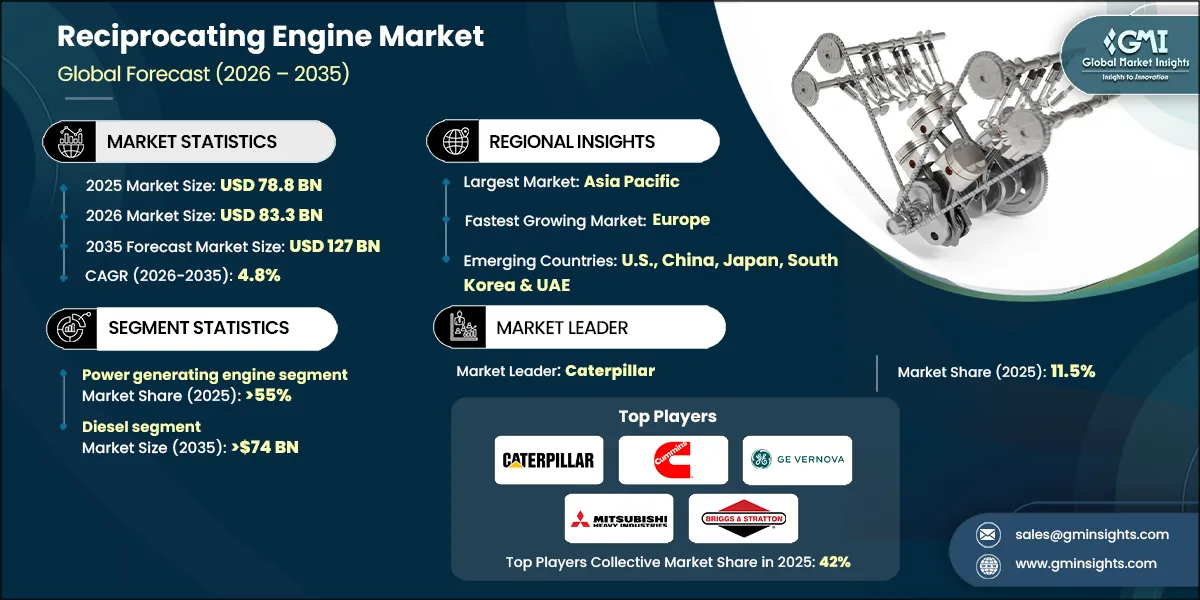
According to a recent study by Global Market Insights Inc., the reciprocating engine market was estimated at USD 78.8 billion in 2025. The market is expected to grow from USD 83.3 billion in 2026 to USD 127 billion by 2035, at a CAGR of 4.8%.
To get key market trends
- Ongoing innovation in modular & simpler design coupled with enhanced operational flexibility will drive the business potential. Growing adoption of fuel-efficient technologies in tandem with stringent emission norms is shaping the future of reciprocating engines. Moreover, integration of advanced digital monitoring systems together with predictive maintenance capabilities is improving reliability and reducing downtime.
- Reciprocating engine technology represents a comprehensive set of engineering innovations and operational strategies designed to deliver dependable and efficient power generation. These systems fulfill critical functions such as enhancing combustion efficiency, maintaining thermal stability, enabling operational adaptability, and supporting compatibility with a wide range of fuel sources.
- Modern reciprocating engines are engineered to provide robust performance under varying load conditions while integrating advanced control mechanisms for optimized reliability. Their versatility in applications, from industrial power to distributed generation, underscores their role as a cornerstone in energy infrastructure, ensuring consistent output and seamless integration with evolving energy ecosystems, which in turn will stimulate business growth.
- For citation, in 2024, the U.S. DOE invested USD 75 million in a California pilot project integrating reciprocating engines into distributed energy systems. The project delivered a 20% boost in efficiency and a 30% reduction in downtime during peak demand, ensuring reliable and flexible power supply while enhancing grid stability and reducing operational costs.
- The reciprocating engine market was valued at USD 66.9 billion in 2022 and grew at a CAGR of approximately 3.5% through 2025. Growing focus on compact and lightweight engine configurations in line with space optimization requirements will positively influence the product adoption.
- The rising need for a stable electricity supply coupled with ongoing investments in infrastructure will escalate the business dynamics. Increasing reliance on versatile and dependable energy systems in remote or off-grid areas is further boosting the business presence of these units.
- Advancements in engine architecture, improvements in fuel efficiency, and the integration of hybrid technologies are enhancing overall performance and operational flexibility, making these engines well-suited for both standby and continuous power generation requirements. Moreover, expansion of industrial manufacturing and construction activities will fuel the business momentum.
- For instance, according to the International Energy Agency, global electricity consumption grew by approximately 3.5% in 2025. This surge underscores rising demand for reliable power infrastructure and signals significant growth opportunities for the energy sector.
Reciprocating Engine Market Report Attributes
| Key Takeaway | Details |
|---|---|
| Market Size & Growth | |
| Base Year | 2025 |
| Market Size in 2025 | USD 78.8 Billion |
| Market Size in 2026 | USD 83.3 Billion |
| Forecast Period 2026 - 2035 CAGR | 4.8% |
| Market Size in 2035 | USD 127 Billion |
| Key Market Trends | |
| Drivers | Impact |
| Inclination toward energy optimization | The growing focus on maximizing energy efficiency is driving the adoption of engines equipped with advanced control systems & optimized combustion technologies. These solutions enable operators to reduce fuel consumption and operational costs while maintaining high performance standards. |
| Expansion in seaborne trade | The rise in global maritime activities is creating significant demand for reliable onboard power solutions. These engines, known for their durability and adaptability, are increasingly being deployed in marine applications to support propulsion and auxiliary power requirements. |
| Growing investments toward power generation capacity expansion | Growing investments in power generation capacity expansion are boosting demand for engines as reliable, flexible solutions for distributed and backup power generation. |
| Robust industrial sector growth | Industries require reliable, efficient, and flexible power solutions for continuous processes, peak-load management, and backup power, making reciprocating engines essential for maintaining productivity, minimizing downtime, and supporting energy-intensive industrial activities. |
| Pitfalls & Challenges | Impact |
| High initial investment | The substantial upfront cost associated with installing reciprocating engine systems remains a key challenge for market growth. Expenses related to equipment procurement, advanced control technologies, and compliance with environmental standards can deter small and medium enterprises from adopting these solutions. |
| Opportunities: | Impact |
| Flexible backup for renewables | As renewable penetration grows, reciprocating engines are emerging as a preferred solution for fast-start backup power. Their ability to ramp up quickly and operate efficiently at partial loads makes them ideal for balancing grids with high solar and wind variability. |
| Decentralized energy for emerging markets | In regions with weak grid infrastructure or frequent outages, reciprocating engines offer a reliable and cost-effective solution for distributed generation. Their modularity and scalability make them suitable for rural electrification and industrial clusters in developing economies. |
| Fuel diversity for cost control | Volatile fuel prices and sustainability mandates are driving demand for engines that can run on biogas, landfill gas, renewable natural gas, and hydrogen blends. This flexibility helps operators reduce fuel costs and meet carbon reduction targets without major infrastructure changes. |
| CHP and waste heat recovery | Industries and commercial facilities are increasingly adopting combined heat and power systems based on reciprocating engines to improve energy efficiency. Capturing waste heat for heating or cooling applications provides significant cost savings and supports decarbonization goals. |
| Market Leaders (2025) | |
| Market Leaders |
11.5% market share |
| Top Players |
|
| Competitive Edge |
|
| Regional Insights | |
| Largest Market | Asia Pacific |
| Fastest Growing Market | Europe |
| Emerging Country | U.S., China, Japan, South Korea & UAE |
| Future outlook |
|
What are the growth opportunities in this market?
Reciprocating Engine Market Trends
- The reciprocating engines market is increasingly shaped by the pursuit of operational efficiency. Businesses are prioritizing technologies that minimize fuel consumption and reduce lifecycle costs without compromising reliability. Advanced engine designs now incorporate optimized combustion systems and precision control mechanisms to ensure maximum energy output from every unit of fuel.
- The drive toward energy optimization is closely linked to the adoption of cleaner and more efficient fuels. Natural gas is gaining prominence as alternatives to traditional diesel, offering lower emissions and better thermal efficiency. Reciprocating engines designed for multi-fuel capability provide flexibility to switch between fuel types based on availability and cost, ensuring optimized energy output under varying conditions.
- The steady rise in global seaborne trade is creating significant opportunities for these units in marine applications. Ships require reliable propulsion systems and auxiliary power units to ensure smooth operations during long voyages. These engines, known for their durability and adaptability, are increasingly favored for powering vessels engaged in cargo transport, offshore drilling, and specialized maritime services.
- For citation, in April 2025, the municipal utility in Florida commissioned six high efficiency reciprocating internal combustion engines, adding 120 MW around 14% of its 845 MW system capacity. Supplied by MAN Energy Solutions and designed for future hydrogen compatibility, the units support Lakeland Electric’s generation modernization strategy, delivering flexible dispatch and reliable grid support during peak demand periods.
- The growth of international trade has led to significant investments in port infrastructure and shipping fleets, further boosting the adoption of these units. These engines are not only used for vessel propulsion but also for auxiliary power generation in ports, ensuring uninterrupted operations for loading, unloading, and cargo handling.
- The government and private players are investing heavily in expanding generation capacity to meet rising electricity demand across power, marine, and mechanical sectors. Moreover, increasing adoption of these engines in microgrid applications together with distributed energy systems will accelerate the business scenario.
- Investments in power generation projects are creating a strong preference for distributed and modular systems that can be deployed quickly and efficiently. Reciprocating engines meet this requirement by offering flexibility in installation and the capability to operate independently or in parallel with other units. This adaptability makes them an attractive solution for regions where grid expansion is slow, offering significant opportunities for industry expansion.
- For instance, in 2025, the U.S. DOE invested USD 80 million in a project showcasing the application of gas reciprocating engines in industrial power systems. The initiative delivered a 17% improvement in fuel efficiency and a 12% reduction in emissions compared to baseline systems, underscoring the operational and environmental advantages of this technology.
- Tightening global emission standards is compelling for manufacturers to develop reciprocating engines that meet strict environmental requirements. Governments and international bodies are enforcing regulations aimed at reducing greenhouse gas emissions and particulate matter, which has accelerated the adoption of advanced combustion technologies and cleaner fuel options.
- Ongoing technological advancements, including compact modular designs, rapid start-up capabilities, and multi-fuel compatibility will stimulate the business outlook. Strong demand for these systems in both mobile and stationary power applications combined with their modular architecture, operational flexibility, and minimal maintenance requirements will further proliferate the business landscape.
Reciprocating Engine Market Analysis
Learn more about the key segments shaping this market
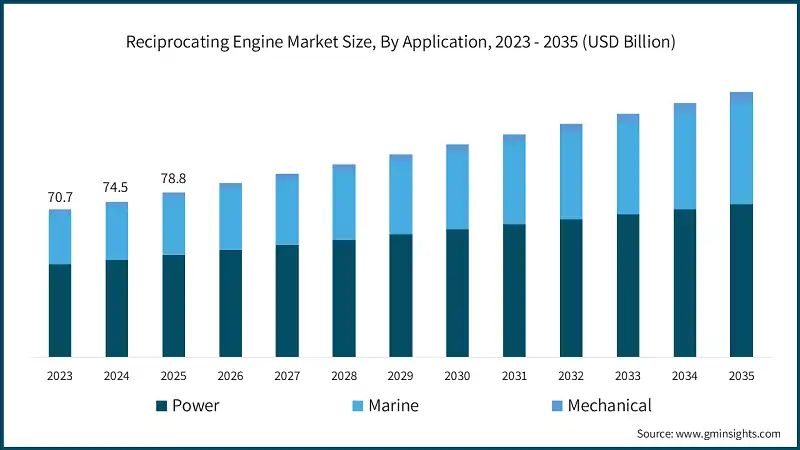
- Based on application, the industry is segmented into power, marine and mechanical. The reciprocating power generating engine market holds a share of over 55% in 2025 and is projected to grow at a growth rate of over 4% through 2035. The industry is driven by increasing demand for reliable power solutions, advancements in modular engine designs, and growing adoption in distributed generation systems.
- The growing need for distributed power generation along with increasing reliance on modular & flexible energy solutions are set to transform the industry landscape. These engines are widely adopted across industrial, commercial, and utility-scale applications due to their ability to deliver rapid start-up, high operational efficiency, and seamless integration with renewable energy sources.
- The marine reciprocating engine market is set to exceed USD 45 billion by 2035. The surge in international trade and maritime activities is boosting demand for these units in marine propulsion systems. Their durability and ability to operate under harsh conditions make them indispensable for shipping fleets.
- For illustration, in May 2025, Kerrville Public Utility Board announced plans for a 122 MW power project comprising six reciprocating internal combustion engines, located about 10 miles south of Columbus, Texas. The project involves Sky Global as developer and operator, MAN Energy Solutions supplying and maintaining engines, Summit Industrial handling construction, SEnergy providing engineering and design services, and Kinder Morgan supplying natural gas via pipeline.
- Stringent emission regulations in the shipping industry are driving the adoption of cleaner reciprocating engines that utilize low-sulfur fuels or natural gas. Manufacturers are innovating to meet IMO standards while maintaining performance, which in turn will stimulate business dynamics.
- The mechanical reciprocating engine market was valued at USD 2.3 billion in 2025. Increasing demand for reliable mechanical drive systems in industrial applications including compressors, pumps, and oil & gas operations will energize the industry dynamic. Moreover, growing investments in automation and process optimization will proliferate business scenario.
- Fuel flexibility is becoming important in mechanical drive applications, especially in regions with fluctuating fuel availability. Engines that can switch between natural gas and diesel offer operational resilience and cost savings. Advancements in engine technology, including improved lubrication systems and thermal management, are enhancing efficiency in mechanical drive applications.
- For instance, in 2024, the Canadian government has unveiled policy proposals targeting a 35% reduction in oil and gas sector emissions by 2030, strengthening national decarbonization efforts. These measures are designed to curb greenhouse gas output, promote cleaner technologies, and accelerate the transition toward low-carbon operations within one of the most emissions-intensive industries.
Learn more about the key segments shaping this market
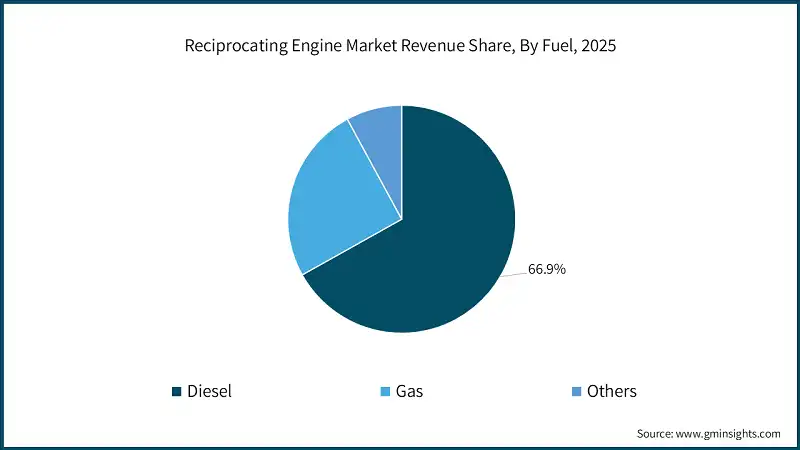
- Based on fuel, the market is divided into diesel, gas and others. The diesel reciprocating engine market holds a share of 66.9% in 2025 and is set to surpass USD 74 billion by 2035. Their ability to deliver high torque and withstand harsh operating conditions makes them indispensable for sectors requiring robust and reliable performance.
- Continuous improvements in fuel injection systems, turbocharging, and heat management are enhancing the efficiency of these systems. These advancements help reduce fuel consumption and operational costs, making them more competitive in cost-sensitive markets, thereby escalating the business growth.
- For citation, in April 2025, EKPC proposed the development of a 214 MW natural gas fired reciprocating engine power plant comprising twelve 18 MW units, designed to meet rising regional electricity demand while enhancing renewable energy integration through fast ramping & dispatchable power generation.
- The gas fired reciprocating engine industry will witness a CAGR of over 5.5% by 2035. These unit produces lower levels of nitrogen oxides, sulfur dioxide, and particulate matter, making these engines an attractive choice for industries aiming to comply with stringent environmental regulations. This cleaner profile aligns with global sustainability goals and positions gas engines as a preferred solution for eco-conscious power generation strategies.
- Natural gas offers a cost advantage over liquid fuels in many regions, which is driving its adoption in reciprocating engines. Countries with abundant gas reserves or established LNG infrastructure are witnessing rapid deployment of gas-based engines for both industrial and commercial applications.
- For instance, in June 2025, Kentucky Municipal Energy Agency has begun construction of Energy Center I, a new reciprocating internal combustion engine power plant equipped with four Wärtsilä 18V50SG generators, each rated at 18.8 MW. The facility is designed for continuous and peaking operations, offering fast-start capabilities to support renewable integration & strengthen grid flexibility.
Looking for region specific data?
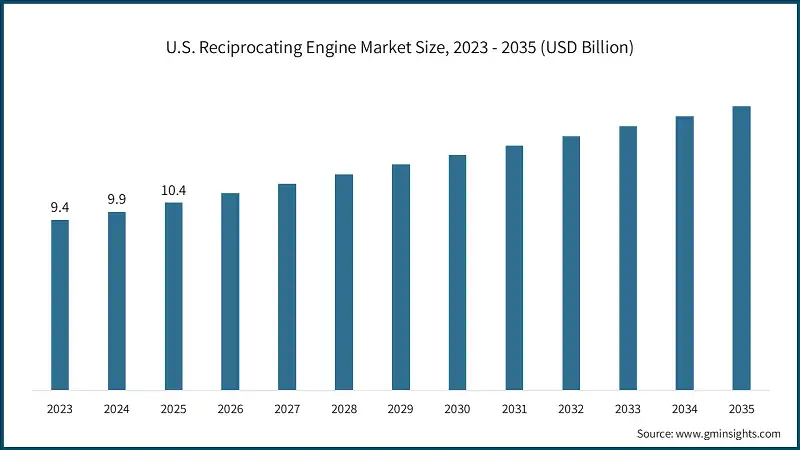
- The U.S. dominated the reciprocating engine market in North America with over 70% share in 2025 and generated above USD 10.4 billion in revenue. Increasing infrastructure development combined with the rise of mechanized farming will drive the adoption of these engines, particularly across rural and semi-urban areas.
- For citation, the USD 1 trillion federal infrastructure bill, combined with increased green investments and ongoing efforts to reshore manufacturing, is fueling substantial growth in the U.S. construction sector in 2024. This surge is driven by accelerated infrastructure projects, including data centers and manufacturing facilities, highlighting the industry expanding scale & strategic significance.
- The North America reciprocating engine market is projected to hit USD 20 billion by 2035. Increasing modernization efforts within the energy sector in line with the adoption of high-performance, efficient, and low-emission engines will elevate the business landscape. Rapid industrialization across key regions, supported by continuous advancements in engine technologies will further strengthen the industry outlook.
- The Europe reciprocating engine market was estimated at USD 19.9 billion in 2025. The increasing inclination toward comfort, luxury, and reliable engine performance combined with economic will accelerate the product deployment. In addition, the growing need for efficient and resilient power generation solutions across wide tandem of application areas will propel the business momentum.
- The Asia Pacific reciprocating engine market is set to grow at a rate of over 5% by 2035, driven by the increasing adoption of dual-fuel engine technologies along with the expanding scope of offshore and subsea operations, including production, drilling and maintenance activities.
- For instance, in 2025, Singapore and India permitted a Letter of Intent to advance maritime digitalization and decarbonization. The partnership combines India’s strengths in IT and green fuel with Singapore’s position as a global shipping hub. This initiative aims to accelerate zero-emission technologies and digital solutions, paving the way for the Singapore-India Green and Digital Shipping Corridor.
- A strong emphasis on energy security and reliability, particularly in remote and off-grid areas will enhance the business opportunities across Latin America. At the same time, the shift toward cleaner fuel alternatives, reinforced by stringent environmental regulations, is reshaping the industry landscape.
- In Middle East & Africa, rising industrialization, rapid infrastructure development, and growing energy demand will strengthen the industry outlook. Moreover, engine’s ability to provide reliable and scalable power makes them a preferred choice for both prime and backup applications.
- Latin America reciprocating engine industry will grow substantially, propelled by rising investments in natural gas infrastructure and the expansion of power generation projects. Favorable government policies focused on lowering reliance on imported fuels, along with the availability of substantial domestic natural gas reserves, are set to further enhance and reinforce the overall industry outlook.
- For instance, in 2024, Saudi Arabia committed USD 2.7 billion to roll out the standard incentives program for the industrial sector, following approval by the Council of Ministers. The program is designed to strengthen competitiveness and accelerate sectoral growth through financial support & strategic investments.
Reciprocating Engine Market Share
- The top five players in the reciprocating engine industry are Caterpillar, Cummins, GE Vernova, Mitsubishi Heavy Industries and Briggs & Stratton contribute around 42% of the market share in 2025.
- The industry is substantially competitive and technology-driven, shaped by the growing need for reliable, fuel-flexible, and low-emission power generation solutions. Market leaders are focusing on advanced engine designs, modular configurations, and digital monitoring systems to enhance efficiency, durability, and operational flexibility.
- Caterpillar delivers robust reciprocating engine solutions designed for prime and standby power applications across industrial, commercial, and remote environments. Their portfolio emphasizes fuel flexibility, modular configurations, and advanced control systems to ensure operational reliability. Caterpillar integrates digital monitoring platforms for predictive maintenance, enabling customers to optimize performance and reduce lifecycle costs.
- Cummins offers high-performance reciprocating engines engineered for efficiency, durability, and low emissions. Their solutions include multi-fuel capabilities and hybrid-ready designs, supporting diverse applications from distributed generation to backup power. Cummins leverages smart technologies such as IoT-enabled monitoring and analytics to enhance reliability and minimize downtime, reinforcing its commitment to sustainable and cost-effective power solutions.
- GE Vernova specializes in reciprocating engine systems that complement renewable energy and hybrid configurations. Their engines feature advanced combustion technology, digital twins, and real-time performance optimization tools. GE Vernova focuses on delivering flexible and reliable power generation for industrial and utility-scale projects, aligning with global energy transition and decarbonization objectives.
- Mitsubishi Heavy Industries provides a comprehensive range of reciprocating engines designed for superior efficiency and operational flexibility. Their offerings include low-emission technologies, optimized cooling systems, and fuel-flexible designs suitable for demanding industrial environments. MHI emphasizes lifecycle services and modernization programs, helping operators improve performance and meet stringent environmental standards.
- Briggs & Stratton delivers reciprocating engine solutions tailored for distributed generation and specialized industrial applications. Their focus includes modular designs, rapid start-up capability, and integration with renewable energy systems. The company combines mechanical expertise with advanced digital platforms for monitoring and energy management, supporting customers in achieving sustainability and operational resilience.
Reciprocating Engine Market Companies
Major players operating in the reciprocating engine industry are:
- AB Volvo Penta
- Briggs & Stratton
- Caterpillar
- Cummins
- GE Vernova
- Guascor Energy
- Honda Motor
- IHI Corporation
- J C Bamford Excavators
- Kawasaki Heavy Industries
- KUBOTA Corporation
- Lister Petter
- MAN Energy Solutions
- Mitsubishi Heavy Industries
- Perkins Engines
- Rehlko
- Rolls-Royce
- Wärtsilä
- Yamaha Motor
- Yanmar Holdings
- GE Vernova reported USD 27.1 billion in revenue for the first nine months of 2025, underscoring the strength and breadth of its operations. During this timeframe, the power segment generated USD 14 billion, while the wind segment contributed USD 6.7 billion, and the electrification segment accounted for USD 6.8 billion in revenue.
- Caterpillar reported USD 17.6 billion in revenue for the third quarter of 2025, reflecting a 10% increase from USD 16.1 billion in Q3 2024, largely driven by higher equipment sales volumes to end users. The company’s operating profit margin stood at 17.3% in Q3 2025, down from 19.5% in the same period last year.
- Mitsubishi Heavy Industries posted revenues of USD 13.6 billion for the first half of 2025, supported by a net profit of about USD 750 million. These results underscore the company’s operational scale and profitability during the reporting period, reflecting its ability to deliver consistent financial performance.
Reciprocating Engine Industry News
- In October 2025, AB Volvo Penta strengthened its presence in the agricultural machinery sector by supplying its TAD883 engine as the standard power unit for Delvano’s self-propelled sprayer lineup. This move supports Delvano’s efforts to streamline its product range while enhancing performance and reliability. This collaboration underscores its commitment to delivering high-performance, dependable power solutions tailored to the evolving needs of modern agriculture.
- In October 2025, Guascor Energy expanded its HM engine portfolio with a new configuration engineered to comply with the stringent emission standards enforced by Northern European countries under the EU Medium Combustion Plant Directive. The updated design meets the maximum allowable limit for Total Hydrocarbons (THCs) of 1300 mg/Nm³, underscoring the company’s strategic focus on regulatory compliance and sustainable energy solutions.
- In September 2025, Cummins announced the launch of a high-performance engine brake integrated into its new X10 engine platform, targeting medium and heavy-duty vehicles across vocational, regional haul, and transit bus segments. The X10, part of Cummins’ HELM fuel-agnostic engine series, is positioned to replace the X12 and L9 models, offering enhanced operational efficiency and flexibility. The newly developed 1.5-Stroke HPD engine brake delivers a substantial improvement in retarding capability, providing up to 40% greater braking force.
- In January 2025, GE Vernova announced plans to invest approximately USD 600 million across its U.S. factories and facilities over the next two years. This strategic initiative is aimed at strengthening the company’s manufacturing capabilities to address rising global electricity demand. The investment supports key national priorities such as energy affordability, security, and industrial competitiveness, while also enhancing its export capacity.
The reciprocating engine market research report includes in-depth coverage of the industry with estimates & forecast in terms of revenue (USD Million) & volume (MW) from 2022 to 2035, for the following segments:
Market, By Fuel
- Diesel
- Gas
- Others
Market, By Rated Power
- 0.5 MW - 1 MW
- > 1 MW - 2 MW
- > 2 MW - 3.5 MW
- > 3.5 MW - 5 MW
- > 5 MW - 7.5 MW
- > 7.5 MW
Market, By Application
- Power
- Marine
- Mechanical
Market, By Cylinder Configuration
- Inline
- V-Type
- Radial
- Opposed piston
The above information has been provided for the following regions and countries:
- North America
- U.S.
- Canada
- Mexico
- Europe
- UK
- France
- Germany
- Russia
- Italy
- Spain
- Netherlands
- Denmark
- Asia Pacific
- China
- India
- Japan
- South Korea
- Australia
- Thailand
- Singapore
- Middle East & Africa
- UAE
- Saudi Arabia
- Qatar
- Oman
- Kuwait
- Egypt
- Turkey
- South Africa
- Latin America
- Brazil
- Argentina
- Chile
Frequently Asked Question(FAQ) :
Which region leads the reciprocating engine market?
Asia Pacific is the largest market, driven by dual-fuel technology adoption, expanding offshore operations, strong emphasis on energy security in remote areas, and rising industrial activities across emerging economies.
Who are the key players in the reciprocating engine market?
Key players include Caterpillar, Cummins, GE Vernova, Mitsubishi Heavy Industries, Briggs & Stratton, AB Volvo Penta, Guascor Energy, Honda Motor, IHI Corporation, J C Bamford Excavators, Kawasaki Heavy Industries, KUBOTA Corporation, Lister Petter, MAN Energy Solutions, Perkins Engines, Rehlko, Rolls-Royce, Wärtsilä, Yamaha Motor, and Yanmar Holdings.
What are the upcoming trends in the reciprocating engine market?
Key trends include hydrogen blend compatibility, IoT-enabled predictive maintenance, AI-driven analytics for real-time optimization, multi-fuel capability for biogas and renewable natural gas, combined heat and power systems, and fast-start backup solutions for renewable integration.
What is the growth outlook for the gas-fired reciprocating engine segment from 2026 to 2035?
Gas-fired reciprocating engines are projected to grow at a CAGR of over 5.5% till 2035, driven by lower emissions, cost advantages in regions with abundant gas reserves, and compliance with stringent environmental regulations.
What was the valuation of the diesel fuel segment in 2025?
Diesel reciprocating engines held 66.9% market share in 2025 and are set to surpass USD 74 billion by 2035, driven by high torque delivery and robust performance in harsh operating conditions.
How much revenue did the power generation application segment generate in 2025?
Power generation applications held over 55% market share in 2025, leading the market due to increasing demand for reliable distributed power solutions and seamless integration with renewable energy sources.
What is the market size of the reciprocating engine in 2025?
The market size was USD 78.8 billion in 2025, with a CAGR of 4.8% expected through 2035 driven by modular designs, improved operational flexibility, and fuel-efficient technologies meeting stringent emission norms.
What is the projected value of the reciprocating engine market by 2035?
The reciprocating engine market is expected to reach USD 127 billion by 2035, propelled by digital technologies integration, hydrogen-compatible systems, and adoption of advanced low-emission designs across power generation applications.
What is the current reciprocating engine market size in 2026?
The market size is projected to reach USD 83.3 billion in 2026.
Reciprocating Engine Market Scope
Related Reports