Summary
Table of Content

Rare Sugar Market
Get a free sample of this report
Form submitted successfully!
Error submitting form. Please try again.
Thank you!
Your inquiry has been received. Our team will reach out to you with the required details via email. To ensure that you don't miss their response, kindly remember to check your spam folder as well!
Request Sectional Data
Thank you!
Your inquiry has been received. Our team will reach out to you with the required details via email. To ensure that you don't miss their response, kindly remember to check your spam folder as well!
Form submitted successfully!
Error submitting form. Please try again.
Rare Sugar Market Size
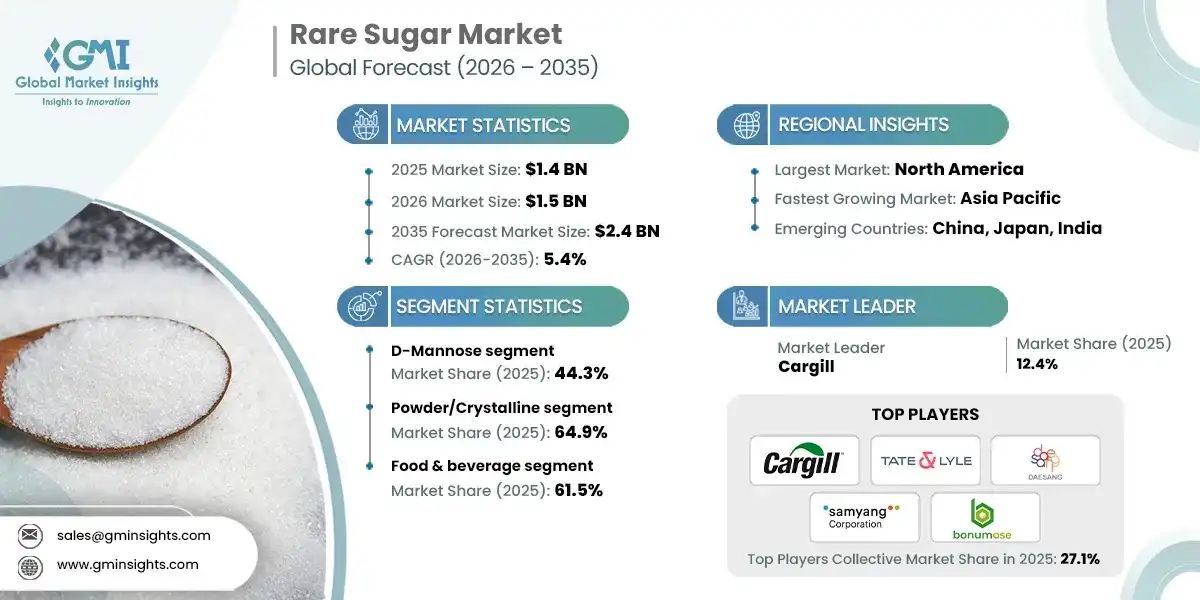
The global rare sugar market size was valued at USD 1.4 billion in 2025. The market is expected to grow from USD 1.5 billion in 2026 to USD 2.4 billion in 2035, at a CAGR of 5.4% according to latest report published by Global Market Insights Inc.
Rare Sugar Market Key Takeaways
Market Size & Growth
- 2025 Market Size: USD 1.4 Billion
- 2026 Market Size: USD 1.5 Billion
- 2035 Forecast Market Size: USD 2.4 Billion
- CAGR (2026–2035): 5.4%
Regional Dominance
- Largest Market: North America
- Fastest Growing Region: Asia Pacific
Key Market Drivers
- Rising global demand for healthier low-calorie sweeteners replacing conventional sugars.
- Increasing prevalence of diabetes and obesity driving functional sugar innovation.
- Encourages manufacturers to incorporate rare sugars offering metabolic benefits, expanding market penetration across food and beverage sectors..
Challenges
- High production costs and limited large-scale manufacturing capabilities.
- Regulatory uncertainties and varying global approvals for emerging rare sugars.
Opportunity
- Expanding clean-label and natural ingredient trends across global consumer markets.
- Advances in enzymatic and microbial production improving cost-efficient sugar synthesis.
Key Players
- Market Leader: Cargill led with over 12.4% market share in 2025.
- Leading Players: Top 5 players in this market include Cargill, Tate & Lyle PLC, Tate & Lyle PLC, Samyang Corporation, Bonumose, which collectively held a market share of 27.1% in 2025.
Get Market Insights & Growth Opportunities
- The demand for rare sugars globally is rapidly increasing with the increased demand for the ingredients Allulose, Tagatose, D-Mannose and Allose due to their appeal to consumers as low-calorie, low-glycemic and clean-label sugar replacements. As a result, an increasing number of food/beverage products are now containing these rare sugars as the understanding of the metabolic health benefits of rare sugars, regulations, and supply chain infrastructures, have been developed.
- D-mannose is expected to continue to hold the largest market share through 2025 at 44.3%, primarily attributed to its use as a urinary supplement. Allulose, with 30.6% of the market, continues to grow in clean-label food products. The low-glycemic index and prebiotic nature of tagatose are making it more suitable for diabetic products in all areas, especially in bakery, dairy, cereals, beverages and sweets categories.
- In 2025, powder and crystalline rare sugars occupy 64.9% of the total market share, as these products are highly stable, have a longer shelf-life and can be used in bakery products, confectionery and beverages. Their use in the marketplace will increase, and their CAGR is forecasted to be 7.4%. Syrups and liquids are becoming increasingly popular in the functional beverage category and for large scale manufacturing.
- In 2025, the food and beverage sector accounts for the largest market share at 61.5%. The demand for low-calorie, low-GI, and clean labelled sweeteners drive this segment of the market. Other applications that are experiencing moderate growth are pharmaceuticals, cosmetics, nutraceuticals and specialty products and benefit from the functional, prebiotic and therapeutic properties of rare sugars.
- By geography, North America has the highest market share with sales of USD 461.7 million by the year 2025 primarily driven by the increasing demand for functional foods, the support of regulatory bodies, and the growing concern for diabetes awareness in the USA. Europe accounts for 23.8% of the market, which is being driven by Germany.
- The fastest growing region is APAC, with China, Japan and India being the largest contributors to this growth due to rising disposable incomes, increase urbanization and the demand for healthy foods. Latin America and the Middle East and Africa are emerging markets for rare sugars. Brazil and Saudi Arabia are the main contributors to regional growth through the increased sale and importation of rare sugars.
To get key market trends
Rare Sugar Market Trends
- Rare sugars are becoming more integrated into mainstream food and beverage formulation. Allulose, tagatose, and D-mannose have been quickly adopted as popular ingredients among consumers. Brands are changing their formulations to meet consumer demand for products with a clean label, a low-calorie count, and low glycemic index values. Consequently, rare sugars are quickly replacing traditional sugars in many products. The rapidly growing awareness of metabolic health benefits, the improvement of regulatory acceptance, and the establishment of supportive supply chain networks will all help accelerate the ongoing acceptance of rare sugars.
- Due to the advancements in technologies that allow for scalable production and cost-effective processes for producing rare sugars, manufacturers have been able to produce rare sugars at lower costs and higher yields. Technology has allowed the rapid development of enzymatic pathways, microbial fermentation, and bioconversion techniques that enable manufacturers to meet the growing demand for rare sugars. As these technologies have matured and developed, they have opened the door to many new food-related and nutraceutical companies that are looking to expand into the areas of functional foods, nutraceuticals, and pharmaceuticals globally.
Rare Sugar Market Analysis
Learn more about the key segments shaping this market
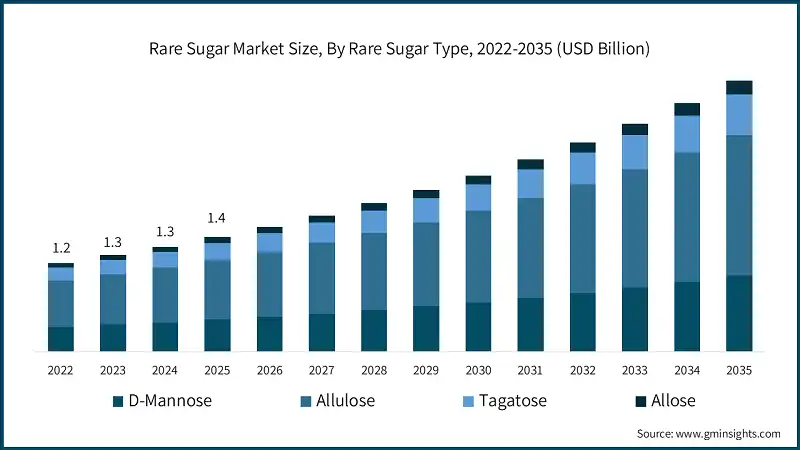
Based on rare sugar type, the rare sugar market is segmented into D-Mannose, Allulose, Tagatose, and Allose. D-Mannose dominated the market with an approximate market share of 44.3% in 2025 and is expected to grow with a CAGR of 1% up to 2035.
- D-Mannose is the largest segment at USD 643 million in 2025 and is supported through widespread use in urinary supplements. Allulose is forecasted to have a 30.6% market share in 2025 and has been strongly adopted in clean label food formulations giving it the fastest growth rate of any segment.
- Tagatose has become a significant player due to its unique qualities as an extremely low glycemic index (GI) sweetener. Tagatose also provides numerous prebiotic benefits, which make tagatose an excellent choice for developing diabetic-friendly food products. Tagatose has all of the same sweetness and functionality as table sugar (sucrose), enabling tagatose to be utilized in a variety of industries that manufacture dairy products cereals, beverages, and confections. Allose has begun to increase its presence in the marketplace due to its antioxidant properties; almost no calories; and its ability to regulate metabolism.
Learn more about the key segments shaping this market
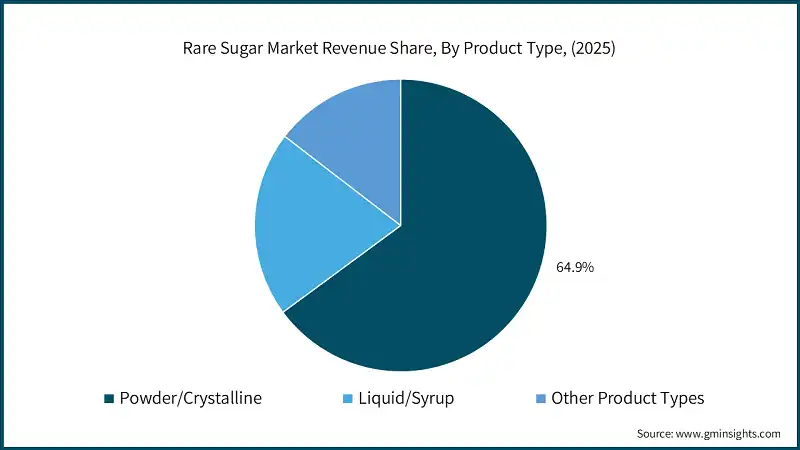
Based on product type, the rare sugar market is segmented into powder/crystalline, liquid/syrup, and other product types. Powder/Crystalline held the largest market share of 64.9% in 2025 and is expected to grow at a CAGR of 4.4% during 2025 to 2034.
- The powder/crystalline variety of rare sugar products will dominate the global market with a total market value of USD 942.1 million in 2025. Powder/crystalline type rare sugar is more stable compared to other product forms such as liquid/syrup therefore, it typically has a longer shelf-life. This makes the powder/crystalline product the most suitable ingredient for most bakery, confections, and drink formulations.
- Liquid/syrup product types are becoming increasingly popular because they dissolve easily into beverages, sauces, and dairy products and also have the advantage of easy processing on a large scale for rare sugar manufacturer production. Liquid rare sugars are projected to have a CAGR of 7.4% during the forecast period. Growth in functional beverage and ready-to-drink categories across the globe leads to the increasing popularity of liquid rare sugars.
- There are a few other product types that arise in the rare sugar market, such as blends, granules, and specialized formulations for unique applications. Even though the total volume of these product categories is small, steady growth is expected to continue as manufacturers develop customized applications.
Based on application, the rare sugar market is segmented into food and beverage, pharmaceuticals, cosmetics, nutraceuticals, and other applications. Food and beverage segment dominated the market with an approximate market share of 61.5% in 2025 and is expected to grow with the CAGR of 4.8% through 2035.
- In 2025, with 61.5% of the market share, food and beverage continues to be the largest segment. Demand for low-calorie, low-glycemic and clean label sweeteners, such as allulose, tagatose, and d-mannose are the driving factor in food and beverage. These rare sugars are anticipated to be used across the bakery, confectionery, beverage and dairy product industries to replace conventional sugars without changing the taste, texture or functionality of these products.
- The projected CAGR of the pharmaceuticals segment is 4.3%, with rare sugars being used in growing numbers of supplements, medical nutrition products and drug formulations; these sugars provide extensive functional, metabolic, and/or prebiotic benefits to provide greater product stability and support for health-conscious consumers to receive the greatest benefit of therapeutic uses of rare sugars.
- The use of rare sugars in cosmetics is expected to continue to grow as they are incorporated into products for their moisturizing, antioxidant, and anti-aging properties, particularly in premium formulations. The other applications segment, which includes specialty foods, industrial uses and animal nutrition, account for 4.8% of the total market, with a progressive growth trend through customized solutions.
Looking for region specific data?
North America rare sugar market leads the industry with revenue of USD 461.7 billion in 2025 and is anticipated to show lucrative growth over the forecast period.
- The rare sugar industry is dominated by North America, which leads due to increased demand for low-calorie and low-glycemic foods and beverages, as well as clean-label sweeteners. The U.S. continues to grow at a rapid rate because of an increased awareness of health issues, increased prevalence of diabetes, and the growing popularity of functional foods/functional beverages/dietary supplements; regulatory approval of several rare sugars, such as allulose and tagatose, will also contribute to future growth of this market in North America.
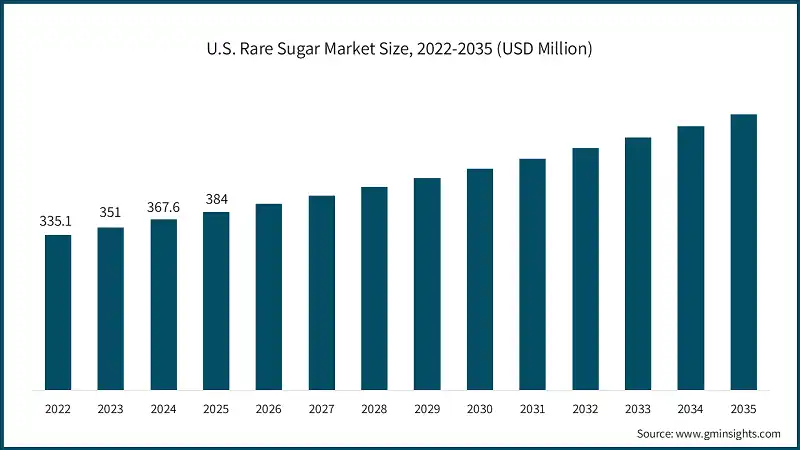
U.S. dominates the North America rare sugar market with a size of USD 384 million in 2025, showcasing strong growth potential.
- The U.S. has the largest market for rare sugars as a single country due to the growing consumer awareness of functional, low-calorie, and low-glycemic sweeteners. The majority of the applications for allulose and tagatose are found in bakery applications, followed by confectionery, beverage, and dietary supplement applications. The current trend of "clean-label" products, the increasing number of people suffering from diabetes, and the increase in regulatory support for rare sugars have also contributed greatly to the rapid growth of the rare sugar market in the U.S.
The Europe rare sugar industry is growing rapidly on the global level with a market share of 23.8% in 2025.
- The European Union is experiencing moderate growth in the market for rare sugars, particularly in Germany, France, and the U.K., where there is a growing demand for natural and functional sweeteners. The European market focuses on clean-label and diabetic-friendly sweeteners; therefore, there has been strong adoption in the baking industry, the confectionery industry, and within beverage applications. The development of the market in the European region is also driven by current government initiatives promoting metabolic health and nutrition awareness.
Germany dominates the European rare sugar market, showcasing strong growth potential.
- Germany is currently the leader in the European market for rare sugars. The high level of acceptance of rare sugars in bakery applications, confectionery applications, and functional beverages has resulted in a growing consumer base for healthy products and has increased the demand for diabetic-friendly and clean-label products. Government initiatives to improve nutrition awareness supported by regulatory support for rare sugars has further supported the growth of the market in Germany.
The Asia Pacific rare sugar market is anticipated to grow at a CAGR of 7.1% during the analysis timeframe.
- The APAC region is the fastest growing market for rare sugars because of the increase in urbanization and disposable income for consumers in China, Japan, and India, as well as growing health consciousness among these consumers. The demand for functional foods and functional beverages, as well as nutraceuticals, is driving the growth of the market; in addition, the growth of the rare sugar market is being accelerated by an increase in government support for alternative sweeteners and improved production and manufacturing capabilities.
China rare sugar market is estimated to grow with a significant CAGR in the Asia Pacific region.
- China is a significant market for rare sugars, fuelled by urbanisation, increasing discretionary incomes, and growing demand for rare sugars, functional foods, beverages, and nutraceuticals. The development of local production and the importation of rare sugar products have contributed to China’s increasing consumption of Rare Sugar Products. Regulatory agencies granting approval for the use of ingredients such as Allulose have led to the commercialization of this sweetener in the food industry.
Latin America rare sugar accounted for 10.7% market share in 2025 and is anticipated to show highest growth over the forecast period.
- The emerging market for rare sugars in Latin America is driven by a rise in consumer awareness of functional and low-calorie products (eg: baked goods) and is occurring primarily in Mexico and Brazil. There is also a demand for beverages, confectionery, and nutraceuticals with a growing amount of imports coming into Latin America, and the establishment of manufacturing operations within Latin America to manufacture rare sugars has been a contributing factor to the growth of this emerging market as well.
Brazil leads the Latin American rare sugar market, exhibiting remarkable growth during the analysis period.
- Brazil has the largest, market in Latin America, as there is increasing uptake of rare sugars within the beverage industry, bakery products, and nutraceuticals. As consumers become more health-conscious, the demand for low-calorie sweeteners is increasing. Additionally, investments in both imports of rare sugar products and production infrastructure will continue to drive growth.
Middle East & Africa rare sugar accounted for 4.8% market share in 2025 and is anticipated to show lucrative growth over the forecast period.
- The Middle East & Africa (MEA) region is a small but burgeoning market for rare sugars due to the growth of functional foods, dietary supplements, and the influence of the current trend for healthy lifestyle choices in the Gulf region. The limited local production of rare sugars and the growing number of imports of rare sugars to the area, combined with increasing knowledge of the connection between metabolism and metabolic health, are contributing to the gradual acceptance of rare sugars within the MEA.
Saudi Arabia rare sugar industry to experience substantial growth in the Middle East and Africa market in 2025.
- In the Middle East, the Kingdom of Saudi Arabia controls the rare sugar market, with the primary use of rare sugars being in the production of dietary supplements, functional foods, and beverages. The rapid growth in health-conscious trends and an increase in lifestyle-related metabolic disorders will continue to support the growth of rare sugars in the region. Because there is limited local production of rare sugars, imports will play a significant role in contributing to the growth of the Middle East market.
Rare Sugar Market Share
The top 5 companies in rare sugar industry include Cargill, Tate & Lyle PLC, Daesang Corporation, Samyang Corporation, and Bonumose. These are prominent companies operating in their respective regions covering approximately 27.1% of the market share in 2024. These companies hold strong positions due to their extensive experience in rare sugar market. Their diverse product portfolios, backed by robust production capabilities and distribution networks, enable them to meet the rising demand across various regions.
- Cargill is a worldwide leader in the agricultural, food ingredient, and industrial solution sectors. In the rare sugar sector, they concentrate on innovative sweeteners (such as allulose and tagatose) to satisfy the health-conscious consumer. With a considerable research & development capacity, robust supply chains, and strategic partnerships, Cargill is able to provide global markets with superior quality and sustainable product offerings across all food, beverage, and nutraceutical domains.
- Tate & Lyle PLC is a UK-based multinational company that specializes in sweeteners, starches, and functional ingredients such as rare sugars and alternative sweeteners for use in clean label and low-calorie food products. The company has a strong commitment to creating products through sustainable methods that are consumer-centric and dedicated to innovation, primarily targeting the global markets for food & beverage and health & nutrition.
- Daesang Corporation is a South Korean international company that has an extensive range of food ingredient and sweetener offerings, including fermentation-based products, as well as a variety of rare sugars, namely D-mannose and tagatose, that cater to low-calorie and functional foods. As such, Daesang is committed to creating innovative food and beverage products through an R&D-centric approach, and Daesang's ongoing efforts to create high-quality products through advanced manufacturing methods have resulted in the continued growth of Daesang on a global scale in the food, beverage, and nutraceutical industry.
- Samyang Corporation creates items with the intention of satisfying consumers looking for a healthy lifestyle. Samyang Corporation was founded in South Korea and specializes in the manufacture of pharmaceuticals, food additives, and biochemicals. In addition to manufacturing finished goods, Samyang Corporation also produces raw materials and intermediate products for pharmaceutical companies. Samyang produces such a wide variety of products, including amino acids, sugars, sweeteners, preservatives, acids, food coloring, and other specialty chemicals.
- Bonumose is a biotech company located in the United States that creates rare sugars through the use of enzyme technology. Bonumose's primary focus is on producing the rare sugars allulose and tagatose. Bonumose's products are designed to be used in the production of functional foods, beverages, and nutraceuticals. Bonumose prides itself on innovation, scalability, and clean label possibilities. Bonumose's goal is to provide global food, beverage, and nutraceuticals marketplaces with sustainable, high-quality rare sugars.
Rare Sugar Market Companies
Major players operating in the rare sugar industry include:
- Anderson Global Group, LLC
- Ardilla Technologies
- Bonumose
- Cargill
- Daesang Corporation
- Matsutani Chemical Industry Co., Ltd
- Roquette Frères
- Samyang Corporation
- SAVANNA Ingredients GmbH
- Shandong Bailong Chuangyuan Bio-tech Co., Ltd
- Shandong Fuyang Bio-tech Co., Ltd
- Tate & Lyle PLC
Rare Sugar Market Report Attributes
| Key Takeaway | Details |
|---|---|
| Market Size & Growth | |
| Base Year | 2025 |
| Market Size in 2025 | USD 1.4 Billion |
| Market Size in 2026 | USD 1.5 Billion |
| Forecast Period 2026-2035 CAGR | 5.4% |
| Market Size in 2035 | USD 2.4 Billion |
| Key Market Trends | |
| Drivers | Impact |
| Rising global demand for healthier low-calorie sweeteners replacing conventional sugars | Accelerates adoption of rare sugars as clean-label alternatives, boosting product development and widening consumer acceptance. |
| Increasing prevalence of diabetes and obesity driving functional sugar innovation | Encourages manufacturers to incorporate rare sugars offering metabolic benefits, expanding market penetration across food and beverage sectors. |
| Encourages manufacturers to incorporate rare sugars offering metabolic benefits, expanding market penetration across food and beverage sectors. | Expands high-value applications, enhancing profitability for producers and encouraging investment in production technologies. |
| Pitfalls & Challenges | Impact |
| High production costs and limited large-scale manufacturing capabilities | Constrains supply availability and keeps prices elevated, limiting adoption among cost-sensitive food manufacturers. |
| Regulatory uncertainties and varying global approvals for emerging rare sugars | Regulatory uncertainties and varying global approvals for emerging rare sugars |
| Opportunities: | Impact |
| Expanding clean-label and natural ingredient trends across global consumer markets | Creates strong demand for minimally processed rare sugars, supporting premium pricing and broader product innovation. |
| Advances in enzymatic and microbial production improving cost-efficient sugar synthesis | Enables scale-up and price reduction, making rare sugars more competitive with traditional sweeteners. |
| Market Leaders (2025) | |
| Market Leaders |
12.4% |
| Top Players |
|
| Competitive Edge |
|
| Regional Insights | |
| Largest Market | North America |
| Fastest growing market | Asia Pacific |
| Emerging countries | China, Japan, India |
| Future outlook |
|
What are the growth opportunities in this market?
Rare Sugar Industry News
- In July 2024, Roquette and Bonumose announced a cooperation agreement to advance the development and scalability of tagatose, a natural sweetener with health benefits, combining enzymatic technology and large-scale starch-based production expertise.
- In September 2024, Samyang Corporation completed Korea's largest allulose plant in Ulsan, with a 22,150m² facility producing 25,000 tons annually, investing KRW 140 billion, and aiming to double its specialty product revenue share by 2030.
This rare sugar market research report includes in-depth coverage of the industry, with estimates & forecasts in terms of revenue (USD Million) and volume (Kilo Tons) from 2022 to 2035, for the following segments:
Market, By Rare Sugar Type
- D-Mannose
- Allulose
- Tagatose
- Allose
Market, By Product Type
- Powder/Crystalline
- Liquid/Syrup
- Other Product types
Market, By Application
- Food and beverage
- Pharmaceuticals
- Cosmetics
- Nutraceuticals
- Other applications
The above information is provided for the following regions and countries:
- North America
- U.S.
- Canada
- Europe
- Germany
- UK
- France
- Spain
- Italy
- Rest of Europe
- Asia Pacific
- China
- India
- Japan
- Australia
- South Korea
- Rest of Asia Pacific
- Latin America
- Brazil
- Mexico
- Argentina
- Rest of Latin America
- Middle East and Africa
- Saudi Arabia
- South Africa
- UAE
- Rest of Middle East and Africa
Frequently Asked Question(FAQ) :
What was the market size of the rare sugar in 2025?
The market size was valued at USD 1.4 billion in 2025, with a CAGR of 5.4% expected through 2035. The rising demand for low-calorie, low-glycemic, and clean-label sugar alternatives is driving market growth.
What is the projected value of the rare sugar market by 2035?
The market is poised to reach USD 2.4 billion by 2035, driven by increasing consumer awareness of metabolic health benefits, regulatory advancements, and improved supply chain infrastructures.
What is the expected size of the rare sugar industry in 2026?
The market size is projected to reach USD 1.5 billion in 2026.
What was the market share of D-Mannose in 2025?
D-Mannose dominated the market with an approximate share of 44.3% in 2025 and is expected to grow at a CAGR of 1% through 2035.
What was the valuation of the Powder/Crystalline segment in 2025?
The Powder/Crystalline segment held the largest market share of 64.9% in 2025 and is set to observe around 4.4% CAGR up to 2034.
What is the growth outlook for the food and beverage segment through 2035?
The food and beverage segment, which dominated the market with a 61.5% share in 2025, is anticipated to expand at a CAGR of 4.8% till 2035.
Which region leads the rare sugar sector?
North America leads the market, generating USD 461.7 million in revenue in 2025. The region's dominance is led by the demand for low-calorie, low-glycemic foods and beverages, clean-label sweeteners.
What are the upcoming trends in the rare sugar market?
Key trends include wider use of rare sugars in food and beverages, advances in scalable and cost-efficient production, and growing adoption in functional foods, nutraceuticals, and pharmaceuticals.
Who are the key players in the rare sugar industry?
Key players include Anderson Global Group, LLC, Ardilla Technologies, Bonumose, Cargill, Daesang Corporation, Matsutani Chemical Industry Co., Ltd, Roquette Frères, Samyang Corporation, and SAVANNA Ingredients GmbH.
Rare Sugar Market Scope
Related Reports