Summary
Table of Content

Racing Bike Market
Get a free sample of this report
Form submitted successfully!
Error submitting form. Please try again.
Thank you!
Your inquiry has been received. Our team will reach out to you with the required details via email. To ensure that you don't miss their response, kindly remember to check your spam folder as well!
Request Sectional Data
Thank you!
Your inquiry has been received. Our team will reach out to you with the required details via email. To ensure that you don't miss their response, kindly remember to check your spam folder as well!
Form submitted successfully!
Error submitting form. Please try again.
Racing Bike Market Size
In terms of units, the year 2025 is accounting for around 2.4 million racing bike units sold. The racing bike units are projected to surpass 3 million units by 2035 at a CAGR of around 2.5% between 2026 and 2035.
Racing Bike Market Key Takeaways
Market Size & Growth
- 2025 Market Size: USD 7.7 Billion
- 2026 Market Size: USD 7.9 Billion
- 2035 Forecast Market Size: USD 10.3 Billion
- CAGR (2026–2035): 3.1%
Regional Dominance
- Largest Market: Asia Pacific
- Fastest Growing Region: Europe
Key Market Drivers
- Growing Health & Fitness Consciousness.
- Rising Participation in Competitive Cycling Events.
- Professional Racing Influence & Aspirational Purchases.
- Infrastructure Development (Bike Lanes, Velodrome Construction).
Challenges
- Supply Chain Disruptions & Component Shortages.
- Competition from E-Bikes & Alternative Fitness Activities.
Opportunity
- Emerging Markets with Growing Cycling Culture.
- Women's Racing Segment Expansion.
- Rental & Bike-Sharing for Events.
Key Players
- Market Leader: Specialized Bicycle led with over 12.5% market share in 2025.
- Leading Players: Top 5 players in this market include Canyon, Giant, Scott, Specialized Bicycle, Trek, which collectively held a market share of 47.8% in 2025.
Get Market Insights & Growth Opportunities
The expansion in the market may be seen in light of the expansion in biking events and competitions. A significant boost to the market comes from biking events and races in general, but specifically from the Tour de France and Giro d'Italia races and domestic races. Competitive biking events instigate a sense of investment in high-end bikes for everyone from amateur riders to professional bikers around the world.
The development in technology and light and aerodynamic equipment also instigates a sense of interest in consumers. In addition, amateur race popularity and expansion in domestic races are expanding opportunities for participation in races and hence instigating a sense of demand for bikes according to skill levels.
Union Cycliste Internationale is responsible for governing various international competitive events related to cycling, including technical requirements related to racing bicycles such as their weights, etc. This is likely to have a direct impact on product development, especially related to weights, aerodynamics, etc., to ensure that racing bicycles are optimized according to their use.
The European Commission has acknowledged the strategic role that cycling plays as a mode of transport in Europe through policy initiatives such as the European Declaration on Cycling. According to official European Union transport and mobility publications, European Union member states are continually developing and expanding cycling infrastructure networks across Europe, with some nations such as the Netherlands having more than 35,000 kilometers of dedicated cycling paths.
Canyon Bicycles announced in March 2026 that they will be participating in Cyclingworld Europe 2026. This is Canyon’s first-ever exhibition appearance at the event held at Areal Böhler in Düsseldorf. According to Canyon’s official press release announcing their participation in the event, Canyon exhibited race-winning bikes in a variety of performance segments, as well as live demonstrations, challenges, and signing sessions with athletes. This is an indication of brand engagement in the market.
The global racing bike market was valued at USD 7.7 billion in 2025. The market is expected to grow from USD 7.9 billion in 2026 to USD 10.3 billion in 2035 at a CAGR of 3.1%, according to latest report published by Global Market Insights Inc.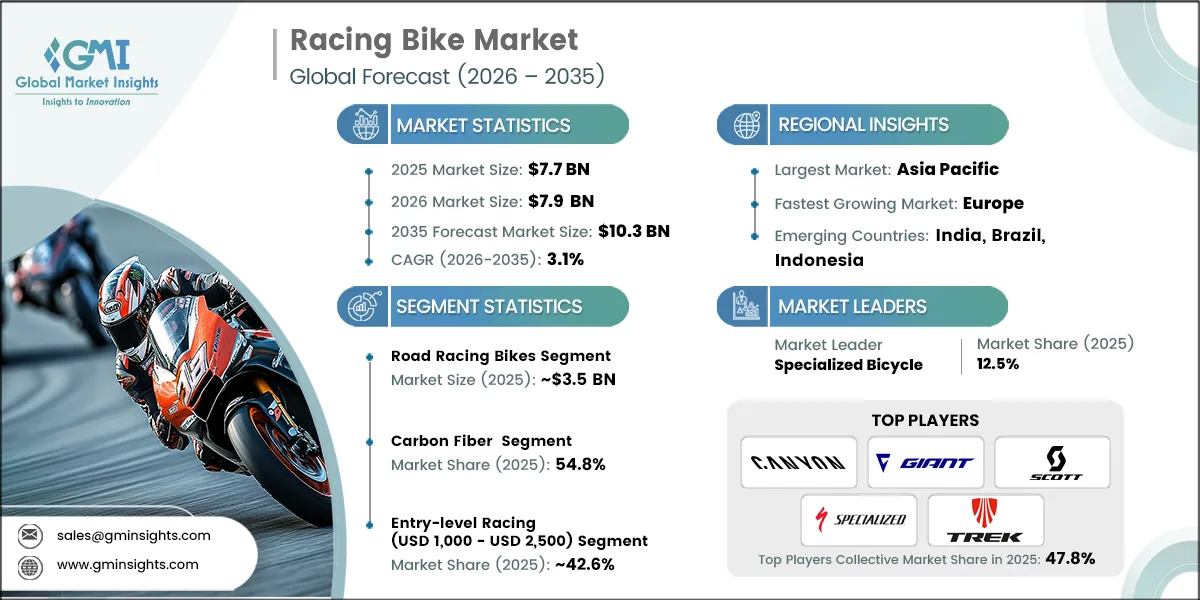
To get key market trends
Racing Bike Market Trends
The market for racing bikes is seeing a major trend in the use of lightweight materials such as carbon fiber and high-end alloys due to the need for performance optimization. Giant Manufacturing pointed out in a release in 2025 that their latest bikes using carbon fiber include aerospace-grade materials, thus leading to improved performance and increased demand even at premium prices. Similarly, in 2025, Trek Bicycle Corporation announced its latest high-end racing frame using 900 Series OCLV carbon.
The growth of organized racing tournaments and international cycling events is also affecting the demand for racing bikes. The Union Cycliste Internationale provides a structured annual calendar of events, which includes World Tour and ProSeries events. Events such as the Tour de France and championships sanctioned by the UCI are of critical importance in terms of visibility and innovation cycles, where manufacturers launch products during the racing season to test the performance of their products.
Government investment in cycling infrastructures also supports the growth of the racing bikes industry. For instance, the European Commission has developed a series of policy frameworks that promote cycling as a sustainable mode of transportation. Official EU statistics indicate that countries such as the Netherlands have more than 35,000 km of cycling infrastructure, which has helped to promote road cycling adoption in those countries.
The leading companies in the industry, such as the Trek Bicycle, use computer modeling and aerodynamic simulation in the design of the bicycle frames. The integration of technology has helped the companies improve the efficiency of the power transfer and reduce the drag associated with the bicycle. This has been instrumental in the racing industry since the factors are vital for the success of the racing events.
Racing Bike Market Analysis
Learn more about the key segments shaping this market
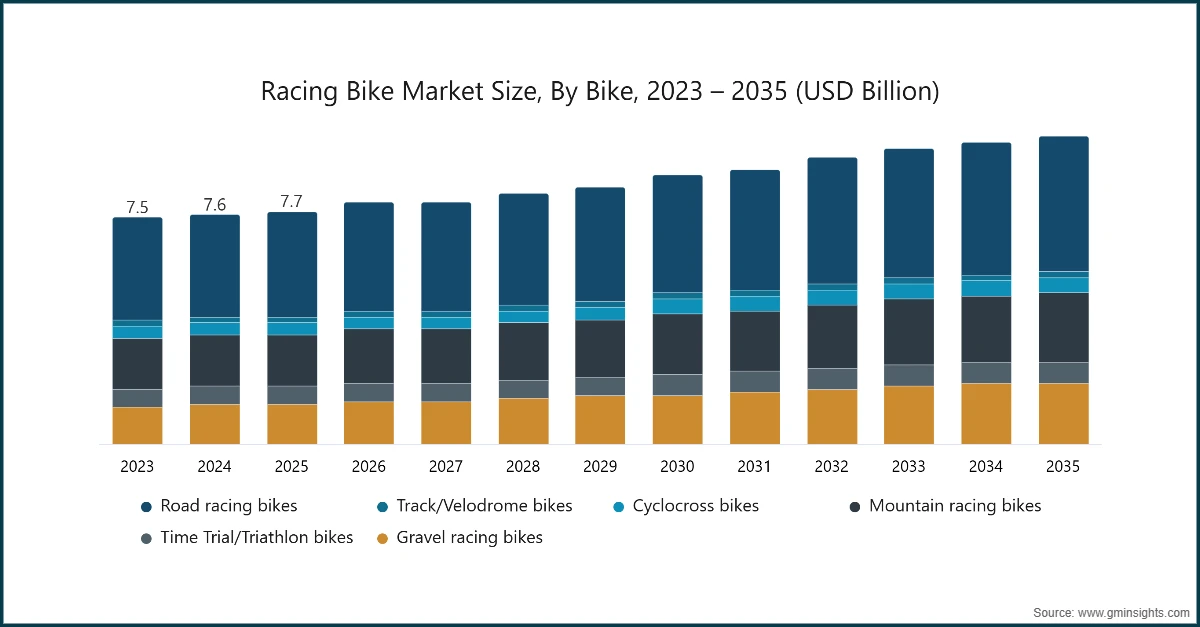
Based on bike, the racing bike market is divided into road racing bikes, track/velodrome bikes, cyclocross bikes, mountain racing bikes, time trial/triathlon bikes and gravel racing bikes. The road racing bikes segment dominated the market with market share of around 45.4% and generating revenue of around USD 3.5 billion in 2025.
- The popularity of road racing bikes can be attributed to their wide use in various racing events at both amateur and professional levels. This bike design has been optimized to achieve high speeds, as it is best suited to ride on paved roads. Official industry reports suggest that road racing bikes led in terms of dominant share in the overall racing bike market in 2025, indicating their high adoption rate among road cyclists and enthusiasts.
- The segment is also helped by the availability and innovations in technology by top brands. In December 2025, Factor Bikes launched its One aero race bike, which is claimed to be the “fastest UCI-legal road bike in the world,” thus reflecting the technology that improves speed. Such innovations in product lines help generate interest in consumers to upgrade their bikes, making road racing bikes the most popular choice for competitive users, amateur racers, and enthusiasts.
- The gravel racing bike segment is also seen as an emerging segment with one of the highest growth rates in the market for racing bikes, owing to the growing demand for versatile racing bikes that can perform well on both paved and unpaved surfaces. The gravel segment is expected to grow at a CAGR of 4.5 percent from 2026 to 2035, reflecting the growing interest among endurance riders, adventure riders, and recreational racers.
Learn more about the key segments shaping this market
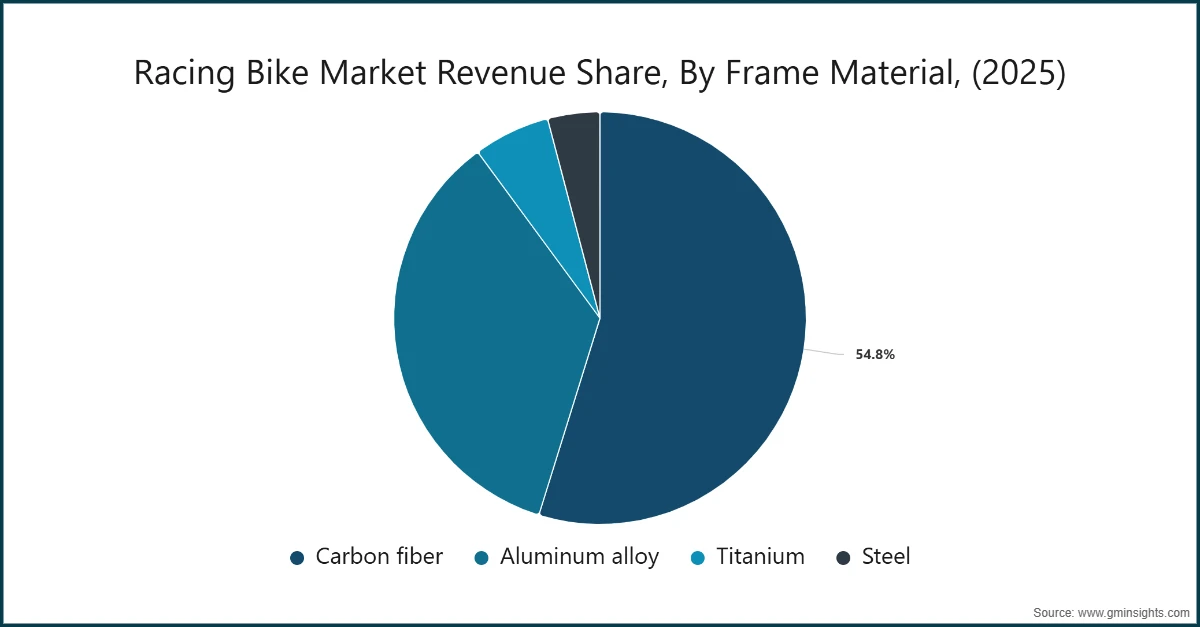
Based on frame material, the racing bike market is divided into carbon fiber, aluminum alloy and titanium, and steel. The carbon fiber segment accounts for 54.8% in 2025, valued around USD 4.2 billion.
- Carbon fiber is used most commonly because it is an exceptional material for providing a high level of structural strength in relation to weight. This is important for competitive racing. The weight is reduced for the rider’s advantage. As many industry standards suggest, racing bikes should be made of such lightweight materials as carbon fiber is.
- Manufacturers have designed carbon fiber frames to provide maximum aerodynamics and rigidity, enabling maximum power transfer between the rider and the road. This is one of the main reasons carbon fiber road bikes have become highly popular, especially for racing, time trials, and other races where performance is critical.
- Other frame materials, such as aluminum alloy, titanium, and steel, still maintain their presence in the racing bike market, particularly at the entry-level to mid-range segment. However, these materials are also heavier compared to carbon fiber, which affects the performance of the rider due to reduced acceleration, agility, and hill-climbing ability.
- In addition, a heavier frame causes fatigue during long distances, making it unsuitable for racing events. Although aluminum alloy and titanium frames are known to be strong and economical, steel frames are known to provide comfort, their use is limited due to their weight, making way for carbon fiber in high-performance racing bikes.
Based on price range, the racing bike market is divided into entry-level racing (USD 1,000 - USD 2,500), mid-range performance (USD 2,500 - USD 5,000) and high-end enthusiast (Above USD 5,000). The entry-level racing (USD 1,000 - USD 2,500) segment is dominant with a market share of around 42.6% in 2025.
- The entry-level racing bikes are the most affordable option. This segment dominates the market because it offers an affordable option for amateur riders and racing enthusiasts. The segment offers racing bikes for sale within the price bracket of USD 1,000 and USD 2,500. This offers the best option for the masses to buy quality racing bikes. The segment of entry-level racing bikes shows high adoption for reliable and performance-based racing bikes by amateurs.
- The segment is well supported in terms of availability from major retailers and online sources, as well as dealerships. Giant and Trek, for example, regularly market bikes in this category. Therefore, this segment is well supported in terms of availability and marketing campaigns that reinforce reliability and value for money, making it the most popular segment for first-time buyers and cost-conscious riders seeking high-performance bikes.
- Increase in disposable income will lead to increased sales in the premium/high-end segment of racing bikes, which is defined as bikes priced above USD 5,000. With more people having higher disposable income, they will be able to afford high-end bikes that offer more features and better riding capabilities.
Based on distribution channel, the racing bike market is divided into online and offline. The online segment is expected to grow at the fastest CAGR of 3.8% between 2026 and 2035.
- In the early days of e-commerce, consumers were reluctant to buy high-priced items such as racing bikes online due to quality, fit, and possible defects in the product. However, with the latest e-commerce policies and guarantees such as return policies, product specifications, and secure payment options, consumers have become confident in purchasing these products. Racing bikes are readily available in prominent online stores for consumers to select and purchase the product.
- As a result of this trend, some of the leading bike manufacturers have started providing direct-to-consumer online channels. Giant Manufacturing and Trek Bicycle are some of the companies that provide performance and racing bikes to consumers through their company websites. This trend will continue to provide more convenience to consumers and reduce dependence on physical retailers, thereby propelling the growth rate of the online distribution segment.
- On the other hand, physical retail enables customers to test their bikes, get professional advice, and enjoy instant access to their purchases, especially high-performance racing bikes. This contributes to sustained offline retail, despite the growth of online retail, thus providing a balanced experience between convenience and instant access, respectively, in the racing bikes retail market.
Looking for region specific data?
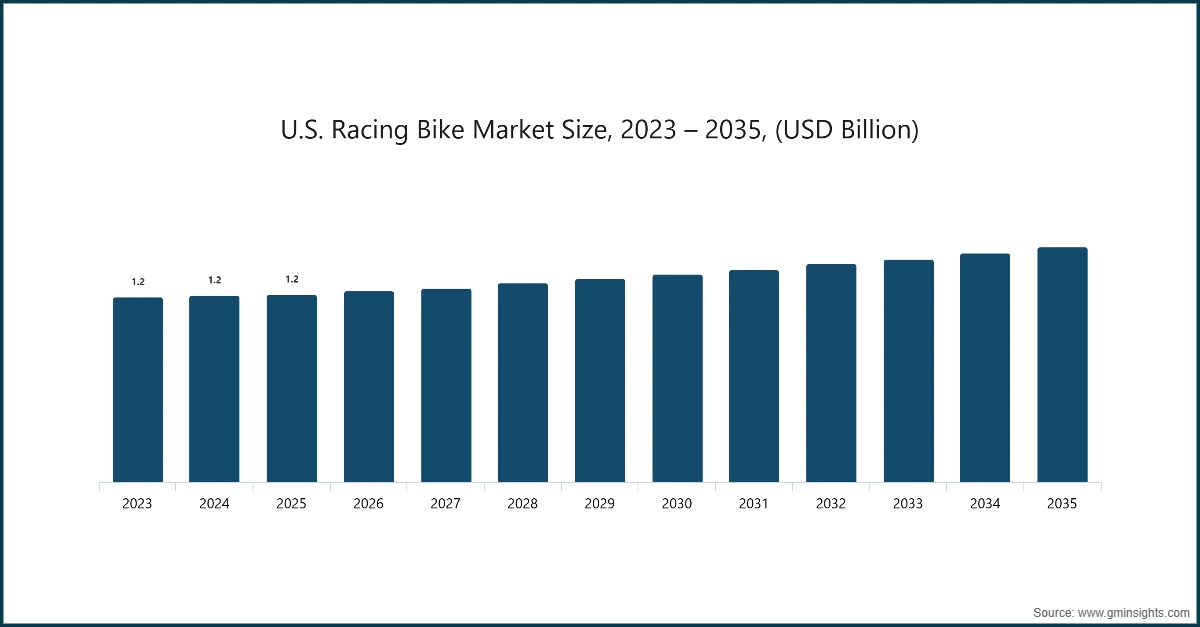
The US racing bike market reached USD 1.2 billion in 2025 and growing at a CAGR of 2.3% between 2026-2035.
- The country is one of the major mature markets for performance and racing bicycles with a robust cycling culture. The cycling market in the United States has been increasing as the study by PeopleForBikes reported a record number of 112 million people in the United States rode a bike at least once in 2024.
- This shows the high interest level among consumers for all types of cycling products, including road and racing bikes. Competitive cycling is also active in the United States with domestic calendars such as the American Track Calendar, which are recognized by the UCI and feature events for elite and junior categories.
- The Federal Highway Administration allocated USD 1.2 billion for the improvement of infrastructure for bicycle and pedestrian facilities across the country, which indirectly influences performance cycling by ensuring the safety of the riders. Such efforts may influence cycling for commuting and leisure, but specific policies for racing cycling infrastructure are left to individual government bodies and events.
The North America region is valued at USD 1.5 billion in 2025. In terms of volume, the racing bike market is estimated to exceed 459.2 thousand units in the same year.
- Collectively, North America reflects a significant percentage of the global market demand for bicycles, including performance bicycles as well as racing bicycles, driven by the existing cycling culture in the region as well as the strong presence of the recreational market. North America is estimated to hold a market share of about 19% in the sales of racing bicycles in 2025, driven by the interest of the consumer in fitness cycling, endurance sports, as well as competitive cycling events.
- In the case of the U.S., the trend is quite robust with millions of users taking part in outdoor cycling. This has resulted in replacement demand for racing and road bikes. Canada has a robust infrastructure for competitive leagues and city cycling initiatives. Urban centers are developing training facilities and cycling clubs for the development of talent.
- Competitive events and community racing circuits such as UCI track and road events will continue to invigorate the North American market for racing bikes. Federated national organizations schedule a variety of competitive events that will continue to sustain interest and investment in equipment and sponsorship within the racing cycling market in this region.
The Europe region holds 32.8% of the racing bike market in 2025 and is expected to grow at the fastest CAGR of 4% between 2026 and 2035.
- The European Commission’s progress report on the European Declaration on Cycling states that there has been significant development in the creation of special infrastructure for cycling, with more than an estimated 900,000 km of cycle paths created. There has also been more than €4.5 billion in funding for cycle lanes and improvements through EU programs. The Declaration also calls for the development of more cycle paths and the provision of subsidies for bicycle usage, thus increasing the use of commuting and sport cycling.
- The density of professional and amateur cycling events in the countries of Europe ranges from the popular stage events such as the Tour de France and the Giro d’Italia to the more local classics and charity events. This creates a robust market for performance and racing bikes as competitive and recreational consumers invest in high-specification road bikes.
Germany's racing bike market is growing quickly in Europe, with a CAGR of 5.2% between 2026 and 2035.
- Germany is an example of an advanced cycling market in Europe with high levels of consumer engagement and cycling-friendly mobility policies. The German federal government launched the National Cycling Plan (NCP) 3.0, which is a strategy for making cycling in Germany even more attractive and safe up to the year 2030. The NCP highlights infrastructure expansion, political support, and digitalisation as key focus points for increased cycling.
- The development of nationally certified cycling routes, with more than 165 routes connecting cultural sites and cities, has helped boost the demand for commuting and recreational cycling. This has indirectly contributed to the interest in performance cycling among road and touring cyclists.
- The “Bicycle Nation” initiative in Germany aims for the continued growth of bicycle use with the integration of transport planning and public engagement. This could contribute to racing and endurance cycling. The growth of sport cycling has been fueled by the long-standing culture of racing and competition.
The Asia Pacific region is expected to grow at a CAGR of 2.9% between 2026 and 2035 in the racing bike market.
- The region, which includes China, Japan, South Korea, Australia, and Southeast Asian markets, reflects strong growth trends in cycling participation, urban mobility, and recreational fitness. Improving disposable incomes, combined with increasing urban cycling infrastructure, are major growth factors that ensure increasing consumer access to performance bicycles. Government initiatives that promote cycling lanes, fitness, and tourism activities help drive cycling participation, including performance cycling, across all age groups.
- Cycling races, both competitive and recreational in nature, are increasingly being organized in this region. UCI Asia Tour races such as Tour of Taihu Lake, Tour of Poyang Lake, and Tour of Huangshan create a buzz about various types of racing disciplines and generate interest in road cycling within this region. This contributes to a culture of competitiveness and a need for high-tech bikes among enthusiasts and aspiring cyclists.
China is estimated to grow with a CAGR of 3.1% in the projected period between 2026 and 2035, in the Asia Pacific racing bike market.
- China’s cycling market remains on the increase, owing to the development of infrastructure, the increase in disposable income, as well as the interest in both recreational and competitive cycling. The country is known for hosting a series of road races, including the UCI World Tour, like the Tour of Guangxi, as well as the Asia Tour, like the Yellow River Estuary Road Cycling Race. The increase in competitive cycling events helps boost the market for racing bikes in the country.
- China’s high rate of urbanisation and transportation policies are conducive to the promotion and adoption of cycling as an environmentally friendly means of transportation. Cycling is also an extremely popular recreational and sporting activity in China, contributing to the increasing interest in performance bicycles among its citizens.
- Additionally, China has the highest participation in performance cycling events, both at a professional and amateur level, which further cements the case for racing bicycles. Despite having one of the largest bicycle manufacturing industries in the world, growth in high-performance bicycles and UCI-compliant equipment points to a mature racing bicycle market in this region.
Mexico is estimated to grow with a CAGR of 1.5% between 2026 and 2035, in the Latin America racing bike market.
- In Mexico, cycling culture is gaining popularity through mobility programs and cycling events that increase public engagement. For example, the Muévete en Bici event in Mexico City is an open streets event that has been running for a while, engaging millions of people annually. This event transforms the streets of Mexico City into cycling-friendly roads.
- The city governments and the metropolitan mobility strategies in Mexico have included the development of cycling lanes and corridors in the transport infrastructure plans. This has been complemented by the open government initiatives and strategies that focus on inclusive mobility and safe cycling infrastructure in the cities.
UAE to experience substantial growth in the Middle East and Africa racing bike market in 2025.
- In the country, the sport of cycling is increasingly recognized for its health benefits as well as its potential in the tourism sector, with the government investing in the development of sports infrastructure, including events that promote the sport of cycling. Major cities like Dubai and Abu Dhabi are hosting international races in the sport, promoting the benefits of cycling while raising the profile of the sport. Major urban development in the region incorporates dedicated cycling lanes in the design of the city.
- The UAE government’s investments in sporting infrastructure such as velodromes, performance training, and city cycling routes also show the government’s commitment to supporting active lifestyles. This has helped the UAE become the center for competitive and recreational cycling in the Middle East, with performance models gaining traction among consumers.
Racing Bike Market Share
The top 7 companies in the racing bike market are Cannondale, Canyon, Giant, Merida, Scott, Specialized and Trek contributing 58.4% of the market in 2025.
- Cannondale makes racing bikes with lightweight aluminum and carbon frames. They use advanced designs and technologies like SAVE and Hollowgram. Their bikes include endurance, road, and performance models for both competitive and recreational riders.
- Canyon designs racing bikes for speed and precision. They use aerodynamic carbon and aluminum frames with integrated parts. Their bikes are sold directly to consumers and include road, endurance, and performance models.
- Giant produces a variety of racing bikes with lightweight frames and integrated drivetrains. Their bikes are designed for endurance and range from entry-level to professional-grade models for all types of riders.
- Merida makes racing bikes with aluminum and carbon frames. Their bikes are durable, easy to handle, and include road, endurance, and lightweight models for both competitive riders and enthusiasts.
- Scott designs racing bikes with advanced carbon and aluminum frames. Their bikes are aerodynamic, lightweight, and include road, endurance, and professional models for responsive rides.
- Specialized builds racing bikes with carbon and aluminum frames. Their bikes are efficient, responsive, and include endurance, road, and professional-grade models for serious cyclists.
- Trek makes racing bikes with carbon and aluminum frames. Their bikes are durable, precise, and include road, endurance, and professional models for both competitive and recreational riders.
Racing Bike Market Companies
Major players operating in the racing bike industry are:
- BMC
- Cannondale
- Canyon
- Cervélo
- Giant
- Merida
- Pinarello
- Scott
- Specialized
- Trek
- Cannondale focuses on advanced aluminum and carbon frames, unique technologies, and innovation. They make lightweight, high-performance racing bikes with global distribution and a strong brand history.
- Canyon uses a direct-to-consumer model, offering competitive prices and close customer connections. They provide modern, high-performance racing bikes and are active in professional cycling.
- Giant uses large-scale manufacturing, vertical integration, and global distribution. This helps them lower costs, maintain quality, and make a wide range of racing bikes for different price levels.
- Merida combines strong research, efficient manufacturing, and partnerships. They make advanced racing bikes at competitive prices and have a global supply network.
- Scott focuses on lightweight materials, aerodynamics, and integration. They have a strong presence in competitive cycling and make racing bikes for professional athletes.
- Specialized invests in research, rider-focused designs, and premium branding. They make advanced racing bikes for professionals and enthusiasts.
- Trek uses its strong brand, large dealer network, and frame technology innovations. They make high-performance racing bikes that are widely available and offer good after-sales support.
Racing Bike Market Report Attributes
| Key Takeaway | Details |
|---|---|
| Market Size & Growth | |
| Base Year | 2025 |
| Market Size in 2025 | USD 7.7 Billion |
| Market Size in 2026 | USD 7.9 Billion |
| Forecast Period 2026-2035 CAGR | 3.1% |
| Market Size in 2035 | USD 10.3 Billion |
| Key Market Trends | |
| Drivers | Impact |
| Growing Health & Fitness Consciousness | Increasing awareness of cardiovascular health and active lifestyles is boosting demand for racing bikes, as consumers adopt cycling for endurance training, fitness tracking, and performance-oriented recreation. |
| Rising Participation in Competitive Cycling Events | Expanding amateur and professional cycling events encourages enthusiasts to invest in high-performance racing bikes, driving upgrades, brand engagement, and repeat purchases across different skill levels. |
| Professional Racing Influence & Aspirational Purchases | Visibility of elite cyclists and global races inspires aspirational buying behavior, with consumers seeking advanced racing bikes that replicate professional-grade performance, design, and technological innovation. |
| Infrastructure Development (Bike Lanes, Velodrome Construction) | Government investments in cycling infrastructure, including dedicated bike lanes and velodromes, improve safety and accessibility, encouraging more individuals to adopt racing cycling as a regular activity. |
| Pitfalls & Challenges | Impact |
| Supply Chain Disruptions & Component Shortages | Ongoing supply chain challenges and shortages of key components like drivetrains and carbon frames delay production cycles, increase costs, and limit availability of premium racing bikes globally. |
| Competition from E-Bikes & Alternative Fitness Activities | Growing popularity of e-bikes and diverse fitness alternatives such as gym training and running reduces consumer preference for traditional racing bikes, impacting market growth and adoption rates. |
| Opportunities: | Impact |
| Emerging Markets with Growing Cycling Culture | Rising urbanization and health awareness in emerging economies are fostering cycling cultures, creating strong demand potential for affordable and mid-range racing bikes among new consumer segments. |
| Women's Racing Segment Expansion | Increasing female participation in competitive cycling is driving demand for gender-specific racing bike designs, inclusive marketing strategies, and tailored performance features, opening new revenue streams. |
| Rental & Bike-Sharing for Events | Event-based rentals and bike-sharing platforms enable trial experiences, lowering entry barriers for new users, increasing exposure to racing bikes, and potentially converting occasional riders into buyers. |
| Market Leaders (2025) | |
| Market Leader |
12.5% market share |
| Top Players |
Collective market share in 2025 is 47.8% |
| Competitive Edge |
|
| Regional Insights | |
| Largest Market | Asia Pacific |
| Fastest growing market | Europe |
| Emerging countries | India, Brazil, Indonesia |
| Future outlook |
|
What are the growth opportunities in this market?
Racing Bike Industry News
In March 2026, Canyon Bicycles announced that they will be participating in Cyclingworld Europe 2026. This is Canyon’s first-ever exhibition appearance at the event held at Areal Böhler in Düsseldorf.
In January 2026, Salsa Cycles launched the Wanderosa, a Class 3 full-suspension gravel e-bike. It has 120mm front suspension, 110mm rear suspension, a long reach, a short stem, wide drop bars, a dropper post, and tyre clearance up to 2.35 inches.
- In December 2025, Factor Bikes introduced the One aero race bike, calling it the “fastest UCI-legal road bike in the world.” It was earlier called the ‘Prototype’ and was first used by Israel–Premier Tech riders at the 2025 Critérium du Dauphiné and Tour de France.
- In August 2025, Trek released the Madone SLR 9 AXS 1x Gen 8, its lightest Madone with disc brakes, weighing 6.4kg. Trek says it is 400g lighter than the UCI’s minimum limit for a medium/large frame.
The racing bike market research report includes in-depth coverage of the industry with estimates & forecasts in terms of revenue ($ Mn/Bn) and volume (thousand units) from 2022 to 2035, for the following segments:
Market, By Bike
- Road racing bikes
- Track/Velodrome bikes
- Cyclocross bikes
- Mountain racing bikes
- Time Trial/Triathlon bikes
- Gravel racing bikes
Market, By Frame Material
- Carbon fiber
- Aluminum alloy
- Titanium
- Steel
Market, By Price Range
- Entry-level racing (USD 1,000 - USD 2,500)
- Mid-range performance (USD 2,500 - USD 5,000)
- High-end enthusiast (Above USD 5,000)
Market, By End-Use
- Professional racing teams
- Amateur competitive cyclists
- Performance enthusiasts
Market, By Distribution Channel
- Online
- Direct-to-consumer e-commerce
- Brand website
- Offline
- Brand flagship stores
- Specialty bike shops
- Independent bike retailers
- Authorized brand dealers
- Sporting goods retailers
The above information is provided for the following regions and countries:
- North America
- US
- Canada
- Europe
- Germany
- UK
- France
- Italy
- Spain
- Poland
- Netherlands
- Norway
- Asia Pacific
- China
- India
- Japan
- South Korea
- Australia
- Singapore
- Malaysia
- Vietnam
- Latin America
- Brazil
- Mexico
- Argentina
- Colombia
- MEA
- South Africa
- Saudi Arabia
- UAE
Frequently Asked Question(FAQ) :
What was the market size of the racing bike in 2025?
The market size was USD 7.7 billion in 2025, with a CAGR of 3.1% expected through 2035. The growth is driven by the increasing popularity of biking events and competitions globally.
What is the projected value of the racing bike market by 2035?
The market is poised to reach USD 10.3 billion by 2035, driven by advancements in lightweight materials, growing participation in competitive cycling events, and government investments in cycling infrastructure.
What is the expected size of the racing bike industry in 2026?
The market size is projected to reach USD 7.9 billion in 2026.
How much revenue did the road racing bikes segment generate in 2025?
The road racing bikes segment generated approximately USD 3.5 billion, dominating the market with a 45.4% share in 2025.
What was the valuation of the carbon fiber segment in 2025?
The carbon fiber segment accounted for USD 4.2 billion in 2025, representing 54.8% of the market.
What is the growth outlook for the entry-level racing bike segment?
The entry-level racing bike segment, priced between USD 1,000 and USD 2,500, held a market share of 42.6% in 2025. This segment is driven by affordability and high adoption among amateur riders and racing enthusiasts.
Which region leads the racing bike sector?
The U.S. leads the racing bike market in North America, with a valuation of USD 1.2 billion in 2025 and a projected CAGR of 2.3% from 2026 to 2035.
What are the upcoming trends in the racing bike market?
Trends include lightweight materials, advanced design simulations, and growing cycling events.
Who are the key players in the racing bike industry?
Key players include BMC, Cannondale, Canyon, Cervélo, Giant, Merida, Pinarello, Scott, Specialized, and Trek.
Racing Bike Market Scope
Related Reports