Summary
Table of Content

Quenching Fluids & Salts Market
Get a free sample of this report
Form submitted successfully!
Error submitting form. Please try again.
Thank you!
Your inquiry has been received. Our team will reach out to you with the required details via email. To ensure that you don't miss their response, kindly remember to check your spam folder as well!
Request Sectional Data
Thank you!
Your inquiry has been received. Our team will reach out to you with the required details via email. To ensure that you don't miss their response, kindly remember to check your spam folder as well!
Form submitted successfully!
Error submitting form. Please try again.
Quenching Fluids & Salts Market Size
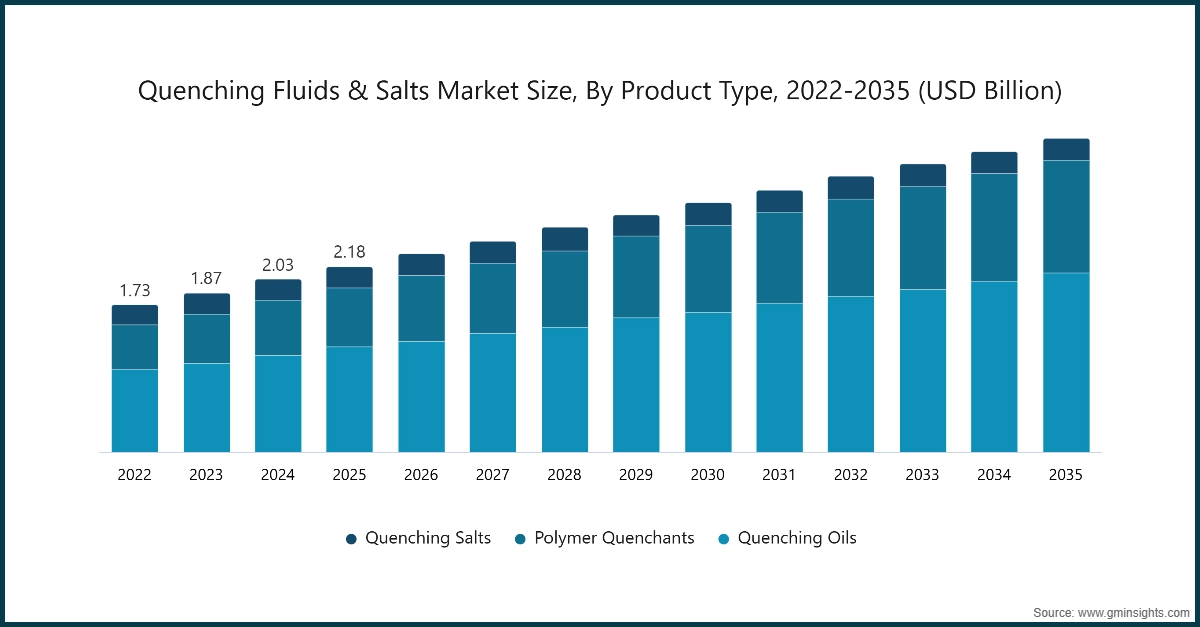
The global quenching fluids & salts market was valued at USD 2.1 billion in 2025. The market is expected to grow from USD 2.3 billion in 2026 to USD 3.6 billion in 2035, at a CAGR of 5.2 % according to the latest report published by Global Market Insights Inc.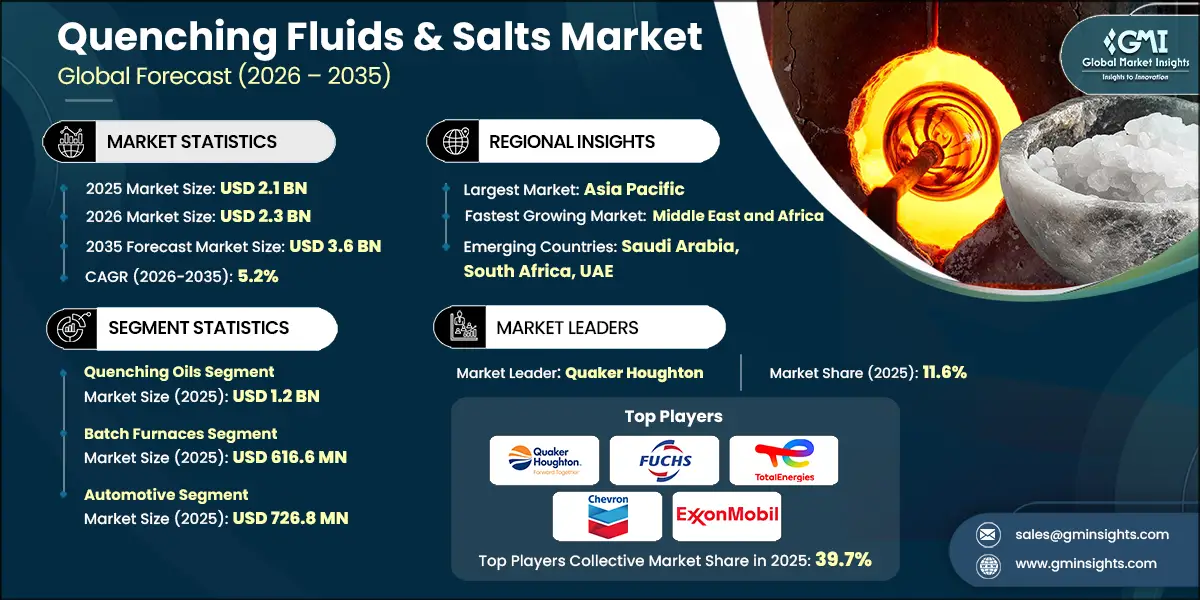
Quenching Fluids & Salts Market Key Takeaways
Market Size & Growth
- 2025 Market Size: USD 2.1 Billion
- 2026 Market Size: USD 2.3 Billion
- 2035 Forecast Market Size: USD 3.6 Billion
- CAGR (2026–2035): 5.2%
Regional Dominance
- Largest Market: Asia Pacific
- Fastest Growing Region: Middle East and Africa
Key Market Drivers
- Growth of automotive and manufacturing industries.
- Rising demand for high-performance materials.
- Technological advancements in heat treatment processes.
Challenges
- Environmental and regulatory challenges.
- Risk of metallurgical defects.
Opportunity
- Increasing adoption of polymer-based quenchants.
- Rising demand from infrastructure and energy projects.
- Demand for customized and application-specific solutions.
Key Players
- Leading Players: Top 5 players in this market include Quaker Houghton, FUCHS Petrolub SE, TotalEnergies SE, Chevron Corporation, Exxon Mobil Corporation, which collectively held a market share of 39.7% in 2025.
Get Market Insights & Growth Opportunities
To get key market trends
- Quenching fluids and salts are materials that are used in heat treatment to cool down heated metals, especially steels, to achieve specific mechanical properties such as hardness and strength in very short time intervals. The most common quenching fluids include water, oil, polymer solutions, and brines, while quenching salts are molten salt mixtures used for controlled and uniform cooling. The choice of quenching medium affects the cooling rate, distortion, residual stresses, and final microstructure of the metal.
- Over the years, much of the conventional water- or oil-based quenching has been replaced by modern high-technology system. Polymer-based quenchants and molten salt baths are gaining more acceptance by industries as they provide an adjustability of cooling rates combined with better safety and reduced risks of cracking or distortion. Moreover, bio disposable and environmentally friendly quenching fluids of low toxicity are manufactured, and more automation in quenching systems with better temperature and process control is driving the design of these systems.
- In terms of performing and supporting heat-treated components, quenching fluids are very crucial. Water provides very fast cooling but may lead to cracking because of heat shock, while oils cool more slowly and evenly, which is better for most of the alloy steels. With a polymer quenchant, concentration can be tailored making this quenchant suitable for different materials and sizes of the components involved for general purposes relating quenching with hardness, toughness, and dimensional stability.
- Quenching salts are generally used in salt bath heat treatment, whereby the metals are cooled under highly controlled and uniform conditions. They are especially beneficial during processes like martempering and austempering, which require sensitive temperature control to reduce internal stresses. Salt baths need to be handled with care and maintained, they generally provide efficiency in heat transfer, reduced oxidation, and produce consistent results, therefore, such baths are important for high-quality and precision manufacturing applications
Quenching Fluids & Salts Market Trends
- Shift in the trends toward environmentally sustainable quenching solutions is being expressed by industries in response to the often-stringent requirements of environmental and workplace safety regulations. Many manufacturers have been very keen in adopting biodegradable and low toxicity quenchants in view of reducing their concerns on emissions and disposal. This trend impacts more on the growing standardization of sustainability in heat treatment operations.
- Most end-use industries are developing specification trends toward polymer-based quenching fluids for purchase decisions. Such quenching fluids allow variable cooling rates and provide enhanced safety levels compared to traditional oils, thus being applicable to a wide range of applications. The trend shows the flexibility and the demand for better process control.
- Advancing technology in automation and digital monitoring into the quenching process will ultimately transform heat treatment facilities. Synchronized advanced quenching media, sensors, and control systems can deliver continuous and defect-free quality process points. This justifies the trend towards intelligent and efficient manufacturing environments.
- Growing acceptance of molten salt quenching in precision heat treatment application is fast growing in sectors such as aerospace and tool manufacture. These salt baths provide uniform and distortion-proof heat distribution, thus providing a better cooling for extremely high-quality components. The trend reflects market increasing focus on accuracy, reliability, and enhancing performance.
Quenching Fluids & Salts Market Analysis
Learn more about the key segments shaping this market
Based on product type the market is segmented into quenching oils, quenching salts, polymer quenchants. Quenching oils hold the largest market value of USD 1.2 billion in 2025.
- Quenching oils are the most popular among automotive, industrial machinery, and general manufacturing heat treatment processes, and they are well accommodated by all types of furnaces and steel grades. Present trends indicate increasing acceptance of fast and medium-speed quenching oils in high-volume batch and continuous operations. End users are advancing toward synthetic, low-volatility, and smoke-reduced formulations for operational safety, longevity of fluids, and for meeting changing environmental needs in developed markets.
- Polymer quenchants and quenching salts are used where greater control over cooling rates and metallurgical consistency is preferred. They have recently been selected for induction hardening and automated heat treatment lines as they provide cooling performance by adjusting concentration control and at the same time, risks of fire and smoke are reduced. On the other hand, quenching salts still find applications such as austempering, martempering, and aluminum brazing, where a stable temperature is necessary at certain temperatures. Formulation choices are influenced by environmental regulations, resulting in increased usage of non-cyanide and lower-toxicity salt systems in regulated regions.
The quenching fluids & salts market by furnace/equipment type is segmented into batch furnaces, continuous furnaces, vacuum furnaces, induction heating systems, salt bath furnaces, sealed quench furnaces and others. Batch furnaces holds the largest market value of USD 616.6 million in 2025.
- In most manufacturing settings, including automotive facilities and similar types of general-manufacturing or commercial heat treatments, batch and continuous furnaces are very flexible and often used in high-throughput operations. Batch furnace production is continuing to see demand trends toward mixing parts in small-to-medium production while continuous batch production is oriented more to standardized, high-volume manufacture. The consistent processes, energy efficiency, and multiple-quench-media compatibility to influence machinery scope are the major parameters for these segments of equipment.
- Vacuum furnaces, induction heating systems, salt bath furnaces, sealed quench systems, and other advanced equipment are selected increasingly according to the dimensions of precision and cleanliness and metallurgical control requirements. Vacuum furnaces are normally used where low oxidation and clean surfaces are required and have a controlled quenching condition primarily in aerospace and tool steel. Induction heating systems are applied for localized surface hardening and automated lines, largely combined with polymer or water-based quenchants. Salt bath furnaces and sealed quench systems continue to be used for applications requiring uniform heat transfer and controlled atmospheres, whereas other niche equipment types will support the specialized heat treatment process across the industrial sectors.
Learn more about the key segments shaping this market
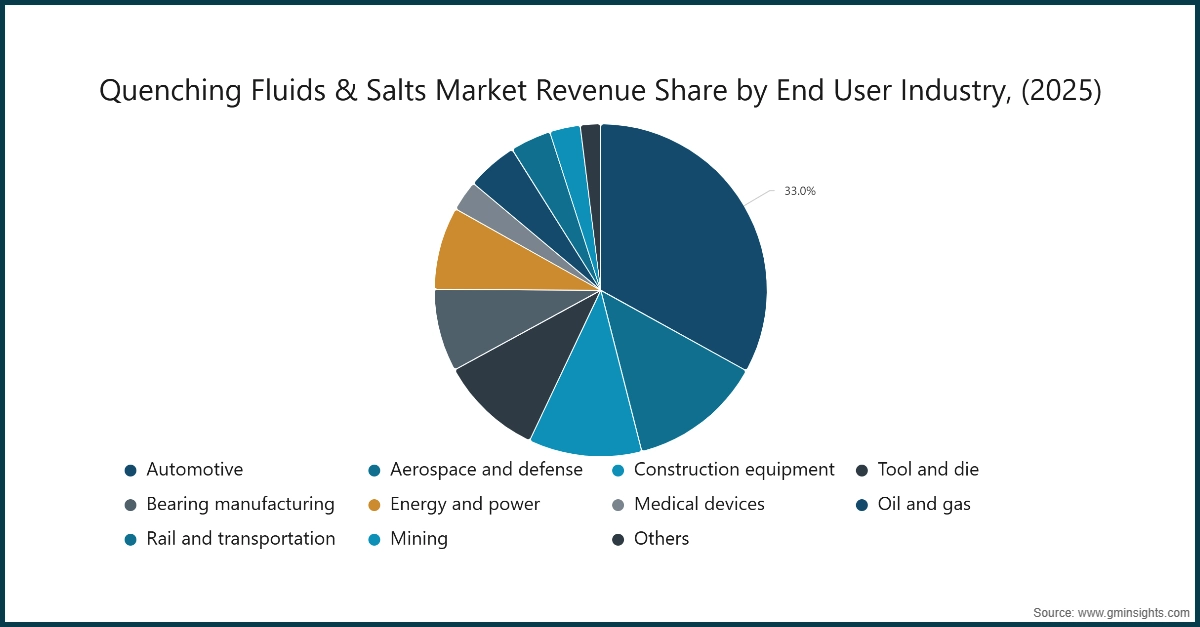
The quenching fluids & salts market by end user industry is segmented into automotive, aerospace and defence, construction equipment, tool and die, bearing manufacturing, energy and power, medical devices, oil and gas, rail and transportation, mining and others. Automotive holds the largest market value of USD 726.8 million in 2025.
- The automotive industry used quenching media and heat treatment equipment as gears, shafts, and transmission components all need to be hardened and resistant to wear. Growth trends are mainly brought about by the acceptance of electric vehicles as well as light weighting, both of which require further precision heating treatment for advanced alloy use. Aerospace and defence applications are concerned with highly critical components such as jet engines, landing gears, or turbines, which require that metallurgical quality, surface integrity, and standards compliance hold true. The construction equipment and the tool and die and bearing manufacturing sectors all have certain reliance on reliable quenching processes that ensure durability and dimensional stability as well as have performance at high amounts of loads.
- Energy and power, medical devices, oil and gas, rail and transportation, mining, and other industrial sectors have continuous demand for heat treatment solutions due to their operational requirements. Controlled cooling processes are employed with turbine components, surgical instruments, drilling equipment, rail couplings, and wear-resistant parts to achieve their desired mechanical properties. Increasing adoption of polymer quenchants, synthetic oils, and salt baths in specialized applications is in fact supporting environmental regulations, improving process control, and precision manufacturing across these industries.
Looking for region specific data?
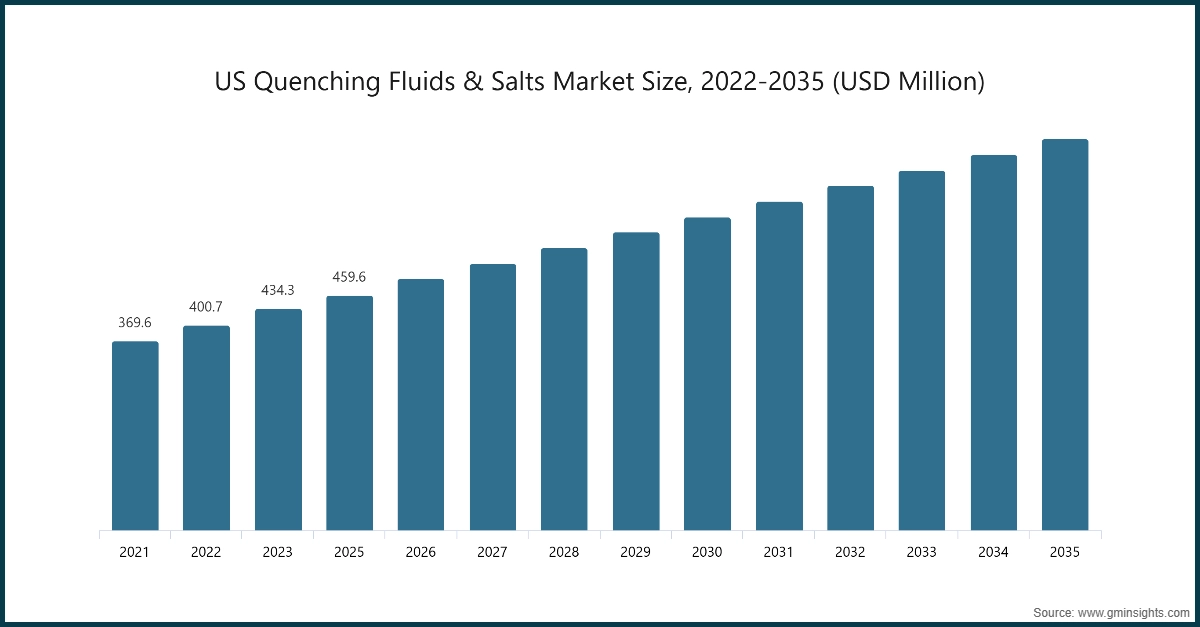
The market in the North America is expected to experience significant and promising growth from USD 537.4 million in 2025 to USD 895.1 million in 2035. The U.S. quenching fluids and Salts market accounted for USD 459.6 million in 2025.
- In the North American market for quenching fluids and salt is growing as manufacturers focus on precision, reliability, and following regulations in aerospace, automobile, and heavy industrial areas to progress further. They further develop a keen interest in using polymer-quenchants or eco-friendly quenchants in industries for better cooling control, less distortion, and maintaining standards of the environment.
- In US, due to its established aerospace, automotive, and defense manufacturing base rise in quenching fluids & salts market as this will lead to demand of heat-treated components with excellent performance. Canada is now becoming a steadily modernized user of new quenching technologies in industrial machinery and metal fabrication, based on efficiency and quality requirements. Both countries are becoming more aligned with smart manufacturing and process automation to reduce error and reduce cost.
The Europe quenching fluids & salts market s expected to experience significant and promising growth from USD 440.5 million in 2025 to USD 751.7 million in 2035.
- The European market for fluids and salts for quenching is emerging from the various industrial sectors to adopt energy-efficient and sustainable methods of manufacturing. These help toward reducing environmental impact, with polymer-based and hybrid quenchants. Increased process consistency along with improved component quality through automated monitoring and controlled heat treatment systems. The demand is primarily contributed by high-value sectors such as automotive and aerospace, alongside precision engineering.
- Germany is capitalizing on its advanced automotive and industrial machinery sectors that demand heat-treated components of high quality. France, Italy, and the UK have gradually been switching toward the adoption of controlled quenching systems to reduce defects and enhance operational efficiency. These three countries are investing in smart heat treatment technologies and R&D to meet stringent regulations on environment and safety.
The Asia Pacific quenching fluids & salts market is expected to experience increasing growth from USD 1 billion in 2025 to USD 1.8 billion in 2035 with a CAGR of 5.2%.
- The Asia-Pacific region is expected to witness significant growth because of rapid industrialization, infrastructure projects, and increasing demand for automotive and machinery components. There is a transition from conventional water and oil quenchants to polymer-based and controlled salt solutions to achieve precise cooling and reduce distortion. Automated heat treatment systems are being implemented to increase efficiencies in production and quality control. Government policies favoring modernization in manufacturing processes thus contribute to higher growth. Volume-driven demand and technology upgrades have an encouraging impact on the market overall.
- China is covering industrial processing of metals, automotive, and machinery production, hence the increased demand for advanced quenching fluids. Infrastructure development and growth in automobiles in India create high opportunities for superior quality and more precise eco-friendly quenchants. Other countries within this region are also venturing into environmentally safe quenching technologies. Increasing industrial standards have pressure on suppliers to make highly customized, high-performance offerings.
Middle East & Africa quenching fluids & salts market is expected to experience significant and promising growth from USD 44 million in 2025 to USD 81.2 million in 2035.
- The market for Middle East and Africa is driven by a series of infrastructure, energy, and industrial projects. Demand for quenching fluids and salts is increasing that further improve process control, reduce distortion, and ensure reliability. Increasingly environmentally friendly solutions are being adopted to meet environmental and safety standards. New automation and monitoring systems are being implemented to ensure a standard quality stream. The steady growth outlook for the market sets it to be driven further by the local manufacturing and industrial diversification.
- Saudi Arabia is leading the region in adoption of advanced quenchants and controlled salt baths as the country has numerous energy and infrastructure projects. The UAE is developing industrial parks with metal processing operations which is making opportunities for automated heat treatment solutions. South Africa is, however, focusing on mining, automotive, and industrial machinery applications, where precision heat treatments are required for components. Gradually the market is embracing polymer-based and environmentally safe quenchants.
Latin America quenching fluids & salts market is expected to experience significant and increasing growth from USD 66.1 million in 2025 to USD 117.2 billion in 2035.
- In Latin America, the automotive, construction, and industrial machinery markets are growing thus manufacturers are moving from classical oil and water quenchants to controlled salt baths and polymer-based solutions for a cooling process with higher precision and less distortion. Safer low-toxicity quenchants are being adopted due to industrial safety and environmental considerations. Investments toward modern heat treatment infrastructure are gradually increasing. Urbanization and growth in industries currently support demand for these quenchants.
- Brazil is a leading country in the automotive, steel, and heavy machinery production that requires a high-quality heat treatment. In Mexico, there is an upgrade of the existing industrial machinery and metal fabrication operations that are using modern quenching solutions. At the same time, Argentina and Chile are focusing more on precision heat treatment for mining and industrial equipment.
Quenching Fluids & Salts Market Share
- Quenching fluids & salts industry are moderately consolidated with players like Quaker Houghton, FUCHS Petrolub SE, TotalEnergies SE, Chevron Corporation, Exxon Mobil Corporation holding 39.7% market share and Quaker Houghton being the market leader holding the market share of 11.6% in 2025.
- Companies continue to gain competitive advantage through very high investment in research and development with the intent to advance quenching solutions, which include polymer-based and environmentally acceptable quenchants designed for precision cooling, low distortion, and globally accepted environmental standards.
- Another very strong strategy employed by companies is to come up with very specific solutions for different applications. Customization of quenching fluids and salts is done according to specific alloys, component sizes, and production requirements.
- Adoption of the latest technologies also differentiates one from the rest in terms of competition. Companies have sought to bring their quenching solutions at par with automated and digitally monitored heat treatment systems. Real-time monitoring, process analysis, and even automatic control serve to help clients improve efficiency, lower defects, and achieve consistency in quality. Those companies attaining such tech-enabled solutions can consider themselves as leading edge in the market.
- Strong technical support and customer service, further rises the position of companies, is another way of improving competitive advantage. Companies can consult with customers on-site and provide troubleshooting and even guidance on the best use of quenchants. Building such long-term relationships with clients would ensure that customers would often prefer practical support in addition to high-performing products by promoting brand loyalty and repeat purchases.
- Strategic partnerships and collaboration as well as global outreach will all contribute towards making company a significant position in the market. Firms also have access into other markets, improve their development of products, and respond quickly to regional needs by partnering with industrial manufacturers, research institutes, and international distributors. There should also be expansion in the emerging markets and a follow-along with local regulations to ensure sustainable growth and broader competitive footprint with respect to the quenching fluids and salts market.
Quenching Fluids & Salts Market Companies
Major players operating in the quenching fluids & salts industry are:
- BP Castrol
- Chemtool Incorporated
- Chevron Corporation
- CONDAT
- Croda International Plc
- Exxon Mobil Corporation
- FUCHS Petrolub SE
- Hubbard-Hall
- Idemitsu Kosan Co., Ltd.
- Metal Heat Treatment Solutions
- Park Thermal International
- Petrofer Chemie
- Quaker Houghton
- Savannah River Nuclear Solutions
- TotalEnergies SE
Quaker Houghton deals in the global production of industrial fluids and special chemicals for industrial applications. It offers a range of heat treatment fluids, quenching oils, and a bunch of additional lubricants meant to meet the requirements of the aerospace and automotive industries. It has manufacturing facilities across the globe and a further presence in North America, Europe, and Asia.
FUCHS Petrolub SE is one of the world's foremost corporate warriors in offering lubricants and industrial fluids, including quenching oils and special products targeted at the treatment of metals. They serve automotive, white heat industries, and are dedicated to improving product sustainability with a focus finishing at bio-based and environmentally friendly formulations. With its base in Europe, the company is well established in production centers here.
TotalEnergies SE is a multinational oil and gas company with a diverse product portfolio encompassing lubricants and heat treatment fluids. The company distributes quenching oils and special products worldwide for industrial purposes. The company maintains a strategic focus on cost-competitive premium products, global distribution networks, and sustainable solutions for both transportation and industrial markets. The use of products is varied and spans all heavy transport sectors, mainly in the automotive, aerospace sectors. The company has manufacturing and distribution operations worldwide.
Chevron Corporation is a multinational American energy company based in the U.S.A., specializing in offering petroleum products/ingredients such as quenching oils and special fluids for industrial applications. They serve these products for industrial applications in automotive, aerospace, and heavy machinery for heat treatment. Research and innovation focus on enhancing the performance of its fluids and environmental regulatory compliance.
Exxon Mobil Corporation deals in the production of energy and chemicals, offering an arsenal of lubricants, quenching oils, and specialty fluids. These are specifically meant for the automotive, industrial, and aerospace applications. A climate of modernization and massive synchronization is being fostered over the object of R&D, reliability, and worldwide distribution. It nearly holds industries due to its broad manufacturing and logistics network exerted in different areas. Exxon Mobil emphasizes environmental compliance, product availability, and performance enhancement of its heat treatment and lubrication actions.
Quenching Fluids & Salts Industry News
- On November 2025, Nanjing Kerun Lubricants introduced new product KR6580 water-soluble quenching agent with upgraded features such as enhanced anti-emulsification, low foaming, anti-rust, and stability, together with some specialized vacuum quenching oils
- On October 2025, Quaker Houghton and Saudi Arabia's Petrolube announced a strategic alliance to provide high-performance industrial process and metalworking fluids across Saudi Arabia and the wider MENA region. This partnership will help Petrolube's local expertise and regional presence to combined with Quaker Houghton's global technical knowledge towards delivering sustainable solutions for steel, automotive, and modern manufacturing sectors.
The quenching fluids & salts market research report includes an in-depth coverage of the industry with estimates and forecast in terms of revenue in USD Billion and volume in terms of kilo tons from 2022–2035 for the following segments:
Market, By Product Type
- Quenching oils
- Fast/accelerated quenching oils
- Medium-speed quenching oils
- Slow-speed quenching oils
- Marquench/martempering
- Vacuum quenching oils
- Synthetic quenching oils
- Others
- Quenching salts
- Nitrate-based salts
- Nitrite-based salts
- Chloride-based salts
- Cyanide-based salts
- Fluoride-based salts
- Others
- Polymer quenchants
- PAG-based (polyalkylene glycol)
- PVP-based (polyvinylpyrrolidone)
- Others
Market, By Furnace/Equipment Type
- Batch furnaces
- Continuous furnaces
- Vacuum furnaces
- Induction heating systems
- Salt bath furnaces
- Sealed quench furnaces
- Others
Market, By End User Industry
- Automotive
- Aerospace and defense
- Construction equipment and heavy machinery
- Tool and die manufacturing
- Bearing manufacturing
- Energy and power generation
- Medical devices
- Oil and gas
- Rail and transportation
- Mining
- Others
The above information is provided for the following regions and countries:
- North America
- U.S.
- Canada
- Europe
- Germany
- UK
- France
- Spain
- Italy
- Rest of Europe
- Asia Pacific
- China
- India
- Japan
- Australia
- South Korea
- Rest of Asia Pacific
- Latin America
- Brazil
- Mexico
- Argentina
- Rest of Latin America
- Middle East and Africa
- Saudi Arabia
- South Africa
- UAE
- Rest of Middle East & Africa
Frequently Asked Question(FAQ) :
What is the market size of the quenching fluids & salts in 2025?
The market size was USD 2.1 billion in 2025, with a CAGR of 5.2% expected through 2035, driven by rising demand for high-performance materials in aerospace and defense, and technological advancements in heat treatment processes.
What is the projected value of the quenching fluids & salts industry by 2035?
The quenching fluids & salts market is expected to reach USD 3.6 billion by 2035, propelled by increasing adoption of polymer-based quenchants.
What is the current quenching fluids & salts industry size in 2026?
The market size is projected to reach USD 2.3 billion in 2026.
How much revenue did the automotive end-user industry segment generate in 2025?
The automotive segment dominated the end-user market with the largest value of USD 726.8 million in 2025, driven by high demand for heat-treated components such as gears, shafts, and transmission parts.
What was the market value of the quenching oils product segment in 2025?
Quenching oils held the largest market value of USD 1.2 billion in 2025, owing to their widespread use across automotive, industrial machinery, and general manufacturing heat treatment processes.
Which region leads the quenching fluids & salts market?
The Asia Pacific quenching fluids & salts market is expected to grow from USD 1 billion in 2025 to USD 1.8 billion in 2035 at a CAGR of 5.2%, supported by expanding automotive and machinery sectors in China and India, and a transition from conventional quenchants to advanced polymer-based and controlled salt solutions.
What are the key trends shaping the quenching fluids & salts market?
Key trends include rising demand for eco-friendly quenching solutions, wider adoption of polymer quenchants for controlled cooling, increased automation and digital monitoring, and growing use of molten salt quenching in precision heat treatment.
Who are the key players in the quenching fluids & salts market?
Key players include Quaker Houghton, FUCHS Petrolub SE, TotalEnergies SE, Chevron Corporation, Exxon Mobil Corporation, BP Castrol, Chemtool, CONDAT, Croda International, Idemitsu Kosan, Park Thermal International, and Petrofer Chemie.
Quenching Fluids & Salts Market Scope
Related Reports