Summary
Table of Content

Protein Hydrolysates in Cosmetic Applications Market
Get a free sample of this report
Form submitted successfully!
Error submitting form. Please try again.
Thank you!
Your inquiry has been received. Our team will reach out to you with the required details via email. To ensure that you don't miss their response, kindly remember to check your spam folder as well!
Request Sectional Data
Thank you!
Your inquiry has been received. Our team will reach out to you with the required details via email. To ensure that you don't miss their response, kindly remember to check your spam folder as well!
Form submitted successfully!
Error submitting form. Please try again.
Protein Hydrolysates in Cosmetic Applications Market Size
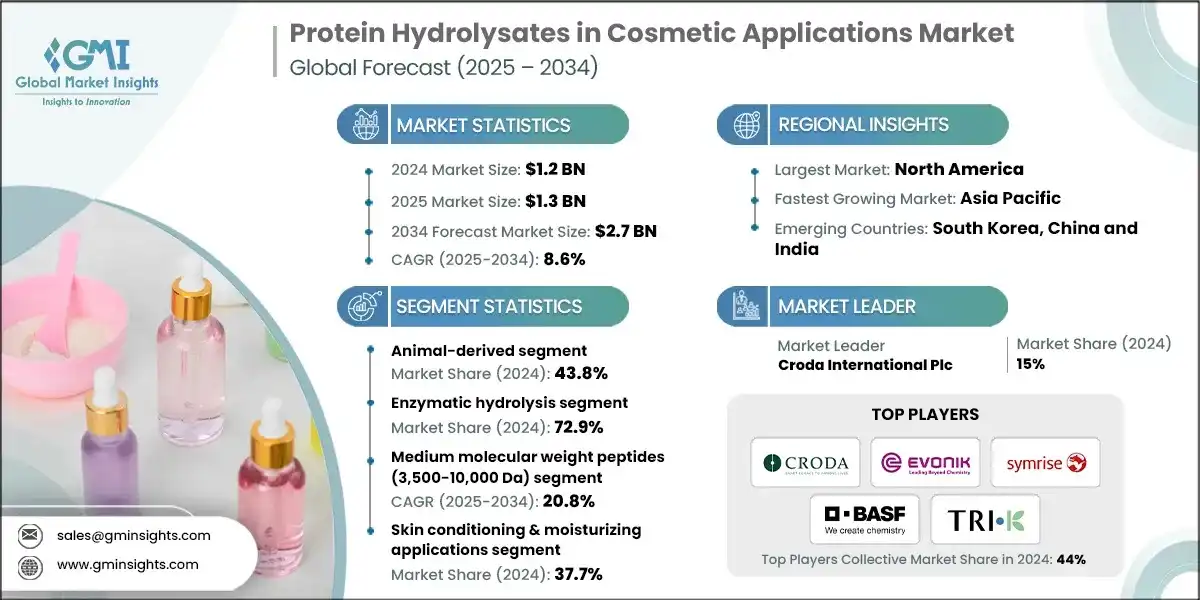
The global protein hydrolysates in cosmetic applications market was estimated at USD 1.2 billion in 2024. The market is expected to grow from USD 1.3 billion in 2025 to USD 2.7 billion in 2034, at a CAGR of 8.6%, according to latest report published by Global Market Insights Inc.
Protein Hydrolysates in Cosmetic Applications Market Key Takeaways
Market Size & Growth
- 2024 Market Size: USD 1.2 Billion
- 2025 Market Size: USD 1.3 Billion
- 2034 Forecast Market Size: USD 2.7 Billion
- CAGR (2025–2034): 8.6%
Regional Dominance
- Largest Market: North America
- Fastest Growing Region: Asia Pacific
Key Market Drivers
- Rising demand for natural & sustainable cosmetic ingredients.
- Increasing consumer awareness of anti-aging benefits.
- Growing preference for vegan & cruelty-free alternatives.
Challenges
- Stringent molecular weight regulations (EU 3.5 KDA restriction).
- Allergenicity concerns & safety assessment requirements.
Opportunity
- Emerging bioactive peptide applications in cosmeceuticals.
- Untapped potential in marine-derived protein sources.
Key Players
- Market Leader: Croda International Plc led with over 15% market share in 2024.
- Leading Players: Top 5 players in this market include Croda International Plc, Evonik Industries AG, Symrise AG, BASF SE, TRI-K Industries Inc., which collectively held a market share of 44% in 2024.
Get Market Insights & Growth Opportunities
- The global protein hydrolysates market in cosmetic applications is witnessing worth-noting growth due to the increasing demand for multifunctional and bioactive ingredients. Hydrolysates such as collagen, whey, and many plant proteins are valued for their ability to assist hydration, skin barrier function, and anti-aging benefits, clean label and hypoallergenic product trends make for further attraction to both formulators and consumers in their search for effective natural cosmetic solutions.
- The advances in enzymatic hydrolysis have enabled the generation of highly specific peptides with better bioactivity and allergenicity for the purposes of cosmetic action, further such improvements may provide an enhancement of formulation stability and sensory appeal for incorporation into a variety of products ranging from creams, serums, emulsions, and haircare treatments.
- With established consumer base North America on the top of adoption with matured personal care market, Asia Pacific is fast emerging as a growth market with rising disposable incomes and a greater focus on skincare products. Europe retains a good stand with the regulations and an emphasis on sustainable sourcing for ingredients. The UAE and Africa are now emerging as growth markets in premium and wellness-oriented products. As the market continues to evolve, the strategic focus is shifting toward innovation, regulatory alignment, and expansion into new consumer segments and geographic regions .
To get key market trends
Protein Hydrolysates in Cosmetic Applications Market Trends
- The development of bioactive peptides has changed as emerging constituents in cosmeceuticals for topical applications in skin rejuvenation, moisture recovery, and anti-aging formulations. These peptides, produced through controlled enzymatic hydrolysis, are gradually being incorporated into formulations designed for specific skin conditions such as fine lines, discoloration, and barrier repair. Since peptide molecules are tiny, they penetrate the dermis better and can be utilized for high-performance skin formulations targeted evermore toward dermatological and wellness trends.
- Protein hydrolysates of marine origin are the next promising but not fully tapped into this area. These ingredients are rich in amino acids and peptides with tremendous antioxidants as well as anti-inflammatory activity and could potentially derive from fish collagen, algae, and marine by-products. Their credentials as natural and sustainable ingredients will also resonate with the growing consumer demand for ocean-friendly and clean-label cosmetics. With the advancement of extraction-purification technologies, marine proteins will be able to find increased applications in the next-generation cosmetic formulations.
- Peptide mapping, bioinformatics, and skin biology are focusing on the more targeted development of actives based on hydrolysates. This allows peptide design towards very specific bioactivities, such as effects on moisture, consistency, and effectiveness, while remaining in compliance with regulatory limits. Thus, protein hydrolysates are increasingly seen not just as functional materials but also as the cornerstone of the formulation of individualized and scientifically backed cosmetology.
Protein Hydrolysates in Cosmetic Applications Market Analysis

Learn more about the key segments shaping this market
Based on protein source, the market is segmented into animal-derived, plant-derived, marine-derived, microbial & fermentation-derived. Animal-derived dominated the market with an approximate market share of 43.8% in 2024 and is expected to grow with a CAGR of 7.6% by 2034.
- Animal-derived hydrolysates remain prominent, especially dairy and collagen hydrolysates because they have traditionally been found to be effective in conditioner formulations for skin and hair. They are further appreciated because of the specific amino acid content and compatibility with conventional bases in cosmetics. plant hydrolysates are gaining momentum, propelled by the increasing claimed vegan, allergen-free, and sustainable products. Among those being considered for their moisturization and anti-inflammatory properties are soy, wheat, and peas for clean-label skin care.
- Marine protein hydrolysates are an emerging category with untapped potential. Hydrolysates from fish collagen, algae, and other marine waste materials are enriched with bioactive peptides that help influence the elastic properties of skin, its antioxidant defense mechanism, and water retention. Meanwhile, derived from microorganisms and fermentation, the hydrolysates are starting to penetrate into the cosmetic market through precision fermentation processes for producing specific peptides with bioactivities.
Learn more about the key segments shaping this market
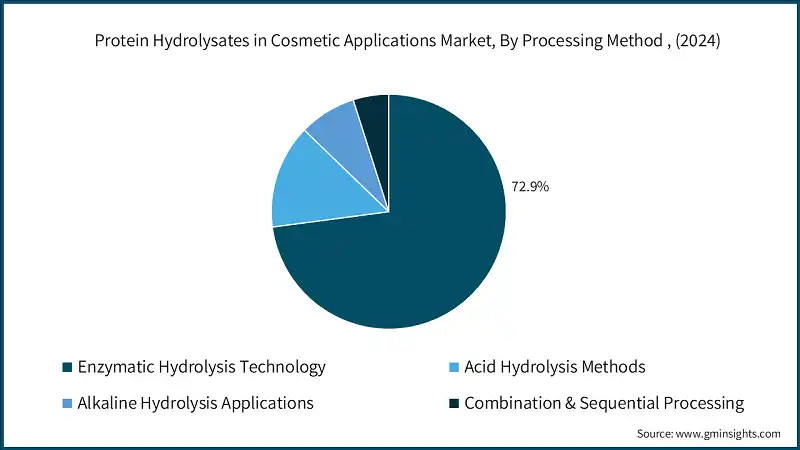
Based on processing method, the protein hydrolysates in cosmetic applications market is segmented into enzymatic hydrolysis technology, acid hydrolysis methods, alkaline hydrolysis applications, combination & sequential processing. Enzymatic hydrolysis holds the largest market share of 72.9% in 2024 and is expected to grow at a CAGR of 9% during 2025-2034.
- Enzymatic hydrolysis is one of the widely used methods that generates specific peptide profiles with minimal destruction to maintain the activity and biocompatibility of the peptides, even in delicate skin formulations. These can be harnessed to develop peptides of specified molecular weight and known functions to counteract the issues of anti-aging, moisturizing, and barrier repair effects. Although acid hydrolysis may serve in the depolymerization of protein substrates into smaller peptides, the pattern usually is a nonspecific one and generates unacceptable by-products that must be removed.
- Alkaline hydrolysis is not much used in cosmetics for fear of degradation, although, it is a suitable technique to use in formulations where strong peptide structures are to be utilized for specific performance objectives, such as hair strengthening or exfoliation. Recently, combinations of processes have been seen for their possible enhanced optimization of yield and functionality of peptides. A combination of enzymatic and chemical steps allows the customization of the properties of the hydrolysate to meet the stringent demands of advanced cosmetic formulations
Based on molecular weight, the protein hydrolysates in cosmetic applications market is segmented into high molecular weight peptides (>10,000 Da), medium molecular weight peptides (3,500-10,000 Da), low molecular weight peptides (500-3,500 Da), and free amino acids (<500 Da). Medium molecular weight peptides (3,500-10,000 Da) segment dominated the market with an approximate market share of 49.8% in 2024 and is expected to grow with the CAGR of 20.8% by 2034.
- Medium molecular weight peptides (3,500-10,000 Da), lead the market due to balanced performance in bioactivity and structural integrity allowing for the wide use of these peptides in skin and hair care product formulation, i.e., in improving hydration, increasing the elasticity of skin and hair, as well as improving barrier function without compromising the stability of the formulation. With better skin penetration and bioactivity, low molecular weight peptides (500-3,500 Da) are increasingly being preferred in targeted anti-aging and repair products as they also have the smallest size that could provide the deepest interaction in the dermis, thus making them ideal products in serums and intensive treatments.
- Although high molecular weight (>10,000 Da.) peptides bear reduced permeation, they can hence be used in hair conditioning applications and protective effects in skin- care. Free amino acids (<500 Da) mainly help in the nourishment of the skin and proper pH balance. They tend to be included in formulations for sensitive skin and after cosmetic treatment.
Based on cosmetic applications, the protein hydrolysates in cosmetic applications market is segmented into skin conditioning & moisturizing applications, hair conditioning & repair applications, film-forming & protective applications, anti-aging & wrinkle reduction, anti-irritant & soothing applications. Skin conditioning & moisturizing applications segment dominated the market with an approximate market share of 37.7% in 2024 and is expected to grow with the CAGR of 20.8% by 2034.
- Skin conditioning and moisturizing remain the most prominent segment, as hydrolyzed proteins in humectant and film-forming properties augment hydration, improve skin texture, and support barrier function. These peptides are often included in creams, lotions, and serums daily used in skincare regimes. Another crucial area is hair conditioning and repair, where hydrolysates of keratin, silk, and plant proteins strengthen hair fibers, reduce breakage, and preferably improve manageability thus, it is all important components of shampoos, conditioners, and leave-in.
- Film-forming and protective effects, high molecular weight peptides create breathable layers upon the skin or hair, protecting from environmental stressors and moisture loss. This functionality is highly relevant to the products designed for sensitive skins and extreme weather. The rapidly growing applications of antiaging and wrinkle reduction are driven mainly by low molecular weight peptides that stimulate collagen synthesis and matrix remodeling to improve elasticity and reduce the appearance of fine lines.
Looking for region specific data?
The North America market dominated the global protein hydrolysates in cosmetic applications market with a market share of 35.5% in 2024.
- North America has now become the eminent region for the cosmetic usages of such protein hydrolysates, especially peptides. A strong preference of evidence-based skincare solutions incorporating bioactive peptides exerts market pull in the U. S., especially those with anti-aging, moisturizing, and skin-repair properties. Consumers are increasingly drawn to clean labels with efficacy, this has sped up application of enzymatic derivation of peptides in premium and mass markets of skin care.
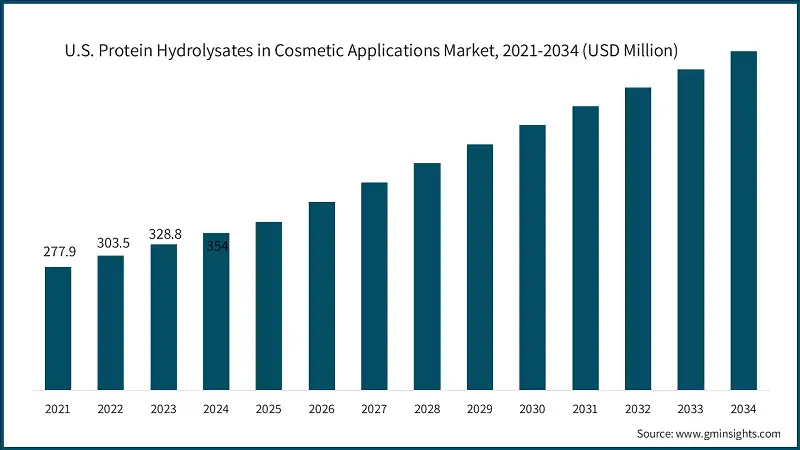
U.S. dominates the North America protein hydrolysates in cosmetic applications market accounted for USD 354 million, showcasing strong growth potential.
- Increase in provisional demand for sustainable and functional beauty ingredients. The beauty industry in U.S. is under transparent and clear regulations, the production technologies for precision enzymatic hydrolysis and green chemistry techniques, resulting in stable and high-quality peptides suitable for topical application helping the market to grow.
Europe market accounted for USD 377.6 million in 2024 and is anticipated to show lucrative growth over the forecast period.
- European region in the global protein hydrolysates market for cosmetic applications is recognized by extremely high ingredient sophistication and regulatory rigors. Specialized hydrolyzed peptides in skincare and haircare formulations have seen good acceptance in key markets.
Germany dominates the European protein hydrolysates in cosmetic applications market, showcasing strong growth potential.
- Germany itself is the strategic hub for innovations and commercialization of protein hydrolysates in cosmetics. The strong technical environment, vigorous research in peptide sciences, and robust cooperative engagement with the respective industries have led to preferentially speeding the introduction of consumer demanded formats of multifunctional hydrolysates across the region.
The Asia Pacific protein hydrolysates in cosmetic applications market is anticipated to grow at a CAGR of 9.8% during the analysis timeframe.
- The cosmetics application for protein hydrolysates offers a fast-changing scenario in the Asia-Pacific region, merging the old beauty philosophies with modern ingredient-based sciences. On the one hand, the consumers actively target functional cosmetics that are clean-label and deliver visible results, aligning with cultural preferences for wellness that is natural and holistic.
China protein hydrolysates in cosmetic applications market is estimated to grow with a significant CAGR in the Asia Pacific Protein Hydrolysates in Cosmetic Applications materials.
- Protein hydrolysates in skin and personal care products have become the major focus for the Chinese cosmetics sector in terms of moisturizing, elasticity, and skin barrier function. Thus, an emerging market paying attention to launching products having high peptide content with a blend of modern science and ancient beauty culture. Such consumers even demand ingredient transparency and efficacy from brands, giving momentum to this.
Latin America protein hydrolysates in cosmetic applications market accounted for 4% market share in 2024 and is anticipated to show lucrative growth over the forecast period.
- Latin American market scaling up as urbanization, health consciousness, and need for functional beauty have always contributed to making it more desirable. Awareness among consumers has also increased among regional users about the old ingredients, effectiveness compared to newer ones, and mostly looking for dedicated skin care and hair care solutions in wellness trends and formulations.
Brazil leads the Latin American market, exhibiting remarkable growth during the analysis period.
- Brazil leads the region with its very dynamic cosmetic sector, embracing innovation and personalization. From anti-aging creams, hydrating serums to restorative hair treatments, Brazilian beauty brands are considerably introducing protein hydrolysates products designed for consumers who care about the performance of the product as well as transparency in its ingredients.
Middle East & Africa protein hydrolysates in cosmetic applications market accounted for 2% market share in 2024 and is anticipated to show lucrative growth over the forecast period.
- In the Middle East and Africa, there is potential for protein hydrolysates on account of urbanization and the growing health consciousness among the people with a demand for functional beauty products. In general, customers in these markets are leaning toward the market products that offer wellness benefit along with cosmetic efficacy, with accent on hydration, skin barrier function, and anti-aging properties.
Saudi Arabia protein hydrolysates in cosmetic applications market to experience substantial growth in the Middle East and Africa market in 2024.
- Saudi Arabia is poised as highest expectation growth in the with all parameters within beautification, healthcare, and wellness exceedingly prospering. Local brands are now adopting peptide-based formulations that cater to the marketplace confusion about clean labels and high-performance ingredients.
Protein Hydrolysates in Cosmetic Applications Market Share
The top 5 companies in Protein Hydrolysates in Cosmetic Applications industry include Croda International Plc, Evonik Industries AG, Symrise AG, BASF SE, TRI-K Industries Inc. These are prominent companies operating in their respective regions covering 44% of the market share in 2024. These companies hold strong positions due to their extensive experience in Protein Hydrolysates in Cosmetic Applications market. Their diverse product portfolios, backed by robust production capabilities and distribution networks, enable them to meet the rising demand across various regions.
- Croda International Plc based in the UK, is a specialty chemicals manufacturer engaged in the manufacturing of ingredients for personal care, life sciences, performance technologies, and industrial chemicals. Their product offering includes skin, hair, and crop care along with pharmaceutical intermediates resulting in sustainability.
- Evonik Industries AG is specialty chemicals company based in Germany, integrated with operations in more than 100 countries. It specializes in Custom Solutions, Advanced Technologies, and Infrastructure production, offering surfactants, polymers, nutritional and care additives, and industrial technologies.
- Symrise AG a German company with operations in fragrances, flavors, and personal care, Symrise operates under two main divisions: taste, nutrition & health and scent & care. The portfolio includes cosmetic actives, aroma molecules, plus the bulk of the substantive products derived from nature to be used in the cosmetic industry on skincare, haircare, oral care, and in selected cases, food applications.
- BASF SE is headquartered in Germany and operates with the production of chemicals, high-performance materials, and surface technology solutions and products which will enable R&D at its nutrition & care department to continue to grow, mostly comprising human nutrition and growth solutions.
- TRIK Industries Inc. is a supplier of protein ingredients, amino acids, peptides, and multifunctional actives for personal care and beauty. The company constantly offers ingredient solutions, focusing on efficacy and sustainability.
Protein Hydrolysates in Cosmetic Applications Market Companies
Major players operating in the protein hydrolysates in cosmetic applications industry include:
- Croda International Plc
- Evonik Industries AG
- Symrise AG
- BASF SE
- TRI-K Industries Inc.
- Sederma
- SILAB
- Ashland Global Holdings Inc.
- Lucas Meyer Cosmetics
- Kelisema Srl
- Proteina
- Ichimaru Pharcos Co. Ltd.
- Naturex
- Geltor Inc.
- Clariant International Ltd.
- Lonza Group Ltd.
Protein Hydrolysates in Cosmetic Applications Market Report Attributes
| Key Takeaway | Details |
|---|---|
| Market Size & Growth | |
| Base Year | 2024 |
| Market Size in 2024 | USD 1.2 Billion |
| Market Size in 2025 | USD 1.3 Billion |
| Forecast Period 2025 – 2034 CAGR | 8.6% |
| Market Size in 2034 | USD 2.7 Billion |
| Key Market Trends | |
| Drivers | Impact |
| Rising demand for natural & sustainable cosmetic ingredients | Drives protein hydrolysates adoption in clean-label formulations for cosmetics among consumers |
| Increasing consumer awareness of anti-aging benefits | Leads to an increase in demands for bioactive peptides in high-end skincare |
| Growing preference for vegan & cruelty-free alternatives | Market share is expanding for plant-based hydrolysates in line |
| Pitfalls & Challenges | Impact |
| Stringent molecular weight regulations (EU 3.5 KDA restriction) | Restricting an ability to formulate and increasing compliance costs |
| Allergenicity concerns & safety assessment requirements | Delaying the approvals of the product for the market |
| Opportunities: | Impact |
| Emerging bioactive peptide applications in cosmeceuticals | Used in cosmeceuticals are opening avenues for high-margin new product segments |
| Untapped potential in marine-derived protein sources | Opens new pathways of innovation for sustainable material sourcing |
| Market Leaders (2024) | |
| Market Leaders |
15% Market share |
| Top Players |
Collective Market Share of 44% in 2024 |
| Competitive Edge |
|
| Regional Insights | |
| Largest Market | North America |
| Fastest growing market | Asia Pacific |
| Emerging countries | South Korea, China and India |
| Future outlook |
|
What are the growth opportunities in this market?
Protein Hydrolysates in Cosmetic Applications Industry News
- In June 2025, Unilever announced a deal to acquire the personal care brand Dr Squatch from growth equity firm Summit Partners. This marks another step in the continued expansion effort of Unilevers portfolio into premium, high-growth areas by making this complementary acquisition.
- In May 2024, Honasa Consumer Ltd. acquired the laboratory assets of CosmoGenesis Labs, renowned for cosmetic formulation and development within the premium skin care solutions arena to strengthen its R&D capabilities.
- In February 2023, the biotechnology company c-LEcta, which deals with enzyme engineering and bioprocess development, announced that it had acquired most shares in Kerry Group-a partner in taste and nutrition for the food, beverage, and pharmaceutical markets. This is a strategically compelling combination that would fast-track Kerry's innovation capabilities in the improvement of enzyme engineering, fermentation, and bio-process development, while enabling C-LEkta to meet its long-term growth potential.
This protein hydrolysates in cosmetic applications market research report includes in-depth coverage of the industry, with estimates & forecasts in terms of revenue (USD Billion) and volume (Kilo Tons) from 2025 to 2034, for the following segments:
Market, By Protein Source
- Animal-derived
- Marine collagen hydrolysates
- Bovine collagen hydrolysates
- Milk protein hydrolysates
- Keratin hydrolysates (wool & feather)
- Plant-derived
- Soy protein hydrolysates
- Wheat protein hydrolysates
- Rice protein hydrolysates
- Emerging sources (pea, hemp, quinoa)
- Oat & corn protein hydrolysates
- Marine-derived
- Fish collagen
- Algae & seaweed protein hydrolysates
- Microbial & fermentation-derived
- Yeast protein hydrolysates
- Bacterial fermentation products
Market, By Processing Method
- Enzymatic hydrolysis technology
- Acid hydrolysis methods
- Alkaline hydrolysis applications
- Combination & sequential processing
Market, By Molecular Weight
- High Molecular Weight Peptides (>10,000 Da)
- Medium Molecular Weight Peptides (3,500-10,000 Da)
- Low Molecular Weight Peptides (500-3,500 Da)
- Free Amino Acids (<500 Da)
Market, By Cosmetic Application
- Skin conditioning & moisturizing applications
- Hair conditioning & repair applications
- Film-forming & protective applications
- Anti-aging & wrinkle reduction
- Anti-irritant & soothing applications
The above information is provided for the following regions and countries:
- North America
- U.S.
- Canada
- Europe
- Germany
- UK
- France
- Spain
- Italy
- Rest of Europe
- Asia Pacific
- China
- India
- Japan
- Australia
- South Korea
- Rest of Asia Pacific
- Latin America
- Brazil
- Mexico
- Argentina
- Rest of Latin America
- Middle East and Africa
- Saudi Arabia
- South Africa
- UAE
- Rest of Middle East and Africa
Frequently Asked Question(FAQ) :
What is the market size of the protein hydrolysates in cosmetic applications industry in 2024?
The market size was USD 1.2 billion in 2024, with a CAGR of 8.6% expected through 2034 driven by rising demand for natural, bioactive, and sustainable cosmetic ingredients.
What is the current protein hydrolysates in cosmetic applications market size in 2025?
The market size is projected to reach USD 1.3 billion in 2025, supported by growing adoption of multifunctional peptides in skincare and haircare formulations.
What is the projected value of the protein hydrolysates in cosmetic applications market by 2034?
The market is expected to reach USD 2.7 billion by 2034, driven by advancements in enzymatic hydrolysis, demand for clean-label actives, and increased usage in anti-aging and barrier-repair products.
How much revenue did the animal-derived protein hydrolysates segment generate in 2024?
dominant protein Animal-derived protein hydrolysates accounted for 43.8% market share in 2024, making it the source category. This leadership is fueled by strong compatibility of collagen and dairy-based peptides with skincare and haircare formulations.
What was the valuation of enzymatic hydrolysis technology in 2024?
Enzymatic hydrolysis held 72.9% market share in 2024, establishing it as the leading processing method in the industry. Its dominance is driven by precise peptide production, superior bioactivity, and higher formulation stability compared to chemical hydrolysis.
What is the growth outlook for medium molecular weight peptides from 2025 to 2034?
Medium molecular weight peptides (3,500–10,000 Da) are expected to grow at a 20.8% CAGR through 2034 after capturing 49.8% share in 2024. Growth is supported by balanced penetration, bioactivity, and structural integrity, making them ideal for moisturizing, firming, and barrier-repair applications.
What are the upcoming trends in the protein hydrolysates in cosmetic applications industry?
Key trends include the rise of bioactive peptides in cosmeceuticals, growing adoption of marine-derived hydrolysates, advances in peptide mapping and precision fermentation, and increasing demand for vegan, allergen-free, and sustainable ingredients. These trends support innovation in high-performance skin and hair formulations.
Which region leads the protein hydrolysates in cosmetic applications market?
The U.S. dominated the North America market with USD 354 million in 2024. Growth is driven by strong demand for evidence-based skincare formulations, high adoption of peptide technologies, and stringent regulatory support for premium and clean-label ingredients.
Who are the key players in the protein hydrolysates in cosmetic applications market?
Major players include Croda International Plc, Evonik Industries AG, Symrise AG, BASF SE, TRI-K Industries Inc., Sederma, SILAB, Ashland, Lucas Meyer Cosmetics, Kelisema Srl, Proteina, Ichimaru Pharcos, Naturex, Geltor Inc., Clariant, and Lonza Group Ltd.
Protein Hydrolysates in Cosmetic Applications Market Scope
Related Reports