Summary
Table of Content

Programmable Matter for Consumer Products Market
Get a free sample of this report
Form submitted successfully!
Error submitting form. Please try again.
Thank you!
Your inquiry has been received. Our team will reach out to you with the required details via email. To ensure that you don't miss their response, kindly remember to check your spam folder as well!
Request Sectional Data
Thank you!
Your inquiry has been received. Our team will reach out to you with the required details via email. To ensure that you don't miss their response, kindly remember to check your spam folder as well!
Form submitted successfully!
Error submitting form. Please try again.
Programmable Matter for Consumer Products Market Size
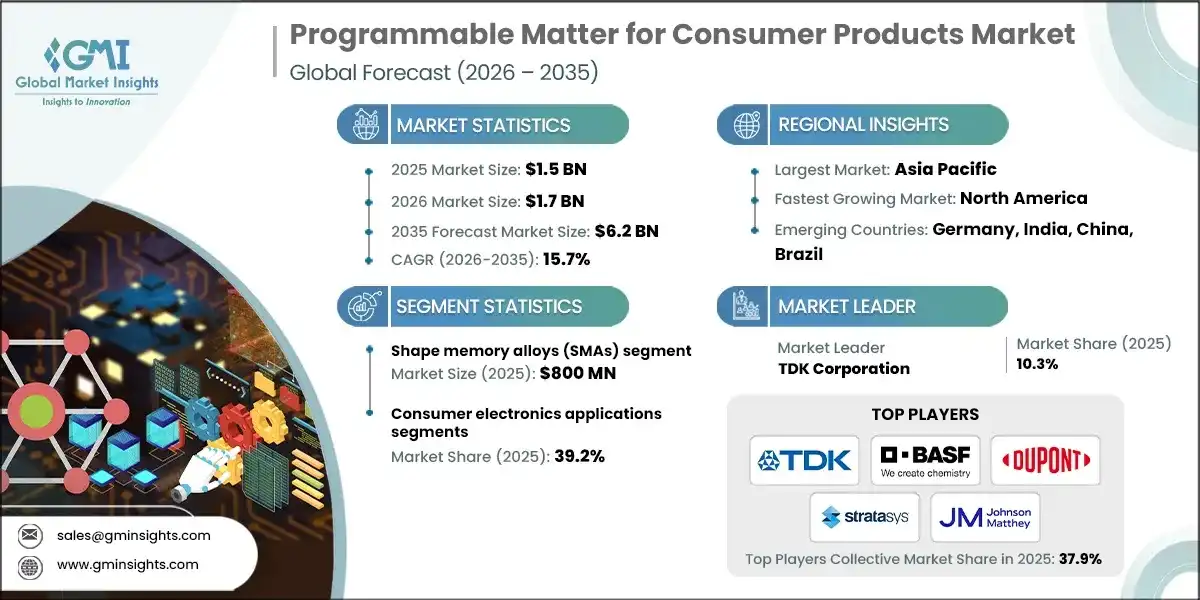
The global programmable matter for consumer products market was valued at USD 1.5 billion in 2025. The market is expected to grow from USD 1.7 billion in 2026 to USD 6.2 billion in 2035, at a CAGR of 15.7%, according to latest report published by Global Market Insights Inc.
Programmable Matter for Consumer Products Market Key Takeaways
Market Size & Growth
- 2025 Market Size: USD 1.5 Billion
- 2026 Market Size: USD 1.7 Billion
- 2035 Forecast Market Size: USD 6.2 Billion
- CAGR (2026–2035): 15.7%
Key Market Drivers
- Demand for customization and personalization.
- Advances in material science and nanotechnology.
- Integration with IoT and AI.
Challenges
- High cost and manufacturing complexity.
- Energy consumption and control systems.
Opportunity
- Next-gen consumer interfaces.
- Circular economy and product longevity.
Key Players
- Market Leader: TDK Corporation led with over 10.3% market share in 2025.
- Leading Players: Top 5 players in this market include TDK Corporation, BASF SE, DuPont, Stratasys, Johnson Matthey, which collectively held a market share of 37.9% in 2025.
Get Market Insights & Growth Opportunities
The U.S. government continues to invest in innovation in programmable matter for consumer products through memorable funding programs. The National Nanotechnology Initiative, for example, contributes over USD 1.2 billion annually to nanotech research, which includes improving programmable matter technologies. The funding is designed to accelerate the development of materials that can respond and adapt to consumer needs, thereby promoting innovation in programmable matter for consumer purposes.
In addition, DARPA's programs represent sources on targeted funding for programmable matter technologies, increasing the pace of development. For example, BASF is already leveraging DARPA funding and resources to advance programmable materials with future consumer applications. BASF is offering expertise in material science and is in an advantageous position to create programmable materials that keep pace with consumer needs.
Military and aerospace funding is creating a new era of innovation for programmable matter technologies, for example, the U.S. Army Research Lab has developed 3D-printable, stimuli-responsive polymeric epoxies that exhibit autonomous healing and shape-memory. These innovations are making progress towards a consumer bound product. Companies like DuPont are exploring similar funded work for wearables, including, for example, the DuPont Liveo Smart Biosensing Patch which has been developed in partnership with STMicroelectronics.
The advancement of advanced manufacturing infrastructure suggests an enormous opportunity for the commercialization of programmable matter in consumer products. For example, Stratasys is pushing the boundaries of 3D printing to create programmability devices in the consumer space for scalable production driven by a strong demand in the market. Oak Ridge National Laboratory innovates in nitinol additive manufacturing, which is an important part of programmability of materials that have special properties, such as shape memory effect, super elasticity and thermal responsiveness.
Federal technology transfer programs are bridging the gap between laboratory research and commercial applications. Interactive wear is advancing programmable matter-based wearables by utilizing federal technology transfer programs, including the Department of Energy’s NNSA and NavalX. By integrating sensor-embedded textiles with edge-AI platforms, their garments adapt in real-time to temperature, motion, or stress. These innovations, initially developed in research labs, now feature in over 200 commercial products.
To get key market trends
Programmable Matter for Consumer Products Market Trends
The changing innovation and technology transformation are important for the growth of the market.
- Government agencies are spending more than ever on R&D in advanced manufacturing to lay the groundwork for any future programmable matter applications in consumer products. The Manufacturing USA network's USD 416 million and 2,572 members illustrate the federal effort to develop programmable matter capabilities. Programmable matter aims to produce smart materials that over time could change shape or properties on demand. One example is Gentherm, a company working on programmable materials for automotive seating that adapt to user input or preferences.
- Agencies working collaboratively enables overall government effort towards developing technologies in programmable matter. DHS, NASA, NSF, DOE, and NIST are working together towards advanced materials R&D, which is sustained by the National Nanotechnology Initiative's funding of over USD 1.2 billion per year. This funding is allowing development of several materials including, BASF's self-healing materials for consumer electronics and. DuPont's flexible conductive inks for wearable device.
- Government-funded research is achieving unprecedented miniaturization, which is critical for programmable matter in consumer applications. MIT researchers, with support from NSF and DARPA, developed a chip-based 3D printer using a millimeter-scale silicon photonics chip with 160-nm-thick optical antennas. This technology can produce micro-scale programmable components for wearables and medical devices. For instance, smart contact lenses with embedded sensors are now feasible due to such advancements. These developments highlight the transformative potential of programmable matter in everyday products.
- The EIC, part of the European Union, is driving competition in deep technology and rapidly refueling the evolution of programmable matter. These efforts have produced breakthroughs such as the utilization of shape-memory alloys in foldable smartphones by Cambridge Mechatronics and adaptive materials already employed in a wide range of industrial and consumer applications by Parker Hannifin. Programmable packaging, including ingredients such as beverage containers that change colors to alert consumers about the contents freshness developed by BASF, is emerging as well
- The development of programmable materials, such as recyclable, biodegradable, and self-healing materials, is gaining traction in consumer products. For examples, BASF has several biodegradable polymers that address and encourage the use of materials in a circular economy, and DuPont has developed self-healing materials waiting to be used in the electronics market. The European Union, with their Circular Economy Action Plan, underscores and supports the usage of sustainable materials as part of the plan and is facilitating the adoption of these materials in many industrial sectors.
Programmable Matter for Consumer Products Market Analysis
Learn more about the key segments shaping this market
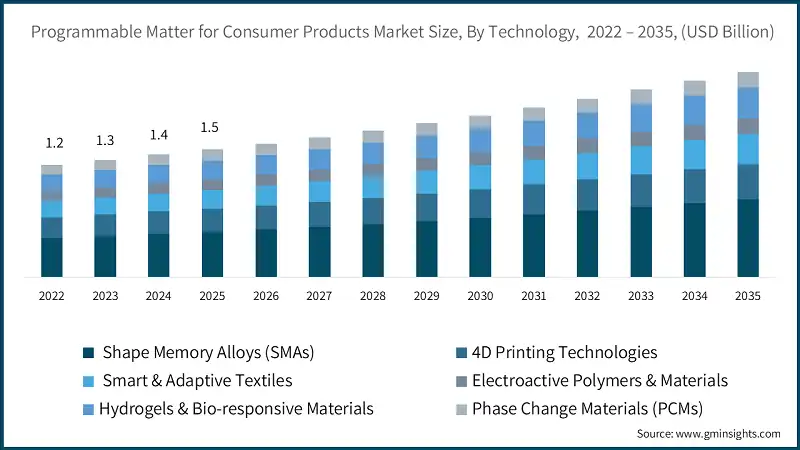
Based on technology, the market is segmented into shape memory alloys (SMAs), 4D printing technologies, smart and adaptive textiles, electroactive polymers and materials, hydrogels and bio-responsive materials, phase change materials (PCMs). The shape memory alloys (SMAs) category held the largest share of the market and generated revenue of USD 800 million in 2025.
- Throughout the decades, government agencies have contributed considerable resources and funding to shape memory alloy (SMA) research. NASA is currently performing advanced research into new shape memory composites and nitinol applications. Oak Ridge National Laboratory and its lead scientists are researching additive manufacturing and nitinol, supporting manufacturing processes required for commercialization. The U.S. Department of Energy recognizes thermoelastic cooling as an elastocaloric SMA with the high potential to fully replace traditional vapor-compression refrigeration systems environmentally harmful to the surrounding environment.
- Government research has defined quantitative performance metrics based on either. For elastocaloric SMAs, under 500 MPa stress for NiTi alloys, an entropy change of roughly 70 J/kg·K can be achieved with the adiabatic temperature change over 15 K Springer. Cu-based SMAs can achieve an approximate entropy change of 20 J/kg·K at 100 MPa over an approximate temperature span of 130 K. Research funded by the government has demonstrated cycle life exceeding 10 million cycles when precipitation engineering is optimized in combination with additive manufacturing methods, for example, Gentherm is using SMA-based actuators as part of an automotive seat climate control system to provide energy-efficient solutions.
- Several agencies coordinate SMA research for layering technology development for each agency. Additionally, the U.S. Army Research Laboratory is developing a stimuli-responsive polymeric epoxies with shape-memory behavior, NASA is advancing shape memory composites for aerospace applications; and Fort Wayne Metals and Johnson Matthey are enhancing SMA manufacturing strategies with efforts to ensure materials generated achieve high-quality specification for eventual medical applications.
- The U.S. Department of Energy's 2014 recognition of elastocaloric SMAs for environmentally friendly cooling applications demonstrates government endorsement of SMA technology for large-scale deployment. This validation provides regulatory and policy support for SMA market expansion.
Learn more about the key segments shaping this market
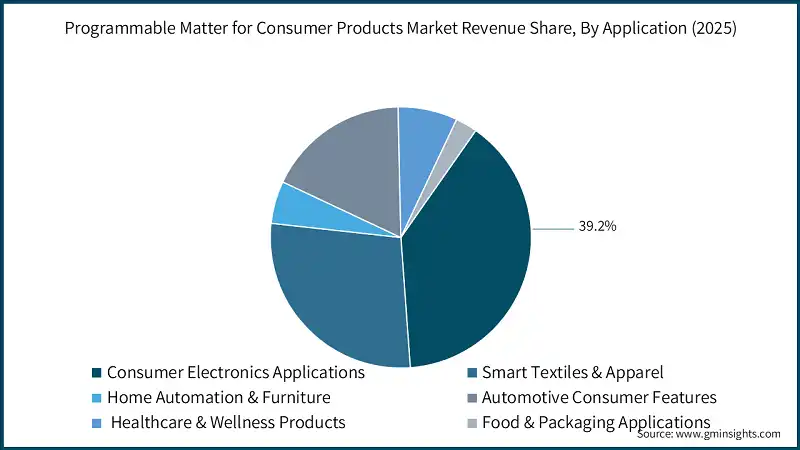
Based on the application the programmable matter for consumer products market is bifurcated into consumer electronics applications, smart textiles and apparel, home automation and furniture, automotive consumer features, healthcare and wellness products, food and packaging applications. The consumer electronics applications segments held the largest share, accounting for 39.2% of the global programmable matter for consumer products market in 2025.
- Research is facilitating the innovation of programmable matter for consumer electronics, thereby providing advances for new products. For example, MIT's PortaChrome system, which is supported by the MIT-GIST Joint Research Program, exhibits portable contact light systems which truly allow for consumer objects to be technologically reprogrammable. Companies such as AiQ Smart Clothing, and Sensoria also take advantage of and employ similar technologies in smart clothing to monitor health metrics and/or the user experience with textiles.
- Technologies funded by NASA, and DARPA demonstrate immediate use in consumer electronics. The 3D printer that is chip-based (funded by NSF and DARPA) is built for rapid prototyping on site and components for medical devices. This technology provides manufacturers with the capabilities necessary for programmable matter consumer products. An example is Stratasys 3D printed components that are used in wearable devices. Additionally, companies such as DuPont and BASF are developing advanced materials which are being integrated into consumer electronics to enhance performance, diversity, durability and adaptability.
- The U.S. directly supports technologies applicable to consumer electronics by the contracts it creates and sends. An example, NASA provided Optomec, USD 0.85 million for an SBIR contract for nonplanar electrical interconnects that will enable truly 3D-conformal electronics, what must be done for all of the consumer applications we describe in the programmable consumer device dimension. NASA also provided an STTR contract in the amount of USD 0.85 million to fund the development of programmable photonic integrated circuits, again, the technologies described here simply and directly support consumer electronic applications and products.
- The U.S. Army Research Laboratory's development of stimuli-responsive materials for autonomous healing and shape-memory behavior has applications in consumer electronics requiring durability and adaptability. NASA's metamaterials research supports consumer applications requiring lightweight, adaptive components. Government-funded research demonstrates all-optical processors using 3D-printable photochromic materials with energy requirements of 10-30 mJ cm2 for threshold-level operations, enabling energy-efficient consumer electronics applications
Looking for region specific data?
North America Programmable Matter for Consumer Products Market
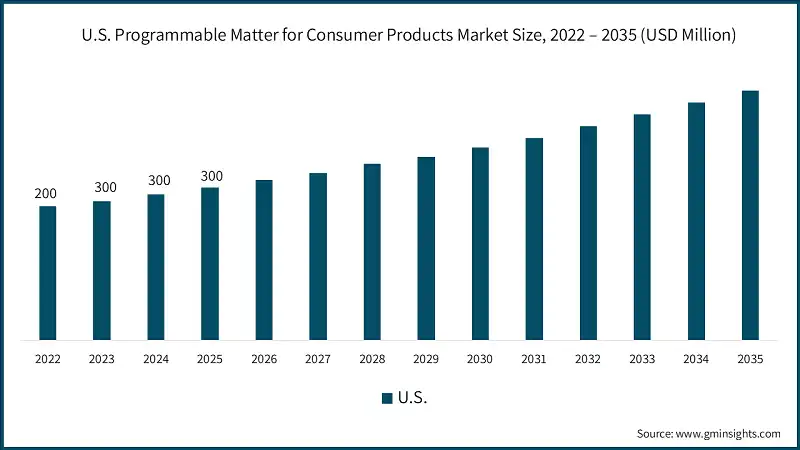
In 2025, the U.S. dominated the market growth in North America, accounting for 74.9% of the share in the region.
- The U.S. market enjoys a vigorous innovation ecosystem, the early adoption of smart materials, and avid consumer demand for customized products powered by technology. The U.S. also has a mature advanced manufacturing infrastructure and R&D investments in material science, IoT, and AI - the main forces behind programmable matter technology. The National Science Foundation (NSF) allocated over USD 86 billion to R&D in 2023, of which advanced materials and emerging technologies received a significant percentage.
- Several leading manufacturers held considerable market share. The companies DuPont, BASF, Stratasys, TDK, and Johnson Matthey have major R&D activities and production operations in Delaware, Texas, Minnesota, and New Jersey. Sensoria, from Washington state, is known as a leader in smart wearables and e-textiles. These manufacturers have both federal and state investment and support (e.g., Advanced Manufacturing Partnership or AMP initiative) and have shown innovation and growth in the programmable matter space.
Asia Pacific Programmable Matter for Consumer Products Market
Asia Pacific market is the largest region and is expected to grow at 16% during the forecast period.
- The Asia Pacific is driven by advancements in technology, innovative products, and government initiatives. For example, Japan has developed programmable textiles that adjust to temperature changes, offering enhanced consumer comfort.
- Similarly, South Korea is investing in programmable surfaces for consumer electronics, improving user interaction. Additionally, China's "Made in China 2025" initiative prioritizes innovation in advanced materials, fostering market growth.
Europe Programmable Matter for Consumer Products Market
Europe market is expected to grow at 15.4% during the forecast period.
- This growth is driven by increasing demand for innovative materials that can adapt to user needs, such as shape-shifting furniture and self-healing smartphone cases. Advancements in nanotechnology and material science are enabling the development of programmable matter, which offers significant potential for customization and sustainability.
- For instance, government initiatives, such as the European Union's Horizon Europe program, are fostering innovation in advanced materials, further supporting market growth. These factors collectively position the region as a hub for technological advancements in programmable matters for consumer application.
Middle East and Africa Programmable Matter for Consumer Products Market
Middle East and Africa market is expected to grow at 15% during the forecast period.
- This growth is driven by increasing adoption of advanced materials in consumer electronics, such as shape-shifting displays and self-healing smartphone screens. Governments in the region are also supporting innovation through initiatives like the UAE's "Fourth Industrial Revolution Strategy," which promotes the development of cutting-edge technologies, including programmable matters.
- For instance, programmable matter technology is being integrated into wearable devices such as Sensoria’s smart socks and garments, enabling them to adapt to user needs dynamically.
Programmable Matter for Consumer Products Market Share
The top companies in the programmable matter for consumer products industry include TDK Corporation, BASF SE, DuPont, Stratasys, and Johnson Matthey collectively hold a share of 37.9% of the market. These prominent players are proactively involved in strategic endeavors, such as mergers & acquisitions, facility expansions & collaborations, to expand their service portfolios, extend their reach to a broad customer base, and strengthen their market position.
- TDK by pairing material science with digital intelligence designs programmable solutions to respond to stimuli in the environment. Innovations in piezoelectric and magnetic materials enable TDK to formulate shape-changing surfaces and wearable technology that responds to touch, heat, or motion. TDK’s smart textiles and flexible electronics are developed to add comfort and interactivity for consumer products to support wellness, merging technology and user-centered design in daily products.
- BASF is proud of their solutions based on programmable polymers that change structure and function in response to user needs. BASF's smart materials are designed for sustainability and high performance. Their designs include self-healing surfaces, responsive packaging for products, and adaptive coatings on products reflect the BASF dedication to transformation through chemistry, while delivering products that respond to use and environment.
- DuPont utilizes its legacy of advanced materials science to develop programmable solutions to enrich consumer experience. Their shape-memory polymer and responsive films, use an extensive background in material science to provide performance features in wearables, home goods, and personal care goods like tactile feedback, temperature regulation, and attractive aesthetics. Human-centered innovation is at the core of DuPont's impact by ensuring materials deliver value and enhance everyday functions.
Programmable Matter for Consumer Products Market Companies
Major players operating in the programmable matter for consumer products industry are:
- AiQ Smart Clothing
- ATI
- BASF
- Cambridge Mechatronics
- DuPont
- Fort Wayne Metals
- Gentherm
- Interactive Wear
- Johnson Matthey
- Ohmatex
- Parker Hannifin
- Schoeller Textil
- Sensoria
- Stratasys
- TDK
Stratasys transforms personalization with programmable 3D printing materials that change form, color, or function in response to stimuli. Utilizing its PolyJet and FDM technologies, Stratasys produces dynamic consumer products, including fashion accessories and smart home components, that adapt in real time. This empowers designers to create interactive, responsive objects that bridge the gap between digital design and physical reality.
Johnson Matthey integrates catalysis and materials science to develop intelligent surfaces and coatings for consumer applications. Its programmable materials purify air, neutralize odors, or adjust properties based on environmental triggers. With a focus on sustainability and well-being, Johnson Matthey’s innovations bring subtle intelligence to everyday products, enhancing health, comfort, and environmental harmony.
Programmable Matter for Consumer Products Market Report Attributes
| Key Takeaway | Details |
|---|---|
| Market Size & Growth | |
| Base Year | 2025 |
| Market Size in 2025 | USD 1.5 Billion |
| Market Size in 2026 | USD 1.7 Billion |
| Forecast Period 2026-2035 CAGR | 15.7% |
| Market Size in 2035 | USD 6.2 Billion |
| Key Market Trends | |
| Drivers | Impact |
| Demand for customization and personalization | Programmable matter enables products to transform their shape, color, or function according to user preferences. This capability addresses the increasing consumer demand for personalized experiences in industries such as fashion, electronics, and home goods. |
| Advances in material science and nanotechnology | Innovations in smart polymers, shape-memory alloys, and nanoscale materials are driving the development of programmable matter. These advancements allow consumer products to exhibit dynamic and responsive behaviors, enhancing their functionality and interactivity. |
| Integration with IoT and AI | When paired with IoT sensors and AI algorithms, programmable matter can intelligently respond to environmental inputs like temperature, motion, or voice commands. This integration creates seamless and adaptive user experiences in wearables, appliances, and smart home systems. |
| Pitfalls & Challenges | Impact |
| High cost and manufacturing complexity | The production of programmable materials often requires advanced fabrication techniques and rare resources, resulting in excessive costs. Scaling these technologies for mass-market adoption remains a significant challenge. |
| Energy consumption and control systems | Programmable matter typically demands continuous or precise energy input to maintain or alter states. Developing efficient, compact control systems that can be embedded into consumer products without compromising usability is a critical challenge. |
| Opportunities: | Impact |
| Next-gen consumer interfaces | Programmable matter has the potential to revolutionize user interactions through innovations like touch-sensitive surfaces, morphing displays, or self-adjusting wearables. These advancements open innovative design possibilities in electronics, fashion, and home automation. |
| Circular economy and product longevity | Materials that can self-heal, adapt, or be reconfigured extend product lifespans and reduce waste. programmable matter supports modularity and recyclability, aligning with sustainability goals and the principles of a circular economy. |
| Market Leaders (2025) | |
| Market Leaders |
10.3% market share |
| Top Players |
|
| Competitive Edge |
|
| Regional Insights | |
| Largest Market | Asia Pacific |
| Fastest Growing Market | North America |
| Emerging Country | Germany, India, China, Brazil |
| Future Outlook |
|
What are the growth opportunities in this market?
Programmable Matter for Consumer Products Industry News
- In May 2025, Johnson Matthey sold its Catalyst Technologies business to Honeywell for USD 2.2 million, marking a strategic pivot toward more agile and focused operations. This move aligns with its broader transformation strategy, potentially enabling deeper investment in advanced materials, including programmable matter for sustainable consumer applications.
- In April 2025, BASF introduced three new natural-based ingredients- Verdessence Maize, Lamesoft OP Plus, and Dehyton PK45 GA/RA, at in-cosmetics Global 2025. These materials are designed for sustainable personal care products and include programmable properties like texture adaptation and environmental responsiveness, aligning with the company’s Longevity Ecosystem strategy.
- In March 2025, Sensoria continues to lead in wearable programmable textiles with patented innovations such as fabric-based pressure sensors, haptic feedback systems, and intelligent footwear. These technologies enable real-time health monitoring and adaptive feedback, positioning Sensoria at the forefront of programmable matter in fitness and healthcare wearables.
- In 2025, DuPont continues to expand the use of Kevlar in consumer goods such as motorcycle gear, workout equipment, and protective gloves. These materials offer programmable properties like flame resistance, cut protection, and lightweight strength, enhancing safety and performance in daily-use products.
- In November 2024, Stratasys introduced new materials and enhancements for its Fused Deposition Modeling (FDM) and Programmable PhotoPolymerization (P3) platforms. These include advanced drying cabinets and customizable layer height options, enabling more precise control over material behavior. This expansion supports the development of programmable consumer products with dynamic form and function.
The programmable matter for consumer products market research report includes in-depth coverage of the industry, with estimates & forecasts in terms of revenue (USD Million) and volume (Thousand Units) from 2022 to 2035, for the following segments:
Market, By Technology
- Shape memory alloys (SMAs)
- 4D printing technologies
- Smart and adaptive textiles
- Electroactive polymers and materials
- Hydrogels and bio-responsive materials
- Phase change materials (PCMs)
Market, By Application
- Consumer electronics applications
- Integration in smartphones and mobile devices
- Wearable technology & accessories
- Adaptive display technologies
- Haptic interface systems
- Smart textiles & apparel
- Adaptive clothing & fashion applications
- Sports & performance monitoring gear
- Health monitoring garments
- Interactive & entertainment textiles
- Home automation & furniture
- Reconfigurable furniture systems
- Adaptive home appliances
- Smart surface technologies
- Interactive interface integration
- Automotive consumer features
- Adaptive interior systems
- Comfort & climate control applications
- Healthcare & wellness products
- Wearable health monitoring devices
- Adaptive medical equipment
- Therapeutic & rehabilitation systems
- Products for elderly & disability assistance
- Food & packaging applications
- 4D printed food products
- Smart packaging technologies
- Temperature & freshness indicators
The above information is provided for the following regions and countries:
- North America
- U.S.
- Canada
- Europe
- Germany
- France
- UK
- Italy
- Spain
- Asia Pacific
- China
- Japan
- India
- Australia
- South Korea
- Latin America
- Brazil
- Mexico
- Argentina
- MEA
- Saudi Arabia
- UAE
- South Africa
Frequently Asked Question(FAQ) :
What was the market size of the programmable matter for consumer products market in 2025?
The market size was valued at USD 1.5 billion in 2025, with a CAGR of 15.7% expected through 2035, driven by advancements in smart materials and increasing R&D investments.
What is the projected value of the programmable matter for consumer products market by 2035?
The market is expected to reach USD 6.2 billion by 2035, fueled by technological innovations and growing applications in consumer electronics and smart textiles.
What was the revenue generated by the shape memory alloys (SMAs) segment in 2025?
The shape memory alloys (SMAs) segment generated USD 800 million in revenue in 2025, holding the largest share in the technology segment.
Which application segment dominated the programmable matter for consumer products market in 2025?
The consumer electronics applications segment led the market, accounting for 39.2% of the global share in 2025.
Which region dominated the programmable matter for consumer products industry in 2025?
The U.S. dominated the North American market, accounting for 74.9% of the regional share in 2025, driven by strong R&D initiatives and technological advancements.
What are the key trends in the programmable matter for consumer products industry?
Key trends include increased government R&D funding, advancements in smart materials like self-healing and flexible conductive materials, and collaborative efforts among agencies to develop programmable matter technologies.
Who are the key players in the programmable matter for consumer products market?
Major players include AiQ Smart Clothing, ATI, BASF, Cambridge Mechatronics, DuPont, Fort Wayne Metals, Gentherm, Interactive Wear, Johnson Matthey, Ohmatex, Parker Hannifin, Schoeller Textil, Sensoria, and Stratasys.
Programmable Matter for Consumer Products Market Scope
Related Reports