Summary
Table of Content

Profilometer Market
Get a free sample of this report
Form submitted successfully!
Error submitting form. Please try again.
Thank you!
Your inquiry has been received. Our team will reach out to you with the required details via email. To ensure that you don't miss their response, kindly remember to check your spam folder as well!
Request Sectional Data
Thank you!
Your inquiry has been received. Our team will reach out to you with the required details via email. To ensure that you don't miss their response, kindly remember to check your spam folder as well!
Form submitted successfully!
Error submitting form. Please try again.
Profilometer Market Size
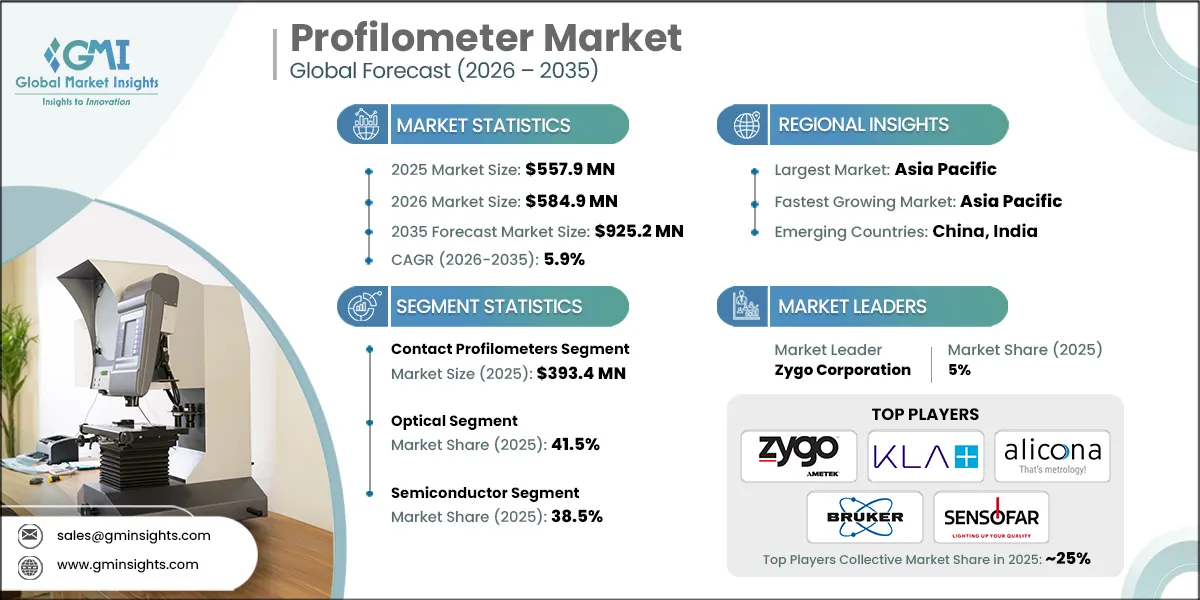
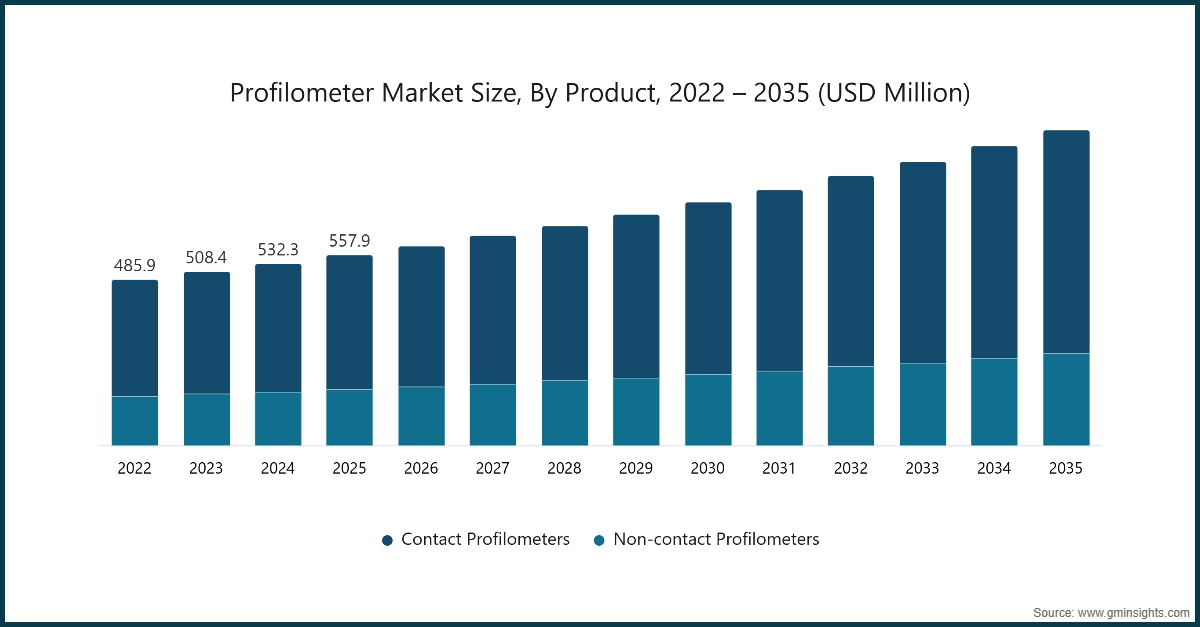
The global profilometer market was estimated at USD 557.9 million in 2025. The market is expected to grow from USD 584.9 million in 2026 to USD 925.2 million in 2035, at a CAGR of 5.9% according to latest report published by Global Market Insights Inc.
Profilometer Market Key Takeaways
Market Size & Growth
- 2025 Market Size: USD 557.9 Million
- 2026 Market Size: USD 584.9 Million
- 2035 Forecast Market Size: USD 925.2 Million
- CAGR (2026–2035): 5.9%
Regional Dominance
- Largest Market: Asia Pacific
- Fastest Growing Region: Asia Pacific
Key Market Drivers
- Rising demand for high-precision surface measurement.
- Expansion of semiconductor & electronics manufacturing.
- Advancements in non-contact & 3d optical technologies.
Challenges
- High equipment cost & integration complexity.
- Operational limitations across varied materials.
Opportunity
- Growing adoption in renewable energy & battery manufacturing.
- Integration with automation, robotics & inline metrology.
Key Players
- Market Leader: Zygo Corporation led with over 5% market share in 2025.
- Leading Players: Top 5 players in this market include Zygo Corporation, KLA Corporation, Alicona, Bruker, Sensofar, which collectively held a market share of 25% in 2025.
Get Market Insights & Growth Opportunities
- Profilometers are indispensable tools in industries such as semiconductor fabrication, automotive, aerospace, and medical devices. The principal application of a profilometer is to measure the characteristics of a surface including roughness, shape and textural characteristics. These measurements confirm that manufactured products are of sufficient quality and are produced consistently.
- Profilometers are very important devices in groups like aerospace or medical devices, as parts produced in these areas must be manufactured with a high degree of precision. As the sophistication of the manufacturing process becomes more advanced and requires even more precision, the requirement for profilometers to measure surface characteristics in greater detail will continue to increase. Profilometers are driven in part by the aerospace and medical device industries, as these two groups are known to be very rigorous to have high impact. For example, the aerospace sector relies on profilometers to ensure the aerodynamic efficiency and structural integrity of components, while the medical device industry uses them to meet strict regulatory standards for surface finishes.
- The growth of the profilometer market is also facilitated due to the development of several emerging profilometry technology. These technologies include white light interferometry, confocal microscopy, and laser scanning. These technologies improve accuracy, speed, and flexibility providing the industries with increased productivity and improved quality of control.
- For instance, white light interferometry is widely adopted for its ability to provide non-contact, high-resolution measurements, making it ideal for applications in microelectronics and precision engineering. Confocal microscopy, with its superior depth measurement capabilities, is crucial for inspecting complex geometries in automotive and aerospace components.
- Moreover, the integration of automation and artificial intelligence (AI) in profilometry systems is reshaping the market landscape. Automated profilometers equipped with AI algorithms can analyze surface data in real-time, reducing human error and enhancing operational efficiency. This aligns with the broader industrial shift toward smart manufacturing and Industry 4.0, where data-driven decision-making is becoming a key competitive advantage.
To get key market trends
Profilometer Market Trends
- The market is experiencing a notable shift from traditional stylus-based systems to advanced optical profilometers, driven by their superior speed, non-destructive measurement capabilities, and ability to analyze intricate geometries. Technologies such as laser triangulation, white-light interferometry, and confocal microscopy are now widely recognized as industry benchmarks. This transition is fueled by the growing demand for faster inspection cycles and precise 3D surface mapping, particularly in high-growth sectors like semiconductors, electronics, and biomedical devices.
- Manufacturers are increasingly embedding profilometers into automated production lines to enable real-time quality control. Inline systems are instrumental in detecting surface irregularities during the manufacturing process, significantly reducing defects, minimizing downtime, and enhancing throughput.
- Emerging industries, including electric vehicle (EV) battery production, solar photovoltaic manufacturing, and wind turbine component fabrication, are driving the demand for profilometry solutions. These sectors require ultra-precision surface inspection to ensure coating uniformity, material efficiency, and long-term reliability. Additionally, the EV battery market has seen a 20% annual increase in demand for profilometry tools, highlighting their importance in ensuring product quality and durability.
- The integration of artificial intelligence (AI), machine learning, and advanced analytics is revolutionizing profilometer functionality. Modern systems can autonomously classify defects, generate predictive insights, and optimize process parameters. This trend enhances measurement accuracy and supports manufacturers in transitioning to predictive maintenance and data-driven quality assurance models. Research indicates that AI-enabled profilometers can improve defect detection rates by 30% compared to traditional systems, significantly reducing operational inefficiencies and production costs.
- As components in electronics, medical devices, and semiconductors continue to shrink, the demand for nanoscale surface measurement is escalating. Profilometers capable of capturing atomic-level roughness, microstructures, and nano-topography are becoming essential tools in precision manufacturing. This trend is driving the development of ultra-high-resolution sensors and hybrid systems that integrate multiple metrology technologies into a single platform.
Profilometer Market Analysis
Learn more about the key segments shaping this market
- Contact profilometers continue to hold a significant share of the market due to their reliability, cost‑effectiveness, and ability to deliver accurate surface roughness measurements across a wide range of materials. Their stylus‑based mechanism makes them particularly suitable for robust industrial environments where tactile measurement is preferred for consistent results. Industries such as automotive, metalworking, and heavy manufacturing still rely on contact systems for routine surface characterization, especially where surface texture standards (Ra, Rz, Rq) must be met.
- Despite competition from non-contact technologies, contact profilometers remain relevant due to their ability to measure deep valleys, steep slopes, and rough surfaces that optical systems may struggle to capture accurately. They also offer strong repeatability and compliance with international metrology standards, which enhances their adoption in regulated sectors. However, their limitations with soft, delicate, or transparent surfaces drive customers toward hybrid or non-contact systems, influencing the market’s gradual shift but not eliminating the importance of contact instruments.
Based on technology type of profilometer market consists of optical, stylus, laser scan and interferometry. The optical segment emerged as leader and held 41.5% of the total market share in 2025 and is anticipated to grow at a CAGR of 6.3% from 2026 to 2035.
- Optical profilometers represent the fastest-growing segment, driven by technological advancements in interferometry, laser scanning, and confocal optical systems. These tools offer high-speed, high-resolution, and non-destructive measurement capabilities, making them ideal for inspecting delicate surfaces, complex microstructures, and miniaturized components. Their ability to quickly capture 3D surface topography without physical contact is a major advantage in precision-driven industries.
- The demand for optical profilometers is rising with the expansion of semiconductor fabrication, advanced electronics, and medical device production, where surfaces must be inspected at micro and nano scales.
- Additionally, improvements in sensor resolution, automated image processing, and AI-based defect classification are enhancing the performance of optical systems, making them more efficient and user-friendly. As industries increasingly prioritize speed, accuracy, and traceability, optical profilometry is expected to continue outperforming traditional technologies.
Based on application, the profilometer market consists of automotive, semiconductor, medical/healthcare, aerospace, electronics and manufacturing. The semiconductor segment emerged as leader and held 38.5% of the total market share in 2025.
- The semiconductor industry is one of the largest and most critical end users of profilometry solutions due to its stringent requirements for surface uniformity, thin‑film integrity, and precise wafer geometry. Profilometers are essential for inspecting etching depth, film thickness, wafer flatness, and micro‑level defects across various fabrication stages. As chip architectures become more complex and transition toward smaller nodes, the need for ultra‑high‑precision surface metrology continues to intensify.
- The rapid growth of semiconductor manufacturing driven by AI chips, 5G devices, data centers, and advanced consumer electronics is accelerating the adoption of both optical and non-contact profilometers. The shift toward 3D packaging, EUV lithography, and advanced wafer materials further boosts demand for high-resolution, automated, and inline-capable profilometry systems. With ongoing global investments in chip fabs, especially in Asia-Pacific and North America, the semiconductor segment will remain a core growth engine for the North America market.
Learn more about the key segments shaping this market
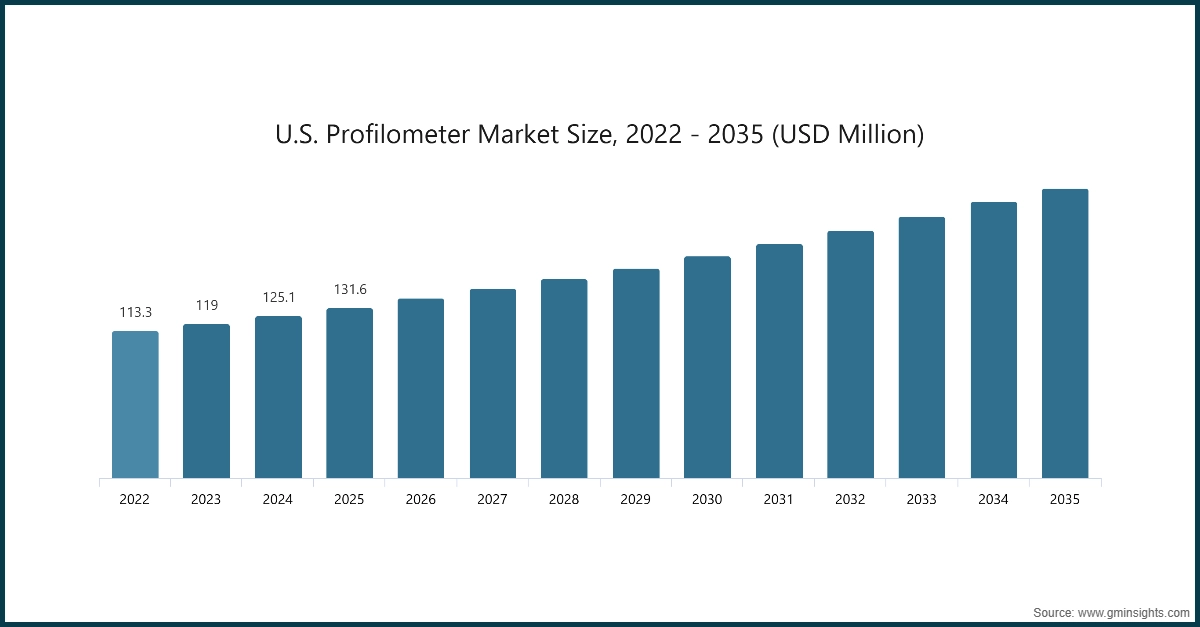
The U.S. dominates an overall North America profilometer market and valued at USD 131.6 million in 2025 and is estimated to grow at a CAGR of 6.2% from 2026 to 2035.
- The US market for profilometers is driven by strong demand from semiconductor fabrication, aerospace, biomedical device manufacturing, and advanced automotive engineering. The country’s robust R&D ecosystem and heavy investment in nanotechnology and precision engineering support rapid adoption of high‑end optical and non-contact profilometers.
- Major semiconductor expansion projects and reshoring initiatives further strengthen the need for high‑accuracy surface metrology tools. The presence of leading OEMs and high adoption of Industry 4.0 automation make the US one of the most technologically advanced and premium markets.
Europe Profilometer Market
In the European market, Germany is expected to experience significant and promising growth from 2026 to 2035.
- Europe maintains significant demand for profilometers due to its strong automotive, aerospace, medical device, and high-precision manufacturing industries. Countries such as Germany, France, and the UK lead adoption due to advanced industrial automation and stringent quality standards.
- EU’s focus on sustainability, lightweight materials, and precision engineering encourages the use of advanced non-contact optical profilometry. Additionally, Europe's strong regulatory environment and emphasis on certification and material testing sustain stable long-term demand for surface metrology technologies.
Asia Pacific Profilometer Market
In the Asia Pacific market, the China held 31% market share in 2025 and is anticipated to grow at a CAGR of 6.7% from 2026 to 2035.
- APAC is the fastest-growing region, fueled by its strong semiconductor manufacturing hubs (Taiwan, South Korea, Japan), expanding electronics production bases (China, Vietnam), and rapid automotive and industrial development.
- The region’s aggressive investment in wafer fabs, OLED/LED manufacturing, EV components, and high‑volume manufacturing creates heightened demand for high-speed, non-contact profilometers. APAC’s ability to scale production and its push toward miniaturization and advanced materials position it as the global growth engine for the market.
Middle East and Africa Profilometer Market
In the Middle East and Africa market, Saudi Arabia held 4% market share in 2025 promising growth from 2026 to 2035.
- Although at an emerging stage, the MEA market is gradually expanding due to increasing investments in electronics assembly, industrial manufacturing, aerospace maintenance, and research facilities in the GCC region. Countries like the UAE and Saudi Arabia are pushing technological diversification, which includes precision engineering and advanced inspection tools.
- Adoption remains modest but is supported by rising industrial automation and the establishment of new manufacturing and testing centers. Over time, MEA is expected to evolve into a steady-demand region with progressive uptake of mid‑range and high-end profilometers.
Profilometer Market Share
- In 2025, the prominent manufacturers in market are collectively held the market share of ~25%.
- Zygo’s competitive edge lies in its strong leadership in optical metrology and interferometry technologies, which are widely regarded as the industry benchmark for ultra‑high‑precision measurement.
- KLA Corporation holds a competitive advantage through its dominance in semiconductor process control and deep expertise in inline inspection systems. Its profilometers benefit from the company's advanced metrology algorithms, AI‑driven defect analysis, and integration with fab‑wide automation platforms. By combining profilometry with broader lithography and wafer‑inspection solutions, KLA creates a highly synergistic ecosystem that strengthens customer lock‑in and maintains its leadership in high‑end semiconductor applications.
- Alicona stands out for its specialization in 3D optical surface metrology focused on micro‑ and nano‑scale measurement. Its systems are known for high vertical resolution, repeatability, and the ability to capture complex geometries with exceptional accuracy. Alicona’s strong foothold in precision machining, toolmaking, and medical device manufacturing combined with user‑friendly software gives it an edge with customers needing high‑accuracy, production‑integrated measurement systems.
Profilometer Market Companies
Major players operating in the market include:
- AMETEK, Inc.
- Bruker
- Carl Zeiss
- Evident Scientific
- Jenoptik Group
- Keyence Corporation
- KLA Corporation
- L.S. Starrett Company
- Mahr Inc.
- Mitutoyo America Corporation
- Nikon Instruments
- Sensofar
- Solarius, Inc.
- Tokyo Seimitsu Co., Ltd.
- Zygo Corporation
Bruker’s competitive strength comes from its broad portfolio of surface characterization technologies, including stylus, optical, and atomic‑force‑based systems. This multi‑technology capability allows the company to serve a wide range of industries and applications with tailored solutions. Bruker is also known for scientific rigor and innovation, often pushing the boundaries of nanoscale measurement making it a preferred choice for research institutions and high‑precision manufacturing environments.
Sensofar differentiates itself through advanced 3-in-1 optical metrology platforms that integrate confocal, interferometry, and focus variation technologies within a single system. This multi‑modal approach gives users flexibility to inspect diverse materials and surface types without switching equipment.
Profilometer Market Report Attributes
| Key Takeaway | Details |
|---|---|
| Market Size & Growth | |
| Base Year | 2025 |
| Market Size in 2025 | USD 557.9 Million |
| Market Size in 2026 | USD 584.9 Million |
| Forecast Period 2026-2035 CAGR | 5.9% |
| Market Size in 2035 | USD 925.2 Million |
| Key Market Trends | |
| Drivers | Impact |
| Rising demand for high-precision surface measurement | Industries such as automotive, semiconductor, medical devices, and aerospace increasingly require ultra-precise surface characterization for quality assurance. Profilometers help ensure tighter tolerances and defect-free production. As manufacturing shifts toward miniaturization and high performance components, demand for advanced profilometry grows. |
| Expansion of semiconductor & electronics manufacturing | The semiconductor industry requires profilometers for wafer inspection, thin film metrology, and microstructure analysis. With the continued rise of consumer electronics, IoT devices, and advanced chips, fabs are investing in metrology tools that offer higher accuracy and faster throughput. This directly boosts the adoption of both optical and non-contact profilometers. |
| Advancements in non-contact & 3D optical technologies | Optical, laser-scanning, and interferometric profilometers are gaining traction due to their speed, non-destructive capabilities, and ability to measure complex surfaces. Technological improvements such as high-resolution sensors and AI-based defect detection further expand use cases. These innovations are pulling users away from traditional stylus systems. |
| Pitfalls & Challenges | Impact |
| High equipment cost & integration complexity | Advanced profilometers, especially optical and interferometric types, involve high acquisition and maintenance costs. Smaller manufacturers often find it difficult to justify these investments. Integration with existing production lines and training personnel also adds to overall expenses. |
| Operational limitations across varied materials | Certain profilometer technologies work better with specific surfaces—e.g., stylus systems struggle with soft materials, while optical systems face issues with highly reflective or transparent surfaces. This variability complicates selection decisions and may require multi-technology setups, increasing cost and complexity |
| Opportunities: | Impact |
| Growing adoption in renewable energy & battery manufacturing | Solar cell production, battery electrode coating, and wind turbine component manufacturing require highly precise surface inspection. As global renewable energy investments surge, profilometers are becoming essential for ensuring efficiency and long-term performance. This emerging sector offers strong long-term market potential. |
| Integration with automation, robotics & inline metrology | Smart factories are increasingly adopting inline inspection systems for real-time quality control. Profilometers integrated with robotic arms and automated inspection lines offer continuous monitoring and reduced human error. The Industry 4.0 trend opens up major opportunities for high-speed, inline, non-contact profilometry solutions. |
| Market Leaders (2025) | |
| Market Leader |
5% market share |
| Top Players |
The collective market share in 2025 is ~25% |
| Competitive Edge |
|
| Regional Insights | |
| Largest Market | Asia Pacific |
| Fastest growing market | Asia Pacific |
| Emerging countries | China, India |
| Future outlook |
|
What are the growth opportunities in this market?
Profilometer Industry News
- In November 2025, Evident Scientific launched the LEXT OLS5500, a hybrid 3D optical profilometer that integrates laser scanning microscopy, white‑light interferometry, and focus‑variation microscopy. The system emphasizes guaranteed accuracy, automated workflows, and high‑resolution surface characterization suitable for semiconductor and electronics applications.
- In September 2024, Bruker released the Dektak Pro, described as the most advanced benchtop stylus profilometer in its long-running Dektak series. The system features expanded measurement capacity (up to 200 mm), higher accuracy, improved stress measurement routines, and automated wafer‑mapping tools, targeting semiconductor and MEMS applications.
The profilometer market research report includes in-depth coverage of the industry, with estimates & forecast in terms of revenue (USD Million) and volume (Thousand Units) from 2022 to 2035, for the following segments:
Market, By Product type
- Contact profilometers
- Non-contact profilometers
Market, By Type
- 2D Profilometers
- 3D Profilometers
Market, By Technology
- Optical
- Stylus
- Laser scan
- Interferometry
Market, By End Use
- Automotive
- Semiconductor
- Medical/healthcare
- Aerospace
- Electronics
- Manufacturing
Market, By Distribution channel
- Direct
- Indirect
The above information is provided for the following regions and countries:
- North America
- U.S.
- Canada
- Europe
- Germany
- UK
- France
- Italy
- Spain
- Asia Pacific
- China
- Japan
- India
- South Korea
- Australia
- Latin America
- Brazil
- Mexico
- Argentina
- MEA
- Saudi Arabia
- UAE
- South Africa
Frequently Asked Question(FAQ) :
What is the market size of the profilometer market in 2025?
The market size for profilometer was valued at USD 557.9 million in 2025, driven by increasing demand for high-precision surface measurement in semiconductor fabrication.
What is the projected value of the profilometer market by 2035?
The market is expected to reach USD 925.2 million by 2035, growing at a CAGR of 5.9% from 2026 to 2035, supported by advancements in optical metrology.
What will be the profilometer market size in 2026?
The market is projected to grow to USD 584.9 million in 2026, reflecting steady investments in semiconductor fabs, EV component manufacturing, and precision engineering.
Which product segment dominates the profilometer industry?
The contact profilometers segment generated approximately USD 393.4 million in 2025 and is expected to grow at a CAGR of 6% through 2035, owing to its reliability, and compliance with international surface roughness standards.
Which technology segment holds the largest share?
The optical segment held 41.5% of the total market share in 2025 and is anticipated to grow at a CAGR of 6.3%, driven by non-contact measurement capabilities, high-speed 3D mapping, and adoption in semiconductor and electronics industries.
Which end-use industry leads the profilometer market?
The semiconductor segment accounted for 38.5% of the total market share in 2025, due to stringent wafer geometry, thin-film measurement, and micro-level defect inspection requirements.
How large is the U.S. profilometer market?
The U.S. market was valued at USD 131.6 million in 2025 and is projected to grow at a CAGR of 6.2% from 2026 to 2035, driven by semiconductor reshoring initiatives, aerospace manufacturing, and strong R&D investments.
Who are the key players in the profilometer market?
Leading companies include KLA Corporation, Zygo Corporation, Bruker, Sensofar, and Evident Scientific, collectively holding approximately 25% of the global market share in 2025.
Profilometer Market Scope
Related Reports