Summary
Table of Content

Printed Circuit Board (PCB) Market
Get a free sample of this report
Form submitted successfully!
Error submitting form. Please try again.
Thank you!
Your inquiry has been received. Our team will reach out to you with the required details via email. To ensure that you don't miss their response, kindly remember to check your spam folder as well!
Request Sectional Data
Thank you!
Your inquiry has been received. Our team will reach out to you with the required details via email. To ensure that you don't miss their response, kindly remember to check your spam folder as well!
Form submitted successfully!
Error submitting form. Please try again.
Printed Circuit Board Market Size
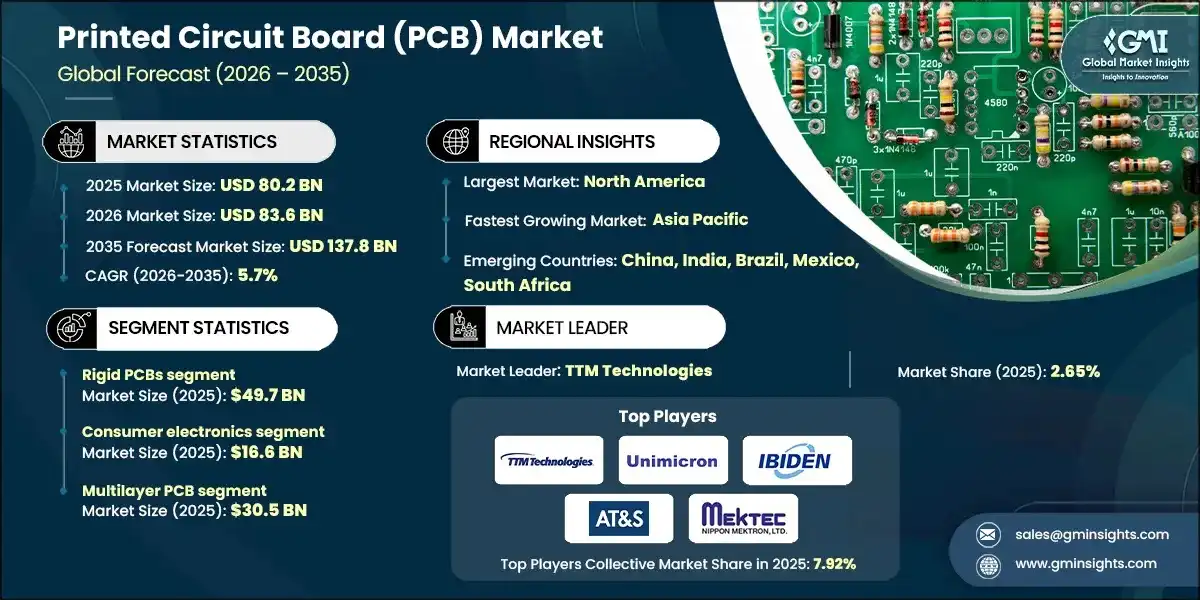
The global printed circuit board market was valued at USD 80.2 billion in 2025. The market is expected to grow from USD 83.6 billion in 2026 to USD 137.8 billion in 2035, at a CAGR of 5.7% during the forecast period according to the latest report published by Global Market Insights Inc.
To get key market trends
Factors contributing to printed circuit board market growth include increased consumer electronics demand, the automotive industry's growth (EV & ADAS capabilities), increased adoption of 5G and telecommunications infrastructure, & increased use of PCBs in industrial automation/smart manufacturing. Additionally, the trend towards smaller products, High-Density Interconnect (HDI) designs, & Flexible Printed Circuit Board Technology has driven adoption across various sectors including automotive, industrial, medical, & telecommunications. For example, Samsung Electronics utilizes advanced PCB technology in the Galaxy Smartphone series and wearables, which enables high-speed performance and effectively manages power consumption. Those advantages generate increased volume sales and increased potential for repeat orders from electronics, automotive, and industrial sectors for PCBs.
Automotive and Electric Vehicle electronic systems incorporate PCBs in functions such as battery management systems, infotainment systems, and in safety electronic devices, such as ADAS. By utilizing high reliability PCB materials, Automotive OEMs are capable of satisfying high-compliance standards required for automobiles and creating safer and more efficient vehicles. For example, both Bosch and Continental are using multilayer and automotive-grade PCB designs to create power modules and control units for Electric Vehicles. As vehicles become more connected and autonomous in nature, the increasing reliance on PCBs for critical electronic functions will only strengthen market growth and create demand for manufacturers of high-quality, scalable PCB solutions among OEMs and Tier I Manufacturers.
Between 2022 and 2024, the printed circuit board market witnessed significant growth, rising from USD 71.4 billion in 2022 to USD 77 billion in 2024. A major trend during this period was the surge in industrial automation, smart manufacturing, and 5G infrastructure deployments, which required high-density, multilayer, and high-frequency PCBs. For instance, Siemens integrates precision PCBs into robotics, programmable logic controllers (PLCs), and factory control solutions, enabling connected production lines and predictive maintenance. Investments in manufacturing capabilities and R&D by PCB suppliers further supported innovation, higher production volumes, and adoption across end-use industries.
PCBs are crucial elements that connect and support electronic circuits to provide stable function for complicated systems across several different categories from consumer electronics to automobile manufacturing to telecommunications, and automation for industrial applications, as well as newer industries such as renewable energy, medical devices, and aerospace. PCBs provide miniaturized and high-performing layouts that allow compact designs, better signal integrity, and enhanced performance of systems. Companies continue improving PCBs with new material; high density interconnects (HDIs) for scalable production and multilayer constructions are also growing significantly helping speed up the growth of the markets of PCBs across all types of industry and everywhere on the globe.
Printed Circuit Board (PCB) Market Report Attributes
| Key Takeaway | Details |
|---|---|
| Market Size & Growth | |
| Base Year | 2025 |
| Market Size in 2025 | USD 80.2 billion |
| Market Size in 2026 | USD 83.6 billion |
| Forecast Period 2026-2035 CAGR | 5.7% |
| Market Size in 2035 | USD 137.8 Billion |
| Key Market Trends | |
| Drivers | Impact |
| Rising Demand from Consumer Electronics and IoT Devices | Drives PCB market growth through rising demand for compact, high-performance boards in smartphones, wearables, and connected consumer devices. |
| Expansion of Automotive Electronics and Electric Vehicles (EVs) | Supports strong demand as automotive electronics require highly reliable PCBs for ADAS, electric vehicles, and infotainment systems. |
| Growing Adoption in 5G Infrastructure and Telecommunications | This contributes to market expansion with growing deployment of advanced PCBs in 5G infrastructure and telecom networking equipment. |
| Increased Use in Industrial Automation and Smart Manufacturing | Strengthens adoption as industrial automation systems rely on durable, high-precision PCBs for reliable operation in harsh environments. |
| Advancements in High-Density Interconnect (HDI) and Flexible PCBs | Expands market scope through increased use of miniaturized and flexible PCBs in medical devices, aerospace electronics, and IoT applications. |
| Pitfalls & Challenges | Impact |
| Supply Chain Disruptions and Raw Material Volatility | Presents a major challenge as reliance on specialty materials exposes PCB manufacturers to price volatility, supply disruptions, and geopolitical risks, leading to higher costs and production delays. |
| High Manufacturing Complexity and Cost Pressures | Hampers market growth as advanced PCB designs require complex fabrication, strict quality control, and high capital investment, limiting adoption in cost-sensitive applications. |
| Opportunities: | Impact |
| Integration with Electric Vehicles (EVs) and Advanced Automotive Electronics | Offers strong growth opportunities as rising EVs, ADAS, and battery systems drive demand for high-reliability, multi-layer PCBs, enabling manufacturers to enter automotive-grade production. |
| Expansion into 5G Infrastructure and Telecommunications | Presents significant potential with 5G rollout, requiring advanced HDI and rigid-flex PCBs for network infrastructure, supporting high-speed data transmission and global telecom expansion. |
| Market Leaders (2025) | |
| Market Leaders |
2.65% Market Share |
| Top Players |
|
| Competitive Edge |
|
| Regional Insights | |
| Largest Market | North America |
| Fastest Growing Market | Asia Pacific |
| Emerging Country | China, India, Brazil, Mexico, South Africa |
| Future Outlook |
|
What are the growth opportunities in this market?
Printed Circuit Board Market Trends
- A major trend shaping the market is the rising demand for high-density interconnect (HDI) and multi-layer PCBs in advanced consumer electronics, IoT devices, and wearable gadgets. These PCBs support miniaturized circuits, higher signal integrity, and faster data transmission, making them essential for smartphones, tablets, and smart home devices.
- The expansion of automotive electronics and electric vehicles (EVs) is driving another key trend. PCBs are increasingly being used in power management modules, battery control systems, infotainment, and advanced driver-assistance systems (ADAS). For instance, TTM Technologies highlights its automotive PCB solutions that support high-voltage EV components, underscoring the trend of PCBs becoming central to next-generation electric mobility systems.
- Growing adoption in 5G infrastructure and telecommunications is also influencing market trends. PCBs for 5G base stations, antennas, and network equipment require higher frequency handling, low loss materials, and precise manufacturing tolerances. This trend supports faster data speeds, reduced latency, and increased network reliability, reinforcing the importance of specialized PCBs in global connectivity expansion.
- Industrial automation and smart manufacturing applications are increasingly relying on PCBs for robotics, sensors, programmable logic controllers (PLCs), and smart machinery. For instance, Nippon Mektron provides PCBs for industrial automation equipment, reflecting the shift toward connected production lines, predictive maintenance, and real-time monitoring in Industry 4.0 environments.
- Advancements in flexible and rigid-flex PCBs are enabling innovative device designs and compact form factors. These PCBs support bendable, foldable, and space-constrained electronics used in medical devices, consumer electronics, and aerospace applications. The trend is helping manufacturers integrate more complex functionality into smaller devices, enhancing design flexibility, energy efficiency, and overall performance.
- Another evolving trend is the integration of PCBs with embedded components, including sensors, microcontrollers, and RF modules, to create highly integrated system-on-board (SoB) solutions. This reduces assembly complexity, improves signal integrity, and supports faster time-to-market for electronics across multiple sectors.
- The printed circuit board market is also witnessing increased R&D in environmentally friendly and lead-free PCB materials, high thermal resistance laminates, and advanced manufacturing processes. Companies are focusing on sustainability, reliability under extreme conditions, and high-frequency performance, signaling that PCBs are becoming a critical foundation for next-generation electronics, EVs, 5G infrastructure, and industrial automation.
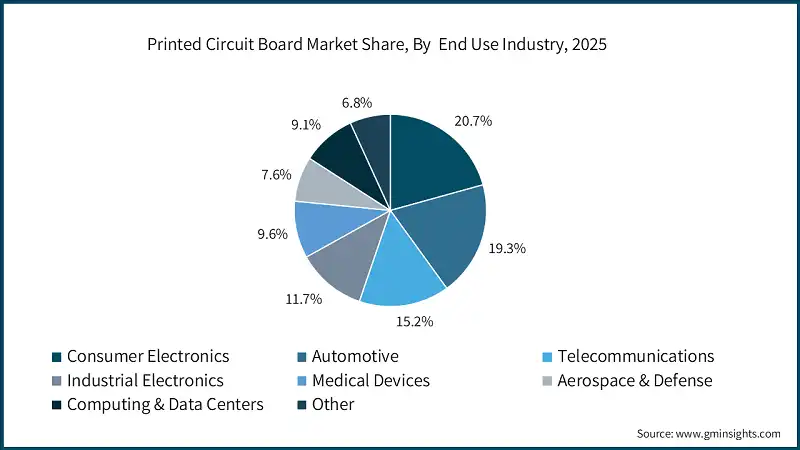
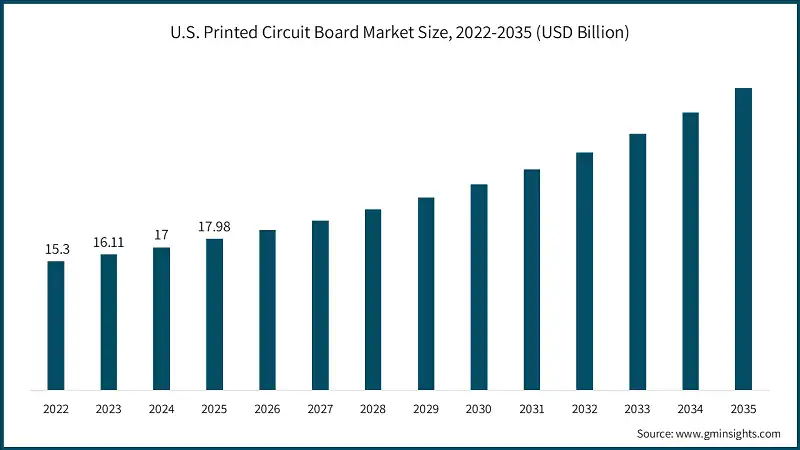
Printed Circuit Board Market Analysis The market was valued at USD 71.4 billion and USD 74.1 billion in 2022 and 2023, respectively. The market size reached USD 80.2 billion in 2025, growing from USD 77 billion in 2024. Based on the PCB structure, the global printed circuit board market is divided into rigid PCB, flexible PCB, rigid-flex PCB. The rigid PCBs segment accounted for the largest market size, 49.7 billion in 2025. Based on end use, the global printed circuit board market is segmented into consumer electronics, automotive, telecommunications, industrial electronics, medical devices, aerospace & defense, computing & data centers, and others. The consumer electronics segment dominated the market in 2025 with a revenue of USD 16.6 billion. Based on type, the global printed circuit board market is segmented into single-sided PCB, double-sided PCB, multilayer PCB, and high-layer-count PCB. The multilayer PCB segment dominated the market in 2025 with a revenue of USD 30.5 billion. The North America printed circuit board market dominated the global PCB market with a significant share of 28.5% in 2025. The U.S. printed circuit board market was valued at USD 15.3 billion and USD 16.1 billion in 2022 and 2023, respectively. The market size reached USD 18 billion in 2025, growing from USD 17 billion in 2024. The Europe printed circuit board market accounted for USD 16.6 billion in 2025 and is expected to witness strong growth over the forecast period. Germany printed circuit board market dominates the Europe market, showcasing strong growth potential. The Asia Pacific printed circuit board market is expected to grow at the highest CAGR of 6.1% during the analysis period. China printed circuit board market is estimated to grow significantly within the Asia Pacific region. Brazil printed circuit board market leads the Latin American market, showing strong growth during the analysis period. South Africa printed circuit board market is expected to witness substantial growth in the Middle East and Africa market during the forecast period. The competitive landscape of the global market is marked by intense competition, continuous technological innovation, and strategic collaborations among leading manufacturers. Top players such as TTM Technologies, AT&S, Unimicron, Ibiden, and Nippon Mektron hold a combined market share of approximately 7.92% in the global PCB market. These companies invest heavily in R&D to enhance product performance, support high-density and high-frequency designs, and expand into emerging applications such as automotive electronics, 5G infrastructure, and industrial IoT. The market also witnesses mergers, acquisitions, and strategic partnerships aimed at broadening geographic presence, improving manufacturing capabilities, and accelerating the adoption of advanced PCB technologies. Smaller and specialized PCB manufacturers contribute by focusing on niche segments such as high-layer-count, heavy-copper, and flexible PCBs, fostering innovation and differentiation. This dynamic environment drives overall market growth and continuous evolution across consumer, automotive, telecom, and industrial sectors. Prominent players operating in the printed circuit board industry are as mentioned below: TTM Technologies is a leading player in the printed circuit board market with a dominant market share of ~2.75%. The company specializes in high-performance printed circuit boards for automotive, aerospace, industrial, and telecommunications applications. Its strong global manufacturing footprint and focus on innovation in HDI and flexible PCBs have positioned it as a front-runner in advanced PCB solutions. AT&S holds a significant share of ~1.13% in the global PCB market and is known for high-end, multilayer PCBs used in smartphones, automotive electronics, and industrial applications. The company’s emphasis on R&D, cutting-edge manufacturing capabilities, and partnerships with global electronics brands drives its competitive advantage in advanced and high-density PCB technologies. Unimicron commands a market share of ~2.38% and is recognized for its expertise in high-volume, high-quality PCB manufacturing. The company focuses on HDI, multilayer, and flexible PCBs for consumer electronics, communication devices, and automotive applications. Its robust production capacity and strong relationships with leading global OEMs reinforce its position as a major player in the PCB market.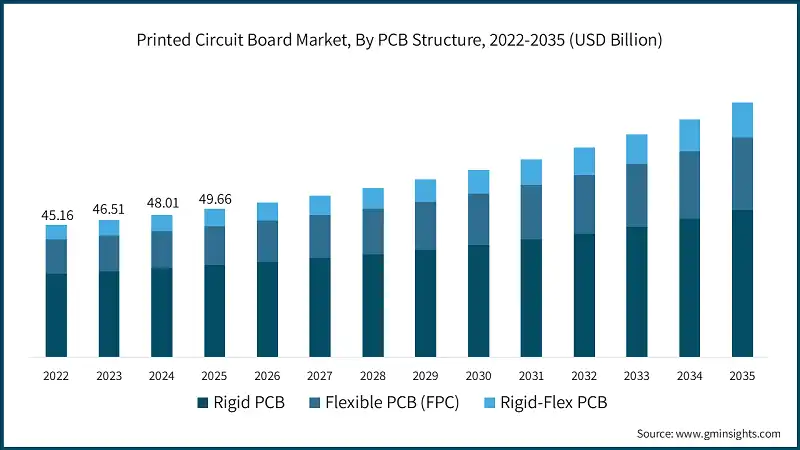 Learn more about the key segments shaping this market
 Learn more about the key segments shaping this market
 Looking for region specific data?
Printed Circuit Board Market Share
Printed Circuit Board Market Companies
Printed Circuit Board Industry News
The printed circuit board market research report includes in-depth coverage of the industry with estimates and forecast in terms of revenue in USD Billion volume in units from 2022-2035 for the following segments:
Market, By PCB Structure
- Rigid PCB
- Flexible PCB (FPC)
- Rigid-flex PCB
Market, By Type
- Single-sided PCB
- Double-sided PCB
- Multilayer PCB
- High-layer-count PCB
Market, By Substrate
- FR-4 (Glass Epoxy)
- Metal-core
- Polyimide
- PTFE
- Ceramic substrate
- Others
Market, By End Use Industry
- Consumer electronics
- Automotive
- Telecommunications
- Industrial electronics
- Medical devices
- Aerospace & defense
- Computing & data centers
- Others
The above information is provided for the following regions and countries:
- North America
- U.S.
- Canada
- Europe
- Germany
- UK
- France
- Spain
- Italy
- Netherlands
- Asia Pacific
- China
- India
- Japan
- Australia
- South Korea
- Latin America
- Brazil
- Mexico
- Argentina
- Middle East and Africa
- South Africa
- Saudi Arabia
- UAE
Frequently Asked Question(FAQ) :
What is the U.S. printed circuit board market size in 2025?
The U.S. market reached USD 18 billion in 2025, reflecting steady expansion supported by domestic manufacturing investments and advanced PCB technology development. Growth is fueled by defense electronics, automotive systems, and high-density PCB innovation.
Who are the key players in the printed circuit board industry?
Leading market players include TTM Technologies, AT&S, Unimicron, Ibiden, Nippon Mektron, Samsung Electro-Mechanics, Tripod Technology, and Sanmina, focusing on advanced multilayer, HDI, and automotive-grade PCB solutions.
What are the key trends shaping the printed circuit board industry?
Major PCB industry trends include rising adoption of HDI and multilayer PCBs, increasing use of flexible and rigid-flex designs, and growing integration in EVs, 5G equipment, and industrial automation systems.
What is the growth outlook for the automotive segment in the printed circuit board market?
The automotive PCB segment is expected to register the highest CAGR of 7.6% through the forecast period, driven by rising electronic content in vehicles, EV adoption, and ADAS integration.
What is the projected value of the printed circuit board (PCB) market by 2035?
The printed circuit board industry is expected to reach USD 137.8 billion by 2035, growing at a CAGR of 5.7% due to expansion in 5G infrastructure, electric vehicles, and high-density electronics.
How much revenue did the rigid PCB segment generate in 2025?
Rigid PCBs generated USD 49.7 billion in 2025, leading the PCB market due to their cost-effectiveness, structural stability, and large-scale use in consumer electronics and industrial applications.
What was the revenue of the consumer electronics end-use segment in the PCB industry in 2025?
The consumer electronics segment generated USD 16.6 billion in 2025, dominating the PCB industry owing to high-volume production of smartphones, laptops, wearables, and home electronics.
What is the market size of the printed circuit board (PCB) market in 2025?
The market was valued at USD 80.2 billion in 2025, supported by rising demand from consumer electronics, automotive electronics, and industrial automation applications.
What is the current printed circuit board market size in 2026?
The PCB market is projected to reach USD 83.6 billion in 2026, driven by increased adoption of advanced PCB technologies across telecom, EVs, and smart manufacturing industries.
Printed Circuit Board (PCB) Market Scope
Related Reports