Summary
Table of Content

Precision Fermentation Dairy Proteins Market
Get a free sample of this report
Form submitted successfully!
Error submitting form. Please try again.
Thank you!
Your inquiry has been received. Our team will reach out to you with the required details via email. To ensure that you don't miss their response, kindly remember to check your spam folder as well!
Request Sectional Data
Thank you!
Your inquiry has been received. Our team will reach out to you with the required details via email. To ensure that you don't miss their response, kindly remember to check your spam folder as well!
Form submitted successfully!
Error submitting form. Please try again.
Precision Fermentation Dairy Proteins Market Size
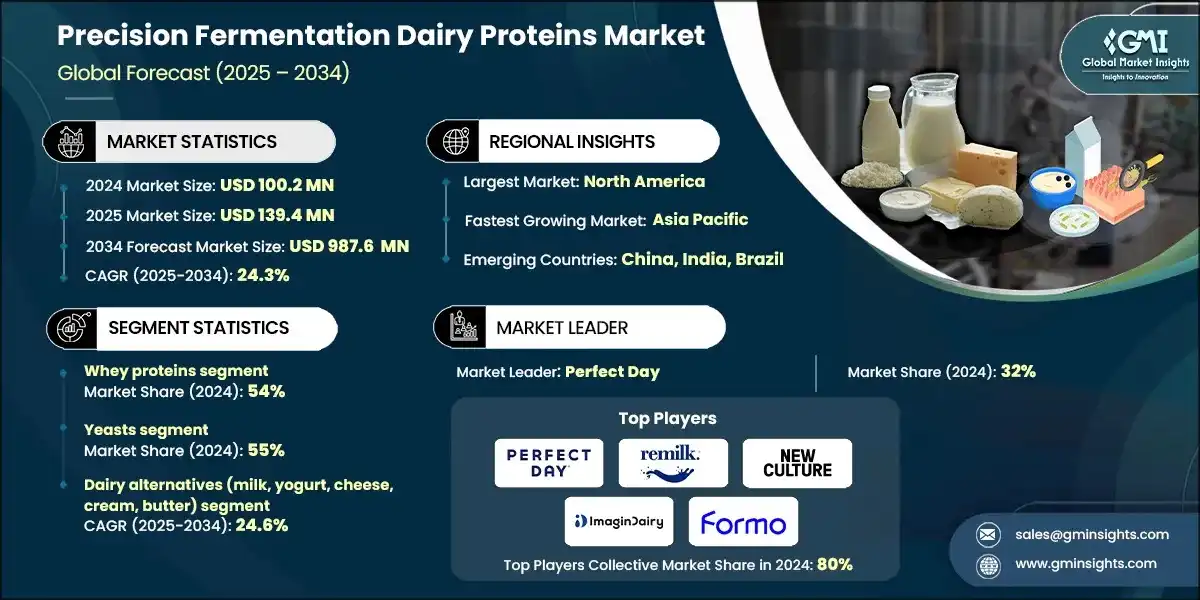
The global precision fermentation dairy proteins market size was valued at USD 100.2 million in 2024. The market is expected to grow from USD 139.4 million in 2025 to USD 987.6 million in 2034, at a CAGR of 24.3% according to latest report published by Global Market Insights Inc.
Precision Fermentation Dairy Proteins Market Key Takeaways
Market Size & Growth
- 2024 Market Size: USD 100.2 Million
- 2025 Market Size: USD 139.4 Million
- 2034 Forecast Market Size: USD 987.6 Million
- CAGR (2025–2034): 24.3%
Regional Dominance
- Largest Market: North America
- Fastest Growing Region: Asia Pacific
Key Market Drivers
- Rising demand for animal-free yet real dairy.
- Sustainability and lower greenhouse gas emissions.
- Advances in synthetic biology and bioprocessing.
Challenges
- High capex and operating bioreactor costs.
- Evolving and fragmented global regulatory pathways.
Opportunity
- Co-creation with legacy dairy and CPG majors.
- Expansion into nutrition, medical and pet segments.
Key Players
- Market Leader: Perfect Day led with over 32% market share in 2024.
- Leading Players: Top 5 players in this market include Perfect Day, magindairy, Remilk, New Culture, Formo, which collectively held a market share of 80% in 2024.
Get Market Insights & Growth Opportunities
- Recent advances in synthetic biology and fermentation have enabled commercial production of proteins traditionally derived from livestock, but without the environmental footprint or ethical concerns associated with conventional animal agriculture. Animal-derived dairy products are nutrient-rich and functionally unique. With consumer interest in dairy alternatives growing, new products and ingredients that closely mimic dairy nutrition are needed. Fortifying traditional and emerging dairy alternatives with animal-free whey and casein ingredients satisfies nutrition, functionality, cost, and sustainability needs. A licensed dairy processor can produce fortified, lactose-free, and lower greenhouse gas-emitting dairy products.
- Investments in fermentation biotechnology to produce dairy proteins and a range of animal products, including meat, alternatives, are attractive due to the high consumer demand, predicted to grow. Investment in alternative proteins in the US reached USD 5.1 billion in 2021, with meat alternatives attracting the most funding. Fermentation-derived alternatives are in high demand due to the high cost, and in many cases, unavailability of animal-derived dairy proteins. Investors are confident that demand will translate to high revenue.
- Timing new product introductions in the US to align with regulatory approvals significantly reduces the commercial risks associated with product launches. Animal-free dairy ingredients in products like protein-enriched ice cream are new to the US market, following successful launches in Canada. Other countries have also approved the use of animal-free dairy protein in various food products.
- Commercial traction is developing rapidly, yet precision-fermented dairy proteins still represent only a small share of the multibilliondollar global dairy ingredients market. New retail launches, brand collaborations with major dairy manufacturers and pilot factories that are capable of producing thousands of tons a year are signs that if production costs continue to decrease and consumer acceptance is on the rise, the market has a lot of potential.
To get key market trends
Precision Fermentation Dairy Proteins Market Trends
- Technological scale-up and cost decline: Companies like Perfect Day and ADM collaborating to access industrial scale fermenters. Increasing strain productivity and downstream yields lowers costs further, steadily closing the cost gap to conventional whey and casein ingredients.
- Branding and product co-creation: Collaboration between food brands and precision fermentation startups is growing. Perfect Day proteins have been featured in branded ice cream and protein powder. Major dairy players have been partnered with Remilk. Such partnerships enable distribution and provide consumers with real world formulation feedback.
- Regulatory clearance and regional expansion: Following the first US GRAS clearance for animal-free β-lactoglobulin, other countries are constructing frameworks for dairy proteins from fermentation. Singapore is encouraging with its novel food policy and selective European regulators are interested. Ultimately, clearer pathways will streamline uncertainty and speed the dairy proteins fermentation in multiple markets.
- Broadening ranges of portfolios: Businesses are deviating from the development of basic milk or ice cream products toward the production of cheese, creamers, specialized nutrition, and functional components. Companies like New Culture and Formo, for instance, concentrate on applications for animal-free cheese, while others investigate high-value fractions, such as lactoferrin. This diversification makes it possible to focus on more profitable niche markets where the functionality and health advantages warrant higher costs.
Precision Fermentation Dairy Proteins Market Analysis
Learn more about the key segments shaping this market
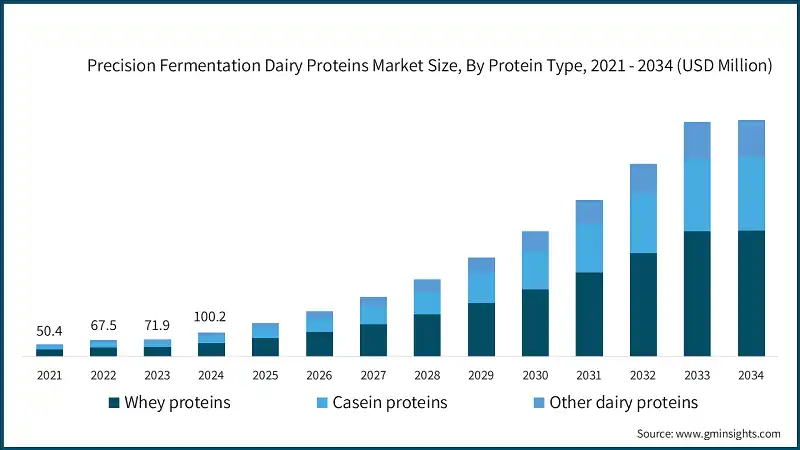
Based on protein type, the precision fermentation dairy proteins market is segmented into whey proteins, casein proteins, and other dairy proteins. Whey proteins dominated the market with an approximate market share of 54% in 2024 and is expected to grow with a CAGR of 24.1% till 2034.
- Beta-lactoglobulin and alpha-lactalbumin have been at the cutting edge of precision fermented protein development because of these proteins’ simplicity and characterization as well as from the ready availability of such proteins for downstream markets including sports nutrition, lactose-free beverages, and ice creams. These proteins also have the functional properties of strong emulsification, foaming, and solubility that make them drop-in replacements for various commercial dairy protein blends.
- Other casein proteins (alpha, beta, and kappa casein) as well as other bioactive dairy proteins will be the next commercial wave in this sector for their ability to enable the functionality (cheese stretch, melt, gelation, and micelle formation) required in most dairy formulations such as yogurts, cheeses, and creamers. Complete protein portfolios that aim to replicate the functionality of whole-milk will be in most cases complemented by glycomacropeptides that lend functionality in medical, nutrition, satiety, and gut health applications.
Learn more about the key segments shaping this market
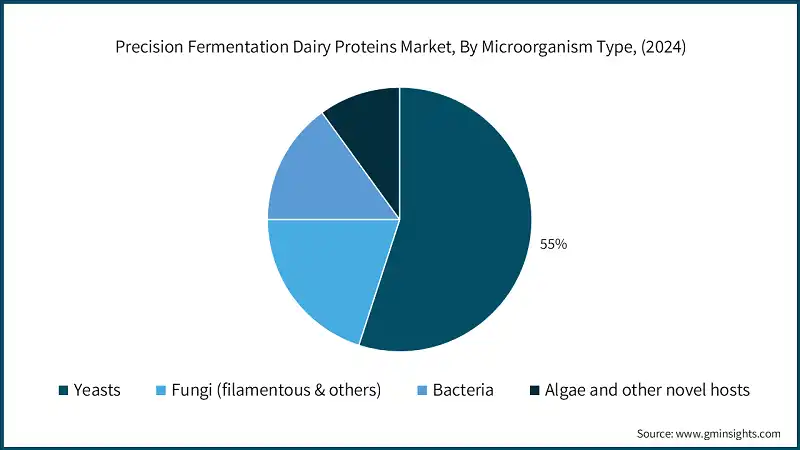
Based on microorganism type, the precision fermentation dairy proteins market is segmented into yeasts, fungi (filamentous & others), bacteria, algae and other novel hosts. Yeasts held the largest market share of 55% in 2024 and is expected to grow at a CAGR of 23% during 2025 to 2034.
- Komagataella phaffii and Saccharomyces cerevisiae are leading the sector for their ability to produce commercially important proteins at high yields and for their compatibility with existing fermentation infrastructures. Aspergillus and Trichoderma are also promising due to their high productivity. Engineered E. coli and its high ability to produce numerous proteins is also an important part of many development pipelines, despite the negative perceptions associated with such organisms.
- Producers are increasingly taking a portfolio approach to selecting hosts, aligning varieties of microorganisms with target proteins, regulatory pathways, and branding stories. Engineered lactic acid bacteria are being considered for a “fermented” or probiotic-adjacent position, while algae and other innovative hosts are aligned with a low-carbon or sunlight-driven narrative. For all platform’s, engineered strains are targeted for higher titters and more efficient secretion of target proteins for easier downstream purification.
Based on application, the precision fermentation dairy proteins market is segmented into dairy alternatives (milk, yogurt, cheese, cream, butter), sports nutrition & protein supplements, bakery & confectionery, infant nutrition & medical nutrition, ready todrink beverages & functional foods, pet food, nutraceuticals, others. Dairy alternatives (milk, yogurt, cheese, cream, butter) segment dominated the market with an approximate market share of 44% in 2024 and is expected to grow with the CAGR of 24.6% up to 2034.
- Demand is currently driven by dairy alternatives and sports nutrition, as precision-fermented whey and casein proteins mimic the taste, and texture of delivery formats like milk, yogurt, and cheese shakes while maintaining a complete amino acid profile. Brands are differentiating from plant-based competitors by leveraging “animal-free dairy” claims and are targeting the premium price point of lactose-free and performance nutrition products.
- Beyond the primary dairy analogues, bakers, confectioners, ready-to-drink beverage formulators, and those in nutraceuticals, pet food, infant, and clinical nutrition domains are expanding their offerings. Here, formulators are motivated to innovate by specific functional attributes such as foaming, emulsification, heat stability, digestibility, and a clean-label story. Early pilots indicate that precision-fermented proteins facilitate new offerings in a range of food formats by enhancing textures in chocolates and coffee creamers, adding protein to fortified drinks, and introducing new health-focused lines.
Looking for region specific data?
North America precision fermentation dairy proteins market is largest region with about USD 45.1 million in 2024 and USD 445 million in 2034, mainly driven by leadership in yeast-based production and dairy alternative applications. Strong biotech capabilities and high adoption of sports nutrition and functional beverages underpin regional dominance across multiple microorganism and application segments.
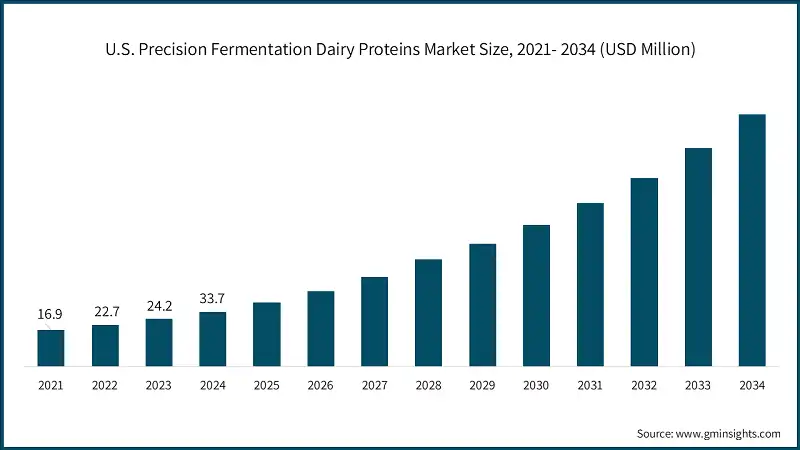
- The U.S. is the core market in North America for precision-fermented dairy proteins amounted to USD 33.7 million in 2024. High lactose-free product demand and robust venture funding support rapid deployment of yeasts and bacteria-based solutions into dairy alternatives, performance nutrition and ready-to-drink functional beverages, with increasing scale-up momentum toward 2034.
Europe is estimated at around USD 33.1 million in 2024, growing to nearly USD 296 million in 2034, mainly driven by sustainability-focused regulation and advanced dairy processing. Strong interest in cheese, yogurt and specialty nutrition accelerates adoption of fungi and yeast platforms in both branded and private-label products.
- Germany is a leading European country in this space. Its strong engineering base and innovation networks help integrate precision-fermented whey and caseins into bakery, confectionery and medical nutrition segments, with a clear emphasis on low-carbon positioning and alignment with EU food safety and novel food requirements.
Asia Pacific precision fermentation dairy proteins market is fastest growing and accounts for roughly USD 17 million in 2024 and is determined to rise about USD 157 million in 2034, mainly driven by growing protein demand and openness to food tech. High lactose intolerance and expanding middle classes support uptake in dairy alternatives, sports nutrition and fortified beverages.
- China is the primary Asia Pacific growth engine. Local players and joint ventures leverage fermentation investments to target animal-free dairy ingredients for beverages, yogurts and nutrition products, supported by government interest in food security and reduced reliance on imported dairy proteins over the forecast horizon.
Latin America stands near USD 5 million in 2024, advancing to roughly USD 44 million in 2034, mainly driven by urban premium niches and export-oriented innovation. Adoption centers on dairy alternatives, high-protein drinks and select sports nutrition SKUs using precision-fermented whey fractions.
- Brazil is the dominant Latin American market. Established dairy and agrifood sectors combined with emerging start-ups foster pilot use of yeast- and fungi-derived dairy proteins in hybrid dairy, ready-to-drink beverages and functional foods, with an eye on regional exports and differentiated sustainable offerings.
MEA precision fermentation dairy proteins market is around USD 5 million in 2024, increasing to about USD 46 million in 2034, mainly driven by food security strategies and interest in climate-resilient protein sources. Governments explore fermentation as a complement to dairy imports, focusing on high-value ingredients.
- Saudi Arabia is a key MEA adopter. National food security and innovation agendas encourage early trials of precision-fermented dairy proteins, particularly for specialized nutrition, fortified beverages and premium dairy alternatives, often in partnership with global technology providers and regional dairy processors.
Precision Fermentation Dairy Proteins Market Share
The precision fermentation dairy proteins landscape is consolidated, as most commercial players are highly specialized. Leading 5 players constitute of 80% of total market share, first is Perfect Day, who has received early GRAS clearance, has several key partnerships, and is ramping up production. Following are Remilk and Imagindairy, who are also pursuing large volume production, and are expanding their B2B partner networks. New Culture and Formo are more focused on cheese, and together are developing the technological, application, and regulatory foundational elements for the landscape.
- Perfect Day: Perfect Day is estimated to have around 32% of the market. This is due to early regulatory approval, strong IP, and several co-branding launches of their products including ice cream, creamers, and protein powders. New partnerships with key ingredient suppliers and contract manufacturers have been established to mitigate supply uncertainties and expand the B2B offer.
- Remilk: Remilk has a market share of approximately 18%. Remilk’s strategy has been to invest in production facilities for the growing dairy alternative market and partner with dairy brands. Remilk’s focus has been to offer whey proteins and other dairy proteins for cheese, milk, and yogurt analogs at a competitive price. Remilk has been able to negotiate production agreements to support the commercialization of their products as well as the growing of white label products.
- Imagindairy: Imagindairy holds 12% of the market share due to their close collaboration with food companies and their efficient production of whey proteins. The company pursuant efforts not to compete with mainstream dairy companies and instead provide them with their first animal-free proteins. Funds have been raised recently to increase the company's capacity to ferment and apply new applications and complete dossiers in regulatory authorities in important regions.
- New Culture: New Culture has an approximate 10% market share and is unique due to their production of animal-free casein specifically for mozzarella and other cheese products. The company has collaborative agreements with several pizzerias and food service companies to test their products in real-life environments. Pilot production of cheese products and commercial production in North America have been announced.
- Formo: With approximately 8% of the market share and based in Europe, Formo has a strong focus on cheese products made with casein produced via precision fermentation. They work with several European dairy producers and chefs to finetune the products. Formo has recently received funding, expanded its research activities to include several forms of cheese, and is working with European authorities to approve the products as novel foods.
Precision Fermentation Dairy Proteins Market Companies
Major players operating in the precision fermentation dairy proteins industry include:
- Perfect Day
- Remilk
- Imagindairy
- New Culture
- Formo
- Change Foods
- Those Vegan Cowboys
- All G Foods
- Every (formerly Clara Foods)
- Motif FoodWorks
- Standing Ovation
- Eden Brew
- Vivici
Precision Fermentation Dairy Proteins Market Report Attributes
| Key Takeaway | Details |
|---|---|
| Market Size & Growth | |
| Base Year | 2024 |
| Market Size in 2024 | USD 100.2 Million |
| Market Size in 2025 | USD 139.4 Million |
| Forecast Period 2025 – 2034 CAGR | 24.3% |
| Market Size in 2034 | USD 987.6 Million |
| Key Market Trends | |
| Drivers | Impact |
| Rising demand for animal-free yet real dairy | Drives rapid adoption in premium and specialized segments |
| Sustainability and lower greenhouse gas emissions | Attracts climate-conscious brands and institutional buyers |
| Advances in synthetic biology and bioprocessing | Lowers production costs, improves scalability and functionality |
| Pitfalls & Challenges | Impact |
| High capex and operating bioreactor costs | Limits scale-up speed and keeps prices above parity |
| Evolving and fragmented global regulatory pathways | Slows approvals, complicates multi-region commercialization |
| Opportunities: | Impact |
| Co-creation with legacy dairy and CPG majors | Accelerate distribution, brand trust and application development |
| Expansion into nutrition, medical and pet segments | Diversity of revenue and stabilizes long-term demand base |
| Market Leaders (2024) | |
| Market Leaders |
32% |
| Top Players |
Collective market share in 2024 is 80% |
| Competitive Edge |
|
| Regional Insights | |
| Largest Market | North America |
| Fastest growing market | Asia Pacific |
| Emerging countries | China, India, Brazil |
| Future outlook |
|
What are the growth opportunities in this market?
Precision Fermentation Dairy Proteins Industry News
- In September 2024, Perfect Day expanded its B2B offerings by deepening its partnership with ADM and other contract manufacturers, boosting large-scale fermentation capacity for animal-free whey proteins and enabling broader supply for dairy alternatives, sports nutrition and mainstream food brands.
- In June 2023, Remilk announced progress on its large-scale production facility and new commercial agreements with major dairy players, aimed at supplying animal-free dairy proteins for cheese, milk and yogurt applications, signaling movement toward cost-competitive, industrial-scale precision fermentation.
- In November 2022, Imagindairy secured significant funding to scale its precision fermentation platforms for dairy proteins, focusing on improving yields and expanding pilot collaborations with global food manufacturers. The company emphasized mainstream dairy brands seeking animal-free, yet functionally identical, whey ingredients.
- In March 2022, New Culture revealed advancements in animal-free casino for mozzarella-style cheese, including successful foodservice trials with pizzerias. The development highlighted precision fermentation’s potential to replicate cheese stretch, melt and flavor, positioning the company as a specialist in cheese-centric dairy alternatives.
This precision fermentation dairy proteins market research report includes in-depth coverage of the industry, with estimates & forecasts in terms of revenue (USD Million) and volume (Kilo Tons) from 2025 to 2034, for the following segments:
Market, By Protein Type
- Whey proteins
- Beta lactoglobulin
- Alpha lactalbumin
- Glycomacropeptide
- Casein proteins
- Alpha casein
- Beta casein
- Kappa casein
- Other dairy proteins
Market, By Microorganism Type
- Yeasts
- Saccharomyces cerevisiae
- Komagataella phaffii (Pichia pastoris)
- Fungi (filamentous & others)
- Aspergillus spp.
- Trichoderma spp.
- Bacteria
- Escherichia coli (engineered strains)
- Lactic acid bacteria (engineered strains)
- Algae and other novel hosts
Market, By Application
- Dairy alternatives (milk, yogurt, cheese, cream, butter)
- Sports nutrition & protein supplements
- Bakery & confectionery
- Infant nutrition & medical nutrition
- Ready to drink beverages & functional foods
- Pet food
- Nutraceuticals
- Others
The above information is provided for the following regions and countries:
- North America
- U.S.
- Canada
- Europe
- Germany
- UK
- France
- Spain
- Italy
- Rest of Europe
- Asia Pacific
- China
- India
- Japan
- Australia
- South Korea
- Rest of Asia Pacific
- Latin America
- Brazil
- Mexico
- Argentina
- Rest of Latin America
- Middle East and Africa
- Saudi Arabia
- South Africa
- UAE
- Rest of Middle East and Africa
Frequently Asked Question(FAQ) :
What is the market size of the precision fermentation dairy proteins in 2024?
The market size was valued at USD 100.2 million in 2024, with a CAGR of 24.3% expected through 2034. Advances in synthetic biology and fermentation technologies are driving market growth.
What is the projected value of the precision fermentation dairy proteins market by 2034?
The market is poised to reach USD 987.6 million by 2034, driven by increasing demand for sustainable and animal-free dairy alternatives.
What is the expected size of the precision fermentation dairy proteins industry in 2025?
The market size is projected to reach USD 139.4 million in 2025.
How much revenue did the whey proteins segment generate in 2024?
The whey proteins segment generated approximately 54% of the market share in 2024 and is expected to grow at a CAGR of 24.1% through 2034.
What was the market share of the yeast-based production segment in 2024?
Yeasts held the largest market share of 55% in 2024 and is set to expand at a CAGR of 23% till 2034.
What is the growth outlook for the dairy alternatives segment from 2025 to 2034?
The dairy alternatives segment dominated the market with a 44% share in 2024 and is anticipated to showcase around 24.6% CAGR up to 2034.
Which region leads the precision fermentation dairy proteins sector?
North America leads the market, valued at USD 45.1 million in 2024 and projected to reach USD 445 million by 2034. This growth is driven by leadership in yeast-based production, strong biotech capabilities, and high adoption of sports nutrition and functional beverages.
What are the upcoming trends in the precision fermentation dairy proteins market?
Trends include cost-reducing technologies, brand–startup collaborations, wider regulatory approvals, niche products like animal-free cheese and lactoferrin, and greater adoption of sustainable dairy alternatives.
Who are the key players in the precision fermentation dairy proteins industry?
Key players include Perfect Day, Remilk, Imagindairy, New Culture, Formo, Change Foods, Those Vegan Cowboys, All G Foods, Every (formerly Clara Foods), Motif FoodWorks, Standing Ovation, Eden Brew, and Vivici.
Precision Fermentation Dairy Proteins Market Scope
Related Reports