Summary
Table of Content

Precipitated Silica Market
Get a free sample of this report
Form submitted successfully!
Error submitting form. Please try again.
Thank you!
Your inquiry has been received. Our team will reach out to you with the required details via email. To ensure that you don't miss their response, kindly remember to check your spam folder as well!
Request Sectional Data
Thank you!
Your inquiry has been received. Our team will reach out to you with the required details via email. To ensure that you don't miss their response, kindly remember to check your spam folder as well!
Form submitted successfully!
Error submitting form. Please try again.
Precipitated Silica Market Size
The global precipitated silica market was estimated at USD 3.4 billion in 2024, and it is expected to grow at a CAGR of 7% from 2025 to 2034.
Precipitated Silica Market Key Takeaways
Market Size & Growth
- 2024 Market Size: USD 3.4 Billion
- 2034 Forecast Market Size: USD 6.8 Billion
- CAGR (2025–2034): 7%
Key Market Drivers
- Rising demand for fuel-efficient and green tires.
- Expanding applications in personal care and oral care products.
- Growing industrialization and infrastructure development in emerging economies.
Challenges
- Volatility in raw material prices and energy costs.
- Environmental and regulatory compliance burdens.
Get Market Insights & Growth Opportunities
The global market for precipitated silica is experiencing steady growth because of the material's unique properties and wide range of applications in industries. Demand has kept rising over the last decade as a performance enhancer in rubber, oral care, and coatings. The market is continuing to experience robust opportunities for growth, and volumes and revenues will expand over the next few years. Urbanization, automotive production, and the application of green technologies are the key drivers for the trend.
Tire and rubber are still the stronghold of precipitated silica uses. Its most important role in offering traction, fuel economy, and rolling resistance reduction has made it a must in modern tire formulations, especially in electric and high-performance cars. Its other growing uses are as an anti-cake, thickener, and detergent in pharmaceuticals, food products, and personal care. Increasing regulatory pressures towards environment-friendly and non-toxic additives are also promoting its uses in all industries.
Asia Pacific leads the global market, with industrialization increasing, strong automotive manufacturing, and expanding consumer goods sectors driving regional consumption. China and India, in this context, are becoming production hubs and big consumers as well. Developed economies like North America and Europe, in contrast, are seeing higher demand due to the tightening of environmental regulations and application of advanced materials to manufacturing and sustainability purposes. Global supply chains are playing along with new manufacturing capabilities set up in strategic locations.
The future of the precipitated silica market is characterized by mounting product development, including hydrophobic varieties and eco-friendly variants. Process development and capacity augmentation are being invested in to satisfy growing demand. Where market segments such as EVs, battery materials, personal care, and agriculture continue to grow, precipitated silica's multi-functionality will remain the key material. The intersection of regulatory change, technological advancement, and widening application space guarantees long-term market stability and potential.

To get key market trends
Precipitated Silica Market Trends
- Technological advances & nanotech integration: Firms are actively investing in leading-edge manufacturing technology, e.g., next-generation reactors and surface treatment technology—to deliver high-performance silica tailored for applications. Technologies related to particle size, porosity, and hydrophobic treatment are opening opportunities in electronics, high-performance composites, and coatings. Nanotechnology-enabled grades offer reinforcement, thermal conductivity, and stability, opening applications to areas beyond traditional ones.
- Sustainability & circular economy imperatives: With rising environment-related awareness and regulatory policies such as the EU Green Deal and REACH, the industry is moving towards sustainable manufacturing. Trends vary from biomass-based feedstocks to energy-efficient manufacturing and recycling of silica. Companies are also looking at closed-loop manufacturing and biodegradable forms of silica, aligning business with sustainability goals and enhancing brand reputation.
- End use industries with unmet needs: Although tire uses remain the backbone, demand is increasingly emerging for specialty grades in food, pharma, personal care, agrochemicals, and batteries. Food-grade, pharma-grade, and battery-separator silica with specific functionality (e.g., anti-caking, moisture control) are required by industry users. Regulatory complexity and formulation issues are the drivers for demand for tailored, compliant grades.
- Government policies & EV-driven demand: Governments across the globe are introducing fuel-efficiency standards and promoting electric vehicles (EVs) and environmentally friendly tires. India's tire star labelling and the EU's emissions policy are driving demand for low-rolling-resistance, silica-typed tire compounds. Government incentives for EV battery technology, in the meantime, are driving demand for silica as a separator material.
Precipitated Silica Market Analysis
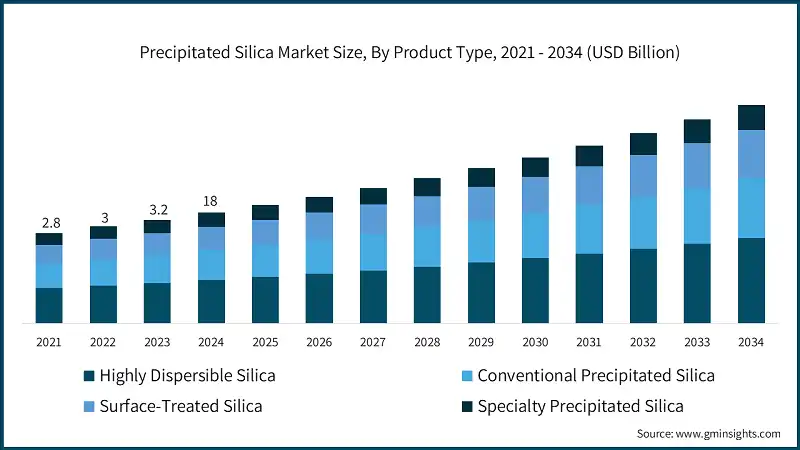
Learn more about the key segments shaping this market
Based on product type, the precipitated silica industry is divided into highly dispersible silica, conventional precipitated silica, surface-treated silica, and specialty precipitated silica. Highly dispersible silica segment generated a revenue of USD 1.3 billion in 2024 and USD 2.6 billion in 2034 at a CAGR of 7.1%.
- Highly dispersible silica is most used due to its superior reinforcement feature and compatibility with tire rubber compounds. Its performance in rolling resistance, wet traction, and fuel efficiency has made it a must in green and high-performance tire production, especially in hybrid and electric vehicles. This trend is in line with growing environmental regulations and OEM fuel-efficiency demands across the globe. Growing demand for low-emission vehicles and green tires has also encouraged tire manufacturers to apply HDS on an increasing scale.

Learn more about the key segments shaping this market
Based on end use industry, the precipitated silica market is divided into automotive, consumer goods, food and beverage, healthcare and pharmaceuticals, industrial, construction, agriculture, and others. In 2024, Automotive segment held major market share, accounted for 43% share.
- Automotive is the largest segment because of the widespread application of precipitated silica in tire production. Silica enhances tire performance by improving grip, wear resistance, and fuel efficiency through low rolling resistance. With energy-efficient, low-emission vehicles becoming increasingly popular across the world, manufacturers are increasingly utilizing silica-reinforced tires to comply with regulations and customers' demands.
- Moreover, the rapid development of electric vehicles (EVs) and hybrid vehicles is driving the usage of high-performance tires that need precipitated silica for better traction and range extension. OEM coordination and sustainability objectives are further consolidating this trend.

Looking for region specific data?
Precipitated silica market in the U.S. is expected to experience promising growth from 2025 to 2034 due to growth of increasing consumption within the country.
- U.S. market is growing at an estimated 6.7% CAGR, with revenues projected to nearly double by 2030, driven predominantly by tire and rubber applications and rising EV-related tire sales.
- Beyond rubber, expansion in personal care, pharmaceuticals, coatings, and adhesives is a strategic step towards market diversification. Environmental pressures for eco-materials and carbon footprint reduction are driving manufacturers towards sustainable silica production processes. Capital expenditures by dominant players—expansion of plants by Evonik and R&D in green materials—reflect a broader commitment towards sustainability and innovation.
China precipitated silica market generated a revenue of USD 653.7 million in 2024. China market is projected to grow at a CAGR of 7.2% reaching USD 1.3 billion by 2034 as it is driven by increased the consumption.
- China accounts for major share of the world's precipitated silica consumption, and nearly half of Asia-Pacific demand. Its dominance is driven by broad-based automotive and tire production, and electric vehicle (EV) sector growth, and high growth in electronics, oral care, and food applications.
- Government strengthening of environmental controls—most notably around "green tire" regulations and increased emissions standards—has driven the adoption of high-performing silica in tire compounds more quickly. Industrial expansion in construction, infrastructure, and agriculture meanwhile drives demand for specialty grades of silica, setting China up for long-term growth.
Precipitated Silica Market Share
Top 5 companies in the precipitated silica industry are Evonik Industries, PPG Industries, Solvay S.A., W.R. Grace & Co., and Oriental Silicas Corporation. The global market is moderately concentrated with the top five companies controlling a substantial share—estimated between 55% to 65% of the market. Top companies dominate based on their strong global presence, advanced R&D capabilities, and extensive product portfolios. These players are heavily investing in capacity enhancements, especially in Asia-Pacific, to leverage increasing demand from tire, personal care, and electronics applications.
Strategic joint ventures and acquisitions—such as Evonik's recent merger of J.M. Huber's silica business—have helped dominant companies consolidate technology and drive regional penetration. The competition in the market also centers around product performance, pricing tactics, customization, and sustainability. Although price is an issue for volume buyers such as tire makers, innovation in surface-treated as well as application-based silica grades provides a competitive edge. Use of high-dispersibility silica for low-rolling-resistance tires and sustainable formulations has become popular.
Players are also investing in circular economy models, energy-efficient operations, and green certifications to keep pace with global regulatory patterns. Local and regional players are emerging, particularly in China and India, challenging incumbents with cost-effective propositions and agile supply chain networks.
Precipitated Silica Market Companies
Evonik Industries AG: Evonik is a global market leader in precipitated silica, selling the product under the brand names ULTRASIL and SIPERNAT. The company is most focused on the tire and rubber industry, especially for eco-friendly use in tires. It has a big emphasis on sustainability, having established sustainable production lines and renewable raw material-based silica.
Solvay S.A.: Solvay boasts a strong R&D platform and offers premium silica grades branded as Tixosil. It is focused on personal care, food and pharmaceuticals apart from the automotive segment. Innovation and capacity growth in emerging markets led by Asia-Pacific is the strategy focus.
PPG Industries Inc.: PPG is the leading North American precipitated silica market player, with strong coverage in the coatings and adhesives markets. Its HI-SIL mark addresses tire reinforcement and oral care markets. PPG integrates sustainability into operations and leverages cross-industry expertise from its coatings business.
W.R. Grace & Co.: W.R. Grace is a producer of high-purity silica products for the pharmaceutical, food, and catalysis markets. It differentiates its products through rigorous quality control and special formulation support. Grace is expanding in specialty applications over high-volume rubber markets.
Oriental Silicas Corporation: Taiwan's Oriental Silicas caters to domestic and overseas markets with low-cost, high-performance silica for rubber and tires, investing in local customer support and technological enhancements to provide responsiveness and reliability.
Precipitated Silica Market Report Attributes
| Key Takeaway | Details |
|---|---|
| Market Size & Growth | |
| Base Year | 2024 |
| Market Size in 2024 | USD 3.4 Billion |
| Forecast Period 2025 - 2034 CAGR | 7% |
| Market Size in 2034 | USD 6.8 Billion |
| Key Market Trends | |
| Growth Drivers |
|
| Pitfalls & Challenges |
|
What are the growth opportunities in this market?
Precipitated Silica Industry News
- In March 2025, Hankook and Solvay entered an MOU for circular silica—focusing on more sustainable recycling and procurement of silica, with emphasis on tire and rubber.
- In January 2025, Solvay's Gunsan plant in South Korea was reported to be "to produce highly dispersible precipitated silica," a major capacity expansion to produce specialty grades in Asia-Pacific region markets.
- In October 2024, Evonik officially broke ground on the expanded precipitated silica plant at the same Charleston site, further solidifying its commitment to locally produced, sustainable silica supply to the North American tire industry.
- In February 2024, Evonik increased its Charleston precipitated silica production plans to enhance regional supply-chain resiliency and progress toward carbon-neutral operations.
- In January 2024, Evonik expanded the capacity of its precipitated silica at Charleston, South Carolina by 50% to supply growing demand from the tire, oral care, and coatings industries; the new plant would be commissioned in early 2026.
The precipitated silica market research report includes in-depth coverage of the industry, with estimates & forecast in terms of revenue (USD Billion) & volume (Tons) from 2021 to 2034, for the following segments:
Market, By Product Type
- Highly dispersible silica
- Conventional precipitated silica
- Surface-treated silica
- Specialty precipitated silica
Market, By Grade
- Industrial grade
- Food grade
- Pharmaceutical grade
- Cosmetic grade
- Others
Market, By Application
- Rubber
- Tire applications
- Passenger car tires
- Commercial vehicle tires
- Off-road tires
- Others
- Non-tire rubber applications
- Footwear
- Industrial rubber products
- Others
- Tire applications
- Oral care
- Toothpaste
- Other oral care products
- Food and feed additives
- Anti-caking agents
- Carriers
- Others
- Industrial applications
- Paints and coatings
- Plastics
- Adhesives and sealants
- Others
- Personal care and cosmetics
- Skin care products
- Hair care products
- Others
- Pharmaceuticals
- Tablet excipients
- Others
- Agriculture
- Others
Market, By End Use Industry
- Automotive
- Consumer goods
- Food and beverage
- Healthcare and pharmaceuticals
- Industrial
- Construction
- Agriculture
- Others
Market, By Manufacturing Process
- Wet Process
- Dry Process
- Others
The above information is provided for the following regions and countries:
- North America
- U.S.
- Canada
- Europe
- Germany
- UK
- France
- Spain
- Italy
- Rest of Europe
- Asia Pacific
- China
- India
- Japan
- Australia
- South Korea
- Rest of Asia Pacific
- Latin America
- Brazil
- Mexico
- Argentina
- Rest of Latin America
- Middle East and Africa
- Saudi Arabia
- South Africa
- UAE
- Rest of Middle East and Africa
Frequently Asked Question(FAQ) :
How big is the precipitated silica market?
The market for precipitated silica was valued at USD 3.4 billion in 2024 and is expected to reach around USD 6.8 billion by 2034, growing at 7% CAGR through 2034.
What is the size of highly dispersible silica segment in the precipitated silica industry?
The highly dispersible silica segment generated over USD 1.3 billion in 2024.
How much is the U.S. precipitated silica market worth in 2024?
The U.S. market was worth over USD 653.7 million in 2024.
Who are the key players in precipitated silica industry?
Some of the major players in the precipitated silica market include Anten Chemical Co., Ltd., Evonik Industries AG, Gujarat Multi Gas Base Chemicals Pvt. Ltd., Huber Engineered Materials, Madhu Silica Pvt. Ltd., W. R. Grace & Co., and Wacker Chemie AG.
Precipitated Silica Market Scope
Related Reports