Summary
Table of Content

Power Semiconductor Market
Get a free sample of this report
Form submitted successfully!
Error submitting form. Please try again.
Thank you!
Your inquiry has been received. Our team will reach out to you with the required details via email. To ensure that you don't miss their response, kindly remember to check your spam folder as well!
Request Sectional Data
Thank you!
Your inquiry has been received. Our team will reach out to you with the required details via email. To ensure that you don't miss their response, kindly remember to check your spam folder as well!
Form submitted successfully!
Error submitting form. Please try again.
Power Semiconductor Market Size
The growth of the power semiconductor market is attributed to accelerating electric vehicle adoption which is increasing demand for IGBTs and silicon carbide devices, rising industrial automation, rapid expansion of data centers and fast-charging infrastructure deployment boosting adoption of wide-bandgap semiconductors.
Power Semiconductor Market Key Takeaways
Market Size & Growth
- 2025 Market Size: USD 55.7 Billion
- 2026 Market Size: USD 58.8 Billion
- 2035 Forecast Market Size: USD 97.5 Billion
- CAGR (2026–2035): 5.8%
Regional Dominance
- Largest Market: Asia Pacific
- Fastest Growing Region: Asia Pacific
Key Market Drivers
- Rapid EV adoption increasing IGBT and SiC demand.
- Industrial automation growth raising demand for power modules.
- Energy efficiency regulations mandating advanced power electronics.
- Data center power optimization increasing MOSFET consumption.
- Fast-charging infrastructure expansion boosting wide-bandgap semiconductors.
Challenges
- High manufacturing cost of SiC and GaN devices.
- Supply chain dependence on limited wafer suppliers.
Opportunity
- Adoption of SiC in 800V electric vehicle platforms.
- Smart grid upgrades increasing demand for high-power discrete devices.
Key Players
- Market Leader: Infineon Technologies AG led with over 19.5% market share in 2025.
- Leading Players: Top 5 players in this market include Infineon Technologies AG, ON Semiconductor Corp., Texas Instruments Inc., STMicroelectronics NV, Mitsubishi Electric Corporation, which collectively held a market share of 45.5% in 2025.
Get Market Insights & Growth Opportunities
The power semiconductor market is driven by rapid electric vehicle adoption. This rise in vehicle production boosts demand for IGBTs and silicon carbide devices, which are essential for traction inverters, onboard chargers, and power control units. The International Energy Agency (IEA) reports that the UK aims for 80% of new car sales to be electric by 2030, reinforcing a strong push towards electrification. This policy speeds up the integration of power semiconductors in EV designs, improving efficiency, lowering emissions, and driving demand for high-performance IGBTs and SiC devices.
Additionally, growth in the power semiconductor market is further supported by energy efficiency regulations used in industrial and infrastructure applications. The U.S. Department of Energy indicated that new energy efficiency standards adopted by distribution transformers are expected to help Americans conserve more than USD 14 billion in energy costs, along with nearly 85 million metric tons of CO₂ emissions, over a period of 30 years. Such standards minimize energy loss and maximize performance for power conversion devices. Therefore, leading to manufacturers to use efficient semiconductor devices like MOSFETs and SiC. Such compliances can help enhance efficiencies and reduce greenhouse gas emission.
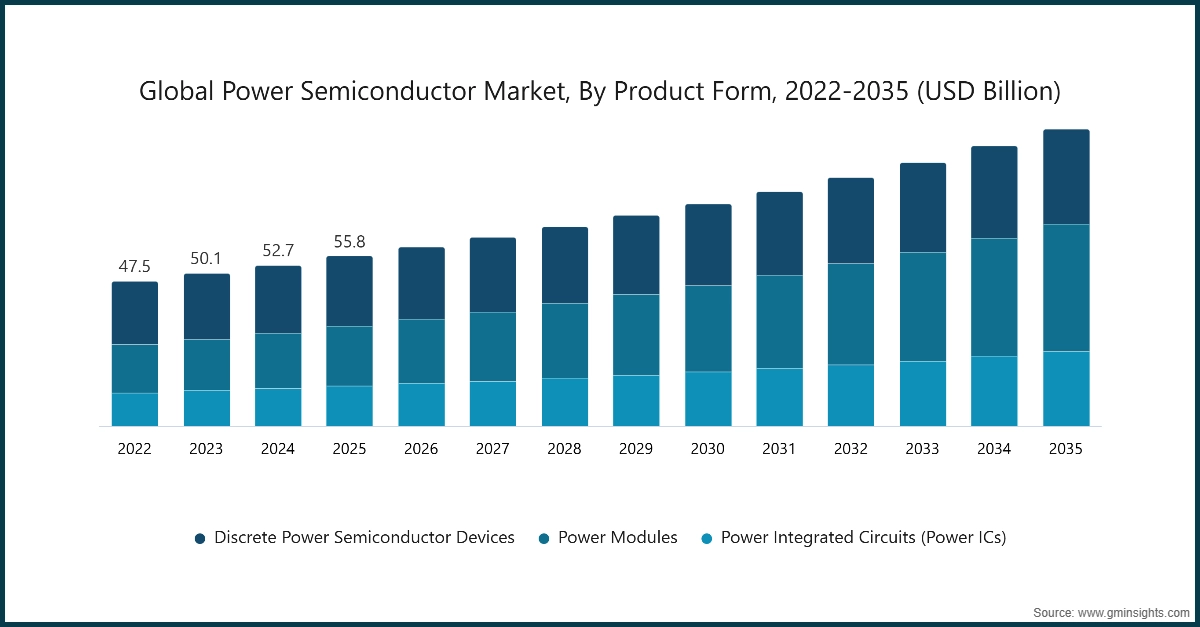
The power semiconductor market increased steadily from USD 47.6 billion in 2022 and reached USD 52.8 billion in 2024, driven by the electrification of transportation, increasing investment in automated manufacturing, and the usage of high-efficiency power systems. During this period, the production of EV scaled up rapidly, industrial sites upgraded their operational equipment to energy-saving technologies, hyperscale data centers emerged all over the world, fast-charging infrastructures were deployed, renewable energy usage attained efficiency, and regulations became more specific for reducing energy loss in industrial and infrastructure environments.
The global power semiconductor market was valued at USD 55.7 billion in 2025. The market is expected to grow from USD 58.8 billion in 2026 to USD 77 billion in 2031 & USD 97.5 billion in 2035, at a CAGR of 5.8% during the forecast period according to the latest report published by Global Market Insights Inc.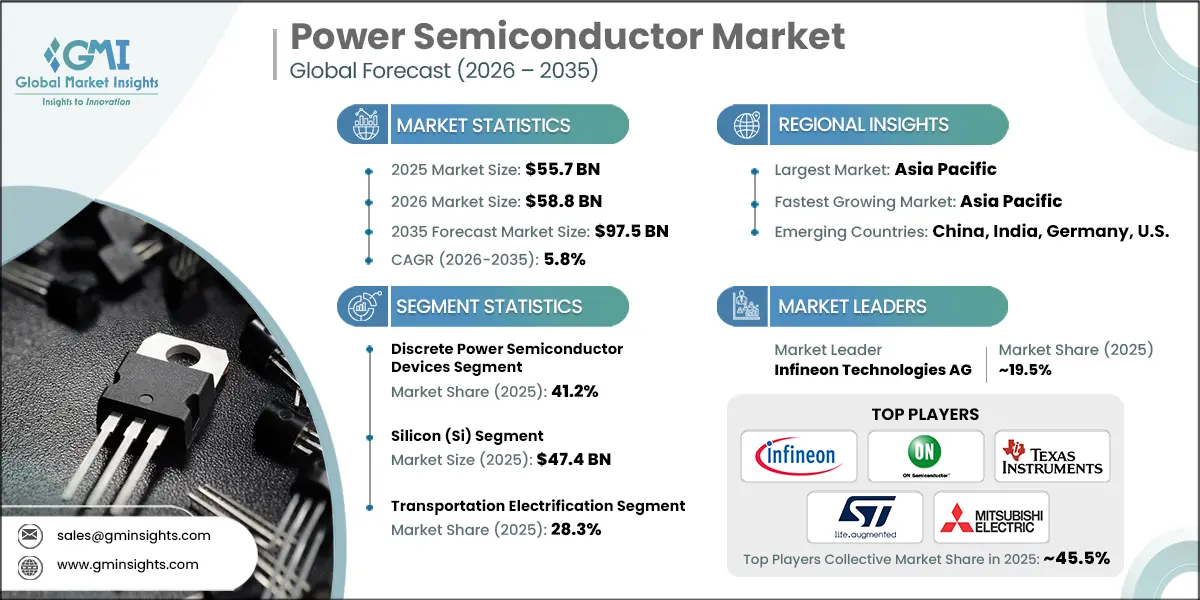
To get key market trends
Power Semiconductor Market Trends
- The vertical integration/local production approach is changing the market dynamics in power semiconductors to take ownership of the wafer, epitaxy, and back-end processes. This trend began in 2021 because of geopolitical risks and supply chain disruption, though it is expected to last until 2030 to guarantee supply security. The consequences of this are a raised entry barrier with increased stability of capacity in the long run.
- New power module integration and packaging designs are becoming key trends. The focus is more on efficiency, power densities, and smaller system sizes. The concept has started taking ground around 2020, largely as a reaction of system-oriented design teams who were looking at pushing discrete devices to their limits, especially in the application sphere. The progression is likely to continue till 2028. It enables system-level efficiency gains and simplifies power electronics design.
- Digital design, simulation, and software-assisted power optimization are increasingly influencing power semiconductor development. This trend began around 2021 as device complexity and qualification costs rose. It will continue through 2030 as manufacturers rely on virtual prototyping and digital twins. The impact includes shorter development cycles, reduced failure rates, and faster customer design-in processes.
Power Semiconductor Market Analysis
Learn more about the key segments shaping this market
Based on product form, the market is segmented into discrete power semiconductor devices, power modules, and power integrated circuits (power ICs).
- The discrete power semiconductor devices segment led the market in 2025, holding a 41.2% share due to their widespread use in automotive, consumer electronics, power supplies, and industrial equipment. Discrete devices like MOSFETs, IGBTs, and diodes are favored for their cost-effectiveness, design flexibility, and suitability for high-volume applications. Their essential role in power conversion and switching ensures steady demand across many industries.
- The power modules segment is anticipated to grow at a CAGR of 7.9% over the forecast period. Increase in electric vehicles, industrial drives, and renewable energy systems is going to spur this further growth. Power modules integrate different devices in a single package to provide better power density and thermal performance. These advantages accelerate adoption in high-power, high-reliability applications, supporting rapid growth.
Learn more about the key segments shaping this market
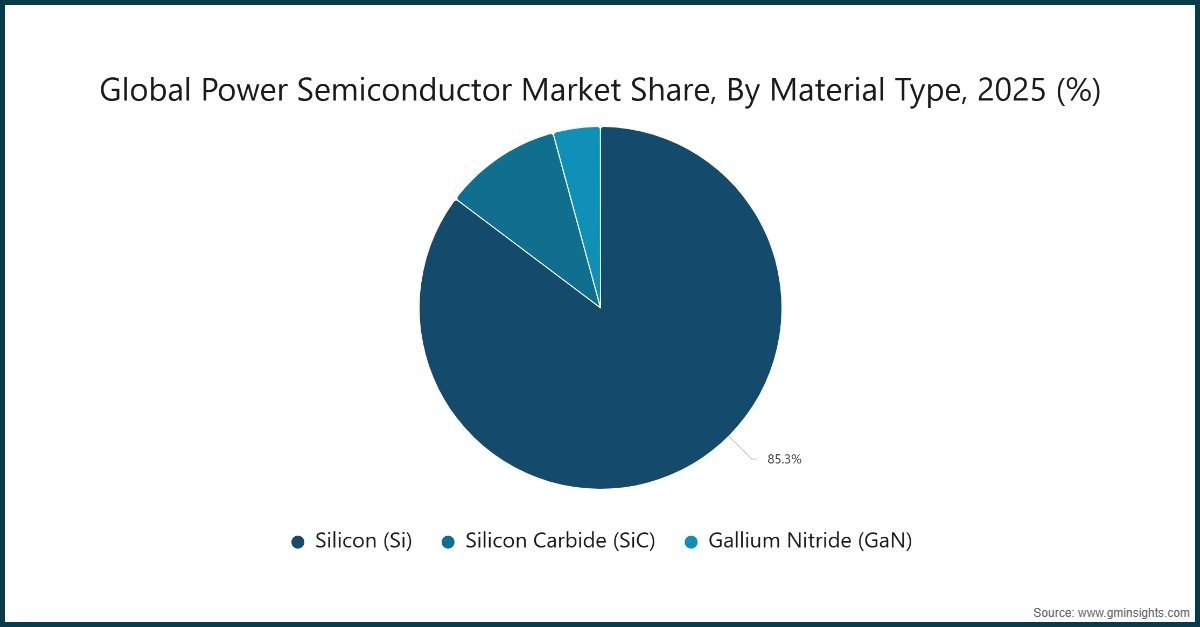
Based on material type, the global power semiconductor market is divided into silicon (Si), silicon carbide (SiC), and gallium nitride (GaN).
- The silicon (Si) segment dominated the market in 2025 and valued at USD 47.4 billion, due to its well-established manufacturing ecosystem, availability, and economic advantages. Power devices made of silicon are used in low- and medium-voltage applications for consumer, industrial, and power supplies. Their proven reliability, standardized designs, and broad supplier base help maintain a strong market share.
- The gallium nitride (GaN) segment is expected to witness growth at a CAGR of 12.9% during the forecast period. This growth is driven by the rising need for high-frequency, high-efficiency power conversion. GaN devices are increasingly used in fast chargers, data centers, and telecom power systems because of their low switching losses, compact size, and ability to support higher power density, prompting further commercialization and adoption.
Based on application, the global power semiconductor market is divided into transportation electrification, power generation, transmission and distribution infrastructure, industrial manufacturing and automation, consumer, ICT infrastructure, commercial buildings and infrastructure, aerospace, defense and space, and healthcare equipment.
- The transportation electrification segment led the market in 2025 with a market share of 28.3%, owing to the large-scale deployment of power semiconductors in electric vehicles, charging infrastructure, and rail electrification systems. Power devices are crucial for traction inverters, onboard chargers, and power control units, hence making this segment the largest contributor in global mobility transitioning toward an electrified platform.
- The ICT infrastructure segment is expected to grow at a CAGR of 7.2% during the forecast period. This growth is supported by rapid expansion in data centers, 5G networks, and cloud computing infrastructure. There is rising demand for energy-efficient power supplies, voltage regulation modules, and backup power systems, which increases the consumption of advanced power semiconductors, positioning ICT infrastructure as a high-growth area.
Looking for region specific data?
North America Power Semiconductor Market
The North America held around 21.9% of power semiconductor industry share in 2025.
- The North America market is expanding due to the accelerated electrification of transportation, grid upgrades, and increasing energy-efficiency requirements in industrial and commercial settings. The strong adoption of electric vehicles, fast-charging networks, and renewable energy systems is driving up the demand for IGBTs, MOSFETs, and wide-bandgap semiconductors. Power electronics are increasingly being utilized in industrial automation, data centers, and energy systems in the region.
- There is increase in government and private sector initiatives in domestic semiconductor fabrication, electric vehicle charging infrastructure, and grid hardening in the region. North America would remain at the forefront in the global market in terms of use of advanced power semiconductor devices with investments in electrification initiatives, energy efficiency, and high-performance computing infrastructure slated to continue until 2035.
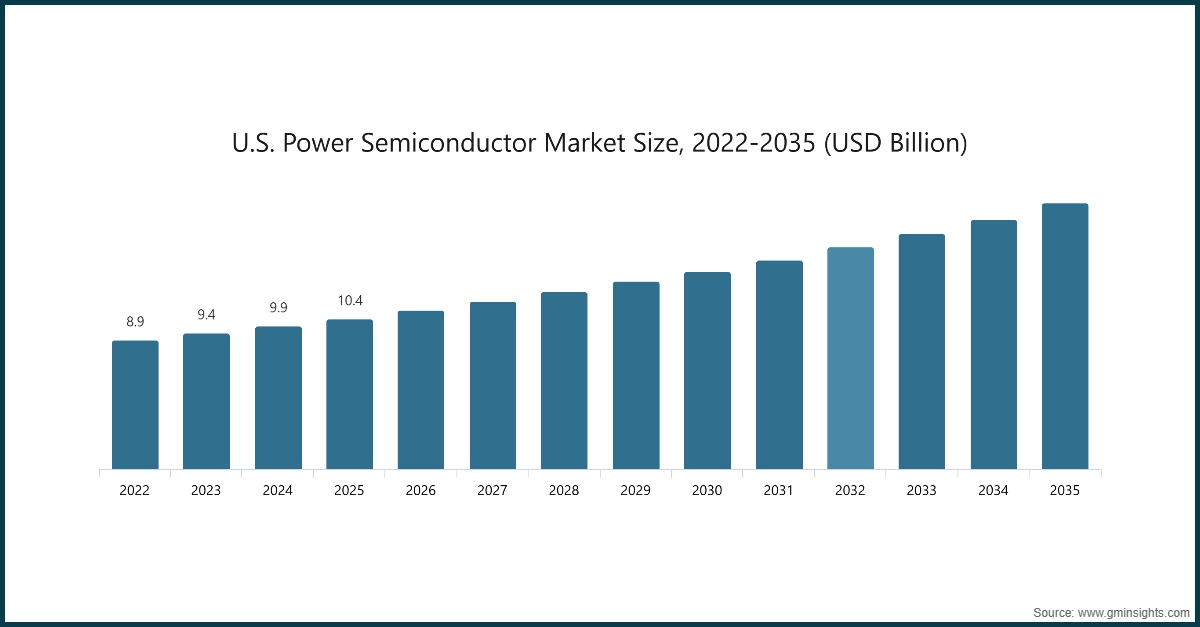
The U.S. market for power semiconductor was valued at USD 8.9 billion and USD 9.4 billion in 2022 and 2023, respectively. The market size reached USD 10.4 billion in 2025, growing from USD 9.9 billion in 2024.
- The power semiconductor market in the U.S. is in a growth phase due to federal government investment in electric vehicle infrastructure and chip production in the country. For instance, the Infrastructure Investment and Jobs Act has authorized USD 7.5 billion for the deployment of EV charging nationwide. That, in turn, will push up demand for power semiconductors used in fast chargers and grid equipment.
- Additionally, CHIPS and Science Act in U.S. provide funding of up to USD 39 billion to incent US semiconductor manufacturing, including power devices that support electric vehicles, industrial systems, data centers, and energy infrastructure. These government programs strengthen the U.S.'s position as the leading in North America for both consumption and production.
Europe Power Semiconductor Market
Europe market accounted for USD 11.4 billion in 2025 and is anticipated to show lucrative growth over the forecast period.
- Europe’s power semiconductor market is expanding due to legally binding decarbonization targets, electrification of transport, and large-scale grid modernization programs. EU regulations, such as the Fit for 55 package and CO₂ fleet emission standards, further accelerate power electronics in electric vehicles, renewable energy systems, and charging infrastructures. The demand from manufacturing and utilities is driven by focus and initiatives within Europe on energy-efficient industrial equipment and grid stability.
- Countries like Germany, France, and the UK are actively supporting local power semiconductor manufacturing, expanding SiC capacity, and qualifying automotive-grade devices to ensure that the push for more advanced power semiconductors in transportation continues unabated within Europe, along with energy and industrial infrastructure.
Germany dominates the Europe power semiconductor market, showcasing strong growth potential.
- Germany leads Europe in power semiconductor adoption due to its strong automotive manufacturing base, its energy transition policies, and industrial electrification initiatives. Germany’s Automotive Masterplan and Climate Action Programme 2030 are creating high demand for power semiconductors in electric vehicle powertrains, charging systems, and power conversion. Germany also has one of the largest bases of industrial drives, rail systems, and renewable energy inverters.
- Support for the development of the manufacturing industry for semiconductors, SiC devices, and energy-effective industrial systems by the federal government promotes the adoption of the technology by automotive industry vendors and industrial automation industry vendors across the country, thus making Germany the largest European market.
Asia Pacific Power Semiconductor Market
The Asia Pacific power semiconductor industry is anticipated to grow at the highest CAGR of 6.7% during the forecast period.
- The Asia Pacific region is growing at a high rate, attributed to the presence of large electronics manufacturing, automotive manufacturing, and energy infrastructure development in the region. The APAC region is home to a number of EV manufacturers, battery producers, and contract manufacturers, maintaining a steady market for power semiconductor devices.
- Supportive government policies, increasing local semiconductor fabrication capacity, and ongoing foreign investment in power electronics manufacturing are establishing Asia Pacific as the largest hub for power semiconductor production and consumption globally.
India power semiconductor market is estimated to grow with a significant CAGR, in the Asia Pacific market.
- India has tremendous potential to become a high-growth market for power semiconductors driven by the rapid rate of electrification of transportation modes, increasing domestic manufacturing activities, and extensive upgrades in the power infrastructure. In addition, India’s focus on electric buses, two-wheeled vehicles, and commercial fleets has created a large market for cost-effective IGBT devices. Furthermore, modernizing transmission networks, expanding metro rails, and the growth of industrial motor-driven applications are boosting power semiconductor usage.
- Government initiatives that promote domestic electronics manufacturing, along with increasing demand for reliable power conversion in data centers and renewable energy integration, are speeding up adoption. This positions India as a key growth market in the Asia Pacific region.
Middle East and Africa Power Semiconductor Market
Saudi Arabia power semiconductor industry to experience substantial growth in the Middle East and Africa.
- The power semiconductors market in Saudi Arabia is growing at a fast pace due to rapid electrification and infrastructure spend under the Vision 2030 program. Projects such as NEOM, the Red Sea Project, and Qiddiya are planned to be among the world’s most energy-efficient cities, with a need to drive power semiconductor demand in renewable power supply, smart grid, rail switchgear, and EV charging infrastructure.
- In parallel, increased investments in Electric Vehicle charging infrastructure, railway & metro electrification, data center growth, and smart infrastructure are also driving growth factors in wide-bandgap semiconductors and associated advanced power ICs, thereby establishing Saudi Arabia as a growth market for semiconductor suppliers.
Power Semiconductor Market Share
The power semiconductor industry is led by players such as Infineon Technologies AG, ON Semiconductor Corp., Texas Instruments Inc., STMicroelectronics NV, and Mitsubishi Electric Corporation, which together account for 45.5% share of the global market. These companies possess strong competitive positions with their wide portfolio in discrete devices, power modules, and power ICs, and their extensive expertise in automotive, industrial, energy, and infrastructure segments.
Their large global footprint in the manufacturing domain, long customer relationships, and commitment to automotive-level reliability have helped these companies achieve leadership position. Further, their ongoing commitment to wide-bandgap materials, advanced packaging, and capacity expansion helps these companies sustain the increasing demand from several regions.
Power Semiconductor Market Companies
Prominent players operating in the power semiconductor industry are as mentioned below:
- Fuji Electric Co., Ltd.
- Infineon Technologies AG
- Littelfuse, Inc.
- Mitsubishi Electric Corporation
- NXP Semiconductors NV
- ON Semiconductor (onsemi)
- Powerex, Inc.
- Renesas Electronics Corporation
- ROHM Semiconductor
- Semikron International GmbH
- Shindengen Electric Manufacturing Co., Ltd.
- STMicroelectronics NV
- Texas Instruments Inc.
- Toshiba Corporation (E-Devices)
- Vishay Intertechnology, Inc.
- Wolfspeed, Inc.
- Infineon Technologies AG
Infineon Technologies AG provides a wide range of silicon, silicon carbide, and gallium nitride power semiconductors. The company mainly specializes in the power semiconductor sector to cater to the need for efficient power electronic systems around the world.
ON Semiconductor Corp. focuses mainly on automotive and industrial power solutions, with strength in silicon carbide devices for electric vehicle traction inverters and fast-charging infrastructure. Its vertically integrated manufacturing strategy and long-term supply agreements enhance cost control, scalability, and supply reliability for high-growth electrification markets.
Texas Instruments Inc. offers power semiconductors and has a broader analog and embedded processing technology landscape. The company offers highly integrated power management devices and offers long product lifecycle support. The goal is optimized power efficiency and simpler designs for its users, specifically for various industrial, data center, and communications markets.
STMicroelectronics NV has a comprehensive portfolio of power devices from silicon and wide-bandgap materials. The devices enjoy wide usage in the field of automotive electrification, renewable energy, and industrial automation. The company has a focus on strategic partnerships, SiC-specific manufacturing, and innovation driven by application to deliver future power conversion systems.
Mitsubishi Electric Corporation’s main expertise lies in the design and development of high-power semiconductor devices like IGBTs for use in rail traction systems, industrial drives, and in power infrastructures in general, where the company's integration of power devices with power electronics systems plays a unique advantage in reliability and performance in the field.
Power Semiconductor Market Report Attributes
| Key Takeaway | Details |
|---|---|
| Market Size & Growth | |
| Base Year | 2025 |
| Market Size in 2025 | USD 55.7 Billion |
| Market Size in 2026 | USD 58.8 Billion |
| Forecast Period 2026-2035 CAGR | 5.8% |
| Market Size in 2035 | USD 97.5 Billion |
| Key Market Trends | |
| Drivers | Impact |
| Rapid EV adoption increasing IGBT and SiC demand | Drives 28% growth as it increases demand for IGBTs and SiC MOSFETs used in traction inverters, onboard chargers, and DC-DC converters, particularly across 400V and emerging 800V vehicle architectures. |
| Industrial automation growth raising demand for power modules | Supports 20% growth by accelerating adoption of power modules in industrial automation, robotics, and motor drives, where efficient power conversion and high reliability are critical for continuous manufacturing operations. |
| Energy efficiency regulations mandating advanced power electronics | Contributes 18% growth as global energy efficiency regulations for appliances, industrial equipment, and power supplies mandate the use of advanced power electronics to reduce switching losses and improve overall system efficiency. |
| Data center power optimization increasing MOSFET consumption | Adds 17% growth through data center expansion and hyperscale cloud infrastructure, where power MOSFETs are increasingly deployed in power supplies, voltage regulation modules, and backup power systems to reduce energy losses. |
| Fast-charging infrastructure expansion boosting wide-bandgap semiconductors | Accounts for 17% growth driven by fast-charging infrastructure deployment for electric vehicles, increasing the use of wide-bandgap semiconductors such as SiC and GaN to enable higher power density, faster charging, and reduced thermal losses. |
| Pitfalls & Challenges | Impact |
| High manufacturing cost of SiC and GaN devices | Restrains market growth as silicon carbide and gallium nitride devices involve higher manufacturing costs compared to silicon, driven by expensive substrates, lower wafer yields, and complex epitaxial processes, limiting adoption in cost-sensitive automotive and industrial applications. |
| Supply chain dependence on limited wafer suppliers | Limits growth due to strong dependence on a small number of qualified wafer suppliers for SiC substrates and epitaxial wafers. Supply constraints, long lead times, and pricing volatility increase procurement risk and slow capacity expansion for device manufacturers. |
| Opportunities: | Impact |
| Adoption of SiC in 800V electric vehicle platforms | Presents strong growth potential through the adoption of SiC devices in 800V electric vehicle platforms, enabling higher efficiency traction systems, reduced cabling weight, faster charging capability, and extended driving range, accelerating OEM transition toward premium and next-generation EV architectures. |
| Smart grid upgrades increasing demand for high-power discrete devices | Offers opportunity as smart grid modernization and renewable energy integration increase demand for high-power discrete devices such as IGBTs and high-voltage MOSFETs used in inverters, solid-state transformers, and grid protection systems to improve grid stability and energy efficiency. |
| Market Leaders (2025) | |
| Market Leader |
~19.5% market share |
| Top Players |
Collective Market Share of ~45.5% |
| Competitive Edge |
|
| Regional Insights | |
| Largest Market | Asia Pacific |
| Fastest growing market | Asia Pacific |
| Emerging countries | China, India, Germany, U.S. |
| Future outlook |
|
What are the growth opportunities in this market?
Power Semiconductor Industry News
- In September 2025, Infineon Technologies AG signed a collaboration agreement with ROHM to jointly develop silicon carbide (SiC) power electronics packages that enhance design and procurement flexibility for automotive, renewable energy, and AI data center applications. The partnership enables interchangeable SiC package options and increases power density for high-efficiency inverters.
- In November, 2025, ON Semiconductor (onsemi) secured a USD 530 million state aid package from the European Commission to support its next-generation SiC power device manufacturing facility in the Czech Republic, enabling accelerated capacity expansion and next-gen SiC production.
- In October 2025, Mitsubishi Electric Corporation completed construction of a new 8-inch silicon carbide (SiC) power semiconductor manufacturing facility in Kikuchi, Kumamoto, initiating preparations for pilot production in late 2025 and mass output by 2027 to strengthen its SiC device portfolio.
The power semiconductor market research report includes in-depth coverage of the industry with estimates and forecast in terms of revenue (USD Million) from 2022 – 2035 for the following segments:
Market, By Product Form
- Discrete power semiconductor devices
- Discrete power transistors
- Discrete MOSFETs
- Discrete IGBTs
- Other discrete power transistors
- Discrete power diodes & rectifiers
- Rectifier diodes (PN junction)
- Schottky barrier diodes
- Fast & ultra-fast recovery diodes
- Discrete thyristors & AC power control devices
- SCR / thyristors
- TRIACs and other AC power control devices
- Discrete power transistors
- Power modules
- IGBT modules
- MOSFET modules
- Diode & thyristor modules
- Hybrid & mixed-technology modules
- Intelligent power modules (IPMs)
- Power Integrated Circuits (Power ICs)
- DC-DC converter ICs
- AC-DC controller & converter ICs
- Gate driver ICs
- Power management ICs (PMICs)
- Motor control & driver ICs
Market, By Material Type
- Silicon (Si)
- Silicon carbide (SiC)
- Gallium nitride (GaN)
Market, By Application
- Transportation electrification
- Power generation, transmission & distribution infrastructure
- Industrial manufacturing & automation
- Consumer
- ICT infrastructure
- Commercial buildings & infrastructure
- Aerospace, defense & space
- Healthcare equipment
The above information is provided for the following regions and countries:
- North America
- U.S.
- Canada
- Europe
- Germany
- UK
- France
- Spain
- Italy
- Russia
- Asia Pacific
- China
- India
- Japan
- Australia
- South Korea
- Latin America
- Brazil
- Mexico
- Argentina
- Middle East and Africa
- South Africa
- Saudi Arabia
- UAE
Frequently Asked Question(FAQ) :
What is the market size of the power semiconductor in 2025?
The market size was USD 55.7 billion in 2025, with a CAGR of 5.8% expected through 2035, driven by accelerating electric vehicle adoption, rising industrial automation, and fast-charging infrastructure deployment boosting adoption of wide-bandgap semiconductors.
What is the projected value of the power semiconductor industry by 2035?
The power semiconductor market is expected to reach USD 97.5 billion by 2035, propelled by increasing demand for energy-efficient industrial and data center power systems.
What is the current power semiconductor industry size in 2026?
The market size is projected to reach USD 58.8 billion in 2026.
How much revenue did the silicon material type segment generate in 2025?
The silicon segment was valued at USD 47.4 billion in 2025, driven by its well-established manufacturing ecosystem, broad availability, and economic advantages.
What was the market share of the transportation electrification application segment in 2025?
The transportation electrification segment led the market with a 28.3% share in 2025, driven by large-scale deployment of power semiconductors in electric vehicles.
What is the growth outlook for the gallium nitride (GaN) material type segment?
The gallium nitride segment is the fastest-growing material type with a CAGR of 12.9% expected through 2035, driven by rising demand for high-frequency, high-efficiency power conversion in fast chargers, and high power density capabilities.
Which region leads the power semiconductor market?
Asia Pacific market is anticipated to grow at a CAGR of 6.7% through 2035, supported by large electronics and automotive manufacturing bases, increasing local semiconductor fabrication capacity, and ongoing foreign investment in power electronics manufacturing.
What are the key trends shaping the power semiconductor market?
Key trends include vertical integration for supply security, advancements in power module integration for higher efficiency, and increased adoption of digital design and software-assisted power optimization to accelerate development cycles.
Who are the key players in the power semiconductor market?
Key players include Fuji Electric Co. Ltd., Infineon Technologies AG, Littelfuse Inc., Mitsubishi Electric Corporation, NXP Semiconductors NV, ON Semiconductor (onsemi), Powerex Inc., Renesas Electronics Corporation, ROHM Semiconductor, Semikron International GmbH, Shindengen Electric Manufacturing Co. Ltd.
Power Semiconductor Market Scope
Related Reports