Summary
Table of Content

Power Quality Meter Market
Get a free sample of this report
Form submitted successfully!
Error submitting form. Please try again.
Thank you!
Your inquiry has been received. Our team will reach out to you with the required details via email. To ensure that you don't miss their response, kindly remember to check your spam folder as well!
Request Sectional Data
Thank you!
Your inquiry has been received. Our team will reach out to you with the required details via email. To ensure that you don't miss their response, kindly remember to check your spam folder as well!
Form submitted successfully!
Error submitting form. Please try again.
Power Quality Meter Market Size
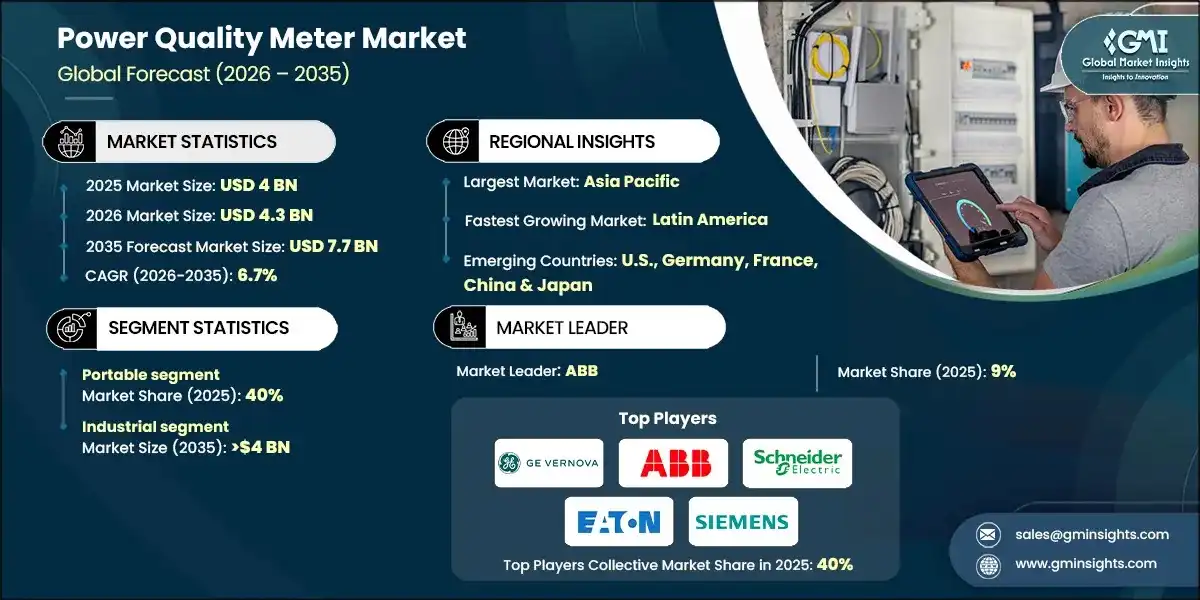
According to a recent study by Global Market Insights Inc., the power quality meter market was estimated at USD 4 billion in 2025. The market is expected to grow from USD 4.3 billion in 2026 to USD 7.7 billion by 2035, at a CAGR of 6.7%.
Power Quality Meter Market Key Takeaways
Market Size & Growth
- 2025 Market Size: USD 4 Billion
- 2026 Market Size: USD 4.3 Billion
- 2035 Forecast Market Size: USD 7.7 Billion
- CAGR (2026–2035): 6.7%
Regional Dominance
- Largest Market: Asia Pacific
- Fastest Growing Region: Latin America
Key Market Drivers
- Shifting focus toward grid modernization.
- Rising integration of renewable energy.
Challenges
- High initial & maintenance cost.
Opportunity
- Eco-conscious metering technologies.
- Expansion of energy infrastructure & electrification initiatives.
- Growth in energy-as-a-service models.
- Expansion of AI-driven energy platforms.
Key Players
- Market Leader: ABB led with over 9% market share in 2025.
- Leading Players: Top 5 players in this market include Siemens, Eaton, Schneider Electric, ABB, GE Vernova, which collectively held a market share of 40% in 2025.
Get Market Insights & Growth Opportunities
- Increasing applicability of precision electronics across wide tandem of application areas will foster the demand for these meters to prevent disruptions and damage. Increasing deployment of smart grids in line with expansion of renewable energy sources will stimulate the business dynamics. Moreover, implementation of energy efficiency programs in line with growing regulatory mandates will positively impact the power quality meter market landscape.
- These meters are critical for identifying power disturbances, harmonics, and voltage sags across complex grid networks. Real-time communication with centralized platforms enables rapid fault analysis and predictive maintenance, supporting the shift toward decentralized energy systems where data-driven insights are key to load balancing and renewable energy integration.
- Paradigm shift toward cloud computing has transformed how power quality data is stored, accessed, and analyzed. Modern meters are equipped with connectivity features that allow seamless transmission of data to cloud platforms. This enables users to visualize trends, generate reports, and receive alerts from anywhere, using mobile and desktop interfaces. Furthermore, rising cybersecurity threats in conjunction with more rigorous benchmarks for power quality standards will foster the power quality meter market growth.
- Growing advancements in electronics have led to the miniaturization of power quality meters, making them more suitable for installation in compact & distributed environments. These smaller devices often come with edge computing capabilities, allowing them to process data locally and respond to anomalies without relying on external servers, which in turn will enhance the product penetration.
- For instance, industrial production growth across India was more modest compared with the strong rebound seen in 2023, with the Index of Industrial Production (IIP) rising by approximately 3.5% year-on-year in July 2025, reflecting a moderate expansion in factory output driven primarily by manufacturing gains.
- The power quality meter market was valued at USD 3.1 billion in 2022 and grew at a CAGR of approximately 4.5% through 2025. This evolution is particularly beneficial for industries with multiple facilities, where centralized oversight is crucial for operational efficiency.
- The meters are evolving to handle the dynamic nature of energy generated from solar panels, wind turbines and battery storage systems. These units offer advanced capabilities to measure bidirectional power flows, frequency variations, and inverter performance. Their role in managing grid stability and ensuring compliance with interconnection standards is becoming increasingly important, primarily in regions with aggressive clean energy targets.
- Smart buildings are adopting interconnected systems that rely on real-time data exchange and automation. These environments demand consistent and high-quality power to support robotics, sensors, and control systems. These meters are becoming integral to these setups, offering granular insights into energy usage and disturbances, which in turn will positively sway the power quality meter market scenario.
- For instance, in 2025, Germany reaffirmed its national commitment to achieving net-zero emissions by 2045, as mandated by its parliament, federal government, and constitutional court. This strategic pledge emphasizes the country’s focus on improving energy efficiency and reducing demand across key sectors such as industry, transport and buildings.
To get key market trends
Power Quality Meter Market Trends
- The areas frequently affected by natural disasters such as floods, hurricanes, or earthquakes are increasingly focusing on energy resilience. Power quality meters are utilized to monitor microgrids, backup systems, and emergency power supplies, ensuring fault detection and stable electricity delivery, making them vital for disaster preparedness and uninterrupted operations.
- For instance, in 2024, the International Energy Agency’s World Energy Investment reported that global energy investments will surpass USD 3 trillion for the very first time, with USD 2 trillion assigned to clean energy technologies and infrastructure, and the remaining portion directed toward fossil fuel supply activities.
- Governments and municipalities are investing in electrified infrastructure, mainly smart street lighting, electric buses, and public charging stations. Quality meters are being integrated into these projects to ensure performance, reduce maintenance costs, and support long-term sustainability goals. Moreover, the adoption of high frequency switching devices will bolster power quality meter market growth.
- For citation, China has announced plans to double its nationwide electric vehicle (EV) charging capacity by 2027, aiming to install 28 million charging facilities to support the country’s rapidly expanding EV market. This initiative is designed to address uneven distribution of public charging networks and improve infrastructure reliability. The action plan includes the deployment of 1.6 million new DC fast chargers, alongside upgrades to aging systems and low-voltage platforms.
- The rollout of 5G and expansion of telecom networks are increasing the demand for stable & high-quality power at cell towers, data centers, and switching stations. Growth in electrified warehousing and cold chain logistics coupled with rising adoption of building management systems will improve the power quality meter market opportunities.
- For instance, in 2025, the Canadian Radio-television and Telecommunications Commission (CRTC) committed over USD 14 million from its Broadband Fund to support the build-out of roughly 250 km of new fibre transport infrastructure connecting remote communities in British Columbia and the Yukon to high-speed Internet, enhancing network resilience and expanding digital access.
Power Quality Meter Market Analysis
Learn more about the key segments shaping this market
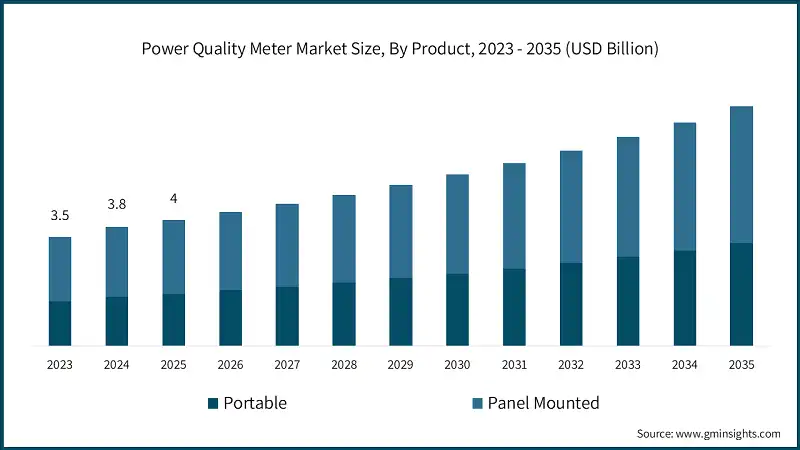
- Based on product, the industry is segmented into portable and panel mounted. The portable power quality meter market holds a share of about 40% in 2025 and is projected to grow at a growth rate of over 6.5% by 2035. Increasing urbanization rate coupled with proactive government efforts to upgrade fragmented small-scale industries in emerging economies will proliferate the industry landscape.
- The rising complexity of electrical systems in line with the growing reliance on sensitive electronic equipment will escalate the industry growth. These systems play a critical role in detecting energy inefficiencies, allowing organizations to streamline energy usage & achieve cost reductions.
- These meters are gaining popularity owing to their flexibility and ease of use in field environments. Technicians carry these devices to multiple locations for quick diagnostics, making them ideal for troubleshooting power issues in remote or temporary setups. Their ability to deliver instant reading without permanent installation is driving demand across wide tandem of industries.
- For instance, ABB introduced a suite of metering solutions aimed at enhancing energy management across diverse sectors. These meters are designed to support informed decision-making by providing detailed insights into power consumption and power quality performance.
- Panel-mounted power quality meter industry was valued at USD 2.4 billion in 2025. Designed for permanent deployment, these systems integrate seamlessly with building management systems and industrial control platforms, enabling centralized monitoring and control. Moreover, their ability to monitor and log power parameters over extended periods makes them indispensable for facilities aiming to meet ISO, IEC, and national standards.
- Organizations focused on sustainability and cost control are using panel-mounted meters to track energy performance over time. These meters support detailed analytics, enabling facility managers to identify inefficiencies and implement corrective actions. Furthermore, their role in long-term energy strategy is growing, especially in large commercial and industrial setups.
- In February 2025, India began evaluating a USD 12 billion bailout plan aimed at restructuring financially strained state-run power distribution companies. The proposal includes conditions such as partial privatization or public listing of utilities, alongside debt-sharing mechanisms between states and private entities. The initiative represents a significant reform effort to improve operational efficiency and enhance financial viability.
Learn more about the key segments shaping this market
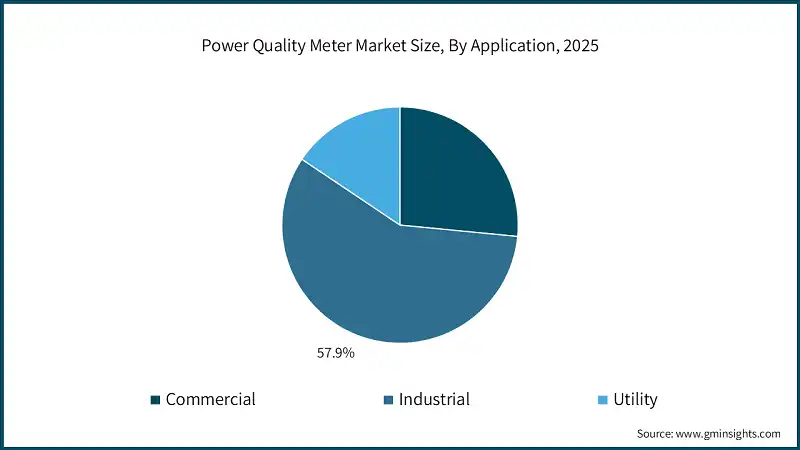
- Based on application, the industry is bifurcated into commercial, industrial and utility. The industrial power quality meter market holds a share of 57.9% in 2025 and is set to exceed USD 4 billion by 2035.
- Modern manufacturing lines operate at high speeds and rely on synchronized machinery. Any power disturbance can lead to production errors or equipment damage. These systems support maintaining consistent electrical supply stability, enabling manufacturers to meet production targets and quality standards without interruption, accelerating the power quality meter market potential.
- For citation, in May 2025, GE Vernova announced plans to invest USD 600 million in U.S. based manufacturing facilities over the following two years. This initiative is part of a broader effort to strengthen domestic production capacity for critical electrical components. The investment is expected to support the scaling of technologies such as power quality meters, which play a vital role in grid reliability, energy efficiency, and infrastructure modernization.
- Commercial power quality meter industry was estimated at USD 1.1 billion in 2025. Retail stores and hospitality venues rely on uninterrupted power for POS systems, refrigeration, lighting, and guest services, thereby accelerating business momentum. Moreover, commercial property owners are pursuing certifications including LEED and BREEAM, which require detailed energy monitoring will elevate the power quality meter market outlook.
- The rise of co-working spaces and tech incubators has created demand for high-quality power infrastructure. These environments host a variety of electronic devices and networking equipment that are sensitive to voltage fluctuations. These meters support sustaining a stable power environment, ensuring productivity and protecting digital assets.
- Utility power quality meter industry is set to grow at a rate of 5.5% from 2026 to 2035. These meters help utilities manage these fluctuations by providing real-time data on voltage, frequency, and harmonics. Moreover, utilities are under pressure to reduce outage times and improve service reliability, which in turn will stimulate the power quality meter market dynamics.
- For instance, between 2003 and 2023, annual spending by major U.S. utilities on electricity production and delivery increased by about 12%, reaching USD 320 billion, based on financial filings with FERC. This growth was driven by sustained capital investments in electric infrastructure, including modernization of aging assets and the integration of renewable energy sources.
Looking for region specific data?
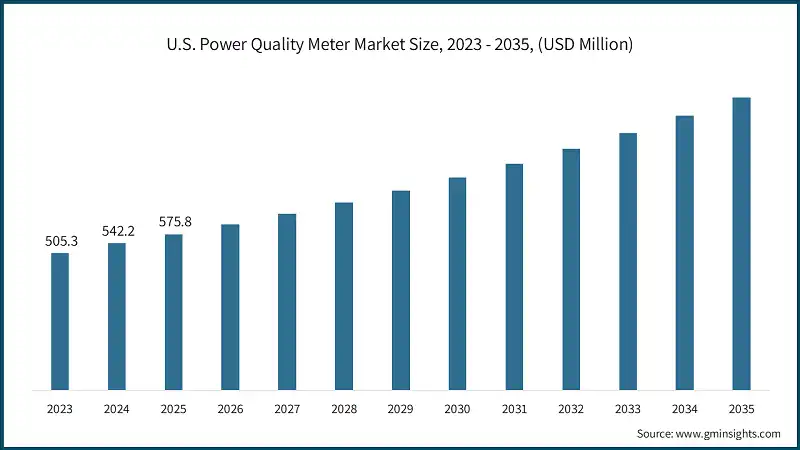
- The U.S. dominated the power quality meter market in North America with around 55% share in 2025 and generated USD 575.8 million in revenue. Growing recognition of the critical role power quality plays in operational reliability, combined with the enforcement of more stringent regulatory frameworks, is poised to stimulate the industry expansion.
- For instance, U.S. electric utilities are projected to invest nearly USD 208 billion in 2025, with cumulative spending expected to exceed USD 1.1 trillion over the next five years. This capital will be directed toward strengthening and modernizing the national power grid, including upgrades to transmission infrastructure, integration of renewable energy, and deployment of smart technologies.
- The North America power quality meter market is projected to hit USD 1.5 billion by 2035. The region is witnessing a strong push toward enhancing grid reliability, especially in the face of increasing weather-related disruptions and aging infrastructure. Utilities across the region are investing in advanced monitoring tools, including power quality meters, to detect faults, manage voltage fluctuations, and improve response times.
- The Europe power quality meter industry is set to grow at a rate of over 6% by 2035. The electrification of public transport systems, including trains, trams, and EV charging networks, is accelerating across Europe. These systems demand high-quality, uninterrupted power to operate safely and efficiently.
- The Asia Pacific power quality meter market reached USD 1.6 billion in 2025. The rising adoption of renewable energy sources and the expansion of smart grid infrastructure are propelling demand for power quality meters. Rising awareness of energy efficiency, supported by government initiatives aimed at lowering carbon emissions, is accelerating the adoption of advanced solutions.
- For citation, Japan has committed USD 21 million toward accelerating microgrid development, reinforcing its long-term strategy to enhance energy efficiency and expand renewable power generation. This investment supports smart grid innovation, including advanced storage systems, electric mobility, and AI-enabled energy optimization.
- The Middle East & Africa market is undergoing rapid urbanization, with large-scale infrastructure projects such as smart cities, high-rise commercial complexes, and industrial zones, offering the significant opportunities for adoption of power quality meters. These projects demand reliable and high-quality power to support advanced building systems, automation, and digital services.
- Latin America governments are launching energy efficiency programs aimed at reducing consumption and improving sustainability, escalating the industry dynamics. These meters play a key role in these efforts by providing detailed insights into energy usage, identifying inefficiencies, and helping organizations comply with evolving environmental regulations and reporting standards.
- For instance, in April 2025, a climate finance initiative in Brazil has supported over 400 small and medium-sized enterprises in implementing energy efficiency measures, particularly within industrial sectors. The project, backed by international donors, aims to unlock untapped potential in energy savings and reduce greenhouse gas emissions.
Power Quality Meter Market Share
- The top 5 players in power quality meter industry are GE Vernova, ABB, Schneider Electric, Eaton and Siemens contribute around 40% of the market share in 2025.
- The industry is defined by its precision-driven and reliability-focused nature, closely aligned with the transformation of modern energy systems and digital grid infrastructure. This sector is evolving rapidly to meet the demands of increasingly complex electrical networks, where real-time monitoring and diagnostics are essential for operational stability and equipment performance.
- GE Vernova delivers intelligent power quality metering systems that support grid modernization and distributed energy integration. Their meters are designed for high-density installations and offer advanced features including real-time waveform capture, predictive analytics, and compatibility with renewable energy systems. GE focuses on enabling utilities and large facilities to maintain grid stability and meet evolving energy transition goals.
- ABB offers a comprehensive range of power quality metering solutions tailored for industrial, commercial, and utility-grade environments. Their meters are built to support smart grid integration, advanced fault detection, and continuous power quality analysis. ABB focuses on scalable designs, cybersecurity features, and interoperability with energy management systems, helping users maintain voltage stability, reduce harmonics, and optimize system performance.
- Schneider Electric delivers advanced solutions engineered to enhance energy reliability, system transparency, and operational performance. These meters are built to monitor critical electrical parameters, detect disturbances, and support proactive maintenance strategies across various environments. Their integration with its EcoStruxure architecture enables seamless connectivity, centralized data access, and intelligent diagnostics.
- Eaton provides robust power quality meters engineered for mission-critical operations such as data centers, manufacturing facilities, and healthcare infrastructure. Their solutions support multi-point monitoring, waveform analysis, and transient detection, enabling proactive maintenance and operational efficiency. Eaton integrates cloud-based platforms and remote diagnostics to enhance visibility and reduce energy-related risks across complex electrical networks.
- Siemens offers high-performance power quality meters that combine digital intelligence with engineering precision. Widely used in smart buildings, industrial automation, and utility networks, Siemens meters support remote configuration, event logging, and harmonic analysis. Their integration with building and energy management platforms enables proactive energy control, fault prevention, and compliance with international standards.
Power Quality Meter Market Companies
- In the first nine months of 2025, Schneider Electric reported total revenue of USD 33.4 billion, underscoring the strength of its core business segments. The Energy Management division contributed USD 27.5 billion, driven by sustained demand for solutions in power distribution, automation, and energy optimization areas where metering plays a critical role in ensuring system reliability and performance. The industrial automation segment generated USD 5.9 billion, reflecting continued investment in smart manufacturing and digital control technologies.
- GE Vernova reported revenue of USD 27.1 billion for 2025 (9 months), reflecting steady performance across its energy-focused operations. During this period, the company directed USD 371 million toward research and development within its power segment, reinforcing its commitment to innovation in grid technologies and energy infrastructure. This investment supports advancements in intelligent monitoring systems, which are essential for improving grid reliability, operational efficiency, and data-driven energy management.
- ABB reported total revenue of USD 25.9 billion for the first nine months of 2025, reflecting consistent performance across its core business segments. The company recorded an operational EBITA of USD 5 billion, supported by strong execution and demand for electrification and automation technologies. Free cash flow reached USD 3.1 billion, highlighting a disciplined approach to financial management and operational efficiency.
Major players operating in the power quality meter market are:
- ABB
- Accuenergy
- Algodue Elettronica
- Delta Electronics
- Eastron Electronic
- Eaton
- Elspec
- Emerson Electric
- Fluke Corporation
- GE Vernova
- Honeywell International
- HIOKI E.E. CORPORATION
- LUMEL
- M B Control & Systems
- Megger
- Mitsubishi Electric Corporation
- MTE Power Quality
- PCE Instruments
- Phoenix Contact
- Rishabh Instruments
- Rockwell Automation
- Schneider Electric
- Siemens
- Vitrek
Power Quality Meter Market Report Attributes
| Key Takeaway | Details |
|---|---|
| Market Size & Growth | |
| Base Year | 2025 |
| Market Size in 2025 | USD 4 Billion |
| Market Size in 2026 | USD 4.3 Billion |
| Forecast Period 2026-2035 CAGR | 6.7% |
| Market Size in 2035 | USD 7.7 Billion |
| Key Market Trends | |
| Drivers | Impact |
| Shifting focus toward grid modernization | Utilities adopt digital grids, driving demand for advanced meters ensuring stability, reliability, and real-time power quality visibility. |
| Rising integration of renewable energy | Intermittent renewables increase voltage fluctuations, requiring power quality meters to monitor harmonics, instability and grid compliance. |
| Pitfalls & Challenges | Impact |
| High initial & maintenance cost | Advanced meters involve high upfront investment and ongoing calibration, software, and maintenance expenses, limiting adoption among cost-sensitive users. |
| Opportunities: | Impact |
| Eco-conscious metering technologies | Growing emphasis on sustainable energy practices is driving demand for power quality meters built with energy-efficient components and recyclable materials, supporting green infrastructure and environmental compliance. |
| Expansion of energy infrastructure & electrification initiatives | Expansion of energy infrastructure & electrification initiatives |
| Growth in energy-as-a-service models | The rise of subscription-based energy management solutions is increasing the need for embedded power quality monitoring, enabling service providers to offer performance guarantees and proactive maintenance. |
| Expansion of AI-driven energy platforms | The integration of artificial intelligence into energy management systems is enhancing the value of power quality data, enabling predictive analytics, automated responses, and smarter load balancing across networks. |
| Market Leaders (2025) | |
| Market Leaders |
9% market share |
| Top Players |
|
| Competitive Edge |
|
| Regional Insights | |
| Largest Market | Asia Pacific |
| Fastest Growing Market | Latin America |
| Emerging Country | U.S., Germany, France, China & Japan |
| Future outlook |
|
What are the growth opportunities in this market?
Power Quality Meter Industry News
- In September 2025, Eaton introduced a firmware-based enhancement to its Power Xpert Quality (PXQ) power meter, enabling detection of AI-driven power bursts in data centers. This new capability identifies sub synchronous oscillations (SSO) caused by sudden GPU-intensive load spikes, which can pose risks to both data center infrastructure and the grid. By integrating edge analytics into the PXQ platform, operators can now proactively monitor and mitigate these disturbances. The update supports greater resilience in high-performance computing environments where power quality is critical.
- In August 2025, Honeywell International strategically expanded its smart energy portfolio through the acquisition of SparkMeter’s data platform and software suite, including Praxis, GridScan, and GridFin. These technologies enhance its capabilities in advanced grid analytics, operational intelligence, and financial performance optimization for utility networks. This move complements its power quality metering solutions by enabling deeper insights into grid behavior, improving energy cost control, and supporting smarter decision-making across utility operations.
- In May 2025, Accuenergy introduced the AcuDC 300 Series, a revenue-grade DC energy meter engineered for the evolving needs of EV fast charging infrastructure. Designed to support voltages up to 1000 VDC with 0.1% accuracy, it enables precise bidirectional energy measurement for advanced applications like vehicle-to-grid systems. Its compact DIN rail–mountable design ensures easy integration into high-performance charging stations. Certified under MID and IEC standards, the meter meets international legal metrology requirements for billing and regulatory compliance.
- In December 2024, Mitsubishi Electric Power announced an USD 86 million investment to establish a 160,000 square-foot manufacturing facility in the Pittsburgh region. This facility is expected to support the expansion of advanced power electronics, including precision metering technologies. The development aligns with growing demand for power quality meters that enable real-time monitoring, fault detection, and energy performance optimization across utility and industrial networks.
The power quality meter market research report includes in-depth coverage of the industry with estimates & forecast in terms of revenue (USD Million) & volume (Units) from 2022 to 2035, for the following segments:
Market, By Product
- Portable
- Panel mounted
Market, By Application
- Commercial
- Industrial
- Utility
Market, By Phase
- Single phase
- Three phase
Market, By Communication
- Wired
- Wireless
The above information has been provided for the following regions & countries:
- North America
- U.S.
- Canada
- Mexico
- Europe
- Germany
- France
- Russia
- UK
- Italy
- Spain
- Netherlands
- Austria
- Asia Pacific
- China
- Japan
- South Korea
- India
- Australia
- New Zealand
- Malaysia
- Indonesia
- Middle East & Africa
- Saudi Arabia
- UAE
- Qatar
- Egypt
- South Africa
- Nigeria
- Kuwait
- Oman
- Latin America
- Brazil
- Peru
- Argentina
Frequently Asked Question(FAQ) :
What is the market size of the power quality meter in 2025?
The market size was USD 4 billion in 2025, with a CAGR of 6.7% expected through 2035 driven by grid modernization, renewable energy integration, and rising use of precision electronics to prevent disruptions and equipment damage.
What is the projected value of the power quality meter market by 2035?
The power quality meter market is expected to reach USD 7.7 billion by 2035, propelled by smart grid deployment, AI-driven energy platforms, and increasing demand for real-time power quality monitoring across utilities and industries.
What is the forecasted market size for power quality meters in 2026?
The market size is projected to reach USD 4.3 billion in 2026.
What trends are influencing the U.S. power quality meter market growth?
The U.S. power quality meter market is set to surpass USD 400 million by 2034, fueled by rising awareness of power quality issues and stricter regulations aimed at improving grid management and operational efficiency.
How much revenue did the portable power quality meter segment generate in 2025?
Portable power quality meters held approximately 40% market share in 2025, led by their flexibility, ease of use in field environments, and ability to deliver instant readings without permanent installation.
What was the valuation of the industrial application segment in 2025?
The industrial segment held 57.9% market share in 2025 and is set to exceed USD 4 billion by 2035, supported by high-speed manufacturing requirements and the need to maintain consistent electrical supply stability.
What is the growth outlook for the utility application segment from 2026 to 2035?
The utility segment is projected to grow at a rate of 5.5% from 2026 to 2035, due to increasing pressure to reduce outage times, improve service reliability, and manage renewable energy fluctuations.
Which region leads the power quality meter market?
Asia Pacific is the largest market, reaching USD 1.6 billion in 2025. The region's dominance is fueled by renewable energy adoption, smart grid expansion, and government initiatives aimed at lowering carbon emissions and improving energy efficiency.
What are the key trends in the power quality meter market?
Key trends include cloud-based data analytics for remote monitoring, miniaturization with edge computing capabilities, integration with renewable energy systems for bidirectional power flow measurement, and AI-driven predictive analytics for automated fault detection and smarter load balancing.
Who are the key players in the power quality meter market?
Key players include ABB, GE Vernova, Schneider Electric, Eaton, Siemens, Accuenergy, Algodue Elettronica, Delta Electronics, Eastron Electronic, Elspec, Emerson Electric, Fluke Corporation, Honeywell International, HIOKI E.E. CORPORATION, LUMEL, M B Control & Systems, Megger, Mitsubishi Electric Corporation, MTE Power Quality, PCE Instruments, Phoenix Contact, Rishabh Instruments, Rockwell Automation, and Vitrek.
Power Quality Meter Market Scope
Related Reports