Summary
Table of Content

Portable X-ray Devices Market
Get a free sample of this report
Form submitted successfully!
Error submitting form. Please try again.
Thank you!
Your inquiry has been received. Our team will reach out to you with the required details via email. To ensure that you don't miss their response, kindly remember to check your spam folder as well!
Request Sectional Data
Thank you!
Your inquiry has been received. Our team will reach out to you with the required details via email. To ensure that you don't miss their response, kindly remember to check your spam folder as well!
Form submitted successfully!
Error submitting form. Please try again.
Portable X-ray Devices Market Size
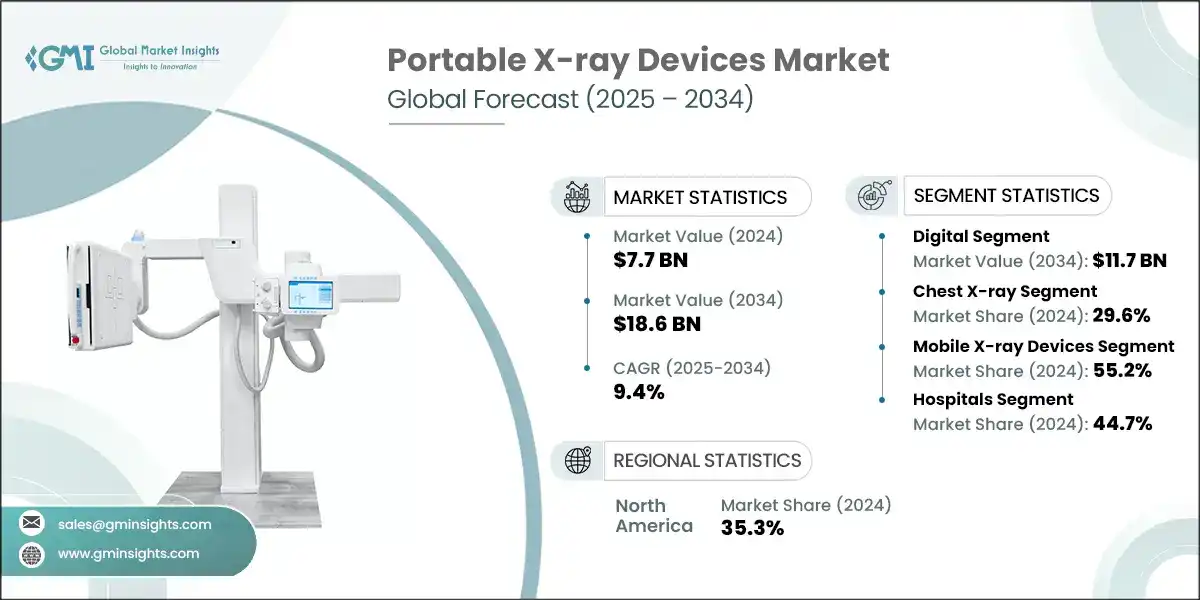
The global portable X-ray devices market was valued at USD 7.7 billion in 2024 and is projected to grow from USD 8.3 billion in 2025 to USD 18.6 billion by 2034, expanding at a CAGR of 9.4%. The consistent expansion of this market is owing to the increased incidence of chronic conditions and growing demand for point-of-care testing. The demand for digital X-ray systems and inclusion of advanced technologies like artificial intelligence, wireless transmission, as well as cloud connectivity is greatly supporting diagnostic performance and effectiveness of the workflow.
Portable X-ray Devices Market Key Takeaways
Market Size & Growth
- 2024 Market Size: USD 7.7 Billion
- 2034 Forecast Market Size: USD 18.6 Billion
- CAGR (2025–2034): 9.4%
Regional Dominance
- Largest Market: North America
- Fastest Growing Region: Asia Pacific
Key Market Drivers
- Technological advancement in x-ray devices.
- Rising prevalence of chronic diseases worldwide.
- Growing number of diagnostic imaging procedures.
- Rising geriatric population.
Challenges
- Stringent regulatory scenario.
- High risk of radiation exposure.
Opportunity
- AI-powered imaging and smart integration.
- Government screening and health programs.
Key Players
- Market Leader: GE Healthcare led with over 18.5% market share in 2024.
- Leading Players: Top 5 players in this market include GE Healthcare, Siemens Healthineers, Canon Medical Systems, Philips, Fujifilm, which collectively held a market share of 45% in 2024.
Get Market Insights & Growth Opportunities
Moreover, the increasing geriatric population and the rise in diagnostic imaging procedures throughout emergency care, home healthcare, which is expected to reach USD 555.6 billion by 2032, and remote locations are driving the market growth. Government policies to improve healthcare infrastructure and investments by the private sector in healthcare infrastructure and mobile diagnostic equipment are also boosting adoption of portable X-ray systems worldwide. Portable X-ray machine is a small, mobile imaging unit used to conduct radiographic studies outside of conventional imaging facilities, providing convenience and quick diagnosis in diverse clinical settings. Major industry players are GE Healthcare, Siemens Healthineers, Canon Medical Systems, and Philips.
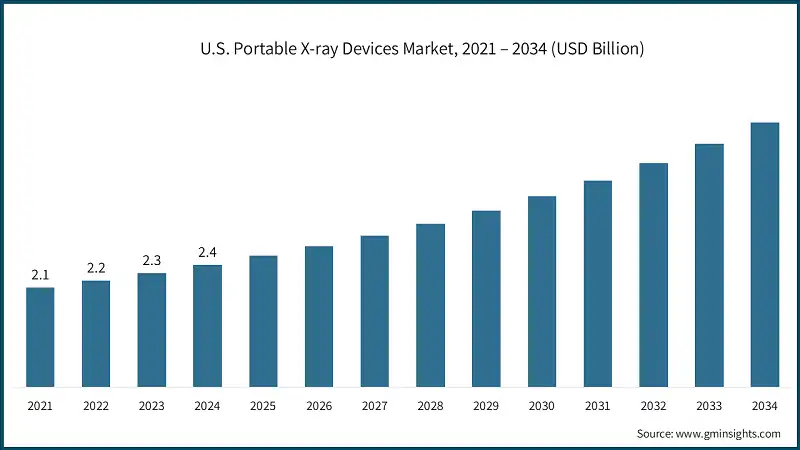
The market increased from USD 6.3 billion in 2021 to USD 7.2 billion in 2023. This growth can be primarily attributed to the rising number of chronic diseases and the rising awareness among people for early detection. The adoption of digital and AI-powered devices surged, supported by government screening programs and technological advancements. Furthermore, healthcare system is shifting towards patient-centric diagnostics, which has made portable x-ray the preferred choice, enhancing comfort and reducing dependency on hospital-based imaging.
The surge in the number of people affected by chronic diseases is one of the major factors that is aiding in the growth of the portable X-ray devices market, as timely and accessible imaging is critical for effective disease management. For example, cardiovascular diseases affected around 500 million people globally and were the reason of 20.5 million deaths, in 2021, accounting for nearly one-third of all global deaths. Also, diabetes affected more than 470 million people globally, with high fasting plasma glucose resulting significantly to mortality, especially in low- and middle-income countries. These alarming figures highlight the urgent need for rapid, point-of-care diagnostic tools that can be used across range of end user settings.
Additionally, there has been an increase in the geriatric population base worldwide. This is also a significant reason that is supporting the growth of the market. According to the World Health Organization (WHO), the number of people above 60 years of age globally is projected to reach 1.4 billion by 2030 from 1.1 billion in 2023. These statistics show that regular screening is essential, as older people are more prone to developing chronic diseases.
Portable X-ray devices are compact and mobile imaging systems that form an integral part of modern diagnostic workflows, especially in point-of-care and remote settings. These devices are designed to perform radiographic examinations outside traditional imaging departments, such as in emergency rooms, patient homes, or field operations. Equipped with advanced digital imaging capabilities, wireless connectivity, and user-friendly interfaces, portable X-ray systems enable rapid image acquisition and transmission.
To get key market trends
Portable X-ray Devices Market Trends
- Integration of artificial intelligence for image enhancement, automated positioning, and predictive diagnostics is improving workflow efficiency and diagnostic accuracy.
- Agfa’s SmartXR platform uses AI-driven predictive assistance to guide radiographers during image acquisition, reducing retakes and optimizing image quality. It enhances workflow by automating key steps and supports real-time decision-making.
- Moreover, demand for lightweight, portable systems suitable for field use, home care, and mobile clinics is rising, especially in remote and resource-limited settings.
- This ultra-compact, battery-powered X-ray system is designed for mobile diagnostics in veterinary, military, and rural healthcare. It supports wireless operation and cloud-based image sharing, making it ideal for decentralized care.
Portable X-ray Devices Market Analysis

Learn more about the key segments shaping this market
The global market was valued at USD 6.3 billion in 2021. The market size reached USD 7.2 billion in 2023, from USD 6.7 billion in 2022.
Based on technology, the market is segmented into digital and analog. The digital segment led this market in 2024, holding the highest market share owing to the better quality of image, faster processing times, and integration capabilities with hospital IT systems. This segment was valued at USD 4.8 billion in 2024 and is projected to reach USD 11.7 billion by 2034, growing at a CAGR of 9.6%. This growth is fueled by surge in demand for AI-enhanced imaging, transmission of wireless data, as well as cloud-based storage solutions that support efficient diagnostics across end user settings such as diagnostic centers and hospitals. On the contrary, the analog segment, valued at USD 2.9 billion in 2024, is anticipated to reach USD 6.9 billion by 2034, with a slightly lower CAGR of 9.2%.
- Digital X-ray systems dominated the portable X-ray devices market as they have better image quality and require less time for processing. Moreover, they provide seamless integration with IT infrastructure. These systems support advanced features such as AI-assisted diagnostics, real-time image acquisition, along with wireless data transmission, making them perfect for emergency care, bedside imaging, and also diagnostics monitored from remote settings. This ability of theirs to reduce radiation exposure while enhancing diagnostic clarity has made them the preferred choice across healthcare settings.
- Moreover, a major driver for this segment is its capability to streamline workflow and improve clinical decision-making. Digital systems are enabling instant image review, automated image enhancement, and compatibility with PACS and EMR platforms, which significantly reduces time required for interpretation and improve reporting efficiency as well. Such features are quite valuable in high-volume environments like hospitals and diagnostic centers.
- For example, GE Healthcare’s AMX Navigate is offering AI-powered Auto Image Paste and smart navigation features, while Carestream’s DRX-Rise provides advanced image processing as well as wireless mobility. Overall, the digital X-ray segment is set to remain the backbone of innovation and efficiency in portable radiography.
Based on the application, the portable X-ray devices market is segmented into dental X-ray, mammography, chest X-ray, cardiovascular, orthopedics, and other applications. The chest X-ray segment accounted for the majority of the market share of 29.6% in 2024, because of the widespread use of chest imaging in diagnosing respiratory and cases related to the heart. With more than 300 million people that are affected by chronic respiratory diseases and cardiovascular diseases responsible for 20.5 million deaths globally in 2021, this segment remain a frontline diagnostic tool.
- For example, portable systems such as GE Healthcare’s AMX Navigate and Carestream’s DRX-Rise are widely used in emergency rooms and ICUs for rapid, bedside imaging. These devices offer high-resolution output and real-time image processing, making them essential for managing acute and chronic pulmonary conditions.
- On the other hand, the cardiovascular segment has the fastest CAGR in this market. This is because of the surge in the number of heart-related disorder cases, especially among the aging population, is driving demand for mobile imaging solutions that support early detection and monitoring. These systems are being integrated with AI algorithms to assist in identifying cardiac abnormalities such as enlarged heart silhouettes, pulmonary edema, and vascular calcifications. Their use in ambulatory care, cardiac units, and remote screening programs is expanding rapidly, supported by innovations in low-dose imaging and wireless data transmission.
Based on the modality, the portable X-ray devices market is segmented into mobile X-ray devices and handheld X-ray devices. The mobile X-ray devices segment accounted for the highest market share of 55.2% in 2024.
- This prevalence is due to the extensive utilization of mobile systems across hospitals, emergency rooms, and long-term care centers. Mobile X-ray units are more flexible and made to be quickly moved to the bedside of a patient, minimizing patient transport and enhancing workflow efficiency.
- Such systems have advanced digital imaging, wireless data transmission, and integration with hospital IT infrastructure like PACS and EMRs. Their capacity to produce high-quality images in real-time makes them well suited for critical care, trauma, and infectious disease wards. Mobile X-ray devices are also being widely used in various applications and distant healthcare environments, opening up further utility across different clinical settings.
- On the other side, handheld X-ray devices segment captured USD 3.4 billion in 2024 due to its small size, simplicity, and increasing usage in home healthcare and field diagnostics.
Learn more about the key segments shaping this market
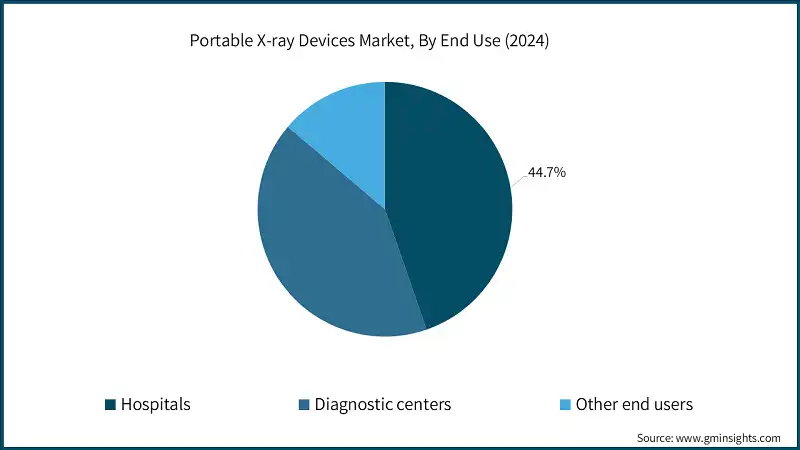
Based on end use, the portable X-ray devices market is segmented into hospitals, specialty clinics, and other end users. The hospitals segment accounted for the highest market share of 44.7% in 2024.
- Hospitals are the largest shareholders of this market because they have large imaging facilities, their radiology personnel are experienced, and also they have high patient traffic. Mobile imaging is critical for emergency situations, inpatient diagnosis, and surgery support in these facilities. PACS, RIS, and EMR integration have enabled them to share data easily and achieve streamlined clinical workflows, providing portable X-ray machines with a critical role in hospital-based diagnostics.
- The diagnostic centers segment, which held 41.5% market share in 2024, is growing very aggressively with the growth of outpatient imaging services and freestanding diagnostic facilities. Such centers prefer portable systems for their cost-effectiveness, compact size, and rapid turnaround capabilities. The provision of walk-in services and remote diagnostics gives them the ideal option for community-level healthcare delivery.
- The other end user category, such as home healthcare providers, field units of the military, is also gaining popularity. These settings find the portability, convenience, and real-time imaging features of portable X-ray machines quite useful, particularly in environments where conventional imaging facilities are not available.
Looking for region specific data?
North America dominated the global portable X-ray devices market with the highest market share of 35.3% in 2024. The region has advanced healthcare infrastructure, and the rate of adoption of innovative medical technologies is also high. Further, there is an increasing prevalence of chronic diseases in the U.S. and Canada, thus propelling the growth of this market.
- The U.S. benefits from a high concentration of licensed dental professionals, including implantologists, which supports the widespread adoption of portable X-ray systems. According to the American Dental Association, there were approximately 200,000 licensed dentists in 2022, many of whom rely on portable imaging for pre-implant assessments, root canal planning, and post-operative monitoring.
- Further, as there is growing demand for cloud-based diagnostics, remote collaboration, as well as workflow automation, the market is expected to see sustained revenue growth through 2030, driven by both public health initiatives and private sector innovation.
Europe portable X-ray devices market accounted for USD 2.1 billion in 2024 and is anticipated to show lucrative growth over the forecast period.
- The region faces a rising burden of chronic diseases such as cardiovascular conditions, diabetes, and respiratory disorders. According to the OECD, more than one-third of Europeans aged 16 and over reported living with a longstanding illness or health problem in 2021, with rates exceeding 50% in countries like Finland.
- Further, Europe has seen a rise in elderly population which becomes a major driver - the number of people who are 60 and older are projected to rise from 215 million in the year 2021 to 247 million by the year 2030. Such statistics show increasing the need for bedside and home-based imaging solutions. Public-private partnerships, mobile diagnostic units, and investments in decentralized healthcare infrastructure are further accelerating market growth.
Germany portable X-ray devices market is projected to experience steady growth between 2025 and 2034.
- The market in Germany is expanding steadily, driven by rising diseases’ incidence and strong healthcare infrastructure. For instance, according to Statista, in 2022, breast cancer had the highest incidence rate among females, at 148 per 100,000 population, according to Statista.
- Such statistics show that there is a requirement for accelerating demand for advanced imaging solutions that support 2D, 3D tomosynthesis, and AI-powered diagnostics. Further, hospitals and screening centers are increasingly adopting multimodal workstations to enhance workflow efficiency and diagnostic accuracy.
The Asia Pacific region is projected to be valued at USD 1.8 billion in 2025 and is expected to reach USD 4.3 billion by 2034.
- The region is expected to grow at the fastest CAGR because of the surge in awareness about chronic diseases, expanding government-sponsored screening programs, and rising disposable incomes. Furthermore, the region’s growing aging population and improving insurance coverage boost demand.
- In Asia Pacific, the number of older persons is projected to increase from 630 million in 2020 to about 1.3 billion by 2050. By 2050, one fourth of the population will be 60 or older.
Japan portable X-ray devices market is poised to witness lucrative growth between 2025 – 2034.
- The country’s aging demographic is a major driver, with 29.1% of the population aged 65 and older as of 2023, according to Statista. This trend is increasing demand for early detection and preventive care, boosting adoption of digital portable X-ray devices.
- Government initiatives and public awareness campaigns are expanding access to screening services, positioning Japan as a key player in the Asia-Pacific imaging landscape.
Brazil is experiencing significant growth in the portable X-ray devices market, driven by its expanding adoption of chronic disease management.
- Brazil’s aging population is supporting the requirement of increased screening needs. As per the Brazilian Institute of Geography and Statistics, the number of people who are aged 65 and above reached 22.17 million in the year 2022, accounting for 10.9% of the total population, which is a 57.4% increase since 2010.
- These statistics of demographic shift are driving adoption of digital and analog devices, particularly in public hospitals and regional screening programs, positioning Brazil as a key emerging market in Latin America for portable X-ray devices.
The portable X-ray devices market in Saudi Arabia is expected to experience significant and promising growth from 2025 to 2034.
- Saudi Arabia's elderly population is rising at a much faster pace than any other segment. It is estimated that the population aged 60 years and above will grow from 2 million (5.9% of the total population) in 2020 to 10.5 million by 2050. This population shift will lead to greater requirements for portable X-ray devices as older people are more prone to chronic conditions.
Portable X-ray Devices Market Share
- The top 5 players-GE Healthcare, Siemens Healthineers, Canon Medical Systems, Philips, and Fujifilm-accounted for almost 45% of the overall market share as of 2024. They retain their position through sustained innovation in digital imaging, AI application, regulatory clearance, and strategic agreements with hospitals and governments. Their extensive global distribution networks and strong R&D pipelines enable them to maintain their leadership in both developed and emerging economies.
- GE Healthcare takes the lead with its AMX Navigate, a transportable digital X-ray system with AI-based Auto Image Paste and intelligent navigation. Philips's product - MobileDiagnost wDR, which is acclaimed for its resolution and sleek design, while Fujifilm's FDR nano is famous for its ultra-light weight and low-dose imaging. These systems find extensive usage in hospitals, ICUs, and emergency care environments.
- In the meanwhile, new industry participants like Carestream Health, Agfa HealthCare, and DRGEM are winning favor with affordable, AI-powered, and cloud-based portable X-ray systems. They are serving the interest of underserved markets like rural healthcare, mobile diagnostic, and military field operations.
- In an effort to reach deeper into the market, players are concentrating on light and battery-efficient systems, AI-based diagnostic applications, as well as interoperable systems that work seamlessly with PACS and EMRs. Wireless image transmission innovation, and also low-dose imaging are transforming the competitive landscape of the market.
Portable X-ray Devices Market Companies
Few of the prominent players operating in the portable X-ray industry include:
- GE Healthcare
- Siemens Healthineers
- Canon Medical Systems
- Philips
- Shimadzu
- MinXray
- Hitachi Medical
- Hologic
- Carestream Health
- Samsung Electronics
- Ziehm Imaging
- Fujifilm
- Agfa HealthCare
- DRGEM
- OR Technology
- Fujifilm
Fujifilm is unique in its FDR nano and FDR CROSS systems that aim to provide high-resolution imaging with minimal radiation exposure. These systems utilize noise reduction circuits that clarify in low-density regions, rendering them suitable for sensitive diagnostic environments. Fujifilm hybrid systems feature the convenience of portable X-ray with the functionality of C-arm imaging, providing flexibility in surgery and emergency care situations.
- Ziehm Imaging
Ziehm Imaging is focused on mobile C-arm technologies that combine cutting-edge imaging technology with small mobility. Their equipment is recognized for excellent intraoperative imaging quality, particularly in orthopedics, trauma, and cardiovascular interventions. Ziehm's products include SmartDose technology, which adjusts radiation exposure according to anatomy and procedure.
- Carestream Health
Carestream Health has a portfolio of digital mobile X-ray systems that are engineered for usability, rapid deployment, and high image quality. Its DRX-Revolution system has a fully automated collapsible column and thus is very maneuverable in small clinical environments. Carestream's imaging software accommodates real-time image processing and wireless data transfer, which means faster diagnosis and better patient throughput.
Portable X-ray Devices Market Report Attributes
| Key Takeaway | Details |
|---|---|
| Market Size & Growth | |
| Base Year | 2024 |
| Market Size in 2024 | USD 7.7 Billion |
| Forecast Period 2025 – 2034 CAGR | 9.4% |
| Market Size in 2034 | USD 18.6 Billion |
| Key Market Trends | |
| Drivers | Impact |
| Technological advancement in x-ray devices | Continuous innovation in digital imaging, AI integration, and wireless technologies are enhancing image quality, portability, and diagnostic speed. |
| Rising prevalence of chronic diseases worldwide | Increasing cases of conditions like tuberculosis, arthritis, and cardiovascular diseases are driving demand for quick and accessible imaging solutions. |
| Growing number of diagnostic imaging procedures | The global rise in diagnostic procedures, especially in emergency and outpatient settings, is boosting the need for portable and efficient X-ray systems. |
| Rising geriatric population | The aging population is more prone to chronic and degenerative conditions, increasing the need for frequent and accessible diagnostic imaging, thereby boosting demand for portable X-ray solutions. |
| Pitfalls & Challenges | Impact |
| Stringent regulatory scenario | Compliance with international safety and quality standards (e.g., FDA, CE) can delay product approvals and increase development costs. |
| High risk of radiation exposure | Despite technological improvements, concerns about cumulative radiation exposure remain, especially in pediatric and frequent-use cases. |
| Opportunities: | Impact |
| AI-powered imaging and smart integration | AI algorithms are improving diagnostic accuracy and enabling automated image analysis, especially in remote and underserved areas. |
| Government screening and health programs | Public health initiatives and mobile screening units are expanding access to diagnostic imaging, especially in rural and low-income regions. |
| Market Leaders (2024) | |
| Market Leaders |
18.5% Market Share |
| Top Players |
Collective Market Share in 2024 is 45% |
| Competitive Edge |
|
| Regional Insights | |
| Largest Market | North America |
| Fastest Growing Market | Asia Pacific |
| Emerging Countries | India, Brazil, Mexico, South Africa |
| Future outlook |
|
What are the growth opportunities in this market?
Portable X-ray Devices Industry News:
- In July 2022, Siemens Healthineers, a medical technology firm unveiled its new mobile X-ray device, the Mobilett Impact, during European Congress of Radiology (ECR) in Vienna. The system combines the advantages of a bedside mobile X-ray unit with complete digital integration, all at an affordable cost. With Mobilett Impact, the entire imaging process can be performed directly at the patient's bedside, improving efficiency and patient care.
- In September 2021, GE Healthcare, global medical technology company has introduced the AMX Navigate, a power-assisted, digital X-ray system with a Free Motion telescoping column. The design is intended to minimize lift force up to 70%, thus lowering technologist injury. The system also features workflow solutions such as Zero Click Exam that automates workflow and minimizes user interface interactions, improving efficiency.
The portable X-ray devices market research report includes an in-depth coverage of the industry with estimates and forecast in terms of revenue in USD Million and from 2021 – 2034 for the following segments:
Market, By Technology
- Digital X-ray
- Analog X-ray
Market, By Application
- Dental X-ray
- Mammography
- Chest X-ray
- Cardiovascular
- Orthopedics
- Other applications
Market, By Modality
- Handheld X-ray devices
- Mobile X-ray devices
Market, By End Use
- Hospitals
- Diagnostic centers
- Other end use
The above information is provided for the following regions and countries:
- North America
- U.S.
- Canada
- Europe
- Germany
- UK
- France
- Italy
- Spain
- Netherlands
- Asia Pacific
- China
- India
- Japan
- Australia
- South Korea
- Latin America
- Brazil
- Mexico
- Argentina
- Middle East and Africa
- Saudi Arabia
- South Africa
- UAE
Frequently Asked Question(FAQ) :
What is the market size of the portable X-ray devices in 2024?
The market size was USD 7.7 billion in 2024, with a CAGR of 9.4% expected through 2034, driven by the rising incidence of chronic conditions and growing demand for point-of-care testing.
What is the projected value of the portable X-ray devices market by 2034?
The market is expected to reach USD 18.6 billion by 2034, supported by advancements in digital X-ray systems, artificial intelligence, wireless transmission, and cloud connectivity.
What is the projected size of the portable X-ray devices market in 2025?
The market is expected to reach USD 8.3 billion in 2025.
How much revenue did the chest X-ray segment generate?
The chest X-ray segment generated USD 2.28 billion in 2024, accounting for 29.6% of the market share, driven by its widespread use in diagnosing respiratory and cardiac conditions.
What was the valuation of the mobile X-ray devices segment?
The mobile X-ray devices segment held the largest share 55.2% in 2024, due to widespread use in hospitals, emergency rooms, and long-term care centers.
Which region leads the portable X-ray devices market?
North America held the largest share 35.3% in the global portable X-ray devices industry in 2024, driven by advanced healthcare systems, tech adoption, and rising chronic disease cases.
What are the upcoming trends in the portable X-ray devices industry?
Key trends include the integration of artificial intelligence for image enhancement, automated positioning, and predictive diagnostics, as well as the adoption of platforms like Agfa’s SmartXR, which optimize image quality and improve workflow efficiency.
Who are the key players in the portable X-ray devices market?
Key players include GE Healthcare, Siemens Healthineers, Canon Medical Systems, Philips, Shimadzu, MinXray, Hitachi Medical, Hologic, and Carestream Health.
Portable X-ray Devices Market Scope
Related Reports