Summary
Table of Content

Plant-Based Egg Protein Isolates Market
Get a free sample of this report
Form submitted successfully!
Error submitting form. Please try again.
Thank you!
Your inquiry has been received. Our team will reach out to you with the required details via email. To ensure that you don't miss their response, kindly remember to check your spam folder as well!
Request Sectional Data
Thank you!
Your inquiry has been received. Our team will reach out to you with the required details via email. To ensure that you don't miss their response, kindly remember to check your spam folder as well!
Form submitted successfully!
Error submitting form. Please try again.
Plant-Based Egg Protein Isolates Market Size
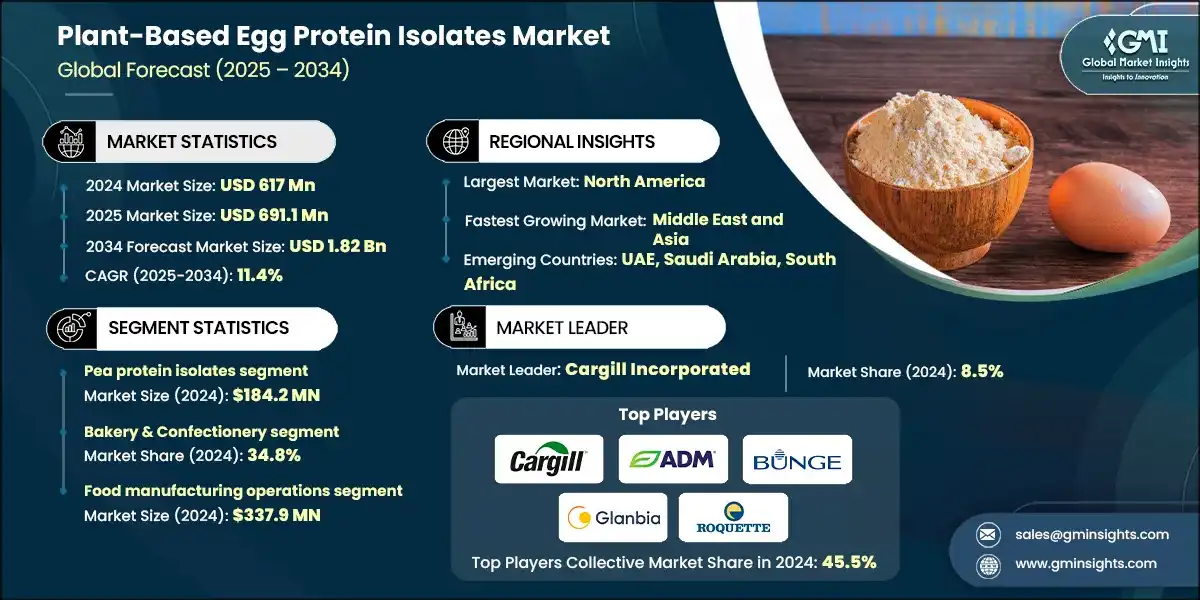
The global plant-based egg protein isolates market size was valued at USD 617 million in 2024. The market is expected to grow from USD 691.1 million in 2025 to USD 1.82 billion in 2034, at a CAGR of 11.4% according to the latest report published by Global Market Insights Inc.
Plant-Based Egg Protein Isolates Market Key Takeaways
Market Size & Growth
- 2024 Market Size: USD 617 Million
- 2025 Market Size: USD 691.1 Million
- 2034 Forecast Market Size: USD 1.82 Billion
- CAGR (2025–2034): 11.4%
Regional Dominance
- Largest Market: North America
- Fastest Growing Region: Middle East and Asia
Key Market Drivers
- Rising consumer demand for plant-based alternatives.
- Advancements in food technology.
- Increasing consumer focus on health and wellness.
Challenges
- High production costs limit market expansion.
- Inconsistent supply of key plant ingredients disrupts manufacturing.
Opportunity
- Growing demand for sustainable protein sources.
- Technological advancements enabling product improvement.
- Rising consumer shift towards flexitarian diets.
Key Players
- Market Leader: Cargill Incorporated led with over 8.5% market share in 2024.
- Leading Players: Top 5 players in this market include Cargill Incorporated, Archer Daniels Midland Company (ADM), Bunge Limited, Glanbia PLC, Roquette Frères, which collectively held a market share of 45.5% in 2024.
Get Market Insights & Growth Opportunities
- Plant-based egg proteins have emerged as alternatives to eggs derived from sources such as mung beans, chickpeas, and algae. They are gaining remarkable traction in the markets due to their advantages ethical-wise, environmentally, and health-wise. Customers get a sustainable option with no cholesterol value.
- The vegan and flexitarian shift is the main factor for rise in demand for plant-based egg replacements. Consumers are more ethical, and health-driven nowadays leading to an increase in the consumption of plant-based eggs. Emerging market developments are focusing on how plant-based products can meet individual needs among consumers while addressing potential concerns with the animal welfare aspect and environmental impact traditional egg production.
- Technological advancements include innovations such as protein engineering with hybrid plant-protein blends that simulate properties of traditional eggs, making them more appetizing for consumers. Other processes such microencapsulation play an important role in increasing the shelf life and flavour retention of plant-based eggs, while product development is being further optimized by AI in terms of taste and nutritional content.
To get key market trends
Plant-Based Egg Protein Isolates Market Trends
- Consumers shift to plant-based egg proteins as people become more aware of health, animal welfare, and environmental sustainability. Many have shifted toward plant-based diets-some for ethical reasons but more often due to an increased awareness of the way traditional animal agriculture affects the environment. Therefore, food manufacturers and retailers are encouraged by this evolving mindset to expand their plant-based eggs to offer what the consumer expects in healthier and increasingly ethical choices.
- The biggest impetus in consumer demand for plant-based egg proteins is the drive toward health and wellness by consumers seeking good nutrition in clean-label foods. The prospect of having cholesterol, antibiotics, and hormones-free products is well received by the consumers looking for plant-based alternatives.
- The food industry is reaping the benefits of increasing consumer demands for alternatives to animal products as people are looking for sustainable and ethical choices. The development of a variety of plant-based egg alternatives corresponds to the paradigm shift that is making the demand of the consumers for this newly emerging preference.
- The plant-based egg protein market is significantly influenced by innovations in food technology for formulation improvements. Such innovations include fermentation, protein isolation, and flavour optimization to look like traditional eggs as much as possible in taste and texture. These technological developments further widen the scope from baking to straight consumption. Hence, manufacturers are developing products that resemble the same functionality as real eggs, breaking down barriers for consumers and chefs alike, thus compounding this innovation in adoption and market growth.
- The demand for plant-based eggs protein isolates is growing from niche markets into more mainstream grocery stores and restaurants.
Plant-Based Egg Protein Isolates Market Analysis
Learn more about the key segments shaping this market
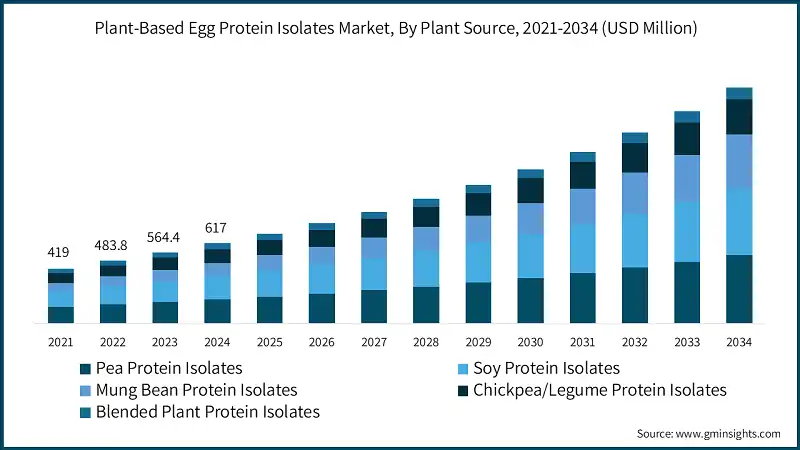
The plant-based egg protein isolates market by plant source is segmented into pea protein isolates, soy protein isolates, mung bean protein isolates, chickpea/legume protein isolates and blended plant protein isolates. Pea protein isolates hold the largest market value of USD 184.2 million in 2024.
- In the plant egg protein market, pea and soy protein isolates holds the highest market value because of their stability during processing, general economic availability, and functional compatibility with existing food systems. These proteins disperse easily in dry or liquid formulations without any major modifications, making them suitable for the use in commercial bakery mixes, vegan sauces, and ready meals. Pea protein, in fact, is most favoured for its allergenic-friendly properties and its mild flavour, while soy remains favourable due to its strong emulsifying and binding properties.
- Mung bean and chickpea protein isolates are gaining demand in the area of innovation for having their discrete beneficial functional attributes. Mung bean for gelling and thickening like those of egg texture, while chickpea proteins for foaming and moisture retention in baked goods. This is especially advantageous in allergen-sensitive or gluten-free applications. Innovations on blended protein systems are emerging from a combination of sources such as mung bean and pea or legumes to potentially optimize flavour, texture, and functionality within one product.
Learn more about the key segments shaping this market
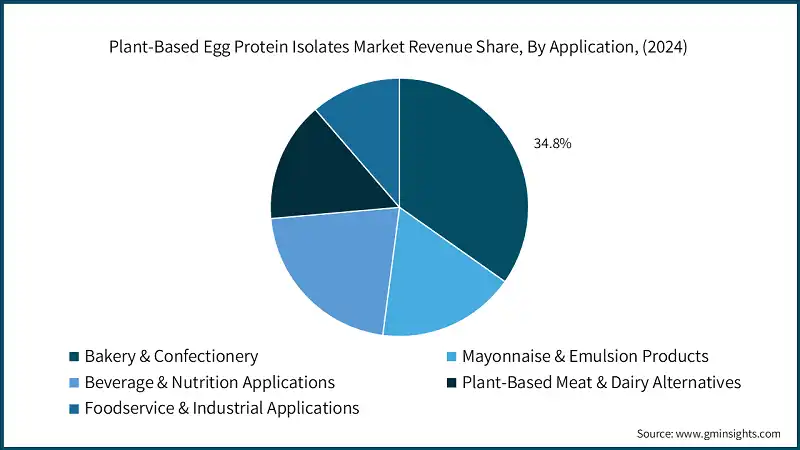
The plant-based egg protein isolates market by application is segmented into bakery & confectionery, mayonnaise & emulsion products, beverage & nutrition applications, plant-based meat & dairy alternatives, foodservice & industrial applications. Bakery & Confectionery holds the largest market value of USD 214.5 million occupying 34.8% in 2024.
- Bakery & confectionery segment is growing at a faster pace as plant-based egg proteins offer properties like structure, moisture, and aeration needed for egg-free baking. The demand for vegan and allergen-free baked goods is increasing more adoption in this segment. Mayonnaise & Emulsion Products are driving demand for plant-based proteins because of their emulsifying and stabilizing properties. These alternatives help brands to create clean label for ensuring transparency without compromising texture or shelf life.
- In functional drink, consumers seek dairy-free protein options, so beverage & nutrition segments are expanding and thus growing the market. Plant-based egg proteins are used in ready to drink beverages as it offers a smooth texture and nutritional value. For binding ingredients and improving mouthfeel in patties, cheeses, and spread egg replacers are used in plant-based meat & dairy alternatives. Foodservice & Industrial Applications are adopting plant-based proteins for scalability, allergen control, and sustainability.
Based on end-use industry, the plant-based egg protein isolates market is segmented into food manufacturing, foodservice operations, retail & consumer products and nutritional supplements. Food manufacturing operations accounts for USD 337.9 million in 2024.
- Food Manufacturing is growing as it is a simple matter of integrating the use of egg proteins of plant origin in large production facilities that would not require major changes in equipment. They are being adopted by manufacturers to cater to the differentiating demand for clean-label and allergen-free in various kinds of processed foods.
- Food service operations are increasingly using plant-based egg alternatives to cater to veganism, vegetarianism, and health-focused populations. Some of their versatile applications include scrambles, baked goods, and sauces; hence, they are seen as a feasible commercial kitchen solution.
- Nutraceuticals are now forming a niche, but a growing segment, drawn by the demand for plant-based, high-protein formulations. Plant egg proteins serve as an alternate protein source in powders and meal replacement mixes that are easily digestible and allergen-free compared to animal-based ingredients.
- With the introduction of plant-based egg items the sector of retail & consumer products is growing because both in grocery stores and on e-commerce platforms. Customers are looking for simple shelf-stable alternatives to eggs that correspond with their ethics and diets.
Based on processing technology, the plant-based egg protein isolates market is segmented into conventional extraction isolates, enzymatically modified isolates, fermentation-derived isolates and native/cold-processed isolates. Food manufacturing operations accounts for USD 337.9 million in 2024.
- Conventional extraction isolates have been in use for a long time because they are cheap and reliable to produce plant proteins that manifest consistent functionalities. The well-established process is good for scaling up to manufacturing foods with only minor changes.
- Enzymatically modified isolates are becoming more interesting owing to the improved functional properties of these products, namely, solubility, emulsification, and foaming. This is particularly useful for the simulation of egg textures in complex food applications.
- Natural microbes create fermentation-derived isolates, which in turn produce pure and high-quality proteins. These proteins are more accepted by the public because of their natural and environment-friendly quality along with less chemical addition.
- The natural/cold-processed isolates are prepared by using low temperature, gentle techniques, thus optimizing the preservation of the plant proteins' natural structure and nutrients. So, it fits well into clean-label and health-focused products, wherein the consumers need ingredients that are less processed and closer to their natural state.
Looking for region specific data?
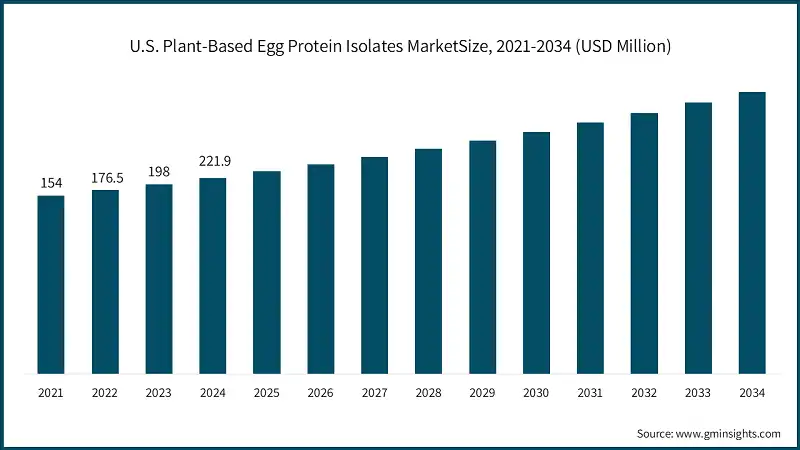
The U.S. plant-based egg protein isolates market accounted for USD 221.9 million in 2024.
- In North America markets the demand for plant-based egg protein isolates is growing at a fast pace due to consumer awareness regarding plant-based diet alternatives, allergy issues, and environmental sustainability. In U.S. retail chains and quick service restaurants are testing and unleashing plant-based egg sandwiches, bakery items, and protein-rich beverages, which also boosts the uptake.
- The presence of start-ups and established food tech companies which are driving innovation with respect to textures and protein blends makes it easier for products to meet consumer expectations. All these developments mean that North America continues to play a leading role globally in the development and commercialization of egg-protein isolates.
The market in the Europe is expected to experience significant and promising growth from 2025 to 2034.
- Plant-based egg protein isolates are experiencing robust growth in Europe with rising awareness of health, sustainability, and animal welfare. Germany is taking the lead in this change by embracing plant-based items in retail and food service as it is known for its food culture. Manufacturers and innovative startups in Germany are working on formulations that imitate egg functionality while maintaining the most vigorous food safety and labelling regulations. This combination of consumer demand and innovation is driving Europe’s expanding role in plant-based protein.
The plant-based egg protein isolates market in China is expected to experience significant and promising growth from 2025 to 2034.
- Rapid urbanization in Asia-Pacific, an increase in disposable incomes, and transformation of diets are some of the promising factors that will make the market fertile ground for plant-based alternatives, including egg protein isolates. Local startups try to blend traditional culinary preferences with new proteins such as mung beans and chickpeas to create substitutes that match local tastes more.
- Growth in foodservice as well as that construction of other distribution channels (including e-commerce) will enable products to reach a wider audience. There is a healthy increase in demand as consumers become more aware of health, sustainability, and allergen concerns, making APAC one of the most dynamic areas for future growth.
UAE plant-based egg protein isolates market is expected to experience significant and promising growth from 2025 to 2034.
- In the Middle East & Africa (MEA), the demand keeps growing, nourished by increasing health concerns, knowledge of dietary restrictions, and the impact of international vegan/plant-based movements. Premium plant-based egg proteins imported into niche restaurants and upscale retail in the Gulf region are starting to penetrate, while NGOs and governmental health initiatives are endorsing sustainability and alternative proteins into the region.
Brazil is expected to experience significant and promising growth from 2025 to 2034.
- Latin America's plant-based egg protein market is witnessing stable growth due to rising consumer interest in healthier and more sustainable food options. These are some of the key hubs like Brazil, São Paulo and Rio de Janeiro where local companies are innovating with native legumes to create cost-effective and culturally relevant egg alternatives, helping to grow the market across the country.
Plant-Based Egg Protein Isolates Market Share
- Plant-based egg protein isolates industry is moderately consolidated with players like Cargill Incorporated, Archer Daniels Midland Company (ADM), Bunge Limited, Glanbia PLC, Roquette Frères holding 45.5% market share and Cargill Incorporated being the market leader holding the market share of 8.5% in 2024.
- The leading companies of the plant-based egg proteins isolates market tend to retain their position because of constant investment into research and development. The goal is to produce plant-based eggs that taste, look, and behave like actual eggs. Such innovations can attempt a multitude of plant sources like mung bean, chickpeas, and peas, thereby allowing manufacturers to offer varieties that cater to cooking as well as nutritional needs.
- Sustainability also plays a huge role in influencing competitive strategies employed by firms besides innovation. Efficient production processes that reduce environmental impact and have an element of scalability are being adopted by many companies. These firms appeal to a growing range of consumers who cherish food products with better sensory quality and sustainable practices through the optimization of their manufacturing processes by implementing greater environmental responsibility.
- Compliance with changing food safety and labeling regulations is yet another crucial parameter where market leaders create an edge for themselves. Regulatory requirements inspire consumer confidence and ensure an easy entry into new markets. Transparent labeling and higher safety standards mean that products conform to the expectations of a growing base of informed consumers actively looking for trustworthy plant-based alternatives.
Plant-Based Egg Protein Isolates Market Companies
Major players operating in the plant-based egg protein isolates industry are:
- AGT Food and Ingredients Inc.
- Aminola BV
- Archer Daniels Midland Company (ADM)
- Axiom Foods Inc.
- Beneo GmbH
- Bunge Limited
- Burcon NutraScience Corporation
- Cargill, Incorporated
- Cosucra Groupe Warcoing SA
- Eat Just, Inc.
- Equinom Ltd.
- ETprotein Co., Ltd.
- FUJI Plant Protein Labs
- Glanbia PLC
- Laybio Natural Ingredients
- Motif FoodWorks
- Organicway Inc.
- PURIS Holdings LLC
- Roquette Frères
- Tate & Lyle
- Verdient Foods
- Vestkorn Milling AS
- VW Ingredients
- Yantai Shuangta Food Co., Ltd.
Cargill Incorporated, Cargill Incorporation deals in food and agriculture, with a huge supply chain network and investments in plant-based proteins. Besides, it offers functional protein ingredients like pea protein, which is an output of its partnership with PURIS. Driving innovations in clean label, sustainable food solutions and developing manufacturing capabilities spread across North America and Europe lays Cargill's strategy in expanding its footprint in alternative proteins.
Archer Daniels Midland Company (ADM) It is one of the largest processors of agriculture and suppliers of ingredients. It is establishing a growing portfolio of proteins from plants. Because of its experience in soy, wheat, and pulse processing, ADM provides top-quality protein isolates for use in meat and egg substitutes. It is a world leader in sourcing, food science capability, and capacity to support large-scale food manufacturers.
Roquette Frères Roquette is a company based in France, family-owned, and involves itself with plant-based ingredients and solutions to serve food, nutrition, and pharmaceuticals. The company's focus on innovation and sustainability also provides health and wellness-supporting products, such as starches, proteins, and excipients. Roquette's operations extend internationally from the robust research and development network backing them. Active projects by Roquette development of plant-based egg protein isolates are alternatives to other styles of food today that are sustainable and allergen-friendly by design.
Bunge Limited It is a global agribusiness and food company involved in agriculture, food processing, and trading. Farmers, processors, and customers process oilseeds grains and associated products into ingredients for food production and animal feed. An integrated business model of Bunge consists of farming, processing, and trading into the delivery of raw materials across the globe.
Glanbia PLC It is a global nutrition company based in Ireland producing various food ingredients, nutritional products, and supplements. The company focus on health and wellness innovation, with divisions catering to performance nutrition, food ingredients, and joint ventures serving customers worldwide. Active expansion into plant protein solutions, an example of which is plant-based egg protein isolates, is initiated by Glanbia to meet the rising demand for sustainable and allergen-friendly alternatives in food manufacturing.
Plant-Based Egg Protein Isolates Market Report Attributes
| Key Takeaway | Details |
|---|---|
| Market Size & Growth | |
| Base Year | 2024 |
| Market Size in 2024 | USD 617 Million |
| Market Size in 2025 | USD 691.1 Million |
| Forecast Period 2025 - 2034 CAGR | 11.4% |
| Market Size in 2034 | USD 1.82 Billion |
| Key Market Trends | |
| Drivers | Impact |
| Rising consumer demand for plant-based alternatives | An increasing number of consumers are choosing plant-based options due to health concerns, ethical considerations, and environmental awareness. This shift is driving the demand for plant-based egg alternatives, as more individuals seek to reduce their consumption of animal products. |
| Advancements in food technology | Innovations such as precision fermentation and hybrid plant-protein blends are enhancing the quality and functionality of plant-based eggs. These technological advancements are making plant-based egg substitutes more appealing and accessible to a broader consumer base. |
| Increasing consumer focus on health and wellness | Consumers are increasingly seeking plant-based egg alternatives due to concerns over cholesterol, allergies, and overall health. These products offer a healthier option, contributing to their growing popularity. |
| Pitfalls & Challenges | Impact |
| High production costs limit market expansion | Plant-based egg proteins require specialized ingredients and processing, making production more expensive than traditional eggs. This price difference restricts affordability for many consumers, especially in cost-sensitive markets. As a result, wider adoption is slowed, impacting overall market growth. |
| Inconsistent supply of key plant ingredients disrupts manufacturing | The supply of essential plant proteins like peas and mung beans is subject to seasonal changes and agricultural risks. These fluctuations cause interruptions in manufacturing and increase raw material costs. Such instability challenges producers’ ability to meet growing consumer demand consistently. |
| Opportunities: | Impact |
| Growing demand for sustainable protein sources | Climate change and resource use intensify; consumers and businesses are actively seeking low-impact protein alternatives. Plant-based eggs meet this need, creating a strong growth opportunity as sustainability becomes a key purchasing factor. |
| Technological advancements enabling product improvement | Innovation in ingredient processing and formulation is reducing the sensory gap between plant-based and real eggs. Better taste, texture, and functionality increase consumer acceptance and market penetration. |
| Rising consumer shift towards flexitarian diets | More people are adopting flexitarian lifestyles, reducing animal products from their diets. This growing group seeks versatile, plant-based egg options that fit into their balanced eating habits, presenting a broad and expanding market opportunity. |
| Market Leaders (2024) | |
| Market Leaders |
8.5% market share |
| Top Players |
Collective market share of 45.5% in 2024 |
| Competitive Edge |
|
| Regional Insights | |
| Largest Market | North America |
| Fastest growing market | Middle East and Asia |
| Emerging country | UAE, Saudi Arabia, South Africa |
| Future outlook |
|
What are the growth opportunities in this market?
Plant-Based Egg Protein Isolates Industry News
- In March 2025, Australian Plant Proteins (APP), the company that developed its own technology in the isolation of pulse protein, was acquired by My Co., the Paule Family office's investment vehicle following the voluntary administration entry in 2024. The acquisition is anticipated to redirect its focus in staying true to local farmers, securing jobs, and directing growth into Australia's plant-based food industry.
- In October 2024, Burcon NutraScience Corporation introduced launch of new product Puratein Canola Protein, a plant-based protein for the egg replacement in baked goods. The Puratein derived from non-GMO Canadian canola seeds has over 90% protein purity with functional benefits like foaming and solubility. The product is a sustainable and economical substitute in view of the rising egg prices and supply disruptions due to some cases of Avian influenza. Burcon states that Puratein can replace up to 100% of powdered or shelled eggs with great cost savings and a vegan solution for food manufacturers.
The plant-based egg protein isolates market research report includes an in-depth coverage of the industry with estimates and forecast in terms of revenue in USD Million and volume in terms of kilo tons from 2021–2034 for the following segments:
Market, By Plant Source
- Pea protein isolates
- Soy protein isolates
- Mung bean protein isolates
- Chickpea/legume protein isolates
- Blended plant protein isolates
Market, By Application
- Bakery & confectionery
- Mayonnaise & emulsion products
- Beverage & nutrition applications
- Plant-based meat & dairy alternatives
- Food service & industrial applications
Market, By End Use Industry
- Food manufacturing
- Foodservice operations
- Retail & consumer products
- Nutritional supplements
Market, By Processing Technology
- Conventional extraction isolates
- Enzymatically modified isolates
- Fermentation-derived isolates
- Native/cold-processed isolates
The above information is provided for the following regions and countries:
- North America
- U.S.
- Canada
- Mexico
- Europe
- Germany
- UK
- France
- Spain
- Italy
- Rest of Europe
- Asia Pacific
- China
- India
- Japan
- Australia
- South Korea
- Rest of Asia Pacific
- Latin America
- Brazil
- Mexico
- Argentina
- Rest of Latin America
- Middle East and Africa
- Saudi Arabia
- South Africa
- UAE
- Rest of Middle East & Africa
Frequently Asked Question(FAQ) :
What was the market size of the plant-based egg protein isolates in 2024?
The market size was valued at USD 617 million in 2024, with a CAGR of 11.4% expected through 2034. The growth is driven by increasing consumer demand for sustainable, ethical, and health-conscious food alternatives.
What is the projected value of the plant-based egg protein isolates market by 2034?
The market is poised to reach USD 1.82 billion by 2034, fueled by advancements in food technology, rising health awareness, and the growing adoption of plant-based diets.
What is the expected size of the plant-based egg protein isolates industry in 2025?
The market size is projected to reach USD 691.1 million in 2025.
What was the valuation of pea protein isolates in 2024?
Pea protein isolates held the largest market value of USD 184.2 million in 2024, led by their allergenic-friendly properties, mild flavor, and functional compatibility with food systems.
What was the market share of the Bakery & Confectionery segment in 2024?
The Bakery & Confectionery segment accounted for the largest market share, valued at USD 214.5 million, representing 34.8% of the total market in 2024.
What was the revenue generated by food manufacturing operations in 2024?
Food manufacturing operations generated USD 337.9 million in 2024, propelled by the integration of plant-based egg proteins into large-scale production facilities with minimal equipment changes.
Which region leads the plant-based egg protein isolates sector?
North America leads the market, with the U.S. accounting for USD 221.9 million in 2024. The region's growth is attributed to increasing consumer awareness of plant-based diets, allergy concerns, and environmental sustainability.
What are the upcoming trends in the plant-based egg protein isolates market?
Trends include fermentation, protein isolation, flavor optimization, and the mainstream growth of plant-based egg products.
Who are the key players in the plant-based egg protein isolates industry?
Key players include AGT Food and Ingredients Inc., Aminola BV, Archer Daniels Midland Company (ADM), Axiom Foods Inc., Beneo GmbH, Bunge Limited, Burcon NutraScience Corporation, Cargill, Eat Just, Inc., and Equinom Ltd.
Plant-Based Egg Protein Isolates Market Scope
Related Reports