Summary
Table of Content

Plant-Based Bars Market
Get a free sample of this report
Form submitted successfully!
Error submitting form. Please try again.
Thank you!
Your inquiry has been received. Our team will reach out to you with the required details via email. To ensure that you don't miss their response, kindly remember to check your spam folder as well!
Request Sectional Data
Thank you!
Your inquiry has been received. Our team will reach out to you with the required details via email. To ensure that you don't miss their response, kindly remember to check your spam folder as well!
Form submitted successfully!
Error submitting form. Please try again.
Plant-Based Bars Market Size
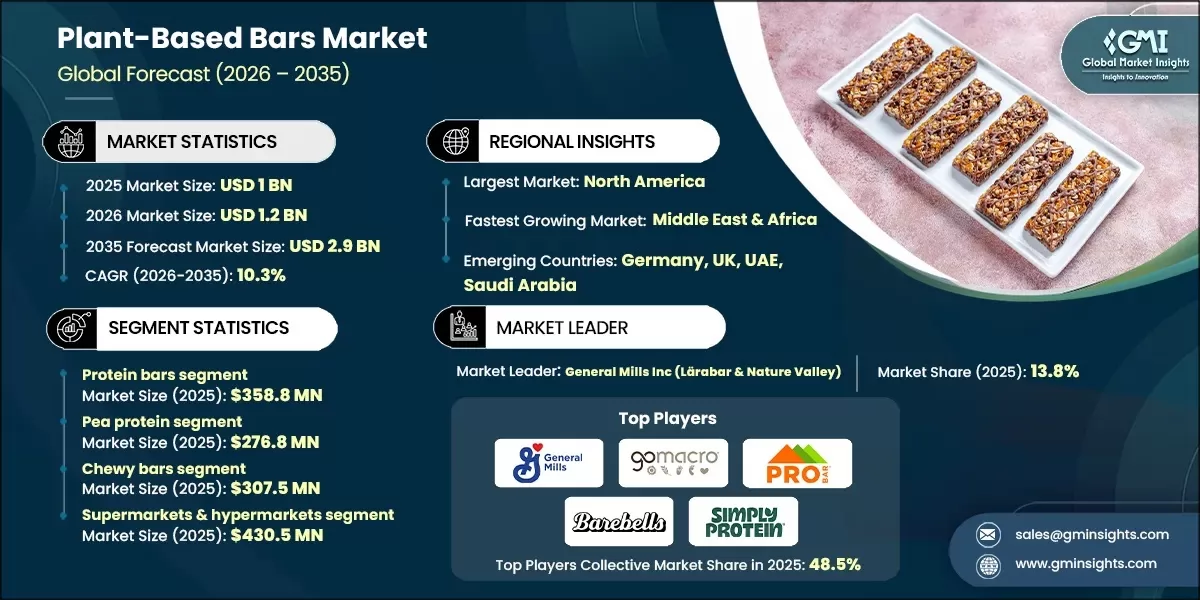
The global plant-based bars market was estimated at USD 1 billion in 2025. It is expected to grow from USD 1.2 billion in 2026 to USD 2.9 billion by 2035, at a CAGR of 10.3%, according to latest report published by Global Market Insights Inc.
Plant-Based Bars Market Key Takeaways
Market Size & Growth
- 2025 Market Size: USD 1 Billion
- 2026 Market Size: USD 1.2 Billion
- 2035 Forecast Market Size: USD 2.9 Billion
- CAGR (2026–2035): 10.3%
Key Market Drivers
- Rising consumer demand for plant-based nutrition & flexitarian diets.
- Growing health & wellness consciousness.
- Sports nutrition & active lifestyle market expansion.
Challenges
- Shelf life & stability issues with clean label formulations.
- Supply chain volatility for specialty plant proteins.
Opportunity
- Institutional & foodservice channel expansion.
- Sustainable packaging innovation & premium positioning.
Key Players
- Market Leader: General Mills Inc (Lärabar & Nature Valley) led with over 13.8% market share in 2025.
- Leading Players: Top 5 players in this market include General Mills Inc (Lärabar & Nature Valley), GoMacro, PROBAR, Inc, Barebells, Simply Protein, which collectively held a market share of 48.5% in 2025.
Get Market Insights & Growth Opportunities
- Plant-based bars are on the growth path with increasing consumer demand in plant-based nutrition and flexitarian diets. The growth of the knowledge about the health and environmental advantages of plant-based diets are motivating consumers to minimize their consumption of animal proteins, which can expand the customer base of the plant-based bars. On-the-go, allergen free, clean-label and convenient ingredients are becoming means of adoption amongst health conscious and mainstream consumers.
- The increased awareness of health and wellness is another major driver of market growth. There is a growing demand for consumers to consume functional snacks that will help them in maintaining their heart health, weight reduction, and overall well-being. The positioning of plant-based bars as high-protein, high-fiber and natural products is appropriate to address the shifts in the global lifestyle toward a healthier one and aligns with the preferences of the target audience.
- Sports nutrition and active lifestyle category is also driving up the demand of plant-based bars. Plant-based bars are being embraced by fitness enthusiasts, athletes, and gym-goers as a source of easy-to-use high-quality protein to recover muscle and to provide energy for the body. Brands are capitalizing on this trend by coming up with products that are performance and functional nutrition oriented.
To get key market trends
Plant-Based Bars Market Trends
- The market for plant-based bars is heavily influenced by the development of product forms and textures, with manufacturers balancing between chewing, crunchy, and soft-baked products to adapt to the changing preferences of their customers. This diversification enables the brands to serve a wide range of consumption occasions on the go between on-the-go snacking to meal substitutes contributing to the attractiveness of the brand in various demographic groups.
- The incorporation of functional and performance-oriented ingredients, such as plant-based proteins and fiber blends and natural energy boosters, is another major trend. This strategy makes plant-based snacks not only a welcome change of gourmet snacks but also a product that promotes active lifestyles, recovery and well-being, which supports its applicability to the health-conscious snack market.
- Strategic partnerships and collaborations are also impacting market forces, with brands uniting with ingredient suppliers, fitness platforms, and retail chains to increase distribution, co-create new ideas, and build strength in the market. These partnerships make innovation processes faster and offer a competitive advantage in the fast-paced market environment.
- E-commerce and direct-to-consumer models are also drawing more attention to the digital aspect and personalization in the market. Data analytics enable companies to learn consumer behavior as well as optimize product portfolios and develop personalized experiences which build a stronger brand loyalty and lead to repeat purchase behaviors.
Plant-Based Bars Market Analysis
Learn more about the key segments shaping this market
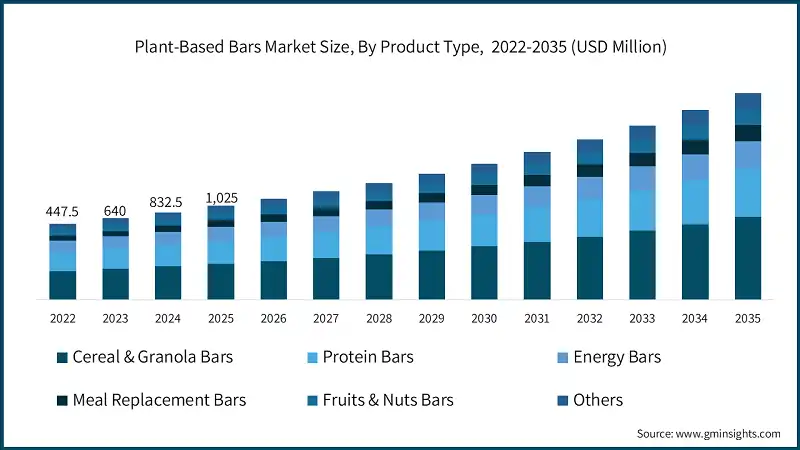
Based on Product type, the market is segmented into cereal & granola bars, protein bars, energy bars, meal replacement bars, fruit & nuts bars, and others. The protein bars hold a significant share at a valuation of USD 358.8 million in 2025.
- Protein bars hold major share in the market of plant-based bars and occupy the largest portion of the segmentation according to product type since they have a strong correspondence with the consumer demand on functional nutrition products and active lifestyles. Protein bars are also poised to be sold as convenient on-the-go, muscle-recovery, and satiating options, and are therefore receiving favor among both the fitness-centric consumer and flexitarians seeking plant-based protein options.
- Other new product lines including cereal and granola bars, energy bars, meal replacement bars, and fruit and nut bars are still complementary to the overall market growth along with protein bars. These formats will serve different consumption occasions, such as breakfast substitutes for long energy and snacking. Although their respective portions have been less substantial to protein bars, continuous product improvement in flavor, functionalities, and natural sweeteners is improving their applicability, which helps in portfolio diversification and expands consumer appeal about various diets and lifestyle requirements.
Based on source, the market is segmented into soy protein, pea protein, rice protein, wheat protein, nut proteins, and others. The pea protein holds a significant share at a valuation of USD 276.8 million in 2025.
- Pea protein comprises significant share in the market of plant-based bars by source with most of the share as it has a high nutritional value, no taste, and can be accepted by a wide range of consumers. The high digestibility, complete amino acid profile, and allergen sensitive consumers make pea protein an ideal choice because it is naturally free of soy and gluten. The flexibility in formulation enables the manufacturers to meet the desired texture and mouthfeel in bars and to position it with clean-label and non-GMOs, which contributes to its popularity in protein-rich plant-based snacks.
- Additional protein sources, including soy, rice, wheat and nut proteins are also capable of diversifying products, but they are second to pea protein in the market penetration. Although the soy protein has cost and functional benefits, its application is progressively limited by the allergen issue and clean-label trends. Proteins of rice and nuts are usually combined to increase the balance of amino acids and taste, whereas wheat protein has not become niche yet because of gluten intolerance.
Based on processing method, the market is segmented into chewy bars, crunchy bars, soft-baked bars, raw & cold-pressed bars, extruded bars, and binder-free bars. The chewy bars hold a significant share at a valuation of USD 307.5 million in 2025.
- The processing method of the plant-based bars market is mainly controlled by chewy bars that take most of the market share as they have a wide target audience of consumers and can be used in various types of products such as protein bars, energy bars, and meal replacement bars. Chewy textures are popular due to their palatious texture, easy to eat qualities as well as their capacity to bind plant-based foods, including nuts, seeds, and protein isolates without affecting the flavor. This form also allows flexibility in design, allowing the manufacturers to introduce functional ingredients, natural sweeteners and clean-label binders.
- Processing other types such as crunchy, soft baked, raw and cold-pressed, extruded and binder-free bars have a complementary role in meeting the niche consumer preferences as well as specialized dietary requirements. The extruded and crunchy bars will serve the convenience and texture-oriented group of consumers, whereas the raw and cold-pressed bars will serve the niche of clean-eating and minimally processed food.
Learn more about the key segments shaping this market
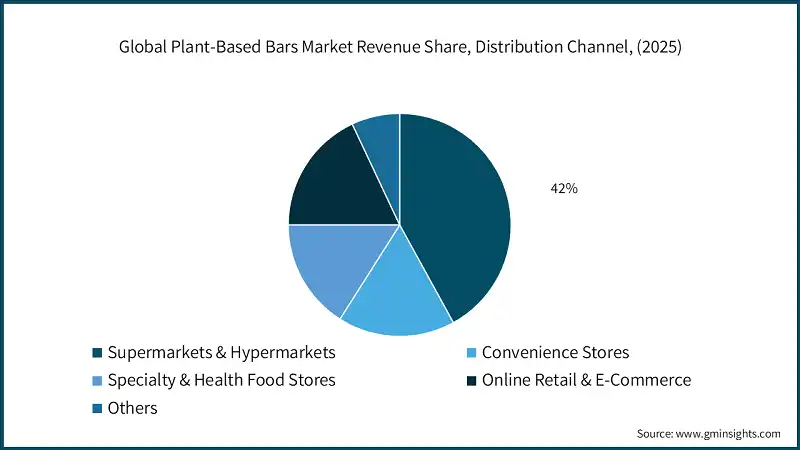
Based on distribution channel, the market is segmented into supermarkets & hypermarkets, convenience stores, specialty & health food stores, online retail & e-commerce, and others. The supermarkets & hypermarkets is estimated to grasp a value of USD 430.5 million in 2025 and is expected to grow at 9.7% of CAGR during the forecast period.
- The supermarkets and hypermarkets dominate the market of plant-based bars by the distribution channel, as they take the largest share because of the wide range of products offered and due to their high traffic and demand for a structured retail format with the high level of consumer trust. These outlets give a wide exposure to plant-based bars of various price ranges and categories and facilitate impulse buying, in addition to the effects of planned purchasing.
- The other channels of distribution comprise of convenience stores, specialty and health food stores, online shopping, and alternative stores, which help to expand the market by focusing on a particular need of consumers and buying habits. Specialty stores are essential in early adoption and high-end placement whereas e-commerce assists in expanding the reach, subscriptions, and direct to consumer.
Looking for region specific data?
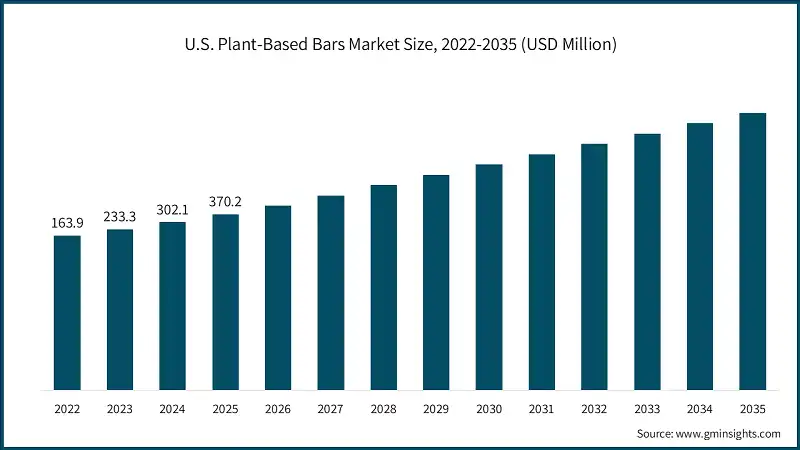
North America plant-based bars market accounted for USD 430.5 million in 2025 and is anticipated to show lucrative growth over the forecast period.
- North America contributes approximately 42% market in 2025 with United States contributing majority of the market as it has huge base of health-conscious consumers and well-developed snack industry. The U.S. is the biggest country market in the region with high awareness of plant-based nutrition, high culture of fitness and wellness and extensive product availability via the well-developed retail and e-commerce platforms.
- Canada is no exception to the regional development as vegan and flexitarian diets become increasingly popular, though on a smaller scale than the U.S. Intensive innovation in plant protein blends, high-end and functional products, and intensive retail promotion have increased uptake, with North America being the more developed and competitive market among all worldwide in regards to plant-based bars.
Europe plant-based bars market accounted for USD 287 million in 2025 and is anticipated to show lucrative growth over the forecast period.
- The share of plant-based bars in the global market is estimated to be about 28% in Europe in 2025, and consumer behavior is largely motivated by strong indications of health- and sustainability-conscious consumers and the increasing trends towards plant-based diets. Among the markets in the region, Germany and the United Kingdom can be considered the most important ones because they are characterized by the developed retail market, the level of consumer awareness of wellness and ethical food products and the strong involvement in sports and other active lifestyles, which precondition the consumption of functional and clean-label snacks.
- The comfortable ecosystem of vegan products and its large markets are the keys to the leading position of Germany, and the popularity of flexitarian and vegan diets among the UK population is a benefit. Like these countries, other Western European nations like France, Spain and Netherlands are also recording good growth and this is due to the growing distribution, the growing fitness awareness and the rising inclination to convenience nutrition solutions.
Asia Pacific market accounted for USD 184.5 million in 2025 and is anticipated to show lucrative growth over the forecast period.
- The Asia-Pacific region controls approximately 18% of the worldwide plant-based bars market in 2025, as it is among the quickest expanding markets because urbanization has accelerated, there has been an increase in disposable income, and people have gained health and sustainability awareness. China and India are the two engines of growth in the region, and the large urban population of China is shifting to functional, plant-based snacks due to food safety and prevention of chronic diseases, and India is driven by the high demand of the protein-based, plant-based products due to its vegetarian-based consumer base.
- East and Southeast Asian urban consumers are demanding convenient, healthy on-the-go products that reflect wellness and preventive health concerns and multinational and local brands are building mass distribution via modern retail and e-commerce platforms to embrace this opportunity.
Latin America market accounted for 8% market share in 2025 and is anticipated to show steady growth over the forecast period.
- Latin America plant-based bars market has been recording a stable and steady growth based on the increasing health awareness and growing retail penetration in the major countries like Brazil and Mexico. The Brazilian market is the strongest in the region with rising consumption of healthy nutritious snack products, and government nutrition programs that encourage the adoption of healthy eating.
- Though Latin America has a smaller proportion than North America and Europe, the market keeps growing with the expansion of distribution channels and the increase in interest of local consumers towards the plant-based choice, especially in large cities where the trend of wellness is actively developing. Incremental growth is likely to remain in retail growth and availability of goods in supermarkets and new trade formats.
Middle East and Africa market accounted for 4% market share in 2025 and is anticipated to show steady growth over the forecast period.
- The plant-based bars market in the Middle East & Africa (MEA) is on an upward trend because of the rising popularity of health and wellness among customers in such nations as the United Arab Emirates and South Africa. Adoption is also assisted because there is increased availability of plant-based products in the supermarkets and an increasing number of expatriate population who are accustomed to plant-forward diets. Efforts by the government to encourage healthier living and nutrition education are slowly changing the consumption behavior but the availability of the products is also getting easier with the help of the urban stores and e-commerce platforms.
Plant-Based Bars Market Share
The market structure of plant-based bars in 2025 can be characterized as a moderate degree of consolidation where the top five companies - General Mills Inc (Lärabar & Nature Valley), GoMacro, PROBAR, Inc, Barebells, and Simply Protein hold market share of about 45.8%. These power players enjoy the advantage of a well-built brand name, retail and online distribution channel, and a product mix diversification manned in the production of protein nutrition, energy and functional nutrition bars. They have competitive advantage which is always supported by their scale benefits and the availability of products together with their marketing investments which help them to set benchmarks of quality, pricing and innovation in major regions.
To remain competitive, market participants are putting more and more emphasis on product differentiation and portfolio optimization, the use of clean-label formulations, superior nutritional value, and functional advantages in line with the changing consumer preferences. Sustainability efforts, including responsible sourcing and green packaging, are also helping companies enhance their positions, as they expand their omnichannel distribution to reach more markets.
Plant-Based Bars Market Companies
Major players operating in plant-based bars industry are:
- BHU Foods
- PROBAR, Inc
- Barebells
- General Mills Inc (Lärabar & Nature Valley)
- Simply Protein
- NuGo Nutrition
- Rise Bar
- Raw Rev
- GoMacro
- Orgain
- No Cow
- Nutree Life
- Numix
General Mills is a large U.S.-based multinational food corporation with extensive snacks portfolio such as plant-based bar brands such as LARABAR and some Nature Valley products. LÄRABAR is a clean-label and vegan-oriented company that packs simple and whole-food ingredients (primarily, fruit and nut blends), whereas Nature Valley focuses on nut and granola-based bars with a few plant-friendly selections. The company also uses the resources of large-scale retail distribution and international presence in the healthy snack category. In its bar lines General Mills maintains product innovation and sustainability.
GoMacro is a mission-oriented vegan snack, plant-based business, whose product line is a MacroBar dubbed the MacroBar-line of certified organic and non-GMO, gluten-free protein bars. The brand focuses on sustainability as well as clean, responsibly sourced ingredients, where a wide dietary focus (e.g. low-FODMAP) is prioritized. GoMacro Snacks will attract healthy and environmentally aware consumers who are interested in nutrient-rich full-course snacks.
PROBAR is a family-focused, active lifestyle, plant-based, all-natural bar company with the goal of providing consumers with everyday energy and nutrition. Its products consist of energy, meal replacement and high protein bars based on whole ingredients, such as nuts, seeds and organic fruits. The quality assurance and brand trust in the functional plant bar segment are contributed by the manufacturing control and the long-term existence of PROBAR.
Barebells is a Swedish functional snack company where the specialization is high-protein bars, and vegan ones are available; the main another focus is on taste and indulgence without any added sugar. The brand has grown in various parts of the world including 40 markets with a product line that balances between the flavor and nutrition of the on-the-go consumer. The vegan bars of Barebells use vegan protein blends (e.g., pea, soy, rice), which serve both the fitness and everyday snacking purposes.
Simply Protein is a vegan-friendly protein bar brand created using plant proteins (non-GMO soy and pea) and packaged to snack and get a lot of protein. They have an average of 12-15 g of low sugar plant protein in these bars, which attracts health conscious and diet conscious customers. Simply Protein is focused on cleaning and prices in the general plant protein snack space.
Plant-Based Bars Market Report Attributes
| Key Takeaway | Details |
|---|---|
| Market Size & Growth | |
| Base Year | 2025 |
| Market Size in 2025 | USD 1 Billion |
| Market Size in 2026 | USD 1.2 Billion |
| Forecast Period 2026-2035 CAGR | 10.3% |
| Market Size in 2035 | USD 2.9 Billion |
| Key Market Trends | |
| Drivers | Impact |
| Rising consumer demand for plant-based nutrition & flexitarian diets | Expands market size and accelerates mainstream adoption of plant-based bars. |
| Growing health & wellness consciousness | Boosts demand for clean-label, functional bars, enabling premium pricing. |
| Sports nutrition & active lifestyle market expansion | Drives growth in high-protein bar segment and performance-focused formulations. |
| Pitfalls & Challenges | Impact |
| Shelf life & stability issues with clean label formulations | Increases production costs and limits scalability for certain bar types. |
| Supply chain volatility for specialty plant proteins | It causes price fluctuations and margin pressure for manufacturers. |
| Opportunities: | Impact |
| Institutional & foodservice channel expansion | Opens high-volume contracts and diversify revenue streams beyond retail. |
| Sustainable packaging innovation & premium positioning | Strengthens brand differentiation and appeals to eco-conscious consumers. |
| Market Leaders (2025) | |
| Market Leaders |
13.8% market share |
| Top Players |
|
| Competitive Edge |
|
| Regional Insights | |
| Largest Market | North America |
| Fastest Growing Market | Middle East & Africa |
| Emerging Country | Germany, UK, UAE, Saudi Arabia |
| Future Outlook |
|
What are the growth opportunities in this market?
Plant-Based Bars Market News
- In November 2025, plant-based protein bar brand TRUBAR signed a final deal with Turkish consumer goods firm ETI Gida in a deal worth around C$201 million. This acquisition should enhance the growth momentum of TRUBAR as it will build on the scale, production capacity and global distribution network of ETI Gida in supporting its growth in North America, as well as selected markets in other parts of the world.
- In June 2025, snack bar brand David, a U.S.-based, raised USD 75 million of Series A to facilitate scale-up and strategic integration. The company has purchased food-tech company Epogee, giving it the rights to the patented plant-based fat substitute technology. The relocation will help to boost product innovation, supply chain control, and speedy penetration in the functional and plant-based snack bar segment.
The plant-based bars market research report includes in-depth coverage of the industry with estimates & forecast in terms of revenue (USD Million) & volume (Units) from 2022 to 2035, for the following segments:
Market, By Product Type
- Cereal & granola bars
- Protein bars
- Energy bars
- Meal replacement bars
- Fruits & nuts bars
- Others
Market, By Source
- Soy protein
- Pea protein
- Rice protein
- Wheat protein
- Nut proteins
- Almond
- Cashew
- Peanut
- Others
Market, By Processing Method
- Chewy bars
- Crunchy bars
- Soft-baked bars
- Raw & cold-pressed bars
- Extruded bars
- Binder-free bars
Market, By Distribution Channel
- Supermarkets & hypermarkets
- Convenience stores
- Specialty & health food stores
- Online retail & e-commerce
- Others
The above information is provided for the following regions and countries:
- North America
- U.S.
- Canada
- Europe
- UK
- Germany
- France
- Italy
- Spain
- Rest of Europe
- Asia Pacific
- China
- India
- Japan
- South Korea
- Australia
- Rest of Asia Pacific
- Latin America
- Brazil
- Mexico
- Argentina
- Rest of Latin America
- MEA
- UAE
- Saudi Arabia
- South Africa
- Rest of Middle East and Africa
Frequently Asked Question(FAQ) :
What is the market size of the plant-based bars in 2025?
The market size exceeded USD 1 billion in 2025, with a CAGR of 10.3% expected through 2035 driven by rising consumer demand for plant-based nutrition and the growing adoption of flexitarian diets.
What is the projected value of the plant-based bars market by 2035?
The plant-based bars market is expected to reach USD 2.9 billion by 2035, propelled by health and wellness consciousness, sports nutrition expansion, and functional ingredient innovation.
What is the current plant-based bars market size in 2026?
The market size is projected to reach USD 1.2 billion in 2026.
How much revenue did the protein bars segment generate in 2025?
Protein bars generated USD 358.8 million in 2025, holding a significant share due to strong alignment with functional nutrition and active lifestyle demands.
What was the valuation of the pea protein segment in 2025?
Pea protein held a significant share and generated USD 276.8 million in 2025, driven by its high nutritional value, neutral taste, and allergen-free properties.
What is the growth outlook for supermarkets & hypermarkets from 2026 to 2035?
Supermarkets & hypermarkets are projected to grow at 9.7% CAGR through 2035, valued at USD 430.5 million in 2025, due to wide product accessibility and high consumer traffic.
Which region leads the plant-based bars market?
North America held approximately 42% market share with USD 430.5 million in 2025, driven by health-conscious consumers, strong fitness culture, and well-developed retail infrastructure.
What are the upcoming trends in the plant-based bars market?
Key trends include diversification of textures (chewy, crunchy, soft-baked), incorporation of functional ingredients like adaptogens and probiotics, expansion of e-commerce channels, and sustainable packaging innovation for premium positioning.
Who are the key players in the plant-based bars market?
Key players include General Mills Inc (Lärabar & Nature Valley), GoMacro, PROBAR Inc, Barebells, Simply Protein, NuGo Nutrition, Rise Bar, Raw Rev, Orgain, No Cow, Nutree Life, and Numix.
Plant-Based Bars Market Scope
Related Reports