Summary
Table of Content

Piezoelectric Micro Pump Market
Get a free sample of this report
Form submitted successfully!
Error submitting form. Please try again.
Thank you!
Your inquiry has been received. Our team will reach out to you with the required details via email. To ensure that you don't miss their response, kindly remember to check your spam folder as well!
Request Sectional Data
Thank you!
Your inquiry has been received. Our team will reach out to you with the required details via email. To ensure that you don't miss their response, kindly remember to check your spam folder as well!
Form submitted successfully!
Error submitting form. Please try again.
Piezoelectric Micro Pump Market Size
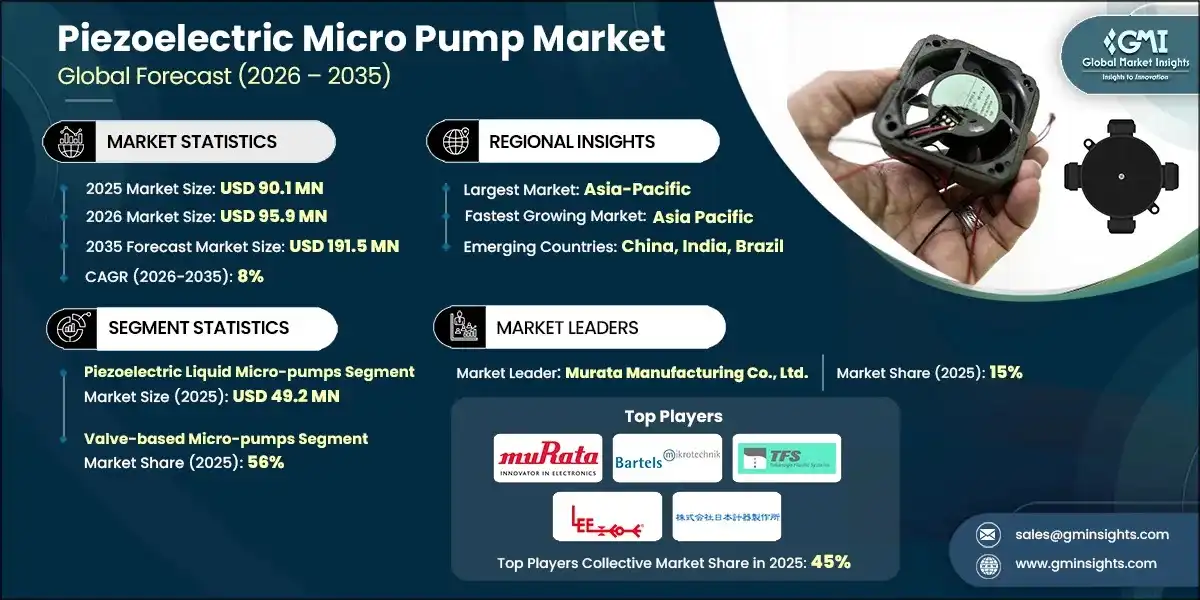
The piezoelectric micro pump market was estimated at USD 90.1 million in 2025. The market is expected to grow from 95.9 million in 2026 to USD 191.5 million in 2035, at a CAGR of 8% according to latest report published by Global Market Insights Inc.
To get key market trends
The global piezoelectric micro-pump market is gaining attention as industries look for compact, precise, and energy-efficient fluid handling solutions. These pumps, powered by piezoelectric actuators, are redefining how liquids and gases are moved in applications where space and accuracy matter most. Their appeal lies in silent operation, low power consumption, and the ability to deliver controlled flow without bulky mechanical parts. This makes them a natural fit for sectors like medical devices, where they enable portable infusion systems and drug delivery units, and in consumer electronics, where miniaturization is key.
Beyond healthcare, technology is finding its way into analytical instruments, cooling systems for microelectronics, and even emerging fields like wearable devices. The growing focus on point-of-care diagnostics and personalized healthcare is pushing demand for pumps that can integrate seamlessly into compact systems. At the same time, industries are exploring these pumps for precise dosing in chemical and biotech processes, where reliability and repeatability are critical.
Innovation is shaping the competitive landscape, with companies investing in advanced materials and smarter designs to improve durability and performance. As sustainability becomes a priority, the energy efficiency of piezoelectric micro-pumps adds another layer of appeal. While challenges like cost and manufacturing complexity remain, the market’s trajectory suggests a future where these pumps become standard in miniaturized fluid control systems. In essence, the piezoelectric micro-pump market is not just growing it is evolving to meet the demands of a world that values precision, portability, and efficiency.
Piezoelectric Micro Pump Market Report Attributes
| Key Takeaway | Details |
|---|---|
| Market Size & Growth | |
| Base Year | 2025 |
| Market Size in 2025 | USD 90.1 Million |
| Market Size in 2026 | USD 95.9 Million |
| Forecast Period 2026-2035 CAGR | 8% |
| Market Size in 2035 | USD 191.5 Million |
| Key Market Trends | |
| Drivers | Impact |
| Rising Demand for Miniaturized Medical Devices | The growing trend toward portable and wearable healthcare solutions is driving the need for compact and precise fluid control systems, making micro-pumps essential in drug delivery and diagnostic applications |
| Advancements in Microfluidics and Lab Automation | Rapid innovation in microfluidic technologies and automated laboratory systems is increasing the adoption of micro-pumps for accurate dosing and sample handling in biotechnology and chemical processes |
| Integration in Consumer Electronics and Cooling Systems | The push for efficient thermal management in electronics and the miniaturization of consumer devices is creating strong demand for micro-pumps that offer silent operation and low power consumption |
| Pitfalls & Challenges | Impact |
| High Manufacturing Complexity and Cost | Producing micro-pumps with precision components and advanced materials involves complex processes, which can lead to higher costs and limit adoption in price-sensitive markets |
| Reliability Issues in Harsh Environments | Ensuring consistent performance under varying temperatures, pressures, and fluid types remains a challenge, especially for applications in industrial and chemical sectors |
| Opportunities: | Impact |
| Expansion in Point-of-Care Diagnostics | The growing need for portable diagnostic tools in healthcare opens new avenues for micro-pumps that can integrate seamlessly into compact systems |
| Adoption in Wearable and IoT Devices | As wearable technology and IoT-based health monitoring gain traction, micro-pumps present opportunities for fluid handling in next-generation smart devices |
| Market Leaders (2025) | |
| Market Leaders |
15% market share |
| Top Players |
|
| Competitive Edge |
|
| Regional Insights | |
| Largest market | Asia-Pacific |
| Fastest growing market | Asia-Pacific |
| Emerging countries | China, India, Brazil |
| Future outlook |
|
What are the growth opportunities in this market?
Piezoelectric Micro Pump Market Trends
The Global piezoelectric micro-pump industry is growing dynamically, owing to their special property to control small volumes of fluid precisely without using a mechanical component.
- Miniaturization and Integration in Portable Devices: There is a never-ending quest to reduce the size and increase the portability of electronic and medical devices. Piezo-based micro-pumps are very beneficial to be used in portable diagnostic solutions and medical devices. This is mainly because they consume a very small area and are highly portable.
- Rise in the Field of Point-of-Care Diagnostics: Piezoelectric Micro-Pumps have become significantly important in the development of fast and reliable Point of Care (POC) testers. The Piezoelectric Micro-Pumps make it feasible to handle the liquid in precise portions in the miniature cartridges, making it very helpful in diagnosing diseases promptly.
- Rise in Lab-on-a-Chip & Microfluidic Systems: The rapid development in lab-on-a-chip technology, which involves the merging of all lab processes into one chip, has required extensive use of piezoelectric micro-pumps in this sector too. The use of these micro-pumps has promoted lab processes in biotech areas such as complicated analyzes, DNA sequencing, and cell analysis in microfluidic systems due to the required fluid manipulation capability in microfluidic channels
- Rise in Usage in Industrial and Analytical Instruments: Piezoelectric micro-pumps are being used in various industries for micro-fluid metering. Piezoelectric micro-pumps are being used in industries that require precise fluid metering. This includes chemical dosing in industries, inkjet printers, and environmental testing. The precision of these pumps makes them useful in high-quality analytical instruments.
- R&D Focused on Improved Performance & Efficiency: One of the most prominent trends of this kind relates to R&D work that focuses on the improvement of fluid rates, pressure, and energy efficiency of piezoelectric micro-pumps. R&D work done in the development of piezoelectric materials and designs is generating stronger and stronger pumps that use low power, making their applications possible in battery-driven devices as well.
Piezoelectric Micro Pump Market Analysis
Learn more about the key segments shaping this market
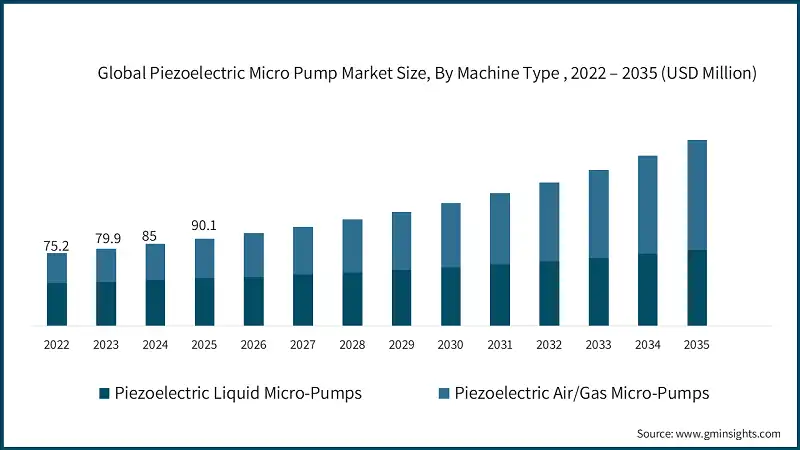
Based on machine type, the market is divided into piezoelectric liquid micro-pumps and piezoelectric air/gas micro-pumps. In 2025, piezoelectric liquid micro-pumps held the major market share, generating a revenue of USD 49.2 million.
- The piezoelectric liquid micro-pumps are quickly gaining popularity, meeting the market demand for miniaturization and accuracy. The piezoelectric liquid micro-pumps are based on piezoelectric actuators that can precisely deliver fluids with negligible mechanical parts, making them essential components for applications such as drug delivery and miniaturized diagnosis kits.
- Due to the rising wearables trend in the healthcare industry, the piezoelectric liquid micro-pumps are set to meet the required accuracy and efficiency needed for critical procedures. The piezoelectric liquid micro-pumps are power-efficient with less noise, offering improved usability and portability of the devices.
- Another factor that propels the growth of nano-cantilevers is their versatility. In the electronics industry, they improve micro-chip cooling systems. In biotechnology and chemistry, they allow dosing and sample processing.
- Energy efficiency is one of the key reasons why they are sought after for futuristic designs. However, work on materials and designs is narrowing the size gap and addressing issues related to cost. Innovations are increasing the versatility of nano-cantilevers. This increases demand across industry segments.
- In the drive for accuracy, portability, and seamless integration, there is an emerging trend in the adoption of piezoelectric liquid micro-pumps in the industry, and these are seen to be the future of fluid management in medical, electronic, biotech, and other applications related to fluid control. By virtue of their adaptability to the required standards of modern applications, piezoelectric liquid micro-pumps are an innovator in miniaturized systems.
Learn more about the key segments shaping this market
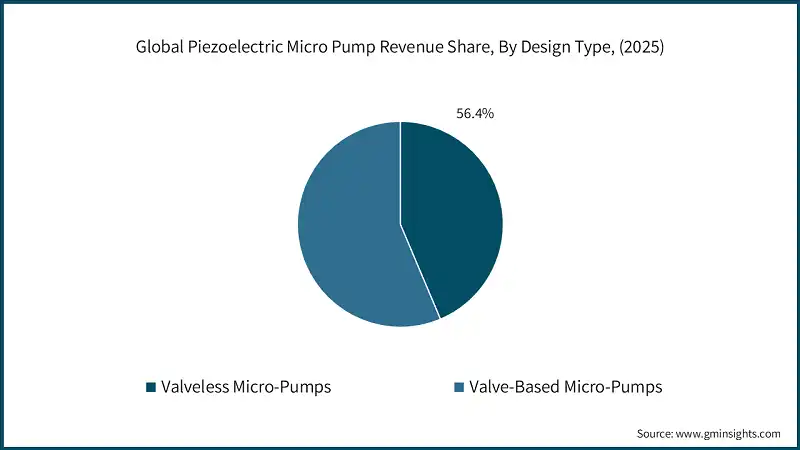
Based on design type, the piezoelectric micro pump market is segmented into valveless micro-pumps and valve-based micro-pumps. The valve-based micro-pumps segment held around 56.4% of the market share in 2025.
- Valve-based micro-pumps are rapidly gaining prominence because they allow for increased fluid control, a critical factor in many precision application scenarios. Micro pumps with valve systems utilize mechanical valves to provide specific directional flow of fluid and prevent backflow.
- For this reason, industries such as medical, chemical processing, as well as lab automation, mostly favor these types of micro-pumps in their quest to realize accuracy without compromising safety. In addition, their ability to handle different types of fluids, including those that possess viscosity, adds to their advantage, especially in complex applications where different micro-pumps might not work.
- The CAGR of this segment is fueled by its malleable nature and success in challenging conditions. The increasing need for portable healthcare, diagnostic, and fluid handling systems in a compact and efficient way points towards a drift towards more precise and rugged solutions, which is enabled by valve-based pumps. The relentless pursuit towards miniaturization and material science is reducing their footprint and allowing their seamless integration into a compact system
- Manufacturers are drawn to Valve-Based Micro Pumps due to their demonstrated ruggedness in harsh business environments, and versatility with respect to the many different fluids that can be accommodated.
- Valve-Based Micro Pumps provide exceptional accuracy, versatility and dependability to their owners, all of which has positioned them to take advantage of the growth in the Micro Pump Market while meeting the challenges and utilizing advancements in technology.
Based on distribution channel, the piezoelectric micro pump market is segmented into direct sales and indirect sales. In 2025, direct sales dominate the market with highest market share.
- Direct sales represent the leading portion of the piezoelectric micro pump industry since most OEMs and medical and biotech facilities find it convenient to procure their components either from the manufacturers of such pumps or from recognized third-party sources. This is important because it gives compression to the specifications that must be followed and therefore critical applications that demand utmost accuracy.
- Direct sales allow for customization, technical support, warranty, calibration, and long-term technical collaborations for the buyers. The buyers feel assured about the reliability for performance, traceability of components, and compliance, especially for healthcare and pharma solutions. Large organizations that work with multiple microfluidic platforms or adopt customized device development are satisfied with strong communication, quick problem-solving, and co-development, thus emphasizing the need for direct sales.
- Indirect sales account for the fastest-growing share in the worldwide market for piezoelectric micro pumps, owing to their increasing distribution channels, online suppliers, and retailers for microfluidics devices. Smaller R&D facilities, universities, and startups for developing prototypes most likely prefer indirect sales to acquire their products quickly without being bound by contracts.
- Indirect sales offer cost-sensitive and nascent buyers the benefits of internet-based price comparisons, fast shipping, variable orders, and additional values such as packaged parts, starter kits, and temporary purchasing. The trend of online procurement and the demand for modular microfluidic components is also projected to fuel the fast expansion of the indirect sales market, giving it a mainstream role in the distribution of piezoelectric micro pumps.
Looking for region specific data?
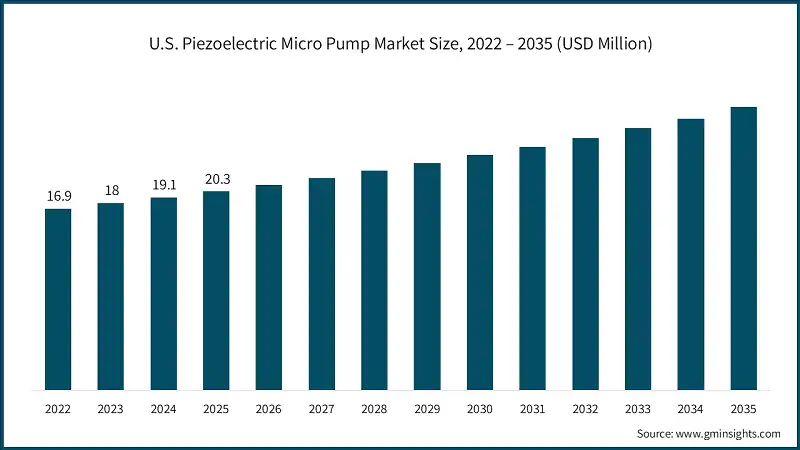
In 2025, the U.S. dominated the North America piezoelectric micro pump market, accounting for around 75% share and generating around USD 20.3 million revenue in 2025.
- the North American market is one of the most prominent and mature region in piezoelectric micro pumps market, especially with regards to advanced adoption in the medical and aerospace fields. This can primarily contribute to a strong research and development budget and early commercialization in the context of micro fluidic technology.
- Cross-specification benefits from the focused presence of top-class innovators and strategic partnerships which drive the integration of products into high-value applications. Such leadership gets sustained by ongoing advances in technology as well as end-user industries dependent upon miniaturized and energy-efficient pumping solutions.
In Europe piezoelectric micro pump market, Germany leads the 26% share in 2025 and is expected to grow at 7.3% CAGR during the forecast period.
- The European region displays steady and innovative growth in the piezoelectric micro pump industry due to robust manufacturing expertise and adoption in medical, biotech, and other industries.
- Enhanced regulatory standards, as provided for in the EU's Medical Device Regulations (EU MDR) and environmental regulations RoHS and WEEE, influence product development, encouraging suppliers to increase levels of quality, reliability, and safety. Such costly development conditions, however, drive technological improvement and quality enhancement, resulting in a precision microfluidic technology hub in the region of Europe.
The Asia Pacific holds significant share in the piezoelectric micro pump market. China holds a share of around 38% in 2025 and is anticipated to grow with a CAGR of around 8.9% from 2026 to 2035.
- APAC is the fastest growing region in the global market, driven by rapid industrialization, expanding healthcare infrastructure, and rising investment in biotechnology and microfluidics. Countries such as China, Japan, South Korea, and India are increasing adoption of miniaturized medical devices and lab on a chip technologies, fueling strong demand for high precision micro pumps.
- The region benefits from large-scale electronics manufacturing, government-backed R&D expansion, and growing consumer demand for compact, efficient devices. As a result, APAC is expected to outpace all other regions in growth, becoming an increasingly influential part of the global microfluidic ecosystem.
Piezoelectric Micro Pump Market Share
Murata Manufacturing is leading with 15% market share. Murata Manufacturing, Bartels Mikrotechnik, Takasago Electric, The Lee Company and Nippon Keiki Works collectively hold around 45%, indicating moderately fragmented market concentration. These prominent players are proactively involved in strategic endeavors, such as mergers & acquisitions, facility expansions & collaborations, to expand their product portfolios, extend their reach to a broad customer base, and strengthen their market position.
- Murata is a world leading manufacturer in electronic components, such as piezoelectric ceramics. They produce miniature piezoelectric micropumps, which are suitable for medical, inkjet, and analyzing devices. Murata has gained its leading position because of its extensive experience in piezoelectric technology and miniaturization, allowing them to produce high-performance fluid devices.
- Bartels Mikrotechnik focuses on high-performance components and custom-designed systems in the field of microfluidics. A highly innovative company in the development of piezoelectric micropumps, most notably in the mp6 series, which provides high accuracy, miniaturization, and full functionality in the medical and lab segments.
- Takasago Electric produces precision solenoid valves, pumps, and fluidic control components. They have piezoelectric micro pumps that are highly energy efficient and provide accurate flow rates. Their major market presence has been developed over the years for reliable miniature fluid control.
Piezoelectric Micro Pump Market Companies
Major players operating in the piezoelectric micro pump industry are:
- Murata Manufacturing Co., Ltd.
- Bartels Mikrotechnik GmbH
- Takasago Electric, Inc
- The Lee Company
- Nippon Keiki Works, Ltd.
- NITTO KOHKI CO., LTD.
- MicroJet Technology Co., Ltd.
- Audiowell Electronics (Guangdong) Co., Ltd.
- HeYi Precision Pump
- Maxclever Electric Co., Ltd.
- Dolomite Microfluidics
- Koge Micro Tech Co., Ltd.
- Debiotech SA
- PiezoData Inc.
- HOERBIGER Motion Control GmbH
The Lee Company designs and manufactures miniature, high-precision fluid control components. While known for valves, their expertise in compact fluidics positions them relevantly in the piezoelectric micropump market. They provide critical components and solutions that enable highly accurate micro-pumping and dispensing systems in various advanced applications.
Nippon Keiki Works primarily deals with precision instruments and electromechanical components. Its entry in the piezoelectric micropumps market is derived from their expertise in miniaturized, accurate liquid handling systems. They provide their clients with reliable and compact systems that are essential for accurate liquid dispensing in niche industrial and biomedical applications.
Piezoelectric Micro Pump Market News
- In December 2024, Spectris acquired Piezocryst Advanced Sensorics from AVL List for €133.5M to expand its precision sensor portfolio. This helps the company penetrate high-temperature, high-precision sensor markets and broaden customer offerings across demanding industrial applications.
- In January 2024, Fraunhofer EMFT developed a 5×5×0.6mm³ silicon-based piezo micropump enabling flexible drug delivery patterns with high precision. This helps the institute pioneer personalized medicine solutions through programmable, customized pharmaceutical release profiles for patient-specific treatment regimens.
- In May 2024, CTS Corporation merged Ferroperm Piezoceramics with CTS Ceramics Denmark to form CTS Denmark A/S as its consolidated entity. This helps the company streamline operations, optimize manufacturing efficiency, and unify its piezoelectric solutions portfolio under integrated Danish operations.
- In July 2024, CTS Corporation launched nine lead-free piezoceramic materials including four new LF Series formulations for actuation and ultrasound applications. This helps the company address regulatory pressures, meet environmental compliance demands, and capture growing market demand for sustainable piezoelectric solutions.
- In April 2024, PI Ceramic introduced piezoceramic composite technology combining piezoelectric ceramics with filling polymers at Sensor+Test 2024. This helps the company offer application-specific design flexibility for ultrasonic components, flow metering, and medical diagnostics across diverse industrial sectors.
The piezoelectric micro pump market research report includes in-depth coverage of the industry with estimates & forecasts in terms of revenue (USD Million) and volume (Thousand Units) from 2022 to 2035, for the following segments:
Market, By Machine Type
- Piezoelectric liquid micro-pumps
- Piezoelectric air/gas micro-pumps
Market, By Design Type
- Valveless micro-pumps
- Valve-based micro-pumps
Market, By End Use Industry
- Medical & life sciences
- Consumer electronics
- Industrial applications
- Automotive & transportation
- Household appliances
- Others
Market, By Distribution Channel
- Direct sales
- Indirect sales
The above information is provided for the following regions and countries:
- North America
- U.S.
- Canada
- Europe
- Germany
- UK
- France
- Italy
- Spain
- Turkey
- Asia Pacific
- China
- India
- Japan
- Australia
- South Korea
- Latin America
- Brazil
- Mexico
- Argentina
- Middle East and Africa
- South Africa
- Saudi Arabia
- UAE
Frequently Asked Question(FAQ) :
Who are the key players in the piezoelectric micro pump market?
Key players include Murata Manufacturing Co., Ltd., Bartels Mikrotechnik GmbH, Takasago Electric, Inc., The Lee Company, Nippon Keiki Works, Ltd., NITTO KOHKI CO., LTD., MicroJet Technology Co., Ltd., Audiowell Electronics (Guangdong) Co., Ltd., HeYi Precision Pump, Maxclever Electric Co., Ltd., Dolomite Microfluidics, Koge Micro Tech Co., Ltd., Debiotech SA, PiezoData Inc., and HOERBIGER Motion Control GmbH.
Which region leads the piezoelectric micro pump market?
North America held a significant position with the U.S. accounting for 75% share and generating USD 20.3 million in 2025. Advanced R&D capabilities and early adoption fuel the region's leadership.
What are the upcoming trends in the piezoelectric micro pump market?
Key trends include miniaturization for portable devices, expansion in point-of-care diagnostics, integration in lab-on-a-chip systems, and R&D focused on improved performance and energy efficiency.
What is the growth outlook for the Asia Pacific region from 2026 to 2035?
Asia Pacific is the fastest-growing region, with China expected to grow at a CAGR of around 8.9% till 2035, driven by rapid industrialization and expanding healthcare infrastructure.
How much revenue did the piezoelectric liquid micro-pumps segment generate in 2025?
Piezoelectric liquid micro-pumps generated USD 49.2 million in 2025, leading the market as the dominant machine type segment.
What is the market size of the piezoelectric micro pump in 2025?
The market size was USD 90.1 million in 2025, with a CAGR of 8% expected through 2035 driven by rising demand for compact, precise, and energy-efficient fluid handling solutions.
What was the market share of valve-based micro-pumps segment in 2025?
Valve-based micro-pumps held 56.4% market share in 2025, dominating due to their superior fluid control and ability to prevent backflow.
What is the current piezoelectric micro pump market size in 2026?
The market size is projected to reach USD 95.9 million in 2026.
What is the projected value of the piezoelectric micro pump market by 2035?
The piezoelectric micro pump market is expected to reach USD 191.5 million by 2035, propelled by miniaturization trends, advancements in microfluidics, and growing adoption in medical devices.
Piezoelectric Micro Pump Market Scope
Related Reports