Summary
Table of Content

Photochemistry Reagents for Green Synthesis Market
Get a free sample of this report
Form submitted successfully!
Error submitting form. Please try again.
Thank you!
Your inquiry has been received. Our team will reach out to you with the required details via email. To ensure that you don't miss their response, kindly remember to check your spam folder as well!
Request Sectional Data
Thank you!
Your inquiry has been received. Our team will reach out to you with the required details via email. To ensure that you don't miss their response, kindly remember to check your spam folder as well!
Form submitted successfully!
Error submitting form. Please try again.
Photochemistry Reagents for Green Synthesis Market Size
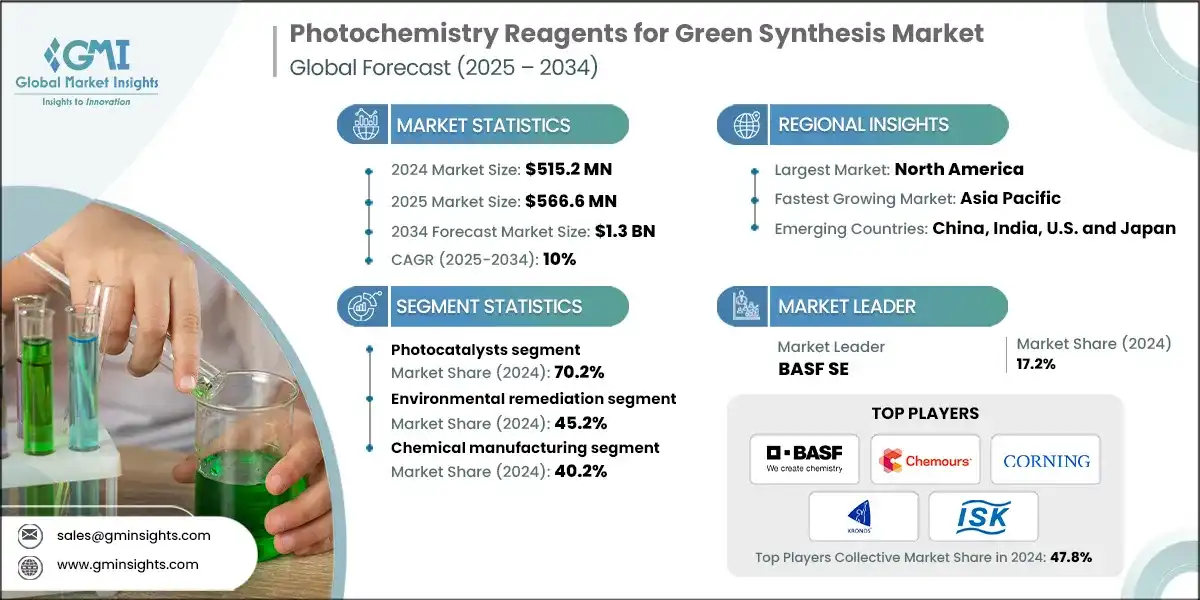
The global photochemistry reagents for green synthesis market was estimated at USD 515.2 million in 2024 The market is expected to grow from USD 566.6 million in 2025 to USD 1.3 billion in 2034, at a CAGR of 10% according to latest report published by Global Market Insights Inc.
To get key market trends
- The photochemical reagents applied in green synthesis offer great opportunities owing to global emphasis on sustainability and eco-friendly processes in chemistry. Increasingly, industries have been moving toward eco-manufacturing, thus photochemistry reagents have grown in significance, largely avoiding the use of toxic solvents and reagents.
- The key factors driving this trend are the increasing application of photoredox catalysts, which provide a method of mild transformation with high efficiency and selectivity. Photochemistry reagents enable green synthesis through reactions such as oxidation, reduction, and C–C bond formation, incorporating low input of energy and waste in their processes. Minimizing the environmental impact from the chemical processes makes them quite attractive for pharmaceutical, agrochemical, and specialty chemical industries.
- The advantages of photochemistry reagents include better selectivity in reactions, lesser quantities of toxic reagents used, lesser energy, and reactions occurring at ambient conditions. The demand for photochemistry reagents in green synthesis is poised to continue on the rise with the advancement of research and implementation of ecologically sound regulations globally, presenting it as a highly promising sector within the greater chemical market.
- North America is the largest market for photochemistry reagents for green synthesis due to advancement in technology and research facilities in U.S. and Canada.
- Asia Pacific is the fastest growing region for photochemistry reagents for green synthesis market, due to increasing industrialization and awareness among big players, the region can enhance its performance in this market in the coming years.
Photochemistry Reagents for Green Synthesis Market Report Attributes
| Key Takeaway | Details |
|---|---|
| Market Size & Growth | |
| Base Year | 2024 |
| Market Size in 2024 | USD 515.2 Million |
| Market Size in 2025 | USD 566.6 Million |
| Forecast Period 2025 - 2034 CAGR | 10% |
| Market Size in 2034 | USD 1.3 Billion |
| Key Market Trends | |
| Drivers | Impact |
| Stringent environmental regulations & green chemistry mandates | These regulations promote the adoption of eco-friendly photochemical processes, boosting market growth. |
| Rising demand for sustainable manufacturing processes | Increasing focus on sustainability drives the adoption of photochemistry reagents in green synthesis. |
| Energy efficiency & cost reduction benefits | The potential for lower energy consumption and cost savings encourages industries to adopt photochemical methods. |
| Pitfalls & Challenges | Impact |
| High initial capital investment requirements | Significant upfront costs limit entry for small and medium enterprises into photochemical green synthesis. |
| Limited awareness & technical expertise | Lack of knowledge and skilled workforce hampers adoption and integration of photochemical reagents. |
| Opportunities: | Impact |
| Emerging applications in pharmaceutical manufacturing | Growing pharmaceutical demand presents new opportunities for photochemical reagents in drug synthesis. |
| Integration with flow chemistry & continuous processing | Combining photochemistry with flow systems enhances efficiency and opens new industrial avenues. |
| Expansion in environmental remediation applications | Increasing environmental concerns drive demand for photochemical reagents in pollution control. |
| Market Leaders (2024) | |
| Market Leaders |
17.2% market share |
| Top Players |
Collective market share of 47.8% in 2024 |
| Competitive Edge |
|
| Regional Insights | |
| Largest Market | North America |
| Fastest growing market | Asia Pacific |
| Emerging countries | China, India, U.S. and Japan |
| Future outlook |
|
What are the growth opportunities in this market?
Photochemistry Reagents for Green Synthesis Market Trends
- This market is characterized by tremendous prospective growth driven by an increase in technological advancements in the field, changing regulatory standards, and constant product innovation. Recent advancements in technology include the introduction of visible-light photocatalysts working at low energy consumption and mild conditions, using alternative solvents only where necessary to minimize energy and hazardous waste.
- Green chemistry principles are encouraged by governments and industry standards, thereby forcing companies to adopt safer and less toxic reagents and processes. Therefore, this regulatory pressure stimulates innovation toward photochemical reagents that are less harmful to the environment and more compliant with stringent safety standards, thus stimulating further growth of the market.
- Another significant trend gaining momentum is product innovation, which concerns the design of photoreagents that are highly selective, stable, and reusable and increase the efficiency of reactions while minimizing waste. Cutting-edge catalysts and light sources are being incorporated, as in the case of LED-based systems, enhancing energy efficiency and operational safety. Other innovations regarding hybrid materials that combine photochemistry with other green technologies are opening different avenues of application in pharmaceuticals, agrochemicals, and, indeed, materials science.
Photochemistry Reagents for Green Synthesis Market Analysis
Learn more about the key segments shaping this market
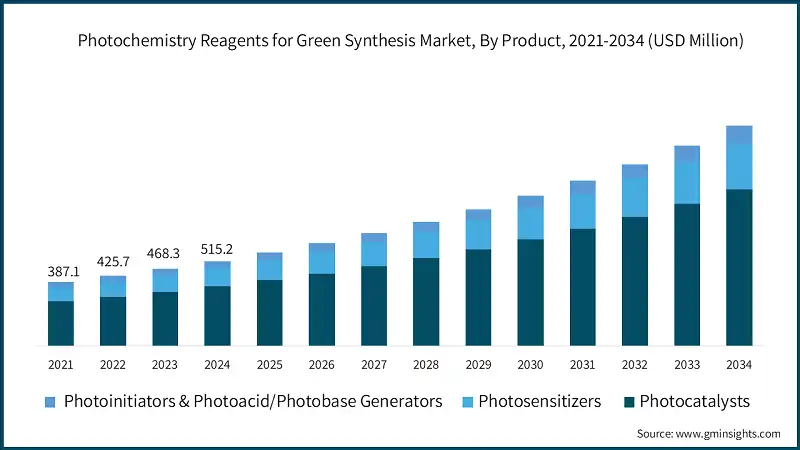
Based on product, the market is segmented into photocatalysts, photosensitizers, photoinitiators & photoacid/photobase generators.
- Photocatalysts are poised to command major chunks of market share, at 70.2% by 2024, demonstrating their multi-faceted utility and universal application in processes of environmental remediation and chemical synthesis. This segment's growth will continue to show supremacy with a CAGR value of 10% into 2034, encouraged by its immediate acceptance because of its application in water treatment and the paving of newly visible-light active catalysts that exhibit superior efficiency and lower energy consumption in application.
- Photosensitizers comprise the second-largest product segment with a 21.8% market share in 2024, projecting a CAGR of 9.7% throughout the forecast period. This segment is defined by specialized organic molecules that allow site-specific light-driven chemical transformations in the synthesis of pharmaceuticals and fine chemicals. It is in an expansion phase, with increasing applications of photoredox catalysis, which uses photosensitizers to facilitate electron transfer and thus access new synthetic pathways that would otherwise not be possible through more conventional means.
- Photoinitiators & photoacid/photobase generators contain 8% of the shares in the market, having a projected CAGR of 9.8%. This growth will reflect the unique niche of this compound in polymer chemistry and materials science.
Learn more about the key segments shaping this market
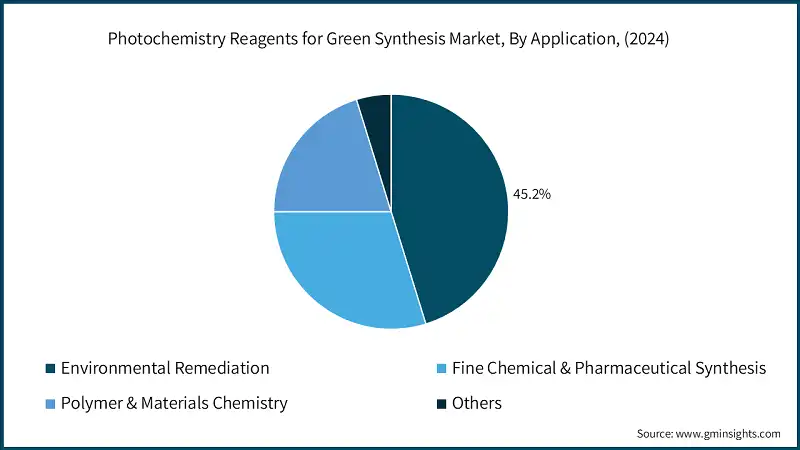
Based on applications, the photochemistry reagents for green synthesis market is segmented into environmental remediation, fine chemical & pharmaceutical synthesis, polymer & materials chemistry, others.
- The application segmentation indicates environmental remediation to be the foremost among the sectors, with market share of 45.2% in 2024 at a CAGR of 10.2%. Environmental regulations and the need for cost-effective methodologies for the treatment of emerging contaminants, including pharmaceuticals and personal care products, in wastewater streams are the two primary drivers for industry growth.
- Fine chemical & pharmaceutical synthesis takes up 29.8% of the market with a 9.7% CAGR illustrating the trend in the pharmaceutical industry towards sustainable manufacturing methods. This segment is involved in API synthesis intermediate production, and specialty chemical manufacture, where photochemical methods provide advantages in terms of selectivity and waste.
- Polymer & materials chemistry possesses a market share of 20.2% with CAGR of 10.4%, driven by photopolymerization and novel concepts in materials synthesis. This segment includes coatings, adhesives, and advanced composites wherein photochemical processes provide control on an unprecedented level over material properties and processing conditions.
Based on end use, the photochemistry reagents for green synthesis market is segmented into chemical manufacturing, waste treatment & remediation, manufacturing & electronics, research & development, others.
- Pharmaceuticals manipulated by photochemistry have been among the key markets under the categories of chemical manufacturing, leading with a whopping 40.2% of the market by 2024 and commanding a CAGR of 10.2%. Growth prospects are linked to the ever-increasing pressures of new regulations in green chemistry, as well as economical photochemical processes that require mild conditions reducing energy use and waste.
- With 25% of the overall specific market, waste treatment & remediation holds a CAGR of 9.9% and corroborates flourishing awareness of pollution cleanup and water treatment applications. Adoption pace has increased due to stricter policies in the environment and the immediacy of treatment for new contaminants such as pharmaceuticals, personal care products, and other industrial chemicals detected in water systems. The anticipated growth is due to the increasing need for cleanliness in production and the use of advanced materials.
- Research & development carries 9.8% of the market share, including academic institutions, government research laboratories, and those corporate R&D facilities that utilize photochemistry reagents for fundamental research and developing technologies. This segment is crucial in the advancement of photochemical synthesis methodologies and the development of new applications. The segment is experiencing growth as more research funding continues to increase for green chemistry initiatives, and the next generation of photochemical technologies is developed.
Looking for region specific data?
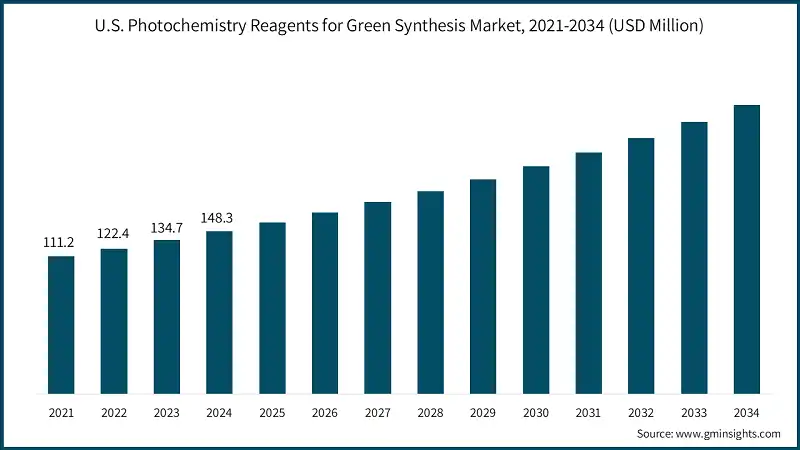
North America accounts for a decent chunk of the regional market with 36.9% of the share and 10.1% CAGR. The US occupies largest share in the North American region and has a market size of 148.3 million in 2024.
- The region has advanced research infrastructure and early acceptance of innovative technologies with the U.S. leading the development path in terms of market size and technological advancements. A very positive regulatory environment is provided by the Green Chemistry Program of the EPA, which is stimulating the use of photochemical synthesis methods across several industries.
Europe photochemistry reagents for green synthesis market accounted for USD 130.6 million in 2024 and is anticipated to show lucrative growth over the forecast period.
- Europe holds a 25.4% market share with a 9.9% CAGR, with the strict EU environmental regulations and promotion of sustainable development goals aiding growth. With Germany, France, and the U.K. leading in both consumption and technological advancement, the region offers good chemical production with a good research base and moderate market development. Further green chemistry development will be fostered under the European Green Deal and through regulatory steppingstones up until 2034.
The Asia Pacific photochemistry reagents for green synthesis market is anticipated to grow at the CAGR of 10.1% during the analysis timeframe.
- Asia-Pacific occupies 29.8% of the market; thus, it is the fastest-growing region. The growth is driven by expanded pharmaceutical manufacturing in China and India, increasing environmental remediation investments, and government support for sustainable chemistry practices. Investments by China in environmental protection and the growth of India's pharmaceuticals sector present many opportunities in this regard for the acceptance of photochemistry reagents.
Latin America photochemistry reagents for green synthesis market accounted for 4.7% in 2024 and is anticipated to show lucrative growth over the forecast period.
- The Latin American market for photochemistry reagents for green synthesis is growing steadily on the back of promotions for green synthesis and environmental awareness in strict terms in relation to chemical wastes. In Brazil and Mexico, for example, there are investments for adopting sustainable manufacturing processes that are pulling eco-friendly reagents. The pharmaceutical and agrochemical sectors are switching to photochemical methods for reducing usage of hazardous chemicals, thus further pushing the market. Further market innovations are being supported through government initiatives for green chemistry and increased funding in R&D.
Middle East & Africa photochemistry reagents for green synthesis accounted for 3.2% in 2024 and is anticipated to show lucrative growth over the forecast period.
- With an increasing emphasis on sustainable industrial practice, an emerging market for photochemistry reagents for green synthesis in Middle East & Africa is being shaped. The pharmaceutical and chemical industries in the region are, slowly but certainly, adopting photochemical processes to meet international environmental standards. South Africa & UAE are investing in green chemistry programs supported by various governmental policies and international collaborations.
Photochemistry Reagents for Green Synthesis Market Share
The top 5 companies in the photochemistry reagents for green synthesis industry include BASF SE, Chemours Company, Corning Incorporated, Ishihara Sangyo Kaisha Ltd., Kronos Worldwide Inc. These are prominent companies operating in their respective regions covering 47.8% of the market share. These companies hold strong positions globally due to their experience in photochemistry reagents for green synthesis market. Their diverse product portfolios, backed by robust production capabilities and distribution networks, enable them to meet the rising demand across various regions.
- BASF SE is a global chem company having full-swing capabilities in the development and manufacture of photochemistry reagents. Their huge R&D infrastructure provides for continuous innovation in photocatalyst formulations and application technologies. They have built a market strategy around integrated solutions that combine photochemical reagents with process optimization services, focusing on pharmaceutical and fine chemical manufacturers searching for sustainable alternatives to synthesis.
- The Chemours Company sustains its position by virtue of specialized expertise focusing on titanium-dioxide-based photocatalysts and advanced materials for photochemical applications. Because of this, the company concentrates its efforts on high performance applications with new products, so that it stresses its pricing strategy and engenders customer loyalty.
- Corning Incorporated brings distinct capabilities in optical materials and precision manufacturing to the photochemistry reagents market. Corning integrates solutions through its strategic partnerships with both equipment manufacturers and process technology providers to meet its customers' demands for total photochemical synthesis systems.
- KRONOS Worldwide, Inc concentrates on organic photosensitizers and photoinitiators for specialized applications such as pharmaceutical synthesis and advanced materials manufacturing.
- ISHIHARA SANGYO KAISHA,LTD. is one of Japan's largest producers of titanium dioxide and photocatalytic materials. The company's technological expertise in semiconductor photocatalysts and surface modification technology makes the development of better photocatalytic materials with high efficiency and selectivity possible.
Photochemistry Reagents for Green Synthesis Market Companies
Major players operating in the photochemistry reagents for green synthesis industry include:
- BASF SE
- Chemours Company
- Corning Incorporated
- Huntsman Corporation
- Ishihara Sangyo Kaisha Ltd.
- Kronos Worldwide Inc.
- Lomon Billions Group Co. Ltd.
- Tayca Corporation
- Tronox Holdings PLC
- Venator Materials PLC
Photochemistry Reagents for Green Synthesis Industry News
- On March 17, 2025, Tronox announced its intention to idle its pigment plant in the Netherlands. The decision is part of a strategic review aimed at optimizing operations and responding to market conditions. The idling will impact the local workforce and production capacity, with Tronox committed to managing the transition responsibly while exploring future opportunities for the site.
- On February 19, 2025, Chemours announced the launch of Ti-Pure TS-6706, a TME-free version of their flagship universal-grade Ti-Pure R-706. This new product enhances coating applications by offering improved appearance and environmental benefits, including the absence of TME. The innovation aims to meet growing industry demands for sustainable and high-quality titanium dioxide solutions across various coating markets.
This photochemistry reagents for green synthesis market research report includes in-depth coverage of the industry, with estimates & forecasts in terms of revenue (USD Million) and volume (Tons) from 2025 to 2034, for the following segments:
Market, By Product
- Photocatalysts
- Titanium dioxide TiO2)
- Metal oxide semiconductors
- Zinc oxide (ZnO)
- Tungsten trioxide (WO3)
- Iron oxide (Fe2O3)
- Carbon-based photocatalysts
- Photosensitizers
- Porphyrin & chlorin derivatives
- Transition metal complexes
- Organic dyes & chromophores
- Photoinitiators & photoacid/photobase generators
- Acylphosphine oxide systems
- Onium salt photoinitiators
- Benzophenone & thioxanthone derivatives
Market By Application
- Environmental remediation
- Water treatment & purification
- Municipal wastewater treatment
- Industrial effluent processing
- Groundwater remediation
- Air purification & VOC degradation
- Indoor air quality management
- Industrial emission control
- Atmospheric pollutant degradation
- Soil remediation & contaminant degradation
- Water treatment & purification
- Fine chemical & pharmaceutical synthesis
- Active pharmaceutical ingredient (API) manufacturing
- Late-stage functionalization
- Stereoselective transformations
- Specialty chemical production
- Agrochemical intermediates
- Fragrance & flavor compounds
- Dye & pigment synthesis
- Green oxidation & reduction processes
- Active pharmaceutical ingredient (API) manufacturing
- Polymer & Materials Chemistry
- UV-curable coatings & inks
- Photopolymerization & 3D printing
- Surface functionalization & modification
- Others
Market, By End Use
- Chemical manufacturing
- Basic chemical manufacturing
- Specialty chemical manufacturing
- Pharmaceutical manufacturing
- Waste treatment & remediation
- Manufacturing & electronics
- Research & development
- Others
The above information is provided for the following regions and countries:
- North America
- U.S.
- Canada
- Europe
- Germany
- UK
- France
- Spain
- Italy
- Rest of Europe
- Asia Pacific
- China
- India
- Japan
- Australia
- South Korea
- Rest of Asia Pacific
- Latin America
- Brazil
- Mexico
- Argentina
- Rest of Latin America
- Middle East and Africa
- Saudi Arabia
- South Africa
- UAE
- Rest of Middle East and Africa
Frequently Asked Question(FAQ) :
Who are the key players in the photochemistry reagents for green synthesis market?
Key players include BASF SE, Chemours Company, Corning Incorporated, Kronos Worldwide Inc., Ishihara Sangyo Kaisha Ltd., Huntsman Corporation, Lomon Billions Group Co. Ltd., and Tayca Corporation.
Which region leads the photochemistry reagents for green synthesis market?
North America held a 36.9% share in 2024. The region's dominance is fueled by strong regulatory frameworks and advancements in sustainable manufacturing technologies.
What are the upcoming trends in the photochemistry reagents for green synthesis industry?
Key trends include the integration of photochemistry with flow chemistry, innovations in energy-efficient light sources, and the development of advanced photocatalysts for environmental and pharmaceutical applications.
What is the growth outlook for the pharmaceutical application segment from 2025 to 2034?
The pharmaceutical application segment is projected to grow at a 10.2% CAGR till 2034, driven by increasing demand for green chemistry solutions and cost-effective photochemical processes.
What was the market share of the photocatalysts segment in 2024?
The photocatalysts segment held a dominant position in 2024, capturing a significant 70.2% share of the overall market.
What is the market size of the photochemistry reagents for green synthesis industry in 2024?
The market size was USD 515.2 million in 2024, with a CAGR of 10% expected through 2034, driven by stringent environmental regulations and the adoption of sustainable manufacturing processes.
What was the valuation of the environmental remediation application segment in 2024?
The environmental remediation segment held a 45.2% market share in 2024.
What is the current photochemistry reagents for green synthesis market size in 2025?
The market size is projected to reach USD 566.6 million in 2025.
What is the projected value of the photochemistry reagents for green synthesis market by 2034?
The market is expected to reach USD 1.3 billion by 2034, driven by advancements in visible-light active photocatalysts and increasing applications in pharmaceuticals and environmental remediation.
Photochemistry Reagents for Green Synthesis Market Scope
Related Reports