Summary
Table of Content

Phase Change Memory (PCM) Market
Get a free sample of this report
Form submitted successfully!
Error submitting form. Please try again.
Thank you!
Your inquiry has been received. Our team will reach out to you with the required details via email. To ensure that you don't miss their response, kindly remember to check your spam folder as well!
Request Sectional Data
Thank you!
Your inquiry has been received. Our team will reach out to you with the required details via email. To ensure that you don't miss their response, kindly remember to check your spam folder as well!
Form submitted successfully!
Error submitting form. Please try again.
Phase Change Memory Size
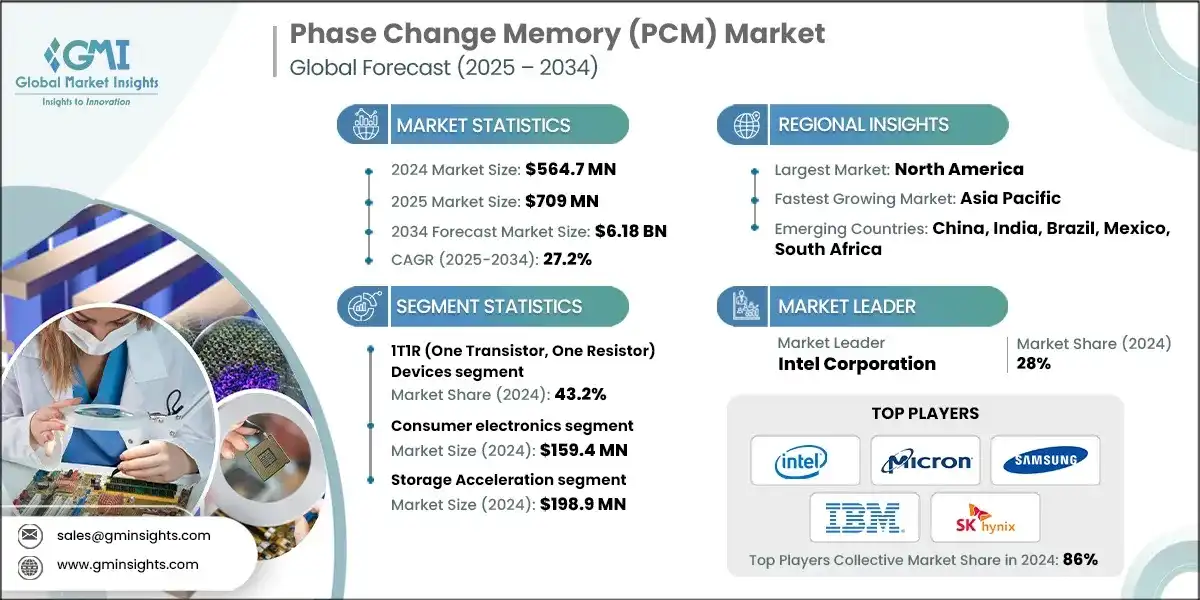
The global phase change memory market was valued at USD 564.7 million in 2024. The market is expected to grow from USD 709 million in 2025 to USD 6.18 billion in 2034, at a CAGR of 27.2% during the forecast period according to the latest report published by Global Market Insights Inc.
To get key market trends
The PCM market is gaining traction as demand builds for high speed, non volatile memory solutions that combine DRAM class performance with flash class persistence. These memories are increasingly required in AI, big-data and edge systems where throughput, energy efficiency and data retention are critical.
The transition toward architecture designs that embed larger, faster non volatile memory blocks on chip or near processor is accelerating PCM’s role in future memory hierarchies. For instance, STMicroelectronics describes its embedded PCM (ePCM) technology as offering “>50% better performance to power ratio, 2.5× smaller non volatile memory, 3× higher digital density” compared to conventional flash based eNVM at equivalent node size. This driver is fuelling the adoption of PCM by enabling richer firmware, AI/ML code-footprint, and persistent caching or in memory compute capabilities, increasing the demand for high-performance, on-chip memory solutions.
Industries such as automotive electronics, electric vehicles (EVs) and autonomous systems are rapidly adopting advanced memory technologies to support over the air (OTA) updates, complex domain controllers, sensor fusion, and real-time data logging. PCM is particularly well suited because of its retention, high temperature tolerance and embedded non-volatile character. For instance, STMicroelectronics’ automotive MCU portfolio with embedded PCM (the “Stellar” family) is described as delivering scalable memory upgrades and future proofing vehicles’ electronic architectures.
This driver is accelerating PCM integration in premium automotive microcontrollers and domain controllers, increasing per unit memory content and generating higher-value deployments.
PCM’s role is also expanding through integration into hybrid memory architectures and storage class memory solutions bridging the gap between DRAM and NAND, offering persistent memory closer to the processor, and enabling new system level architectures for AI, edge and cloud systems. For instance, Rambus, Inc. in collaboration with IBM Corporation announced hybrid memory system architectures combining DRAM and emerging memories including PCM for future highly memory intensive AI and data-center workloads.
This trend is expanding PCM’s application in multi tier memory hierarchies, driving demand in hybrid modules, storage class memory, and persistent memory markets. Recent advancements in materials engineering, cell architecture, 3D/stacked PCM cell technologies and process node scaling are accelerating PCM’s performance, density, and energy efficiency. These innovations are making PCM more viable for high-volume applications.
For instance, STMicroelectronics states that their ePCM at 18 nm and 28 nm nodes enables high temperature retention, radiation hardening, automotive grade qualification and operation up to +165-°C. Such technological advancements are broadening PCM’s reach into previously inaccessible markets such as automotive, ruggedized industrial, & edge computing, boosting adoption & scaling deployment volumes.
Phase Change Memory (PCM) Market Report Attributes
| Key Takeaway | Details |
|---|---|
| Market Size & Growth | |
| Base Year | 2024 |
| Market Size in 2024 | USD 564.7 Million |
| Market Size in 2025 | USD 709 Million |
| Forecast Period 2025 - 2034 CAGR | 27.2% |
| Market Size in 2034 | USD 6.18 Billion |
| Key Market Trends | |
| Drivers | Impact |
| Rising Demand for High-Speed, non-Volatile Memory in AI, Big Data & Edge Systems | PCM drives approximately 30–35% of market demand due to its high-speed, low-latency, and persistent memory characteristics. Its ability to process and store large datasets locally makes it ideal for AI, edge computing, and real-time analytics applications, enabling faster decision-making and reducing reliance on slower flash or DRAM memory. |
| Increasing Adoption in Automotive Electronics, EVs & Autonomous Systems | The automotive sector contributes roughly 25–30% of incremental PCM market growth, as memory-intensive applications such as OTA updates, sensor fusion, and autonomous control systems require reliable, high-temperature-tolerant non-volatile memory. PCM’s embedded, durable nature ensures deterministic performance in EVs, ADAS, and next-generation automotive electronics. |
| Integration with Hybrid Memory Architectures and Storage-Class Memory Solutions | PCM integration into hybrid memory hierarchies accounts for about 20–25% of market expansion, bridging the gap between DRAM and NAND. Its persistent yet fast-access nature enables storage-class memory, in-memory compute, and AI acceleration, supporting high-performance enterprise, edge, and cloud systems while increasing memory content per device. |
| Advancements in Material Engineering and 3D/Stacked PCM Cell Technologies | Technological innovations drive nearly 15–20% of the market’s growth by improving density, thermal stability, and energy efficiency. Advanced 3D stacking, process-node scaling, and improved phase-change materials allow PCM to meet automotive, industrial, and edge-computing requirements, enhancing scalability for mass adoption. |
| Surging Deployment of IoT Devices and Consumer Electronics Driving Low-Power Memory Needs | The proliferation of connected devices contributes roughly 25–30% of PCM market demand, as IoT and consumer electronics require low-power, high-endurance memory for edge analytics, local AI inference, and persistent data storage. PCM reduces energy consumption while enabling smarter, always-on devices. |
| Pitfalls & Challenges | Impact |
| High Manufacturing Costs and Complex Fabrication Processes | PCM adoption faces constraints due to the high cost of production and intricate manufacturing processes, including precise material deposition and 3D stacking. These factors slow large-scale deployment, especially in cost-sensitive consumer electronics and IoT devices, limiting near-term market penetration. |
| Limited Endurance and Thermal Stability Concerns in Certain Applications | Despite improvements, PCM still faces challenges with cell endurance and retention at extreme temperatures, affecting reliability in high-stress environments such as automotive, aerospace, and industrial applications. This limitation can reduce adoption in mission-critical systems that demand consistent long-term performance. |
| Opportunities: | Impact |
| Expansion into AI, Edge Computing, and High-Performance Data Centers | PCM presents an opportunity to capture 30–35% of incremental market growth by enabling ultra-fast, persistent memory for AI workloads, edge inference, and big-data analytics. Its ability to combine speed, non-volatility, and low latency allows data centers and edge devices to handle massive parallel computations efficiently. |
| Adoption in Automotive, Industrial, and IoT Systems for Persistent and Low-Power Memory | PCM adoption in automotive electronics, industrial automation, and IoT offers a growth opportunity contributing 25–30% to market expansion. Its high endurance, low-power consumption, and reliable data retention make it ideal for connected vehicles, smart factories, and consumer electronics requiring always-on memory and real-time local analytics. |
| Market Leaders (2024) | |
| Market Leaders |
28% market share |
| Top Players |
Collective market share in 2024 is 86% |
| Competitive Edge |
|
| Regional Insights | |
| Largest Market | North America |
| Fastest growing market | Asia Pacific |
| Emerging countries | China, India, Brazil, Mexico, South Africa |
| Future outlook |
|
What are the growth opportunities in this market?
Phase Change Memory Market Trends
- A significant trend is the movement towards hybrid memory architectures and SCM solutions that leverage PCM with DRAM/NAND architectures to narrow the performance and persistence gap. Companies are developing PCM based SCM modules targeting enterprise storage systems where non volatility and high speed are equally critical. This trend supports the optimization of data centre and edge systems by enabling faster recovery, persistent caches and improved system resilience.
- With this capability, PCM is being positioned not just as a replacement for embedded NVM, but as a tier in the memory storage hierarchy enabling new system architectures that reduce latency, power consumption and cost in data intensive applications. The increasing use of PCM in automotive electronics, EVs and autonomous systems for which reliability under stress and non-volatile fast memory is a requirement. For example, automotive qualified PCM cells are being developed to endure high temperatures and vibrations, enabling real time logging, domain controller memory and over the air firmware updates in vehicles. This trend enhances memory content per vehicle and supports new safety, ADAS and autonomous functionality.
- By meeting automotive grade requirements, PCM is increasingly substituting legacy flash/NAND solutions in vehicles, accelerating deployment in this high growth vertical and raising the value of memory content in each system. A further trend is ongoing material engineering and 3D/stacked cell technologies for PCM innovations in chalcogenide alloys, nanostructuring, vertical stacking and advanced packaging are driving higher densities, lower energy per bit and improved scalability. For instance, research shows that interfacial thermal resistance management in ultra thin phase change layers can reduce reset energy by ~40 50%. These improvements make PCM more commercially viable for mass applications beyond niche segments.
- As these technologies mature, cost per bit falls, enabling PCM to compete with mainstream memory types in volume markets and opening new application spaces in consumer electronics and edge devices. The PCM market is also experiencing a trend of increasing deployment in AI, big data and edge systems that demand high speed, non volatile memory with low latency and high endurance. For example, PCM is being referenced as a candidate for “persistent memory” in high performance computing, hybrid compute storage modules and in memory compute.
- By enabling near DRAM speed with non volatility, PCM supports real time analytics, local AI inference and edge processing, thus significantly expanding its market potential. By aligning with edge infrastructures and data intensive workloads, this trend is enlarging PCM’s addressable market and positioning it as a key enabler in future computing architectures.
- There is a trend to low-power, always-on memory in the fields of IoT and consumer electronics, with advantages of PCM's non-volatility, high endurance and low standby power, compared to normal memory options. For instance, some PCM technology road maps highlight extremely low energy per bit operation and better retention, making it well suited for wearable, sensor node and smart device platforms.
- This trend supports wider adoption of PCM in the vast IoT/consumer ecosystem. As device makers seek to integrate smarter, connected, energy efficient electronics, the availability of advanced memory like PCM becomes a differentiator enabling smaller factors, less power draw, and longer device lifetimes.
Phase Change Memory Market Analysis

Learn more about the key segments shaping this market
Based on the device, the global phase change memory market is divided into 1T1R (One Transistor, One Resistor) Devices, Crosspoint Array Devices and 3D Stacked Devices. The 1T1R (One Transistor, One Resistor) Devices segment accounted for 43.2% of the market in 2024.
- The 1T1R (One Transistor, One Resistor) device segment holds the largest share in the PCM market in 2024 due to its mature, well-understood architecture, high reliability, and efficient integration with standard CMOS processes. This architecture enables predictable switching behavior, low leakage, and effective control of write/read operations, making it ideal for embedded applications, consumer electronics, and automotive memory modules. Its simplicity, cost-effectiveness, and compatibility with existing fabrication lines support widespread adoption across diverse sectors requiring non-volatile, high-speed memory.
- Manufacturers are focusing on optimizing 1T1R devices to improve endurance, energy efficiency, and density. Enhancements such as reduced cell size, improved thermal management, and optimized programming schemes are critical to meet the growing demand for low-latency memory in edge devices, AI accelerators, and industrial applications. Strategic partnerships with semiconductor foundries and memory system integrators can further accelerate adoption in high-volume consumer and enterprise segments.
- The 3D stacked PCM device segment is projected to be the fastest-growing segment from 2025 to 2034, driven by the increasing demand for high-density, energy-efficient, and high-speed memory solutions. By stacking multiple PCM layers vertically, 3D architectures achieve significantly higher storage capacity per unit area while maintaining low power consumption and fast read/write performance. This makes them ideal for AI, big data, edge computing, and automotive applications where performance-per-watt and density are critical.
- Manufacturers are investing in advanced 3D stacking technologies, such as through-silicon vias (TSVs) and layer-to-layer thermal management, to enhance scalability, reliability, and cost-efficiency. Collaborations with semiconductor fabs and system designers are enabling faster time-to-market for 3D PCM solutions, supporting their deployment in next-generation memory systems, high-performance computing, and persistent storage applications.
Based on the end use, the phase change memory market is segmented into consumer electronics, automotive, enterprise data center, industrial & aerospace and others. The consumer electronics segment dominated the market in 2024 with a revenue of USD 159.4 million.
- The consumer electronics segment holds the largest share in the PCM market in 2024 due to the increasing integration of non-volatile, high-speed memory in smartphones, wearables, tablets, and smart home devices. PCM enables instant-on capabilities, high endurance for frequent read/write cycles, and low-power operation, enhancing user experience and device responsiveness. Its ability to store critical data locally without relying on cloud storage is particularly valuable in mobile and portable electronics, making PCM a preferred memory solution in consumer-facing applications.
- Manufacturers are focusing on optimizing PCM for compact form factors, low power consumption, and high reliability to meet the demands of consumer electronics. Collaborations with OEMs and system integrators ensure seamless integration with SoCs and AI-enabled devices, facilitating faster adoption in mass-market products.
- The enterprise data center segment is projected to be the fastest-growing from 2025 to 2034, driven by increasing requirements for high-speed, persistent memory to support AI, big data, and cloud computing workloads. PCM offers a unique combination of DRAM-like latency and NAND-like persistence, making it ideal for caching, storage-class memory, and hybrid memory solutions in servers and hyperscale data centers. Its deployment improves system performance, reduces I/O bottlenecks, and enhances energy efficiency, which are critical for enterprise IT infrastructures facing growing data and compute demands.
- Manufacturers are investing in scaling PCM for high-capacity, low-latency modules suitable for enterprise-grade servers and storage solutions. Strategic partnerships with cloud providers, server OEMs, and enterprise IT integrators are enabling faster adoption and deployment of PCM-based memory solutions in next-generation data centers, supporting AI-driven analytics, real-time processing, and persistent storage applications.
Learn more about the key segments shaping this market
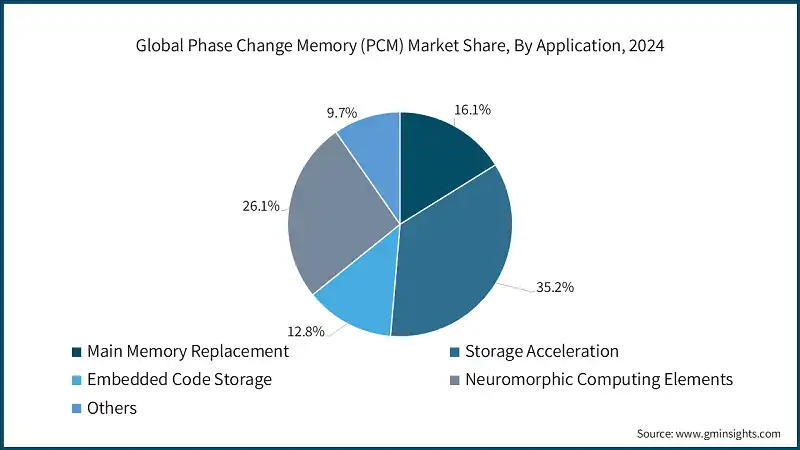
Based on the application, the phase change memory market is segmented into Main Memory Replacement, Storage Acceleration, Embedded Code Storage, Neuromorphic Computing Elements and others. The Storage Acceleration segment dominated the market in 2024 with a revenue of USD 198.9 million.
- The storage acceleration segment holds the largest share in the PCM market in 2024 due to its ability to bridge the gap between DRAM and NAND flash. PCM’s non-volatility, high endurance, and low latency make it ideal for caching, tiered storage, and persistent memory applications in data centers, enterprise servers, and cloud infrastructures. Its capacity to significantly reduce I/O bottlenecks enhances system performance for big data analytics, AI workloads, and high-frequency transactional operations, establishing PCM as a preferred solution for storage acceleration.
- Manufacturers are focusing on integrating PCM with high-speed interfaces and memory controllers to maximize its effectiveness in storage acceleration. Optimization strategies include improving write endurance, reducing energy consumption per bit, and enabling seamless hybrid memory configurations. Collaborations with cloud providers, server OEMs, and storage solution integrators further support adoption in enterprise and hyperscale environments.
- The neuromorphic computing elements segment is projected to be the fastest-growing from 2025 to 2034, driven by increasing interest in brain-inspired computing architectures. PCM’s inherent analog storage capability, fast switching speeds, and energy efficiency makes it well-suited for synaptic emulation in neuromorphic chips, enabling efficient implementation of spiking neural networks and edge AI accelerators. This emerging application is attracting attention from AI hardware developers, robotics companies, and research institutions aiming to achieve low-power, high-density, and real-time cognitive computing.
- Manufacturers are investing in advanced material engineering and cell-level innovations to enhance PCM performance for neuromorphic applications, including multi-level resistance states and precise conductance modulation. Partnerships with AI chipset designers and neuromorphic research labs are accelerating deployment of PCM in next-generation cognitive computing platforms, enabling more energy-efficient and scalable AI processing at the edge and in data centers.
Looking for region specific data?
The North America region dominated the global phase change memory market with a share of 40.2% in 2024.
- North America growth is driven by increasing demand for high-speed, non-volatile memory across AI, edge computing, data centers, and consumer electronics. The presence of advanced semiconductor R&D centers, well-established memory fabrication infrastructure, and strategic investments by leading technology firms further support market expansion. Government initiatives promoting advanced memory technologies and AI-driven applications also contribute to PCM adoption.
- North America’s expanding AI, IoT, and automotive electronics ecosystem further drives PCM demand. The proliferation of connected devices and autonomous systems increases the need for high-speed, non-volatile memory that can handle large datasets locally. PCM adoption is accelerating in applications such as automotive infotainment, edge AI accelerators, and enterprise-grade storage-class memory solutions, providing improved performance, reliability, and energy efficiency.
- Government programs and research initiatives, such as funding for advanced semiconductor materials and memory technologies, are accelerating innovation in PCM. Collaborations between public research institutions, universities, and private technology companies are fostering the development of high-density, low-power PCM solutions, enabling North America to maintain a leading position in the global market.
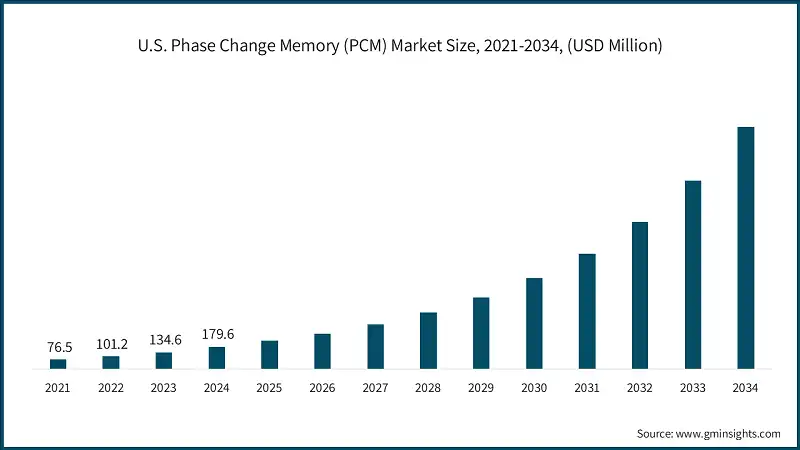
The U.S. phase change memory market was valued at USD 76.5 million and USD 101.2 million in 2021 and 2022, respectively. The market size reached USD 179.6 million in 2024, growing from USD 134.6 million in 2023.
- The U.S. continues to lead the phase change memory industry, driven by its advanced semiconductor manufacturing capabilities, strong R&D ecosystem, and growing adoption of AI, edge computing, and high-performance data center applications. With major technology companies such as Intel, Micron, IBM, and Samsung investing heavily in next-generation memory technologies, the U.S. supports large-scale PCM deployments across enterprise storage, persistent memory, and neuromorphic computing platforms. Government-backed initiatives promoting advanced memory research and AI innovation further accelerate adoption, reinforcing the country’s position as a global leader in high-speed, non-volatile memory solutions.
- The U.S. PCM ecosystem is being strengthened by growing deployment in enterprise storage acceleration, hybrid memory architectures, and automotive electronics, particularly in EVs and autonomous systems. The increasing integration of PCM into next-generation data centers, AI accelerators, and edge devices enhances performance, reliability, and energy efficiency, catering to latency-sensitive workloads. Collaborative efforts between public research institutions, semiconductor foundries, and technology companies are driving innovations in high-density, low-power PCM, enabling faster adoption and solidifying the U.S. as a central hub for advanced memory technology development.
European market accounted for USD 100.3 million in 2024 and is anticipated to show lucrative growth over the forecast period.
- Europe holds a significant share in the phase change memory market, driven by increasing investments in semiconductor R&D, advanced data centers, and AI-enabled industrial applications. Countries like Germany, France, and the Netherlands are focusing on high-performance memory solutions for enterprise storage, edge computing, and automotive electronics. The region benefits from strong government support for AI, Industry 4.0, and next-generation semiconductor initiatives, which are accelerating the adoption of PCM technologies across critical sectors.
- European enterprises and research institutions are actively deploying PCM in hybrid memory architectures, storage-class memory, and neuromorphic computing applications. PCM’s low-latency, high-endurance, and non-volatile characteristics make it ideal for AI workloads, edge devices, and industrial automation systems. Collaborations between universities, semiconductor manufacturers, and automotive OEMs are fostering innovation in 3D/stacked PCM cells and low-power memory solutions. These initiatives are helping Europe enhance its capabilities in AI-driven, latency-sensitive applications and strengthen its position in the global PCM market.
Germany dominates the Europe phase change memory market, showcasing strong growth potential.
- Germany is emerging as a key market for phase change memory (PCM) due to its strong semiconductor R&D ecosystem, advanced industrial automation, and focus on AI-driven applications. The country is investing heavily in next-generation memory technologies to support enterprise storage, edge computing, and automotive electronics, particularly for electric and autonomous vehicles. Government initiatives, including funding programs for Industry 4.0 and advanced semiconductor manufacturing, are accelerating PCM adoption across critical sectors.
- German enterprises and research institutions are increasingly integrating PCM into hybrid memory architectures, storage-class memory, and neuromorphic computing platforms. PCM’s non-volatile, high-speed, and energy-efficient characteristics make it ideal for latency-sensitive applications in smart factories, industrial IoT, and automotive AI systems. Collaborations between leading semiconductor firms, universities, and automotive OEMs are driving innovations in 3D/stacked PCM cells, enabling higher density, reliability, and performance for next-generation computing solutions.
The Asia-Pacific phase change memory market is anticipated to grow at the highest CAGR of 31.1% during the analysis timeframe.
- Asia-Pacific represents a rapidly growing market for phase change memory (PCM), driven by extensive semiconductor manufacturing capabilities, increasing AI adoption, and a booming consumer electronics industry. Countries such as China, Japan, South Korea, and Taiwan are investing heavily in next-generation memory solutions for edge computing, data centers, and automotive electronics. Regional government initiatives promoting advanced semiconductor research and AI-driven innovation further accelerate PCM adoption across both enterprise and industrial sectors.
- The proliferation of smart devices, IoT endpoints, and EVs in the APAC region is boosting demand for low-latency, high-speed, non-volatile memory. PCM’s ability to deliver energy-efficient, high-endurance performance makes it suitable for AI inference, storage-class memory, and neuromorphic computing platforms. Collaborations between semiconductor manufacturers, research institutions, and automotive OEMs are enabling advancements in 3D-stacked PCM cells and hybrid memory architectures, supporting high-density memory integration and faster adoption in edge and industrial applications.
China phase change memory market is estimated to grow with a significant CAGR 29.1% from 2025 to 2034.
- China is a key growth market for phase change memory (PCM), driven by its leading semiconductor manufacturing ecosystem, strong government support for AI and next-generation memory technologies, and rapid expansion of consumer electronics and data center infrastructure. National initiatives such as “Made in China 2025” and large-scale investments in AI, EVs, and smart manufacturing are accelerating the adoption of PCM across enterprise, automotive, and industrial applications.
- Chinese technology companies are increasingly deploying PCM in storage-class memory, hybrid memory architectures, and edge computing solutions. The high-speed, non-volatile, and energy-efficient characteristics of PCM make it ideal for latency-sensitive workloads, including AI inference, industrial automation, and autonomous vehicle applications. Collaborations among semiconductor manufacturers, research institutions, and automotive OEMs are driving innovations in 3D-stacked PCM cells and high-density memory solutions, enabling improved performance, reliability, and scalability across China’s rapidly expanding technology ecosystem.
The Latin America phase change memory market, valued at approximately USD 24.5 million in 2024, is driven by growing adoption of high-speed, non-volatile memory in data centers, edge computing, and AI-enabled industrial applications. Rising investments in smart infrastructure, automotive electronics, and consumer devices are further fueling demand. Supportive government initiatives promoting digitalization, semiconductor innovation, and AI adoption across sectors such as healthcare, finance, and manufacturing are accelerating PCM deployment in the region. Expanding collaborations with global semiconductor and technology firms are enhancing access to advanced PCM solutions and enabling broader market growth.
The Middle East & Africa phase change memory market is projected to reach approximately USD 266 million by 2034, driven by rising adoption of high-speed, non-volatile memory in smart cities, industrial automation, and edge computing applications. Government-backed digital transformation initiatives, growing investments in data centers, and AI-driven infrastructure development are accelerating regional PCM demand.
UAE is poised for significant growth in the MEA phase change memory market, fueled by its ambitious smart city programs, strong government support for AI and semiconductor innovation, and investments in advanced digital infrastructure. PCM adoption is being prioritized in data centers, autonomous systems, and IoT deployments, supporting real-time analytics, energy efficiency, and low-latency memory needs.
- UAE is emerging as a key growth market for phase change memory , driven by its strategic investments in smart city initiatives, advanced digital infrastructure, and AI-enabled technologies. Government-backed programs focusing on automation, autonomous systems, and IoT adoption are accelerating PCM deployment across enterprise, industrial, and smart infrastructure applications.
- Technology companies and system integrators in the UAE are increasingly deploying PCM in data centers, edge computing, and hybrid memory solutions. The high-speed, energy-efficient, and non-volatile nature of PCM makes it suitable for latency-sensitive applications such as AI inference, industrial automation, and autonomous transport systems. Collaborations between semiconductor vendors, local technology firms, and research institutions are fostering innovations in 3D-stacked PCM cells and high-density memory integration, enabling enhanced performance, reliability, and scalability across the UAE’s growing technology ecosystem.
Phase Change Memory Market Share
The global phase change memory industry is experiencing rapid growth, driven by increasing adoption of high-speed, non-volatile memory in AI, edge computing, automotive electronics, and industrial applications. Leading companies such as Intel Corporation, Micron Technology, Inc., Samsung Electronics Co., Ltd., IBM Corporation, and SK hynix Inc. collectively account for over 86% of the global PCM market. These key players are leveraging strategic collaborations with semiconductor manufacturers, system integrators, and enterprise solution providers to accelerate PCM adoption across data centers, hybrid memory architectures, and edge devices. Meanwhile, emerging PCM developers are innovating compact, energy-efficient memory solutions optimized for AI inference, storage-class memory, and neuromorphic computing, enhancing computational speed and data reliability.
In addition, specialized PCM technology companies are driving market innovation by introducing 3D-stacked, high-density, and low-power PCM architectures tailored for enterprise, automotive, and consumer electronics applications. These firms focus on improving memory endurance, energy efficiency, and latency performance, enabling faster execution of real-time workloads and large-scale data processing. Strategic partnerships with cloud service providers, AI developers, and automotive OEMs are accelerating adoption across diverse sectors. These initiatives are enhancing system reliability, reducing operational costs, and supporting the broader deployment of PCM in next-generation intelligent computing and storage ecosystems.
Phase Change Memory Market Companies
Prominent players operating in the phase change memory industry are as mentioned below:
- Adesto Technologies Corporation
- Avalanche Technology Inc.
- Crossbar, Inc.
- Cypress Semiconductor Corporation
- Fujitsu Ltd.
- Hewlett Packard Enterprise
- IBM Corporation
- Infineon Technologies AG
- Intel Corporation
- Micron Technology, Inc.
- Microchip Technology Inc.
- NXP Semiconductors N.V.
- Renesas Electronics Corporation
- Samsung Electronics Co., Ltd.
- SK hynix Inc.
- Sony Corporation
- STMicroelectronics N.V.
- Texas Instruments Incorporated
- Toshiba Corporation
- Western Digital Corporation
- Intel Corporation (USA)
Intel Corporation holds a leading position in the phase change memory market with a market share of ~28%. The company is recognized for its high-speed, energy-efficient non-volatile memory solutions used in AI, edge computing, and data center applications. Intel leverages innovations in hybrid memory architectures and advanced 3D PCM stacking technologies to enhance memory density, reliability, and low-latency performance. Strategic collaborations with system integrators and enterprise clients further strengthen its adoption across automotive, industrial, and consumer electronics sectors.
Micron Technology commands approximately 22% of the global PCM market. The company specializes in high-performance non-volatile memory solutions, focusing on applications in storage acceleration, neuromorphic computing, and edge devices. Its research in material engineering and multi-level cell (MLC) PCM technology enables high-density, low-power memory with fast write/read cycles. Micron’s partnerships with cloud providers, automotive OEMs, and semiconductor integrators accelerate deployment of PCM solutions across enterprise and industrial environments, reinforcing its market leadership.
Samsung Electronics holds a 17% share in the PCM market, leveraging its advanced semiconductor fabrication capabilities and expertise in high-speed, non-volatile memory technologies. The company focuses on integrating PCM into hybrid memory systems and next-generation storage-class memory solutions, enhancing performance for AI, edge computing, and consumer electronics. Samsung’s continuous innovations in 3D-stacked PCM cells, high-density packaging, and energy-efficient designs support low-latency and high-throughput applications. Strategic collaborations with cloud, automotive, and industrial technology partners further expand its PCM adoption globally.
Phase Change Memory Industry News
- In May 2024, STMicroelectronics N.V. announced a nextgeneration automotive microcontroller family built on an 18nm FDSOI process with embedded phase change memory (PCM), developed jointly with Samsung Electronics Co., Ltd.. These new devices, targeted for production in the second half of 2025, are optimized for high ambienttemperature automotive environments (rated up to 165°C) and combine machine learning capable ARMCortexMcores with highdensity PCM to support advanced real time capabilities and OTA updates.
The phase change memory market research report includes in-depth coverage of the industry with estimates and forecast in terms of revenue in USD Million from 2021 – 2034 for the following segments:
Market, By Device
- 1T1R (One Transistor, One Resistor) Devices
- Crosspoint Array Devices
- 3D Stacked Devices
Market, By Application
- Main Memory Replacement
- Storage Acceleration
- Embedded Code Storage
- Neuromorphic Computing Elements
- Others
Market, By End Use
- Consumer Electronics
- Automotive
- Enterprise Data Center
- Industrial & Aerospace
- Others
The above information is provided for the following regions and countries:
- North America
- U.S.
- Canada
- Europe
- Germany
- UK
- France
- Spain
- Italy
- Netherlands
- Asia Pacific
- China
- India
- Japan
- Australia
- South Korea
- Latin America
- Brazil
- Mexico
- Argentina
- Middle East and Africa
- South Africa
- Saudi Arabia
- UAE
Frequently Asked Question(FAQ) :
Which region leads the phase change memory market?
North America held 40.2% share in 2024, propelled by advanced semiconductor R&D, AI adoption, and strong investments in next-generation memory technologies.
Who are the key players in the phase change memory market?
Key players include Adesto Technologies Corporation, Avalanche Technology Inc., Crossbar Inc., Cypress Semiconductor Corporation, Fujitsu Ltd., Hewlett Packard Enterprise, IBM Corporation, Infineon Technologies AG, Intel Corporation, Micron Technology Inc., Microchip Technology Inc., NXP Semiconductors N.V., Renesas Electronics Corporation, Samsung Electronics Co. Ltd., SK hynix Inc., Sony Corporation, STMicroelectronics N.V., Texas Instruments Incorporated, Toshiba Corporation, and Western Digital Corporation.
What are the upcoming trends in the phase change memory market?
Key trends include integration into hybrid memory architectures, advancement in 3D/stacked cell technologies, deployment in neuromorphic computing, and increasing adoption in automotive electronics and autonomous systems.
What is the current phase change memory market size in 2025?
The market size is projected to reach USD 709 million in 2025.
How much revenue did the 1T1R devices segment generate in 2024?
1T1R (One Transistor, One Resistor) devices dominated the market with 43.2% share in 2024, driven by mature architecture and efficient CMOS integration.
What was the valuation of the consumer electronics segment in 2024?
The consumer electronics segment held the largest share and generated USD 159.4 million in 2024, driven by integration in smartphones, wearables, and smart home devices.
What is the market size of phase change memory in 2024?
The market size was USD 564.7 million in 2024, with a CAGR of 27.2% expected through 2034 driven by rising demand for fast, non-volatile memory combining DRAM-like speed with flash-level durability.
What is the projected value of the phase change memory market by 2034?
The phase change memory market is expected to reach USD 6.18 billion by 2034, propelled by AI adoption, edge computing expansion, and integration into hybrid memory architectures.
Phase Change Memory (PCM) Market Scope
Related Reports